
Phuket itinerary · 2026
Phuket Itinerary 2026: A Realistic 5-Day Plan for First-Time Visitors
A realistic five-day route balancing beaches, Phuket Old Town, Phang Nga Bay and one weather-flexible island day.
The strongest five-day Phuket plan protects one cultural circuit, one major bay day and one flexible sea day.
Phuket rewards travellers who plan by zones and energy, not by the number of attractions they can collect. The island is large, traffic can turn a short-looking route into a slow cross-island drive, and a full-day boat excursion often occupies ten to twelve hours once hotel pickup and pier transfers are included. A workable first visit therefore needs more breathing room than a map suggests.
This Phuket itinerary 2026 is built around five days and one beach base. Day 1 stays local, Day 2 combines Phuket Old Town with the southern cultural and viewpoint circuit, Day 3 is reserved for Phang Nga Bay, Day 4 remains flexible for Phi Phi, Racha and Coral Islands or a genuine rest day, and Day 5 protects the departure buffer. The route is deliberately realistic rather than impressive on paper.
Current transport, weather, entry and safety details were rechecked on 5 September 2026 against official Phuket Airport information, Phuket Smart Bus fares, Thai Meteorological Department forecasts, UK government Thailand entry guidance, Thailand immigration TDAC guidance and Tourism Authority of Thailand material. Prices below are practical planning ranges rather than fixed quotes.
Phuket itinerary 2026: quick answer
For five days, stay in one beach base, keep the first evening local, use Day 2 for Phuket Old Town plus Wat Chalong and Big Buddha, book Phang Nga Bay for Day 3, keep Day 4 flexible for Phi Phi or Racha and Coral Islands, and protect Day 5 for the beach and airport. This avoids back-to-back demanding boat days and leaves room to move plans when sea conditions change.
Best base
Kata or Karon for a balanced first trip
Best paid day
Phang Nga Bay for scenery and canoeing
Best public transport
Smart Bus Airport–Patong–Rawai, currently THB 100 flat
Most useful rule
Keep one sea day movable
Some booking and product links may earn Taylor’s Trailblazing Travels a commission at no extra cost to you. They are included only where they help with a genuine planning decision.
Best overall base
Kata or Karon: beach access, restaurants and manageable journeys around the island.
Best major day trip
Phang Nga Bay: distinctive limestone scenery, caves and canoeing without making swimming the whole point.
Best budget control
One hotel base plus local meals and public transport where the route genuinely fits.
Key practical difference
A boat day can occupy 8–12 hours door to door, so plan the return evening as free time.
How many days do you need in Phuket?
Three days can produce a highlights trip, five days creates a balanced first visit, and seven days finally feels like a holiday rather than an itinerary exercise. The difference is not only the number of attractions. Extra nights give you options when rain, rough water, tiredness or a late flight changes the plan.
Three days is enough for a careful highlights route
With three days, choose one beach base and one major excursion. Keep the arrival evening local, use the middle day for Old Town and the south of the island, then choose Phang Nga Bay or Phi Phi for the final full day. Trying to add both major boat trips usually removes the beach time that made Phuket attractive in the first place.
Five days is the practical first-visit sweet spot
Five days lets you see more than the resort strip without changing hotels. You can recover from the flight, spend a proper half-day in Old Town, visit a temple and viewpoint, take one major bay trip, then decide whether your second sea day still sounds appealing. Crucially, a poor marine forecast does not immediately destroy the schedule.
Seven days gives the weather room to move
A week is better for families, honeymooners, travellers arriving from Europe and anyone who wants a second day trip. It allows a rest day between boats and makes a split stay possible, although changing areas should solve a clear problem rather than simply creating another checkout.
| Length | What fits comfortably | Main compromise | Best for |
|---|---|---|---|
| 3 days | One beach base, Old Town and one day trip | Very little weather flexibility | Short Thailand routes |
| 5 days | Culture, Phang Nga Bay, one flexible sea day and beach time | You still need to choose rather than collect | Most first-time visitors |
| 7 days | Two excursions, slower beach time and a spare weather day | Higher hotel cost and temptation to over-plan | Families and relaxed holidays |
| 10+ days | A split stay or an overnight extension to Khao Sok, Krabi or Koh Yao | More transport decisions | Slow travel and repeat visitors |
Where to stay for this Phuket itinerary
The hotel area affects almost every line of the itinerary: airport time, pickup surcharges, sunset options, restaurant choice and how much energy remains after a tour. For a first five-day trip, the best base is rarely the cheapest room or the most famous nightlife district. It is the area that reduces unnecessary road travel while matching the evenings you actually want.
For a beach-by-beach comparison covering walkability, hotel price bands, families, nightlife and airport access, use the best areas to stay in Phuket guide before opening a hotel search.
Kata or Karon: the easiest all-round choice
Kata and Karon are the default bases for this plan. Both offer long beach time, restaurants, organised-tour pickups and a workable position between Patong, Chalong and the south coast. Kata feels more compact and village-like around parts of the beach; Karon is longer and more spread out, so the precise hotel location matters more than the area name.
Patong: practical for nightlife, less restful for everyone else
Patong has the greatest concentration of hotels, restaurants, shopping and entertainment. It also has straightforward tour pickups. However, the atmosphere around Bangla Road is very different from a quiet resort holiday. Choose Patong because you want its evening energy, not because it appears central on the island map.
Kamala or Bang Tao: calmer resort time
Kamala offers a quieter west-coast base while retaining restaurants and beach facilities. Bang Tao covers a much larger area, from local streets to Laguna-style resorts and beach clubs. Both suit travellers who value a calmer pool-and-beach rhythm, although they increase travel time to Rawai, Promthep Cape and parts of the south-coast circuit.
Nai Harn or Rawai: strong for the south, slower for the airport
Nai Harn suits travellers who prioritise a beautiful southern beach and quieter evenings. Rawai works better for seafood, boat access and longer stays than for classic swimming directly in front of the main seafront. Both areas make Day 2 easy, yet they create a longer airport transfer and often increase taxi use.
Old Phuket Town: excellent for food and culture, not a beach base
Old Town is rewarding for architecture, cafés, local food and the Sunday walking street. Tourism Authority of Thailand highlights the district’s Sino-Portuguese buildings, street art and cultural mix. Even so, a first beach holiday is usually easier when Old Town is a half-day visit rather than the main base. Read the official Old Town overview.
| Area | Best for | Airport planning time | Main advantage | Main trade-off |
|---|---|---|---|---|
| Kata / Karon | Balanced first trip | 60–90 min | Beach, food and south-island access | Traffic and hills vary by hotel |
| Patong | Nightlife and maximum choice | 50–80 min | Restaurants, shops and easy pickups | Busy, noisy and less relaxed |
| Kamala / Bang Tao | Calmer resorts and families | 35–70 min | Quieter west-coast stay | Farther from southern sights |
| Nai Harn / Rawai | South-coast pace and seafood | 75–120 min | Viewpoints and quieter evenings | Longest airport journey |
| Old Town | Food, history and transit | 35–55 min | Culture and local dining | No beach outside the hotel |
What to book first and what to keep flexible
The safest booking order protects the parts that are difficult to replace and leaves the weather-sensitive pieces movable. A rigid itinerary can look organised while being surprisingly fragile.
- Book the flights and the main hotel base first. Choose a cancellation policy that still gives room to change plans if the trip is months away.
- Arrange the airport transfer when landing late, travelling with children, carrying several bags or staying far south. Public transport can remain a same-day option for lighter, daytime arrivals.
- Reserve Phang Nga Bay next if it is a priority, but choose a product with a workable weather and cancellation policy.
- Keep the second sea day flexible until the forecast is clearer. Racha and Coral Islands, Phi Phi or a Phuket beach day can fill the same slot.
- Pre-book only restaurants, shows or experiences that genuinely sell out. Do not turn every evening into another timed commitment.
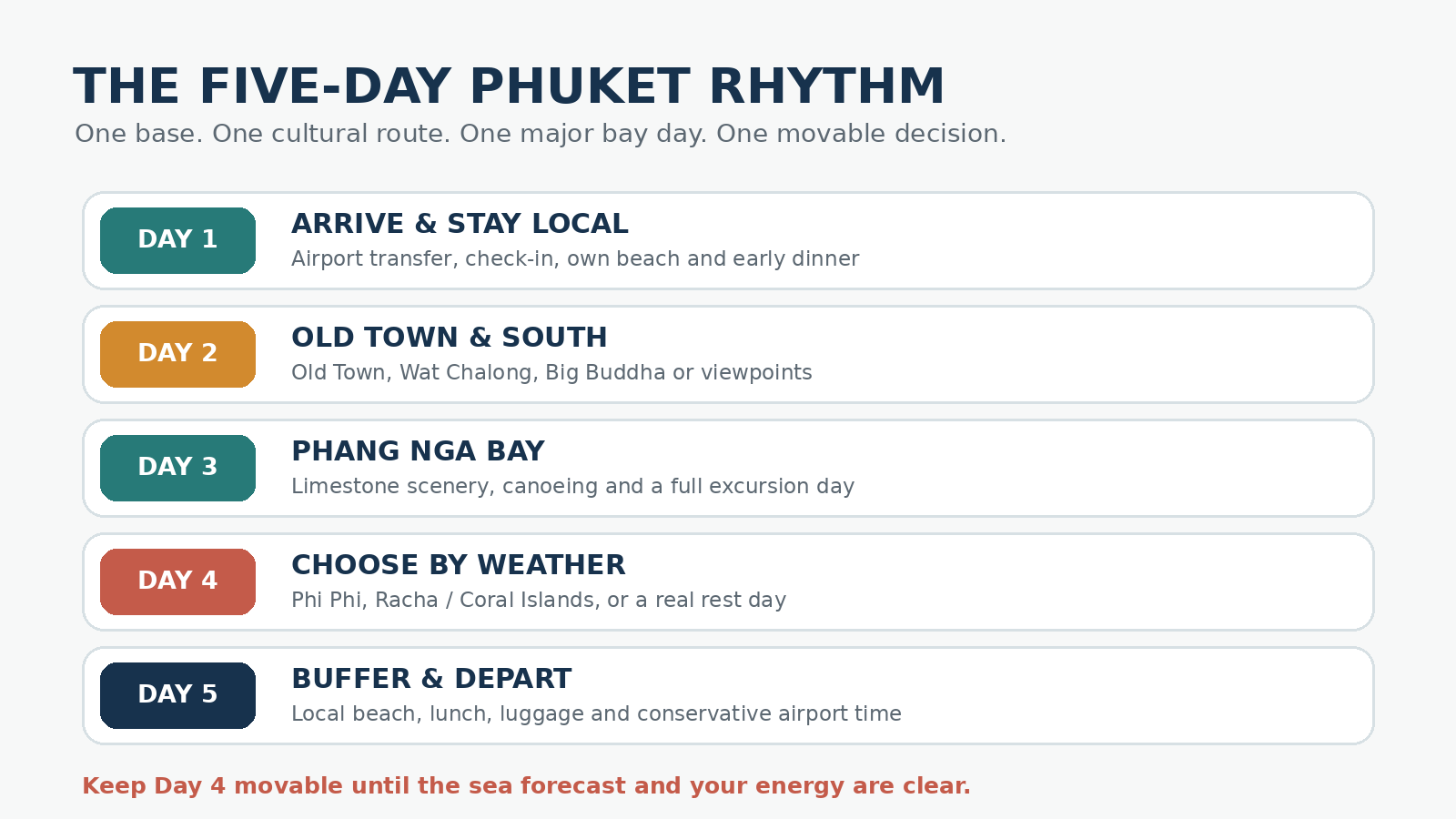
The complete five-day Phuket itinerary
| Day | Core plan | Approximate active window | Weather flexibility |
|---|---|---|---|
| 1 | Arrival, check-in and local beach | 2–5 hours after arrival | High |
| 2 | Old Town, Wat Chalong, Big Buddha and south-coast sunset | 09:00–20:00 | High |
| 3 | Phang Nga Bay and canoeing | 07:00–18:30 | Medium |
| 4 | Phi Phi, Racha / Coral Islands or rest day | Varies by choice | Very high |
| 5 | Local beach, lunch and airport buffer | Morning to departure | High |
Day 1: arrive, check in and stay close to the hotel
Treat the airport transfer as part of the first day. Phuket Airport lists buses, vans, car rental and ride services, while the Smart Bus runs through several west-coast beach areas. The public option is excellent for a daytime arrival with manageable luggage; a private transfer or ride app is usually easier after a long flight, with children or when the hotel sits away from the main road.
The Smart Bus currently lists a THB 100 flat fare for the Airport–Patong–Rawai route and accepts contactless Visa, Mastercard and JCB cards, Thai QR payment and cash. That makes it useful, but not automatically fastest. Check the live timetable and the walk from the stop to the hotel on the operator website. For Phuket Town, the official Route 8411 page says the orange airport bus runs daily, charges by distance and boards from the public-transport area reached by turning left from Exit 3; recheck the current timetable before relying on it.
After check-in, do not cross the island for a viewpoint. Buy water, confirm the next morning’s pickup, walk to the nearest beach and eat locally. A short first evening gives you a useful reading of the area: where the nearest pharmacy sits, whether the return road feels comfortable after dark and how long breakfast actually takes.
Day 2: Old Town, Wat Chalong, Big Buddha and the south coast
Start in Phuket Old Town before the hottest part of the day. Thalang Road is the obvious first stop, but the visit is better when it includes side streets, a local breakfast or lunch and one cultural attraction rather than an hour of photographs. Allow two to four hours, depending on heat and interest.
Tourism Authority of Thailand highlights the district’s architecture, street art, cafés and cultural history. On Sundays, the walking street changes the timing: visit the southern sights first and return to Old Town later for the market. The official suggested route pairs Old Town with Wat Chalong and southern viewpoints.
Continue to Wat Chalong in clothing that covers shoulders and knees. Shoes should be removed where required, voices kept low and religious spaces treated as active places of worship. The temple stop is often short, but it adds context that a viewpoint alone cannot provide.
Big Buddha reopened on 3 March 2026 after the long closure that followed the 2024 landslide. Local reporting listed daily visiting hours of 09:00–18:00 under Wat Kittisangharam management. Nevertheless, the approach road is steep and wet-season conditions matter, so recheck access and hours through your hotel or current local notices before making it the fixed centre of the day. If access changes, replace it with Karon Viewpoint, Nai Harn, Rawai or a longer Old Town visit rather than forcing a detour.
Finish with a south-coast viewpoint or beach according to traffic. Promthep Cape is famous, but it can be crowded and the drive back may be slow. Karon Viewpoint, Windmill Viewpoint, Nai Harn or a beachfront dinner can deliver a calmer ending.
A workable Day 2 sequence
- 09:00–12:00: Phuket Old Town, food stop and one museum or cultural site.
- 12:00–13:30: Lunch and road transfer towards Chalong.
- 13:30–14:30: Wat Chalong.
- 15:00–16:30: Big Buddha if access is confirmed, otherwise Karon Viewpoint or extra beach time.
- 17:00 onwards: Nai Harn, Rawai, Promthep Cape or dinner near the hotel.
Day 3: choose a canoe-focused Phang Nga Bay trip
Phang Nga Bay receives the first paid excursion slot because the scenery contrasts with Phuket’s west-coast beaches. The sheltered bay is known for limestone towers, caves and lagoons. A big-boat itinerary with guided canoeing usually suits a wider range of travellers than a fast, bouncing speedboat, although exact accessibility still depends on the operator and tide.
Expect an early pickup, a drive to the pier, a full day on the water and a late-afternoon return. Ask whether canoeing is passenger-led or handled by a local paddler, whether James Bond Island is a short photo stop, and whether national-park fees are included. Travellers with back, mobility or pregnancy concerns should read the operator restrictions before booking rather than assuming a big boat is automatically suitable.
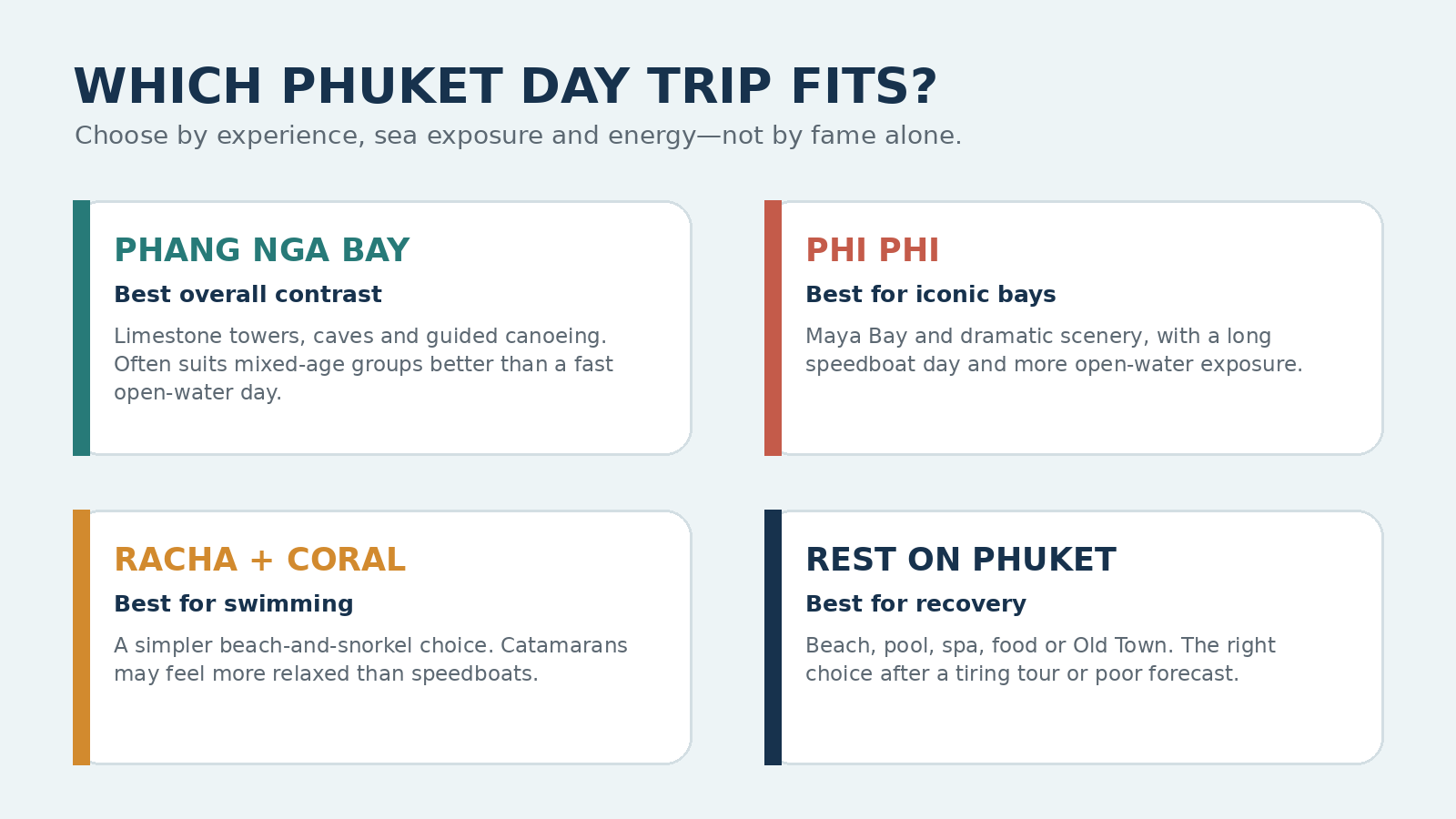
Day 4: choose Phi Phi, Racha and Coral Islands, or a real rest day
Day 4 is the decision point. Check the marine forecast, how the group feels after Phang Nga Bay and what the second trip genuinely adds. This is where a flexible itinerary earns its value.
Choose Phi Phi when iconic scenery is the priority
Phi Phi is the famous choice for Maya Bay, Pileh Lagoon and dramatic limestone scenery. It is also a long open-water day, usually with an early pickup and speedboat travel. The route can feel rushed when several major stops are combined. Confirm whether Maya Bay access is operating, whether the national-park fee is included and which health restrictions apply.
Choose Racha and Coral Islands for a simpler beach-and-snorkel day
Racha and Coral Islands can be a better second sea day when the goal is swimming, snorkelling and a less iconic but more straightforward outing. Some catamaran routes add a Promthep sunset, which creates a long day but may feel gentler than a speedboat for certain travellers. Vessel type, transfer zone and sea state still matter.
Choose a rest day when the previous three days have already delivered enough
A rest day is not a failed itinerary. Sleep later, use the hotel pool, spend time at your own beach, book a massage, take a cooking class or return to Old Town for food. This option is particularly sensible for families, travellers affected by motion sickness, or anyone facing a long transfer immediately after Phuket.
Day 5: stay local and protect the airport buffer
Keep the final day close to the hotel. Use the beach only when flags and lifeguard advice support swimming, then shower, eat and leave with more road time than the fastest map estimate. Southern bases such as Rawai and Nai Harn require the largest buffer; rain and peak-hour traffic can change the drive sharply.
For an evening flight, check whether the hotel will store luggage and provide a shower. For a morning departure, consider moving the final night to Nai Yang or an airport hotel only when the saved travel time is worth another checkout.
Three-day and seven-day Phuket itinerary versions
A realistic three-day Phuket itinerary
| Day | Plan | Reason |
|---|---|---|
| 1 | Arrival and own beach | Avoid losing time in cross-island traffic |
| 2 | Old Town, Wat Chalong and south-coast viewpoint | Combines culture and landscape |
| 3 | Phang Nga Bay or Phi Phi | Choose one defining excursion |
A three-day trip should not include a hotel change, two boat tours and a full nightlife schedule. Choose the beach base carefully, pre-arrange the key excursion and accept that Phuket will remain a highlight rather than a complete survey.
A relaxed seven-day Phuket itinerary
| Day | Plan |
|---|---|
| 1 | Arrival and local beach |
| 2 | Old Town, Wat Chalong, Big Buddha or viewpoints |
| 3 | Phang Nga Bay |
| 4 | Rest, spa, beach or cooking class |
| 5 | Phi Phi or Racha / Coral Islands |
| 6 | Choose a quieter beach, local food day or private island circuit |
| 7 | Flexible morning and departure |
With seven nights, a split stay becomes possible. For example, combine three nights in Kata or Karon with four nights in Kamala, Bang Tao or Nai Harn. However, move only when the second base changes the holiday rhythm. Shifting from one neighbouring resort strip to another can consume half a day without creating a meaningful new experience.
Pros and cons of this five-day Phuket route
This plan protects time and energy rather than trying to cover every coast. That makes it dependable for a first visit, although it deliberately leaves some worthwhile places for another trip.
Where the route works well
- One hotel base removes a mid-trip checkout and repeated luggage transfers.
- Old Town, temples, limestone scenery and beach time create variety without a new early start every morning.
- Day 4 can move when wind, waves, tiredness or a cancelled boat changes the plan.
- The final day stays close to the hotel, reducing the risk of a stressful airport run.
What the route cannot do
- North Phuket, Cape Panwa and smaller local beaches receive little or no time.
- Travellers who want both Phang Nga Bay and Phi Phi still face two long excursion days.
- Cross-island road traffic remains unavoidable on the Old Town and south-coast day.
- A five-day stay cannot include Khao Sok properly without dropping a Phuket day or adding nights.
Phuket day trips compared
| Trip | Typical hotel-to-hotel day | Best for | Main drawback | Planning range |
|---|---|---|---|---|
| Phang Nga Bay | 9–12 hours | Limestone scenery, caves and mixed-age groups | Long road and boat sequence | THB 1,500–3,500 |
| Phi Phi and Maya Bay | 10–13 hours | Iconic bays and open-water scenery | Speedboat exposure and crowds | THB 1,800–4,500 |
| Racha and Coral Islands | 8–11 hours | Swimming, snorkelling and a simpler island day | Less dramatic scenery | THB 1,500–3,800 |
| Khai Islands half-day | 5–7 hours | Short stays and first boat trips | Small islands can feel busy | THB 1,000–2,500 |
| Similan Islands | 12–15 hours | Seasonal snorkelling priority | Very early road transfer north | THB 3,000–5,500 |
| No boat day | Flexible | Rest, families and unstable weather | Fewer famous-island photographs | THB 500–3,000 |
For a longer comparison of Phang Nga Bay, Phi Phi, Racha, Coral Island, Koh Yao, Khao Lak and inland alternatives, see the best day trips from Phuket guide.
National-park and marine access should be checked live. Thailand’s Department of National Parks publishes seasonal closures for safety and ecological recovery, while local restrictions can change with conditions. Check the current park-closure guidance before paying for a seasonal route.
Phuket Airport transfers and getting around
Airport transfer options compared
| Option | Planning price | Best for | Watch for |
|---|---|---|---|
| Smart Bus | THB 100 flat fare on Airport–Patong–Rawai route | Daytime arrivals with light luggage | Timetable and final walk to hotel |
| Airport bus to Phuket Town | Distance-based fare | Old Town and city stays | Not a beach transfer |
| Ride app / taxi | Live quote or metered / agreed fare | Couples and moderate luggage | Pickup point, traffic and tolls |
| Pre-booked private transfer | About THB 700–1,500 by area and vehicle | Families, late arrivals and south-coast hotels | Vehicle type, child seat and waiting time |
| Shared minivan | Often THB 200–500 per person | Solo travellers on a budget | Multiple hotel stops |
| Rental car | Variable daily price plus fuel and deposit | Confident licensed drivers and multi-area stays | Insurance, parking and fatigue |
For trains, domestic flights, ferries, long-distance buses and connection buffers beyond Phuket, use the transport in Thailand guide.
Phuket Airport lists public transport and official ride services. Its current Grab information identifies a service point at the domestic terminal and live fares in the app. Confirm the terminal and current pickup instructions on the official airport page.
Do not rent a scooter simply because it appears cheap
A scooter can reduce taxi costs, but it is not a beginner transport solution. The rider needs the correct licence category, the right international permit where applicable, valid insurance, a proper helmet and confidence on steep, wet and congested roads. A rental agreement does not prove that an insurer will pay a claim.
A private driver can be better value for a route day
For Day 2, a private car can cost less than several separate taxis once waiting time and cross-island transfers are included. Ask for a written duration, overtime rate, pickup area and any parking or attraction charges. The value comes from route control, not from treating the driver as an unlicensed guide.
Realistic Phuket itinerary costs
Phuket can be affordable, but island geography makes transport and tours more expensive than a simple daily food budget suggests. The figures below exclude international flights and use per-person planning ranges for a five-night stay. Couples sharing rooms and transfers may pay less per person; solo travellers often pay more for private transport.
The wider Thailand travel budget guide explains daily spending, cash, cards and how Phuket compares with other stops.
| Cost area | Budget-comfort | Mid-range | Higher-comfort |
|---|---|---|---|
| Accommodation, 5 nights | THB 4,000–8,000 | THB 10,000–22,500 | THB 30,000+ |
| Food and drinks | THB 2,500–4,500 | THB 5,000–9,000 | THB 12,000+ |
| Local transport | THB 1,000–2,500 | THB 3,000–6,000 | THB 8,000+ |
| One major day trip | THB 1,500–2,500 | THB 2,500–4,500 | THB 5,000+ |
| Second activity / island day | THB 0–2,000 | THB 2,000–4,000 | THB 5,000+ |
| Five-day total | THB 9,000–19,500 | THB 22,500–46,000 | THB 60,000+ |
Where spending more usually improves the trip
- A hotel location that reduces repeated taxi journeys.
- A private airport transfer after a late long-haul arrival.
- A boat tour with clear inclusions, sensible capacity and a strong cancellation policy.
- An extra night that removes a same-day flight-and-ferry connection.
Where spending more often adds little
- Changing hotels for a neighbouring beach during a short stay.
- Paying for multiple similar island trips simply because they are famous.
- Booking a sea-view room without checking whether construction, trees or a distant angle affects the view.
- Premium transport that still follows a shared pickup route with many stops.
Phuket weather, sea conditions and flexible-day planning
Phuket weather should be read in layers. A general rain icon does not tell you whether the morning is usable, whether the west-coast beach has a red flag or whether the Andaman Sea is suitable for a small boat. The Thai Meteorological Department’s regional forecast and marine warnings are more useful than a single app symbol.
Month-by-month rainfall patterns are covered separately in the best time to visit Thailand guide; the live marine forecast still takes priority on the day.
November to April is usually the easier broad window
This period often brings more settled Andaman conditions, with December to March particularly popular. However, calm weather is never guaranteed and high season also means higher room prices, busier beaches and fuller tours.
May to October needs a movable itinerary
The greener months can offer lower prices and quieter resorts, but a strong southwest monsoon can bring rough seas and dangerous currents. A dated example shows why: the TMD forecast issued on 5 September 2026 warned of 2–3 metre waves from Phuket northward, waves above 3 metres in thunderstorms and small boats in the upper Andaman Sea remaining ashore through 2 September. That snapshot is not a forecast for a future holiday; it is a reminder to check the live TMD bulletin before every boat day.
Use a four-question morning check
- Has the Thai Meteorological Department issued a regional or marine warning?
- Has the operator confirmed the route, vessel and pickup rather than merely saying the tour is “running”?
- Are beach flags and lifeguard instructions compatible with swimming?
- Would the day still be enjoyable if snorkelling visibility or one stop changes?

How to plan food without crossing the island for every meal
Phuket’s food is part of the itinerary, but dining plans should follow the day’s route. Use Old Town for local breakfast, coffee, Peranakan-influenced dishes and a market evening. Use Rawai or the south for seafood when Day 2 already brings you there. Keep boat-tour evenings close to the hotel because the return time can move.
A simple five-day food pattern
- Arrival evening: choose a restaurant within walking distance of the hotel.
- Old Town day: plan lunch in the historic centre, then south-coast seafood or dinner near the base.
- Phang Nga day: use the included tour meal, followed by a light local dinner.
- Flexible day: choose the meal around the island trip or rest plan.
- Departure day: keep lunch reliable and close to the hotel before the airport transfer.
For allergies, vegetarian requirements or religious dietary needs, send the exact request before a boat day. “Vegetarian option available” may still mean a shared buffet or limited choice. Carry a written translation and a backup snack when the whole day depends on an included meal.
Useful Phuket boat-day products compared
Start with the Thailand packing list so you buy only what solves a real problem. For connectivity, the Thailand SIM card and eSIM guide compares local SIMs, eSIMs and setup timing.
| Item | When it adds value | Buying advice | Main limitation |
|---|---|---|---|
| 5–10 litre dry bag | Keeping towel, clothes and documents together | Choose a roll-top with welded seams and test it | Most are splash-resistant, not guaranteed submersible |
| Waterproof phone pouch | Pier spray and quick access to tickets | Check phone dimensions and tissue-test the closure | Touchscreens and cameras may work poorly underwater |
| Travel power bank | Long pickup days and navigation | Check airline cabin-baggage rules and capacity | Adds weight and must be kept dry |
| Digital luggage scale | Avoiding domestic-flight baggage fees | Choose a readable model with a secure strap | Home scales can still differ from airline scales |
Common Phuket itinerary mistakes
Mistake 1: choosing the hotel from an island-wide map
A five-kilometre line does not show hills, one-way roads, traffic or the location of a safe pedestrian crossing. Check the actual route between the hotel, beach, restaurants and pickup road.
Mistake 2: changing beaches by changing hotels
A short taxi ride lets you visit another beach without packing. Move only when the second area creates a distinct experience, such as switching from nightlife in Patong to a quiet final stay near Nai Yang.
Mistake 3: booking Phi Phi and Phang Nga Bay on consecutive days
The trips are visually different, but both involve early pickups, sun exposure and a long return. A rest or cultural day between them usually improves the second excursion.
Mistake 4: assuming all Phuket pickup zones are free
Rawai, Nai Harn, Bang Tao, airport hotels and private villas may have surcharges or earlier pickup times. Compare the complete price after transfers and park fees.
Mistake 5: fixing Day 4 months in advance
The second sea day is the easiest part to keep flexible. Preserve the ability to choose by forecast and energy rather than protecting a non-refundable plan.
Mistake 6: treating Big Buddha information from 2024 or 2025 as current
The site reopened in 2026 after a long closure, but access, hours and wet-season road conditions should still be rechecked. Old articles may say it is closed, while other pages may list obsolete opening times.
Mistake 7: relying on a scooter without checking insurance
The rental price is only one part of the risk. Check licence category, international permit requirements, helmet, excess and whether the policy excludes riding entirely. The Thailand travel insurance guide explains activity exclusions, medical cover and claims evidence in more detail.
Mistake 8: leaving the airport transfer until the last possible minute
Phuket traffic can be slow, particularly from the south. Build the return around a conservative road time, airline check-in and possible rain rather than the fastest journey seen on a map. Also review the Thailand scams and tourist-trap guide before using unfamiliar transport or paying deposits.
Mistake 9: confusing an included lunch with a dietary guarantee
Send dietary needs in writing, carry a translation and keep a small backup. Shared kitchens and buffets may not be suitable for severe allergies.
Mistake 10: adding a drone without researching Thai registration
Thailand has registration and operating requirements for drones. Check the Civil Aviation Authority of Thailand and any additional radio or protected-area rules before packing or flying one.
Phuket itinerary FAQs
How many days are enough for Phuket?
Five days is enough for a balanced first visit. Three days covers one base, Old Town and one major excursion. Seven days gives better weather flexibility and room for a second boat trip.
Where should a first-time visitor stay in Phuket?
Kata or Karon is the easiest balanced choice for many first-time visitors. Patong suits nightlife, Kamala and Bang Tao suit calmer resort stays, and Nai Harn or Rawai suits travellers who accept a longer airport journey.
Is Patong a good base for five days?
Yes when nightlife, shopping and restaurant choice are central priorities. It is less suitable when quiet evenings and a relaxed beach atmosphere matter more.
Should I stay in Phuket Old Town or by the beach?
Stay by the beach for a first five-day holiday and visit Old Town for a half-day or evening. Old Town is excellent for food and culture but adds road travel to most beach and pier plans.
What is the best day trip from Phuket?
Phang Nga Bay is the best all-round first excursion because its limestone scenery and canoeing contrast with a normal beach day. Phi Phi is the stronger choice when Maya Bay and iconic open-water scenery are the main goal.
Can I do Phang Nga Bay and Phi Phi in five days?
Yes, but leave a rest or cultural day between them and keep one booking flexible. Two long boat days can dominate a short holiday.
Is the Phuket Smart Bus useful?
Yes for travellers staying near its route with manageable luggage and a daytime arrival. The Airport–Patong–Rawai route currently uses a THB 100 flat fare, but the final walk and timetable determine whether it suits the hotel.
Do I need a scooter in Phuket?
No. Ride apps, taxis, private drivers, Smart Bus and organised tours can cover a first visit. Rent only with the correct licence, permit, insurance and riding experience.
Is Big Buddha open in 2026?
The site reopened in March 2026 after the closure that followed the 2024 landslide. Recheck current hours, road access and local safety advice before making a special journey, particularly during heavy rain.
What is the best month for a Phuket itinerary?
December to March often provides the easiest broad combination of drier weather and calmer sea conditions. November and April can also work. May to October may be greener and cheaper, but boat days need more flexibility.
How much money do I need for five days in Phuket?
Excluding international flights, a practical budget-comfort plan may cost THB 9,000–19,500 per person, while a mid-range plan may cost THB 22,500–46,000. Hotel level, private transfers and number of tours drive the difference.
Can I visit the Similan Islands from Phuket?
Yes during the operating season, but it is a very long day because most tours include an early road transfer north before the boat. Check national-park opening status before booking.
What should I book before arriving?
Book flights, the main hotel and any essential late-night airport transfer. Reserve one priority excursion with flexible cancellation, then leave the second sea day open until the forecast is clearer.
Is a five-day Phuket trip suitable for children?
Yes when the hotel location, transfer times and boat choice match the child’s age and swimming confidence. A big-boat Phang Nga route and one beach day may be easier than two speedboat excursions.
What happens when a boat trip is cancelled?
Move Old Town, Wat Chalong, a private island circuit, spa, cooking class or beach day into the slot. Confirm whether the operator offers a refund, date change or altered route before accepting the alternative.
What five-day route would I choose?
I would stay in Kata or Karon, keep the first evening local, use Day 2 for Old Town and the south, book a canoe-focused Phang Nga Bay trip for Day 3, leave Day 4 flexible and protect the final airport buffer. That route contains enough variety without asking every day to be a major excursion.
Final Phuket booking checklist
- Choose one main beach base and check the real walking route.
- Confirm the usable arrival and departure times, not only the dates.
- Book the hotel and any essential late-night transfer.
- Compare Phang Nga Bay vessel, pickup, fees and cancellation terms.
- Leave the second sea day flexible where possible.
- Check passport, visa and Thailand Digital Arrival Card requirements for your nationality.
- Review travel insurance for planned activities and scooter use.
- Check TMD weather, waves and local beach flags before every sea day.
- Save Tourist Police 1155 and the insurer’s emergency number.
- British travellers can use the Thailand entry requirements guide for a plain-English checklist, then confirm the rule that applies on the travel date with the official UK government guidance. On 5 September 2026, that guidance required a full British citizen passport to expire at least six months after arrival and have at least one blank page; it also stated that foreign nationals must complete the Thailand Digital Arrival Card within the permitted three-day pre-arrival window.
- The Tourist Police hotline is 1155. Save it before the trip rather than trying to find the number during a problem.
The Phuket itinerary I would actually book
The strongest first trip is not the one with the most islands. It is the one that leaves enough energy to notice where you are. One beach base, one cultural route, one major bay day and one flexible decision create a Phuket itinerary that can survive traffic, rain and a late return without becoming a disappointment.
Use Day 4 as the pressure release. When the sea is calm and everyone wants another adventure, book Phi Phi or Racha and Coral Islands. When the forecast or energy is poor, use the hotel, the beach and local food. That choice is not wasted time; it is the difference between a holiday and a checklist.
When Phuket is one part of a longer holiday, the Thailand two-week itinerary shows how to combine it with Bangkok and another region without creating a chain of exhausting transfers.
Sources and methodology
Research rechecked 5 September 2026. Official tourism, airport, transport, weather, entry, police, parks and aviation sources are prioritised. Prices and travel times are labelled planning ranges where no fixed official tariff exists.
Official planning sources
- Phuket destination guide — Tourism Authority of Thailand
- 10 Things to Do in Phuket — Tourism Authority of Thailand
- Travelling around Phuket Old Town — Tourism Authority of Thailand
- Recommended route for one day in Phuket — Tourism Authority of Thailand
- Eco and slow adventure in Phuket and Phang Nga — Tourism Authority of Thailand
- Phuket and Ko Phi Phi trip planner — Tourism Authority of Thailand
- Phuket International Airport — Airports of Thailand
- Airport Bus route 8411 — Airports of Thailand
- Grab at Phuket Airport — Airports of Thailand
- Phuket Smart Bus route information — Phuket Smart Bus
- Payment and fares — Phuket Smart Bus
- Daily weather forecast — Thai Meteorological Department
Additional official and local verification sources
- Seven-day forecast — Thai Meteorological Department
- Thailand entry requirements — UK Government
- Thailand travel advice — UK Government
- Tourist Police main site — Tourist Police Bureau
- Phuket Tourist Police station — Tourist Police Bureau
- 2026 national park closure schedule — Government Public Relations Department / DNP
- Marine conservation enforcement update — Department of National Parks
- RPA and drone registration — Civil Aviation Authority of Thailand
- Big Buddha reopens — The Phuket News
Illustrations in this article were created for Taylor’s Trailblazing Travels. Third-party photographs, where used, are credited beside the image or in the source list.