Koh Samui itinerary guide
A practical five-day route that protects beach time, keeps the major boat day flexible and avoids spending the holiday crossing the island.
A useful Koh Samui itinerary alternates active days with lighter ones and keeps the major boat day movable.
Koh Samui is easy to underestimate. On a hotel map, the island looks compact enough to cross whenever you fancy a different beach or dinner area. In practice, repeated journeys between Chaweng, Bophut, Lamai and the west coast can consume both time and taxi money. A strong Koh Samui itinerary therefore begins with the right base, not with the longest list of attractions.
Five days creates a useful rhythm for a first visit. There is room for one efficient island loop, one major marine-park day and genuine beach time, while the final morning can protect an onward flight or ferry. The Tourism Authority of Thailand highlights Chaweng, Lamai and Taling Ngam among Samui’s key beach areas and also places Ang Thong within the wider island experience.[1] That variety is exactly why trying to cover everything in two or three days usually feels rushed.
This guide uses current official transport, tourism, weather and safety information alongside dated live operator examples. Prices are planning ranges rather than promises. Ferry schedules, park access, pickup zones, sea conditions and hotel rates can change, so the final booking page or official notice should always outrank a static article.
Best overall rhythm
Use five days: arrive locally, take one land circuit, keep Ang Thong movable, slow down on Day 4 and protect departure.
Best first base
Bophut is the strongest balanced choice for many first visits; central Lamai works well when the beach matters more.
Best signature day
Choose Ang Thong when the park is open, the marine forecast is suitable and the vessel matches the traveller.
Biggest practical difference
A direct Samui flight protects time. A mainland route may cost less, but it adds road, pier, ferry and hotel-transfer stages.
The order below is deliberate. Arrival day absorbs delays, the land circuit comes before the boat day, and the final two days remain flexible. When the sea forecast weakens, swap Days 3 and 4 rather than forcing an excursion because it appears on the original schedule.
| Day | Morning | Afternoon | Evening | Why this order works |
|---|---|---|---|---|
| 1 | Fly or complete the mainland ferry chain | Check in and use the nearest beach | Local dinner and an early night | No fragile reservation depends on an exact arrival time |
| 2 | North-coast temples or the first half of an island loop | Viewpoint, Lamai area, waterfall or south coast | Eat close to the hotel | One road day gives geographic context before the sea day |
| 3 | Ang Thong pickup and boat journey | Kayak, viewpoint, snorkel or beach according to the tour | Quiet dinner near the hotel | The major excursion sits away from the departure day |
| 4 | Slow beach morning or cooking class | Spa, another beach, Koh Taen and Madsum, or a weather swap | Sunset and an unhurried meal | A flexible day repairs a cancellation without breaking the trip |
| 5 | Short local stop, breakfast or final swim | Airport or pier transfer | Onward journey | No offshore activity threatens a separate connection |
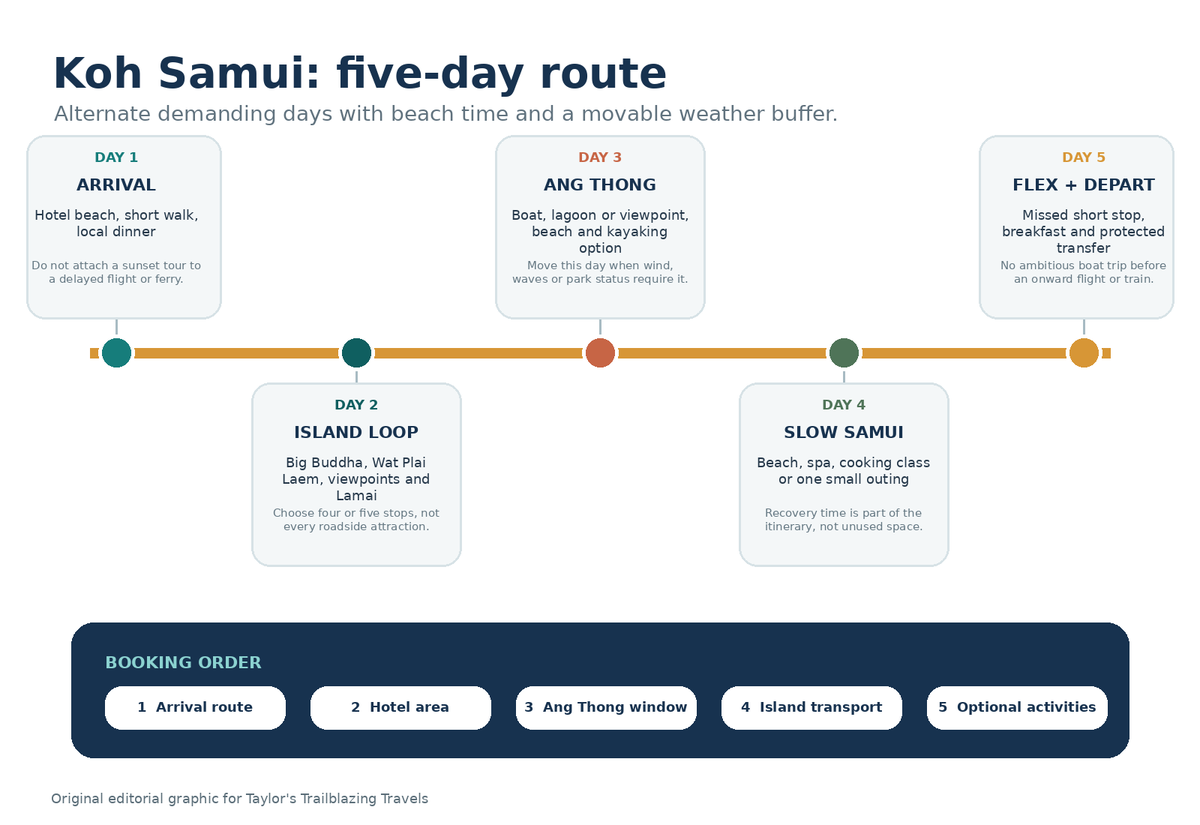
Five days is enough for a satisfying first visit, provided every day is not treated as a full excursion. Samui itself deserves at least one unstructured stretch. Without that breathing space, the trip can become a sequence of minivan pickups, boat briefings and cross-island transfers rather than a beach holiday.
What four days can realistically cover
Four days works best with a direct Samui flight and a well-positioned hotel. Use the arrival day locally, choose either an island loop or Ang Thong for the first full day, take the other on the next day, then protect departure morning. When both ends use Surat Thani plus ferry, however, four calendar days may deliver only two useful island days.
Why five days is the practical sweet spot
A fifth day adds more than one extra activity. It adds recovery capacity. If Ang Thong is cancelled, the excursion can move. If the island loop is tiring, the following morning can remain slow. Moreover, travellers who discover that they prefer the hotel beach can stop chasing a checklist without feeling that the whole trip has failed.
When seven days is clearly better
Choose seven days when diving or snorkelling is central, when children need slower mornings, or when the resort itself is a major part of the holiday. A week also supports a second boat choice, a cooking class and perhaps two carefully chosen bases. Even then, changing hotels is worthwhile only when the second area creates a genuinely different stay.
| Stay length | Best structure | What must be dropped | Best arrival method |
|---|---|---|---|
| 3 nights | Arrival, one major day, one flexible day, departure | Either the full island loop or the major boat day | Direct flight |
| 4 nights | Arrival, island loop, Ang Thong, light day, departure | A second boat day and most long lunches | Preferably direct flight |
| 5 nights | Arrival, island loop, Ang Thong, slow or south day, buffer | Very little for a first visit | Direct flight or a well-timed ferry chain |
| 7 nights | Five-day core plus a second sea day and a deeper beach day | Nothing essential; avoid filling every morning | Either route can work with buffers |
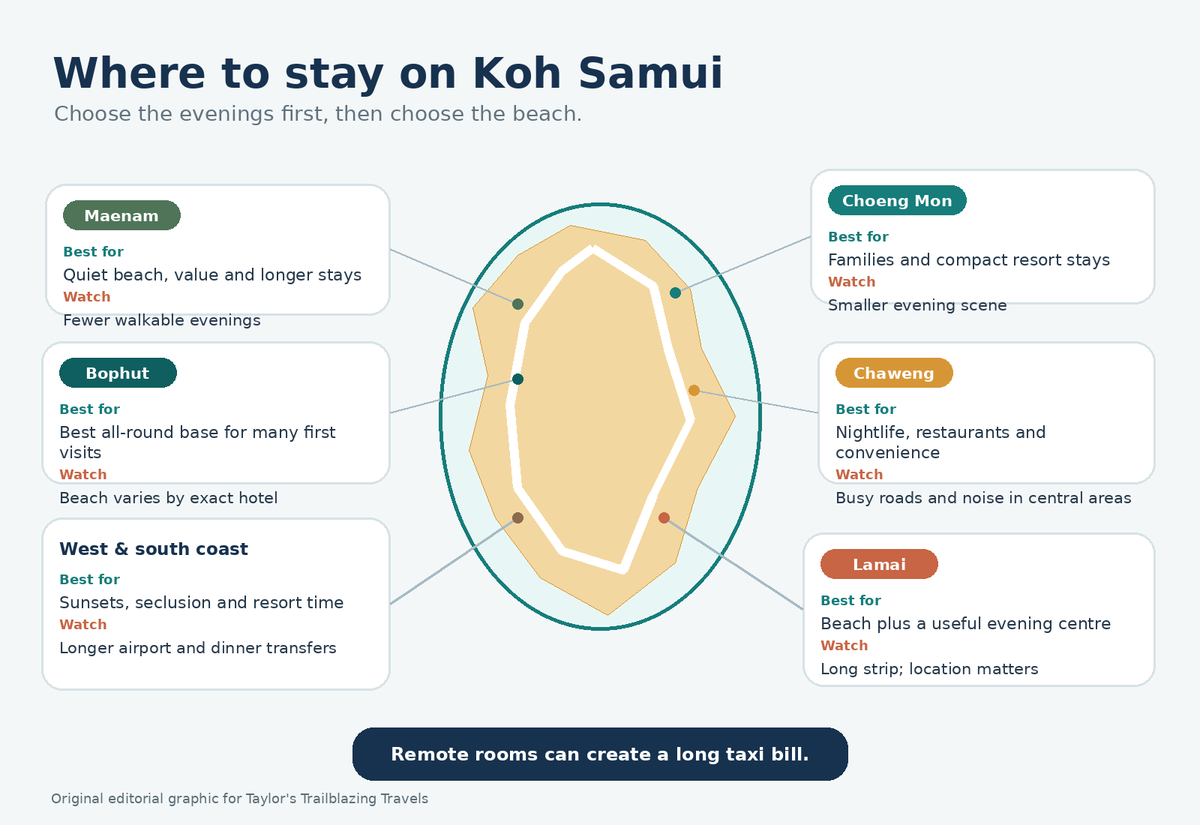
There is no single best area. The useful question is what you want after 17:00, when a day-trip minivan has returned you to the hotel. Bophut, Lamai and Chaweng make spontaneous dinners easier. Maenam, Choeng Mon and the west or south coast trade some choice for calm, space or a more resort-led stay.
How the main bases differ
Six Koh Samui bases at a glance
| Area | Best for | Evening reality | Transfer logic | Main watch-out |
|---|---|---|---|---|
| Chaweng | Nightlife, shopping, restaurants and travellers without a car | The broadest choice; central streets can stay noisy late | Convenient for the airport and east-coast stops | Beach and room atmosphere vary block by block |
| Lamai | A long beach, couples and a lively but less intense base | Enough restaurants and bars for several nights | Useful for the south and east; farther from some north-coast pickups | The area stretches along the road, so map the exact hotel |
| Bophut | Couples, families and people who value a contained evening area | Fisherman’s Village gives dining and strolling without a cross-island taxi | Close to the airport, Big Buddha area and several piers | Popular seafront rooms can be expensive; beach quality varies |
| Maenam | Quiet beach time, longer stays and better-value space | Lower-key evenings with fewer late choices | Good north-coast position; reasonable for some Gulf ferries | A secluded hotel may require transport for every meal |
| Choeng Mon | Families, compact resort comfort and a calmer east-coast bay | Mostly resort and local dining rather than nightlife | Near the airport and north-east attractions | Smaller choice and often higher resort pricing |
| Taling Ngam, Lipa Noi or quiet south coast | Sunsets, villas, special stays and genuine seclusion | The hotel is often the evening plan | Useful for Lipa Noi ferry and south-coast exploring | Longer airport, Chaweng and Bophut journeys |
Bophut: strongest for a balanced first stay
Bophut is the easiest recommendation for travellers who want a pleasant evening without Chaweng’s intensity. Fisherman’s Village combines restaurants, bars and a walkable waterfront, while the airport and north-east temples remain relatively close. Nevertheless, “Bophut” covers more than the compact village. Check whether the room is actually walkable to the seafront or requires a road transfer.
Lamai: beach first, with enough life after dark
Lamai suits travellers who want a substantial beach and a relaxed evening scene. It is also well placed for Hin Ta and Hin Yai, the south coast and several island-loop stops. Because the resort strip is elongated, two Lamai hotels can create very different holidays. Measure the walk to the usable beach, restaurants and main road before comparing only price and star rating.
Chaweng: choose the exact room, not only the area
Chaweng offers the widest nightlife, retail and dining choice. It can therefore reduce taxi dependence for solo travellers, groups and anyone who expects late evenings. By contrast, families or light sleepers should inspect recent room reviews, club proximity and access-road noise. A hotel described as “Chaweng” may sit on a calmer edge, beside the busiest nightlife, or up a hill away from the beach.
Maenam and Choeng Mon: calmer northern choices
Maenam generally provides more space and a quieter beach atmosphere, while Choeng Mon offers a compact bay and resort convenience. Both can suit families. However, a peaceful area does not automatically mean an easy pushchair route or shallow water every day. Confirm steps, road crossings, pool barriers, interconnecting rooms and the seasonal condition of the particular beach.
West and south coast: choose seclusion on purpose
Taling Ngam, Lipa Noi and the quieter south can create the most memorable sunset stays. They are also the easiest places to book accidentally because a villa looks inexpensive on a map. Before paying, price a return dinner transfer, confirm the nearest shop and ask whether the property road is steep. Seclusion works when the resort, pool and sunset are the point; otherwise, it becomes a daily transport problem.
There are two main strategies. The simplest is a direct flight into Samui Airport. By contrast, the budget comparison is usually a flight, train or bus to the mainland followed by a road transfer to Donsak, a ferry and one final island transfer. That mainland option can save money, but only when the complete chain still fits the holiday.
Flying directly to Samui
Bangkok Airways describes Samui Airport as a standard commercial airport in Bo Phut and gives approximately 1 hour 30 minutes as the direct flight time from Bangkok.[3] The airport’s location is particularly convenient for Bophut, Choeng Mon and Chaweng. Direct flying therefore protects the most time on a short break, although fares can be materially higher than mainland-airport alternatives.
Do not compare airfare alone. Add checked baggage, the Bangkok airport used, the Samui hotel transfer and the value of the hours saved. A more expensive flight can be the better-value choice when a mainland route removes most of Day 1 and creates an early departure on Day 5.
Surat Thani plus Donsak ferry
The mainland route has at least four moving parts: arrival at Surat Thani airport or station, transfer to Donsak, pier check-in, the crossing, and the hotel journey from Nathon or Lipa Noi. Seatran’s live 2026 listings commonly show the Donsak–Nathon crossing at about 1 hour 30 minutes with a 200-baht passenger fare, while Raja Ferry’s published fare table lists 200 baht for a Donsak–Samui passenger.[4][5] Those figures are useful references, not the total journey cost.
The operator, arrival pier and through-ticket matter. Nathon is on the west side; Lipa Noi is farther south-west. A room in Chaweng or Choeng Mon still needs another road transfer. Moreover, waiting time can expand during public holidays, vehicle queues or disrupted weather. When buying separate tickets, leave enough recovery time that a late van does not destroy the whole chain.
Night train or long-distance bus
An overnight train can save a hotel night and form part of a slower Thailand route. It does not create a direct train to the island. After the station comes a pier transfer, check-in, the ferry and the final hotel journey. Therefore, compare a through combination with separate tickets and check exactly where responsibility transfers between operators.
| Arrival strategy | Best for | Real door-to-door chain | Main advantage | Main risk |
|---|---|---|---|---|
| Direct Samui flight | Short stays, families and travellers protecting holiday time | Bangkok or regional airport → Samui Airport → hotel | Fewest hand-offs | Higher fare and limited route competition |
| Surat Thani flight + ferry | Budget-conscious travellers with a flexible day | Airport → coach or van → Donsak → ferry → Samui pier → hotel | Can reduce headline transport cost | A “cheap flight” can become a long and fragile day |
| Night train + ferry | Slow travel and multi-stop Thailand routes | Bangkok station → Surat Thani station → road transfer → ferry → hotel | Uses the night for distance | Sleep quality, delays and early hand-offs vary |
| Long-distance bus + ferry | Lowest-cost comparisons and simple through tickets | Origin terminal → Donsak or transfer hub → ferry → hotel | One booking may cover several legs | Long sitting time and unclear interchange details |
| Self-drive car ferry | Road trips, residents and families carrying equipment | Mainland drive → vehicle queue → ferry → island road | Keeps the same vehicle | Vehicle space, queues, insurance and road fatigue |
Protecting a separate onward flight
Do not plan a weather-sensitive ferry to arrive shortly before a separately ticketed international flight. Instead, return to the airport side or mainland one day earlier when the financial consequence of a missed connection is large. Travel insurance should also cover the itinerary and activities; read the delay and missed-departure wording rather than assuming any policy will reimburse separate tickets.[11]
Samui becomes easier when reservations are made in the correct order. The base and arrival route control almost every later decision, whereas a cooking class or massage can wait. During peak school holidays or festive dates, move the first three steps earlier, but still favour changeable terms where weather affects the activity.
Book the travel chain in this order
| Priority | Book or confirm | Why it comes here | What to verify |
|---|---|---|---|
| 1 | Flight or complete mainland chain | It determines usable island time | All transfer points, baggage, pier and cancellation terms |
| 2 | Hotel in the correct area | It controls evening transport and pickup surcharges | Exact room, slope, beach access, occupancy and noise |
| 3 | Ang Thong with flexible terms | The flagship day can sell, yet weather matters | Vessel, park fee, pickup zone, mobility and cancellation |
| 4 | Island-loop driver or tour | A good route avoids backtracking | Guide versus driver, vehicle, hours and included fees |
| 5 | Departure transfer | Morning taxis and remote resorts need planning | Pickup time, pier or terminal and recovery margin |
| 6 | Cooking, spa or Pig Island option | These fill the flexible day | Start time, diet, weather, animal rules and transport |
| 7 | eSIM or local SIM plan | Maps and pickup messages matter from arrival | Activation point, phone compatibility and data allowance |
Set up connectivity before pickup day
For a fuller comparison of eSIMs, physical SIMs, airport counters and activation checks, use the site’s Thailand SIM card and eSIM guide. Travellers building Samui into a longer route should also read the transport in Thailand guide before buying separate legs.
The first day should be almost impossible to ruin. Even a direct flight can arrive later than expected; a mainland chain can lose time at several hand-offs. Therefore, do not attach a prepaid sunset cruise, long dinner transfer or island-wide tour to the arrival afternoon. Check in, understand the immediate area and confirm the next two mornings.
When you arrive before mid-afternoon
Leave the luggage, walk the nearest practical stretch of beach and identify a café, pharmacy or convenience shop. Next, check the hotel’s real position after dark: the route that looked short online may involve an unlit road, a steep hill or no pavement. Finish with dinner nearby. The purpose is orientation, not sightseeing volume.
When you arrive after 17:00
Skip the beach mission if light is fading or the access route is unfamiliar. Instead, eat at the hotel or within a simple return walk. Confirm the Day 2 collection point in writing and set out temple-appropriate clothing, water and sun protection. When Day 3 is already booked, check that the operator has the correct hotel name and district rather than only a generic Samui address.
A first evening by base
| Base | Low-effort first evening | What not to do |
|---|---|---|
| Bophut | Walk Fisherman’s Village, eat close to the waterfront and return early | Do not add a long cross-island beach-club journey after a delayed arrival |
| Lamai | Short beach walk, local dinner and a look at the immediate centre | Do not assume every Lamai hotel is walkable to the same central strip |
| Chaweng | Choose one dinner area and note the route back to the exact hotel | Do not carry passports, large cash or every bank card into a busy first night |
| Maenam or Choeng Mon | Use the local bay or hotel facilities and confirm tomorrow’s transport | Do not expect the same late restaurant choice as Chaweng |
| West or south coast | Stay at the resort, watch sunset and treat the room as part of the experience | Do not improvise a late return from Bophut without a confirmed car |
Day 2 should provide geographic context without turning into a race around the ring road. The official TAT itinerary includes Ang Thong, Big Buddha, Hin Ta and Hin Yai and Lamai among the wider Samui–Surat Thani route ideas.[2] For a single land day, choose six meaningful stops at most and allow one unhurried lunch.
The practical north-and-east start
From Bophut, Choeng Mon or Chaweng, an early start at Big Buddha and Wat Plai Laem is logical. These are active religious sites rather than photo sets, so cover shoulders and knees, remove shoes where requested and keep voices low. Afterward, continue towards a viewpoint or quieter east-coast beach before the middle of the day becomes hotter.
Travellers based in Lamai can reverse the circuit: begin with the south-east coast, then reach the north later. Reversing the route is often better than crossing the island at dawn simply to copy another person’s timetable. A private guide or driver should adapt to the hotel, weather and group rather than forcing one universal loop.
The Lamai and south-coast section
Hin Ta and Hin Yai are quick coastal rock stops near Lamai, not a half-day attraction. Pair them with a beach, the Guan Yu area or lunch rather than building the whole afternoon around them. Farther south, Laem Sor and quieter coastal roads create a different atmosphere from Chaweng, although the extra distance must still fit the return route.
Waterfall and interior choices
Na Muang Waterfall can be worthwhile after rain, but water volume, trail condition and access change. Wear footwear with grip and treat wet rock as slippery. The Secret Buddha Garden and higher interior viewpoints involve steeper roads; consequently, they suit a suitable vehicle and confident local driver better than a casual scooter detour.
A realistic Day 2 timetable
| Time | Plan | Decision behind it |
|---|---|---|
| 08:00–09:30 | Big Buddha and Wat Plai Laem, or the reversed south-coast start | Earlier light and lower heat; allow respectful temple time |
| 10:00–11:00 | Lad Koh viewpoint, Silver Beach or another single coastal stop | One view is useful; collecting viewpoints is not |
| 11:30–13:00 | Lamai area and a long lunch | Avoid making every stop a ten-minute photograph |
| 13:30–15:15 | Na Muang, Guan Yu, Laem Sor or one interior choice | Select by weather, footwear and vehicle |
| 15:15–16:30 | Return through the most logical coast | Do not cross Samui again for an evening attraction |
| After 17:30 | Dinner near the hotel | Save energy for the early boat pickup |
Private driver, licensed guide, group tour or rental car?
| Option | Best for | Advantages | Limitations | Questions before paying |
|---|---|---|---|---|
| Private car with licensed guide | First visits, cultural context and families | Custom pace, explanations and air-conditioning | Costs more than a basic driver | Is the guide licensed and present all day? Which admissions are included? |
| Private driver only | Travellers who already know the route | Flexible transport and less waiting | A driver is not automatically a guide | Can the route change? Are fuel, parking and waiting included? |
| Open 4×4 or safari | Interior roads and travellers who enjoy an active ride | Reaches higher viewpoints and jungle routes | Bumpy, exposed and unsuitable for some bodies | What vehicle, seating, rain cover and medical restrictions apply? |
| Group minivan | Solo travellers and lower budgets | Simple pickup and shared cost | Fixed stops, sales stops and waiting for the group | Exact route, group size, meal, fees and return time? |
| Rental car | Confident, properly licensed drivers | Independence, luggage space and air-conditioning | Navigation, parking, deposits and insurance | What licence is accepted? What is the excess and excluded damage? |
Day 2 advantages and limitations
| Advantages | Limitations |
|---|---|
| You understand how the coasts fit together before choosing later dinners or beaches. | A full circuit can become tiring when every viewpoint and temple is included. |
| A driver removes parking, navigation and scooter pressure. | Group routes may include stops that are not relevant to you. |
| Temples, scenery and the south coast create more variety than another full beach day. | Waterfalls and viewpoints are condition-dependent rather than guaranteed highlights. |
Ang Thong is the major excursion in this five-day plan because it delivers the limestone-island scenery that cannot be recreated by driving around Samui. Current tour examples commonly occupy nine to ten hours including pickup, boat travel and the return.[15][16] That makes it a full day, not an activity to combine with a distant dinner reservation.
What the day normally includes
Most tours combine several of the following: a boat journey through the archipelago, a viewpoint or steps to a lagoon, kayaking, snorkelling, beach time and lunch. The exact order changes with the vessel and sea. Moreover, a product photograph of every highlight does not guarantee that every activity will operate on every departure.
A current speedboat listing describes a nine-hour day and identifies 42 islands across roughly 102 square kilometres, while a big-boat listing gives a nine-to-ten-hour window.[15][16] Treat those as examples. Confirm the date-specific itinerary, because route changes may be made for tide, weather, crowd management or park instruction.
Big boat or speedboat?
| Boat style | Best for | Strengths | Trade-offs | Suitability check |
|---|---|---|---|---|
| Large sightseeing boat | Budget travellers and people who prefer more deck space | Shade, toilets, space to move and often a steadier feel | Longer transit and more passengers; shore transfers may use another boat | Ask about stairs, boarding method and access to the chosen activities |
| Speedboat | Travellers prioritising time at the islands | Faster transit and often more active stops | Bumpier, louder and more exposed to spray | Not suitable for every pregnancy, back, neck, mobility or age situation |
| Small-group speedboat | Couples and confident boat travellers | More guide access and fewer people when the group cap is genuine | Higher price and the ride is still a speedboat ride | Confirm the maximum number, boat model and seating |
| Private charter | Families or groups wanting control | Custom pace and privacy | High price; park and weather rules still apply | Confirm licensed operation, fuel, guide, meals and cancellation |
Park fee and inclusions
Current visitor and tour pages commonly reference a foreign-adult park fee of 300 baht and a foreign-child fee of 150 baht.[14][16] However, one checkout may collect the fee separately, another may bundle it, and the child definition can vary. Read the final inclusion list and carry the requested payment method rather than assuming the headline tour price is complete.
Viewpoint, stairs and mobility reality
The famous viewpoints are not effortless. Current visitor information describes a steep route with rope-assisted or stair sections, and product pages exclude some travellers with mobility limitations.[14][15] Closed shoes with grip are more useful than loose flip-flops. Choosing the beach or boat instead of the climb is a legitimate way to enjoy the park, not a lesser version of the day.
A big boat is not automatically wheelchair-accessible simply because it feels steadier. Boarding, tender transfers, beach landings and toilets can still involve narrow steps or wet surfaces. Ask the operator to describe each transfer rather than accepting a generic “easy” label.
Seasonal closure and daily sea conditions
The Department of National Parks maintains a dataset because national parks can have different closure dates, restricted areas and activity conditions.[7] Ang Thong commonly has a monsoon closure around November into December, but exact dates can move. Therefore, check the current park notice and the operator’s live confirmation for the travel date.
On any open date, daily conditions still matter. The Thai Meteorological Department publishes dedicated marine forecasts with wave and thunderstorm warnings.[8] A general weather app showing a cloud or shower is not enough. When the official marine outlook or licensed operator advises against the route, move the day rather than searching for a company willing to ignore the risk.
Ang Thong booking checklist
- Exact vessel type, passenger cap and approximate time spent in transit.
- Whether national-park fees are included, prepaid or collected separately.
- Hotel pickup zone, surcharge for remote coasts and final drop-off estimate.
- Boarding method, stairs, toilets, shade, life jackets and child sizing.
- Which activities are optional and what happens when a viewpoint or kayak route closes.
- Pregnancy, age, back, neck, mobility and motion-sickness restrictions.
- Meal, vegetarian request, allergy procedure and drinking-water inclusion.
- Weather cancellation, refund, rescheduling and minimum-participant terms.
After two active days, the default should be a slow morning. This is also the repair day if Ang Thong moved. Start with the beach nearest the hotel and choose one optional activity, not three. Samui offers enough variety that a flexible day still feels purposeful.
Option A: beach, pool and a proper long lunch
Use the hotel beach when it is good, or choose one alternative within the same half of the island. A west-coast sunset is appealing, but crossing from Chaweng for a two-hour visit can be poor value once the return car is included. Instead, make the long lunch or sunset the anchor and leave the rest of the day deliberately empty.
Option B: Thai cooking class
A cooking class is one of the strongest wet-weather or lower-energy choices because it adds cultural context without another full transport day. Current listings include roughly three-to-four-hour classes, market visits and small-group formats.[20] Confirm the dishes, hands-on time, hotel transfer and dietary handling. Vegetarian availability does not automatically guarantee protection from fish sauce, shrimp paste or serious cross-contact.
Option C: Koh Taen and Koh Madsum or Pig Island
A south-coast longtail trip to Koh Taen and Koh Madsum can be shorter than Ang Thong and may fit a half day. A current private listing gives about four hours and describes a short crossing, beach time and snorkelling.[21] Even so, longtail comfort and snorkelling quality depend on the sea, tide and operator. Ask where the boat boards, because a remote northern hotel can add a long road transfer to Thong Krut.
The pigs are living animals, not props. Follow the island’s current feeding and contact rules, do not chase an animal for a photograph, and wash hands before eating. When the animal encounter is not appealing, choose a Koh Taen-focused snorkelling trip or keep the day on Samui instead.
Option D: spa or wellness afternoon
Samui has everything from simple massage shops to full resort spas. For a basic massage, choose a clean venue with clear prices and communicate pressure or injuries before treatment. For a resort spa, compare treatment duration with the total booking window and transfer. A discounted package is poor value when the hotel is an hour away.
How to choose Day 4
| Condition or priority | Best Day 4 choice | Why | What to avoid |
|---|---|---|---|
| Tired after Ang Thong | Hotel beach, pool and one nearby meal | No new transport chain | Booking a second full boat day automatically |
| Heavy showers but roads remain safe | Cooking class, café or spa | Works without depending on sea visibility | Cross-island sightseeing through intense rain |
| Calm sea and snorkelling is a priority | Koh Taen and Madsum half day | Shorter south-coast option | Assuming the animal stop is compulsory |
| Ang Thong was cancelled | Move Ang Thong here if officially running | Preserves the flagship excursion | Forcing it when the forecast remains poor |
| Sunset is the main goal | West-coast lunch or sunset with booked return | Turns the journey into the day’s anchor | Improvised late taxi from a remote venue |
Departure day should contain only activities that can be abandoned without financial or logistical damage. Have breakfast, swim, visit a nearby café or make one short local stop. Then leave enough time for the entire airport or pier process, not only the map journey.
For a direct Samui flight
Bophut, Choeng Mon and Chaweng are relatively close to the airport, but traffic, hotel checkout and baggage still require margin. A west- or south-coast resort needs a much earlier departure. Confirm the car the day before, especially for a morning flight, and follow the airline’s current check-in and baggage instruction rather than a generic island transfer estimate.
For Nathon or Lipa Noi ferry
The pier determines the road plan. Seatran commonly uses Nathon for the Donsak route, while Raja services use Lipa Noi.[4][5] Do not ask only for “the ferry pier”. Show the driver the operator, departure and exact terminal. Arrive with enough check-in margin for bags, tickets and possible queues.
For Koh Phangan or Koh Tao
High-speed Gulf services may use different Samui piers and schedules. Lomprayah’s 2026 timetable hub covers Samui, Phangan, Tao and Nang Yuan services.[6] Confirm the pier on the actual ticket because an old blog or map pin can send travellers to the wrong coast. When continuing to a remote Phangan or Tao hotel, include that island’s final transfer as well.
| Onward journey | Leave room for | Do not schedule |
|---|---|---|
| Samui Airport flight | Hotel checkout, road traffic, airline check-in and baggage | Any boat trip, distant waterfall or west-coast lunch |
| Donsak via Nathon | West-coast road transfer, pier check-in, crossing and mainland transfer | A same-day separate flight with a tiny margin |
| Donsak via Lipa Noi | Correct south-west pier, vehicle queue and full mainland chain | An assumption that all Samui ferries use Nathon |
| Koh Phangan or Koh Tao | Exact high-speed pier, weather, baggage and final island transfer | A rigid same-day chain ending in a long-haul flight |
The five-day plan is the most balanced first visit, yet not every Thailand route can spare five nights. Shortening or extending it works best when the structure changes, rather than when the same schedule is simply compressed or repeated.
A realistic four-day version
With four days, keep one land day and one weather-sensitive boat day. Arrival and departure then become deliberately local. Do not combine the island loop and Ang Thong into consecutive early starts after a late mainland transfer unless the group already knows that pace suits them.
| Day | Four-day plan | Why it works | What to leave out |
|---|---|---|---|
| 1 | Arrive, check in and use the hotel beach or nearest village | Protects the first evening from flight or ferry delay | Cross-island dinner and sunset chase |
| 2 | Focused island loop with temples, Lamai and one nature stop | Covers Samui itself before another boat | A full lap with every viewpoint |
| 3 | Ang Thong, with a land-based fallback held ready | Places the most weather-sensitive day before departure | A second offshore trip |
| 4 | Breakfast, short local swim and onward transfer | Keeps the final chain safe | Distant waterfall, long lunch or half-day boat |
A relaxed seven-day version
Seven days changes the character of the trip. Instead of adding two more organised tours automatically, give the island time to breathe. Use one extra day for the coast where you are staying and one for a specific interest such as cooking, diving, Koh Taen, a spa or a west-coast sunset.
| Day | Seven-day plan | Energy level | Weather flexibility |
|---|---|---|---|
| 1 | Arrive and stay local | Very light | None needed |
| 2 | Island loop | Active | Can swap with Day 3 |
| 3 | Beach and village day | Light | Useful rain buffer |
| 4 | Ang Thong | Active | Can move to Day 5 |
| 5 | Cooking class, Koh Taen or spa | Moderate | Strong backup day |
| 6 | Unscheduled favourite: beach, café, diving or sunset | Light to moderate | Excellent recovery space |
| 7 | Departure buffer | Very light | Protect onward travel |
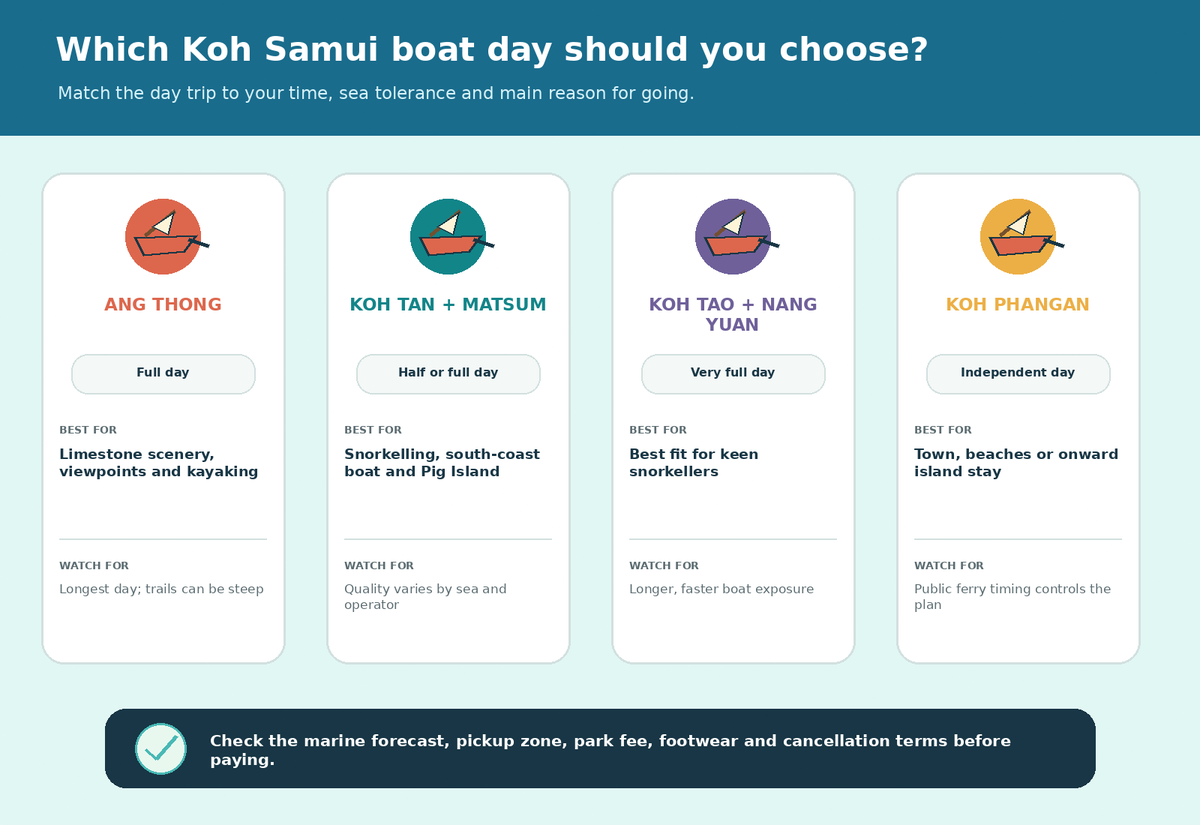
Samui is marketed as a launch point for several very different boat days. They are not interchangeable. Ang Thong prioritises karst-island scenery and viewpoints. Koh Taen and Koh Madsum offer a shorter south-coast outing. Travelling to Koh Tao and Nang Yuan demands a longer fast-boat commitment in exchange for a snorkelling-focused day. Meanwhile, Koh Phangan works better as a separate stay or a carefully chosen visit than as an automatic tick-box excursion.
| Boat day | Typical commitment | Best for | Main compromise | Choose it when |
|---|---|---|---|---|
| Ang Thong Marine Park | Usually a full day of roughly 9-10 hours | Scenery, kayaking, viewpoints and a classic first visit | Steps, boat time, park access and weather dependence | One flagship marine day is the priority |
| Koh Taen and Koh Madsum | Often around half a day, depending on pier and transfer | A shorter boat outing, beach time and light snorkelling | Animal encounter may not appeal; quality varies with tide and sea | The group wants less transit than Ang Thong |
| Koh Tao and Nang Yuan | A long full day, commonly around 10 hours | Snorkelling and travellers considering a future Koh Tao stay | Longest high-speed ride and more physical day | Everyone actively wants the water experience |
| Koh Phangan | Varies by ferry and purpose | A specific event, beach or onward island stay | Day-trip timing can be shaped by ferry schedules | There is a clear reason beyond “another island” |
Choose Ang Thong for the most distinctive landscape
For most first-time visitors who can manage the vessel and walking involved, Ang Thong is the strongest single boat choice. The official national-park material describes a protected archipelago rather than one beach stop.[14] Current speedboat and larger-boat examples both occupy most of a day, which is why the itinerary gives the trip its own morning-to-evening slot.[15][16]
Choose Koh Taen and Madsum for a shorter commitment
The south-coast option is easier to combine with a slow morning or early dinner, particularly for travellers already staying near Lamai, Taling Ngam or the south. Nevertheless, the road transfer to Thong Krut can make a “short” boat trip a long outing from Maenam or Choeng Mon. Ask for the complete pickup-to-drop-off duration before comparing only hours on the water.
Choose Koh Tao only when the long ride is worth it
A current Koh Tao and Nang Yuan excursion example is a ten-hour programme with snorkelling, lunch, pickup details, park-fee information and health restrictions.[22] It can be memorable for confident swimmers and keen snorkellers. By contrast, a traveller who mainly wants a scenic boat day may prefer Ang Thong, while someone who intends to dive for several days should consider staying on Koh Tao rather than commuting from Samui.
Three questions that prevent the wrong boat booking
- Would the group still choose this trip if the most photographed viewpoint, beach or animal stop were unavailable?
- Can every traveller manage the boarding, ride, steps, heat and water activity described by the actual operator?
- Does the day still leave a safe margin before the next flight, ferry or non-refundable booking?
Samui has no island-wide rail system. Transport decisions therefore shape the budget and the number of places that fit comfortably into a day. Taxis and app-based cars are useful but can be expensive for repeated cross-island journeys. Songthaews can work on common routes, although they are not a guaranteed timetable service. Rental cars provide independence, while scooters carry the greatest safety and insurance exposure.
| Transport | Useful for | Planning range | Advantages | Checks before relying on it |
|---|---|---|---|---|
| Pre-booked airport or pier transfer | Arrival, departure and remote resorts | Roughly 400-1,500 THB by distance and vehicle | Known pickup and suitable luggage space | Exact terminal, flight/ferry number, waiting rule and child seat |
| Taxi or app-based car | Dinners and one-way local trips | Often 300-1,200 THB depending on coast and demand | Door-to-door and no parking | Price before departure and return availability |
| Songthaew | Daytime travel along common coastal roads | Often tens to a few hundred baht; agree before boarding | Lower cost and simple for flexible travellers | Route, destination, price and whether it is still operating late |
| Private driver | Island loop, families and mixed mobility | Often about 2,500-4,500 THB per vehicle/day | Flexible stops and one known vehicle | Hours, route, overtime, language, guide status and inclusions |
| Rental car | Multi-day exploration and remote accommodation | Often about 900-1,800 THB/day plus fuel and cover | Independence and weather protection | Licence, insurance, deposit, excess, damage record and parking |
| Scooter | Short local journeys for experienced legal riders | Often about 200-400 THB/day plus fuel and cover | Cheap, nimble and widely available | Correct licence, insurance, helmet, road skill, rain and night riding |
The scooter decision deserves more than a price comparison
The Tourism Authority of Thailand specifically warns that motorbike accidents occur frequently on Samui and advises visitors to use helmets, avoid alcohol and ride defensively.[1] The FCDO also stresses the high level of road risk in Thailand and the need for the correct licence and insurance.[11] A rental shop handing over a scooter does not prove that the traveller is legal, insured or competent to use it.
Do not leave a passport as casual security when another documented deposit arrangement is available. Photograph the vehicle, tyres, mirrors and existing damage. Read the excess and exclusions. More importantly, choose a car, driver or taxi when rain, luggage, children, alcohol, darkness or inexperience makes the scooter unsuitable.
How to price accommodation transport honestly
Before booking a remote hotel, make a small transport worksheet. Add the airport or pier transfer, two evening returns, one day-trip pickup surcharge and one flexible taxi. A room that is 1,000 THB cheaper per night can lose that advantage quickly when every meal requires a car. Conversely, a secluded resort can be excellent value when the traveller genuinely expects to eat, swim and relax there.
Samui can be visited on a moderate budget, but it is rarely Thailand’s cheapest beach destination. The two expenses that move the total fastest are the accommodation coast and transport between coasts. A direct flight and resort transfer can cost more than a mainland chain, while a remote villa can create several unexpected taxi journeys.
Daily planning ranges per person
| Travel style | Accommodation share | Food and drinks | Local transport | Activities | Typical daily total |
|---|---|---|---|---|---|
| Budget-conscious | 700-1,500 THB | 500-900 THB | 150-500 THB | 0-1,200 THB | 1,350-4,100 THB |
| Comfortable mid-range | 1,500-3,500 THB | 900-1,800 THB | 400-1,000 THB | 500-2,500 THB | 3,300-8,800 THB |
| Higher-comfort resort | 3,500-8,000+ THB | 1,500-3,500+ THB | 700-2,000 THB | 1,000-4,000+ THB | 6,700-17,500+ THB |
A five-day example for two people
| Expense | Budget-conscious pair | Comfortable pair | What changes the figure |
|---|---|---|---|
| Four hotel nights | 5,600-12,000 THB | 12,000-28,000 THB | Season, coast, room type, breakfast and cancellation |
| Food and non-alcoholic drinks | 4,000-7,200 THB | 7,200-14,400 THB | Resort dining versus local restaurants |
| Island transport | 2,000-5,000 THB | 4,000-9,000 THB | Remote hotel, private driver and evening taxis |
| Ang Thong or main boat day | 3,600-7,000 THB | 5,000-10,000 THB | Vessel, park fee, transfer and private option |
| Other activities | 0-3,000 THB | 2,000-7,000 THB | Cooking, spa, island loop and south-coast boat |
| Planning total on Samui | 15,200-34,200 THB | 30,200-68,400 THB | Before travel to and from the island |
Where the cheapest decision becomes expensive
- Buying separate mainland tickets with no delay margin, then losing the final ferry or onward flight.
- Choosing a remote resort without pricing dinner transport and day-trip pickup surcharges.
- Booking the lowest boat fare without checking park fees, hotel pickup, vessel type and cancellation terms.
- Hiring a scooter without suitable licence, insurance or experience because one taxi looks expensive.
- Paying for two full-day boat trips before seeing the marine forecast or testing motion tolerance.
The site’s Thailand travel budget guide helps place Samui inside a longer-country budget. For transport chains, compare the time and risk as well as the ticket total in the transport in Thailand guide.
No month guarantees a dry or calm holiday. Samui’s Gulf setting also means its seasonal pattern does not always match Phuket or Krabi. Long-term climate averages help with broad planning, while the seven-day forecast and marine outlook should control the actual itinerary.[26]
| Broad period | Typical planning character | Itinerary approach | What not to assume |
|---|---|---|---|
| January to March | Often popular for drier beach conditions, with variable sea days | Book key rooms early and keep the boat day movable | Every day will be cloudless |
| April to June | Hot, humid and capable of sharp showers | Start active land days early; build shade and water breaks | Midday sightseeing will feel comfortable |
| July to September | Useful Gulf-island period for many travellers, still with showers and rough spells | Use live forecasts and preserve one switchable day | A favourable season removes marine risk |
| October to December | Greater rain and rough-sea risk, particularly around the late-year monsoon | Prioritise flexible rates and strong indoor or land alternatives | Every park route and ferry will operate normally |
Why a normal weather app is not enough for Ang Thong
A phone forecast may show a shower symbol for the whole island. That does not explain wave height, thunderstorms along the route, visibility at a viewpoint or whether the operator can use the planned landing. The Thai Meteorological Department publishes a specific marine forecast as well as a seven-day regional outlook.[8][9] Read both, then follow the licensed operator and official park decision.
A three-stage weather check
- Seven days before: check the broad regional trend and preserve flexibility rather than cancelling from one icon.
- The evening before: read the marine outlook, check the tour message and prepare both Day 3 and Day 4 plans.
- The morning of travel: follow the operator’s live instruction and do not pressure staff to sail when conditions are unsuitable.
Seasonal park access can differ by place and activity
Thailand’s park system uses seasonal and temporary closures for safety and ecological recovery, and the Department of National Parks publishes location-specific information rather than one national rule.[7][23] Check Ang Thong directly because a general statement that “Thailand’s parks are open” does not guarantee a particular viewpoint, kayak route, beach or landing.
For country-wide timing, monsoon differences and regional trade-offs, use the site’s best time to visit Thailand guide. The practical packing consequences are covered in the Thailand packing list.
A useful Samui day bag solves three different problems: sun and heat, sudden rain, and water exposure. It should also work at a temple without requiring an outfit change in a car park. Pack light enough that the bag remains manageable on a boat or songthaew.
| Item | When it earns its space | Buying advice | Skip or reconsider when |
|---|---|---|---|
| Small dry bag | Ang Thong, longtail trips and wet transfers | Choose a roll-top size that is easy to carry and do not treat it as a diving case | The only planned water activity is the hotel pool |
| Waterproof phone pouch | Splash protection and keeping a ticket or note dry | Test the seal with tissue before travel; use a separate camera solution underwater | The product is damaged, cloudy or lacks a secure lanyard |
| Compact power bank | Long tour days, maps and e-tickets | Check airline cabin-baggage rules and carry a short cable | The device is swollen, damaged or unlabelled |
| Shoes with grip | Waterfall approaches, viewpoints and wet piers | Prioritise tread and secure fit over fashion | The itinerary is entirely flat and resort based |
| Packable rain layer | Open vehicles, ferry queues and sharp showers | Choose breathable coverage and keep it accessible | A disposable poncho will be bought and discarded repeatedly |
| Temple layer | Big Buddha, Wat Plai Laem and other sacred places | Carry an opaque shoulder-and-knee layer that stays in place | A thin beach wrap becomes transparent or slips |
Boat-day packing list
- Reef-conscious sun protection that meets the operator or park’s current rules, plus a hat and covering layer.
- Water, any permitted personal medication, motion-sickness plan and a small amount of dry clothing.
- Cash for a clearly disclosed park or island fee, while avoiding unnecessary valuables.
- Swimwear, quick-drying towel if not supplied, and footwear suitable for the stated landing and viewpoint.
- A screenshot of the booking, pickup point, emergency contact and return details.
Families with babies or young children
The easiest family version uses one base, a pre-booked arrival transfer, a private or small-group land day and no more than one major boat day. Ask hotels for the exact cot, bed layout, pool barrier, balcony arrangement and transfer seat. For tours, confirm the child-size life jacket, shade, toilet, boarding method, nap practicality and minimum age rather than relying on a generic “family friendly” label.
Teenagers and mixed-interest families
Teenagers may enjoy snorkelling, kayaking and busy Chaweng more than a full temple circuit. Let each person choose one anchor. A practical compromise is a shorter island loop, a proper lunch and a beach stop, followed by Ang Thong only when everyone accepts the early start and boat time.
Solo travellers
Bophut, Chaweng and central Lamai reduce the need to negotiate every evening journey. Shared tours can also make the land and boat days easier. Nevertheless, send the day plan to someone, keep the hotel card, protect drinks and arrange the journey home before becoming tired. The FCDO safety guidance includes current warnings about drink spiking, methanol, scams and road risk.[11]
Travellers with limited mobility or low confidence in water
Ask for specifics: number of steps, gradient, transfer vehicle, pier surface, boarding method, toilet access, flotation equipment and whether the traveller can remain on the boat during an optional hike. One current private island-tour listing is marked wheelchair accessible, but that label must still be checked against the exact vehicle and stops.[17] Ang Thong’s viewpoints and boat transfers may be unsuitable even when a hotel is accessible.
Serious allergies and dietary restrictions
A vegetarian meal option does not prove that a tour can prevent allergen cross-contact. Contact the provider before booking, carry translated information and keep prescribed medication accessible. Ask what food is prepared, where it is stored and whether the staff can manage the specific risk. For a cooking class, confirm ingredients and shared equipment rather than assuming hands-on instruction is safer.
Diving and flying home
A traveller adding scuba diving should protect the final flight. Divers Alert Network recommends minimum pre-flight surface intervals that vary with a single no-decompression dive, repetitive diving and multi-day diving.[25] Follow the dive professional and current medical guidance for the actual profile; do not place a dive on the last morning merely because the airport is nearby.
| Advantages | Limitations |
|---|---|
| One hotel base avoids losing time to an unnecessary move. | The plan does not attempt every beach or viewpoint. |
| The island loop and Ang Thong provide two genuinely different active days. | Ang Thong remains vulnerable to weather, park and operator changes. |
| Day 4 can absorb a cancelled boat day or tired travellers. | A flexible day can feel under-planned to people who prefer fixed reservations. |
| Day 5 protects a flight, mainland chain or Gulf-island ferry. | The final morning is intentionally light rather than attraction-heavy. |
| Area and transport choices are treated as part of the itinerary. | Remote resort stays still require extra taxi planning. |
| The route works without hiring a scooter. | Private drivers and taxis can increase the budget. |
Choosing a hotel by island name alone
Samui is large enough that the coast changes dinner, taxi, airport and day-trip logistics. Check the exact map pin and walking route.
Counting only the ferry crossing
A mainland arrival also includes the airport or station transfer, pier check-in, island arrival and final hotel journey.
Booking Ang Thong on the last usable day
A cancellation then has nowhere to move and may conflict with the onward flight or ferry.
Treating every boat trip as equivalent
Ang Thong, Koh Taen, Koh Tao and Koh Phangan have different journey lengths, purposes and physical demands.
Planning a complete island lap in half a day
The result is usually a sequence of car parks and photographs, with little time at any stop.
Assuming “beachfront” means flat and direct
Some resorts sit on hills, across roads or above small coves. Confirm the room-to-beach route.
Renting a scooter because taxis cost more
Licence, insurance, road experience and conditions matter more than the day rate.
Ignoring the return journey from a remote sunset
Pre-book the car or dine where the hotel can arrange a reliable return.
Trusting a generic weather icon
Marine forecasts, operator decisions and park access determine offshore trips.
Filling the flexible day in advance
The spare day is what protects the plan from rough sea, heavy rain, illness or fatigue.
Using the wrong Samui pier
Nathon, Lipa Noi and high-speed piers are not interchangeable. Follow the ticket, not an old map pin.
Placing diving before a flight
Keep the required surface interval for the actual dive profile and current professional guidance.
How many days do you need in Koh Samui?
Five days is a strong first visit because it allows one island sightseeing day, one major boat day, real beach time and a protected departure. Four days works with fewer optional activities, while seven days gives better weather flexibility.
Is five days in Koh Samui too long?
No. The island has distinct coasts, beaches, villages and day trips. Five days only feels long when the accommodation area is a poor match or every day is spent travelling across the island.
Where should a first-time visitor stay in Koh Samui?
Bophut is a balanced first base, Chaweng suits nightlife and convenience, Lamai combines beach and a slower resort town, while Maenam and Choeng Mon suit calmer stays. West- and south-coast resorts work best when seclusion is intentional.
Can you follow this Koh Samui itinerary without a scooter?
Yes. Use a pre-booked arrival transfer, taxis or app-based cars for local trips, and a shared tour or private driver for the island loop. This may cost more than scooter hire but avoids relying on a vehicle that does not match the traveller’s licence, insurance or experience.
Is Ang Thong Marine Park worth visiting from Koh Samui?
For many first-time visitors, yes. It provides the most distinctive archipelago scenery and can include kayaking, snorkelling or a viewpoint. The day is long and weather dependent, so vessel type, mobility, park access and cancellation terms matter.
Which is better from Koh Samui: Ang Thong or Koh Tao?
Choose Ang Thong for scenery, islands and a classic marine-park day. Choose Koh Tao and Nang Yuan when snorkelling is the central goal and everyone accepts a longer fast-boat journey. Dedicated divers may gain more by staying on Koh Tao.
Can you visit Koh Phangan as a day trip from Koh Samui?
It is possible on suitable ferry timings, but the trip needs a clear purpose and careful pier planning. For beaches, events or several activities, an overnight stay is often more satisfying than fitting the island around the return ferry.
What is the cheapest way to reach Koh Samui?
A mainland flight, train or bus combined with a transfer to Donsak and a ferry can cost less than a direct Samui flight. Compare the full chain, baggage, final hotel transfer and delay risk rather than the crossing fare alone.
Which airport serves Koh Samui?
Samui Airport is on the island in Bophut. Travellers can also use mainland Surat Thani connections followed by road and ferry transfers, but that route takes materially longer door to door.
Do Koh Samui ferries all arrive at the same pier?
No. Donsak services commonly use Nathon or Lipa Noi depending on the operator, while high-speed Gulf services may use other Samui piers. Use the exact terminal shown on the live ticket.
What is the best month for Koh Samui?
There is no universally best month. January to March is popular, while July to September can suit Gulf-island travel. Late-year rain and rough sea can be more disruptive. Check long-term patterns for planning and live forecasts for the actual itinerary.
Is Koh Samui suitable for families?
Yes, particularly with one base, a suitable room, a pre-booked transfer and a slower rhythm. Confirm pool barriers, cot or bed layout, child-size life jackets, shade, toilets and tour age restrictions.
How much spending money is needed for five days in Koh Samui?
A pair might plan roughly 15,200-34,200 THB for a budget-conscious on-island stay or about 30,200-68,400 THB for comfortable mid-range travel, before reaching and leaving Samui. Season, hotel coast, taxis and boat choices can move the total significantly.
Should the Ang Thong tour be booked before arriving?
During busy periods, booking ahead can secure the preferred vessel and date. Choose a flexible cancellation policy and keep the following day movable because marine conditions and park access can change.
What should you wear to Koh Samui temples?
Wear clothing that covers shoulders and knees, remove shoes where requested and keep beachwear covered. Carry a light opaque layer so the island loop can include both temples and the beach respectfully.
Can you drink tap water in Koh Samui?
Use sealed bottled water or a properly maintained refill source for drinking. Hotels can explain their filtered-water system. On tours, confirm whether drinking water is included and carry enough for heat and delays.
What emergency numbers should travellers save in Thailand?
Tourist Police is 1155, police emergency is 191 and medical emergency is 1669. Save the hotel address and travel-insurance assistance details as well.
Can you scuba dive on the final day before flying?
Do not assume so. Required surface intervals depend on the dive profile and current professional guidance. Plan diving earlier in the trip and confirm the safe pre-flight interval with the dive operator and appropriate medical guidance.
For a first visit, I would stay in Bophut, Choeng Mon, central Lamai or a carefully chosen part of Chaweng, depending on the preferred evenings. Day 1 would remain local. Day 2 would use a driver or small tour for temples, Lamai and one nature stop. Ang Thong would sit on Day 3 with Day 4 protected as the swap day. The fourth day would then become a beach, cooking or short south-coast day, while Day 5 would contain only breakfast, a swim and the onward transfer.
That schedule deliberately leaves several famous beaches unseen. It also avoids spending half the holiday crossing the island for isolated recommendations. The aim is not to prove that five days can contain everything. It is to finish with a clear sense of Samui, enough unhurried time to enjoy the chosen coast and a departure that does not depend on every earlier step running perfectly.
This guide was fact-checked on 6 September 2026. Official sources are prioritised for destination context, transport, weather, national-park access, safety and emergency information. Commercial operator pages are used only as current examples of tour format, duration, restrictions and inclusions; they are not treated as universal rules.
Core destination and national-park references
- Tourism Authority of Thailand: Ko Samui destination guide. Official destination overview, beach areas, Bophut context, activities and motorbike-safety advice.
- Tourism Authority of Thailand: Ko Samui–Surat Thani four-day route. Official itinerary context for Ang Thong, Big Buddha, Hin Ta and Hin Yai, Lamai and wider Surat Thani.
- Department of National Parks: opening and closure dataset. Official dataset explaining that park areas and activities can have different seasonal closure conditions.
- Tourism Authority of Thailand: Thailand in September. Official seasonal context highlighting Gulf of Thailand travel during September.
- Tourism Authority of Thailand: 15 Koh Samui check-ins. Official Thai-language inspiration covering Koh Taen, Fisherman’s Village, Nathon and west-coast sunset areas.
- Department of National Parks: Mu Ko Ang Thong National Park. Official park geography, protected island group, visitor facilities and current park contact context.
- TAT Newsroom: annual seasonal opening and closure of national-park attractions. Official explanation that park attractions may close seasonally or temporarily for safety and ecological recovery.
Weather, safety and traveller-health references
- Thai Meteorological Department: marine forecast. Official marine forecast and thunderstorm or wave warnings for voyage decisions.
- Thai Meteorological Department: seven-day forecast. Official regional outlook used to support the movable boat-day method.
- Tourist Police Thailand. Official Tourist Police 1155 and national emergency-number references.
- UK FCDO: Thailand safety and security. Current UK travel guidance covering road safety, drink safety, scams and appropriate insurance.
- Thailand.go.th: essential tourist assistance contact numbers. Official police, medical, Tourist Police, tourism-information and disaster-warning contacts.
- Divers Alert Network: flying after diving. Established guidance on pre-flight surface intervals after single, repetitive or multi-day diving.
- Thai Meteorological Department: 1991-2020 climate atlas. Long-term monthly rainfall and temperature context; climate averages do not predict a particular travel day.
Commercial transport examples
- Bangkok Airways: Bangkok to Koh Samui route guide. Current operator guidance for the direct Bangkok–Samui flight and mainland alternatives.
- Seatran Ferry live trip list. Live Donsak–Nathon journey-duration and passenger-fare listings checked for 2026.
- Raja Ferry Port: Donsak–Koh Samui fare table. Official published passenger and vehicle fare reference.
- Lomprayah: 2026 timetable. Official 2026 high-speed ferry timetable hub for Samui, Phangan, Tao and Nang Yuan.
Commercial activity and tour examples
- GetYourGuide: Ang Thong speedboat day tour. Current product example for a nine-hour speedboat day, activities, pickup zones and suitability restrictions.
- Viator: Ang Thong big-boat day tour. Current product example for a nine-to-ten-hour big-boat itinerary and separately collected park fee.
- GetYourGuide: private guided island tour. Current six-hour private island-tour example, including wheelchair-accessible listing information.
- GetYourGuide: private 4×4 tour. Current private 4×4 example covering temples, viewpoints, waterfall and interior routes.
- Viator: custom private Koh Samui sightseeing. Current custom route example used to compare a licensed guide with a driver-only service.
- Viator: Koh Samui cooking classes. Current class listings used for duration, format and dietary-confirmation checks.
- GetYourGuide: Pig Island private longtail tour. Current four-hour private longtail example for Koh Madsum and Koh Taen, with pickup and fee details.
- GetYourGuide: Koh Tao and Nang Yuan day tour. Current long speedboat-day example, pickup, snorkelling, park fee and suitability restrictions.
Illustrations in this article were created for Taylor’s Trailblazing Travels. Third-party photographs, where used, are credited beside the image or in the source list.
About Karen Taylor
Karen Taylor created Taylor’s Trailblazing Travels to turn complicated Thailand research into practical, realistic trip plans. Her guides compare routes, timings, costs, booking choices and likely trade-offs using current official information and clearly labelled planning estimates. She does not claim to have personally visited every place covered; recommendations are based on careful research, cross-checking and traveller-focused analysis.