Northern Thailand itinerary
Four days is enough to understand Chiang Mai without turning the visit into a queue of pickups. This plan keeps the Old City, Doi Suthep, modern neighbourhoods and one full mountain or countryside day separate, so transfer time is visible rather than hidden.
Affiliate disclosure
This guide contains selected affiliate links. Taylor’s Trailblazing Travels may receive a commission at no extra cost to you. Links appear only where they help with a specific transport, day-trip or connectivity decision.
A first Chiang Mai itinerary often goes wrong in one of two ways. Some plans treat the city as a two-night pause between Bangkok and the islands, then squeeze temples, Doi Suthep and Doi Inthanon into one exhausting day. Others reserve a week but fill every morning with a distant pickup, which leaves little time for the food, neighbourhoods and unhurried atmosphere that make Chiang Mai appealing.
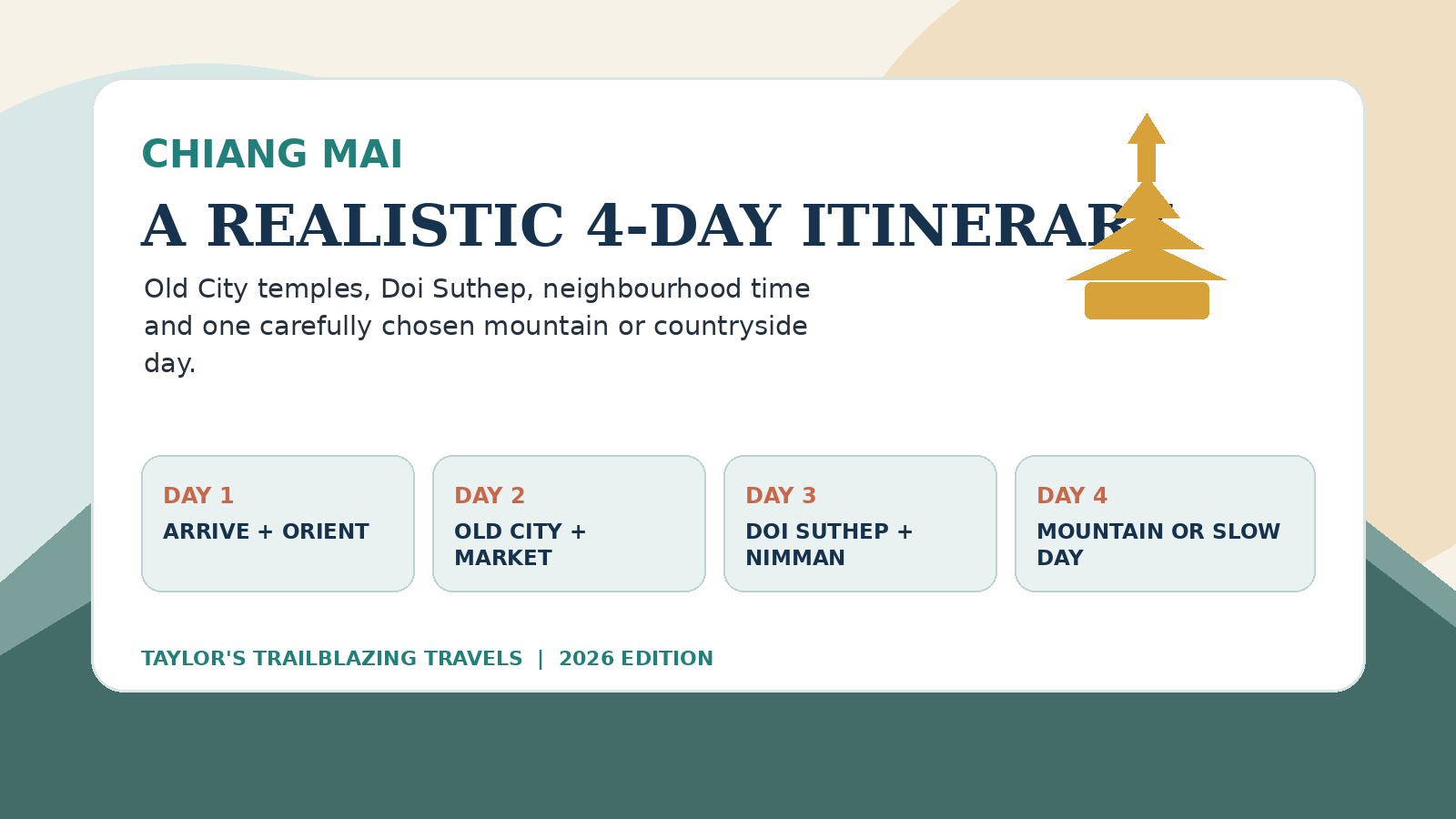
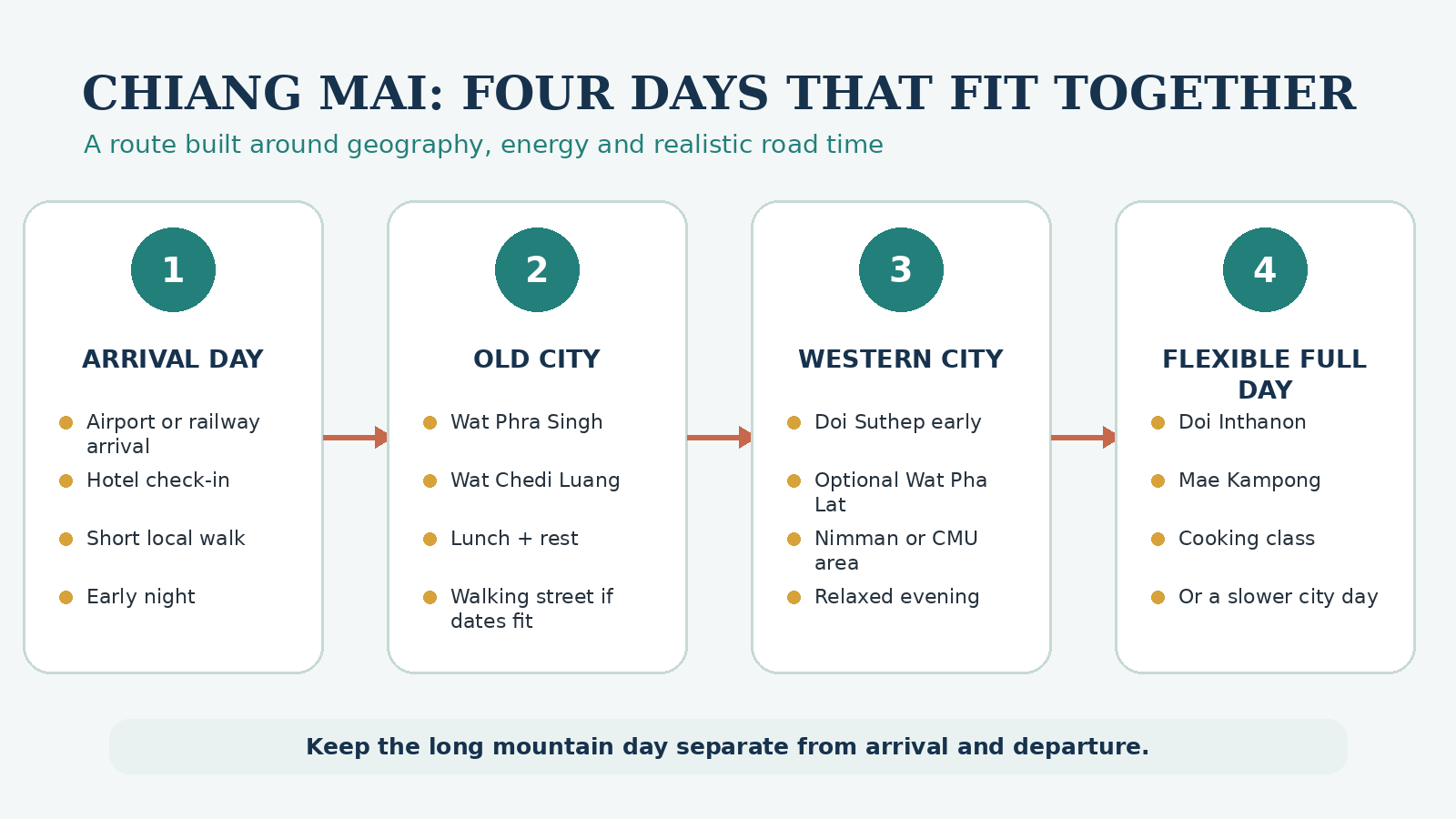
This four-day version sits between those extremes. The first day is an honest arrival day. The second stays inside and around the Old City. On Day 3, the route uses western Chiang Mai for Doi Suthep and Nimman. Finally, Day 4 is protected for one major choice: Doi Inthanon, Mae Kampong, a carefully assessed animal-welfare experience, a cooking class or a slower city day. The Tourism Authority of Thailand highlights exactly this mix of Doi Suthep, the walking streets, Nimman, Doi Inthanon and Mae Kampong, which is why the route combines Lanna culture with neighbourhood and mountain time rather than treating the destination as only a temple checklist. [1]
Nevertheless, the calendar matters. A Sunday market cannot be moved to Tuesday, a mountain view cannot be guaranteed in cloud, and the northern smoke period can make a beautiful itinerary unsuitable for someone with asthma or young children. Therefore, this guide explains what to book, what to keep flexible and what to replace when conditions change.
What is the best four-day Chiang Mai itinerary?
For a first visit, the best four-day Chiang Mai itinerary uses Day 1 for arrival and a local evening, Day 2 for Old City temples and a market, Day 3 for Doi Suthep plus Nimman, and Day 4 for Doi Inthanon, Mae Kampong, a cooking class or a slower city day. Stay on the Old City edge for the easiest first visit, keep the mountain day flexible for weather, and check Air4Thai before committing to northern Thailand in the late dry-season haze period.
Chiang Mai itinerary: quick answers
Ideal time
Four days and four nights, or three full days plus a useful arrival evening.
Recommended first base
The Old City edge, especially when walkable temples and simple day-trip pickups matter.
Ideal mountain day
Doi Inthanon for nature and waterfalls; Mae Kampong for a gentler village-focused day.
Market timing to know
Saturday on Wua Lai Road or Sunday around Tha Phae and Ratchadamnoen when dates align.
Working daily budget
About 1,500-3,500 baht per person excluding accommodation, with the day trip creating the largest swing.
Biggest planning risk
Booking non-refundable mountain activities before checking weather, smoke and arrival energy.
Four-day Chiang Mai itinerary at a glance
First, the timetable below assumes four hotel nights. If the first flight lands after 19:00, treat Day 1 as dinner and sleep rather than borrowing hours from Day 2. Likewise, an early departure on Day 5 removes the option of placing a long mountain tour on the final afternoon.
| Day | Main plan | Suggested timing | Why it works | Sleep |
|---|---|---|---|---|
| 1 | Arrive, check in, explore close to the hotel and eat nearby | Arrival dependent | Protects energy and avoids attaching a booking to a delayed flight or train | Chiang Mai |
| 2 | Wat Phra Singh, Wat Chedi Luang, lunch, rest and a walking market when dates fit | 08:00-21:30 | Keeps the heritage sights inside one walkable area | Chiang Mai |
| 3 | Doi Suthep, optional Wat Pha Lat, then Nimman or the university area | 07:30-20:00 | Uses the western side of the city instead of crossing it repeatedly | Chiang Mai |
| 4 | Doi Inthanon, Mae Kampong, a cooking class or a slower city day | 07:00-18:30 for long trips | Leaves one full day for a weather-dependent choice | Chiang Mai |
Karen’s pacing rule
Above all, count long pickups rather than attractions. For example, one full-day mountain trip, one half-day mountain temple and one city walking day is a balanced four-day visit. By contrast, Doi Inthanon, Chiang Rai and an elephant venue on three consecutive days produces a holiday built around vans, not Chiang Mai.
Moreover, leave at least one evening uncommitted. Likewise, a late lunch, rainstorm, massage or simple decision to stay for another bowl of khao soi should not feel like a scheduling failure.
Is four days in Chiang Mai enough?
Four days is enough for a first visit when the city is part of a wider Thailand route. It covers the Old City, Doi Suthep, a modern neighbourhood and one significant day outside the centre. That is also why the site’s Thailand two-week itinerary allocates four Chiang Mai nights rather than pretending a transfer day is a complete sightseeing day.
Choose three days when
- Chiang Mai is one stop in a short Bangkok-and-beach holiday.
- You are happy to remove Doi Inthanon or Mae Kampong.
- Your arrival is early enough to create a useful first afternoon.
- You prefer a focused city break to several day trips.
Choose five days when
- You want both Doi Inthanon and Mae Kampong without consecutive long road days.
- A cooking class, craft workshop or carefully screened elephant experience matters.
- You are travelling with children, older relatives or anyone who benefits from a recovery day.
- You are visiting during the rainy season and want flexibility to move the mountain day.
Meanwhile, six or seven days can work for slow travellers, remote workers and food-focused visitors. However, the extra time should create quieter mornings and local exploration, not justify a daily excursion.
What to decide before booking this Chiang Mai itinerary
Count the first day honestly
For example, an arrival at 09:00 and an arrival at 20:30 are not the same Day 1. Next, add airport or station exit time, the transfer, hotel luggage storage and a meal before deciding what remains. In practice, a late arrival should contain no timed attraction, while an early arrival can support a gentle Old City walk after a rest.
Place the walking markets on the correct date
Similarly, the Tourism Authority of Thailand identifies Tha Phae Walking Street as a Sunday event running into Ratchadamnoen Road towards Wat Phra Singh. [2] Therefore, move the Day 2 evening to Sunday when possible. Saturday visitors can use the Wua Lai walking street instead, while weekday travellers should choose the Night Bazaar, a food market or a neighbourhood dinner rather than forcing a weekend-only plan.
Keep the mountain day movable
By contrast, Doi Inthanon and Mae Kampong involve substantial road time. Moreover, low cloud can erase the long views, heavy rain can affect paths and waterfalls, and holiday traffic can make a village day less peaceful. Consequently, place the trip on whichever full day has the better forecast rather than treating Day 4 as immovable.
Make an air-quality decision, not a mask decision
Most importantly, late dry-season haze is a route-level issue. Therefore, the Pollution Control Department’s Air4Thai service provides live readings, while the Thai Meteorological Department links current PM2.5 information from its weather pages. [6] [9] The 2026 smoke period was severe enough to disrupt tourism and reduce visibility, which reinforces the value of refundable hotels and tours during March and April. [11]
Moreover, fine-particle pollution is a health concern rather than merely a photography problem; the World Health Organization links particulate exposure with cardiovascular and respiratory harm. [10] Therefore, travellers with asthma, heart or lung conditions, pregnancy, young children or other vulnerabilities should seek medical advice and be willing to replace northern Thailand when readings are poor.
Screen wildlife experiences carefully
However, do not treat the word “sanctuary” as a welfare certificate. In particular, avoid rides, tricks, performances, forced bathing and programmes built around constant touching. Instead, look for observation-led visits, transparent rescue histories, suitable space, limited group size and clear rules that put the animal’s behaviour before the visitor’s photograph. If the answers are vague, choose a cooking class or nature day.
Arrange mobile data before you need the pickup point
Finally, mobile data is useful at Chiang Mai Airport, at ride-app pickup points, for maps and for last-minute tour messages. Nevertheless, download hotel details and offline maps as a backup because mountain coverage and battery life are not guaranteed.
Optional eSIM before arrival
Airalo can be useful for travellers with an unlocked, eSIM-compatible phone who want data ready when they land. Compare the live Thailand plan, data allowance, validity, hotspot rules and activation instructions before purchase.
Check current Airalo Thailand eSIM optionsBook in this order
- Confirm the international or domestic arrival time and the Chiang Mai departure time.
- Choose a hotel area that fits the Old City and day-trip plan.
- Secure Bangkok-Chiang Mai transport when dates are fixed, especially sleeper berths.
- Reserve one high-priority mountain or countryside day with a useful cancellation window.
- Leave ordinary restaurants, massages, cafes and most city transport flexible.
Getting to Chiang Mai: flight, sleeper train or bus
Most first-time visitors arrive from Bangkok. A flight protects holiday time, while an overnight train turns the transfer into part of the experience. Alternatively, a VIP bus is the fallback when rail is sold out, the terminal suits the route or price matters more than sleep quality. For a complete countrywide comparison, read the site’s Transport in Thailand guide.
| Option | Vehicle time | Realistic door-to-door block | Main advantage | Main trade-off |
|---|---|---|---|---|
| Flight | About 1 hour 10-25 minutes in the air | About 4.5-6 hours | Protects most of a day | Airport transfers, baggage and check-in add cost and time |
| Overnight train | Roughly 12-14 hours depending on service | Evening to morning plus station transfers | Memorable journey and may save a hotel night | Sleep quality, availability and berth choice vary |
| VIP or premium bus | Roughly 9.5-11.5 hours | About 10.5-12.5 hours | Useful when trains are sold out | Operator, seat, terminal and sleep comfort matter |
Therefore, compare the actual station or airport, not only the city names. Bangkok flights can use BKK or DMK, long-distance trains usually use Krung Thep Aphiwat, and buses may leave from Mo Chit 2 or a private terminal. Likewise, confirm whether a ticket is refundable and whether checked baggage is included.
Compare the exact Bangkok-Chiang Mai date
12Go places train, bus and flight options on one route page. Use it to compare departure points and total journey length, then read the operator terms and confirm the final price before paying.
Compare Bangkok-Chiang Mai transportArrival-day recommendation
For example, choose a morning flight when the trip is short and Day 1 matters. By contrast, choose the sleeper when the journey itself appeals and the following morning can stay gentle. However, do not book a 07:30 cooking class or mountain pickup immediately after an overnight train; a delayed arrival or poor sleep can ruin both the booking and the day.
Best areas to stay in Chiang Mai for this itinerary
In practice, for four days, location is worth more than a long hotel facilities list. The Old City edge is the safest first-time choice because it supports the Day 2 walk and remains practical for tour pickups. Meanwhile, Nimman suits travellers who value cafes and nightlife, while the east side of the moat works well for markets and the Night Bazaar. By contrast, riverside properties can feel calmer but create more short rides.
| Area | Best for | Transport access | Advantages | Trade-offs |
|---|---|---|---|---|
| Old City | First visits, temples and walking | Walk, songthaew and ride app | Best fit for Day 2 and common pickup zones | Some lanes are quiet; larger resorts are limited |
| Tha Phae / east moat | Markets, nightlife access and convenience | Walk to Old City; short ride to Night Bazaar | Balances heritage and evening activity | Busier roads and more commercial atmosphere |
| Nimman | Cafes, modern dining and nightlife | Ride app or songthaew to Old City | Strong food and evening choice; near university | Aircraft noise in parts; not walkable to every historic sight |
| Chang Klan / Night Bazaar | Hotels, shopping and evening convenience | Short rides to Old City | Wide hotel range and easy evening food | Less neighbourhood calm; main roads can feel busy |
| Riverside | Couples, resort atmosphere and slower evenings | Taxi or ride app for most sightseeing | Quieter setting and attractive hotels | Least efficient for a short temple-focused visit |
| Near the airport | Very early departure or one-night stop | Short airport transfer | Practical for a flight, not an itinerary | Weak base for a four-day first visit |
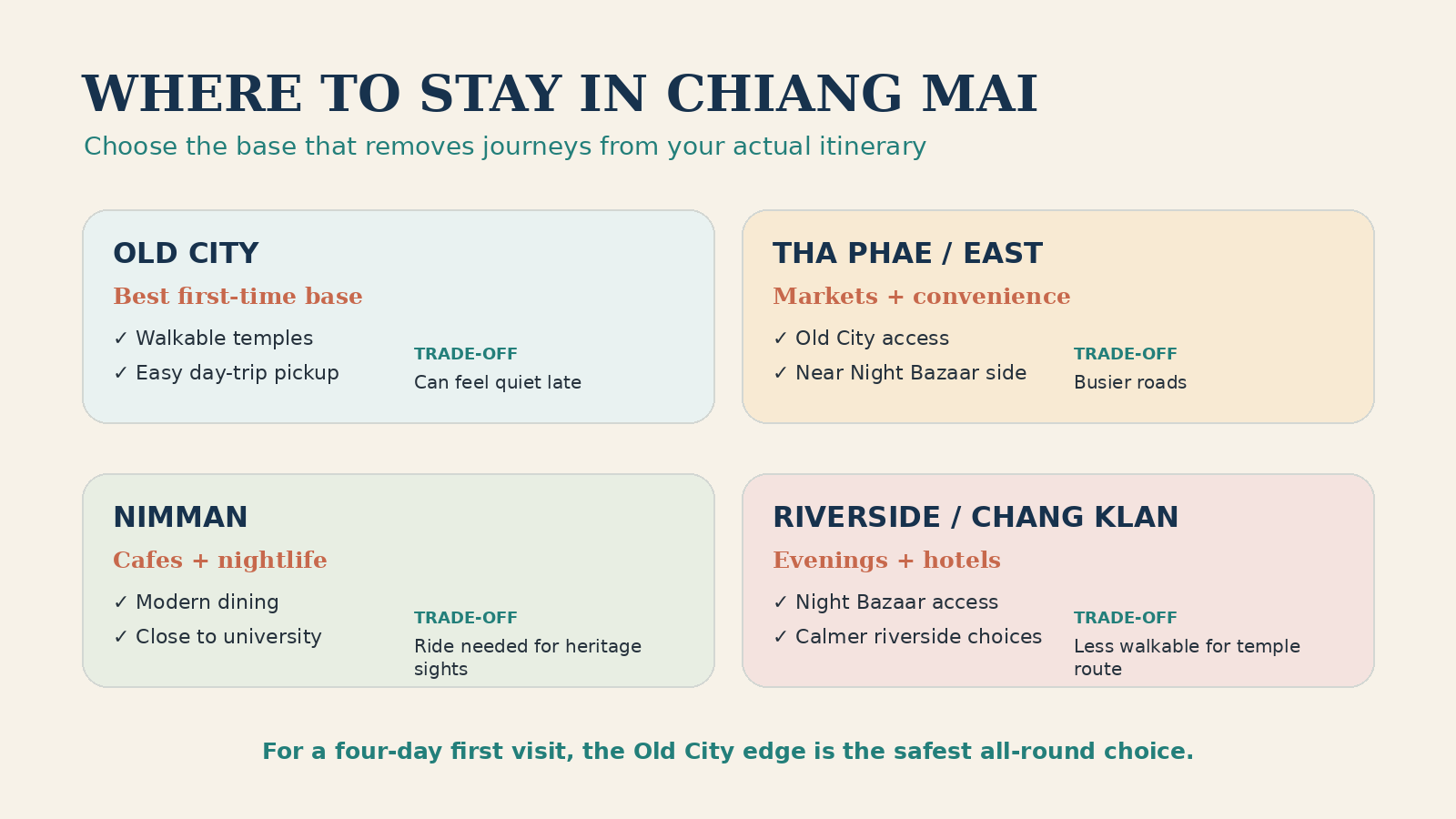
Old City edge versus inside the moat
A hotel just outside the moat can be as convenient as one inside it. For example, the north and east edges offer straightforward road access for pickups while remaining walkable to temples. Therefore, check the actual map pin and pavement route rather than assuming the words “Old City” guarantee a pleasant walk.
Questions to ask before booking
- Is the room exposed to road, bar, temple-bell or aircraft noise?
- Can the property store luggage before check-in and after checkout?
- Is the entrance accessible by a normal car or hidden down a narrow lane?
- Does the day-trip operator collect from this address or require a meeting point?
- Is breakfast useful for a 07:00 pickup, or would a room-only rate be better?
Day 1: arrive, check in and understand the city
Chiang Mai Airport to the hotel
On arrival, Chiang Mai International Airport is close to the central areas, but the best transfer depends on luggage and hotel location. Airports of Thailand lists three shuttle routes: A1 to Nimman, Huay Kaew and the city moat for 40 baht; A2 towards the Night Bazaar and Chang Klan hotel area for 40 baht; and A3 towards the 700th Anniversary Stadium for 60 baht. In addition, the airport page tells passengers to verify the live route and fare before travelling. [3]
Meanwhile, for ride apps, AOT states that Grab Taxi, Grab Car and Just Grab use designated pickup and drop-off points, with the service point listed as operating 24 hours. [4] Consequently, do not stand at an arbitrary kerb and message the driver to stop in a restricted lane.
| Transfer | Planning price | Best for | Check before using |
|---|---|---|---|
| A1 airport shuttle | 40 baht official fare | Nimman, Huay Kaew and the moat corridor | Live stop, luggage space and operating time |
| A2 airport shuttle | 40 baht official fare | Night Bazaar and Chang Klan area | Nearest safe stop to the hotel |
| A3 airport shuttle | 60 baht official fare | Second Ring Road and stadium direction | Whether it suits a visitor hotel location |
| Ride app | Price shown in the app | Door-to-door certainty and cashless payment | Designated pickup point, plate and surge price |
| Official taxi / transfer | Quote before departure | Families, late arrivals and several large bags | Destination, vehicle size and whether price is per vehicle |
If you arrive by train
Chiang Mai Railway Station lies east of the centre. A ride app, taxi, tuk-tuk or agreed songthaew is usually easier than trying to walk with luggage. Next, before leaving the station, save the hotel name in Thai and compare the quoted price with an app estimate when possible.
A simple first afternoon
Once checked in, choose one compact loop near the hotel. Old City guests can walk to a gate, temple courtyard or cafe. Nimman guests can explore the main lanes and the university side. Chang Klan guests can use the Night Bazaar area. In other words, the point is orientation: identify a convenience shop, pharmacy, breakfast option and pickup location rather than crossing the city for a “must-see”.
First-evening food plan
Start with one northern dish rather than ordering an entire tasting menu while tired. Khao soi is the obvious introduction, although sai ua sausage, nam prik ong, gaeng hung lay and simple grilled dishes are equally useful. Ask about spice and portion size, carry small cash, and choose a busy place with clear turnover rather than following a single viral recommendation across town.
Karen’s first-night test
If dinner needs two taxis and a reservation deposit, it is not a first-night plan. The best arrival meal is close enough that a delayed flight changes the time, not the whole evening.
Day 2: Old City temples, northern food and an evening market
Start early because the Old City is most comfortable before the strongest heat. TAT’s moat-area guide connects Tha Phae Gate, the Sunday walking street and Wat Phra Singh inside the historic centre. [2] However, do not attempt every temple on the map. Three meaningful stops, lunch and a proper hotel break create a better day than eight rapid entries.
08:00-09:30: Wat Phra Singh
First, begin at Wat Phra Singh on the western side of the Old City. The complex rewards time because the architecture, murals and active worship matter more than a quick exterior photograph. Dress with shoulders and knees covered, remove shoes where requested and keep voices low. A foreign-visitor fee may apply to specific buildings or areas, so carry cash and check the current sign rather than relying on an old blog.
09:45-11:15: Wat Chedi Luang
Next, walk east towards Wat Chedi Luang. The ruined chedi creates a different experience from Wat Phra Singh, while the surrounding monastic complex gives context to the Old City’s layered history. Again, check the current entry arrangement on arrival because temple charges and access areas can change.
11:30-13:30: lunch before the heat wins
Afterwards, choose lunch within the Old City and sit down properly. Midday is not the moment to add a distant cafe because it appears in a social-media reel. Instead, use the hottest hours for food, water and perhaps an air-conditioned museum or a return to the hotel.
14:30-16:30: one optional third stop
For a third stop, Wat Chiang Man suits travellers who want another historic temple. Alternatively, visit a small museum, book a massage, browse crafts or skip the third attraction entirely. The itinerary is stronger when the afternoon reflects energy rather than guilt.
17:00 onwards: match the evening to the day of the week
| Day | Best evening choice | Practical approach |
|---|---|---|
| Saturday | Wua Lai walking street | Arrive before the busiest period and agree a post-market pickup point away from closed roads |
| Sunday | Tha Phae / Ratchadamnoen walking street | Begin near one end rather than trying to cover every stall; TAT confirms it as a Sunday event |
| Monday-Friday | Night Bazaar, food market or neighbourhood dinner | Choose the option closest to the hotel and avoid pretending a weekday market is the Sunday event |
Temple etiquette that matters
- Cover shoulders and knees; a light overshirt or scarf is useful, although respectful clothing is better than a token wrap.
- Remove shoes where signs or local practice require it.
- Do not point feet towards Buddha images or climb onto sacred structures.
- Ask before photographing monks or ceremonies.
- Avoid blocking worshippers for a posed picture.
What to eat in Chiang Mai
For example, khao soi deserves a place, but the city’s food is broader than one coconut-curry noodle bowl. Try sai ua, nam prik ong with vegetables, gaeng hung lay, grilled chicken, sticky rice and seasonal fruit. Meanwhile, a market is useful for tasting small portions, although hygiene, allergies and spice still require judgement. If a stall cannot explain an ingredient you must avoid, choose another one.
Day 3: Doi Suthep, optional Wat Pha Lat and Nimman
First, Doi Suthep is the landmark mountain temple that TAT places among Chiang Mai’s headline experiences. [1] Go early for cooler air, lighter traffic and a calmer visit. Afterwards, return through the western side of the city for Nimman, the university area or a hotel rest.
07:30-10:30: Wat Phra That Doi Suthep
In practice, allow roughly 30-45 minutes each way from central Chiang Mai under ordinary conditions, then time for the staircase or funicular, the temple and the viewpoint. However, weather can hide the city, while religious events can change access. Therefore, treat the view as a bonus and the temple as the purpose.
Moreover, a small foreign-visitor entry charge and separate funicular fee may apply. Since posted figures can change, carry cash and confirm at the entrance. Dress as you would for the Old City temples, even though the mountain air may feel cooler.
Optional stop: Wat Pha Lat
Meanwhile, Wat Pha Lat sits lower on the mountain and feels more forested. It can be combined by road, while the Monk’s Trail is an option only for travellers with suitable footwear, daylight, dry-enough conditions and route confidence. The trail should not be treated as a casual city pavement; rain, heat and navigation matter.
Transport options for Doi Suthep
| Method | Best for | Advantages | Questions to settle |
|---|---|---|---|
| Shared red songthaew | Budget travellers and flexible timing | Low-cost local option when enough passengers gather | Departure point, one-way or return price, waiting time and return arrangement |
| Private songthaew | Two to six travellers | Control over departure and optional Wat Pha Lat stop | Total vehicle price, waiting time and exact stops |
| Ride app / taxi | Simple one-way or agreed return | Recorded pickup and destination | Return availability on the mountain and waiting charge |
| Guided half-day tour | Context, hotel pickup and minimal negotiation | Transport and explanation in one booking | Group size, temple fee, pickup zone and whether shopping stops are included |
| Rental scooter | Experienced, correctly licensed riders only | Flexible timing | Licence, 1968 IDP where applicable, insurance, helmet, weather and mountain-road skill |
12:00-17:00: Nimman or the university side
Later, eat and slow down around Nimman. In addition, the area is useful for contemporary cafes, design shops, galleries and modern restaurants, while the university side offers green spaces and a different rhythm from the Old City. Importantly, this is not “less authentic”; it is part of contemporary Chiang Mai, which is exactly why TAT includes Nimmanhaemin Road among the city’s major experiences. [1]
Evening choice
Keep the evening light because Day 4 may start early. A massage, neighbourhood dinner or quiet drink works better than a cross-city attraction. If Day 2 did not match a walking-street date, this evening can hold the Night Bazaar, but only when the hotel and remaining energy make the journey sensible.
Day 4: choose one full-day Chiang Mai experience
Finally, the fourth day should answer a personal question rather than repeat somebody else’s “top ten”. Do you want mountains, village atmosphere, food skills, animal observation or recovery? The correct choice changes with season, mobility and the previous three days.
| Option | Typical day | Working price per person | Best for | Main caution |
|---|---|---|---|---|
| Doi Inthanon | 10-12 hours | About 1,200-2,800 baht shared; private substantially more | Waterfalls, forest, viewpoints and Thailand’s highest mountain | Long road time, park fees, cloud, cold mornings and path conditions |
| Mae Kampong | 8-10 hours | About 1,000-2,500 baht shared; private varies | Village scenery, cafes and a gentler pace | Weekend traffic, overtourism and narrow roads |
| Observation-led elephant visit | Half or full day | Often 1,800-3,500+ baht | Travellers who have completed a welfare review | “Sanctuary” language can hide rides, tricks or forced contact |
| Cooking class | Half or full day | About 900-1,800 baht | Food, conversation and mixed-weather days | Menu, group size, allergies and pickup area vary |
| Slow city day | Flexible | About 500-2,000 baht | Rest, cafes, galleries, massage and laundry | Requires confidence to ignore the urge to “use” every hour |
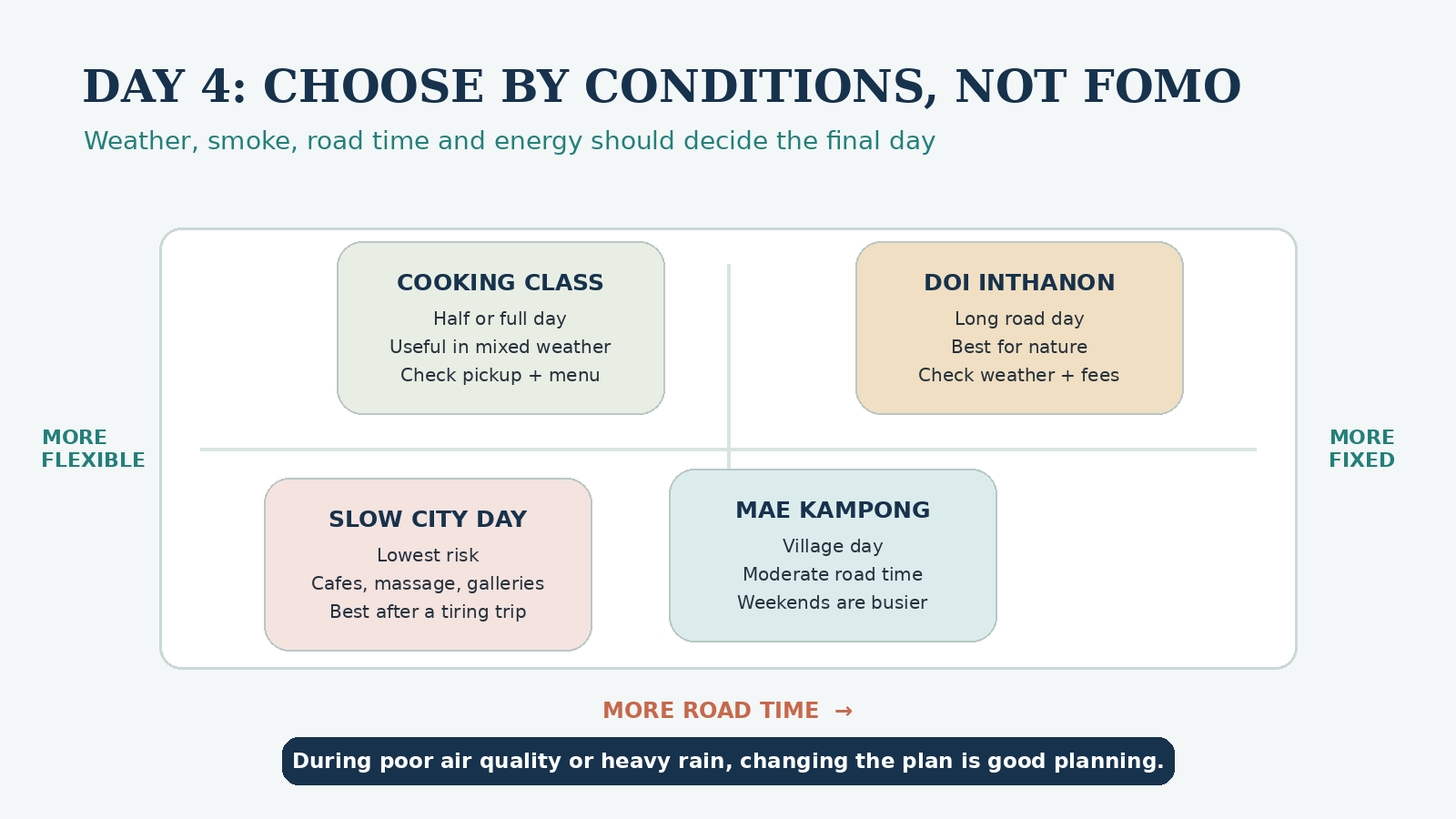
Option A: Doi Inthanon
For example, Doi Inthanon is the classic choice for cooler mountain air, forest, waterfalls and the highest point in Thailand. TAT lists the park among Chiang Mai’s major nature experiences, while the Department of National Parks has included Doi Inthanon in selected electronic-ticketing information. [1] [5] Nevertheless, a day tour may or may not include every park or trail charge, so read the inclusions rather than assuming “all fees included”.
In practice, a realistic group day often leaves around 07:00-08:00 and returns in the early evening. Stops vary by season and operator. The Kew Mae Pan trail, for example, has seasonal access arrangements and should never be assumed open. Likewise, viewpoint visibility depends on cloud and haze.
Sample Doi Inthanon day
- 07:00-08:00: hotel pickup and drive south-west.
- Morning: waterfall or local stop, depending on route and conditions.
- Late morning: summit area and short nature walk when open and suitable.
- Lunch: included or self-paid according to the booking.
- Afternoon: pagodas, village or second nature stop.
- 17:00-19:00: return to Chiang Mai, traffic dependent.
Option B: Mae Kampong
Alternatively, Mae Kampong offers village scenery, forested hills and cafes with less emphasis on major monuments. It is still a road trip, however, and popular weekends can feel busy. Choose an operator that explains where money is spent, limits intrusive behaviour and gives the village enough time rather than treating it as one stop in a crowded multi-attraction route.
Option C: a responsible elephant experience
Only book after checking the specific venue. Observation, feeding under controlled conditions and learning about care can be part of a responsible programme. By contrast, rides, performances, painting, unnatural poses and compulsory bathing are warning signs. A smaller group and a higher price do not automatically prove good welfare.
Option D: a cooking class
A cooking class is one of the most resilient alternatives when mountain visibility is poor. Compare the number of dishes, market visit, hands-on time, dietary support, pickup zone and whether every participant has a proper workstation. A half-day class leaves the evening free; a full-day farm class can replace the mountain day completely.
Option E: stay in the city
Otherwise, a slow day might include Wat Umong, a gallery, coffee, massage, the river, laundry and an early dinner. This choice is particularly sensible after a sleeper train, during heavy rain or when the group is tired. Travel plans improve when rest is treated as a valid decision rather than a failure to maximise attraction count.
Compare current Chiang Mai day trips
Use GetYourGuide only after deciding what kind of day you want. Then check pickup area, duration, group size, walking difficulty, park fees, meal, cancellation window and every optional stop before choosing.
Browse current Chiang Mai tours and day tripsBuying advice that prevents disappointment
- Read the full itinerary and inclusions, not only the title photograph.
- Check whether national-park fees are included or payable in cash.
- Confirm the hotel pickup zone and the actual return window.
- Ask about group size and vehicle type.
- Look for a practical bad-weather cancellation policy.
- For animal visits, assess welfare before price or review score.
Three-day and five-day Chiang Mai itinerary variations
Three days in Chiang Mai
| Day | Plan |
|---|---|
| 1 | Arrive, check in and explore near the hotel. |
| 2 | Old City temples, northern food and a market when dates match. |
| 3 | Doi Suthep in the morning, Nimman in the afternoon and depart the following day. |
Accordingly, this version removes Doi Inthanon and protects the essential city experiences. Do not attach a full mountain day to the departure date unless the onward journey is late, flexible and independently booked with enough recovery time.
Five days in Chiang Mai
| Day | Plan |
|---|---|
| 1 | Arrival and local evening. |
| 2 | Old City and market. |
| 3 | Doi Suthep and Nimman. |
| 4 | Doi Inthanon or Mae Kampong. |
| 5 | Cooking class, responsible wildlife visit or slow city day. |
By contrast, five days is the sweet spot for travellers who want a second special activity without stacking two long road days together. Therefore, place the slower day between excursions where possible.
Chiang Rai is not a casual extra
However, Chiang Rai can be reached on a long day tour, but the road time is substantial. For White Temple, Blue Temple and northern-border interests, one or two nights in Chiang Rai is usually more respectful of both the destination and the traveller’s energy than a pre-dawn departure and late return.
Getting around Chiang Mai
Although Chiang Mai is compact compared with Bangkok, it is not fully walkable. The Old City works on foot, while Doi Suthep, Nimman, the airport, railway station and countryside days need wheels. The simplest approach is to walk one area, then use a songthaew or ride app between areas.
| Mode | Working price | Best for | Main weakness |
|---|---|---|---|
| Walking | Free | Old City clusters and market streets | Heat, uneven pavements and road crossings |
| Red songthaew | Often 30-60 baht for a simple shared central trip; agree first | Flexible city journeys and groups | Route, shared/private status and price need clarification |
| Ride app | Displayed before booking; commonly 60-200 baht for central trips | Map-based pickup and door-to-door travel | Surge pricing and designated airport pickup |
| Tuk-tuk | Often 80-250 baht depending on distance and time | Short evening trips and the experience | Not automatically cheap; price must be agreed |
| Private driver | Often 1,800-3,500+ baht per vehicle for a planned day | Families, mountain stops and custom pacing | Quote must define hours, fuel, fees, parking and overtime |
| Rental scooter | Often 200-400 baht per day before fuel and insurance | Experienced, correctly licensed riders | Road risk, licence, insurance, weather and helmet quality |
However, these are broad planning ranges rather than fixed fares. Consequently, compare the live app or quoted price, confirm whether a songthaew is shared or privately hired, and write down the total before a longer trip.
Songthaew language that helps
First, show the destination on a map and ask the price per person before boarding. If you want the vehicle to wait or travel directly, explain that you are hiring it privately. A cheap shared fare and a private charter are different products, which is why price disagreements often begin with an unspoken assumption.
Scooter reality
Most importantly, easy rental does not prove legal entitlement or insurance cover. A mountain road is not a suitable place to learn. Wear a proper helmet, check the licence and international permit requirements that apply to your nationality, and use a driver when rain, fatigue or experience makes the choice uncertain.
Chiang Mai itinerary budget for four days
Chiang Mai can still be good value, although the mountain day and hotel choice create a wide range. The table below is a planning model per person for four days, excluding transport to Chiang Mai. Accommodation assumes two people sharing a room; solo travellers should add the full room difference.
| Category | Budget | Mid-range | Comfortable |
|---|---|---|---|
| Accommodation, four nights | 2,400-4,800 baht | 4,800-9,000 baht | 10,000-20,000+ baht |
| Food and drinks | 1,600-2,800 baht | 3,000-5,500 baht | 6,000-10,000+ baht |
| Local transport | 600-1,200 baht | 1,200-2,500 baht | 3,000-7,000 baht |
| Temples, small admissions and activities | 300-900 baht | 800-2,000 baht | 2,000-5,000 baht |
| Day 4 experience | 500-1,500 baht | 1,200-3,000 baht | 3,000-8,000+ baht |
| Four-day working total | 5,400-11,200 baht | 11,000-22,000 baht | 24,000-50,000+ baht |
Costs visitors forget
- Airport or railway transfers at both ends.
- National-park fees excluded from a tour price.
- Single-room supplements.
- Checked baggage on a low-cost flight.
- Hotel breakfast that starts after an early pickup.
- Private songthaew waiting time or driver overtime.
- Rain gear, warmer mountain layers or a last-minute mask.
Moreover, keep a small cash reserve. Card and QR payment are common in many businesses, but temples, songthaews, markets and small food stalls may still be easier with cash.
Best time for this Chiang Mai itinerary: weather, rain and smoke
November to February is the easiest version of the itinerary because mornings can be cooler and the main rainy season has eased. January 2026 was officially described as cool to cold across northern Thailand, with very cold mountain conditions and frost in some places. [7] Therefore, pack a layer for Doi Inthanon even when Chiang Mai city feels warm by midday.
| Period | What works | What to watch | Best adjustment |
|---|---|---|---|
| November-February | Full itinerary, outdoor walking and mountain days | Peak demand, cool mountain mornings and holiday crowds | Book key hotels and fixed transport earlier; carry a warm layer |
| March-April | City activities only when air quality is acceptable | Heat, seasonal haze and reduced mountain visibility | Use cancellable bookings and be willing to replace Chiang Mai |
| May-October | Green scenery, food, city days and flexible mountain trips | Heavy showers, slippery paths, cloud and local flooding | Move Day 4 to the best forecast and keep an indoor alternative |
Rainy season does not mean constant rain
However, it does mean greater disruption risk. The TMD northern forecast checked on 22 August 2026 warned of scattered thunderstorms and isolated heavy rain in Chiang Mai and neighbouring provinces, with wider heavy rain expected during the forecast period. [8] That is why a long mountain day should not be locked to a single date without a useful cancellation policy.
Smoke-season decision checklist
- Check Air4Thai for the city and any mountain district relevant to the day trip.
- Look at the trend over several days, not one screenshot.
- Check visibility and the weather forecast alongside PM2.5.
- Consider the most vulnerable person in the group.
- Use the hotel and tour cancellation deadlines as decision points.
- Change the route when the health or visibility trade-off is poor.
Nevertheless, a respirator may reduce some exposure when correctly fitted, but it does not turn hazardous air into a good mountain holiday. Refundability and route flexibility are more valuable than optimism.
How to adapt Chiang Mai for families, older travellers and limited mobility
Families with young children
First, use fewer temples, a hotel pool and a private or small-group vehicle for Day 4. The Old City day can become one temple, lunch, rest and the market. Meanwhile, Doi Inthanon requires warm layers, snacks and patience with road time. A cooking class may be more enjoyable than a long mountain day when children dislike sitting in vehicles.
Older travellers
Moreover, stay close to the planned sights, avoid consecutive early pickups and ask about vehicle step height. Doi Suthep has staircase and funicular options, although the complex still contains walking and uneven surfaces. A private driver can be better value than a cheap group tour when regular rest and flexible stops matter.
Travellers with limited mobility
Contact the hotel and operator directly. Ask about steps, lift access, bathroom accessibility, walking distance from vehicle to attraction and whether a wheelchair can be stored. “Easy tour” is not a useful accessibility description. Instead, request the longest continuous walk, surface type and number of steps.
Solo travellers
By contrast, shared day tours reduce the cost of rural travel, while the Old City and Nimman are comfortable areas for independent meals. Nevertheless, save the hotel address, keep transport details offline and tell somebody the operator when joining a remote day trip.
What to pack for four days in Chiang Mai
- Temple-suitable clothing covering shoulders and knees.
- Comfortable shoes with grip for wet paving and mountain paths.
- A light layer for cool mornings, air-conditioned transport and Doi Inthanon.
- Compact rain protection between May and October.
- Refillable water bottle and sun protection.
- Small cash notes for markets, songthaews and temple fees.
- Portable power bank for maps and ride apps.
- Offline copies of hotel details, transport tickets and tour contacts.
- Any medication in hand luggage, with enough for delays.
- A well-fitting particulate respirator when travelling near the haze period, while still being prepared to change the route.
The full Thailand packing list covers temples, islands and rain in more detail. For Chiang Mai specifically, footwear and a temperature layer matter more than carrying a different outfit for every evening.
Pros and cons of a four-day Chiang Mai itinerary
Pros
- Enough time for the Old City, Doi Suthep and one full day outside the centre.
- Only one major hotel base, so unpacking time stays low.
- Flexible enough for weather, markets and a slower evening.
- Works naturally inside a two-week Thailand route.
- Combines heritage, food, contemporary neighbourhoods and nature.
Cons
- Does not comfortably include both Doi Inthanon and Chiang Rai.
- March-April air quality can make the whole northern section unsuitable.
- A late Day 1 arrival effectively reduces the trip to three useful days.
- Mountain days involve more road time than many itineraries admit.
- Weekend markets require the right calendar dates.
Common Chiang Mai itinerary mistakes
1. Treating the arrival day as a full day
Airport, station and hotel processes consume time. A delayed arrival should remove a walk, not break a non-refundable booking.
2. Booking three long excursions in a row
Doi Inthanon, Chiang Rai and an elephant venue may each look attractive. Together, they create several dawn pickups and many hours in vans. Replace at least one with a city day.
3. Ignoring smoke season until the flight is non-refundable
Keep March-April bookings flexible and decide before cancellation deadlines. Air quality is part of destination suitability.
4. Staying near the airport for a four-day holiday
A short final transfer does not compensate for repeated rides to the sights. Use an airport hotel only when the flight timing genuinely requires it.
5. Assuming every red songthaew trip has one fixed fare
Shared central transport, a direct private trip and a vehicle hired to wait are different services. Confirm the arrangement before boarding.
6. Choosing a wildlife venue by the word “ethical”
Look at actual activities, animal choice, visitor contact and transparency. Marketing language is not evidence.
7. Planning Doi Inthanon immediately before a flight
Road delays, weather and late returns create unnecessary risk. Keep the last evening simple when Day 5 has an early departure.
8. Crossing the city repeatedly
Old City sights belong together; Doi Suthep and Nimman belong together. Geography is the easiest free upgrade to the itinerary.
9. Filling every evening
Markets, massages, dinner and bars do not all need a booking. Leave space for the day to run long or for the group to stop.
10. Trusting old prices without checking
Temple charges, park fees, routes and pickup rules change. Use dated figures as planning anchors and verify the live sign or provider before payment.
Frequently asked questions
How many days do you need in Chiang Mai?
Four days is ideal for a first visit because it covers an arrival evening, Old City temples, Doi Suthep, Nimman and one mountain or countryside day. Three days works when Doi Inthanon or Mae Kampong is removed.
Is four days in Chiang Mai too long?
No. The city, Doi Suthep and a full-day trip use four days comfortably without rushing. Five days is better when two major activities matter.
Where should first-time visitors stay?
The Old City edge is the best all-round base. It supports the temple day, common pickup zones and short rides to the airport, Nimman and Night Bazaar.
What should I do on the first day?
Check in, eat near the hotel, take a short orientation walk and sleep. Add a temple or market only when the arrival is early and energy is genuinely good.
Can I visit Doi Suthep and Doi Inthanon on the same day?
Some private tours may attempt it, but the result is a long, rushed road day. Use Doi Suthep as a half-day and keep Doi Inthanon for a separate day.
Is Doi Inthanon worth a day trip?
Yes for forest, waterfalls, cooler conditions and mountain scenery. It is less rewarding when cloud, smoke, mobility or dislike of long road days outweighs those interests.
Can Chiang Rai be a day trip from Chiang Mai?
It is possible but involves a very long day. One or two nights in Chiang Rai usually creates a better visit for travellers focused on the White Temple, Blue Temple or the far north.
When is Chiang Mai smoke season?
Risk is usually highest in the late dry season, particularly March and April, although exact timing changes. Check Air4Thai and current reporting before committing.
What is the best month for Chiang Mai?
November to February is the easiest period for cooler walking and mountain trips, although peak prices rise. The site’s best time to visit Thailand guide explains the wider seasonal trade-offs.
How do I get from Chiang Mai Airport to the Old City?
AOT lists the A1 shuttle at 40 baht towards Nimman, Huay Kaew and the moat corridor. Ride apps, official taxis and hotel transfers are alternatives; confirm the live route and pickup point. [3] [4]
Is Chiang Mai walkable?
The Old City is walkable in sections. The airport, railway station, Nimman and Doi Suthep require transport for most visitors, especially in heat or rain.
How much should I budget for four days?
A useful mid-range planning total is about 11,000-22,000 baht per person including shared accommodation, food, local transport, modest admissions and one day trip, but excluding travel to Chiang Mai.
Do I need to book temples?
Ordinary temple visits usually do not need advance booking. Check current opening, ceremonies, dress and any visitor charge on arrival.
Should I rent a scooter?
Only when you are experienced, correctly licensed, insured and comfortable with local traffic and mountain conditions. Otherwise use songthaews, ride apps or a driver.
Are Chiang Mai markets open every day?
The famous walking streets are tied to Saturday and Sunday. Weekday visitors should use the Night Bazaar, food markets or neighbourhood dining instead.
Is Chiang Mai suitable for children?
Yes, with fewer temples, hotel downtime and a carefully chosen day trip. A private car or child-friendly cooking class may be easier than a long shared mountain tour.
Do I need an eSIM?
No, but mobile data helps with maps, ride apps and operator messages. An eSIM is useful only when the phone is unlocked and compatible; local physical SIMs and roaming are alternatives.
What should I wear at temples?
Cover shoulders and knees, remove shoes where requested and avoid clothing or poses that disrespect an active religious site.
My practical recommendation
Use four nights and keep the route simple. Stay on the Old City edge, accept Day 1 as an arrival day, walk the heritage centre on Day 2, combine Doi Suthep with Nimman on Day 3, then choose one major Day 4 experience according to the forecast and the group’s energy.
Most importantly, protect flexibility. Move the mountain day when rain is heavy, replace Chiang Mai when smoke makes the trip unsuitable, and keep at least one evening open. A realistic itinerary does not prove its value by containing the most attractions; it proves it by still working when a flight is late, the view disappears or somebody needs a rest.
Sources and methodology
Research was checked on 22 August 2026. Prices, opening arrangements, shuttle routes, park fees, air quality, weather, tour inclusions and transport schedules can change. Therefore, use the dated figures as planning anchors and confirm critical details with the operator or official source before payment.
Official tourism, transport, park, weather and health sources
- Tourism Authority of Thailand – Chiang Mai destination guide. Official destination context covering Doi Suthep, Tha Phae Walking Street, Nimman, Doi Inthanon and Mae Kampong.
- Tourism Authority of Thailand – attractions around the Chiang Mai moat. Official Old City context for Tha Phae Gate, the Sunday walking street and Wat Phra Singh.
- Airports of Thailand – Chiang Mai Airport shuttle bus. Official route and fare information for airport shuttle routes A1, A2 and A3.
- Airports of Thailand – Grab pickup at Chiang Mai Airport. Official designated ride-app pickup information and service availability.
- Department of National Parks – selected national-park e-ticket notice. Official notice referenced for electronic ticketing at selected parks, including Doi Inthanon.
- Thai Meteorological Department – Chiang Mai weather page. Official live province forecast, warnings and seven-day outlook.
- Thai Meteorological Department – January 2026 monthly summary. Official evidence of cool-to-cold northern weather and very cold mountain conditions during January 2026.
- Thai Meteorological Department – Northern region forecast. Official northern forecast and heavy-rain context checked on 22 August 2026.
- Pollution Control Department – Air4Thai. Official live air-quality readings and health colour bands.
- World Health Organization – ambient air pollution. Health context explaining why fine-particle exposure should affect travel decisions.
Independent reporting and supporting site guides
- The Guardian – 2026 Chiang Mai smoke and tourism impacts. Independent reporting used only to illustrate the severity of the March-April 2026 haze period.
- Taylor’s Trailblazing Travels – Thailand 2-Week Itinerary. Internal route-planning guide linking Chiang Mai with Bangkok and the south.
- Taylor’s Trailblazing Travels – Transport in Thailand. Internal guide to flights, sleeper trains, buses, local transport and door-to-door comparisons.
- Taylor’s Trailblazing Travels – Thailand Packing List. Internal packing guide for temples, heat, rain and practical travel equipment.
- Taylor’s Trailblazing Travels – Best Time to Visit Thailand. Internal seasonal guide for weather, crowds and regional planning.
Image credits
Illustrations in this article were created for Taylor’s Trailblazing Travels. Third-party photographs, where used, are credited beside the image or in the source list.