Plan realistic daily and total-trip costs for budget, mid-range and comfortable travel, with regional price differences, booking checks and practical examples.
A realistic Thailand travel budget starts with a simple fact: Thailand is not one price. A 70-baht bowl of noodles and a 15,000-baht beach room can exist in the same day, which is why generic claims that the country costs “30 dollars a day” or “the same as Europe” are both unhelpful.
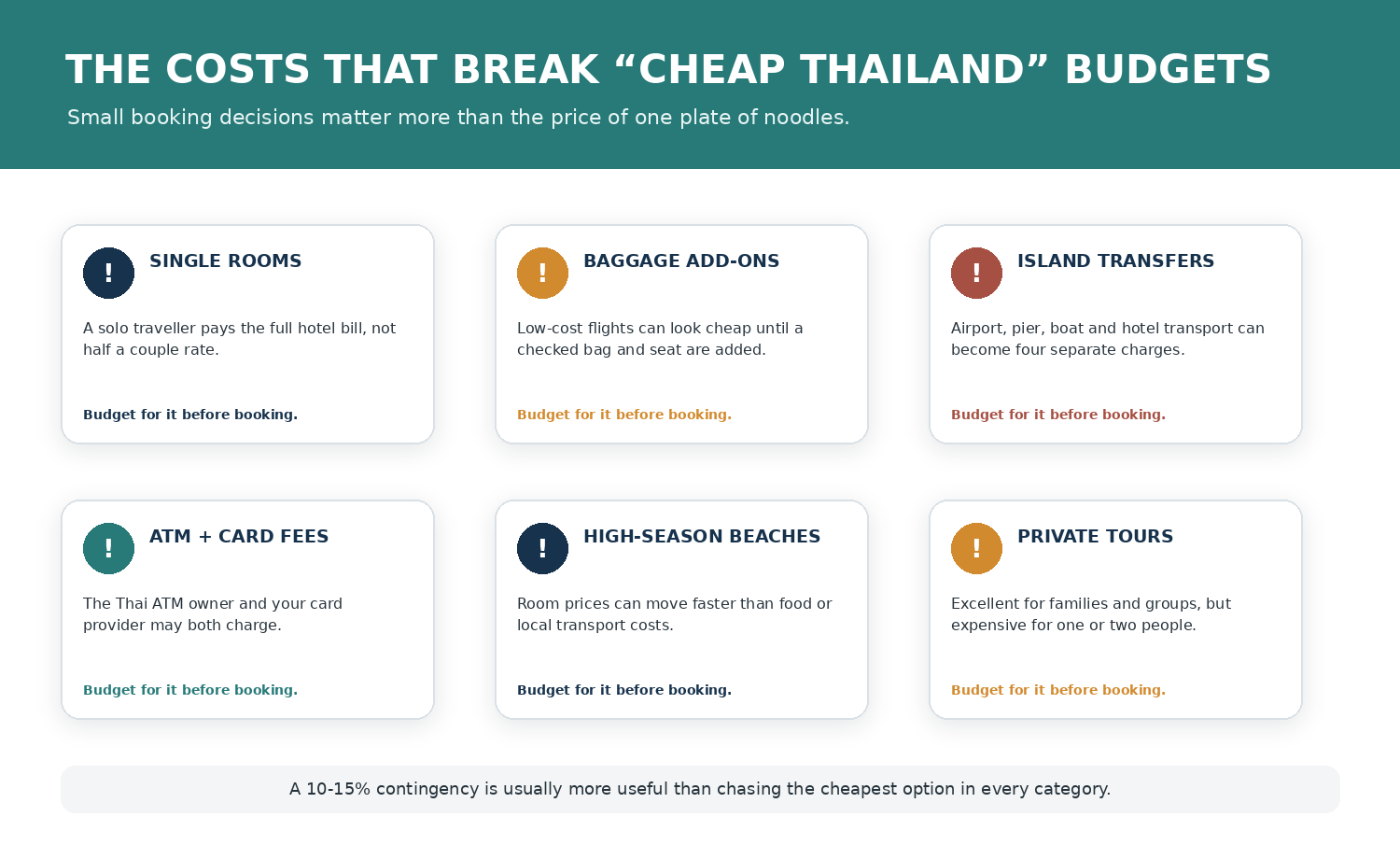
Instead, a realistic budget starts with four choices: whether you share a room, where you travel, how often you fly or take private transfers, and how many paid experiences matter to you. Food is visible and easy to count. The expensive surprises are usually less glamorous: baggage, a badly located hotel, a solo room, a pier transfer or a fixed high-season date.
In practice, the ranges below are designed for planning, not bragging rights. They include enough room for a normal holiday rather than assuming every meal is street food, every journey is a night bus and every attraction is skipped.
Prices and product terms were rechecked on 22 August 2026. Official fees are cited; food, tour, hotel and total-trip ranges are transparent editorial estimates rather than quoted packages. Recheck live fares, exchange rates and cancellation terms for your exact dates.
Thailand travel budget: quick answers
2,300-4,100 baht per person with simple rooms, local food, public transport and selected shared activities.
4,600-7,500 baht per person with comfortable hotels, domestic travel and several paid experiences.
9,600-18,900 baht per person with higher-end rooms, private transfers, premium dining and tours.
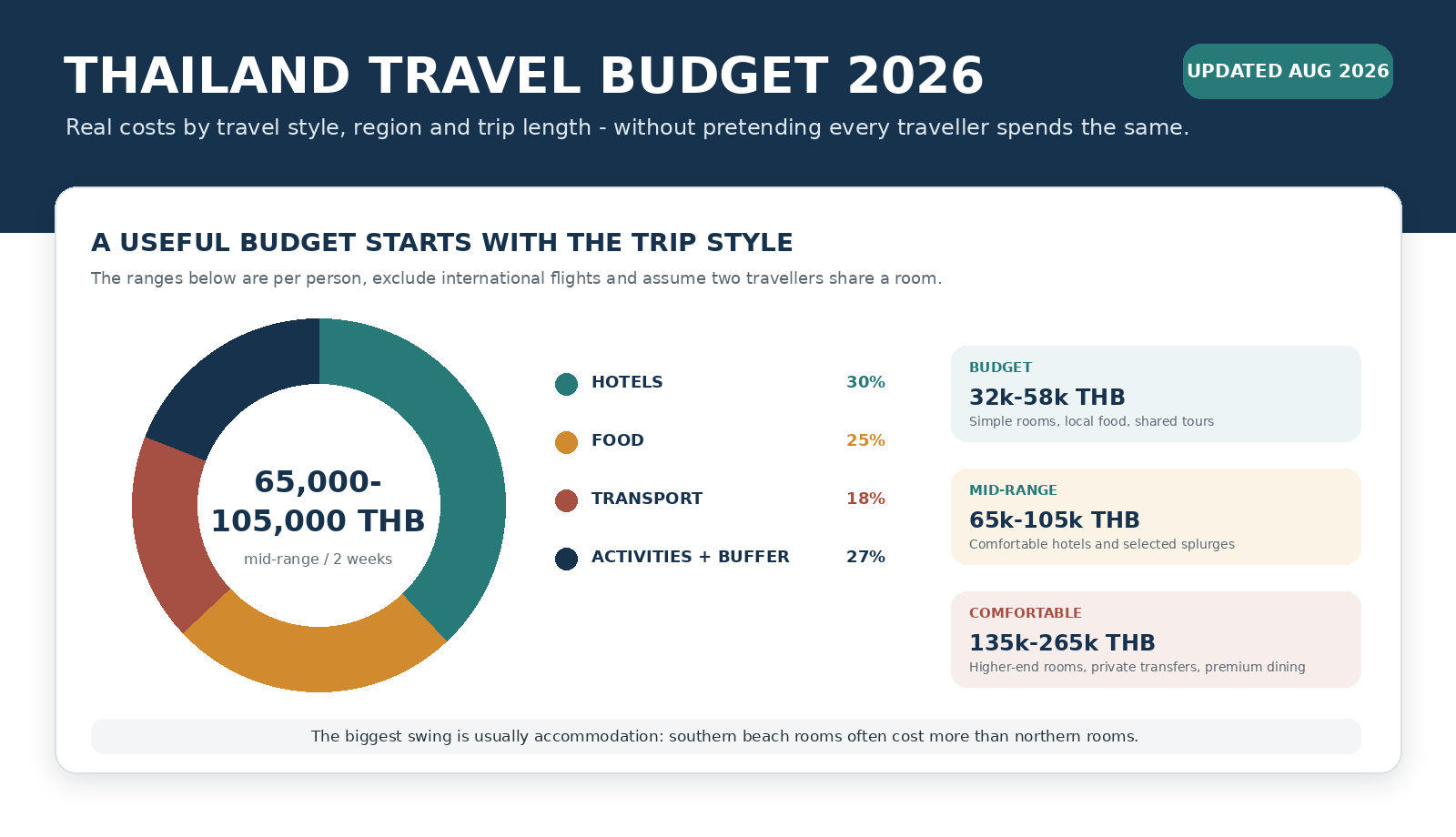
About 65,000-105,000 baht per person, excluding international flights and assuming a shared room.
Accommodation, especially Christmas-New Year, Phuket, Koh Samui and specific beach resorts.
Use both. Cards suit hotels and larger businesses; cash remains useful for markets, taxis, small restaurants and islands.
Add 10-15% after the itinerary is priced, not before. That protects against baggage, weather and transfer changes.
Budgeting food carefully while ignoring hotel location, solo-room cost, airport transfers and island connections.
In this guide
How much does a Thailand trip cost?
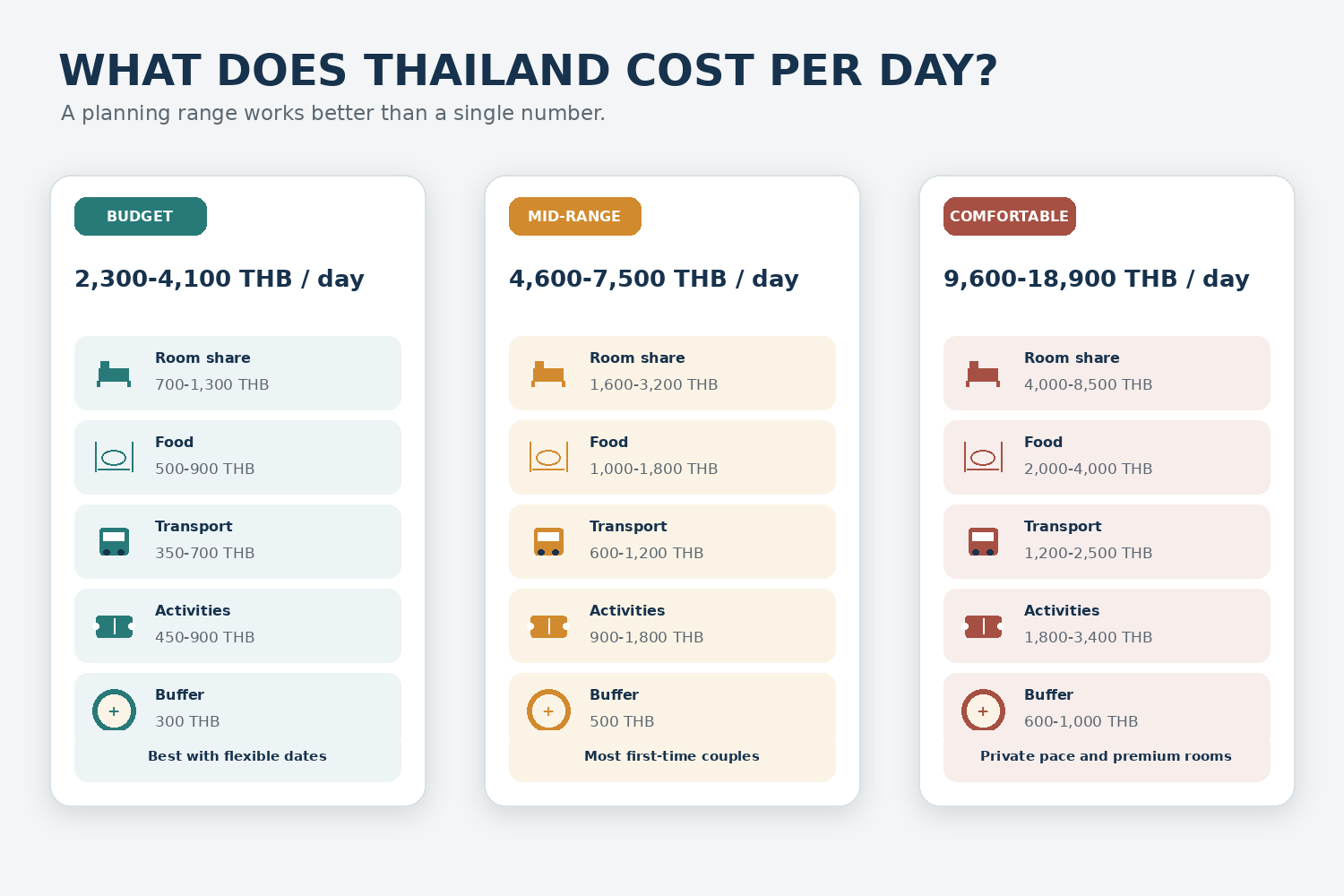
The daily figures include a share of accommodation, food, local transport, activities and a modest contingency. However, they do not include the long-haul flight. A couple sharing a room can often travel for less per person than a solo visitor with the same hotel standard.
Thailand daily budget by travel style
| Travel style | Daily range | What it usually includes | What changes it fastest |
|---|---|---|---|
| Budget | 2,300-4,100 baht | Hostel or simple room share, local meals, public transport, selected shared tours | Solo rooms, island ferries, frequent nightlife |
| Mid-range | 4,600-7,500 baht | Comfortable hotel, varied food, domestic travel, several paid attractions | Peak beach dates, extra luggage, private excursions |
| Comfortable | 9,600-18,900 baht | Higher-end hotels, private transfers, premium restaurants and tours | Luxury resorts, suites, private boats, spa and fine dining |
Is Thailand expensive now?
Thailand remains flexible rather than universally cheap. Local meals, rail, buses and northern guesthouses can still be excellent value. By contrast, the high-demand south, premium islands and international hotel brands can be expensive. The gap between the two is wider than many first-time travellers expect.
Bank of Thailand June 2026 indicators put the average room rate at 1,824.99 baht nationally, 2,097.00 baht in the central region including Bangkok, 2,309.65 baht in the South and 1,331.99 baht in the North. Those are market averages across accommodation, not promises for a beachfront room on your dates. [1]
Thailand budgets by trip length
Working total budget per person, excluding international flights
| Trip length | Budget | Mid-range | Comfortable |
|---|---|---|---|
| 7 days | 18,000-31,000 baht | 35,000-55,000 baht | 70,000-130,000 baht |
| 10 days | 24,000-42,000 baht | 47,000-75,000 baht | 95,000-190,000 baht |
| 14 days | 32,000-58,000 baht | 65,000-105,000 baht | 135,000-265,000 baht |
| 21 days | 45,000-80,000 baht | 90,000-150,000 baht | 190,000-370,000 baht |
| 30 days | 60,000-105,000 baht | 120,000-210,000 baht | 260,000-520,000 baht |
Longer trips do not multiply perfectly. For example, flights and major tours are fixed costs, while weekly or monthly accommodation can reduce the nightly average. Equally, a month with six islands can cost more than two weeks with three bases.
Two-week sample: mid-range first trip
One-week trips are not always cheaper per day
A short trip concentrates airport transfers, domestic flights and major attractions into fewer days. As a result, a seven-night Bangkok-Chiang Mai-Phuket sprint can have a higher daily cost than a slower three-week route.
Accommodation costs in Thailand
Accommodation is normally the largest controllable category. For example, average-price articles fail because a Chiang Mai guesthouse, a Bangkok business hotel and a Koh Samui beachfront resort are not interchangeable.
Typical accommodation planning ranges
| Room type | Typical range per night | Best for | Watch for |
|---|---|---|---|
| Hostel dorm bed | 350-700 baht | Solo budget travellers and social trips | Privacy, lockers, air-conditioning rules |
| Simple private room | 700-1,500 baht | Budget couples and slower routes | Location, bathroom type, noise |
| Boutique guesthouse | 1,500-3,500 baht | Character and value | No lift, breakfast, small rooms |
| Mid-range city hotel | 2,000-5,000 baht | Most first-time couples | Station distance, taxes, room size |
| Southern resort | 3,500-8,000 baht | Beach access, families, facilities | Peak dates, transfers, meal prices |
| Luxury hotel or villa | 8,000-25,000+ baht | Special trips and private space | Service charges, deposits, transport |
Why the south costs more
The Bank of Thailand data show a higher June 2026 average room rate in the South than the North. In addition, island logistics, beachfront land, seasonal demand and fewer low-cost alternatives all matter. A room that looks inexpensive can also require a paid airport-pier-boat transfer. [1]
How season changes the room budget
Christmas, New Year and the drier peak months can move beach rates sharply. Moreover, the correct coast changes with Thailand’s two monsoon systems, so the cheapest non-refundable rate is poor value when the region is a bad fit for the month. [18][19]
- Compare the final price including taxes and breakfast, not only the search-result headline.
- Check the walking route to rail, beach or pier; a cheap remote hotel may create daily taxi costs.
- Price a refundable room first when weather or ferry access is uncertain.
- Solo travellers should search single rooms and dorms, not simply divide a double-room budget.
- Families should compare two rooms with a family room or villa; occupancy rules can change the result.
Food and drink costs
Food can be inexpensive without turning every meal into a challenge. For example, a sensible budget mixes markets and local restaurants with cafés, air-conditioned breaks and one or two meals that are memorable because of the setting rather than the price.
Thailand food price planning guide
| Meal or drink | Typical range | Budget note |
|---|---|---|
| Street-food dish or local noodle/rice plate | 50-100 baht | Busy areas and islands can be higher; portion size varies. |
| Food-court meal | 60-150 baht | Useful for choice, air-conditioning and simple ordering. |
| Casual Thai restaurant main | 120-300 baht | Seafood and tourist zones can exceed the range. |
| Coffee or café drink | 70-160 baht | Specialty cafés and hotel cafés cost more. |
| Mid-range dinner with drinks | 400-900 baht | Per person; cocktails and imported wine move it quickly. |
| Rooftop or hotel dinner | 1,000-3,000+ baht | Check service charge, VAT and minimum-spend rules. |
| Beer / cocktail | 70-250 / 180-450 baht | Beach clubs and rooftops can be much higher. |
Daily food budgets
- 500-900 baht: mostly local meals, water and limited alcohol.
- 1,000-1,800 baht: local food plus cafés, varied restaurants and some drinks.
- 2,000-4,000 baht: premium restaurants, hotel dining, cocktails and flexibility.
Food costs people forget
By contrast, imported wine, western breakfast, beach-club minimum spends, hotel room service, airport meals and delivery-app fees are not priced like local noodle shops. Alcohol can become a larger category than food without being obvious in advance.
Transport costs in Thailand
Transport cost depends more on route design than on distance. For that reason, three cheap flights can cost more than one well-timed full-service flight once baggage and airport transfers are added.
Transport price examples and planning ranges
| Transport | Price or range | What the number means |
|---|---|---|
| Airport Rail Link | 15-45 baht [3][4] | Official Bangkok fare; best value when the hotel connects cleanly to rail. |
| BTS / MRT journey | About 17-65 / 17-42 baht [3] | Official distance-based guide ranges; current line and fare tables should be checked. |
| Bangkok taxi | Meter starts from official base fare [3] | Traffic, tolls, airport surcharge and waiting time affect the total. |
| Domestic flight | About 1,500-5,000+ baht one way | Editorial planning range; baggage and peak dates can double the cheap headline. |
| Sleeper train | About 800-1,800+ baht | Class and berth determine price; use the official booking system. [20] |
| Intercity bus / minivan | About 200-900 baht | Distance, class and operator vary; overnight options save time but not always sleep. |
| Island ferry / speedboat | About 150-1,500+ baht | A short local crossing and a long island transfer are different products. |
| Private airport transfer | About 700-2,500+ baht | Vehicle, airport, island and distance matter; useful for groups and late arrivals. |
Current domestic-flight examples
Thai Airways showed August 2026 Bangkok-Chiang Mai round-trip economy examples from 2,554 baht when checked. Meanwhile, Bangkok Airways advertised 2026 promotional sector fares of 1,480 baht to Chiang Mai and 1,530 baht to Krabi, with conditions and limited availability. Use these as price anchors only; compare the total for your date after baggage. [10][11]
How to cut transport cost
- Use fewer bases. One removed hotel change can save a flight, taxi, transfer and half a day.
- Check BKK versus DMK before accepting a connection in Bangkok.
- Price checked baggage at the same time as the ticket.
- Use the Airport Rail Link when luggage and hotel location make it practical.
- Choose a private transfer when three or four people can share it, not automatically for one person.
- Keep the final island-to-flight connection conservative; missed long-haul tickets are not a budget strategy.
Attraction, tour and experience costs
For example, a trip can be cheap on days spent walking, eating and using the beach, then expensive on a private boat or diving day. Budget paid experiences individually rather than hiding them inside a generic daily number.
Activity price anchors
| Experience | Price anchor or planning range | Source / caveat |
|---|---|---|
| Grand Palace, Bangkok | 500 baht foreign adult | Official standard ticket; check schedule before visiting. [5] |
| Wat Pho, Bangkok | 300 baht foreign visitor | Official visitor information. [6] |
| Doi Inthanon / selected Group 3 park | 300 baht foreign adult | Official DNP fee group; vehicles and special sites can add cost. [7] |
| Selected Group 4 national park | 500 baht foreign adult | Official DNP fee group; exact park category matters. [7] |
| Cooking class | 1,000-2,000 baht | Editorial range; half-day, ingredients and transport vary. |
| Shared island tour | 1,000-3,000 baht | Check national-park fee, hotel transfer, boat type and lunch. |
| Ethical elephant programme | 2,000-4,000+ baht | Research welfare standards; avoid riding and performances. |
| Fun dive / beginner diving day | 3,000-5,000+ baht | Site, equipment, certification and boat schedule change the total. |
| Private long-tail or speedboat | 4,000-20,000+ baht | Value improves when a family or group shares the boat. |
National-park fees are not one universal price
The Department of National Parks groups parks at different foreign-visitor rates, and marine parks may use e-ticketing or seasonal closures. Therefore, confirm whether the operator includes the park ticket; otherwise a “cheap” island tour can gain several extra charges at the pier. [7][8]
Cash, cards, exchange rates and ATM costs
Thailand is neither cash-only nor fully cashless for visitors. Instead, use a travel-friendly card for hotels and larger purchases, carry cash for small businesses and keep a second card separate from the main wallet.
Do not build the budget around a fixed conversion
Bank of Thailand publishes daily commercial-bank rates for GBP, USD, EUR and other currencies. Use the live official page when converting the budget, then, in practice, allow for the difference between the reference rate and the rate or fee your provider actually applies. [2]
Travel-money card comparison for UK readers
Three travel-card examples, checked 22 August 2026
| Product | Current headline terms | Pros | Watch for |
|---|---|---|---|
| Wise card | GBP 7 card; ATM withdrawals free up to GBP 250/month, then 2.69% on the excess [13] | Transparent conversion, multi-currency balance | Conversion fee varies; ATM owner can still charge |
| Revolut Standard | No monthly fee; up to GBP 200 and 5 withdrawals/month without Revolut fee; weekday exchange allowance up to GBP 1,000 [14] | Useful app controls and weekday allowance | Weekend 1% exchange fee; limits reset by plan cycle |
| Currensea Essential | No annual fee; GBP 500 card spend at realtime rate then 1%; GBP 200 ATM allowance then 2% [15] | Links to existing bank account; no preloading | Realtime rate is not zero markup; ATM owner can still charge |
This comparison is not personalised financial advice. Moreover, eligibility, residency, delivery, fair-use cycles and terms can change. Read the provider current official pricing and take at least two payment methods.
ATM and dynamic-currency-conversion rules
- Choose Thai baht when an ATM or card terminal offers to convert the amount into your home currency; the machine conversion is usually the less transparent option.
- Read the ATM screen. A local operator fee may apply even when your card provider offers fee-free withdrawals.
- Withdraw a sensible amount rather than many tiny amounts, but do not carry the whole holiday budget.
- Never use a credit-card cash advance without understanding immediate interest and fees.
- Keep emergency cash and a backup card separate from the main wallet.
Tourist SIM budget
For comparison, the True-dtac 2026 airport promotion listed a 15-day Infinite package at 650 baht special price and 699 baht normal price, with shorter and longer plans also available. Compare data, speed policy, eSIM support and airport-versus-city price rather than assuming every “unlimited” package is identical. [9]
VAT refunds for larger shopping
Thailand Revenue Department says qualifying goods must come from participating stores and reach at least 2,000 baht including VAT per day per store. Afterwards, the passport and P.P.10 documentation need to be handled at purchase, and larger claims can require customs inspection before check-in. [16][17]
How Thailand costs change by destination
Mid-range daily budget by destination
| Destination | Working range per person | Why it moves |
|---|---|---|
| Bangkok | 4,000-7,500 baht | Huge hotel range; rail is cheap, rooftops and private transfers are not. |
| Chiang Mai | 3,300-6,000 baht | Lower room rates and local food; day trips add vehicle and guide costs. |
| Krabi / Ao Nang | 4,500-8,500 baht | Southern rooms, boats, park fees and airport transfer. |
| Phuket | 5,000-10,000 baht | Large resort market, longer road transfers, nightlife and beach-club spending. |
| Koh Samui | 5,000-11,000 baht | Island logistics and premium resorts; local transport can be costly. |
| Koh Lanta | 4,000-7,500 baht | Good-value longer stays, but ferry and onward transport matter. |
| Isaan / secondary cities | 2,800-5,500 baht | Lower room and food costs; fewer direct tourist transfers. |
Solo traveller versus couple
A solo traveller can spend less on food and activities but more per person on accommodation and private transport. However, dorms, shared tours and public transport reduce the difference. A couple often gets the strongest mid-range value because the hotel and taxi divide cleanly.
Family budget
Children do not simply cost half. Family rooms, connecting rooms, airport vehicles, private transfers and attraction age rules shape the total. For example, families can save by staying longer in one resort and sharing a private car or boat, but flight baggage and room occupancy can be expensive.
Peak season versus rainy season
Even so, rainy-season discounts can be worthwhile for flexible mainland trips, but the cheapest island room is poor value if boats are cancelled or the park is closed. Use the weather calendar and refundable booking terms together. [18][19]
Booking tools that can save money – and when not to use them
A comparison site is valuable when it reduces uncertainty. It is poor value when it adds another layer between you and a simple official booking. The table below shows where each comparison site fits
Tool comparison
| Tool | Best use | Advantages | Limitations and checks |
|---|---|---|---|
| 12Go | Comparing trains, buses, ferries, vans and flights on the same route | Shows mixed transport types and departure points together | Check the operating company, station, luggage, ticket collection and change rules; direct booking can sometimes be better |
| GetYourGuide | Structured day trips, city tours and activities booked in advance | Useful filters and a clear place to compare inclusions | Similar tours may be sold by different operators; confirm pickup, fees, group size and cancellation |
| Viator | Cross-checking availability, private options and alternative operators | Broad catalogue and useful second comparison | Do not assume two listings are equivalent; identify the actual operator and every exclusion |
| Airalo | Having mobile data ready before arrival | Advance setup and no physical SIM swap | May cost more per gigabyte, may be data-only and requires a compatible unlocked phone |
| Amazon | Small pre-trip items that prevent baggage, charging or water-damage costs | Easy product comparison before departure | Prices and sellers change; buy only what the itinerary needs. |
Build your own Thailand travel budget
Small purchases that can prevent larger travel costs
The most useful pre-trip products prevent a predictable charge or protect something expensive.
Product comparison and buying checks
| Product to compare | Cost it may prevent | Buying checks | When to skip it |
|---|---|---|---|
| Digital luggage scale on Amazon UK | Airport excess-baggage charges and repacking at check-in | Clear display, secure strap, replaceable battery and a weight range above the heaviest case | Skip when every flight includes a generous checked allowance and the accommodation has a reliable scale |
| Universal travel adapter on Amazon UK | Emergency airport or hotel purchases and unusable chargers | Safety shutters, recognised markings, USB-C output and enough total wattage for the devices carried | Skip when every charger already has the correct plug and the trip does not continue to another socket type |
| Small dry bag or waterproof pouch on Amazon UK | Damage to a phone, passport, medication or charging equipment | Reliable closure, taped seams and a size that fits inside the normal day bag | Skip for a city-only trip with no boat, beach or monsoon exposure |
For a fuller packing comparison, use the site’s Thailand packing list.
A simple worksheet
Budget worksheet
| Category | Your calculation | Example for 14 days |
|---|---|---|
| Accommodation | Nightly room x nights / people sharing | 3,000 x 13 / 2 = 19,500 baht |
| Intercity transport | Every flight, train, ferry and transfer | 14,000 baht |
| Daily food | Daily food allowance x trip days | 1,200 x 14 = 16,800 baht |
| Activities | List each major paid day | 15,000 baht |
| Local transport / data | Daily local allowance + SIM | 6,500 baht |
| Shopping / nightlife | Personal amount, not hidden | 5,000 baht |
| Contingency | 10-15% of planned spend | 8,000-12,000 baht |
What to cut first when the number is too high
- Remove one destination and its transport leg.
- Move one beach base away from the peak holiday week.
- Choose a good mid-range hotel in a useful location instead of a cheap remote room.
- Replace one private tour with a shared trip, not every experience.
- Reduce alcohol, premium dining or shopping if those are lower priorities.
- Keep travel insurance, the final-night buffer and safe transport where they solve a real risk.
Thailand travel budget FAQs
Is Thailand still cheap in 2026?
Thailand can still be good value, especially for local food, public transport and northern accommodation. Popular islands, luxury hotels, private tours and peak dates can cost as much as many other holiday destinations.
How much money do I need per day in Thailand?
Allow roughly 2,300-4,100 baht for budget travel, 4,600-7,500 baht for mid-range travel or 9,600-18,900 baht for comfortable travel, excluding international flights.
How much does two weeks in Thailand cost?
A two-week working budget is about 32,000-58,000 baht for budget travel, 65,000-105,000 baht for mid-range travel and 135,000-265,000 baht for comfortable travel per person.
Is 50,000 baht enough for two weeks in Thailand?
In practice, it can be enough for a budget-conscious trip excluding international flights, particularly with shared rooms and limited domestic flights. It is tight for peak-season islands or a solo traveller paying for every room.
How much cash should I carry in Thailand?
Carry enough baht for one or two days of small purchases, transport and emergencies, then replenish safely. Avoid carrying the entire trip budget in cash.
Can I use a card everywhere in Thailand?
No. However, cards are common at hotels, malls and larger restaurants, but cash remains useful for markets, local eateries, some taxis, ferries and small businesses.
Are Thailand ATMs expensive?
For example, the ATM owner may charge a local fee and your card provider may also charge. The machine should display the local charge before confirmation, so withdraw sensible amounts and check your card terms.
Should I exchange money before Thailand?
Alternatively, bring a small arrival amount if it reduces stress, then compare the live rate and fees in Thailand. Avoid converting the full trip budget at an airport counter without comparison.
What costs more: Bangkok, Chiang Mai or Phuket?
Chiang Mai is usually the cheapest of the three for accommodation. Bangkok covers a wide range. By contrast, Phuket and other high-demand southern islands are often the most expensive, especially in peak season.
Does the Thailand budget include international flights?
The ranges in this article exclude international flights because fares vary enormously by origin, baggage, season and booking date.
Final recommendation: the number I would use
For a first two-week trip, I would start with 80,000 baht per person excluding international flights, then move it down for simple rooms and fewer flights or up for peak-season islands, solo accommodation and private tours. However, that figure is not a target to spend. It is enough space to make good choices without pretending every day will be a bargain.
Thailand can reward a careful budget, but the best savings come from route design, dates and hotel location. The price of lunch is rarely the decision that makes or breaks the holiday.
Article researched and written by Karen Taylor for Taylor’s Trailblazing Travels.
Sources and methodology
Checked 22 August 2026. Government, Bank of Thailand, official attraction, railway, telecom and provider sources are prioritised. Official fees are cited directly; food, tour, hotel and total-trip ranges are editorial planning estimates. Affiliate platforms were checked only to confirm that each link matched the planning task described.
Cost, transport and attraction data
- Tourism Indicators – Bank of Thailand. Official June 2026 occupancy and average room-rate data used to anchor accommodation ranges.
- Daily Foreign Exchange Rates – Bank of Thailand. Official daily commercial-bank exchange-rate data; use the live page rather than a fixed conversion in an evergreen budget.
- Bangkok public transport guide – Thailand.go.th. Official Airport Rail Link, BTS, MRT, taxi and river-boat fare and operating guidance.
- Where the Airport Rail Link can take you – Thailand.go.th. Official 15-45 baht Airport Rail Link fare and route information.
- Practical information for the Grand Palace – The Grand Palace. Official foreign-visitor ticket, opening and dress-code information.
- Visitor information – Wat Pho. Official visitor admission, opening and respectful-dress guidance.
- National park entry fee groups – Department of National Parks, Wildlife and Plant Conservation. Official fee announcement including 300-baht and 500-baht foreign-adult park categories.
- Similan e-ticket and seasonal reopening information – Department of National Parks, Wildlife and Plant Conservation. Official 2025-26 e-ticket and seasonal-access information illustrating why marine-park costs and access should be checked before booking.
Connectivity, flights and payment-provider terms
- 2026 tourist SIM promotion – True-dtac. Official 2026 airport promotion with 5-, 8-, 15- and 30-day package prices.
- Bangkok-Chiang Mai fares – Thai Airways. Live airline fare page used as a dated domestic-flight price example.
- Thai Tiew Thai domestic fares – Bangkok Airways. Official 2026 promotional sector fares and conditions; live totals vary by date and baggage.
- Thailand Digital Arrival Card – Thailand.go.th / Immigration Bureau. Official entry-registration information; the form itself should not require a paid third-party service.
- Wise card fees – Wise UK. Official UK card order, conversion and ATM allowance information checked 22 August 2026.
- Standard plan – Revolut UK. Official Standard-plan withdrawal and currency-exchange allowances checked 22 August 2026.
- Currensea pricing plans – Currensea. Official Essential, Pro and Elite annual, spending and ATM terms checked 22 August 2026.
VAT, weather and rail planning
- VAT Refund for Tourists conditions – Thailand Revenue Department. Official qualifying-store, 2,000-baht minimum and departure-process rules.
- VAT Refund for Tourists FAQ – Thailand Revenue Department. Official explanation of forms, customs checks and common reasons a claim fails.
- Thailand weather overview – Tourism Authority of Thailand. Official climate overview supporting high-season and coast-selection budget cautions.
- Thailand monsoon systems – Thai Meteorological Department. Official explanation of southwest and northeast monsoons and their different regional effects.
- Special Express Train No. 9/10 Bangkok-Chiang Mai – State Railway of Thailand. Official sleeper-train service information; ticket price depends on class and availability.
Affiliate platforms and link compliance
- 12Go affiliate programme – official description of supported transport types and 30-day tracking.
- Viator affiliate links guidance – official guidance on destination, category and product links.
- Amazon.co.uk Associates Programme Policies – direct Special Links, redirect restrictions, pricing and availability rules.
Image credits
All three visuals are original editorial graphics prepared specifically for Karen Taylor and Taylor’s Trailblazing Travels. They are unique to this article and require no third-party photographer attribution.
Files: thailand-travel-budget-hero.png; thailand-daily-budget-comparison.png; thailand-budget-hidden-costs.png.