
Thailand itineraries
City, northern culture and an Andaman finish.
Three regions in fourteen days, without counting airports and hotel changes as free time.
This Bangkok, Chiang Mai and Phuket 2-Week Itinerary gives each region a clear role. Start with Bangkok's cultural sights and neighbourhoods, move north for a focused Chiang Mai stay, then finish with several days based beside the Andaman coast. It is a varied first trip, but it only works when the flight days are treated honestly.
The suggested allocation is three initial Bangkok nights, four Chiang Mai nights, five Phuket nights and one final Bangkok night. A suitable international departure from Phuket removes the last return flight and adds a sixth coastal night. That is worth comparing before choosing hotels, not after the accommodation has become non-refundable.
The route is researched rather than presented as first-hand field testing. The most important choices are the Chiang Mai-to-Phuket journey, the location of each hotel and the balance between organised experiences and ordinary holiday time. Within each stay, the day-by-day plan leaves enough flexibility to respond to weather, tiredness and the discovery that one place deserves a slower afternoon.
Use the travel dates as the fixed framework and regard most sightseeing as movable. That distinction is what lets a broad route remain enjoyable instead of becoming a series of deadlines across three different regions.
Time allocation
13 hotel nights
Arrival and departure are included in the fourteen dates.
Key booking
Chiang Mai to Phuket
Confirm a suitable direct or protected connecting itinerary.
Northern choice
Three full days
Keep one major countryside option rather than adding everything.
Coastal rhythm
Four full days
Beach, a bay option, Old Town and a genuinely open day.
Your Bangkok, Chiang Mai and Phuket 2-Week Itinerary
Thirteen nights, with every move accounted for
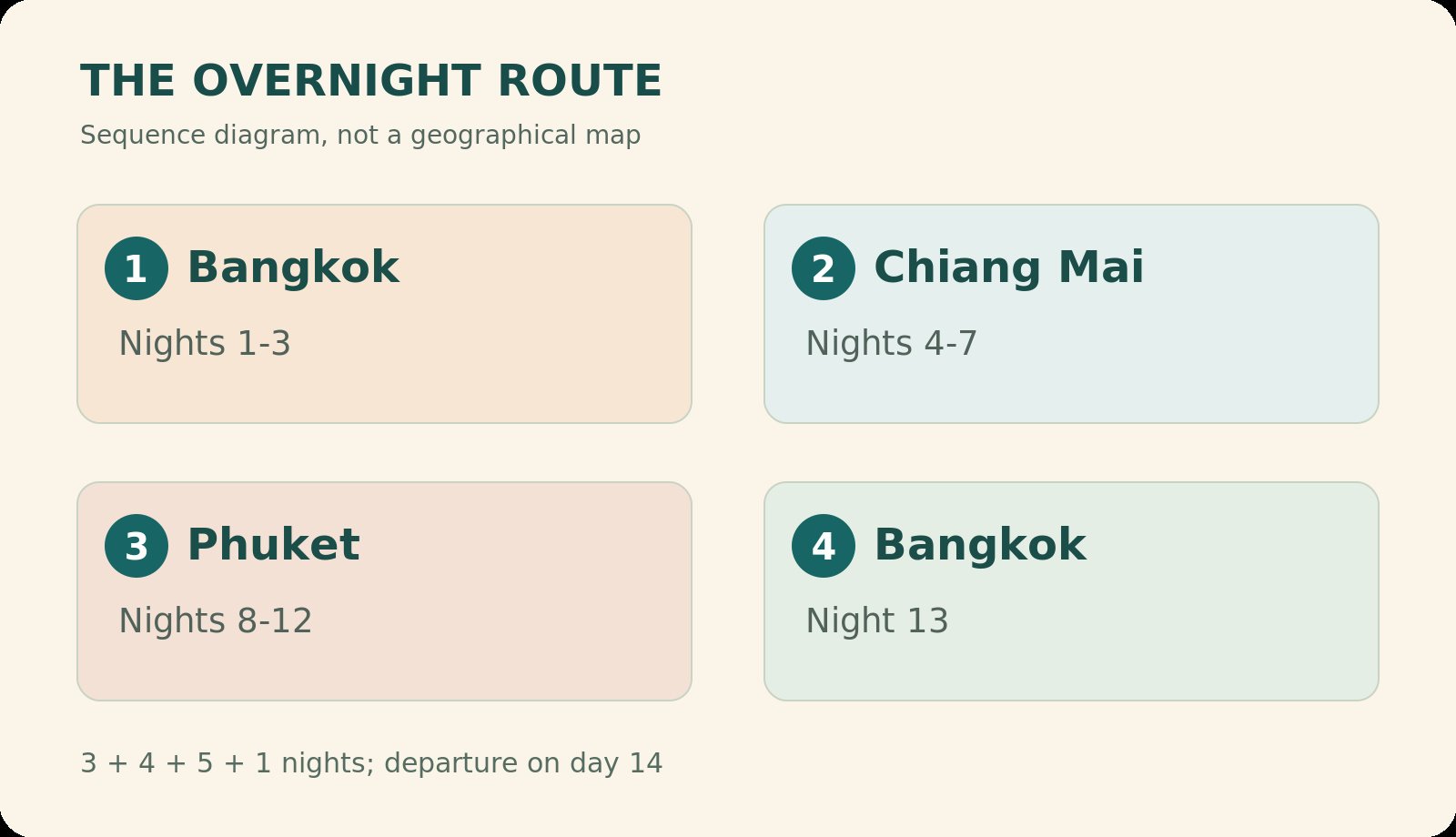
The main allocation is three nights in Bangkok, four in Chiang Mai, five in Phuket and one final night in Bangkok. You arrive on day 1 and depart on day 14. That creates two initial full days in Bangkok, three in Chiang Mai and four in Phuket; the other dates contain arrival, domestic travel or departure.
This is a useful first-visit compromise for someone who wants city sights, northern culture and a beach finish. It is not a comprehensive Thailand tour. The destinations and daily groupings are selected for contrasting experiences and workable transport, rather than a claim that these are objectively the country's best places or that every stop has been personally visited.
| Days | Overnight base | Nights | Purpose |
|---|---|---|---|
| 1-3 | Bangkok | 3 | Arrival and two contrasting city days. |
| 4-7 | Chiang Mai | 4 | Travel north and enjoy three full northern days. |
| 8-12 | Phuket | 5 | Travel south and use four full coastal days. |
| 13 | Bangkok | 1 | Return before the international departure. |
| 14 | Departure | 0 | Airport journey; adapt for a Phuket international ticket. |
The alternative that saves a return flight
Price an international ticket arriving in Bangkok and leaving from Phuket before booking domestic travel. If the schedule and conditions suit, keep night 13 in Phuket and leave from there on day 14. Your total remains thirteen nights; Phuket simply receives six instead of five, and the final Bangkok night disappears.
Do not confuse that arrangement with buying an unrelated Phuket-to-Bangkok flight a few hours before a separate long-haul departure. The latter keeps the domestic journey and its connection risk. A through-ticket with appropriate protection is another possibility, but it needs to be assessed from the actual airline terms rather than assumed from two flights appearing in the same search.
Find a season that works for three different regions
Give the north and the Andaman separate attention
The beach finish makes the Andaman conditions relevant, while the Chiang Mai segment introduces a separate question about comfortable outdoor days and air quality. I would investigate the cooler, generally drier part of the year first for this particular combination, then compare actual dates, forecasts and costs. No month removes the need for local checks. [1]
For Chiang Mai, consult the Pollution Control Department's Air4Thai readings near departure and before strenuous outdoor plans. Look at the timestamp and local station context. A blue-sky photograph in a hotel listing is not evidence of current air conditions, and a northern mountain day should remain a choice rather than a contractual obligation. [2]
Keep the coastal experience flexible
A Phuket holiday can still be enjoyable when the weather favours food, pool time and the Old Town over boats. However, someone travelling primarily for swimming should be more cautious about the season and the hotel's alternatives. Choose a property you would enjoy spending time in when a marine excursion is cancelled.
Leave the Phuket boat day provisional and keep at least one other possible date. By contrast, the Chiang Mai-to-Phuket flight is a structural booking and should be confirmed before non-refundable hotels. The itinerary works best when you distinguish the framework from the weather-dependent detail.
Check the north-to-south flight before arranging the middle hotels
A route search is not a guarantee of your preferred flight
AirAsia's booking site lists direct Chiang Mai-to-Phuket options, with example durations around two hours, but that is not a promise of a particular service on your dates. Search the exact day, operating airline, airport and baggage allowance. A connection shown by another carrier may still be a useful alternative, but it changes the amount of the day consumed by travel. [4]
The important sequence is international flights, the north-to-south sector, then the other domestic sectors and hotels. When an attractive direct flight only operates at an inconvenient time or is too expensive with bags, consider moving the Chiang Mai block by a day before paying for everything else.
Protect the journey, not just the purchase price
For a connection through Bangkok, check whether it is one protected itinerary, whether baggage is transferred and whether the airport stays the same. BKK and DMK are separate airports. A connection requiring a road journey is not equivalent to changing gates inside a terminal.
The standard route assigns day 8 to this move. Do not reserve a Phuket afternoon activity that depends on the earliest possible landing. Keep approximately six to nine hours free door to door as an editorial planning allowance, increasing it for a connection or disruption. The carrier's published departure and check-in requirements remain the controlling times.
Pick an address for each role in the trip
Bangkok for transport and the first cultural days
A convenient hotel near useful rail or river transport supports the opening stay. Check where the actual entrance sits and how you will reach the old-city sights. A luxurious property can be a poor fit if every outing starts with a long ride through traffic.
For the final night, use a different calculation. Choose either a familiar city base for a later departure or an airport-serving property for an early one. Ask about the correct airport, shuttle arrangements and any booking requirement. Treat this as a practical overnight, not another essential luxury stay.
Chiang Mai for evenings as well as pickups
An Old City or east-moat base is a sensible starting point for temple walks and ordinary meals. Check recent room-level comments about noise, stairs and maintenance, then map the specific walking route. A room away from a busy frontage may be worth more than being directly beside a celebrated gate.
Nimman or a riverside stay can work when those surroundings better match your interests, but include the extra journeys to the planned activities. Four nights is short enough that location mistakes are noticeable and long enough that a comfortable room matters.
Phuket for the beach routine you intend to keep
Shortlist the beach area before browsing dozens of unrelated hotels. Kata, Karon, Kamala, a northern coastal area or Old Town each produce a different daily pattern. TAT's beach guidance identifies Kata and Karon as west-coast options; current local conditions still determine whether swimming is appropriate. [5]
Day 1: an easy Bangkok arrival
Leave a clear landing zone in the diary
Travel from the airport to the room, check in when access is available and choose food nearby. Do not attach a fixed evening cruise or a distant restaurant reservation to an untested arrival time. Immigration, baggage and the road journey can all expand beyond the neat estimate in a flight search.
Suvarnabhumi's official transport information lists rail and several road options. Compare the complete journey to your address, especially with larger bags or a late landing. A route involving several changes may be economical but unappealing after a long international flight. [6]
Prepare tomorrow without extending today
Find the booking details for the first temple visit, check the required clothing and save a route back to the hotel. Put the return address in both phones, not only the device used to arrange the trip. Then stop planning for the evening.
An early arrival can be useful, but only when room access is understood. Arrange confirmed early check-in or a preceding night when immediate rest is essential. Otherwise, accept that the first morning may involve luggage storage and breakfast rather than a full sightseeing programme.
Days 2 and 3: two contrasting Bangkok days
Day 2 pairs a principal temple with time by the river
Choose the Grand Palace and Wat Phra Kaew as the main visit, with Wat Pho as an optional second stop after lunch. The palace's own guidance should determine clothing and current admission arrangements. Do not count on a last-minute scarf solving every dress restriction. [7]
A guide can be worthwhile when historical context matters, especially for someone who prefers explanation to independently moving between buildings. Compare admission inclusions and group size, then resist adding a second major organised tour that evening. The combination of heat, walking and travel can make a full-day schedule more demanding than it looks on paper.
Day 3 changes the subject
Use the next day for a museum, neighbourhood food or a smaller interest rather than repeating yesterday's pattern. Jim Thompson House is one possible cultural anchor; its main house is visited with a guide and has access limitations that should be checked directly. Pair it with a nearby meal and a flexible afternoon. [8]
An alternative is a carefully chosen food walk around Chinatown. Check the date and operating times of specific venues, particularly when the trip coincides with a holiday. Keep the afternoon geographically compact and leave a little room for packing. Tomorrow begins the northern segment, so this is not the evening for a cross-city commitment that finishes very late.
Day 4: make the northern transfer straightforward
Compare the whole airport journey
Book Bangkok to Chiang Mai with the correct departure airport, fare conditions and luggage. A cheap seat can become less attractive when airport transport and checked bags are added. Keep the flight number, operating airline and airport code together in your itinerary so they are easy to verify.
For planning, reserve a substantial part of day 4 for travel. Even a short flight requires hotel checkout, transfer, check-in procedures, arrival baggage and transport to the next room. Do not promise a northern countryside excursion on the afternoon of arrival.
A train is possible, but it changes the preceding night
A sleeper alternative replaces Bangkok hotel night 3 with the railway journey and brings you to Chiang Mai on day 4. Confirm the service, departure station and berth through the railway information and your final ticket. Room access after arrival is a separate arrangement. [9]
Once settled, take a small walk and eat near the hotel. That is enough for the first northern evening. Four nights include only three full days, and the most effective way to enjoy them is to start rested rather than squeezing a second travel task into the arrival afternoon.
Day 5: a northern city day without a transport circuit
Look closely at a small number of places
Build the morning around one or two Old City temples and the streets between them. Wat Phra Singh is a useful starting point for northern religious art and architecture; TAT's attraction information identifies its distinctive Lanna features. Check access locally and allow worshippers priority rather than treating the compound only as a photographic stop. [10]
A guided walking visit can help someone who wants context, but the route should remain realistic in warm conditions. Ask how far it walks, where it finishes and whether there is a shaded pause. An itinerary with fewer stops can provide more useful explanation than one that rushes between every well-known temple.
Give the afternoon a different texture
After lunch, choose crafts, a cafe or a museum according to your interests. Avoid making every day a temple count. A short browsing session can also help you identify what is worth purchasing later instead of buying the first souvenir simply because it appears local.
For the evening, use the actual weekday to choose any market visit. Check the current arrangements, then agree a pickup point away from blocked or crowded streets. An ordinary neighbourhood dinner is a good substitute when a particular walking street is not operating; the trip should not depend on one event aligning perfectly with your dates.
Day 6: Doi Suthep and an unhurried afternoon
Keep the journey focused
Use the morning for Wat Phra That Doi Suthep, reached by road above the city. The official tourism listing describes the temple approach and access options, but confirm the current arrangements when steps or mobility are a concern. Arrange a return pickup and make sure the driver knows whether you want only the temple or additional stops. [11]
A clear view is a bonus, not an admission guarantee. Check weather and air conditions before deciding whether this is the right morning. Travellers who are uncomfortable on winding roads should discuss the journey and possible pauses before joining a tightly scheduled group.
Do not turn a half-day into an accidental full-day tour
Extra attractions can be appealing in isolation, but each adds driving, waiting and another decision. Keep the afternoon available for the part of Chiang Mai you most want to experience independently. That might be a modern cafe area, a quiet hotel break or a return to yesterday's favourite streets.
This spacing also protects day 7. With only three complete northern days, two exhausting back-to-back excursions can leave no energy for the city itself. The route is stronger when the mountain temple is treated as a focused outing rather than a platform for accumulating every nearby place name.
Day 7: decide between a class and a longer countryside day
A cooking session keeps the day contained
For many first-time visitors, a hands-on cooking class provides a useful contrast to temples. Compare the actual menu, group size and whether participants cook independently. Ask about dietary requirements in advance and check whether a market component adds meaningful explanation or simply extra transfer time.
A shorter session leaves time for laundry, packing and another northern meal before the flight south. This is my default for travellers who already have a busy Bangkok opening and want the beach segment to begin without fatigue.
Choose Doi Inthanon only when the mountain is a priority
A longer national-park outing can replace the class. TAT's Doi Inthanon information describes waterfalls, forest and highland attractions, but these are spread across a large landscape. Select a modest programme with confirmed access and walking requirements instead of assuming every named trail will be open. [12]
Leave early enough for a sensible return and avoid a late reservation that evening. If an elephant experience is the priority instead, apply an observation-only welfare standard and examine the actual programme. World Animal Protection warns against treating close contact as proof of ethical care. None of these full experiences should be bundled together merely to maximise the final northern day. [13]
Day 8: from the north to the Andaman
Make the direct flight earn its place
A convenient direct Chiang Mai-to-Phuket service can avoid backtracking through Bangkok. However, check the timetable for your date and calculate the fare with the luggage you will actually carry. The booking site's general route page establishes an option to investigate, not a service guarantee for every departure date. [4]
If you need a connection, prefer a clearly ticketed arrangement you understand over a short self-transfer assembled from unrelated fares. Confirm terminal, baggage and immigration instructions with the airline where relevant. International-looking airport layouts do not make all domestic connections identical.
The last road journey is still part of the move
On Phuket, allow for the distance to your chosen beach and any waiting at the airport. A resort arrival several hours after landing is entirely compatible with a relaxed itinerary when nothing else has been prepaid that afternoon. Use the airport's current transport information to compare the appropriate bus or vehicle options. [14]
At the hotel, check the surroundings, find dinner and learn the local beach warnings. Do not immediately book every remaining day at the first excursion desk. The five-night block was chosen to give you time to understand what suits the group before spending the remaining activity budget.
Day 9: let the beach stay begin properly
Use the place you paid to stay in
Start locally: breakfast, a walk and time near the hotel. Look at the actual access to the sand and the water, including flags and local advice. The beach can be beautiful without being suitable for swimming that morning. Respect red flags and choose a different activity when conditions require it. [15]
Having this day free is especially valuable after two cities and two domestic flights. Some travellers will want to explore immediately; others will need a slower morning. Let the group separate for a short activity when practical, rather than forcing everyone into an identical pace.
Prepare one optional marine day
Discuss possible dates, boat types and cancellation rules with the operator. Establish how much of the advertised duration is spent transferring from hotels and piers. A shorter route that suits the group can be more enjoyable than a long programme containing more famous names.
Keep the evening informal. Once you know the local restaurants and the walk back to the hotel, you can decide whether a special dinner later in the stay is worthwhile. A good beach block needs ordinary time as well as an organised highlight.
Day 10: limestone scenery, with a land-based fallback
Match the excursion to the experience
Phang Nga Bay is a logical option for travellers who want limestone formations, mangrove scenery and a bay-oriented outing. It is not the same product as a day primarily devoted to open-water snorkelling. TAT identifies the bay's island and coastal landscape; individual operators determine their own route and activity mix. [16]
Before payment, compare vehicle transfers, boat comfort, group size, park fees, food and any canoe or kayak component. Ask what happens if a particular stop is closed or conditions change. A substitution may be reasonable, but it should not come as a surprise after boarding.
Avoid making the holiday depend on this one day
Keep another possible date within the Phuket stay and a useful alternative that does not involve the sea. A cooking session, Old Town visit or hotel afternoon can replace the trip. Do not swap to a less cautious operator solely because the first one cancels.
Where health, mobility or pregnancy may affect suitability, ask the operator for restrictions and obtain relevant professional advice. The right decision is specific to the person and vessel. A general description such as suitable for everyone is not a substitute for those details.

Day 11: a Phuket Old Town interlude
Follow a small loop instead of chasing the whole island
The historic streets provide a different perspective from the beach resorts. TAT describes the Old Town around Thalang, Dibuk, Phang Nga, Yaowarat, Krabi and Soi Romanee. Choose a connected section and build the outing around a meal, with time to browse rather than a sequence of rushed photo stops. [17]
Arrange the return journey before leaving your hotel and establish the pickup location. If the visit overlaps a market or busy period, a short walk to a clearer pickup point may be easier than expecting a driver to reach the busiest street.
Use the calendar intelligently
The Sunday walking street is tied to Sunday, not to the eleventh day after arrival. Move the town outing within the coastal block when that event matters to you, subject to the current schedule. Keep the marine excursion flexible as well, so the two activities do not compete for the only suitable date. [17]
A wet afternoon still requires a practical plan. Choose sheltered pauses and avoid interpreting the town visit as entirely indoors. Shoes with grip, a compact umbrella and realistic transport arrangements are more useful than promising to cover every street regardless of the conditions.
Day 12: keep a genuine choice in the itinerary
Return to what was enjoyable
The last full Phuket day is deliberately open. Repeat the beach you liked, visit a nearby area or move the boat outing here if conditions and availability support it. This space lets the trip respond to reality without changing flights and hotels.
A family may prefer a long pool morning; a couple might arrange a quiet meal; an active traveller could choose a short guided activity. None of those options needs to become a universal recommendation. The best use of the day depends on the experiences already enjoyed and the energy left after nearly two weeks.
Finish the practical jobs before the evening
Confirm tomorrow's flight and ground transport, repack purchases and check luggage limits. Keep essential documents in hand luggage and verify that both travellers can access the itinerary. A few orderly minutes now are preferable to a late-night search for a missing confirmation.
Do not use the open day as a reason to add an overnight island stay. That would introduce checkout, a boat connection and another return journey at the point when the route should be getting simpler. Enjoy an additional place as a suitable day visit, or save it for another trip.
Days 13 and 14: finish in the right departure city
Day 13 is a planned buffer, not a bonus excursion
For a Bangkok international departure, travel from Phuket on day 13 and sleep there. Choose a domestic service that leaves reasonable alternatives if disrupted, and keep the evening uncomplicated. The final hotel should support the airport journey rather than a new sightseeing ambition.
With a genuine international departure from Phuket, stay in the same room for night 13 and use day 14 for its airport journey. Confirm any onward connection and baggage instructions on the international ticket. That version removes a domestic leg without reducing the holiday's substance.
Day 14 has one important appointment
Work backwards from the airline's required airport time, allowing for the actual hotel location and local conditions. A final breakfast or short walk is fine when it fits. A distant attraction with queues or a boat component is not a sensible way to use a narrow window before departure.
If a disruption occurs, contact the relevant airline and insurer promptly and keep receipts for necessary expenses. The buffer improves the structure of the trip, but it cannot eliminate every operational risk. Treat it as room to respond rather than permission to ignore updates.
Price three regions without double-counting rooms
Start with a transparent model
The budget below was constructed on 5 October 2026 for one adult sharing a double or twin room. It includes thirteen accommodation nights, three domestic flights, ordinary food, local transport and a selected activity allowance. International travel, insurance, any visa requirement, alcohol, large purchases and exceptional disruption costs are excluded. These are planning assumptions, not current bookable quotations.
| Cost assumption | Economical example | Comfort example | Upgraded example |
|---|---|---|---|
| Bangkok: room / night (4 nights) | 1,300 | 2,800 | 5,000 |
| Chiang Mai: room / night (4 nights) | 1,100 | 2,400 | 4,200 |
| Phuket: room / night (5 nights) | 1,700 | 3,600 | 6,800 |
| Accommodation total (one adult sharing a room) | 9,050 | 19,400 | 35,400 |
| Food assumption / person / day | 500 | 1,000 | 1,700 |
| Food total (14 days; 1 adult) | 7,000 | 14,000 | 23,800 |
| Domestic flight allowance | 5,000 | 8,500 | 13,500 |
| Local / island transport allowance | 2,800 | 5,000 | 8,500 |
| Selected activity allowance | 3,500 | 6,500 | 11,000 |
| MODEL TOTAL before contingency | 27,350 | 53,400 | 92,200 |
| Illustrative 15% contingency, rounded up to THB 100 | 4,200 | 8,100 | 13,900 |
| MODEL + contingency | 31,550 | 61,500 | 106,100 |
The accommodation calculation uses the complete route: four Bangkok nights in total, four Chiang Mai nights and five Phuket nights. Room prices are divided between two adults, while food, flights and activity allowances are per person. Change the room calculation for solo travel rather than simply adding a percentage to the whole total.
Spend where the trip has repeated friction
A better-located room can improve several days. A suitable flight time can protect an entire transfer date. By comparison, an extra excursion bought because it is on offer may add little. Use the budget to solve the parts of the route that would otherwise be awkward.
For the Phuket-departure version, remove the final domestic flight and substitute a Phuket hotel night for the last Bangkok night. Then compare the international fare difference. The open-jaw arrangement is not automatically cheaper, but it may still be worthwhile because it reduces backtracking and adds usable time.
Pack for a city, a mountain outing and a beach
Keep the core luggage manageable
Choose a bag you can move independently during airport and hotel changes. A small wheeled case can work well with this flight-first route, while a comfortable backpack may suit the sleeper alternative. Neither is universally better; the useful test is whether you can handle it when a lift, porter or smooth pavement is unavailable.
Pack breathable clothing, a suitable temple outfit, comfortable walking footwear and a light layer. Keep weather protection accessible rather than buried below beach items. For flights, follow the specific carrier rules on liquids, batteries and baggage; do not assume the international allowance applies to every domestic ticket.
Make organisation do some of the work
Keep a small arrival kit available with documents, essential medication and enough clothing to cope with a delayed checked bag. Use separate pouches for wet beach items and electronics. Before changing hotels, charge devices and store the next address offline.
An eSIM can be useful for coordinating pickups, but compatibility and activation terms matter. Check your existing mobile plan first and download documents regardless of the data option chosen. Navigation works better when the essential information is not trapped inside an email account that requires a fresh login.
A booking sequence that avoids expensive rework
Fix the route before the activities
First, compare the international arrival and departure cities. Next, confirm the Chiang Mai-to-Phuket sector and the remaining domestic travel. Then match hotel dates exactly to those flights. Only after the overnight sequence is secure should you start reserving optional experiences.
Keep a simple date list showing where you sleep, how you travel and the cancellation deadline for each booking. Include check-in and checkout dates rather than writing only four nights Chiang Mai. That level of detail catches errors when moving a flight by one day.
Distinguish confirmation from intention
Save final tickets and vouchers, not just screenshots of search results. A pending reservation or request for a train berth is not the same as an issued travel document. Where a hotel is meant to arrange a vehicle, obtain a clear confirmation of the pickup rather than relying on an unanswered message.
Check passport and entry requirements before the non-refundable stage. The official Digital Arrival Card is distinct from permission to enter Thailand, and the relevant rules depend on nationality and circumstances. Use the current official instructions instead of assuming that the route's fourteen-day length settles the matter. [18] [19]
Adapt the three-stop route without turning it into five stops
A slower traveller should remove an activity first
Keep the hotel pattern and make the city days lighter. In Bangkok, one major temple and lunch can be enough. In Chiang Mai, choose a cooking class instead of a long countryside day. On Phuket, use two local beach days and one town outing rather than several separate boat trips.
Families should examine room occupancy, pool arrangements and vehicle requirements before comparing headline rates. Travellers with mobility needs should request specific details about steps, uneven walking, toilet access and boarding arrangements. A destination-wide label such as accessible does not establish suitability for an individual hotel or activity.
Move a night only when the trade-off is clear
Someone focused on the north could give Chiang Mai five nights and Phuket four, keeping the same total and final Bangkok night. That creates another northern full day but reduces the beach block to three complete days. The change is worthwhile only when the additional northern experience matters more than coastal rest.
Do not add Chiang Rai, Pai, Krabi or an overnight island as though the route has spare travel days. Each would displace an existing full day or introduce another move. A good two-week itinerary is selective by design; it is not evidence that the omitted places are unworthy.
Compare two transport offers using the same end point
A hypothetical middle-flight decision
Imagine one option reaches Phuket earlier but has an awkward Bangkok connection, while another reaches the island later on a single flight. Compare when you need to leave the Chiang Mai room, the luggage handling, the protection between sectors and the likely time of entering the Phuket hotel. Do not choose solely from the arrival time printed beside HKT.
Next examine what you would actually do with the earlier arrival. If check-in is not available and the group will be tired, the practical gain may be smaller than it looks. A later, simpler journey can sometimes produce a better first evening, even though it appears to use more of the day on a basic timetable.
This is an example of how to compare, not a claim that either flight pattern is available on your dates. Use live offers and the carrier's terms for the actual decision. A website saying connection does not establish baggage transfer, assistance after disruption or whether another airport is involved.
Apply the same test to hotel value
Consider a cheaper Phuket room that requires paid journeys to meals against a more convenient one. Add the expected daily transport, the time spent waiting and the restrictions on returning in the evening. The extra room cost may buy convenience rather than luxury, particularly over five nights.
Similarly, a Chiang Mai property outside the pickup area of your chosen activity may require a separate ride to the meeting point. Check that detail before confirming both bookings. A hotel and a tour can each look good value separately while combining into an awkward arrangement.
Keep a written decision rather than reopening it daily
Once the route is booked, record why the choices were made: the protected connection, better luggage allowance, convenient entrance or flexible cancellation. That helps when a new headline fare or hotel photograph appears later. Reconsider a decision when the underlying circumstances change, not simply because another advertisement offers an apparently lower number without the same inclusions.
What the three-region combination gives you
The main strengths
The route offers a clear progression from Bangkok's city experiences to Chiang Mai's northern setting and then Phuket's coast. Each principal stop has enough time for more than arrival and departure. Optional activities can move within those blocks, which helps with weather, energy and availability.
It also makes the cost of transport visible. Three domestic flight days in the standard version are substantial, but they are honestly included in the calendar. An international departure from Phuket provides a meaningful way to simplify the route rather than merely squeezing the same movements into fewer hours.
The unavoidable compromises
The itinerary contains only three complete Chiang Mai days. Travellers who want extended trekking or a wider northern circuit may find that restrictive. Phuket likewise serves as a beach base, not the beginning of an extensive island-hopping route.
Domestic flights and multiple hotel bookings make this more involved than a two-centre holiday. Someone who dislikes travel administration or needs a much slower pace may enjoy Bangkok plus one other region more. The broader range of scenery is valuable only when the group is comfortable with the moves needed to obtain it.
Common errors in the Bangkok-north-beach sequence
Choosing hotels before checking the middle flight
The Chiang Mai-to-Phuket journey is the connection most likely to shape the dates. Confirm a suitable service before committing to fixed hotel stays. Otherwise, a timetable mismatch can force a connecting flight, a lost day or unnecessary cancellation charges.
Treating a direct-route listing as a confirmed schedule
Search results can show different operators, fare classes and connections. Read the actual itinerary line by line, including airport codes and luggage. A route page is a starting point for research, not the document you should use to arrange a driver.
Using every flexible day for another excursion
The spare Phuket day and lighter Chiang Mai afternoons are not empty by accident. They are what make the route resilient when conditions or energy change. Filling them immediately can leave you with thirteen nights of bookings and very little room to enjoy the places between them.
Losing count of the last Bangkok night
Keep the initial three-night city stay and the final one-night buffer as separate reservations or clearly separate entries. A hotel booking ending on day 4 does not cover the return on day 13. Check the actual dates, especially after changing the international flight.
Two-week Bangkok, Chiang Mai and Phuket FAQs
Is this route too rushed for a first visit?
It is moderately paced rather than slow. There are three principal destinations and several travel dates, but each has multiple nights. It suits travellers who value variety and accept the domestic flights. Someone who wants long uninterrupted mornings or dislikes repeated packing should consider removing a region rather than trying to make every transfer faster.
How many nights should I reserve in each place?
For the Bangkok-return version, reserve three initial Bangkok nights, four Chiang Mai nights, five Phuket nights and one final Bangkok night. An international departure from Phuket changes that to three, four and six nights respectively. Both use thirteen nights between arrival on day 1 and departure on day 14.
Can I travel from Chiang Mai to Phuket by train?
There is no simple direct rail replacement within this itinerary's day 8 allocation. A rail-led journey would require different connections and substantially more travel time. For this two-week route, compare suitable flights; choose a longer overland itinerary when the journey itself is one of your main interests.
Should I choose Phuket or Krabi for the beach finish?
Choose according to the desired beach base, hotel location and transport rather than treating one as universally superior. This guide is specifically built around Phuket and its airport. Replacing it with Krabi can work, but requires checking the north-to-south flight, the chosen local base and any boat-dependent accommodation separately.
Can I fit both Doi Inthanon and a cooking class?
Possibly, but it makes the three full northern days busier and reduces independent city time. Keep the Doi Suthep outing focused and assess whether the longer park day leaves enough energy for a class. Do not combine them by assuming a full-day excursion will reliably return early enough for a fixed evening booking.
Is the final Bangkok night compulsory?
No. It is a conservative planning choice for a Bangkok international departure with separate domestic travel. A suitable protected connection or an international departure from Phuket may justify another arrangement. The key is understanding the actual tickets and risks, not applying the extra night mechanically to every possible flight plan.
Do I need to pre-book the Phuket boat trip?
Reserve ahead when the specific operator or format is important, but choose conditions that allow an appropriate response to weather. Keep the date changeable where possible. It is more important to select a suitable, clearly described trip than to secure the cheapest available departure several months in advance.
What should I remove when I only have twelve nights?
Remove one northern night and one coastal night, or simplify to two regions if that feels too compressed. Keep arrival and transfer dates visible in the revised plan. Do not create the illusion of extra time by assigning a full activity programme to a day that is already needed for airports and hotel changes.
Make the middle flight and the final departure work first
Use the three-four-five-one night allocation as a practical starting point, then test the international departure city and Chiang Mai-to-Phuket flight. Those decisions determine whether the route flows naturally or spends unnecessary time returning through Bangkok.
Once the transport is sound, keep the daily plan selective: two contrasting Bangkok days, a focused northern stay and a Phuket block with space for the beach and changing conditions. The trip does not need another region to feel complete.
Before booking the last optional tour, ask whether it adds an experience you genuinely want or merely fills a blank line. A free afternoon can be the part of the itinerary that allows everything else to work, particularly after nearly two weeks of unfamiliar places, warm weather and travel decisions.
Sources and fact-checking notes
The route and recommendations are research-led planning judgements. Public sources below were checked for this editorial review on 05 October 2026. Transport availability, admission arrangements, park access and local conditions can change. Budget figures are constructed examples with explicit assumptions, not live quotes or guaranteed costs. The original scene illustrations are conceptual rather than documentary location photographs.
- Thai Meteorological Department: regional weather Current regional forecasts and warning links; not a guarantee for future dates.
- Pollution Control Department: Air4Thai Check the location and timestamp of air-quality observations.
- FCDO: Thailand warnings and insurance Current travel warnings; check again before travel.
- AirAsia MOVE: Chiang Mai-Phuket flight search Dated direct-flight examples were visible; availability and operating carrier must be checked for the intended date.
- Tourism Authority of Thailand: Kata and Karon beaches Geographical beach context; swimming decisions must follow current local warnings.
- Airports of Thailand: Suvarnabhumi ground transport Official airport transport choices; confirm current services and meeting points.
- Grand Palace: official practical information Visitor arrangements, dress restrictions and direct admission information.
- Jim Thompson House: official visitor information Guided main-house visits and published access limitations.
- State Railway of Thailand: official D-Ticket search Check the dated service, station and final issued ticket; no fixed train schedule is promised here.
- Tourism Authority of Thailand: Wat Phra Singh Northern religious art and architecture; check current local access.
- Tourism Authority of Thailand: Wat Phra That Doi Suthep Temple setting and access overview; operational details should be reconfirmed.
- Tourism Authority of Thailand: Doi Inthanon National Park Park landscape and attraction types; not proof of current trail opening.
- World Animal Protection: elephant-friendly tourism guidance Observation-led welfare criteria rather than reliance on a sanctuary label.
- Airports of Thailand: Phuket airport Ground-transport options and airport information; check live operating details.
- FCDO: Thailand safety and security Water-safety guidance and other current precautions.
- Tourism Authority of Thailand: Ao Phang Nga Bay landscape, islands and landmarks; individual excursion programmes vary.
- Tourism Authority of Thailand: Phuket Old Town Historic streets and the described Sunday walking street; confirm the date-specific arrangements.
- FCDO: Thailand entry requirements British-passport guidance; other nationalities must check their own applicable conditions.
- Thai Immigration Bureau: Digital Arrival Card instructions Official arrival-form guidance; the form is not visa permission.
Illustrations in this article were created for Taylor’s Trailblazing Travels. Third-party photographs, where used, are credited beside the image or in the source list.