
Best Time to Visit Thailand: Weather, Beaches & Crowds
November to February is the best starting point for most first trips. Your beach coast can change that answer.
The useful question is which part of Thailand works with the dates you have. November can favour Chiang Mai and Krabi while Koh Samui is in its wetter period. In August, the beach comparison often reverses.
This guide helps you choose a route before booking rooms: compare the regions, find your month, then weigh rain, heat, crowds and flexibility. Its recommendations combine official climate records with practical editorial judgement, without treating an average month as a promise of sunshine.
For destination ideas once you have chosen a season, start with the Thailand destinations guide.
November–February
A useful starting window for cities, the north and an Andaman beach.
November–January
Cooler sightseeing; check air quality even during the dry season.
November–April
December–March is the simpler beach-first choice; November can be transitional.
February–April
Also consider June–August when your dates fall in the UK summer holidays.
Best time to visit Thailand by region
Use the region that matters most to your holiday as the starting point. A week built around a particular island needs a different decision from a city break with one optional boat trip.
| Region | Months to consider first | The trade-off |
|---|---|---|
| Bangkok, Ayutthaya and central Thailand | November–February | Generally more comfortable for outdoor sights. March and April are hotter; wet-season days need indoor alternatives. [1][11] |
| Chiang Mai, Chiang Rai and Pai | November–January | Cooler mornings and evenings. Smoke can develop in January–February and intensify in March–April; no month guarantees clear air. [3] |
| Phuket, Krabi, Khao Lak and Andaman islands | November–April; favour December–March for beach-first trips | Early November may still be unsettled. Wetter-season boat plans need flexibility. [4][12] |
| Koh Samui, Koh Phangan and Koh Tao | February–April; consider June–August for summer holidays | October–December is the key wet-season caution. These islands do not follow Phuket’s calendar. [1][5] |
| Koh Chang and Koh Kood | November–February for cooler trips; March–April if you accept more heat | These eastern islands do not share Samui’s summer advantage. Rain and reduced low-season boat choices need checking. [6][10] |
If you want one month to start with
January is a strong editorial choice for a first trip combining Bangkok, northern Thailand and Krabi or Phuket. It keeps the itinerary within a broadly comfortable seasonal window, although popular places can be busy. February is also appealing, especially for a city-and-beach trip; give northern air quality more attention as the dry season progresses.
If the beach is the main purpose, decide between the coasts before choosing a hotel. The Thailand islands guide helps narrow the choice beyond weather alone.
Phuket or Koh Samui? The coast changes the answer
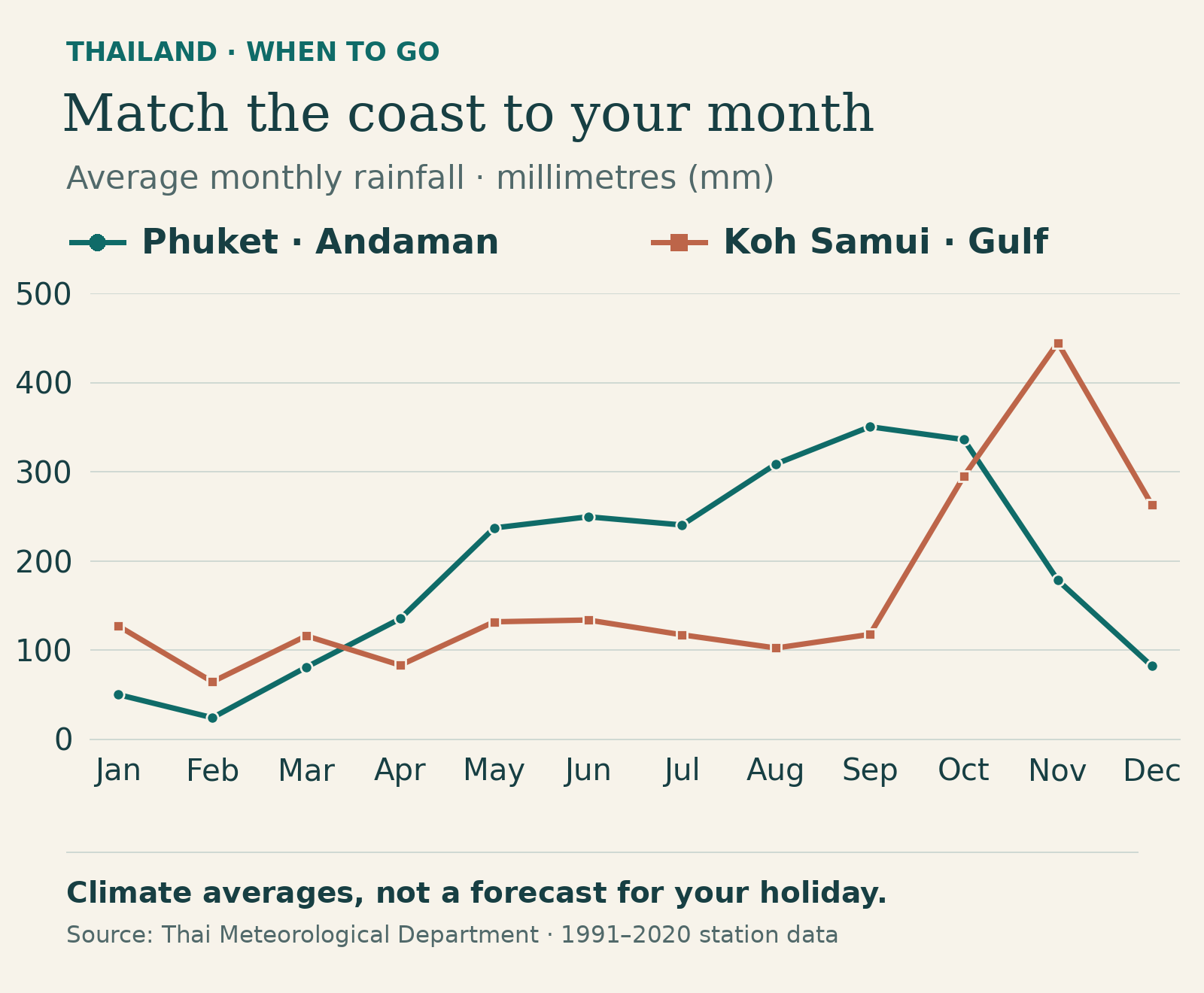
Phuket and Krabi face the Andaman Sea on the west. Samui, Phangan and Tao lie in the Gulf to the east of the southern peninsula. Thailand’s southwest and northeast monsoons affect those coasts differently, so a national “rainy season” label is not enough. [1]
| Month | Phuket | Koh Samui | Planning implication |
|---|---|---|---|
| February | 24.0 mm | 64.3 mm | Both coasts merit consideration. |
| August | 308.7 mm | 102.2 mm | Give Samui priority for a beach-focused summer trip. |
| November | 178.2 mm | 444.6 mm | Favour the Andaman over Samui, allowing for transition weather. |
Rainfall totals cannot tell you how many usable beach hours a particular week will have. Wind, waves and local warnings still govern swimming and boat trips.
Thailand month by month: where to focus
This is an editorial route selector based on the regional patterns above. It balances outdoor comfort, beach choice and flexibility; it is not a ranking of guaranteed sunshine or the cheapest dates. Each month can work if the route fits.
| Month | A useful trip to build | What to plan around |
|---|---|---|
| January | Bangkok, the north and an Andaman beach. | Popular winter dates; check northern air quality and allow for cool mountain evenings. |
| February | City sightseeing with either an Andaman or Gulf beach base. | A closer air-quality check before adding a northern hiking section. |
| March | A beach-led trip with shorter, early-morning city outings. | Heat and northern haze; avoid making long outdoor days the only attraction. |
| April | Songkran celebrations followed by a relaxed beach stay. | Strong heat and festival logistics. Keep time for cooling down and transfers. |
| May | A flexible city-plus-one-base trip; compare Gulf options. | A seasonal transition. Be cautious about an itinerary built around multiple Andaman boat trips. |
| June | Bangkok and Samui, with spare time rather than daily fixed tours. | Showers remain possible; a hotel with useful wet-weather facilities adds value. |
| July | A Gulf-focused family holiday, keeping island changes modest. | School-holiday prices can outweigh a national low-season label. |
| August | Samui as a beach base, plus city time before or after. | Make boat excursions optional and compare the coast before booking Phuket. |
| September | Slower travel with flexible rooms and indoor alternatives. | Wet-weather disruption can undermine a tightly scheduled, ferry-heavy trip. |
| October | A flexible city or inland trip; reassess beach conditions near departure. | Changing monsoons. Andaman reopenings do not mean settled seas, and Gulf rain can increase. |
| November | Northern Thailand plus the Andaman, especially later in the month. | Festival dates and transition rain; avoid treating Samui as the default beach extension. |
| December | A classic city, north and Andaman holiday. | Christmas and New Year demand; the southern Gulf can remain unsettled. |
For a fixed school-holiday week, flexibility may mean changing the destination rather than the dates. For an open-ended trip, it may mean fewer advance boat bookings. Those are different ways to manage the same seasonal uncertainty.
Rainy season, hot season and northern smoke
When is Thailand’s rainy season?
Much of Thailand becomes wetter with the southwest monsoon, roughly mid-May to mid-October. The southern Gulf coast is the major exception: the northeast monsoon can bring substantial rain later in the year, including December. The onset and end vary each year. [1]
A rainy-season trip can still work, but “it only rains for an hour” is too reassuring. Some days have short showers; a prolonged wet spell can change transport and activities. Choose a base you would enjoy without a boat trip, keep indoor options, and avoid a sequence of non-refundable island transfers.
When is Thailand hottest?
The hot season generally runs from around mid-February to mid-May, with April especially demanding for inland sightseeing. Southern destinations remain warm throughout the year. [11] For March or April, plan one main outdoor visit early, a shaded or air-conditioned break, and a more relaxed evening. A long midday walking route is a poor use of a short holiday if everyone is exhausted.
When should you be cautious about northern smoke?
NASA’s account of northern Thailand’s seasonal haze describes smoke developing in January–February, increasing through March–April and easing as rains arrive in May. Timing and intensity vary. [3] Check the official Air4Thai readings before committing to outdoor northern activities. A dry forecast does not mean clear air.
Cheapest and quietest times: compare the whole trip
There is no single cheapest month for every traveller. Flight origin, school holidays, the coast, room type and cancellation terms can outweigh the broad season. As a starting shortlist, compare May–June and September–October with your winter dates, then check whether the weather compromise suits the trip.
For example, TAT describes June–September on Koh Chang as quieter with more affordable accommodation, but also rainy. [6] That is a local trade-off, not proof that a Samui resort or a flight from Britain will be cheaper during the same week.
A useful three-check value test
- Compare your preferred dates with a nearby week using the same room and baggage assumptions.
- Add the cost and time of transfers. A cheaper hotel on the wrong coast may make the route worse value.
- Ask whether you would still enjoy the trip if a boat excursion were cancelled. If the answer is no, place more weight on season than on the room discount.
For quieter sightseeing, try to avoid the busiest holiday dates, stay longer in fewer places and give headline attractions an early start. For budgeting beyond the hotel, use the Thailand travel budget guide.
Choose a seasonal route, not just a month
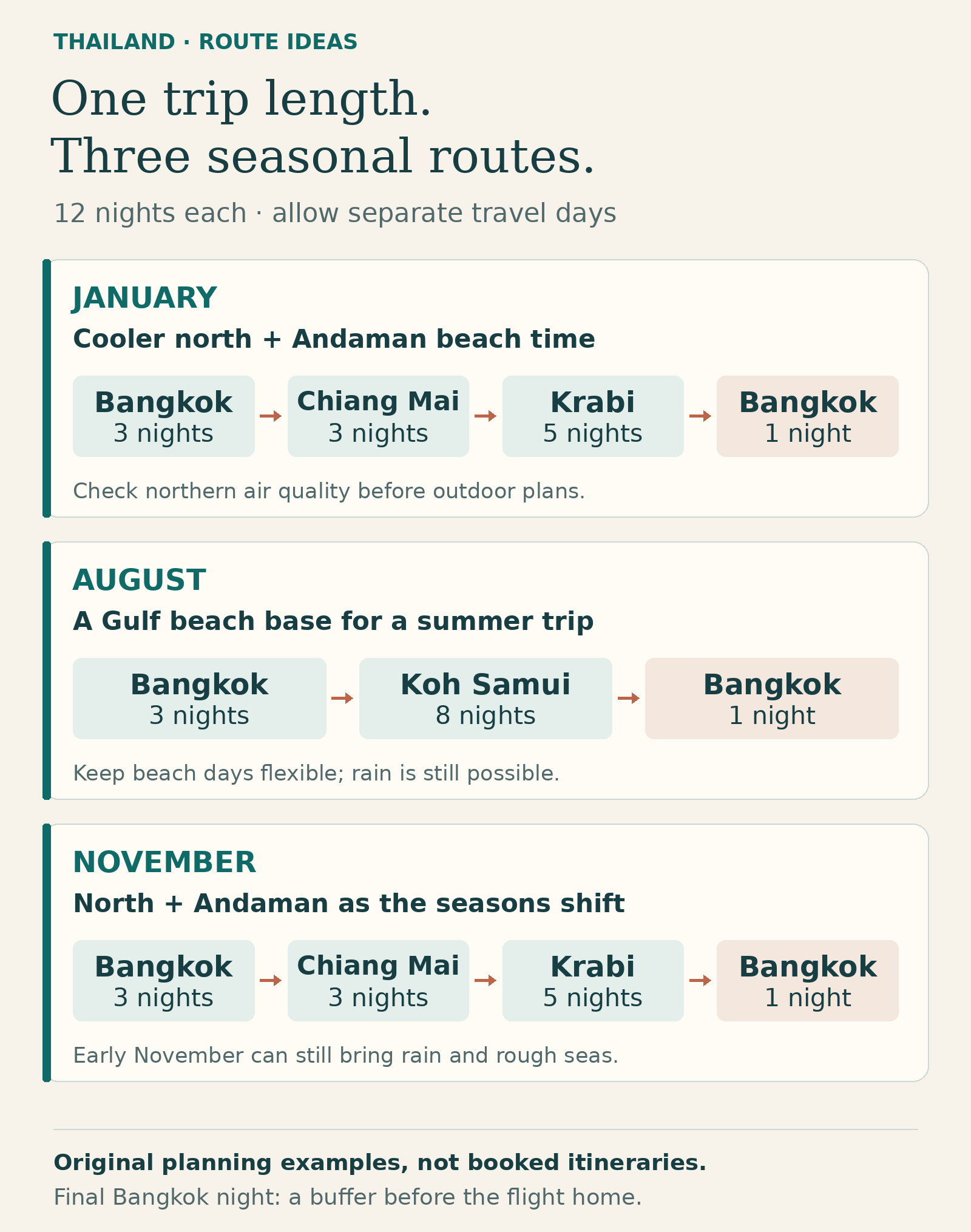
The following original examples all allocate 12 nights. They keep a final Bangkok night before a Bangkok international departure and show how the beach choice changes. They are planning models: internal travel uses part of a day, and flight or ferry availability must be checked for your dates.
January: culture and an Andaman beach
Three nights in Bangkok, three in Chiang Mai, five in Krabi and one back in Bangkok. This gives the north meaningful time without turning the holiday into constant transfers. Check air quality and keep the Krabi boat days adjustable around the short-range forecast.
August: one Gulf beach base
Three nights in Bangkok, eight on Samui and one final Bangkok night. The longer island stay makes it easier to move an excursion to a better day. Adding Phangan or Tao means another sea leg and another move; do it because that island adds something you want, not to fill a checklist.
November: north plus Andaman, with flexibility
Use the January outline, but keep sea excursions flexible while the Andaman season settles. If a festival is central to the northern stay, choose its actual local dates first. For a longer version, adapt the Thailand two-week itinerary rather than squeezing in extra islands.
Closures, festivals and what to book first
Check seasonal access before paying
Some marine attractions close seasonally. Mu Ko Similan National Park normally opens from 15 October to 15 May and closes from 16 May to 14 October; check the park’s current announcements before booking. [7] An official reopening date is not a promise that every tour will run or seas will be calm. TAT specifically cautions that October and early November can still bring rain and boat delays. [4]
Build festival travel around the event
Songkran’s usual core dates are 13–15 April, with some local celebrations extending beyond them. Reserve essential accommodation and transport early if those dates are fixed. [8] Loy Krathong follows the lunar calendar and usually falls in November; verify the destination’s programme for your year before booking around it. [9]
Book the hard-to-replace parts first
Secure international flights, particular family rooms or must-have stays, then fit internal transport around them. Leave more flexibility for weather-sensitive excursions. For a ferry-dependent island, returning to your departure city the day before the international flight gives more room than a tight same-day connection.
Pack for the route you actually chose
Keep the seasonal additions modest: a light layer for northern evenings, breathable clothing for heat, and rain protection for wetter months. A packable rain poncho or roll-top dry bag can be useful for wet journeys; these links show product searches, so compare the item’s actual specifications. The Thailand packing list covers the wider checklist.
Before a weather-dependent outing, check Thai Meteorological Department forecasts and warnings and the operator’s latest instructions. If you need mobile data to receive updates away from Wi-Fi, compare Airalo eSIMs, select Thailand and check your phone’s compatibility and the plan’s terms before buying.
Common questions about when to visit
Is there a worst month to visit Thailand?
No single month is worst for every route. September is a poor starting choice for a tightly scheduled Andaman island-hopping holiday; November is often a poor choice for a Samui trip that depends on settled beach weather. That is different from saying either month is unsuitable for the whole country.
Is July or August a bad time for Thailand?
Not automatically. For a beach-led trip, consider Samui, Phangan or Tao before choosing an Andaman itinerary. Keep some excursions flexible and compare school-holiday prices rather than assuming every hotel will be in low season.
Can you visit both coasts on one holiday?
Yes, but crossing coasts adds travel and may combine different seasonal compromises. With a short holiday, one well-chosen beach base usually leaves more usable time. Add a second coast only when it offers an experience you value enough to justify the move.
Is Christmas a good time for a Thailand beach holiday?
The Andaman coast is a useful starting point, particularly for a trip combining a beach with Bangkok or the north. Book sought-after stays early. Do not assume Koh Samui has identical conditions: the southern Gulf can still be unsettled in December. [1][4]
Can monthly weather averages predict my holiday?
Use climate patterns to choose the season and region, then use current forecasts and marine warnings for the final activity decisions. A monthly average cannot tell you whether your particular ferry or snorkelling trip will run.
Sources and editorial method
Reviewed on 22 October 2026. Seasonal facts are drawn from the official sources below. The regional windows, value test and 12-night routes are editorial planning recommendations; they are not a weather forecast, a personal trip account or a claim that particular services are available. Rainfall data are long-term station averages for 1991–2020, rather than this year’s forecast.
- Government of Thailand / Thai Meteorological Department: monsoon winds and Thailand’s climate — national timing and the southern Gulf exception.
- Thai Meteorological Department: Climatological Data of Thailand, 1991–2020 — Ko Samui and Phuket station rainfall tables, printed pages 71 and 82 (PDF pages 77 and 88).
- NASA Earth Observatory: Grappling with Thailand’s Seasonal Haze — seasonal fire and smoke patterns.
- Tourism Authority of Thailand: The Andaman Opens Its Doors Again — transition-season conditions and winter booking considerations, 20 October 2026.
- Tourism Authority of Thailand: Surat Thani brochure — Samui and Phangan’s broader February–September visitor window, read alongside measured rainfall.
- Tourism Authority of Thailand: Koh Chang seasonal guide — eastern-island seasons and quieter-period trade-offs.
- Department of National Parks: Mu Ko Similan National Park — normal opening and seasonal closure dates.
- Tourism Authority of Thailand: Songkran’s origins and observance — core April dates and local variation.
- Thailand Foundation / Ministry of Foreign Affairs: Loy Krathong — lunar-calendar timing; consult the current local programme for travel dates.
- Tourism Authority of Thailand: Ko Kut — cooler-season visiting window and low-season transport considerations.
- Government of Thailand / Thai Meteorological Department: seasons of Thailand — hot-season timing and April heat.
- Tourism Authority of Thailand: Ko Phi Phi — the broader November–April Andaman visitor window.
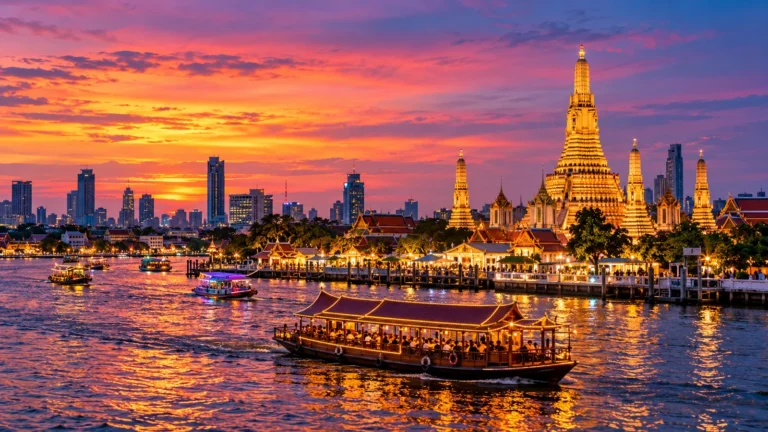
The hero is an AI-generated editorial illustration inspired by southern Thailand, not a photograph of a specific beach or a record of current conditions. The chart and route graphic were created for this guide.
Illustrations in this article were created for Taylor’s Trailblazing Travels. Third-party photographs, where used, are credited beside the image or in the source list.