Phuket Travel Guide for First-Time Visitors
Choose the right coast, make time for the old town and build a beach holiday that fits you.
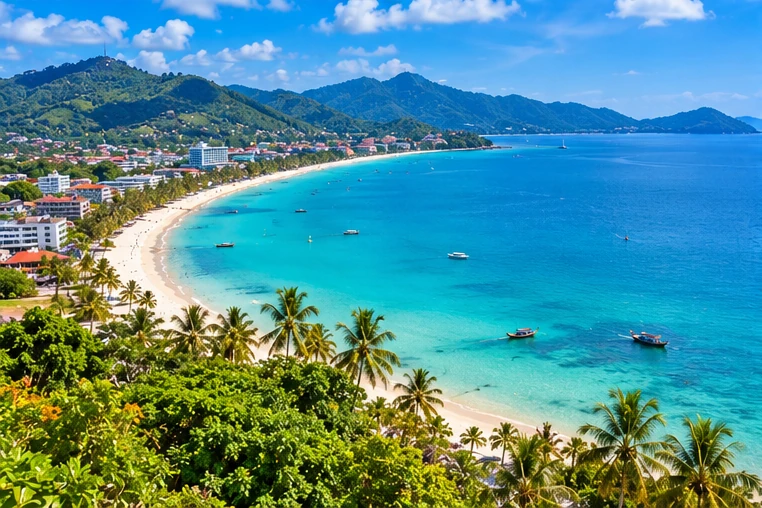
Original illustration inspired by Phuket's west-coast bays, not a photograph of a named hotel.
A Phuket travel guide for first-time visitors should begin with the hotel location, not a list of attractions. Phuket offers several very different holidays within the same island: a walkable beach stay, a busy nightlife base, a resort-led retreat or a food-focused visit to the old town. Choosing the wrong area can turn every meal and outing into a transport decision, even when the hotel itself is excellent.
The island works best when you group activities geographically and leave some empty space. A beach morning, a town afternoon and an excursion day can provide more variety than chasing five viewpoints between taxi rides. Boat trips also need flexibility, because the Andaman Sea does not follow a fixed holiday schedule. A famous stop on a brochure is never a reason to disregard conditions or park restrictions.
This guide is written for travellers building their first independent Phuket stay. It compares areas by practical fit rather than giving them an invented score, offers a realistic five-day framework and shows how to budget without presenting model allowances as hotel quotations. The advice is research-led, using tourism authorities, transport operators, current local reporting and official safety guidance rather than claiming personal visits. [1] [2] [3]
This article contains affiliate links. If you book or buy through one, Taylor’s Trailblazing Travels may earn a commission at no extra cost to you. Recommendations are based on their practical fit, not the commission available.
Kata or Kamala shortlist
Inspect the precise hotel access and evening options.
Compare Patong
Choose the room position with noise in mind.
Give Old Town time
Plan a walk, a meal and one checked attraction.
One main base
Add a boat day only when conditions suit.
Your first decisions
Phuket travel guide for first-time visitors: the essentials
Plan the holiday before choosing the room
Decide what you want to do on an ordinary evening. Walking to dinner is a different requirement from staying in a self-contained resort, and both differ from being close to late-night entertainment. An impressive hotel photograph cannot answer those questions. Check the map, the road outside and the likely route to the places you will visit repeatedly.
Next, decide how many outings you genuinely want. A traveller planning one boat day and one town visit does not need to optimise the whole island’s transport network. A traveller determined to explore widely should consider a driver for a geographically sensible day rather than assuming cheap spontaneous rides between every stop.
The four decisions to settle first
Choose your base, arrival transfer, one priority experience and departure plan. Leave less important activities adjustable until you see the weather and understand local journey times. This produces a more useful foundation than buying several discounted tours before checking whether their pickup zones include your hotel.
The shortlist below is based on a first-timer’s access to beach time, evening food, transport and variety. It is an editorial comparison, not a claim that one area is objectively superior. Individual hotels, room positions and the time of year can change the experience significantly.
First-time accommodation shortlist
On a small screen, swipe within the table to see every column.
| Area | Why shortlist it | Check before booking |
|---|---|---|
| Kata / Karon | A recognisable beach-holiday base | Exact beach walk, gradients and room position |
| Kamala | A beach-centred plan with less emphasis on nightlife | Hillside versus lower-area access |
| Patong | Nightlife and a lively resort atmosphere | Road/bar noise and your room position |
| Nai Yang / Mai Khao | A northern, more resort-oriented comparison | Dining access and longer south-island outings |
| Old Town | Food, architecture and an urban stay | No beach outside the hotel |
Beach bases with different rhythms
Where to stay: Kata, Karon and Kamala
Kata and Karon
Kata is a sensible first shortlist for travellers who want a recognisable beach holiday with dining nearby. Karon offers a different, broader beachfront setting, but the precise hotel location still matters. Neither area should be treated as a single compact pedestrian village. Check whether your room is behind the coastal road, up a hill or near the part of the beach you intend to use. TAT includes both among Phuket’s established beach areas. [1]
For families, prioritise a safe-feeling walk to meals, a suitable pool and a manageable room layout. For couples, consider whether the restaurant choice nearby is enough for the stay. A nominal sea view can be less useful than easy access when you expect to walk out several times a day.
Kamala and a quieter evening plan
Kamala is worth comparing when you prefer a beach-centred stay without making nightlife the main event. However, the broader area includes accommodation with very different access arrangements. A hillside resort and a room close to the beach’s restaurants should not be judged as though they offer the same walkability.
Ask the property for the route to the beach and whether any shuttle operates on a timetable that suits your evenings. A shuttle available only at limited times may be helpful, but it is not equivalent to walking out whenever you like. Choose convenience deliberately rather than discovering that your quiet retreat requires a taxi for every simple errand.
Choose the atmosphere you want
Patong, the north and Phuket Old Town
Patong is a choice, not an obligation
Patong belongs on the shortlist when a lively atmosphere and nightlife are priorities. It need not be the automatic base for everyone merely because it appears prominently in booking searches. Examine the hotel’s position relative to busy roads and entertainment streets, and read recent room-specific comments about noise rather than relying on an overall property score.
Travellers seeking a quieter stay can investigate northern beach areas such as Nai Yang or Mai Khao. TAT describes northern beaches as generally more tranquil than busier southern areas, but that is a broad orientation rather than a guarantee for a particular resort. Check dining access and the cost of reaching any south-island activities on your list. [1]
Old Town is not a beach substitute
Phuket Old Town suits a food-and-architecture stay or a short split visit. Its shophouses, museums and streets reward time on foot, but it does not put a swimming beach outside your room. Choose it because you want the town experience, not because a cheaper room looks close to the sea on a small map. [4]
For most four- or five-night visits, one beach base plus a town outing is simpler than changing hotels. A longer stay can justify a separate Old Town night, particularly around a planned food walk or market evening. Count the packing and transfer time before deciding that a split stay adds value.
Start with the exact hotel
Arriving at Phuket Airport
HKT is only the beginning of the journey
Phuket International Airport uses the code HKT and sits towards the island’s northern end. Your onward journey depends heavily on the chosen area. A nearby northern hotel and a southern beach resort are different transfer tasks, so compare transport to the precise entrance rather than accepting a generic Phuket price. The airport publishes taxi, bus, rental and other ground-transport information. [2]
After an international arrival, allow for the entry process and baggage before any collection. Save the driver’s meeting instructions offline and check the arrival terminal on the booking. A private transfer should specify the vehicle, passenger and luggage capacity, waiting policy and final drop-off, not simply show a photograph of a minivan.
Bus or private vehicle?
The Phuket Smart Bus is a useful option when its coastal route matches your destination and you can handle the final walk from a stop. Its airport-to-Rawai route serves major west-coast areas, but it is not a door-to-door hotel service. The operator listed a THB 100 flat fare for that route at the 3 October 2026 check; verify the current timetable and stop before committing. [3]
A private car or van can make more sense with children, bulky luggage or a hotel away from the route. Compare the whole-party quote with bus fares plus any final ride. For a late arrival, confirm what actually operates at that time rather than relying on a daytime schedule.
Group nearby stops
Getting around without spending the holiday in traffic
Build a day around one part of the island
Treat north, west-coast beaches, Old Town and the southern viewpoints as separate planning areas. You can combine some of them, but repeatedly criss-crossing the island makes a relaxed day harder. Put the places you most want to visit on a map and remove low-priority stops that require a disproportionate detour.
A private driver can be useful for a multi-stop day when you agree the route, total duration, waiting and any extra charges beforehand. Confirm whether the quote is for transport only or includes a guide. A driver who takes you to a temple is not necessarily providing an interpretation of its history.
Public transport has specific routes
Phuket Smart Bus publishes its routes and live tracking, including coastal and town-related services. Use those details for the journey you need instead of assuming a single bus loops past every attraction. The cheapest possible route may involve waiting or a walk that feels less attractive in midday heat. [3]
App-based transport can be convenient, but check the fare and pickup instructions at the time of travel. When planning an outing far from your hotel, consider the return arrangement as well as getting there. Do not book a one-way ride to a remote viewpoint without understanding how you will leave.
Swimming and expectations
Beach days: choose conditions, not photographs
A beautiful bay can still be unsafe
Check flags and local instructions on the day. Red flags are not merely a warning that swimming might be less pleasant; stay out when swimming is prohibited or advised against. UK travel guidance highlights dangerous coastal currents, particularly during the monsoon, and a confident swimmer should not treat that advice as optional. [9]
Water appearance also changes with wind, rain, tide and sand movement. A promotional image of flat turquoise sea does not promise those conditions throughout the year. Choose accommodation with a pool or attractive indoor space when beach swimming is central to the trip but your dates fall in a more changeable period.
Keep one beach morning uncomplicated
For a first visit, spend enough time at the beach near your base to discover whether you actually enjoy it. There is little benefit in paying for several transfers to collect brief stops at bays that feel similar to you. A second beach outing is worthwhile when it offers a clear difference, such as quieter surroundings or a different dining area.
Bring sun protection, drinking water and something to keep valuables dry, but do not leave important belongings unattended while everyone swims. Check any equipment hire and local restrictions before using it. Boat lanes, water sports and swimming areas need to be respected rather than treated as one open playground.
Streets, food and architecture
Phuket Old Town: give it an afternoon and evening
Visit for more than a quick photograph
TAT describes the old quarter around roads including Thalang, Dibuk, Phang Nga and Soi Romanee, with a history reflected in Sino-European shophouses. Plan a walk that leaves room for a museum, a drink and a meal rather than racing between colourful facades. The value is in seeing how the streets fit together, not just reproducing one familiar picture. [4]
Start earlier or later in the day when possible, and allow pauses in shade. Shops, galleries and small museums have their own opening arrangements, so choose one or two specific places to check before travelling across the island. A neighbourhood itself may be accessible while the attraction you wanted is closed.
Sunday market planning
The TAT listing gives the Sunday walking market on Thalang Road as 16:00-22:00; that published schedule was checked on 3 October 2026 and should be reconfirmed around weather, events and holidays. A market evening is a useful anchor for a town visit, but arrange the return transport before you are tired and carrying purchases. [4]
A guided food walk can help when you want context and several tastings without deciding each stop yourself. Compare included dishes, dietary accommodation, walking distance and the meeting point. It should solve a genuine planning need, not simply add another reservation to an already full day.
Culture without an overloaded circuit
Temples and viewpoints
Wat Chalong is a place of worship
Wat Chalong, also known as Wat Chaitaram, is an important temple in Phuket rather than a decorative backdrop. Dress respectfully, follow the rules for entering buildings and avoid obstructing worshippers for photographs. TAT’s official entry provides its location and cultural context; current opening arrangements should be checked before you make a special journey. [5]
Combine the visit with a compatible outing rather than trying to connect every temple, beach and viewpoint in one day. Allow enough time to look around without turning a religious site into a hurried stop between commercial activities. Carry appropriate clothing instead of relying on a loan or purchase being available.
Big Buddha needs a fresh access check
Local reporting in March 2026 described the reopening of the Big Buddha site under conditions after its extended closure. That is not a reason to assume that every approach road or part of the site will be open during your visit. Check access with the site or a reliable local operator shortly beforehand, particularly after heavy rain. [6]
Avoid building the whole day around an unverified stop. If access is restricted, keep Wat Chalong or the town visit as the confirmed core of the plan. The same principle applies to viewpoints generally: a good itinerary should survive one closure without requiring unsafe improvisation or a long, disappointing detour.
Pick a boat day with a purpose
Phang Nga Bay or Phi Phi?
Two different experiences
Phang Nga Bay is associated with limestone formations, islands and cave or canoe excursions. A tour can be a good choice when scenery and exploring the bay are the priority. Phi Phi-oriented trips are a different proposition, usually involving more open-water travel and a selection of island or snorkelling stops. Read the route rather than selecting by the most famous photograph. [7]
For a first four- or five-night Phuket stay, one carefully chosen sea day is often enough. Two consecutive excursions can leave little time for the island itself and make the holiday more vulnerable to weather. Compare the pickup time, pier, boat size, group capacity and actual time ashore before deciding.
Treat Maya Bay as a regulated visit
Maya Bay access has conservation restrictions and can change seasonally or with conditions. Do not buy a trip expecting unrestricted swimming simply because the brochure includes a beach image. Ask the operator which park rules apply on the travel date, whether the stop is operating and what replaces it if access is unavailable. [8]
National-park fees, meals, snorkelling equipment and hotel collection may or may not be included. A cheaper listing can become less attractive after those additions. Keep some flexibility in your preferred day and avoid scheduling the sea trip immediately before an unprotected flight departure.
Read beyond the sales language
How to choose a responsible excursion
Safety and inclusions before discounts
Look for a clearly named operating company, understandable cancellation terms and specific information about the itinerary. Check restrictions affecting children, pregnancy, mobility or other conditions with the operator and an appropriate professional where necessary. A speedboat trip is not automatically suitable merely because the booking form accepts your reservation.
Ask what happens when weather changes the route. Some operators offer an alternative itinerary; others cancel according to their terms. There is a difference between choosing not to travel and the company cancelling the service. Understand both situations before paying, especially when the sea day is a major reason for the holiday.
Wildlife encounters need scrutiny
The word sanctuary does not establish good animal welfare. World Animal Protection recommends observation-led elephant experiences rather than riding, bathing or touching. Use that as a practical screening test, then examine the actual venue’s programme rather than relying on a marketplace category label. [12]
The same care applies to wildlife photographs on the street or in a tour brochure. You can enjoy the destination without paying for an animal to pose or perform. When a tour combines a worthwhile activity with an encounter you do not support, ask whether the itinerary can be changed or select a different excursion.
Build variety into the day
Eating well without a restaurant checklist
Let the area guide the meal
Phuket’s food identity is a reason to spend time beyond a generic beach menu. TAT’s Old Town material highlights influences from the island’s trading communities and Hokkien noodles and the town’s Chinese-Thai cultural heritage. A town visit offers a convenient opportunity to explore that variety without travelling across the island solely for one recommended plate. [13]
Choose a few dishes you are interested in and leave room for what looks appealing on the day. A busy kitchen with clearly handled food and transparent prices is more useful than a claim that a place is secret or authentic. When ordering seafood sold by weight, confirm the weight, preparation and total before it is cooked.
Dietary needs need an actual conversation
Communicate allergies and dietary restrictions directly, ideally with a clear written translation when the consequences matter. A dish that appears vegetarian may contain ingredients in its sauce or stock that you would avoid. Do not rely on the absence of a visible ingredient or on a crowded tour guide remembering every request.
A cooking class can provide a structured alternative to another sightseeing circuit, especially on a less suitable beach day. Compare how much cooking you do yourself, whether a market visit is included and whether the menu can accommodate your needs. Check that the collection zone includes your hotel rather than assuming all Phuket pickups are identical.
Four nights, useful variety
A realistic five-day first visit
Day one: arrive and establish the base
Travel to the hotel, check the immediate area and keep the first meal simple. Find the route to the beach and a convenient shop, then leave the rest of the day open. A late arrival or a slow airport process should not force you to cancel a paid activity.
Use the evening to confirm the next day’s transport and review the marine forecast for the boat excursion. Avoid turning the first night into an attempt to see every entertainment area. The point is to recover from travel and learn how the location works.
Days two and three: beach time and the old town
Spend one morning at your local beach, swimming only when conditions permit. Add a nearby second stop if it offers something different, then return without a complicated circuit. Use another day for Old Town and, if geographically sensible, a temple visit. Allow time for food rather than treating lunch as an inconvenience between attractions.
Where the calendar suits, place the town visit on Sunday for the published market programme, but do not distort the entire stay around it. A quieter town walk on another day can also be rewarding. Your priorities should determine the timing, not a checklist’s insistence that every event is compulsory.
Days four and five: one excursion and a protected exit
Use a suitable day for the selected boat trip, with the option to swap it with the beach or town day when conditions require. On the final day, keep activities close to the base or airport route. Leave adequate time for checkout, the road journey and the airline’s check-in requirements.
This is a framework rather than a fixed timetable. Travellers with five full nights can add a genuinely free day, a cooking class or a second beach area. The extra day should improve the pace, not simply provide space for more early starts.
Five calendar days, with room to adapt
On a small screen, swipe within the table to see every column.
| Day | Main idea | Keep flexible |
|---|---|---|
| 1 | Arrive, settle and walk locally | No paid activity tied to landing time |
| 2 | Your base beach and a nearby contrast | Swimming follows flags and conditions |
| 3 | Old Town, food and optional temple | Check specific opening arrangements |
| 4 | One suitable boat excursion | Swap with another day for weather |
| 5 | Local time and airport transfer | Protect checkout and airline reporting time |
Adjust the scope, not just the speed
Phuket in three days or a week
Three days means making choices
With three calendar days including arrival and departure, choose one base and one main outing. A beach visit plus Old Town can produce a satisfying first impression without a boat tour. Alternatively, a traveller whose main interest is Phang Nga Bay can reserve that as the priority and keep the rest close to the hotel.
Do not compress a five-day programme by shortening every stop. Transport time does not shrink just because the holiday does. When the trip is brief, selecting a base with dining and beach access becomes especially important because it reduces the number of arrangements needed for ordinary enjoyment.
A week creates room for contrast
With seven nights, you can add a quieter northern area, a second marine excursion on a suitable day or a short Old Town stay. Consider a split only when the second base changes the experience substantially. Moving from one similar resort to another may add admin without much benefit.
Keep a rest day between demanding excursions. You may discover that the hotel’s pool, a familiar restaurant or an unplanned walk is exactly what you wanted from the holiday. A good itinerary leaves enough room to recognise that rather than making every hour serve a booking.
Model allowances, not promised prices
Budgeting for the trip
Separate fixed and flexible spending
Flights and accommodation are the largest fixed choices for many visitors, while transfers and excursions can materially change the total. Price the room for your exact occupancy, including breakfast, taxes and any extra-bed charge. Then add the transport needed because of that room’s location. A cheaper isolated property may cost more once daily travel is included.
The table below is an illustrative allocation model reviewed on 3 October 2026, not a survey of current hotel quotes. It assumes two adults sharing a room and is intended to help you decide what to price. Festive dates, premium resorts, private boats and expensive dining can take spending well beyond these allowances.
Illustrative five-day / four-night couple budget
On a small screen, swipe within the table to see every column.
| Item | Example allocation | Calculation / scope |
|---|---|---|
| Shared room | THB 12,000 | 4 nights x THB 3,000; chosen assumption |
| Meals and non-alcoholic drinks | THB 6,000 | 5 days x THB 1,200 for two |
| Airport and local transport | THB 4,000 | Group allowance, not a quoted fare |
| One boat day and selected activities | THB 6,000 | Two-person allowance; check park fees |
| Contingency | THB 3,000 | Unplanned needs and changed transport |
| Model total | THB 31,000 | Excludes flights, insurance, shopping and alcohol |
Illustrative allocation prepared 3 October 2026, not observed live market rates or a bookable package. Replace assumptions with your quotes.
Keep the units consistent
A room price is normally per room per night, while an excursion is often per person and an airport car is often per vehicle. Mixing those units is a common reason holiday totals look unexpectedly low. Write down who pays, how often and whether the item is already included elsewhere.
For boat trips, ask about park fees and hotel pickup. When hiring a driver, confirm whether parking and waiting are included. For a hotel, compare the final payable amount rather than the first nightly figure on a search page. A modest contingency is useful, but it should not conceal known costs that could have been included from the start.
Flexibility is part of the plan
Weather and the time of year
Seasonal patterns are not daily forecasts
Phuket is on the Andaman coast, where the southwest monsoon can bring rougher seas and wetter periods. Broadly, the drier-season months are the usual starting point for a beach-focused visit, while transitional and wetter months call for more flexible expectations. There is no month in which a beach flag or marine warning can be ignored. [1] [9] [10]
Use the Thai Meteorological Department close to the trip rather than relying on an annual chart alone. At the 3 October 2026 review, its regional bulletin discussed thundershowers and sea conditions; that is a reminder to check a date-specific forecast, not a prediction for your holiday months later. [10]
Have a useful wet-weather alternative
Old Town, a cooking class, a museum or a relaxed hotel day can replace a beach outing, provided the roads and local conditions are suitable. A rainy-day alternative should not require driving through flooding or climbing a slippery hill just to avoid an empty itinerary.
Keep the most weather-sensitive reservation movable where the terms allow. Ask the hotel about cancellation and transport consequences when severe weather affects your arrival. Paying attention to conditions is part of enjoying the coast responsibly, not a failure to complete the planned attractions.
Practical preparation
Entry, money, connectivity and safety
Check the rules for your passport
Entry requirements depend on nationality, purpose and length of stay. Verify them with the relevant official immigration or embassy guidance rather than assuming a previous holiday’s conditions still apply. The official Thailand Digital Arrival Card service is separate from any visa permission; use the government system and its current submission instructions for an international arrival. [11]
Keep your first accommodation address and onward arrangements accessible. Save essential documents securely and avoid handing your passport over as a rental deposit. UK travel advice includes guidance on documents, road risks and common travel problems, but travellers of other nationalities should also check their own government’s advice. [9]
Make communication work before an urgent problem
Set up your chosen connectivity option and save the hotel number before travelling. Check that an eSIM is compatible with an unlocked device and understand whether the package provides data only or includes calling. Keep a backup way to contact the hotel if a transfer message cannot be delivered.
For driving, confirm that your licence and insurance cover the exact vehicle. A holiday scooter is not a harmless substitute for a taxi when you lack experience. Choose suitable transport, wear required safety equipment and do not assume a rental agreement proves that an insurer will cover you. [9]
A destination with several versions
Pros and cons of Phuket
Why it can work very well
Phuket offers an airport gateway, a broad choice of accommodation and enough variety for a beach holiday that is not entirely dependent on the sea. A well-chosen base can give you easy dining and straightforward access to a few excellent outings. Travellers who value comfort and choice may find those practical strengths more useful than chasing the idea of an undiscovered island.
The trade-offs are development, traffic and the need to understand distances. Some visitors are disappointed because they expected every part of Phuket to feel quiet and secluded. Others book an isolated retreat and then wish they could walk to more places. Both problems begin with a mismatch between the chosen area and the expected holiday.
Why Phuket may or may not fit
On a small screen, swipe within the table to see every column.
| Strength | Benefit for a first trip | Trade-off |
|---|---|---|
| Choice of bases | Different beach and town experiences | Area selection needs care |
| Airport gateway | A straightforward regional entry point | Longer transfers to some coasts |
| Activity variety | Beach, food, culture and sea days | Overplanning creates traffic-heavy days |
| Accommodation range | A broad comfort and budget comparison | A room price does not show its transport costs |
Phuket or another Andaman base?
Choose Phuket when its flight options, hotel range and mix of town and beach activities suit you. Consider a different base when a smaller-scale coastal stay or a particular landscape is the central goal. There is no need to turn the choice into an overall contest: the precise hotel area and travel style matter more than the destination name alone.
For a split trip, compare the time spent transferring against the additional experience. A week can disappear quickly when too many nights are allocated to packing, checking out and crossing to another destination.
Fix the plan before departure
Common first-time mistakes
Trying to see the island in one day
A long list of beaches, temples, viewpoints and boat piers does not create an efficient circuit. Group nearby places and keep a realistic lunch break. When the day looks rushed on paper, it will not become more relaxed in heat or traffic.
Another common mistake is selecting a hotel solely by star rating. Confirm the beach access, dining options, room position and actual journey to your preferred activities. A lower-priced property in the right place can offer a better holiday than a more impressive one that repeatedly creates transport problems.
Confusing availability with suitability
A tour being bookable does not mean the weather is suitable, the activity fits every passenger or all fees are included. Read the restrictions and confirm special requirements before paying. Likewise, do not interpret a reopened attraction as a guarantee that every part of it remains accessible indefinitely.
Keep the final day simple. A distant excursion before an important flight introduces a dependency that a relaxing beach morning does not. Protect the departure and finish the trip with enough time to enjoy it rather than turning the last hours into a race.
First-trip decisions answered
Frequently asked questions
Which area is best for a first visit?
Kata and Kamala are useful starting points for a balanced beach holiday, while Patong suits travellers prioritising nightlife and Old Town suits a more urban, food-focused stay. The best fit still depends on the individual hotel’s access and your evening plans. Compare those details before relying on an area label.
How many nights should I stay?
Four or five nights provides room for a beach day, a town visit and one excursion, allowing for arrival and departure. A week offers more flexibility and a slower pace. With fewer nights, remove activities rather than expecting transfers and boat days to take less time.
Do I need to hire a scooter?
No. A suitable base, airport transfer, selected bus journeys and occasional private transport can cover a first visit. Hire a vehicle only when you have the appropriate licence, experience and insurance and it genuinely improves the itinerary. The potential saving is not a reason to learn to ride in unfamiliar traffic.
Is Phuket Old Town worth staying in?
Yes for travellers who specifically want its streets, food and architecture, but it is not a beachfront base. A shorter first holiday can work better with a beach hotel and one substantial town visit. A longer trip may justify a separate night when it gives you an experience you would otherwise miss.
Can I swim throughout the year?
Swimming suitability depends on the beach and conditions on the day. Follow flags, lifeguards and local advice rather than assuming that a popular resort beach is always safe. Choose a hotel with a pool when swimming is a high priority and your travel dates may bring rougher seas. [9]
Is an airport-area final night worthwhile?
It can be useful before an early flight when your main hotel is far south or when you would otherwise worry about the road transfer. Compare the extra packing and hotel change with the simpler departure. A nearby room is not automatically necessary for every flight; choose it when it removes a genuine timing problem.
Can I combine Phuket and Krabi in one week?
You can, but count usable days rather than destinations. One transfer and two substantial stays may work, while several island additions can consume too much time. Check the actual hotel-to-hotel journey and avoid booking an immediate excursion after the move. With a short week, staying in one well-chosen base may offer more relaxation and still provide substantial variety.
Should I book Phi Phi or Phang Nga Bay?
Choose by the experience you want: an island-and-snorkelling itinerary is different from a bay-focused scenery or canoe trip. Compare the actual route, sea travel, group size, access restrictions and inclusions. Booking both is not essential for a satisfying first Phuket visit.
One base, a few good days
Final recommendation
Choose a hotel area that suits your ordinary evenings, reserve a clear arrival transfer and plan one beach day, one town-and-culture outing and one optional sea excursion. Keep the boat day responsive to conditions and give the final airport journey a comfortable margin. This is enough structure to make the first visit work without removing spontaneity.
For most first-time visitors, Phuket becomes easier when the plan is smaller and more deliberate. Spend less effort collecting stops and more effort choosing the right location, suitable transport and experiences you actually want. The island has room for several kinds of holiday; the useful task is choosing yours.
Research and verification
Sources and fact-checking notes
The accommodation areas and itinerary are editorial recommendations, not hotel inspections or a ranking by review score. The Smart Bus fare and market schedule are dated published references; accommodation budgets are transparent planning models. Verify access, conditions and final prices for your own dates.
- TAT: Phuket destination overviewBeach areas and island orientation. Reviewed 03 October 2026.
- Airports of Thailand: Phuket transportOfficial airport ground-transport information. Reviewed 03 October 2026.
- Phuket Smart Bus: official routesAirport-Rawai fare and route information checked 3 October 2026; use live route details. Reviewed 03 October 2026.
- TAT: Phuket Old TownArchitecture, principal streets and published Sunday market schedule. Reviewed 03 October 2026.
- TAT: Wat ChalongTemple location and cultural context. Reviewed 03 October 2026.
- The Phuket News: Big Buddha conditionsLocal reporting dated 7 March 2026 on conditional reopening; access should be rechecked. Reviewed 03 October 2026.
- TAT: Phang Nga BayBay scenery and nature-based excursion context. Reviewed 03 October 2026.
- Simba Sea Trips: Maya Bay access rulesOperator explanation of regulated access. Its dated closure banner is not treated as a live open/closed status. Reviewed 03 October 2026.
- FCDO: Thailand safety and securityCoastal currents, road risks and activity precautions. Reviewed 03 October 2026.
- Thai Meteorological Department: Andaman forecastRegional marine/weather information; check the current date. Reviewed 03 October 2026.
- Thailand Immigration: TDACOfficial digital arrival-card service; separate from visa permission. Reviewed 03 October 2026.
- World Animal Protection: elephant-friendly tourismObservation-led animal-welfare screening. Reviewed 03 October 2026.
- TAT: travelling around Phuket Old TownLocal cultural context and Hokkien-noodle example. Reviewed 03 October 2026.
Illustrations in this article were created for Taylor’s Trailblazing Travels. Third-party photographs, where used, are credited beside the image or in the source list.