Thailand planning guide
A practical UK-focused guide to medical treatment, evacuation, scooters, diving, cancellations, baggage and claims—without paying for impressive-looking benefits that do not match your trip.
Affiliate disclosure
This guide contains selected affiliate links to transport, accommodation, activities, connectivity and travel products. Taylor’s Trailblazing Travels may earn a commission if you book or buy through them, at no extra cost to you. No insurer has paid to appear here, and no insurance provider is recommended through an affiliate link. As an Amazon Associate I earn from qualifying purchases.
A Thailand holiday can feel inexpensive right up to the moment when something goes wrong. A short domestic flight may cost less than a UK train ticket, yet an unexpected hospital admission, medical transfer, cancelled island connection or scooter injury can create a bill that bears no relation to the original holiday budget.
The most useful way to choose Thailand travel insurance is not to chase the longest benefit list. Start with the costs that would be difficult to pay yourself: emergency medical treatment, authorised evacuation or repatriation, cancellation of non-refundable bookings and liability arising from a serious incident. After that, check whether the policy actually covers the activities, transport and possessions on your itinerary.
That order matters in Thailand. UK government guidance says public and private hospitals charge for treatment, care is rarely free, and hospitals can require proof or a guarantee of payment. A UK GHIC is not valid in Thailand, while private facilities can be expensive. The policy wording—not a comparison-site summary—is therefore the document that decides whether your claim succeeds.
Important: this UK-focused guide is general information, not personal insurance or financial advice. Policy wording, eligibility and exclusions differ. Read the full policy and, where needed, use an appropriately authorised adviser.
Thailand travel insurance should include emergency medical treatment, medical evacuation or repatriation, cancellation, baggage, personal liability and cover for every planned activity. Declare pre-existing conditions, check scooter licence and helmet rules, confirm diving depth and supervision limits, compare excesses and single-item limits, and buy once meaningful non-refundable bookings are made. A UK GHIC cannot be used in Thailand.
Thailand travel insurance: quick answers
Most important benefit
Emergency medical treatment with evacuation or repatriation and a genuine 24-hour assistance service.
When to buy
As soon as flights, accommodation or other meaningful non-refundable costs are booked.
GHIC in Thailand
A UK GHIC is not valid in Thailand and never replaces travel insurance or repatriation cover.
Scooter warning
Cover may fail without the correct UK motorcycle entitlement, 1968 IDP, helmet and policy permission.
Diving warning
Depth, certification, supervision, operator credentials, oxygen and hyperbaric transfer conditions all matter.
Emergency numbers
Call 1669 for the medical emergency network. Tourist Police can be reached on 1155; police emergencies use 191.
Do you need travel insurance for Thailand in 2026?
Entry rules and sensible protection are separate questions
For the most common British tourist visit, current UK government entry guidance does not list a blanket travel-insurance certificate as a standard requirement. That does not make insurance optional in any practical sense. Visa categories, work arrangements and organised programmes can have their own rules, so check the exact Thai visa or programme conditions that apply to you.
Insurance exists for the financial consequences of illness, injury, cancellation and disruption. Thailand does not have a reciprocal healthcare arrangement that makes a UK GHIC useful, and treatment is not automatically free. Even a traveller who could pay for a routine clinic visit may struggle to fund surgery, intensive care, an air ambulance or an escorted journey home.
Check official travel advice before buying and before travelling
The FCDO currently advises against all but essential travel to some parts of Thailand. It also warns that travelling against its advice can invalidate insurance. A route can change after a policy is bought, so check current FCDO Thailand travel advice when comparing cover, again before departure and whenever you change regions.
Karen Taylor planning note
I would treat the destination wording as a route check, not a country checkbox. A policy that covers “Thailand” may still exclude a province, border area, transit country, cruise or activity. Write down the real route first, including airport stopovers and island connections, then test the policy against that list.
What should Thailand travel insurance cover?
A good policy is built around losses that would be hard to absorb. Medical treatment and repatriation come first. Cancellation follows when the trip contains expensive non-refundable bookings. Activity, liability, baggage and disruption wording then decide whether the cover fits the itinerary rather than merely looking comprehensive on a summary page.
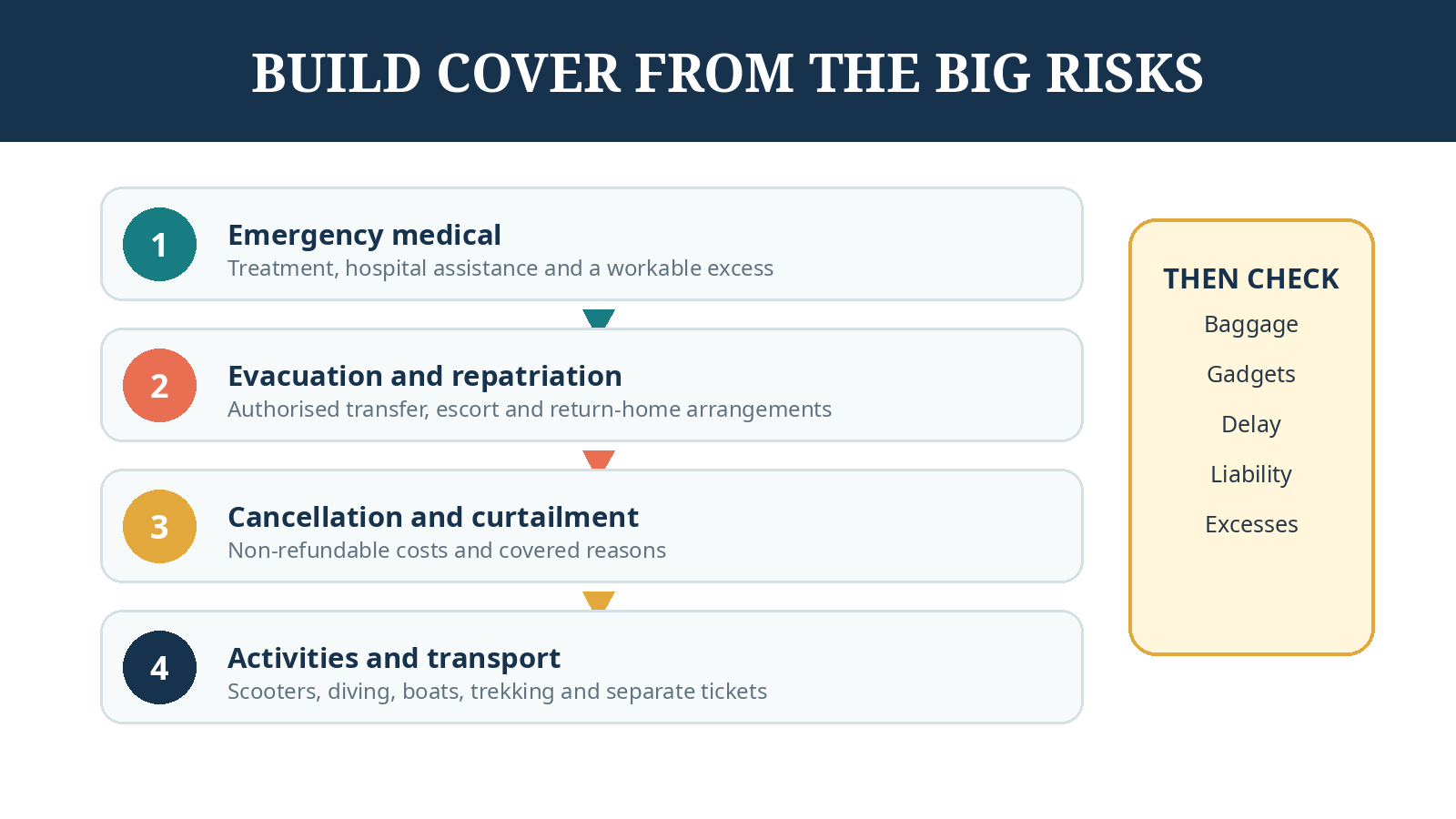
| Cover area | What to inspect | Why it matters in Thailand | Common trap |
|---|---|---|---|
| Emergency medical | Limit, excess, exclusions, direct-settlement process and 24-hour assistance | Hospitals charge, and a serious admission can include tests, surgery and specialist care | Looking only at the headline limit |
| Evacuation and repatriation | Who authorises movement, suitable transport, medical escort and return-home arrangements | Island or provincial treatment may require transfer within Thailand or back to the UK | Assuming any self-arranged flight will be reimbursed |
| Cancellation and curtailment | Covered reasons, total trip cost, unused bookings and early-return expenses | Domestic flights, villas, dive courses and tours can become non-refundable | Buying after a known event develops |
| Activities | Exact activity name, depth, altitude, engine size, licence, guide and equipment conditions | Scooters, diving, snorkelling, trekking and boat trips are common | Relying on the phrase “adventure cover” |
| Delay and missed departure | Accepted causes, minimum delay, separate-ticket rules and evidence required | Monsoon weather and island transport can affect onward connections | Assuming every missed connection is insured |
| Baggage and gadgets | Single-item limit, valuables definition, depreciation and unattended-property exclusions | The total baggage limit may be much higher than the amount payable for a phone | Comparing total limits instead of item limits |
| Personal liability | Injury and property-damage wording, exclusions for vehicles and rented equipment | A serious accident can involve another person, hotel or operator | Thinking travel insurance replaces vehicle damage cover |
Read the definitions, endorsements and exclusions
Benefit tables are only the front door. Search the full policy wording for “motorcycle”, “scooter”, “scuba”, “unattended”, “pre-existing”, “alcohol”, “reasonable care”, “separate tickets”, “official advice” and “excess”. Also read any medical-screening endorsement and activity upgrade because those documents can change the standard wording.
Do not let small benefits hide a weak core
A generous allowance for delayed luggage is useful, but it should not compensate for vague evacuation terms or an activity exclusion. Likewise, a £3,000 baggage headline can be poor value when the phone limit is £300 and a separate excess applies. Compare the expensive risks first; only then rank convenience benefits.
How much medical cover do you need for Thailand?
There is no single universal “correct” number
Consumer guides use different benchmarks, and insurers structure limits differently. MoneyHelper gives example minimums for some destinations rather than a Thailand-specific figure, while consumer comparison criteria may start at several million pounds. The safest approach is to choose a substantial limit that includes emergency treatment and authorised repatriation, then examine exclusions and assistance quality as closely as the number.
| Comparison question | Why it matters more than a large headline | What to look for |
|---|---|---|
| Is repatriation included inside the medical limit? | A medically appropriate return can require specialist transport and an escort | Clear wording for evacuation, repatriation and funeral or return-of-remains costs |
| Does the assistance team authorise treatment? | Hospitals may ask for payment assurance while the insurer assesses the case | A 24-hour number, case management and direct-settlement procedures |
| Are chronic and recent conditions accepted? | An undeclared condition can affect a related claim | Written acceptance after complete screening |
| Are activity injuries covered? | A high medical limit is irrelevant if the incident falls under an excluded activity | Named cover for every activity with conditions you can meet |
| How many excesses can apply? | One incident can trigger medical, baggage and curtailment sections | Excess per person, per claim and per section clearly stated |
Published hospital room charges show why “Thailand is cheap” is misleading
Room charges are only one part of a medical bill, yet current published rates provide useful context. Bumrungrad International lists 2026 total daily charges of US$320 for a shared two-bed room and US$443 for a standard single room. Bangkok International Hospital lists a standard room total of THB 13,600 per day. These figures exclude much of the treatment that creates a serious claim, such as scans, procedures, medication, intensive care and specialist fees.
Rates can change without notice and do not predict the cost of your own care. Their value is simply to show that even the bed can be a meaningful expense before medical work begins. See the current Bumrungrad inpatient rates and Bangkok Hospital room rates.
Evacuation can be the decisive benefit
“Repatriation” does not automatically mean the next commercial flight home. Depending on the medical situation, it might involve an ambulance to another Thai hospital, a boat or helicopter transfer, a stretcher booking, additional airline seats, oxygen, a nurse or doctor, or an air ambulance. Insurers normally want their assistance team to approve the plan. Self-arranging an expensive movement without permission can make reimbursement harder unless immediate action was medically unavoidable.
A GHIC does not fill the gap
Thailand is not on the NHSBSA list of countries where a UK GHIC can be used. In any event, GHIC and EHIC cards are not substitutes for travel insurance and never cover repatriation. Check the current NHSBSA country list rather than relying on an old social-media post.
Single-trip, annual or backpacker insurance for Thailand?
| Policy type | Best suited to | Advantages | Points to check |
|---|---|---|---|
| Single-trip | One defined Thailand holiday | Dates and cancellation value can be matched closely to one journey | Include every travel day and stopover; tell the insurer if the route changes |
| Annual multi-trip | Several holidays within 12 months | Convenient and sometimes better value across multiple trips | Maximum length per trip, worldwide region, age limits and activity upgrades |
| Backpacker or long-stay | Extended Thailand travel or multi-country routes | Longer duration, flexible countries and sometimes casual-work options | Trips home, one-way travel, work, volunteering, scooters and lower benefit limits |
| Specialist activity policy | Trips built around diving, sport or higher-risk activities | More precise activity and rescue wording | Whether ordinary sightseeing, cancellation and baggage are equally strong |
The annual-policy trap
“Annual” describes the policy period, not necessarily the permitted length of one holiday. A policy can last 12 months while limiting each trip to 31, 45 or 60 days. A 10-week Thailand stay would then exceed the individual-trip limit even though the certificate is still in date.
Count every country and transit point
A Thailand itinerary may connect through Qatar, the UAE, Singapore, Malaysia or another hub. Long-stay travellers may also cross into Laos, Vietnam or Cambodia. Add all destinations and transits to the comparison notes, especially where official advice, regional definitions or medical costs differ.
Returning home can change long-stay cover
Some backpacker policies end when you return to the UK; others allow a limited home visit but suspend benefits while you are there. Read this before booking a family event or medical appointment midway through a long trip. The cheapest long-stay policy can become expensive if a short visit home terminates it.
Pre-existing conditions, medication, mental health and pregnancy
Declare more than the diagnosis you consider “serious”
Insurers define pre-existing conditions differently. Screening questions can cover recent consultations, tests, medication changes, hospital visits, referrals, symptoms under investigation and conditions from years ago. MoneyHelper advises travellers not to assume a minor condition is irrelevant and offers a directory for people who need specialist cover.
Answer the exact questions fully and keep the written screening outcome. If a quotation journey is unclear, ask the insurer whether a condition, pending test or prescription change must be declared. A verbal assumption is weaker than a written confirmation attached to the policy.
Tell the insurer when health changes after purchase
A new diagnosis, hospital appointment, medication change or planned procedure between purchase and departure may be a “change in health”. Policies handle this differently. Contact the insurer rather than waiting until a claim. It may continue cover, add an exclusion, charge an extra premium or advise that the trip should not proceed.
Medication needs both insurance and border planning
Carry medication in original packaging, bring enough for delays where permitted, and keep a copy of the prescription or clinician letter. Thailand’s rules for controlled medicines can differ from UK rules, so check official requirements. Insurance may cover replacement after an insured loss, but it does not legalise a restricted medicine or guarantee an identical brand will be available.
Pregnancy cover is usually conditional
Pregnancy itself is not always treated as an illness, but policies can restrict routine care, childbirth, travel after a stated week, complications and claims where a clinician advised against travel. Confirm both airline rules and insurance wording. Also check destination health advice; TravelHealthPro identifies Zika as a risk in Thailand and advises pregnant travellers to discuss suitability with a healthcare professional.
Medical declaration checklist
- Conditions, symptoms and consultations requested by the insurer
- Medication, dosage and recent changes
- Tests, referrals, waiting lists and planned procedures
- Mental-health history where asked
- Pregnancy dates and any complications
- Written acceptance, exclusions and additional premium
Use MoneyHelper’s medical-condition guidance and, where relevant, its specialist directory as a starting point rather than concealing information to keep the premium low.
Does Thailand travel insurance cover scooters and motorbikes?
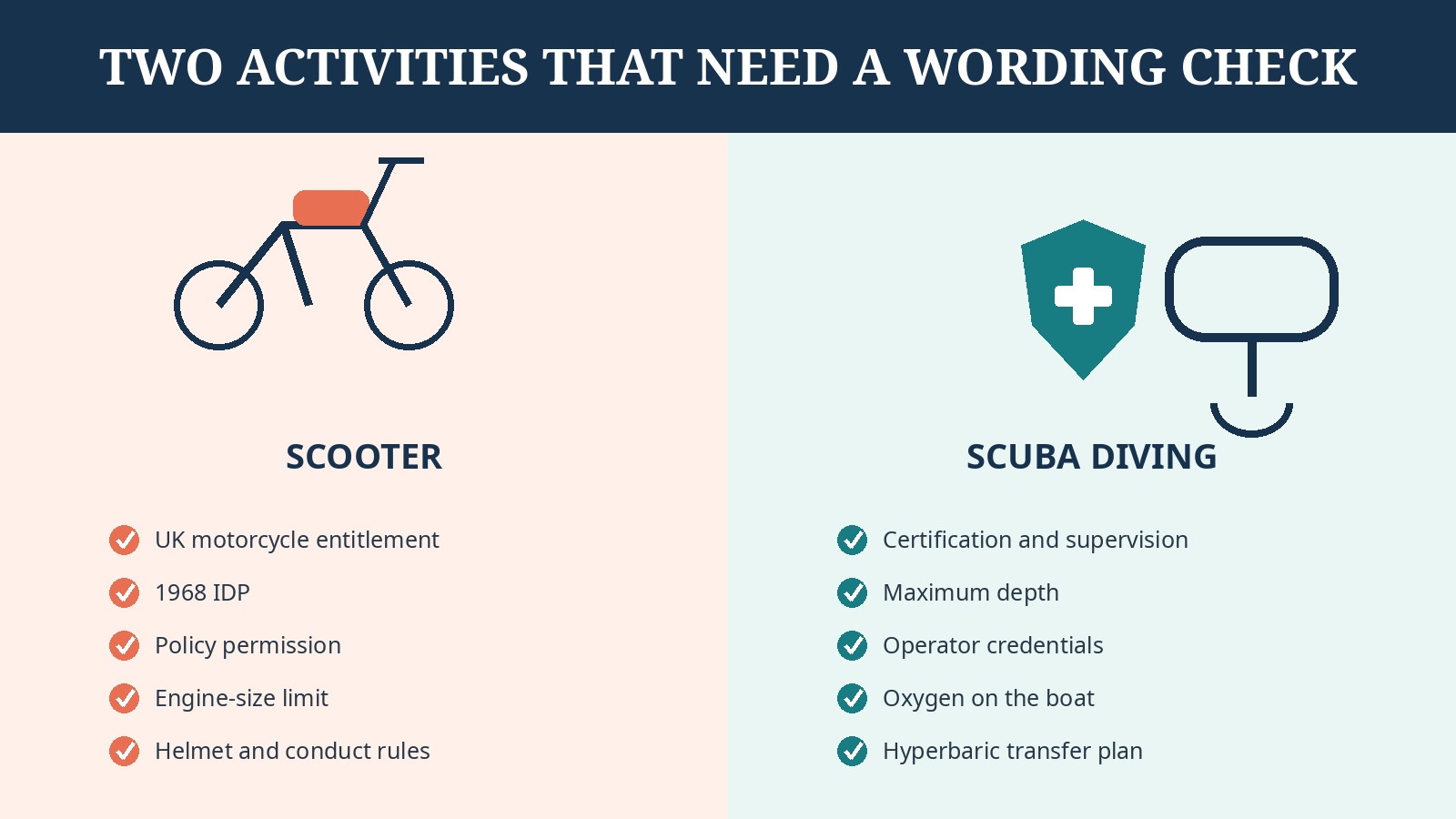
Scooter claims are where a policy’s medical headline and its exclusions can collide. FCDO guidance says you need both your UK driving licence and the 1968 International Driving Permit while driving in Thailand. It also warns that many policies expect the correct UK licence entitlement for the vehicle, and driving without a valid licence can invalidate insurance.
The 1968 IDP is not a motorcycle licence
A 1968 IDP translates or supports the entitlement on your home licence; it does not create a new entitlement. GOV.UK lists Thailand under the 1968 permit and states that an IDP costs £5.50. A traveller with no appropriate motorcycle entitlement should not assume that buying the permit makes scooter riding legal or insured.
Check six separate layers before riding
| Layer | Question to answer in writing | Why it matters |
|---|---|---|
| Legal entitlement | Does your UK licence permit this motorcycle category, and do you hold the 1968 IDP? | An invalid licence can undermine the medical claim |
| Policy permission | Is riding covered automatically or only through an activity upgrade? | Some policies exclude motorised two-wheel vehicles |
| Engine size | Is there a cc limit, and what is the exact rented model? | A common 125cc scooter may exceed a lower policy threshold |
| Protective equipment | Is an approved helmet compulsory under the policy? | Thailand requires helmets, and policy conditions can be stricter |
| Conduct | What are the alcohol, drug, reckless-behaviour and road-use exclusions? | Medical cover is not permission to ignore local law |
| Vehicle damage | Who pays for damage, theft, tyres, keys and third-party property? | Travel medical cover rarely replaces rental collision protection |
Passengers need to check their own wording
Being a passenger can be treated differently from riding. Conditions may still require a licensed driver, helmet and legal vehicle. Ask whether you are covered as a passenger on a motorcycle taxi, rented scooter or friend’s bike rather than assuming passenger status removes every condition.
A lower-risk transport alternative
If the licence or policy conditions do not work, a pre-booked transfer is often the simpler choice. Compare Bangkok airport transfers on GetYourGuide and Bangkok airport transfers on Viator, then check meeting points, vehicle type, luggage allowance and cancellation terms.
Karen Taylor planning note
I would never treat “everyone hires one” as evidence of insurance. Before paying, photograph the scooter, record the registration and engine size, read the rental agreement, confirm the licence position and save the policy clause. If one link in that chain is missing, taxis or a driver are the cleaner decision.
Official references: FCDO Thailand safety and security, GOV.UK IDP country list and GOV.UK IDP purchase guidance.
Scuba diving, snorkelling, trekking, boats and Muay Thai
Use the exact activity name
“Adventure activities included” is too vague. Search the policy schedule for scuba diving, freediving, snorkelling, trekking, climbing, zip-lining, kayaking, rafting, Muay Thai training, competitive sport, elephant activities and paid or volunteer work. The wording may distinguish a supervised taster session from independent participation.
Scuba cover can depend on depth and credentials
FCDO advice tells divers to inspect operator credentials, equipment, oxygen availability and plans for transfer to a hyperbaric chamber. A policy may also set a maximum depth, require recognised certification or instruction, exclude solo diving, and restrict technical, cave or wreck diving. Rescue and hyperbaric treatment should be checked explicitly rather than inferred from the general medical limit.
Compare the activity before assuming it is insured
You can review the inclusions and operator information on a Koh Tao diving experience listed by GetYourGuide or a Koh Tao scuba course listed by Viator. A booking-platform listing is not proof of insurance cover; compare the exact depth, certification, supervision and equipment against your policy.
Snorkelling is not always treated as “nothing risky”
Ordinary recreational snorkelling is often included, but conditions can change for unsupervised trips, remote locations, strong currents or excursions against local warnings. FCDO guidance highlights monsoon-season riptides, strong river and waterfall currents, and the importance of beach flags. A tour cancellation caused by unsafe sea conditions is also a separate issue from medical cover.
Trekking may have altitude and route limits
Check the maximum altitude, whether a recognised guide is required, and whether rescue from a remote area is included. “Walking” and “trekking” may be different categories. Northern routes can also be affected by heat, poor air quality, storms and slippery terrain, so the activity description should match the actual route rather than the footwear you plan to wear.
Muay Thai training and competition are different risks
A casual fitness class may be covered where sparring, contact training or a bout is excluded. Ask about protective equipment, supervised training, amateur competition and pre-existing injuries. When the holiday is built around a camp, a specialist sport policy can be more suitable than adding a small activity pack to basic cover.
Boat safety and missed connections need separate checks
Medical cover can respond to an insured injury on a boat, yet it does not automatically pay for a missed flight after rough seas. FCDO notes that passenger-boat accidents can involve overloading, poor maintenance and rough weather, particularly during monsoon conditions. Choose reputable operators, follow cancellations, and leave a meaningful buffer before an international departure.
Cancellation, curtailment, delays and separate tickets
Match cancellation cover to the money genuinely at risk
Add non-refundable flights, accommodation, domestic transport, tours, dive courses and event tickets. Do not insure the fully refundable portion twice. The cancellation limit should cover the amount each insured person could lose for a reason that appears in the policy, not merely the total retail value of the trip.
Buy before a problem becomes known
Cancellation insurance normally protects unforeseen insured events after cover begins. It is not designed for a storm, strike, illness or family situation that was already known. Both GOV.UK and MoneyHelper advise buying travel insurance promptly after booking, even when the travel dates are months away.
Separate tickets create an evidence and timing problem
Imagine booking a Koh Lanta transfer, a domestic flight from Krabi and a separate international ticket from Bangkok. If the boat or road transfer is late, one section might describe travel delay, another missed departure and another missed connection. Cover may depend on the cause, the timetable, a minimum connection margin and written evidence from the operator.
| Connection | Planning issue | Evidence to save | Insurance question |
|---|---|---|---|
| Bangkok to Chiang Mai | Overnight rail or bus delay before a prepaid tour | Original ticket, delay notice and replacement cost | Does missed-event cover exist, or only missed international departure? |
| Bangkok to Krabi | Separate domestic and international flight bookings | Both itineraries, airline notices and rebooking receipts | Are separately ticketed connections covered? |
| Krabi to Koh Lanta | Road, ferry or combined transfer affected by weather | Operator confirmation and cancellation notice | Which causes count, and what connection buffer is required? |
Use schedules to document the plan, not to remove the risk
For route research, compare Bangkok to Chiang Mai transport on 12Go, Bangkok to Krabi transport on 12Go and Krabi to Koh Lanta transport on 12Go. Keep booking confirmations and allow a wider buffer than the shortest theoretical connection.
Curtailed trips need a covered reason too
Returning home early because you simply changed your mind is usually not enough. Curtailment normally responds to listed events such as a serious illness, bereavement or other defined emergency. Check who must be affected, whether the insurer must approve the return, and how unused accommodation is calculated.
Baggage, phones, cameras and claim evidence
The single-item limit is the number most travellers miss
A £2,000 baggage limit does not necessarily mean a £900 phone is covered for £900. Policies often impose lower single-item, valuables and gadget limits, then deduct depreciation and an excess. Check whether a camera body and lens count as one item, whether jewellery must be worn or locked away, and whether cash has a separate low limit.
“Unattended” can be broader than it sounds
Property left on a beach while swimming, in a scooter basket, on an open hostel bed or in checked baggage may be treated differently. Read the security requirements for hotel rooms, safes, vehicles and public transport. FCDO advice also warns against handing over a passport as a guarantee to motorcycle or jet-ski businesses.
Build a lightweight claim kit before departure
| Useful item | Best for | Advantages | Limitations and buying advice |
|---|---|---|---|
| Waterproof document wallets on Amazon.co.uk | Separating originals, copies and receipts | Low cost, easy to move between bags, useful in heavy rain | Not a safe; choose a size that fits folded A4 documents without forcing zips |
| Luggage trackers on Amazon.co.uk | Locating checked baggage | Can help establish where a bag was last detected | Does not replace an airline report or insurer evidence; check phone compatibility |
| Waterproof phone pouches on Amazon.co.uk | Boat days, beaches and rainy-season transfers | Protects against splashes and keeps the phone attached | Test the seal before use; not every pouch is suitable for submersion or diving |
| Travel power banks on Amazon.co.uk | Keeping access to the assistance number and booking evidence | Useful during delays and long transfers | Check current airline battery limits and carry-on rules before flying |
| Compact travel first-aid kits on Amazon.co.uk | Minor cuts and basic supplies | Keeps small items organised | Does not replace medical assessment; remove items restricted by airline or border rules |
Photograph proof before it disappears
Save receipts, serial numbers, device model pages and photographs of higher-value items. After a loss, obtain the report required by the policy—often an airline property irregularity report, police report or written operator confirmation—within the stated deadline. A tracker screenshot can support the timeline but usually does not replace formal reporting.
Connectivity helps only when the information is accessible
Store the assistance number, policy number and first accommodation address offline. An eSIM can be useful for contacting an insurer or opening booking documents, but it is not a substitute for emergency planning and may provide data without a Thai voice number. Compare Airalo Thailand eSIM options and confirm device compatibility, data validity and whether a local number is included.
A practical Thailand travel insurance comparison scorecard
Price matters, but it should be the final comparison rather than the first. This 100-point scorecard makes the policy’s ability to handle a serious event more visible. Adjust the weighting when a particular risk—such as a pre-existing condition or diving holiday—dominates the trip.
| Category | Points | Full-score standard | Warning sign |
|---|---|---|---|
| Medical and assistance | 25 | Substantial limit, 24-hour case management, clear direct-settlement process and modest excess | Large headline with vague assistance or broad exclusions |
| Evacuation and repatriation | 15 | Authorised movement, escort and suitable return-home arrangements clearly included | Repatriation mentioned but not explained |
| Medical declarations | 10 | All conditions accepted in writing after complete screening | Unanswered questions or pending tests ignored |
| Activities and vehicles | 15 | Every activity named with conditions you can actually meet | Generic “adventure” wording without scooter or dive detail |
| Cancellation and curtailment | 10 | Limit matches non-refundable cost and covered reasons are understandable | Low limit or narrow close-relative definitions |
| Delay and missed departure | 10 | Separate-ticket and connection rules fit the route | Only outbound UK departure is covered |
| Baggage and gadgets | 5 | Single-item limits match possessions and security conditions are realistic | High total, low phone or camera limit |
| Liability and legal support | 5 | Useful non-vehicle liability cover with understandable exclusions | Assuming rented-vehicle damage is included |
| Excess structure | 5 | Affordable and not multiplied unexpectedly across people and sections | Several excesses can arise from one event |
How to use the scorecard
- Reject policies that fail a non-negotiable need, even if the total score is high.
- Score from the full wording, not the quotation headline.
- Write the page number or clause beside each score.
- Compare the best two or three policies side by side.
- Only then compare premium, excess and cooling-off terms.
Cheap versus broader cover
A lower-cost policy can be sensible for a simple city holiday with modest prepaid costs, no medical complications and no higher-risk activities. Broader cover can be better value for an expensive itinerary, older traveller, medical condition, diving plan, long stay or multiple separate connections. Paying more is worthwhile only when the wording solves a real problem.
MoneyHelper’s policy guidance suggests checking medical expenses, repatriation, cancellation, missed departure, baggage and liability, while also warning that excesses may differ by section. Use its good travel-insurance policy checklist as a second opinion.
Realistic Thailand claim scenarios
Scenario 1: a scooter fall outside Pai
The traveller breaks a wrist while riding a 125cc scooter. The medical limit is high, but the insurer asks for the UK licence category, 1968 IDP, rental agreement, helmet evidence and police or medical report. If the rider had only a car entitlement or the policy excluded that engine size, the medical claim could be disputed.
Scenario 2: dengue requiring a Bangkok admission
After several days of fever, the traveller calls the assistance team and attends the recommended hospital. The insurer opens a case, requests medical reports and discusses payment with the hospital. Prompt contact and complete medical screening support the claim. A policy with weak medical cover or an undeclared relevant condition creates avoidable uncertainty.
Scenario 3: a ferry delay causes a missed flight
Rough seas delay the island departure, and the traveller misses a separately ticketed domestic flight. The policy asks whether the delay cause is covered, whether the original connection allowed a reasonable margin and whether the ferry operator provided written confirmation. A screenshot of a weather app alone is unlikely to prove the operator’s disruption.
Scenario 4: a phone disappears from a beach bag
The overall baggage limit is £2,000, but the phone has a £400 item limit and a £100 excess. The insurer also examines whether the bag was unattended and whether a police report was obtained promptly. The likely payout can therefore be much lower than the phone’s replacement cost.
Scenario 5: ear injury after a recreational dive
The diver was certified, stayed within the policy depth and used a recognised operator. Medical assessment and treatment are potentially within cover. If the dive exceeded the stated depth, involved an excluded type of diving or ignored medical advice, the same injury could receive a different decision.
Scenario 6: a family emergency cuts the trip short
The traveller needs to return to the UK after a close relative becomes seriously ill. The policy definition of “close relative”, medical evidence and insurer approval become central. It may pay the additional return cost and unused accommodation, but only within the curtailment wording and limits.
What these examples show
Claims are decided by facts, definitions and evidence. The event alone is not enough. A useful policy is one whose conditions you can meet before the incident, whose assistance process you understand during it, and whose evidence requirements you can satisfy afterwards.
How to buy Thailand travel insurance step by step
1. Price the trip before pricing the policy
List the money you would lose if the trip were cancelled today: flights, accommodation deposits, domestic travel, tours, courses and event tickets. Separate refundable from non-refundable costs.
2. Write the full route and dates
Include departure from home, stopovers, Thailand regions, islands, neighbouring countries and the return journey. Annual policies must still cover the length of this individual trip.
3. List activities and vehicles by name
Write “125cc scooter”, “recreational scuba to 18 metres”, “guided trek to 2,000 metres” or “Muay Thai contact training” rather than “adventure”. Precise wording makes comparison much faster.
4. Complete medical screening accurately
Have medication, diagnoses, consultations, tests and referral details ready. Save the insurer’s answers and any additional endorsement.
5. Compare the medical assistance process
Find the emergency number, confirm it operates 24 hours, and check how direct hospital payment or a guarantee is arranged. Ask what happens when you cannot contact the insurer before emergency treatment.
6. Read the activity and transport exclusions
Check motorcycles, rental cars, boats, diving, trekking, alcohol, drugs, reckless behaviour and travel against official advice. An upgrade should amend the relevant exclusion in writing.
7. Test cancellation and disruption against the itinerary
Use a realistic island-to-airport connection. Ask what would be covered if a ferry, domestic flight or road transfer were delayed. Read separate-ticket and missed-departure definitions.
8. Compare item limits and excesses
Add the highest-value phone, camera, jewellery and cash you will carry. Check depreciation and whether one incident can trigger several excesses.
9. Buy promptly and use the cooling-off period
Purchase once meaningful bookings are made. Then read the documents while the cancellation period is open, rather than discovering an exclusion at the airport.
10. Recheck after any change
Tell the insurer about a changed route, new activity, health update or extended return date. Save the written response with the policy.
Keep accommodation records clear
Booking confirmations help establish dates, payments and cancellation terms. When comparing stays, review Bangkok hotels on Agoda, Phuket hotels on Agoda or Chiang Mai hotels on Agoda, then save the exact rate conditions and payment receipt. When comparing stays, save the exact rate conditions, payment receipt and cancellation terms.
The 15-minute insurance setup before departure
| Task | Where to store it | Reason |
|---|---|---|
| Save the policy certificate and full wording | Phone, cloud folder and one offline copy | You may need the wording without reliable data |
| Save the medical-assistance number | Contacts under “INSURANCE EMERGENCY” | It should be visible to a companion or hospital |
| Share the policy and itinerary | Trusted contact at home | Someone else can assist if your phone is lost |
| Photograph valuables and serial numbers | Cloud folder separate from the device | Supports ownership and model evidence |
| Record medical information | Wallet card and secure phone note | Useful when you cannot explain everything quickly |
| Check official advice and weather | Saved links and email alerts | Warnings can affect route and insurance validity |
Also complete the Thailand Digital Arrival Card through the official portal within the permitted window and keep the confirmation accessible. The arrival card is an entry form, not insurance, and unofficial paid websites should not be confused with the government service.
For wider trip preparation, use the site’s Thailand packing list, Thailand travel budget guide and two-week Thailand itinerary.
What to do in a medical emergency in Thailand
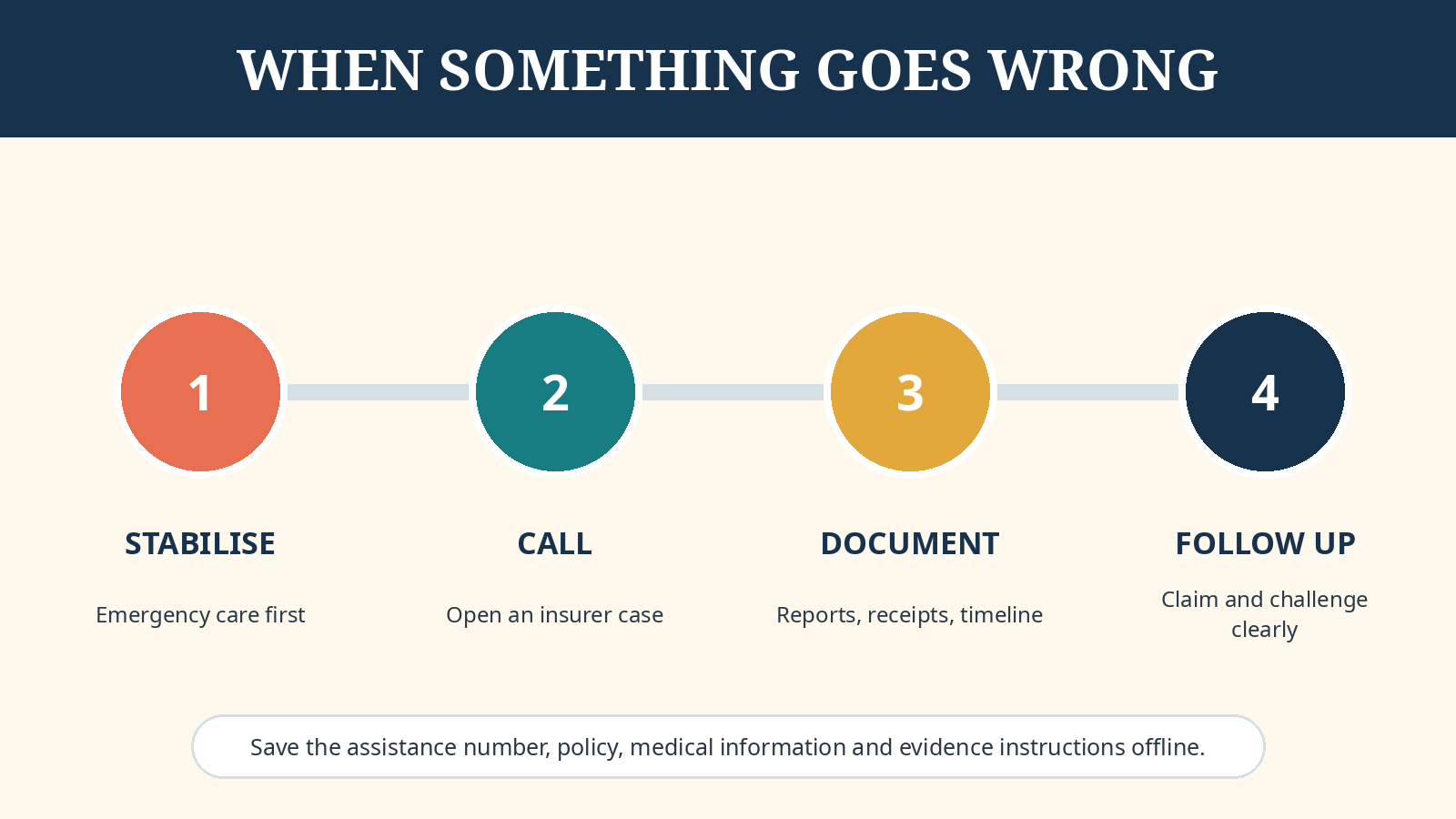
1. Get urgent help first
Call 1669 for Thailand’s medical emergency network. If you cannot obtain the required response, FCDO guidance also lists Tourist Police on 1155 and Royal Thai Police on 191. A private hospital may operate its own ambulance for a fee.
2. Contact the assistance team as soon as practical
Give the policy number, location, hospital, symptoms and contact details. Ask whether the insurer has opened a case and whether treatment or transfer needs prior authorisation. In an immediate life-threatening emergency, do not delay essential care solely to make a telephone call.
3. Expect payment questions
FCDO health guidance says hospitals require a guarantee of payment before treatment, while its detailed healthcare guidance says treatment is rarely free and patients may be asked to pay. Procedures vary by facility and urgency. Ask the hospital and insurer what has been authorised, what deposit is needed and which charges you may have to settle directly.
4. Keep every document
Collect the medical report, diagnosis, itemised invoice, receipts, prescriptions, test results and discharge summary. Record names, times and case numbers from the hospital and insurer. Photograph paper receipts because thermal printing can fade.
5. Do not arrange an expensive transfer casually
A friend’s preferred hospital or an early flight home may not be medically necessary. Let the treating doctor and assistance team discuss the appropriate facility and transport unless waiting would create immediate danger.
Emergency contact box
- Medical emergency network: 1669
- Tourist Police: 1155
- Royal Thai Police emergency: 191
- Your insurer’s 24-hour assistance number: save before departure
- UK FCDO consular support: useful for information, but it cannot pay hospital or repatriation bills
Read the current FCDO healthcare and medical-services guidance and Thailand health advice before travel.
How to prepare and submit a travel-insurance claim
Report the event through the correct channel
A medical emergency goes to the assistance team. Stolen property usually needs a police report. Airline baggage requires a property irregularity report, while a transport delay needs written confirmation from the operator. The insurer’s claim instructions should state the deadline and required documents.
Build a simple timeline
Write the date, time, location, people involved, what happened, whom you called and what each organisation said. Add photographs, messages and receipts in order. A clear timeline helps the claim handler understand an unfamiliar Thai operator or multi-stage journey.
Claim refundable costs elsewhere first when required
Insurers may expect you to request refunds, chargebacks, airline compensation or operator remedies before claiming the remaining insured loss. Keep the response, even when it is a refusal. Do not claim the same cost twice.
Explain currency conversions
Keep the original THB receipt and the card statement showing the sterling amount. When you paid cash, record the withdrawal and exchange evidence if available. The insurer may apply its own conversion method, but the source documents make the calculation auditable.
Challenge a decision with the wording, not frustration
If a claim is declined, ask for the exact clause and evidence used. Compare that reasoning with the policy schedule, endorsement and facts. Follow the insurer’s complaint process, then use the relevant ombudsman route if the dispute remains unresolved and the policy falls within its jurisdiction.
Claim-file checklist
- Policy schedule, wording and medical-screening endorsement
- Insurer case number and contact log
- Medical, police, airline or operator report
- Original receipts and itemised invoices
- Proof of ownership and booking terms
- Refund requests and responses
- Chronological explanation of the loss
Common Thailand travel insurance mistakes
- Buying after a problem or warning has become known
- Choosing solely by premium or star rating
- Assuming a GHIC works in Thailand
- Failing to declare a condition, test or medication change
- Using “scooter cover” without the correct licence entitlement
- Ignoring engine-size and helmet conditions
- Assuming a tour listing guarantees activity cover
- Booking a ferry-to-flight connection with no realistic buffer
- Comparing total baggage limits rather than single-item limits
- Leaving the assistance number inside an inaccessible email account
- Travelling against official advice without checking the policy effect
- Discarding receipts, reports or operator messages
Pros and cons of choosing a higher-tier policy
| Potential advantages | Potential disadvantages | Who may benefit most |
|---|---|---|
| Higher cancellation and item limits | Higher premium for benefits you may not need | Travellers with expensive flights, villas, tours or equipment |
| Lower excess or fewer excess deductions | The cheapest top tier can still exclude the key activity | Families or couples who could face per-person excesses |
| Broader disruption or activity wording | Policy documents may be longer and still require upgrades | Island-hopping, diving and multi-ticket itineraries |
| Higher gadget limits | Security conditions and depreciation still apply | Photographers and travellers carrying premium devices |
The cover worth buying is the cover you can explain
For a typical two-week Thailand trip involving Bangkok, Chiang Mai and one island, I would prioritise substantial medical and repatriation cover, cancellation equal to the non-refundable cost, a manageable excess, clear boat and snorkelling wording, and item limits that fit the luggage. I would add scooter or diving cover only when the traveller can meet every condition.
The final test is simple. Before paying, you should be able to explain what happens after a hospital admission, how the insurer would move you if specialist treatment is needed, whether each planned activity is covered, what could invalidate the policy and what evidence a claim would require. When those answers are unclear, the policy is not ready to buy.
Frequently asked questions about Thailand travel insurance
Do I legally need travel insurance to enter Thailand?
Current entry guidance for the most common British tourist visit does not list a blanket insurance certificate as a standard requirement. Other visas or programmes can differ. Insurance is still strongly advisable because treatment is chargeable and emergency evacuation can be expensive.
Can I use a UK GHIC in Thailand?
No. Thailand is not listed among the countries where a UK GHIC is valid. A GHIC also never covers repatriation and is not a replacement for travel insurance.
How much medical cover should I choose?
Choose a substantial limit that includes emergency treatment and authorised evacuation or repatriation. Then compare exclusions, assistance arrangements, excesses and activity wording as carefully as the headline number.
Will travel insurance pay a Thai hospital directly?
Sometimes the assistance company can arrange a guarantee or direct settlement, but procedures depend on the hospital, treatment and policy. You may still be asked for a deposit or to pay some costs. Contact the assistance team promptly.
Does Thailand travel insurance cover scooter riding?
Only when the policy permits the vehicle and you meet every legal and contractual condition. These can include the correct UK motorcycle entitlement, a 1968 IDP, engine-size limit, helmet use and sobriety.
Is a 1968 IDP enough to ride a scooter?
No. The IDP does not give you a motorcycle entitlement that is absent from your UK licence. You need the correct home-licence entitlement as well as the permit and policy permission.
Does standard travel insurance cover scuba diving?
Some policies cover recreational diving within stated depth, certification and supervision limits; others require an upgrade. Confirm rescue, hyperbaric treatment and operator conditions by reading the exact scuba clause.
When should I buy Thailand travel insurance?
Buy once meaningful non-refundable bookings are made. Cancellation cover usually cannot protect against an event that was already known before the policy started.
Is annual multi-trip insurance enough for Thailand?
It can be, provided the worldwide region, trip length, activities, medical declarations and destination wording fit. Check the maximum length of each individual trip rather than the 12-month policy period alone.
Will insurance cover a missed flight after a ferry delay?
It may, but only where the cause, connection and evidence meet the missed-departure or disruption wording. Separate tickets and an unrealistically short buffer can limit cover.
What excess should I choose?
Choose an excess you could pay without stress. Check whether it applies per person, per claim or per policy section because one incident can trigger more than one deduction.
What documents should I carry?
Carry the policy number, assistance contact, passport copy, medical information and claim instructions. Keep offline and cloud copies in different places, and give a trusted person access to the essentials.
What number should I call for a medical emergency?
Call 1669 for the medical emergency network. FCDO guidance also lists Tourist Police on 1155 and police emergencies on 191. Contact the insurance assistance service after urgent help is arranged.
Can the British Embassy pay my hospital bill?
No. Consular staff can provide information and support, but they cannot pay medical bills or repatriation costs. Uninsured travellers are responsible for their own expenses.
Final Thailand travel insurance checklist
- The destination and every transit country are covered
- The trip length fits the policy’s individual-trip limit
- Medical conditions and health changes are accepted in writing
- Emergency medical, evacuation and repatriation wording is clear
- Cancellation matches the non-refundable cost
- Scooters, diving, trekking and other activities are checked by exact name
- Separate-ticket and missed-departure rules suit the itinerary
- Single-item limits cover the phone, camera and other valuables
- The excess is affordable and its application is understood
- The assistance number and policy are stored offline
- Official travel advice has been checked immediately before travel
- Receipts, serial numbers and booking conditions are saved
Travel insurance cannot remove every risk from Thailand, and it does not make an unsafe activity sensible. What it can do is stop a difficult event becoming an unmanageable financial problem—provided the cover matches the facts of the trip and the traveller follows its conditions.
Sources and methodology
This guide was researched and fact-checked on 25 August 2026. It prioritises UK government, NHS, MoneyHelper, TravelHealthPro and current hospital information. It does not rank insurers because medical screening, prices, limits and policy wording vary between travellers and can change. The insurer’s current schedule, wording and endorsements remain the final authority for an individual policy.
Official health, safety and insurance guidance
- FCDO Thailand travel advice — current warnings and the effect of travelling against advice
- FCDO Thailand health advice — insurance, emergency numbers and healthcare preparation
- FCDO healthcare and medical services in Thailand — hospital charging, passports, emergency response and payment expectations
- FCDO Thailand safety and security — scooters, road travel, diving, boats and outdoor activities
- FCDO foreign travel insurance guidance — medical, cancellation, activities, trip duration and repatriation
- FCDO medical emergencies and hospitalisation abroad — insurer contact and consular limits
- NHSBSA GHIC and EHIC country list — card validity and repatriation exclusion
- TravelHealthPro Thailand guide — destination health risks, rabies, dengue and pregnancy considerations
Consumer and practical comparison guidance
- MoneyHelper: what travel insurance covers — policy types, exclusions, excesses and buying timing
- MoneyHelper: what a good policy looks like — medical, cancellation, baggage, missed departure and liability checks
- MoneyHelper medical-condition guidance — declarations and specialist-provider directory
- GOV.UK IDP country list and IDP purchase guidance — Thailand’s 1968 permit and current £5.50 fee
- Bumrungrad 2026 inpatient accommodation rates and Bangkok Hospital room rates — examples of current published room charges, not estimates of total treatment cost
Image credits
Illustrations in this article were created for Taylor’s Trailblazing Travels. Third-party photographs, where used, are credited beside the image or in the source list.