A practical guide to choosing where to stay in Phuket, comparing beaches, nightlife, airport transfers, walkability, family suitability, hotel value, monsoon backup and the journeys you will make after check-in.
Disclosure: This article contains carefully selected affiliate links. Taylor’s Trailblazing Travels may earn a commission if you book or buy through them, at no extra cost to you. Recommendations appear only where they help with a genuine travel decision.
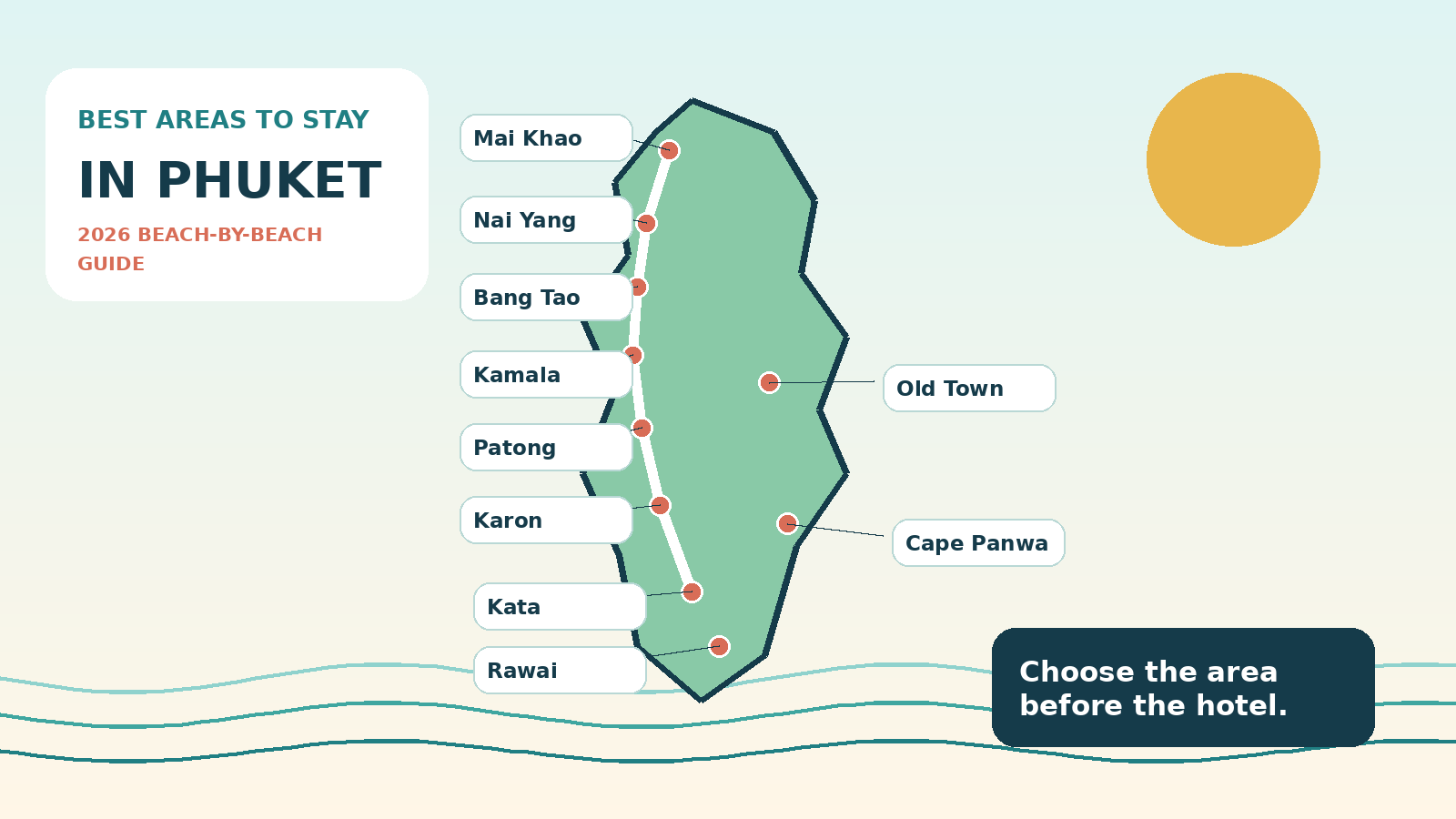
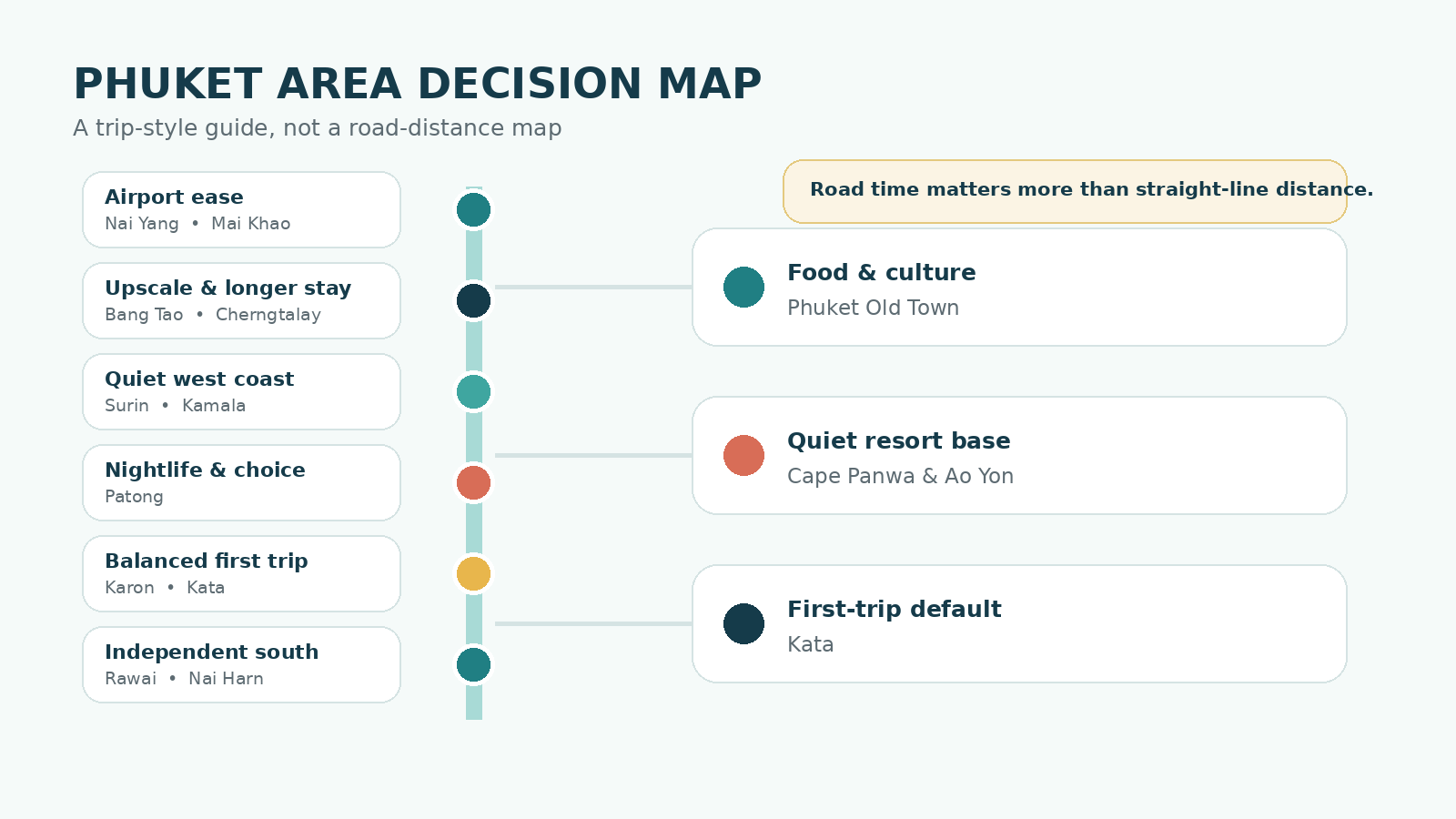
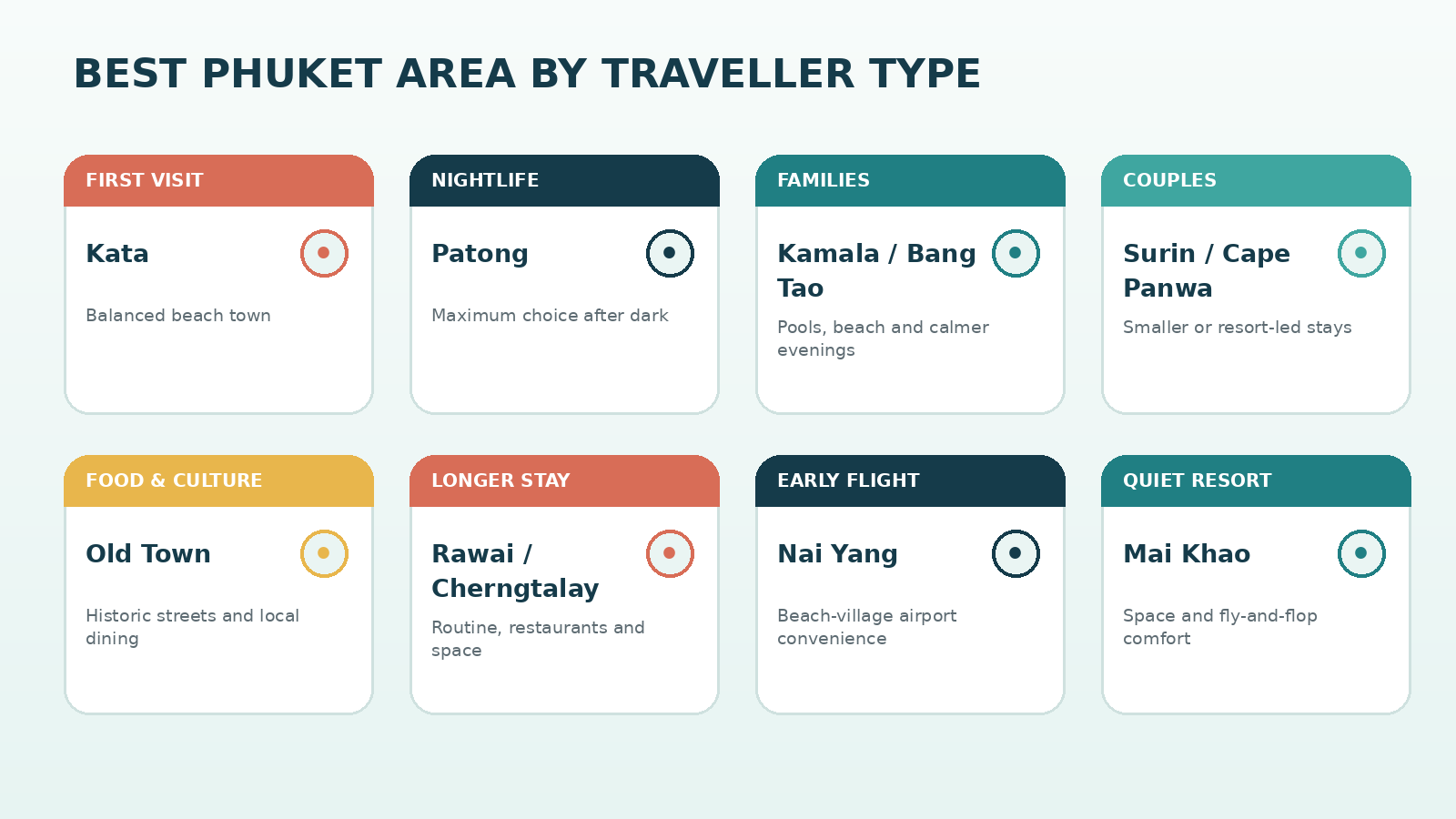
The best area to stay in Phuket for a first visit is Kata, because it balances a popular beach, restaurants and manageable evening life. Choose Karon for more space, Patong for nightlife, Kamala for a quieter family trip, Bang Tao for upscale resorts and dining, Rawai or Nai Harn for an independent longer stay, Old Town for food and culture, and Nai Yang or Mai Khao for airport convenience.
Quick answer: which Phuket area fits your trip?
Best all-round first base
Choose Kata for a beach-town holiday with restaurants, family facilities and enough evening atmosphere without Patong’s intensity.
Nightlife and maximum choice
Choose Patong when clubs, bars, shopping, late food and easy tour pickups matter more than quiet surroundings.
Families and calmer evenings
Compare Kamala, Kata and Bang Tao. The right answer depends on pool facilities, beach access, budget and how often you want to leave the resort.
Couples and a polished stay
Look at Kata Noi, Kamala, Surin, Bang Tao or Cape Panwa, then check whether dinner is walkable or the hotel is designed as a self-contained retreat.
Food and culture
Stay one or two nights in Phuket Old Town, then add a beach base. Old Town is walkable and characterful, but it is not beside the sea.
Early flight or late arrival
Choose Nai Yang for a practical beach village near the airport, or Mai Khao when you want a quiet resort and do not need southern nightlife.
In this guide
How to choose the best area to stay in Phuket
Phuket is often sold as a single destination, yet the experience changes sharply from one coast to another. Patong behaves like a busy resort city. Kata feels like a compact beach town. Bang Tao covers a long corridor of resorts, villas and dining areas. Old Town is a cultural and food base with no beach outside the hotel. Mai Khao can feel wonderfully private, although a spontaneous evening in Patong becomes a major road journey.
The Tourism Authority of Thailand describes Phuket as Thailand’s largest island and lists Rawai, Patong, Karon, Kamala, Kata and Mai Khao among its beaches. It also makes a useful north-versus-south distinction: southern beaches are typically busier, while the north is generally more tranquil.[1] That broad pattern helps, but the exact hotel position still matters more than the area name alone.
Begin with the evenings you actually want
Most visitors will travel by vehicle for at least some sightseeing, boat trips or airport transfers. Consequently, the most revealing question is what you want at 8:30 p.m. Do you want dozens of restaurants, a lively street and late-night choices within a short walk? Would you rather eat at the resort and hear little beyond the sea? Perhaps you want a local food street, a supermarket and a simple café routine for a two-week stay.
That evening picture separates the main choices quickly. Patong solves nightlife logistics. Kata offers enough life for a first holiday without making nightlife the entire identity. Kamala is calmer. Mai Khao and Cape Panwa work best when the hotel is part of the holiday, not merely somewhere to sleep.
Inspect the micro-location, not just the beach name
Two hotels labelled “Kata” can produce different trips. One may sit on a level street between the beach and restaurants; another may be uphill with a steep final approach. In Karon, a property can be near the sand but separated from it by a main road. Around Bang Tao, “near the beach” and “near Boat Avenue” are not always the same thing. Around Rawai, a sea view does not mean a classic swimming beach.
Open the walking route before paying. Check the gradient, road crossings, pavement, lighting and entrance. Then look for one breakfast option, one dinner option, a convenience shop and the pickup point used by taxis or tours. A hotel that makes those four journeys easy often works better than a more luxurious property in the wrong pocket.
Map the repeated journeys, not every possible day trip
A one-off transfer to a pier is manageable. Repeating a 45-minute drive for dinner every evening is not. List the journeys you expect to make at least three times: beach, evening area, supermarket, children’s meals, gym, diving centre or nightlife. Those repeated routes should shape the hotel choice more than an attraction you will visit once.
Likewise, check the likely departure point for the tours you care about. Phang Nga Bay trips may use marinas in the east or northeast, while many southern island services use Chalong or other piers. Pickup zones vary by operator, so an area that looks geographically close is not automatically the fastest once hotel collections and traffic are included.
Make the hotel work on a rough-sea day
During wetter months, a beachfront address does not guarantee safe swimming. Red flags, rough water and heavy showers can change the day. Therefore, pool quality, covered seating, room size, nearby food and a useful indoor area deserve more weight than they would on a short dry-season trip.
Phuket areas at a glance
| Area | Best for | Planning range per night | Main advantage | Main compromise |
|---|---|---|---|---|
| Kata | First visits, couples and families | 1,500-7,500 THB | Balanced beach-town routine | Hills, traffic and peak-season crowds |
| Karon | Long beach walks and more space | 1,400-7,000 THB | Broad beach and calmer feel | Spread out; road position matters |
| Patong | Nightlife, shopping and maximum services | 1,200-8,000 THB | Largest choice and easy evenings | Noise, crowds and heavy traffic |
| Kamala | Families and quieter resort stays | 1,800-8,500 THB | Manageable beach-town atmosphere | Smaller restaurant and nightlife range |
| Bang Tao and Cherngtalay | Upscale resorts, dining and longer stays | 2,200-12,000+ THB | Strong resorts and polished food scene | Large area; transport often useful |
| Surin | Couples and small-scale beach stays | 2,000-9,000 THB | Compact, attractive beach setting | Limited depth and rough monsoon surf |
| Rawai and Nai Harn | Repeat visitors and independent longer trips | 1,300-7,500 THB | Restaurants, space and south-coast access | Transport useful; Rawai is not the swim beach |
| Phuket Old Town | Food, architecture and culture | 900-4,200 THB | Walkable historic streets and local dining | No beach beside the hotel |
| Nai Yang | Airport convenience and relaxed short stays | 1,300-6,500 THB | Beach-village feel near the airport | Far from southern nightlife and many tours |
| Mai Khao | Quiet resorts, space and fly-and-flop trips | 3,000-14,000+ THB | Long, tranquil northern resort zone | Remote and frequently expensive |
| Cape Panwa and Ao Yon | Quiet couples and resort-led stays | 2,500-11,000+ THB | Calm southeast atmosphere | Limited walking and long west-coast journeys |
How to use the comparison
These are broad editorial planning bands for a standard private room, not live quotes or promises. Christmas, New Year, school holidays, dry-season weekends, room category, cancellation terms and beach access can move prices sharply. Premium villas and named luxury resorts may cost far more, while wet-season promotions and longer-stay agreements may reduce the nightly equivalent.
Kata: best all-round Phuket base for many first visits
Kata is the safest starting point for travellers who want a recognisable beach holiday without building the entire trip around nightlife. The area has hotels at several price levels, restaurants that work for both adventurous and cautious eaters, family services, tour pickups and a lively enough evening atmosphere. At the same time, it is smaller and less relentless than Patong.
The area is not completely uniform. Kata Yai is the main beach-town choice, while Kata Noi is smaller, quieter and more resort-led. Between them, the terrain becomes a serious planning detail. A hotel can look close to the water yet involve a steep return walk, especially in heat or rain. Families with pushchairs and travellers with limited mobility should inspect the route rather than trusting the map pin.
What a stay in Kata feels like
A typical day can work without much organisation: breakfast nearby, beach time, lunch, a swim at the hotel, then dinner on foot. That simple rhythm is why Kata suits a first Phuket trip. There are enough services to recover when plans change, while the south-coast position is useful for viewpoints, Chalong-side activities and selected boat departures.
However, peak-season traffic can make the central streets feel busier than the photographs suggest. During the southwest monsoon, surf and red-flag conditions can also interrupt swimming. A good pool becomes a practical feature rather than a decorative one.
Pros
- Balanced mix of beach, restaurants and services.
- Works reasonably well without renting a vehicle.
- Good range of hotels, from simple rooms to polished resorts.
- Useful south-coast position for viewpoints and day trips.
Cons
- Hills can turn a short map distance into a tiring walk.
- Busy roads and peak-season congestion affect some hotel locations.
- Rougher monsoon conditions can limit swimming.
Karon: best for a long beach and a little more breathing room
Karon suits travellers who want a broad sweep of sand, longer walks and a resort area that feels less compressed than central Patong. The beach is the headline, although the practical experience depends on where along the bay you stay. Northern, central and southern Karon do not place you beside the same restaurants, shops or connections to Kata.
For couples and families, Karon can be an excellent compromise: enough infrastructure for an easy holiday, yet more space than the busiest resort centre. The main trap is assuming that every hotel is equally convenient. Some properties sit across a substantial road from the beach. Others are set back on hills or at an end of the bay where an evening walk becomes longer than expected.
Where to position yourself in Karon
Central Karon works for travellers who want a recognisable town centre, local services and an easy evening routine. The southern end can make Kata more accessible, while the northern side can feel calmer but may leave you farther from your preferred restaurants. In every case, look at the hotel entrance rather than the centre of the property shown on the map.
Karon is particularly useful when the beach itself is a daily priority. By contrast, travellers who mainly want nightlife may spend too much time returning to Patong. Those who want a compact café-and-dinner village may prefer Kata.
Pros
- Long beach and a spacious resort feel.
- Generally calmer than Patong while retaining useful services.
- Good choice for travellers who enjoy walking beside the sea.
Cons
- The resort is spread out, so the wrong end can feel inconvenient.
- Main-road crossings matter at some hotels.
- Evenings are quieter and less varied than Patong.
Patong: best for nightlife, shopping and maximum convenience
Patong is the correct choice when the trip genuinely centres on nightlife, shopping, late dining and a huge range of services. It is not a planning failure or a place every traveller must avoid. The mistake is choosing it because the hotel inventory is large, then expecting a quiet beach-village atmosphere.
The Tourism Authority of Thailand describes Patong as an internationally known tourist centre with hospitals, department stores, wide-ranging accommodation and restaurants.[2] That density makes practical tasks easy. Tours commonly collect in the area, pharmacies and shops are abundant, and travellers who do not want to hire a vehicle can build a full holiday around walking and occasional taxis.
Street choice matters more than the district name
Central Patong near Bangla Road creates the shortest nightlife journey and the highest risk of noise. Northern Patong can feel calmer while retaining access to the beach and central services. Quieter side streets may work well, although a hotel set behind a busy road or up a slope can defeat the convenience you expected.
Read recent reviews for bass, corridor noise, construction, traffic and the route back after dark. A review that simply says “great location” may mean ideal for clubs rather than ideal for sleep. Families can stay in Patong successfully, but the hotel needs to be selected with more precision than in a quieter area.
Pros
- Phuket’s largest concentration of restaurants, shops and nightlife.
- Easy to organise tours, transfers and practical services.
- Can work without a rental car or scooter.
- Broad range of accommodation prices.
Cons
- Traffic, crowds and noise can dominate the experience.
- Hotel quality and street atmosphere vary sharply over short distances.
- Not the natural choice for a secluded beach break.
Kamala: best for a quieter family beach holiday
Kamala sits north of Patong and offers a more contained beach-town rhythm. It often works well for families, couples and travellers who want enough restaurants for an easy stay without being surrounded by late-night intensity. Nearby evening attractions and beach venues add variety, although they do not turn the whole town into a nightlife centre.
For families, the practical advantage is a straightforward routine around the beach, hotel pool and a smaller set of restaurants. Choice is the trade-off. A visitor who wants a new bar, shopping centre or large dining district every night may feel constrained after several days. Conversely, someone who values familiarity and a shorter decision list may find Kamala more relaxing than Patong or Bang Tao.
Check which part of Kamala you are booking
Central locations make the beach and evening food easier. Properties on the edges can be peaceful but may rely on hotel shuttles or taxis. Hillside villas can offer views while making casual walks unrealistic. As elsewhere in Phuket, the word “Kamala” on a booking page does not guarantee a flat route to the sand.
Kamala is also a good example of why the pool matters. Families may spend more time at the property than expected, particularly after a morning excursion or during rough weather. Shade, children’s depth, seating and connecting-room availability can be worth more than a nominal beachfront label.
Pros
- Calmer than Patong without feeling completely isolated.
- Manageable beach-town routine for families.
- Range of independent hotels and larger resorts.
Cons
- Fewer evening choices than Patong, Kata or Cherngtalay.
- Hillside and edge-of-town properties may require taxis.
- Traffic still affects west-coast transfers.
Bang Tao and Cherngtalay: best for upscale resorts, dining and longer stays
Bang Tao is not a compact beach village. The name covers a long beach, large resort compounds, villa developments and the inland dining and shopping scene around Cherngtalay. It can be one of Phuket’s most comfortable bases for families, groups and longer stays, yet it demands a more detailed map check than almost any other area.
A hotel near the sand may not be convenient for Boat Avenue. Meanwhile, a villa near restaurants may require transport to the beach. Within Laguna, a property can provide excellent pools, grounds and organised facilities while feeling self-contained. None of these positions is inherently wrong; the problem begins when the traveller assumes they are interchangeable.
Who gets the most from Bang Tao?
Families who value resort facilities, couples who enjoy polished dining, groups considering villas and travellers staying ten days or more often find the area appealing. There are supermarkets, cafés, gyms, beach clubs and a broad range of modern services. However, the cost can rise quickly, and walking between different pockets is not always comfortable or realistic.
Therefore, decide whether your centre of gravity is the beach, Laguna, Cherngtalay dining or a private villa. Then check the repeated journeys. A cheaper villa can stop feeling economical after several daily taxi trips and food deliveries.
Pros
- Strong selection of polished resorts and villas.
- Good dining, cafés, supermarkets and longer-stay services.
- Works well when the hotel or villa is a major part of the holiday.
Cons
- Large and fragmented; transport is often useful.
- Accommodation, beach clubs and meals can be expensive.
- A generic “Bang Tao” search can hide an inconvenient micro-location.
Surin: best for a smaller, polished beach stay
Surin appeals to travellers who want an attractive west-coast beach and a smaller accommodation area than Patong or Bang Tao. It can suit couples and short resort stays particularly well. Surin has a narrower surrounding choice, so the hotel, nearby restaurants and transport plan carry more weight.
Seasonal conditions deserve equal attention. Tourism Authority of Thailand describes Surin as a steep beach and specifically warns that strong waves and storms during the monsoon make swimming inadvisable.[2] That official warning is a reminder not to select any west-coast hotel solely for the sea. During wetter months, choose a property you would still enjoy when red flags are flying.
Surin’s main trade-off
The scale is both its strength and weakness. You can enjoy a more contained stay, but you will not have the same breadth of shops, late dining and services as Patong. Travellers who want a quiet hotel, beach time and occasional taxis may be very happy. Those who enjoy wandering through a large evening district may prefer Kata, Patong or Cherngtalay.
Pros
- Attractive, relatively compact beach setting.
- Can feel more polished and peaceful than larger resort centres.
- Useful position between Kamala and Bang Tao.
Cons
- Limited evening depth compared with bigger areas.
- Strong monsoon surf can remove the main reason for staying.
- Transport may be needed for variety.
Rawai and Nai Harn: best for repeat visitors and independent longer stays
Rawai and Nai Harn are frequently grouped together, but they do different jobs. Rawai offers a working seafront, seafood, restaurants, long-stay accommodation and access to parts of southern Phuket. Nai Harn provides the classic sandy beach experience nearby. A Rawai sea-view hotel is not automatically a swimming-beach hotel.
This part of Phuket suits repeat visitors, longer stays, wellness travellers and people comfortable arranging transport. The atmosphere is less packaged than Patong, while the restaurant scene and residential services can make a two-week stay feel easy. Chalong, viewpoints and southern boat activity are also more accessible than from the northern resort areas.
Why first-time visitors sometimes misread Rawai
Booking photographs may show water, boats and a promenade, creating the impression that the beach holiday begins outside the room. In practice, visitors often travel to Nai Harn or another swimming spot. That can be perfectly acceptable when the hotel has a strong pool and the traveller plans to use a car or driver. It is disappointing only when the expectation was to walk straight onto a classic swimming beach.
The airport journey is another trade-off. Rawai and Nai Harn sit among the longest common resort transfers from Phuket Airport. A late arrival or early departure can justify one night near the airport rather than forcing the entire holiday into a northern base.
Pros
- Strong restaurant and longer-stay routine.
- Good access to the southern part of Phuket.
- Often feels more independent and residential than the largest resort centres.
Cons
- Transport is useful or essential for many properties.
- Rawai itself is not the main swimming-beach choice.
- Long airport transfers and limited west-coast nightlife access.
Phuket Old Town: best for food, architecture and culture
Phuket Old Town is the strongest non-beach base on the island. Its compact streets, Sino-Portuguese shophouses, museums, cafés, street food and Sunday market create a trip that feels different from the west-coast resorts. Tourism Authority of Thailand describes the quarter as compact enough to explore on foot and highlights its historic architecture and food traditions.[3]
Food is not a secondary reason to stay. Phuket has belonged to UNESCO’s Creative Cities Network in the Gastronomy category since 2015, reflecting the island’s layered culinary culture and its role in preserving traditional recipes.[4] An early morning and evening in Old Town allow more time to eat and walk than a rushed day trip from a beach.
Old Town works best as a split-stay partner
One or two nights can be ideal at the beginning or end of a longer Phuket holiday. You can explore before the day-trip crowds, visit the Sunday Lat Yai market when dates align, and enjoy local breakfast without committing the whole trip to road transport for the beach.
Old Town is not a substitute for Kata, Karon or another coastal base. There is no beach beside the hotel, and west-coast transfers can be slow. Travellers with four nights and a beach-first priority usually gain more from one base. With seven nights or longer, a split becomes easier to justify.
Pros
- Walkable historic streets and excellent local-food access.
- Characterful boutique hotels and guesthouses.
- Useful contrast to a resort stay.
- Free Dragon Line city shuttle links parts of the urban area.
Cons
- No beach outside the hotel.
- Road travel required for west-coast resort areas.
- Some heritage buildings have small rooms, stairs or street noise.
Nai Yang: best for airport convenience without giving up the beach
Nai Yang is the practical answer when you need an easier airport day but do not want to spend the night in a generic airport hotel. The area has a relaxed beach-village feel and sits by Sirinat National Park. Tourism Authority of Thailand highlights Nai Yang’s pine setting and national-park context.[2]
It works especially well after a late arrival, before an early departure or for travellers who want a calm northern stay. A few nights can feel easy: beach, local restaurants and a short airport transfer. The limitation is distance from the famous southern and west-coast resort districts. Repeated trips to Patong, Kata or Rawai defeat the point of staying here.
Nai Yang or an airport hotel?
Choose Nai Yang when you want the final night to feel like part of the holiday. Choose an airport hotel when arrival time, luggage or a very early check-in makes pure logistics more important. In either case, confirm the transfer arrangement rather than assuming a property provides a free shuttle.
Pros
- One of the easiest beach choices for Phuket Airport.
- Calm, low-key atmosphere compared with major resort centres.
- Can turn an arrival or departure night into useful holiday time.
Cons
- Far from Patong, Kata, Rawai and many southern activities.
- Smaller restaurant and shopping range.
- Not every hotel provides an included airport transfer.
Mai Khao: best for quiet northern resorts and fly-and-flop trips
Mai Khao is for travellers who want space, privacy and a resort-led holiday. The long northern coastline and larger hotel compounds can feel far removed from Patong’s density. That distance is the appeal when the plan is to use the pool, beach, spa and resort restaurants. It is the problem when the traveller expects to explore a different evening area every night.
The Tourism Authority of Thailand’s general Phuket guidance notes that the north is more tranquil than the typically crowded south.[1] Mai Khao illustrates that trade-off clearly. A quiet beach and large grounds may be excellent for families, couples or a recovery stop after a busy itinerary, but the property must supply enough food, shade and activity for the stay.
Price the resort, not just the room
A discounted room can become expensive when every meal, drink, transfer and activity stays inside a premium resort. Before booking, inspect breakfast inclusion, children’s meals, shuttle schedules, nearby independent restaurants and the cost of getting off the property. Families should also check pool shade, room layout and whether the sea is suitable on the dates of travel.
Pros
- Tranquil northern setting and spacious resort grounds.
- Relatively convenient for the airport.
- Strong fit when the hotel itself is the main attraction.
Cons
- Remote from the best-known southern resort areas.
- On-site food and transport can raise the real trip cost.
- Limited spontaneous evening choice outside some resorts.
Cape Panwa and Ao Yon: best for a quiet southeast resort stay
Cape Panwa and Ao Yon offer a quieter southeast alternative to Phuket’s main west-coast resort strip. The area can suit couples, families who plan to spend time at the property and travellers combining a resort stay with Old Town or eastern-pier excursions. It feels removed from Patong and Kata, which is either a welcome feature or a logistical warning.
Hotels here range from small beach properties to substantial resorts. The exact access matters because hills, private approaches and isolated roads can make walking difficult. Some travellers imagine that a short line on the map to Old Town means an easy evening stroll; in reality, a vehicle is usually required.
Choose this area for the hotel, not for island-wide convenience
Cape Panwa works best when you have found a property whose pool, beach access, restaurants and room are strong enough to anchor the holiday. It can also be useful for selected east-coast departures, although pickup details must be confirmed with the operator. Repeated trips to Patong nightlife or western sunsets are inefficient.
Pros
- Quiet alternative to the busy west coast.
- Good fit for resort-led holidays and selected east-side activities.
- Can pair well with Phuket Old Town.
Cons
- Vehicle dependence for many hotels.
- Long journeys to Patong, Kata and Karon.
- Limited evening variety outside the property in some pockets.
Best Phuket area by traveller type
No area wins every category. A first-time couple who wants dinner on foot needs a different base from a family planning resort days, a solo traveller focused on nightlife or a repeat visitor renting a villa. The following recommendations assume the exact hotel position has also been checked.
| Traveller or trip style | Best starting choices | Why they work | What to verify |
|---|---|---|---|
| First-time visitor | Kata, Karon or Kamala | Recognisable beach holiday with useful services | Hills, beach walk and evening location |
| Nightlife | Patong | Late food, bars, clubs and shopping on foot | Noise distance and the route home |
| Families | Kamala, Kata, Bang Tao or Mai Khao | Beach-resort choice and family facilities | Pool shade, room layout, meals and sea conditions |
| Couples | Kata Noi, Kamala, Surin, Bang Tao or Cape Panwa | Quieter hotels and a more polished atmosphere | Walkable dinner versus resort dependence |
| Luxury resort | Bang Tao, Mai Khao or Cape Panwa | Large properties, villas and destination resorts | Full food, drink and transfer cost |
| Longer stay | Rawai, Nai Harn, Bang Tao or Cherngtalay | Restaurants, supermarkets, villas and daily routine | Laundry, transport, workspace and exact micro-location |
| Food and culture | Phuket Old Town | Historic streets, local breakfast and Sunday market | No beach; consider a split stay |
| Early flight | Nai Yang or Mai Khao | Shorter airport journey | Confirmed transfer and check-in time |
| Quiet beach-town stay | Kamala, Surin or Nai Yang | Smaller-scale atmosphere | Restaurant depth and wet-weather backup |
| Repeat independent trip | Rawai, Nai Harn or Cherngtalay | Less packaged routine and wider accommodation types | Car, driver or taxi budget |
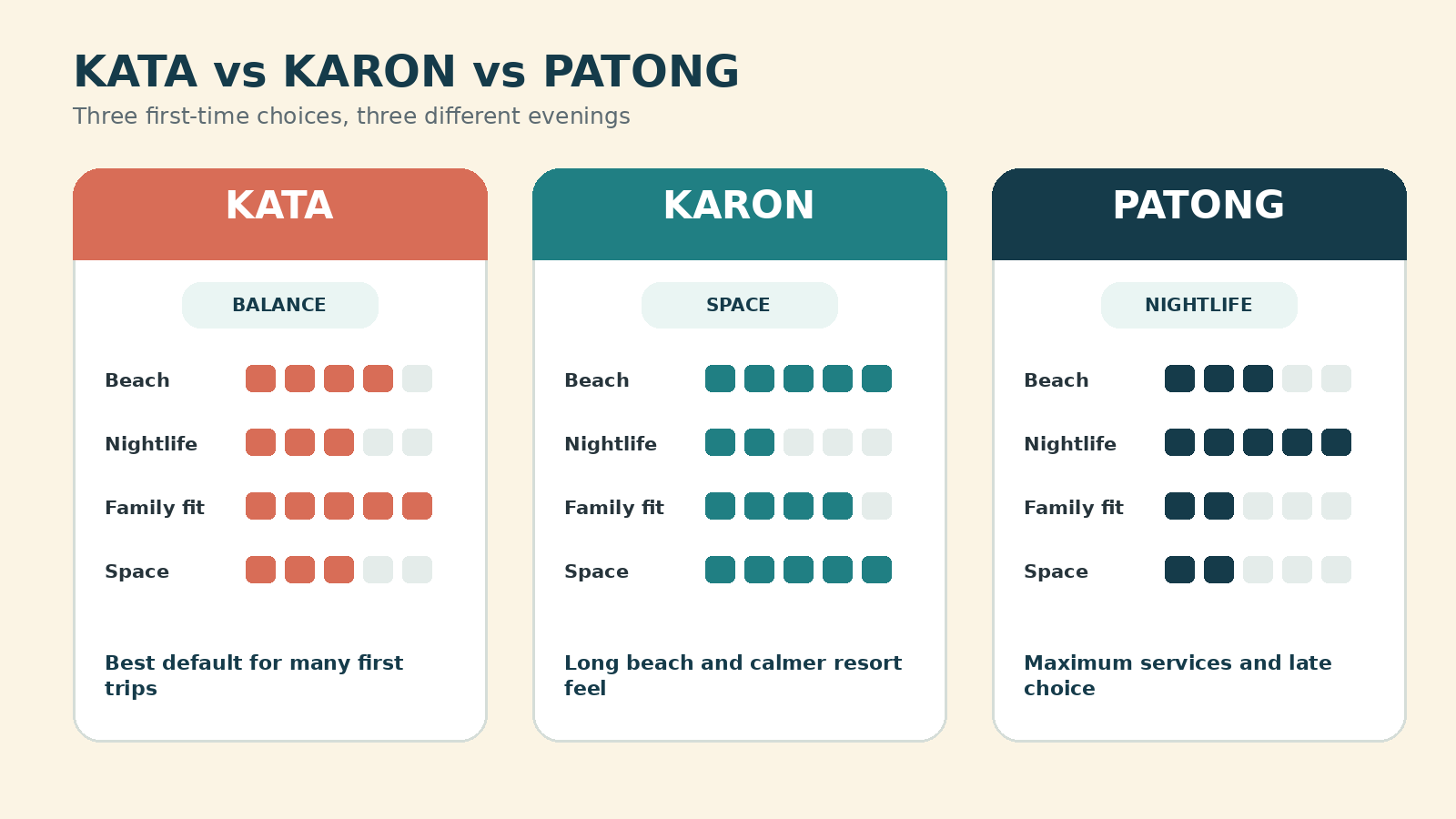
Kata vs Karon vs Patong: the first-time decision
Kata, Karon and Patong appear together in many hotel searches, but they produce different evenings. Kata is the balanced choice, Karon prioritises space, and Patong prioritises activity. The best answer depends less on which beach photographs well and more on what you want after sunset.
| Question | Kata | Karon | Patong |
|---|---|---|---|
| Overall feel | Compact, lively beach town | Longer, more spacious resort | Busy resort city |
| Best for | First trips, couples and families | Beach walks and calmer stays | Nightlife and maximum services |
| Evenings | Restaurants and moderate bars | Calmer and spread out | Large, late and intense |
| Without a vehicle | Good if the hotel is central | Good only in the right pocket | Excellent for central activities |
| Main location risk | Hills and busy roads | Wrong end of the bay or road crossing | Noise and crowd intensity |
| Family fit | Strong | Strong with the right hotel | Possible, but street choice is critical |
| Nightlife fit | Moderate | Low to moderate | Very strong |
| Best stay length | Four to seven nights | Four to seven nights | Two to five nights for most visitors |
Should you split your Phuket stay?
A split stay is useful when the two bases create genuinely different trips. Old Town plus a beach is the clearest example. Two nights in Old Town provide early and late access to historic streets and local food, while five nights in Kata, Kamala or Bang Tao deliver the beach holiday. Moving from Kata to Karon usually adds packing without changing the experience enough.
When a split stay makes sense
- You have seven nights or more and want both Old Town and the coast.
- Your flight arrives very late or leaves very early, making Nai Yang a practical first or final night.
- You want several active nights in Patong followed by a quieter resort stay.
- You are combining a northern fly-and-flop resort with southern diving, boating or longer-stay plans.
When one base is better
- You have four or five nights and mainly want one beach.
- You are travelling with young children and moving luggage creates more stress than the second area adds.
- Your tours include hotel pickup and your evening routine is already walkable.
- The two proposed bases are neighbouring resort areas with similar daily experiences.
Before splitting, count the true move cost: checkout, luggage storage, transfer, traffic, waiting for the new room and unpacking. A two-hour road move can consume half a usable day once those stages are included.
Phuket Airport, Smart Bus and pier logistics
Phuket Airport sits in the north, while many first-time resort areas lie on the west and south coasts. A low hotel rate can therefore be offset by a long transfer. Traffic varies sharply, so the ranges below are planning allowances rather than schedules.
Phuket Smart Bus: the useful 2026 basics
Phuket Smart Bus lists a 100-baht flat fare on its airport-Patong-Rawai route and accepts contactless Visa, Mastercard or JCB, Thai QR payments and cash.[5] Airports of Thailand lists the route from the airport through Cherngtalay, Surin, Kamala, Patong, Karon and Kata to Rawai, departing from Exit 3 in the public area.[6]
The operator also publishes a 50-baht Bus Terminal 2-Phuket Town-Patong service and a free Dragon Line city shuttle linking Central Festival, Old Town and OTOP Market. It warns that times are approximate and traffic-dependent.[7] The Smart Bus can be excellent value, but it is not a hotel-door transfer. Add the walk or local taxi between the stop and the property.
Airport planning ranges by area
| Area | Editorial airport planning range | Useful transfer choices | Planning note |
|---|---|---|---|
| Nai Yang | 10-20 minutes | Hotel car, taxi or short local transfer | Best beach-village choice for airport convenience |
| Mai Khao | 15-30 minutes | Hotel car, taxi or private transfer | Exact resort entrance changes the time |
| Bang Tao and Cherngtalay | 30-55 minutes | Smart Bus, taxi or private transfer | Large area; add time for inland villas |
| Surin | 35-60 minutes | Smart Bus, taxi or private transfer | West-coast traffic can extend the journey |
| Kamala | 45-75 minutes | Smart Bus, taxi or private transfer | Allow more at busy arrival times |
| Patong | 55-95 minutes | Smart Bus, taxi or private transfer | Central traffic can be slow |
| Phuket Old Town | 35-65 minutes | Airport bus, taxi or private transfer | Different public route from the west-coast Smart Bus |
| Karon | 70-110 minutes | Smart Bus, taxi or private transfer | Southbound road delays are common |
| Kata | 75-120 minutes | Smart Bus, taxi or private transfer | Add time for hills and hotel access |
| Rawai and Nai Harn | 90-140 minutes | Smart Bus to Rawai or direct road transfer | Among the longest common resort transfers |
| Cape Panwa and Ao Yon | 55-90 minutes | Taxi or private transfer | Route differs from the main beach bus corridor |
Plan for the pier used by your actual trip
Do not choose a hotel because it is “near the boats” without checking the named marina or pier. Chalong, Rassada and the marinas farther north and east serve different routes and operators. Hotel pickup may include several stops before reaching the water, so the advertised tour start time is not the same as the time you leave the room.
Ask the operator for the pickup zone, any surcharge and the approximate return before booking a non-refundable hotel transfer. For early departures, an included breakfast may be useless unless the hotel offers a takeaway box.
For wider route planning, the site’s Thailand two-week itinerary and Thailand islands guide can help decide whether Phuket should be a final resort stop, an island-hopping base or part of a longer north-to-south trip.
Phuket hotel costs and a better booking strategy
Phuket hotel prices move by beach, room type and season more than a single island-wide average suggests. A wet-season weekday in Patong is not comparable with a Christmas beachfront villa in Bang Tao. As a wider market reference, Bank of Thailand reported a 67.05% accommodation occupancy rate for southern Thailand in June 2026, a 23.25% three-month advanced booking rate and an average room rental rate of 2,309.65 baht.[8] Those are regional indicators, not Phuket quotes, but they show why a single “average hotel price” can mislead.
| Accommodation type | Broad nightly planning band | Where it can work well | Main checks |
|---|---|---|---|
| Hostel or very simple room | 500-1,500 THB | Old Town, Patong and selected beach towns | Air-conditioning, bathroom, lockers and late noise |
| Budget private hotel | 1,200-3,200 THB | Patong, Karon, Kata, Rawai and Old Town | Renovation quality, road position and lift |
| Reliable mid-range resort | 2,800-7,000 THB | Kata, Karon, Kamala, Patong and Nai Yang | Pool, breakfast, beach route and room category |
| Upscale beach resort | 6,000-15,000 THB | Bang Tao, Mai Khao, Cape Panwa and Kata Noi | Meal prices, beach access and cancellation terms |
| Luxury villa or premium resort | 12,000-45,000+ THB | Bang Tao, Mai Khao, Cape Panwa and hillside locations | Transport, staffing, deposit, privacy and sea view accuracy |
Compare the same room, not the hotel headline
One listing may show a non-refundable base room, while another displays a larger room with breakfast and cancellation. Open the final payment screen and compare taxes, breakfast, child policy, bed type, cancellation deadline and the named room category. A cheaper room can be worse value when it removes breakfast, a balcony or the bedding the family needs.
Book high-demand dates differently
For Christmas, New Year and popular dry-season weeks, start with a cancellable booking earlier than you would for a flexible wet-season trip. Recheck the price later rather than waiting without protection. When booking a villa, also confirm electricity, cleaning, security deposit and whether the advertised rate covers the whole group.
Use recent reviews as location evidence
Review scores are less useful than recurring details. Search recent reviews for “hill”, “road”, “noise”, “shuttle”, “beach entrance”, “construction”, “breakfast queue” and “pool shade”. Five guests mentioning the same steep walk provide stronger planning evidence than a single polished marketing paragraph.
For a full trip estimate beyond the room, use the site’s Thailand travel budget guide. A remote resort can have a reasonable room rate but a high daily total once taxis and on-site food are included.
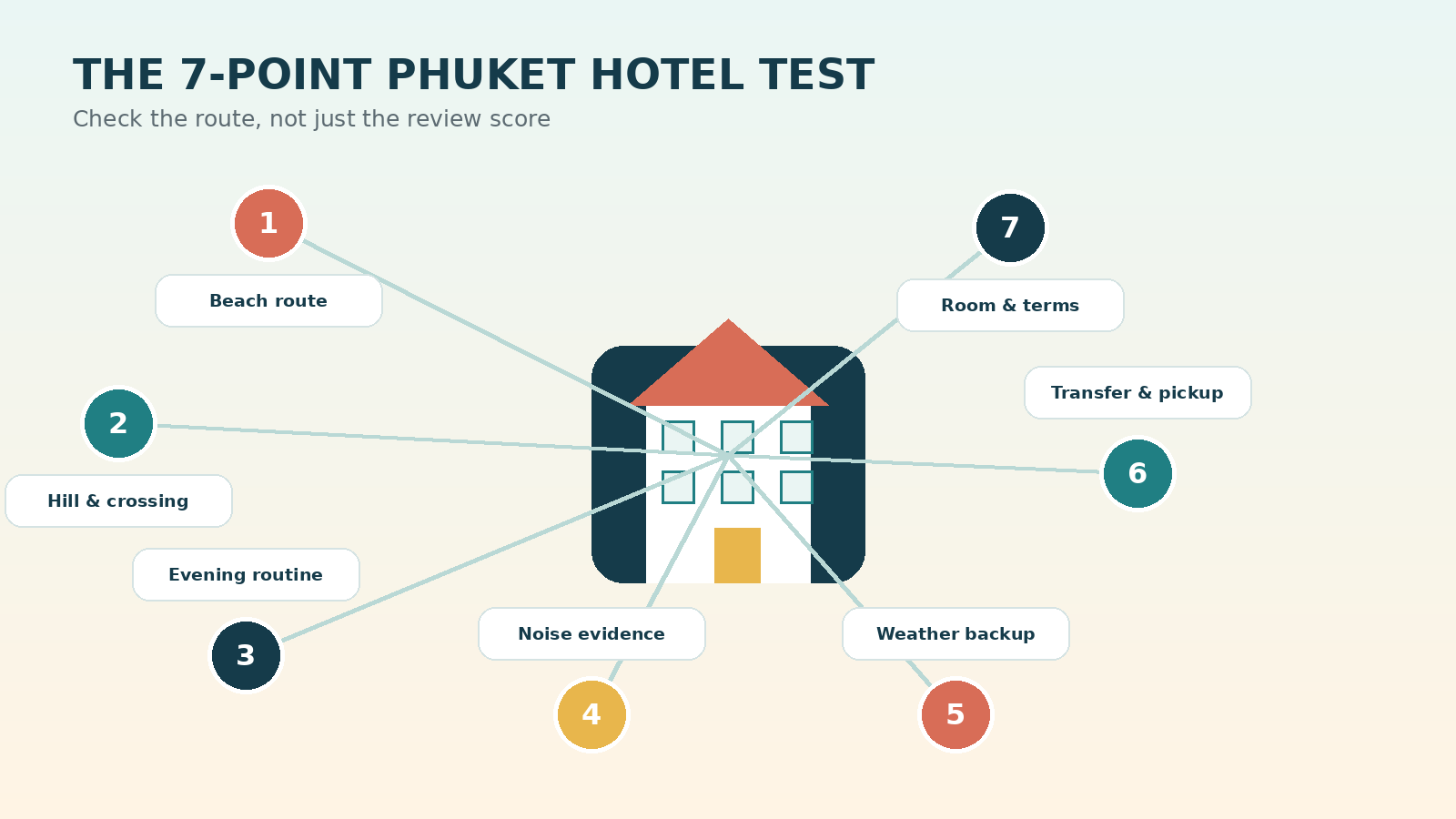
The seven-point Phuket hotel-location test
Before paying, run the property through this seven-point test. It takes a few minutes and catches the location problems that a broad area guide cannot see.
| Test | What to check | Why it matters in Phuket |
|---|---|---|
| 1. Beach route | Actual entrance-to-sand walk, not straight-line distance | Walls, resorts and roads can block the obvious route |
| 2. Gradient and crossing | Hill, steps, pavement and main-road crossing | Heat and rain magnify a difficult “short” walk |
| 3. Evening routine | Two realistic dinner choices and the return after dark | A remote hotel can create daily taxi dependence |
| 4. Noise evidence | Recent reviews for bars, traffic, aircraft and construction | Street conditions change faster than hotel descriptions |
| 5. Rough-weather backup | Pool shade, room space, covered seating and nearby food | Red flags or rain can remove the beach for a day |
| 6. Transfer and pickup | Airport time, pier, tour zone and shuttle schedule | “Phuket pickup” can still involve surcharges or long collections |
| 7. Room and terms | Exact category, beds, breakfast and cancellation deadline | The headline price may not represent the room you need |
Monsoon weather, beach choice and swimming safety
Phuket’s west coast is generally easiest during the drier part of the year, while the southwest monsoon brings a greater chance of rough seas, heavy showers and disrupted boat plans. The UK Foreign, Commonwealth and Development Office says Thailand’s rainy season is generally May to October, while also noting that it has become more unpredictable. It advises travellers to follow Thai Meteorological Department warnings.[9]
Rain does not make every day unusable, nor does sunshine guarantee safe water. Swimming decisions must be made at the beach, at that time. FCDO warns about strong riptides during monsoon season and tells visitors to follow the flag system, especially red flags.[9] Tourism Authority of Thailand gives the same broad warning for Phuket’s major beaches.[1]
How weather should change the hotel choice
- Give more weight to a usable pool, covered seating and room size.
- Choose an area with restaurants and practical services nearby.
- Avoid non-refundable boat trips on consecutive days when flexibility is available.
- Leave a buffer before a long-haul flight rather than relying on a same-day sea connection.
- Check the Thai Meteorological Department forecast and marine warnings close to travel.
Road and boat safety matter too
FCDO highlights high motorcycle accident risk in Thailand and warns that driving without the correct licence can invalidate insurance. It also notes that boat accidents can involve overloading, poor maintenance and rough seas.[9] Do not treat a scooter as the automatic solution to a poorly located hotel. A valid licence, suitable insurance, helmet and realistic experience are essential.
For broader seasonal planning, read the site’s best time to visit Thailand guide and Thailand packing list.
Tours and day trips: choose for logistics, not just photographs
Phuket’s position makes island and bay trips a major part of many itineraries. However, the best tour is not simply the one with the most dramatic cover image. Compare the departure point, hotel pickup zone, group size, boat type, sea-time, meal, safety information and cancellation policy.
Phang Nga Bay
Phang Nga Bay tours can involve different marinas and boat styles. A smaller or earlier departure may improve the experience, but it can also require a very early hotel pickup. Travellers in Rawai or Kata should check whether the collection crosses the island before reaching a northeast marina.
Phi Phi, Racha and southern island trips
Sea conditions, boat type and transfer time matter as much as the headline islands. TAT identifies Racha Yai and Racha Noi among Phuket’s notable nearby island experiences.[2] For any trip, confirm whether the itinerary is suitable for children, non-swimmers or travellers prone to seasickness.
Old Town food and cultural introductions
A guided food walk or city introduction can add context to Phuket’s history and mixed culinary influences. It is especially useful when your main hotel is on the beach and you have only one Old Town visit. When staying in Old Town, an early or evening tour lets you enjoy the area without adding a long same-day road transfer.
Phuket eSIM and connectivity planning
Mobile data helps with hotel pickup messages, map checks, translation and transport changes. Resort Wi-Fi can be strong inside the room and weak at the beach entrance or pickup point, so having independent data reduces friction.
Before buying an eSIM, confirm that the phone is unlocked and supports eSIM. Compare the data allowance, validity period, activation method and whether the plan starts on installation or first network connection. Keep the installation details available offline in case airport Wi-Fi is inconsistent.
The site’s Thailand SIM card and eSIM guide explains the broader choices and setup checks.
Useful products for a Phuket hotel and boat-trip holiday
The most useful purchases solve a specific problem: protecting essentials on a wet boat, keeping a phone usable, carrying power during a long pickup day or dealing with a sudden shower. Avoid buying bulky “travel” products that duplicate what the hotel or tour already provides.
| Product | Best for | Advantages | Limitations and buying advice |
|---|---|---|---|
| 10-litre roll-top dry bag | Boat trips and wet transfers | Keeps a small towel, clothes and electronics together | Not all bags are designed for submersion; roll the top correctly |
| Waterproof phone pouch | Beach and boat days | Simple protection from spray and sand | Test with tissue before use and do not rely on it for deep diving |
| Compact packable rain jacket | Monsoon showers and transfers | Hands-free coverage during luggage moves | Breathability matters in tropical heat; choose a light shell |
| Compact power bank | Long tour and transfer days | Useful for maps, messages and digital tickets | Check airline carry-on rules and connector type |
| Universal travel adaptor | Rooms with limited socket choices | Supports several plug types and devices | It does not convert voltage; check appliance compatibility |
Sample Phuket stay plans
Four nights: first beach trip
Stay in Kata, Karon or Kamala. Choose one beach day, one boat or bay day and one flexible day for Old Town, a viewpoint or rough-weather backup. Avoid changing hotels because the move consumes too much of a short trip.
Seven nights: family holiday
Choose Kamala, Kata, Bang Tao or a suitable Mai Khao resort. Build two slower pool-and-beach days between excursions. A family room, breakfast and walkable dinner can be worth more than saving a small amount on a hillside property.
Seven nights: culture plus beach
Spend two nights in Phuket Old Town and five nights in Kata, Kamala or Bang Tao. Place Old Town over a Sunday when the market is a priority, but check street access and noise before choosing the hotel.
Seven nights: couple seeking calm
Compare Kata Noi, Surin, Bang Tao and Cape Panwa. Decide whether you want independent restaurants or a destination resort. A resort with excellent food and pool space can justify a quieter location; an average resort cannot.
Late arrival plus south-coast stay
Use one night in Nai Yang, then transfer in daylight to Kata, Rawai or Nai Harn. This avoids beginning the trip with a long late-night drive and lets the first evening remain simple.
Two weeks: independent repeat visit
Rawai, Nai Harn, Cherngtalay or Bang Tao can support a routine with laundry, supermarkets and varied accommodation. Before choosing a villa, calculate transport, electricity, cleaning and food delivery rather than comparing only the nightly rate.
Common Phuket accommodation mistakes
| Mistake | Why it causes trouble | Better decision |
|---|---|---|
| Booking only by the word “Phuket” | The island contains very different beaches and towns | Choose the named area before comparing hotels |
| Trusting the straight-line beach distance | Walls, roads and hills can block the obvious route | Open the actual entrance-to-beach walking route |
| Assuming Rawai means swimming beach | The seafront is not the classic sandy beach experience | Check access to Nai Harn or choose a strong hotel pool |
| Choosing Mai Khao for Patong nightlife | Repeated cross-island taxis consume time and money | Stay near the evenings you want |
| Ignoring wet-weather facilities | Red flags can remove the beach from the day’s plan | Prioritise pool, covered space and nearby food |
| Using a scooter to repair a bad location | Licensing, insurance and road risk remain serious | Choose a workable base and use suitable transport |
| Comparing different room terms | Headline prices may exclude breakfast or cancellation | Compare the same room category and final total |
| Forgetting the tour pickup zone | Remote hotels can attract surcharges or very early collections | Confirm pickup before finalising the hotel |
| Adding too many hotel moves | Checkout, traffic and waiting consume usable holiday time | Split only when the second base creates a different trip |
| Underestimating airport time | South-coast traffic can extend the journey substantially | Leave a large departure buffer or use a northern final night |
Overall pros and cons of staying in Phuket
| Advantages | Disadvantages |
|---|---|
| Large choice of beaches, hotels, villas, restaurants and tours | Road traffic makes poor area choices expensive and tiring |
| International airport and straightforward access from many routes | Airport-to-south-coast transfers can be long |
| Works for nightlife, families, luxury, food and independent longer stays | No single area delivers every version of Phuket |
| Strong choice of day trips to bays and islands | Boat plans depend on weather, operator and departure logistics |
| Old Town adds culture and food beyond the beaches | Old Town and the main beaches require road travel between them |
| Accommodation ranges from hostels to premium resorts | Peak-season and resort spending can rise quickly |
Phuket rewards precision. The island’s range is a strength only when the hotel area matches the trip. Otherwise, the same variety becomes a collection of places you repeatedly pay to reach.
Frequently asked questions
What is the best area to stay in Phuket for first-time visitors?
Kata is the strongest all-round starting point for many first-time visitors because it combines a popular beach, restaurants, family facilities and manageable evening life. Karon suits travellers who prefer more space, while Patong is better when nightlife is the priority.
Is Kata or Karon better?
Choose Kata for a more compact evening routine and a balanced first trip. Choose Karon for a longer beach and a more spacious resort feel. In both places, check the hotel’s hill, road crossing and exact end of the beach.
Is Patong a good place to stay?
Yes, when you want nightlife, shopping, late dining and maximum services. It is a poor match for a quiet romantic break unless the hotel is carefully positioned away from the busiest streets.
Where should families stay in Phuket?
Kamala, Kata, Bang Tao and selected Mai Khao resorts are strong family choices. Compare pool shade, room layout, children’s meals, beach route and the amount of transport required.
Where should couples stay in Phuket?
Kata Noi, Kamala, Surin, Bang Tao and Cape Panwa can all suit couples. The deciding question is whether you want independent restaurants on foot or a self-contained resort.
What is the quietest area in Phuket?
Mai Khao, Nai Yang, Cape Panwa and quieter sections of Bang Tao are among the calmest common choices. Confirm nearby restaurants and transport before booking a remote hotel.
Is Phuket Old Town a good base?
Old Town is excellent for food, architecture and culture, but it is not a beach base. Use it for one or two nights or accept road travel to the coast.
Is Rawai good for first-time visitors?
Rawai suits repeat and independent travellers who value restaurants and south-coast access. First-time visitors expecting a classic swimming beach outside the hotel may be happier in Kata, Karon or Nai Harn.
Where should I stay for an early Phuket flight?
Nai Yang is the most practical beach-village option near the airport. Mai Khao also works for resort stays, while a basic airport hotel is sensible when the flight time matters more than the final evening.
How much is Phuket Smart Bus?
The operator currently lists a 100-baht flat fare on the Airport-Patong-Rawai route, with contactless card, Thai QR and cash payment options. Check the live route and timetable immediately before travel.
How long does Phuket Airport transfer take?
It can be around 10-20 minutes to Nai Yang and well over 90 minutes to Rawai, Nai Harn or Kata when traffic is heavy. Treat all ranges as planning allowances rather than guaranteed journey times.
Which Phuket beach is best in rainy season?
No west-coast beach is guaranteed safe during monsoon conditions. Choose a hotel with a strong pool and indoor backup, then follow lifeguards, warning signs and red flags every day.
Do I need a scooter in Phuket?
No. A well-chosen area can reduce transport needs, while taxis, hotel cars, buses and organised pickups cover many journeys. Only ride when properly licensed, insured, helmeted and experienced.
Should I stay in Bang Tao or Kamala?
Choose Bang Tao for larger resorts, villas, modern dining and longer stays. Choose Kamala for a smaller, calmer beach-town routine. In Bang Tao, exact micro-location is especially important.
Should I split Phuket between Old Town and a beach?
Yes, when you have at least seven nights and genuinely want both experiences. Two nights in Old Town plus five at a beach is more useful than moving between neighbouring beach resorts.
How far in advance should I book a Phuket hotel?
Book cancellable options earlier for Christmas, New Year, school holidays and popular dry-season weeks. Flexible wet-season trips may have more late availability, but exact beachfront and family room types can still sell out.
Final recommendation
For a first Phuket holiday, I would begin with Kata when the aim is a balanced beach town, Karon when a long beach and extra space matter, and Kamala when the family wants calmer evenings. Patong is the correct answer for a nightlife-led trip, not a compromise to apologise for. Bang Tao works well when the budget supports its resorts and the exact pocket has been chosen deliberately.
For a repeat or longer stay, Rawai, Nai Harn and Cherngtalay offer more independent routines. Old Town deserves one or two nights when food and culture are important. Nai Yang is the practical solution for an awkward flight, while Mai Khao and Cape Panwa suit travellers who want the hotel to become a substantial part of the holiday.
After choosing the area, apply the seven-point hotel test. Check the actual route to the beach, the road after dark, the wet-weather backup, the tour pickup zone and the exact room terms. Phuket becomes much easier when the daily journeys are short and intentional.
Written and researched for Taylor’s Trailblazing Travels by Karen Taylor.
Sources and methodology
Transport, safety and destination details were checked against official sources in August 2026. Hotel prices are planning bands, not live quotes. Check live tour routes, beach conditions, transport schedules and booking terms before travel.
- Phuket destination guide from Tourism Authority of Thailand – island context, named beaches, north-versus-south character and red-flag guidance.
- TAT guide to 10 things to do in Phuket – Patong, Old Town, Nai Yang, Surin and nearby island context.
- Old Town guide from Tourism Authority of Thailand – historic architecture, walkability and local-food context.
- UNESCO Creative Cities Network: Phuket – Creative City of Gastronomy status and food-culture context.
- Phuket Smart Bus: payment and fares – current route fares and payment methods.
- Airports of Thailand: Phuket Smart Bus – airport boarding point, route and listed fare.
- Phuket Smart Bus: timetable and routes – west-coast route, city service and traffic caveat.
- Bank of Thailand: tourism indicators – June 2026 southern-region occupancy, booking and room-rate indicators.
- UK FCDO Thailand safety and security advice – swimming, road, boat and rainy-season safety.
- Thailand Tourist Police – official hotline information.
- Thai Meteorological Department – official forecasts, warnings and marine information.
Image credits
Illustrations in this article were created for Taylor’s Trailblazing Travels. Third-party photographs, where used, are credited beside the image or in the source list.