Compare Thailand’s island regions by weather, atmosphere, transfer time, budget and travel style, then build a route that leaves enough time to enjoy the beach.
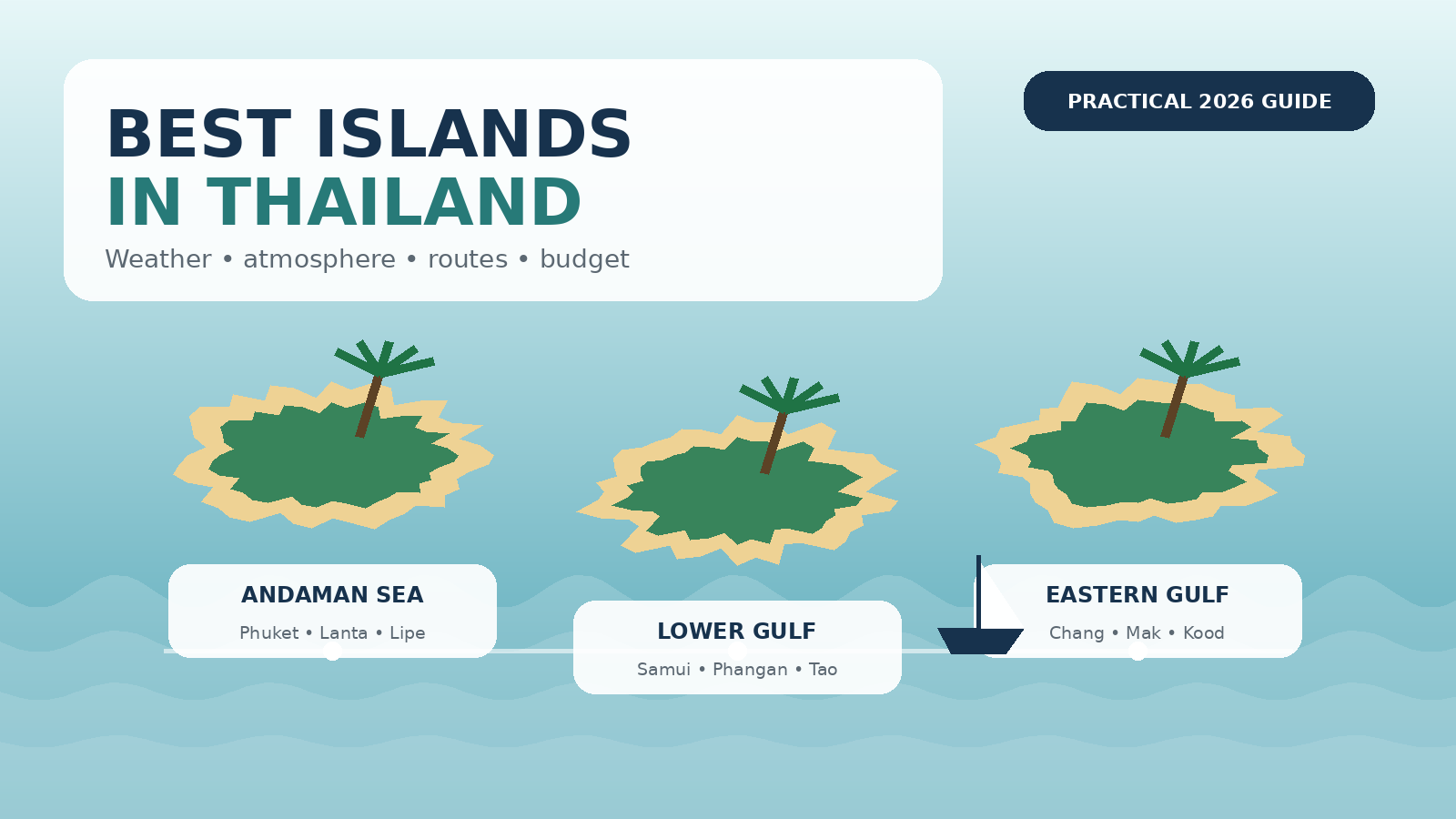
Thailand’s islands can look remarkably similar in a hotel search: pale sand, blue water, green headlands and a long row of tempting resorts. Yet the holidays they create are not interchangeable. Phuket can work as a complete coastal base with an airport, shopping and dozens of day trips. Koh Tao makes far more sense when diving or snorkelling is central to the plan. Koh Kood becomes quiet early, while parts of Koh Phangan can switch from peaceful to intensely social around major party dates.
Therefore, the useful question is not simply, “Which is the prettiest island?” Start with the month, the arrival airport and the type of trip you actually want. Thailand is influenced by two monsoon systems, so the Andaman Sea and Gulf coasts can experience different conditions at the same time.[1][2]
Next, price the complete journey. A cheap room can become poor value when reaching it requires a domestic flight, a long van transfer, a pier wait, a speedboat and another taxi. Conversely, an expensive direct flight to Samui may protect most of a day. Door-to-door time matters just as much as the ticket headline.
The comparisons below use official tourism, weather, national-park and transport information checked on 22 August 2026. Hotel, meal and tour figures are transparent planning ranges rather than guaranteed prices. Ferry timetables, park access, sea conditions and room rates change, so confirm the exact date, pier, baggage rules and cancellation terms before paying.
Thailand island quick answers
Phuket for maximum choice, or Koh Samui when a Gulf-coast trip and direct flight suit the dates.
For a relaxed stay, choose Koh Lanta when four or more nights and space matter more than concentrated nightlife.
Divers should start with Koh Tao; Similan and Surin are seasonal marine-park trips rather than normal resort islands.
Quiet-seeking travellers can compare Koh Kood, Koh Mak or Koh Yao Noi, accepting limited evening choice and extra transfer planning.
From Bangkok, choose Koh Samet for the simplest classic island break, or Koh Chang when several nights justify the longer road journey.
Stay on one coast and use no more than two island bases unless the trip is longer than two weeks.
Koh Samui, Koh Phangan and Koh Tao often have the strongest seasonal case in July and August, though rain is still possible.
Return to the airport side or mainland one day before a separate long-haul flight when ferries are involved.
In this guide
How to choose the best Thai island for your trip
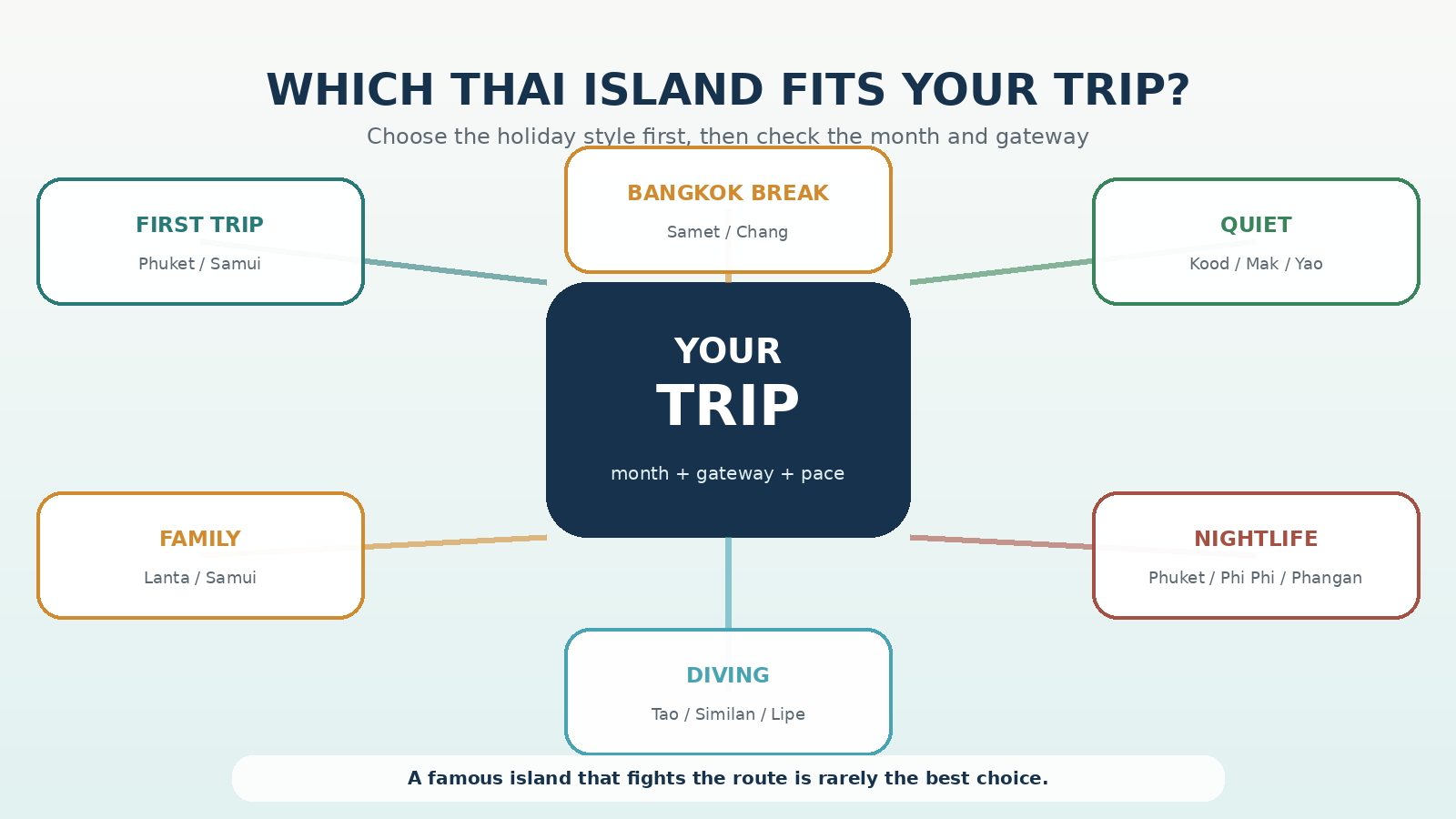
Start with a shortlist of three. Then remove any island that fights the season, creates an awkward backtrack or needs more transfer time than the holiday can spare. This approach is less glamorous than choosing a resort from photographs, but it produces a more usable trip.
Thailand island comparison at a glance
| Island | Best for | Usual gateway | Ideal stay | Main compromise |
|---|---|---|---|---|
| Phuket | First trips, groups, nightlife, varied day trips | Phuket airport | 4-7 nights | Traffic, development and long cross-island drives |
| Koh Phi Phi | Dramatic scenery, social stays, short add-ons | Phuket or Krabi by boat | 2-3 nights | Crowds, limited space and no road escape |
| Koh Lanta | Families, couples and a slower beach holiday | Krabi airport plus road/boat transfer | 4-7 nights | Beach location affects convenience; quieter nightlife |
| Koh Yao Noi / Yai | Quiet couples, local atmosphere, bay views | Phuket or Phang Nga piers | 3-5 nights | Fewer restaurants, taxis and evening options |
| Koh Lipe | Clear water, snorkelling and a remote feel | Hat Yai/Trang plus Pak Bara | 4-6 nights | Long transfer and seasonal route pressure |
| Koh Samui | Resorts, families, wellness and easy logistics | Samui airport or Donsak ferry | 5-8 nights | Flights and taxis can cost more |
| Koh Phangan | Parties, yoga, longer stays and quiet coves | Samui or Surat Thani by ferry | 4-7 nights | Event dates alter prices and atmosphere |
| Koh Tao | Diving, snorkelling and a younger social scene | Chumphon or Gulf islands by boat | 4-6 nights | No airport, steep roads and extra hand-off |
| Koh Chang | Nature, families and Bangkok-linked trips | Trat or Bangkok plus car ferry | 4-7 nights | Mountain roads and a long Bangkok transfer |
| Koh Kood | Quiet resorts, couples and beach time | Trat coast plus seasonal boat | 4-6 nights | Limited transport, services and nightlife |
| Koh Mak | Low-key cycling, couples and small-scale stays | Trat coast or nearby islands | 3-5 nights | Small choice and reduced low-season frequency |
| Koh Samet | A short Bangkok beach break | Ban Phe pier by road from Bangkok | 2-4 nights | Busy weekends and less island-hopping variety |
| Koh Phayam | Offbeat, simple and slower travel | Ranong plus boat | 4-6 nights | Long rainy season and fewer polished services |
| Koh Kradan / Ngai / Mook | Small-island beaches and quiet couples’ stays | Trang or Lanta by seasonal boat | 3-5 nights | Limited cash, shops and wet-season access |
Count hotel changes, not island names
A seven-night beach holiday normally needs one base. Ten to fourteen days can support two nearby bases, especially when the boat journey is short. Three islands in two weeks can work, but only when they sit in a logical chain and each stay has a purpose. Otherwise, the trip becomes a sequence of packing, checkout, pier waits and check-ins.
Best Thailand islands by month
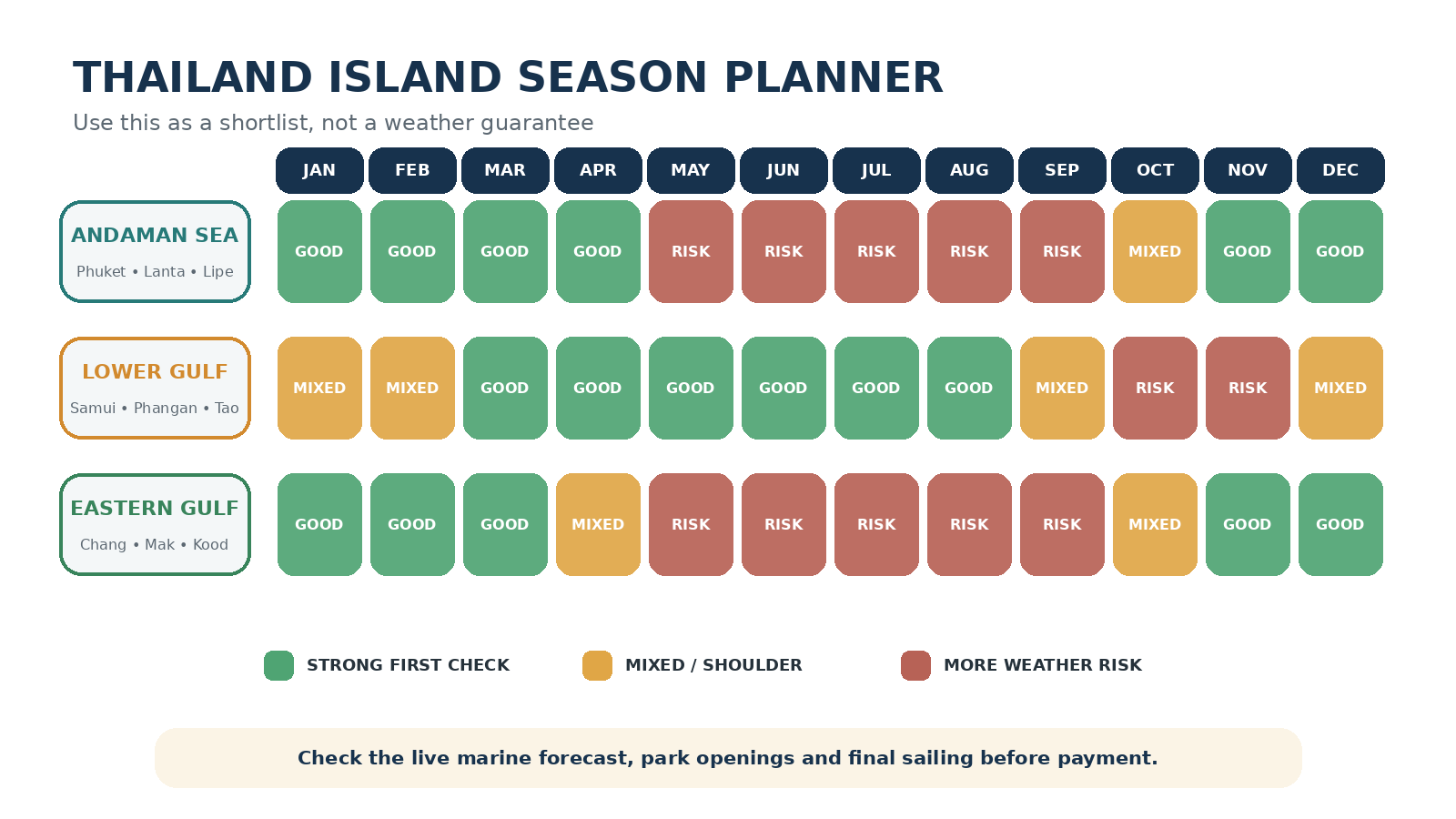
Thailand’s seasons are patterns rather than promises. The southwest monsoon usually operates from mid-May to mid-October, while the northeast monsoon normally follows from mid-October to mid-February. The latter can bring wetter conditions to the east coast of southern Thailand even when Bangkok and much of the country feel drier.[2]
Month-by-month island shortlist
| Month | Strong first checks | Why | Planning caution |
|---|---|---|---|
| January | Phuket, Lanta, Lipe, Chang, Mak, Kood, Samui | Broad dry-season choice on the Andaman and Eastern Gulf | Peak prices and fuller boats; book festive carry-over dates early |
| February | Most Andaman islands, Tao, Chang, Mak, Kood | Strong sea and beach window across several regions | Popular dive and beach dates can sell first |
| March | Phuket, Phi Phi, Lanta, Lipe, Tao, Samui | Hotter weather but generally strong island choice | Heat and haze can affect comfort; use shade and hydration |
| April | Samui, Phangan, Tao, Phuket, Lanta | Transition month with many routes still operating | Songkran demand and heat raise prices and transfer pressure |
| May | Samui, Phangan, Tao; Phuket for flexible travellers | Lower Gulf often becomes the safer first shortlist | Andaman park closures and reduced routes begin |
| June | Samui, Phangan, Tao | Gulf islands often have the strongest seasonal case | Sun is not guaranteed; keep boat-day expectations flexible |
| July | Samui, Phangan, Tao | Useful European-summer beach option | School-holiday demand can raise fares and room prices |
| August | Samui, Phangan, Tao | Lower Gulf usually deserves the first look | Weather varies; do not force a marginal Andaman speedboat chain |
| September | Samui or Phangan for a flexible stay; mainland alternatives | Shoulder period with fewer obvious winners | Heavy rain and rough seas can affect several regions |
| October | Phuket late in the month; Samet for flexible short breaks | Transition towards the Andaman high season | Conditions can change quickly and routes restart gradually |
| November | Phuket, Lanta, Lipe, Chang, Mak, Kood | Andaman and Eastern Gulf seasons strengthen | Lower Gulf can still receive northeast-monsoon rain |
| December | Phuket, Phi Phi, Lanta, Lipe, Chang, Mak, Kood | Classic peak island month | Christmas and New Year require early rooms, transfers and buffers |
Do not cross the country to chase one forecast
A wet symbol on a phone app does not mean continuous rain, and a sunny icon does not guarantee a calm crossing. Unless the forecast shows a sustained severe pattern, a last-minute coast swap can cost more time than it saves. Instead, build indoor or flexible options into larger islands and avoid non-refundable chains with no recovery margin.
Andaman Sea islands: Phuket, Phi Phi, Lanta, Yao and Lipe
The Andaman side delivers many of Thailand’s most recognisable limestone views. Phuket and Krabi are the main gateways, while seasonal boats connect a longer chain towards Trang and Koh Lipe. November to April is the usual first planning window, although each island and year can differ.[1]
Phuket: easiest for a first island holiday
Phuket works when choice matters. It has an international airport, a huge accommodation range, day trips in several directions and enough restaurants, shopping and cultural activity for a poor-weather day. Old Phuket Town adds food, architecture and museums beyond the resort coast.[22]
However, Phuket is large. Patong suits nightlife and convenience; Kata and Karon are more conventional beach bases; Kamala can feel calmer; Bang Tao suits longer resort stays; and Nai Yang is useful near the airport. Cross-island traffic can make a cheap hotel on the wrong coast an expensive daily mistake.
Koh Phi Phi: scenery with concentrated energy
Phi Phi suits a short, active stay. Phi Phi Don combines a pedestrian centre, beach bars and boat access to surrounding bays. TAT identifies November to April as the stronger weather period and recommends booking rooms early for peak dates.[7]
Still, every arrival is a boat arrival. Tonsai and Loh Dalum are convenient but busy; a remote bay can be far quieter, yet long-tail transfers add cost and reduce spontaneity. For many travellers, two or three nights are enough. A day tour is simpler when nightlife and a central stay are not priorities.
Koh Lanta: the practical slower island
Koh Lanta is one of the strongest all-round recommendations for families, couples and travellers who want at least four nights. The main island is more than 30 kilometres long, has a paved north-south road and offers a sequence of beaches without the intensity of Phuket or Phi Phi.[6]
Long Beach is a practical first base; Klong Khong has a more informal social feel; Klong Nin balances restaurants with a slower pace; and the far south becomes quieter. Smaller park islands are commonly closed during the May to October monsoon period, so a low-season stay should not assume every snorkelling trip will operate.
Koh Yao Noi and Koh Yao Yai: quiet inside Phang Nga Bay
The Yao islands suit travellers who want limestone views, local communities and slower evenings between Phuket and the Phang Nga side. Official sustainable-tourism material highlights mangroves, beaches and community experiences.[23] In return, the islands offer fewer taxis and restaurants. A well-located hotel or pre-arranged scooter alternative matters more here than an attraction checklist.
Koh Lipe: clear-water reward with a long approach
Koh Lipe sits in the Satun island region and works best when the route can absorb the distance. Pak Bara is the usual mainland gateway, while seasonal Andaman boats link Lipe with islands farther north. TAT warns that west-coast monsoon conditions make marine travel more hazardous from May through October and that Tarutao-area access is seasonal.[10]
Therefore, Lipe is not a sensible one-night trophy stop. Four nights gives the transfer a purpose; five or six adds weather flexibility. Walking Street is convenient, Pattaya Beach handles many arrivals and Sunrise Beach is popular for a longer beach stay, though exact atmosphere varies by section.
Trang islands: Kradan, Ngai and Mook
These smaller islands can deliver the quiet, barefoot image that travellers expect from Thailand. They also have fewer shops, cash machines, transport choices and medical services. Seasonal boats and resort transfers matter, so confirm meals, payment methods and the final connection before leaving Trang or Lanta. Koh Mook offers the broadest village life; Koh Kradan and Koh Ngai are more resort-led.
Similan and Surin: marine parks, not ordinary resort bases
The Similan and Surin groups are seasonal national-park trips known for beaches and underwater scenery. The DNP’s published fee grouping lists both among the higher foreign-adult entry categories, and Similan has used seasonal closure and e-ticket requirements.[17][18] Treat them as regulated excursions or dive trips, and verify the current opening date and ticket process.
Lower Gulf islands: Koh Samui, Koh Phangan and Koh Tao
The Lower Gulf is the strongest first check for many July and August holidays. Samui has an airport and the widest services; Phangan changes dramatically by area and event date; Tao rewards travellers who make the sea central to the trip.
Koh Samui: the easiest complete Gulf holiday
Samui offers the broadest Lower Gulf hotel and activity range. TAT highlights Chaweng, Lamai and Taling Ngam, alongside cooking, yoga, Muay Thai, diving, golf and resort stays.[3] Consequently, it works for families, couples and travellers who do not want to depend on another ferry after a flight.
Chaweng is the busiest base; Bophut combines restaurants with a more contained evening scene; Lamai remains lively at a smaller scale; Choeng Mon is practical for some families; and the west or south can be much quieter. The trade-off is taxi cost and journey time when the hotel is far from the planned activities.
Koh Phangan: more than the Full Moon Party
Phangan is famous for its monthly event, but the island also has mountains, waterfalls, yoga centres and moderately developed beaches. TAT describes a genuine split between party access and quiet beach holidays.[4] Therefore, check the event calendar even when nightlife is not the goal: room prices, boat demand and road traffic can rise across the island.
Haad Rin is the party reference point. Sri Thanu attracts wellness and longer-stay visitors, while Thong Nai Pan and parts of the north-east offer a much quieter resort experience. A remote bay may require a hotel transfer or water taxi, so check the route after dark before booking.
Koh Tao: build the stay around the water
Koh Tao is the strongest choice for a diving-led holiday. TAT describes it as one of Thailand’s leading scuba destinations and identifies February to April as a particularly useful period, while stressing coral, turtle and litter protection.[5]
Non-divers can snorkel, hike and visit small bays. Even so, the extra boat connection should have a purpose. Sairee gives the broadest choice and social scene; Mae Haad is practical for the pier; and quieter bays suit resort time. Four or five nights is more sensible than racing through for one full day.
What Gulf ferry logistics actually look like
Seatran’s live booking page listed the Donsak to Nathon passenger crossing at about 1 hour 30 minutes and 200 baht when checked on 22 August 2026.[20] Lomprayah’s published route information gives useful planning examples of roughly 30 minutes from Samui to Phangan, one hour from Phangan to Tao and 1 hour 45 minutes from Chumphon to Tao.[21]
Those are sailing examples, not door-to-door totals. Add airport or station travel, pier check-in, baggage handling and hotel transfer. A “one-hour ferry” can still occupy half a day.
Eastern Gulf islands: Koh Chang, Koh Kood, Koh Mak and Koh Samet
The Eastern Gulf creates a logical Bangkok-linked island region. Koh Chang has the broadest services, Koh Mak and Koh Kood become progressively quieter, while Koh Samet is the simplest short break from the capital. The smaller-boat network becomes more seasonal during the wetter months.[13]
Koh Chang: a large nature island
Koh Chang is Thailand’s second-largest island and is heavily forested. TAT positions it for beaches, waterfalls, snorkelling and a range of budgets.[11] White Sand Beach is convenient and developed, Klong Prao balances space with services, Kai Bae has restaurants and viewpoints, and Lonely Beach retains a more social budget identity.
The road is steep and winding in places, particularly around the west coast. A scooter should not be treated as automatic transport. Families and less confident riders may be better with shared taxis or a hotel transfer.
Koh Kood: quiet resort escape
Koh Kood suits travellers who want beaches, waterfalls and early nights. TAT describes a comparatively quiet island and identifies November to February as a strong planning period, while noting that low-season boat service can be restricted.[12]
Resort location matters because restaurants and transport are dispersed. Confirm whether breakfast, pier transfer and local transport are included. Keep some cash, but check current ATM and payment availability directly with the accommodation rather than trusting an old blanket statement online.
Koh Mak: small-scale and low-key
Koh Mak is small enough for a slower cycling holiday and has developed a low-carbon tourism identity.[25] It works well between Chang and Kood during the main season, or as a single quiet base. Nevertheless, a limited hotel and dining market means that specific rooms can sell before the island feels busy.
Koh Samet: shortest classic island break from Bangkok
Koh Samet is reached through Ban Phe in Rayong and makes sense when time is limited. TAT identifies October to April as the calmer sea period and notes practical island services, including some ATMs.[14] Sai Kaew is the busiest beach; Ao Phai and Ao Tubtim become progressively calmer; and quieter southern bays suit travellers who do not need to walk to nightlife.
Weekends and Thai public holidays can feel much busier than weekdays. Therefore, a midweek stay often gives a truer picture of the island.
Koh Phayam: offbeat Andaman alternative from Ranong
Koh Phayam does not belong to the Eastern Gulf, but it fits the same traveller who is comparing quieter islands. TAT’s Ranong guidance describes a long rainy season and a boat connection of roughly one to two hours.[16] Choose it for simplicity and slower travel, not polished resort infrastructure.
Best Thailand island by travel style
The island name is only the first decision. The beach area, hotel position and transport plan can matter just as much. A quiet hotel in northern Phuket may suit a couple better than a party-week room on Phangan, while a central Samui base may be easier for a family than a remote Lanta villa.
Island pros and cons by traveller type
| Travel style | Strong shortlist | Why it works | Watch-out |
|---|---|---|---|
| First trip | Phuket, Samui | Airports, broad hotel choice, activities and backup plans | Convenience brings development and higher transport costs |
| Families | Lanta, Samui, Phuket, Chang | Road access, larger rooms and useful services | Choose the beach and transfer length carefully |
| Couples seeking quiet | Kood, Mak, Yao Noi, south Lanta | Slower evenings and resort-led stays | Fewer spontaneous dining and transport choices |
| Nightlife and social travel | Patong, Phi Phi, Haad Rin, Sairee | Concentrated bars, events and younger crowds | Noise, event dates and inflated room rates |
| Diving | Tao, Similan/Surin trips, Lipe | Dive schools or major marine sites | Seasonal access, certification and boat dependence |
| Snorkelling without a dive course | Tao, Lipe, Kradan, selected Lanta trips | Accessible reefs or strong day-trip networks | Visibility and sites depend on weather and operator choice |
| Bangkok short break | Samet, Chang | Manageable mainland connection | Chang needs more travel time than a weekend may allow |
| Long stay | Lanta, Samui, Phuket, Chang, Phangan | More food, services and accommodation choice | A quiet beach can still need daily transport |
| Remote scenery | Lipe, Kood, Phayam, Trang islands | Transfer effort creates separation | Weather and last-boat risk matter more |
For families: reduce the number of hand-offs
A family route improves when the airport, hotel and beach area connect in one clear chain. Samui’s direct airport can justify the fare; Lanta’s road-and-vehicle-ferry transfer can be easier than carrying bags between passenger boats; Phuket offers medical and retail backup. Check pool barriers, extra-bed wording and whether the beach is safely swimmable in the planned month.
For couples: quiet is usually an area choice
Koh Kood and Koh Mak are obvious calm choices, but quiet versions of larger islands can be easier. A south-Lanta resort or Samui’s less-developed west coast may combine tranquillity with a better flight plan. Compare the evening transport as well as the beach. A beautiful remote dinner becomes less appealing when the only return is an expensive private taxi.
For nightlife: check the exact dates
Patong is reliably busy, Phi Phi is concentrated and walkable, and Phangan changes around event dates. Sairee on Tao has a social dive scene rather than a large-island club market. Book the right distance from the centre: being five minutes closer can save late-night transport, while being fifteen minutes farther away can protect sleep.
Best areas to stay on Thailand’s main islands
“Which island?” often hides the more useful question: “Which part of the island?” The table below is a starting point, not a substitute for checking the exact hotel on a map.
Area comparison for first-time visitors
| Island and area | Best for | Advantages | Possible drawback |
|---|---|---|---|
| Phuket: Kata | First beach holiday, couples, families | Beach, restaurants and access to south-Phuket trips | Traffic and busy peak dates |
| Phuket: Patong | Nightlife and maximum convenience | Large hotel, dining and entertainment choice | Noise, crowds and a commercial atmosphere |
| Phuket: Bang Tao | Resorts, longer stays and dining | Long beach and broad accommodation range | Spread out; local transport may be needed |
| Samui: Bophut | Couples and families wanting evenings nearby | Restaurants, walking area and practical north-coast position | Not the quietest or cheapest base |
| Samui: Lamai | A lively beach without full Chaweng intensity | Useful dining and accommodation mix | Still developed and spread along the road |
| Lanta: Long Beach | First-time Lanta visitors | Restaurants, broad rooms and manageable north-island access | Less secluded than the far south |
| Lanta: Klong Nin | Couples and relaxed evenings | Beachfront dining and slower pace | Farther from Saladan and some transfers |
| Phangan: Sri Thanu | Yoga, wellness and longer stays | Cafes, community and west-coast sunsets | Popular, and not ideal for every party date |
| Phangan: Thong Nai Pan | Quiet resort holiday | Attractive bays and separation from party areas | Longer road transfer and fewer spontaneous options |
| Tao: Sairee | Divers and social travellers | Dive schools, restaurants and sunsets | Busier evenings and variable room quietness |
| Chang: Klong Prao | Families and balanced stays | Long beach, resorts and central west-coast position | Some sections need transport for dinner |
| Samet: Ao Tubtim / Ao Nuan | Couples wanting quieter access | Calmer than Sai Kaew while still connected | Smaller dining choice |
Thailand island ferries, transfer times and realistic costs
Ferry prices are only one part of the island budget. Add airport transport, hotel pickup, pier transfers, national-park fees and the cost of losing a day when a route is poorly timed. The ranges below are planning anchors; use the live operator or booking page for the exact date.
Useful transfer examples
| Route | Planning time | Planning price | Check before paying |
|---|---|---|---|
| Donsak to Samui, Seatran passenger | About 1h30 sailing | 200 baht checked example | Nathon arrival, mainland transfer and vehicle fare if applicable |
| Samui to Phangan | From about 30 minutes on fast services | Often 250-600 baht | Samui pier, Phangan pier, check-in and baggage |
| Phangan to Tao | About 1 hour on published fast-service example | Often 450-750 baht | Sea conditions and onward hotel transfer |
| Chumphon to Tao | About 1h45 on published fast-service example | Often 750-1,200 baht | Train/bus arrival buffer and pier transfer |
| Phuket to Phi Phi | Roughly 1-2 hours by vessel type | Often 450-1,000 baht | Rassada transfer, Tonsai arrival, remote-bay boat |
| Krabi/Ao Nang to Lanta | Roughly 2-4 hours by combined road/boat route | Often 500-1,200 baht | Exact pickup, vehicle ferry, hotel drop and season |
| Pak Bara to Lipe | Roughly 1h30-2h, conditions permitting | Often 700-1,200 baht plus local/park charges | Pier fee, park fee, beach landing and final hotel access |
| Bangkok to Chang | About 6-9 hours door to door | Often 700-1,500 baht by shared route | Whether the ticket ends at pier, ferry or island hotel |
| Ban Phe to Samet | About 30-45 minutes on common boats | Often 100-300 baht plus park/local fees | Boat type, arrival beach and return timetable |
Editorial ranges above are intended to prevent under-budgeting, not to quote a particular operator. A shared van may cost more than a public bus but include the pier and hotel. Likewise, a speedboat may be faster yet less comfortable in rough water.
When to book early
- Christmas, New Year, Songkran and Thai public-holiday weekends.
- Full Moon Party dates when travelling to or through Phangan.
- The last practical boat of the day after an arriving flight.
- Long seasonal routes to Koh Lipe, Koh Kood or smaller Trang islands.
- Any transfer that must connect with a separate international flight.
What to keep flexible
Do not lock every ordinary short ferry months ahead simply because a booking screen exists. A flexible ticket can be useful when weather, a late train or a changed hotel affects the plan. On the other hand, flexibility is not a reason to arrive at a pier after the final service.
Thailand island-hopping routes that protect the holiday
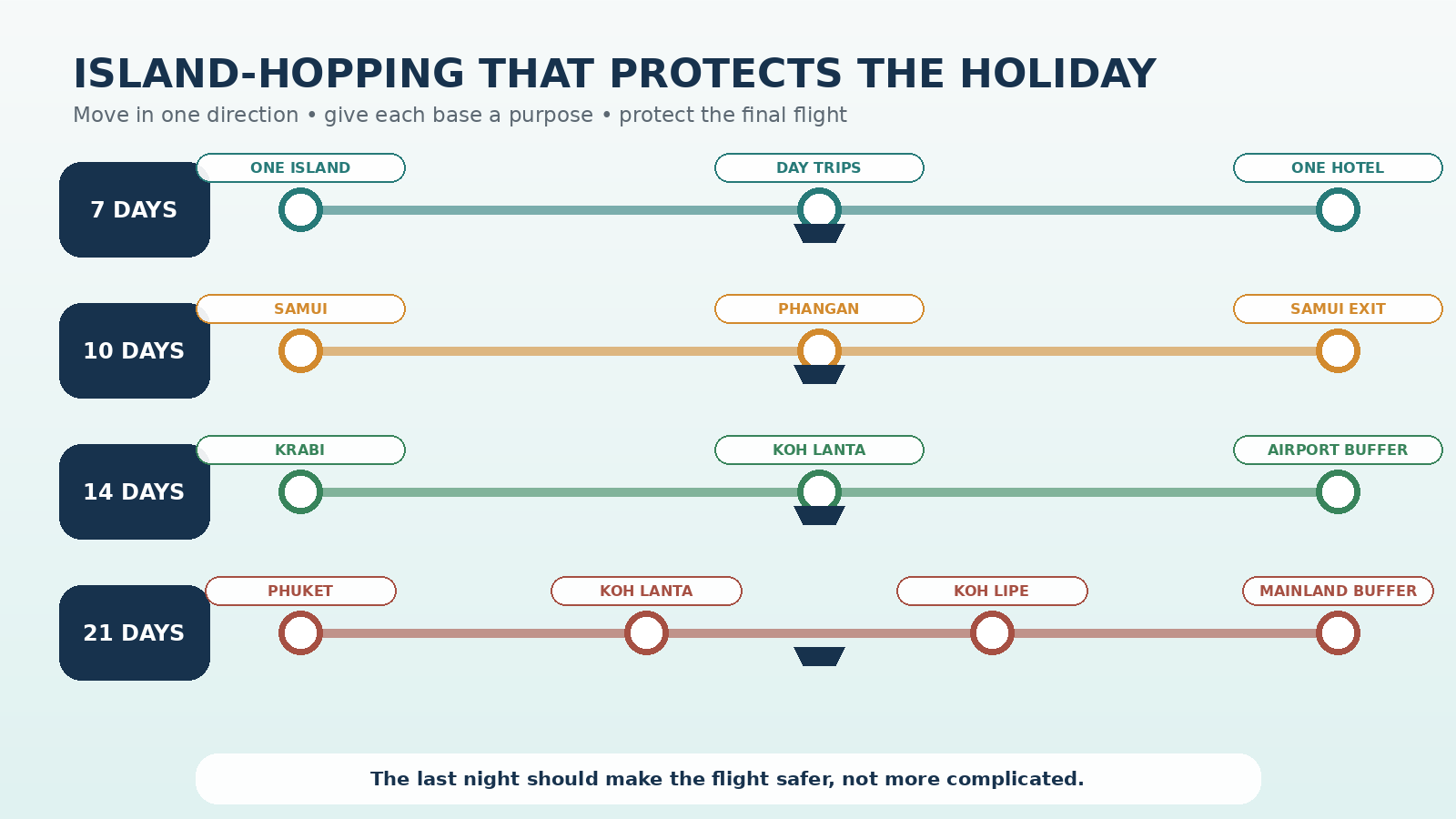
A good island-hopping route moves in one direction and keeps the final flight separate from the final boat. A poor route crosses the country repeatedly, treats every transfer time as best-case and gives each island only one usable day.
Realistic route combinations
| Trip length | Route idea | Why it works | Avoid |
|---|---|---|---|
| 7 days | One island: Phuket, Samui, Lanta or Chang | One arrival, one base and day-trip flexibility | Adding a second island for one or two nights |
| 10 days | Samui 6 + Phangan 4 | Short Gulf connection with contrasting bases | Adding Tao unless diving is the main goal |
| 10 days | Phuket 6 + Yao Noi 4 | Easy gateway plus a quieter bay stay | Another long Andaman transfer |
| 14 days | Krabi/Ao Nang 4 + Lanta 7 + Krabi buffer 2 | Mainland scenery plus a slower island | Crossing to Samui in the same trip |
| 14 days | Samui 5 + Phangan 4 + Tao 4 | Logical Gulf chain when Tao has a purpose | Flying out of Samui immediately after the last Tao boat |
| 14 days | Chang 6 + Mak 3 + Kood 4 | One Eastern Gulf island chain | Returning to Bangkok on the long-haul flight day |
| 21 days | Phuket 5 + Lanta 7 + Lipe 6 + mainland buffer | Logical southbound Andaman progression in season | Reversing direction or using one-night stops |
Seven days: choose one base
One island gives time to recover from the flight, learn the area and move a boat day if the weather changes. Phuket, Samui, Lanta and Chang all have enough variety for a week. Day trips can add scenery without another checkout.
Two weeks: use two bases, or three only in a tight chain
For a first trip, two bases usually feel better. Phuket plus Phi Phi, Krabi plus Lanta, or Samui plus Phangan all create contrast without using the whole holiday in transit. Samui-Phangan-Tao is the main three-island exception, but Tao should earn its place through diving, snorkelling or a four-night stay.
Three weeks: longer chains become realistic
With 21 days, the Eastern Gulf trio or a southbound Andaman route can work. Even then, keep one mainland or airport-side night before the long-haul flight. The last days should become safer, not more complicated.
Island tours worth booking, and those to compare carefully
A tour adds value when it solves access, safety or logistics. It adds less when the destination is easily reached by a local boat or when the listing hides compulsory fees. Read the inclusions line by line.
Trips that often benefit from advance comparison
- Phi Phi and Phang Nga Bay tours from Phuket or Krabi, especially when hotel pickup zones differ.
- Ang Thong Marine Park from Samui or Phangan, where vessel type, kayaking, park fees and lunch vary.
- Koh Tao snorkelling circuits when the operator’s group size and safety equipment are clear.
- Similan or Surin trips, where seasonal opening, park tickets and a long early transfer matter.
- Private family charters when child sizes, shade, toilets and cancellation terms are stated in writing.
Details that deserve more attention than the star rating
Check the operating company, vessel type, maximum group size, life-jacket sizes, pickup boundary, national-park fees, meal wording, snorkel-equipment condition and weather policy. A listing can say “free cancellation” while applying a much earlier deadline than expected. Also confirm whether a remote hotel adds a transfer surcharge.
When booking locally can be better
A simple long-tail boat, a short snorkelling trip with a trusted hotel or a flexible poor-weather day may be easier to arrange locally. Ask for the written route, return time and price. Do not assume that a handwritten board includes the same insurance, park fee or pickup as an online tour.
What to pack for Thailand island transfers
Island packing is less about buying specialist equipment and more about protecting the items that cannot get wet. Boat spray, beach landings and open luggage carts are ordinary possibilities. Pack medicines, passport, phone and one change of clothes as though the main bag could be delayed or splashed.
Useful island products compared
| Item | When it helps | Buying advice | Limitation |
|---|---|---|---|
| 10-20L roll-top dry bag | Open boats, beach landings and wet day trips | Choose welded seams, a simple roll closure and a size you can carry | Not a substitute for a certified diving case |
| Waterproof phone pouch | Spray, rain and sandy beach stops | Test it empty with tissue before the trip; check touchscreen operation | Depth ratings and seals vary; do not assume it is suitable for diving |
| Compact USB-C power bank | Long transfer days and tickets stored on a phone | Use a reputable brand, correct cable and airline-compliant capacity | Power banks usually belong in cabin baggage, subject to airline rules |
| Compact quick-dry towel | Basic rooms, snorkelling trips and an extra dry layer | Choose a practical medium size rather than the smallest packed option | Good hotels and organised tours may already provide towels |
Keep the essentials in a personal bag
- Passport, wallet, medicines and booking confirmations.
- Phone, charging lead and a protected power bank.
- Swimwear or one dry change of clothes.
- Sun protection, drinking water and motion-sickness medicine if medically suitable.
- Hotel name, pier and transfer contact saved offline.
Do not overpack for a boat chain
A large hard case can be awkward on steep piers, beach landings and small hotel transfers. A wheeled case is still workable on major routes, but keep the weight manageable. Check baggage allowances for every domestic flight and speedboat rather than assuming the international allowance follows the trip.
For the broader list, use the site’s Thailand packing guide, which covers temples, rain, electronics and longer journeys.
SIM cards and eSIMs for Thai islands
Mobile coverage can be strong in a main village and weak behind the hill at a remote resort. Ask the accommodation which carrier works inside the exact room area, then download the hotel map and ferry details before leaving the mainland. Offshore coverage should never be assumed.
Local SIM or advance travel eSIM?
A local AIS, True or dtac plan can provide a Thai number and strong value. An advance travel eSIM is useful when the first hour matters: a late arrival, solo transfer or tight connection. However, the phone must be unlocked and compatible, and many travel eSIMs are data-only.
Prepare an offline fallback
Save the hotel name in Thai and English, a screenshot of the ticket, the pier location and the transfer telephone number. Download the relevant map area. If the group splits up, agree a physical meeting point rather than relying entirely on messaging.
Safety and responsible travel on Thailand islands
Respect closures and capacity rules
Seasonal closures protect visitors and marine ecosystems. Do not treat a closed bay or park as a challenge to find an unofficial boat. Confirm national-park access through the DNP or a licensed operator, and ask whether the entry fee is included.
Look without touching
Do not stand on coral, chase turtles, feed fish or take shells from protected areas. Choose operators that brief guests before entering the water and provide correctly sized flotation equipment. A good guide changes the route when conditions make a site unsafe.
Water, power and waste are island resources
Refill water where a safe filtered station exists, refuse unnecessary single-use plastic and switch off air-conditioning when leaving the room. Smaller islands have limited waste and freshwater systems. The best low-impact habit is often simply carrying less disposable packaging onto the island.
Motorbikes require a lawful licence and real confidence
Island roads can be steep, sandy, wet and poorly lit. The UK government’s Thailand safety guidance warns about the high level of road accidents and the need for the correct licence and insurance.[26] Do not learn to ride on holiday, and do not hand over a passport as rental security when another arrangement is available.
Take marine warnings seriously
Wear the life jacket when instructed, keep footwear accessible and follow crew directions. If an operator cancels because of wind or swell, use the time for a land-based day. No viewpoint or snorkelling stop is worth pressuring a crew to sail.
Build your Thailand island plan in six steps
Practical first-trip example
A traveller with fourteen nights in February could use Bangkok for three nights, fly to Krabi, spend four nights in Ao Nang and six nights on Koh Lanta, then return to Bangkok for the final night. The route uses one island, keeps the coast consistent and gives the final international flight a buffer. The site’s Thailand two-week itinerary shows how those transfer days fit into a wider trip.
Practical summer example
A July holiday could fly from Bangkok to Samui, stay six nights around Bophut or Lamai, then move to Phangan for five nights. The final two nights return to Samui before the flight. Tao should be added only by removing nights elsewhere and giving it at least four nights.
Practical Bangkok-linked example
A winter trip can travel from Bangkok to Koh Chang, then continue to Koh Mak or Koh Kood during the main boat season. The final night should be in Trat or Bangkok. Attempting the island boat, long road transfer and international airport on the same day creates an unnecessary failure point.
Use the Thailand travel budget guide to turn the route into daily and total-trip figures, including the transfer costs that are easy to forget.
Frequently asked questions about Thailand islands
Which Thai island is best for a first trip?
Phuket is the easiest all-round first choice because it has an international airport, many beach areas and plenty to do in poor weather. Koh Samui is equally practical when the Lower Gulf suits the month and the flight price fits the budget.
Is Phuket or Koh Samui better?
Choose Phuket for the largest activity range, Old Town and easy Andaman day trips. Choose Samui for a self-contained Gulf resort holiday, especially in parts of the European summer. Compare the month, flight route and preferred beach area before comparing hotels.
Is Koh Lanta or Phi Phi better?
Koh Lanta is better for families, couples and four or more relaxed nights. Phi Phi is better for a short, social stay with dramatic boat scenery. Lanta is spread out and road-based; Phi Phi is compact, pedestrian and dependent on boats.
Which Thailand island is best in July or August?
Koh Samui, Koh Phangan and Koh Tao usually deserve the first look because the Lower Gulf often has a stronger seasonal case than the Andaman. Nevertheless, rain and rough water remain possible, so use flexible bookings and live forecasts.
Which Thailand island is best in December?
December offers a wide Andaman and Eastern Gulf shortlist: Phuket, Lanta, Phi Phi, Lipe, Chang, Mak and Kood. Christmas and New Year prices are high, and popular rooms and boats should be booked earlier.
Which islands are easiest from Bangkok?
Koh Samet is the simplest classic beach break by road and a short boat from Ban Phe. Koh Chang is more substantial but takes longer. Samui becomes easy when a direct flight is affordable.
How many islands should I visit in two weeks?
One or two islands is ideal for most first trips. Three can work in one close chain, such as Samui-Phangan-Tao, but only when every stop has enough nights and the final flight is buffered.
Are Thailand ferries safe in rainy season?
Licensed services operate when conditions and seasonal schedules allow, but delays and cancellations happen. Follow official warnings, wear the life jacket, avoid unofficial operators and do not build a same-day ferry-to-long-haul connection.
Do Thai islands have ATMs?
Large islands normally have ATMs, while smaller or more remote islands may have limited machines, cash supply or card acceptance. Ask the accommodation what is currently available and carry a sensible cash buffer without carrying the whole holiday budget.
Which island is best for families?
Koh Lanta, Koh Samui, Phuket and Koh Chang are strong family shortlists. The best choice depends on transfer tolerance, child age, beach conditions, room layout and whether the family needs clinics, supermarkets or indoor alternatives.
Which island is best for diving?
Koh Tao is the clearest dive-school base. Similan and Surin suit seasonal excursions or liveaboards, while Lipe can work for diving and snorkelling during its stronger weather window.
Can I book island ferries after arriving in Thailand?
Often yes for ordinary short routes outside peak dates. Book earlier for festive periods, party dates, the last useful service of the day and seasonal long routes. Always confirm the exact pier and hotel transfer.
Is it worth staying on Phi Phi or taking a day trip?
Stay two or three nights for early and late boat access, social evenings and a slower view of the island. Take a day trip when the main goal is scenery and you prefer a larger Phuket or Krabi base.
Is Koh Kood too quiet?
It can be for travellers who want shopping, varied nightlife or spontaneous transport. For couples and resort-focused travellers who value beaches and early evenings, the quiet is the point.
Can I visit both the Andaman and Gulf islands in one holiday?
Yes on a longer trip, but it rarely improves a two-week beach holiday. Crossing between coasts uses a large transfer day and can create a flight or ferry chain. Choose one coast unless another destination genuinely justifies the move.
Karen’s practical island recommendation
For a first seven-night island holiday, I would choose Phuket or Samui according to the month and flight route. Both give enough variety to recover from a poor-weather day without changing hotels. For a quieter week, Koh Lanta is the strongest all-round alternative when the Andaman season fits.
With two weeks, I would use one coast and no more than two island bases. Krabi plus Lanta, Phuket plus Yao Noi, Samui plus Phangan, or Chang plus Mak all create contrast without turning the holiday into a transport exercise. Tao, Lipe and Kood deserve longer stays because the extra transfer is part of their character and cost.
The best islands in Thailand are not a fixed ranking. The right island is the one that suits the month, gateway, pace and people travelling. Choose those four things first, then book the hotel.
Article researched and written by Karen Taylor for Taylor’s Trailblazing Travels.
Sources and research method
Destination, weather, ferry and park information was checked on 22 August 2026. Official tourism, meteorological, government, park and operator sources are prioritised. Hotel, meal, tour and non-official transfer ranges are editorial planning anchors rather than quoted packages. Affiliate platforms were checked only to confirm that each link matched the reader task described.
Weather and official destination guides
- Thailand Climate and Weather – Tourism Authority of Thailand. Official national climate overview and seasonal context.
- Thailand monsoon systems – Thai Meteorological Department. Official explanation of southwest and northeast monsoons.
- Ko Samui destination guide – Tourism Authority of Thailand.
- Ko Pha-ngan destination guide – Tourism Authority of Thailand.
- Ko Tao destination guide – Tourism Authority of Thailand.
- Ko Lanta destination guide – Tourism Authority of Thailand. The TAT route currently resolves to Ko Lanta despite its legacy URL text.
- Ko Phi Phi destination guide – Tourism Authority of Thailand.
- Krabi destination guide – Tourism Authority of Thailand. The TAT route currently resolves to Krabi despite its legacy URL text.
- Phang Nga destination guide – Tourism Authority of Thailand.
- Satun destination guide – Tourism Authority of Thailand. The TAT route currently resolves to Satun despite its legacy URL text.
- Ko Chang destination guide – Tourism Authority of Thailand.
- Ko Kut destination guide – Tourism Authority of Thailand.
- Trat destination guide – Tourism Authority of Thailand.
- Ko Samet destination guide – Tourism Authority of Thailand.
- Rayong destination guide – Tourism Authority of Thailand.
- Ranong destination guide – Tourism Authority of Thailand. The TAT route currently resolves to Ranong despite its legacy URL text.
National parks, ferries, safety and sustainable tourism
- National park entrance-fee schedule – Department of National Parks, Wildlife and Plant Conservation.
- Similan seasonal closure and e-ticket information – Department of National Parks, Wildlife and Plant Conservation.
- National park e-ticket pilot – Department of National Parks, Wildlife and Plant Conservation.
- Seatran timetable and fare search – Seatran Ferry. Live Donsak-Nathon passenger example checked 22 August 2026.
- Lomprayah route information – Lomprayah. Published Gulf route times used as planning examples.
- Travelling around Phuket Old Town – Tourism Authority of Thailand.
- Sustainable ways of Ko Yao – Tourism Authority of Thailand 7 Greens.
- Surat Thani destination guide – Tourism Authority of Thailand.
- Ko Mak low-carbon destination story – Tourism Authority of Thailand.
- Thailand safety and security advice – UK Foreign, Commonwealth and Development Office.
Affiliate platform and link-compliance references
- 12Go affiliate programme – official transport-platform information.
- GetYourGuide – destination and activity marketplace used for selected comparison links.
- Viator affiliate link guidance – official guidance on destination, category and product links.
- Amazon.co.uk Associates Programme Policies – Special Link, disclosure, redirect and product-information rules.
- Airalo Thailand eSIM – live package and compatibility information.
Image credits
Illustrations in this article were created for Taylor’s Trailblazing Travels. Third-party photographs, where used, are credited beside the image or in the source list.