
Thailand itineraries
Bangkok first. Beach time that stays beach time.
A ten-day city-and-coast route with one Phuket hotel, one considered boat day and room for the weather.
A Bangkok and Phuket 10-Day Itinerary works best when the two places have different jobs. Bangkok provides the cultural opening and neighbourhood food; Phuket gives the trip a slower coastal finish. The mistake is turning the beach half into another city-style sightseeing schedule, with a new pickup every morning and little time at the hotel you chose.
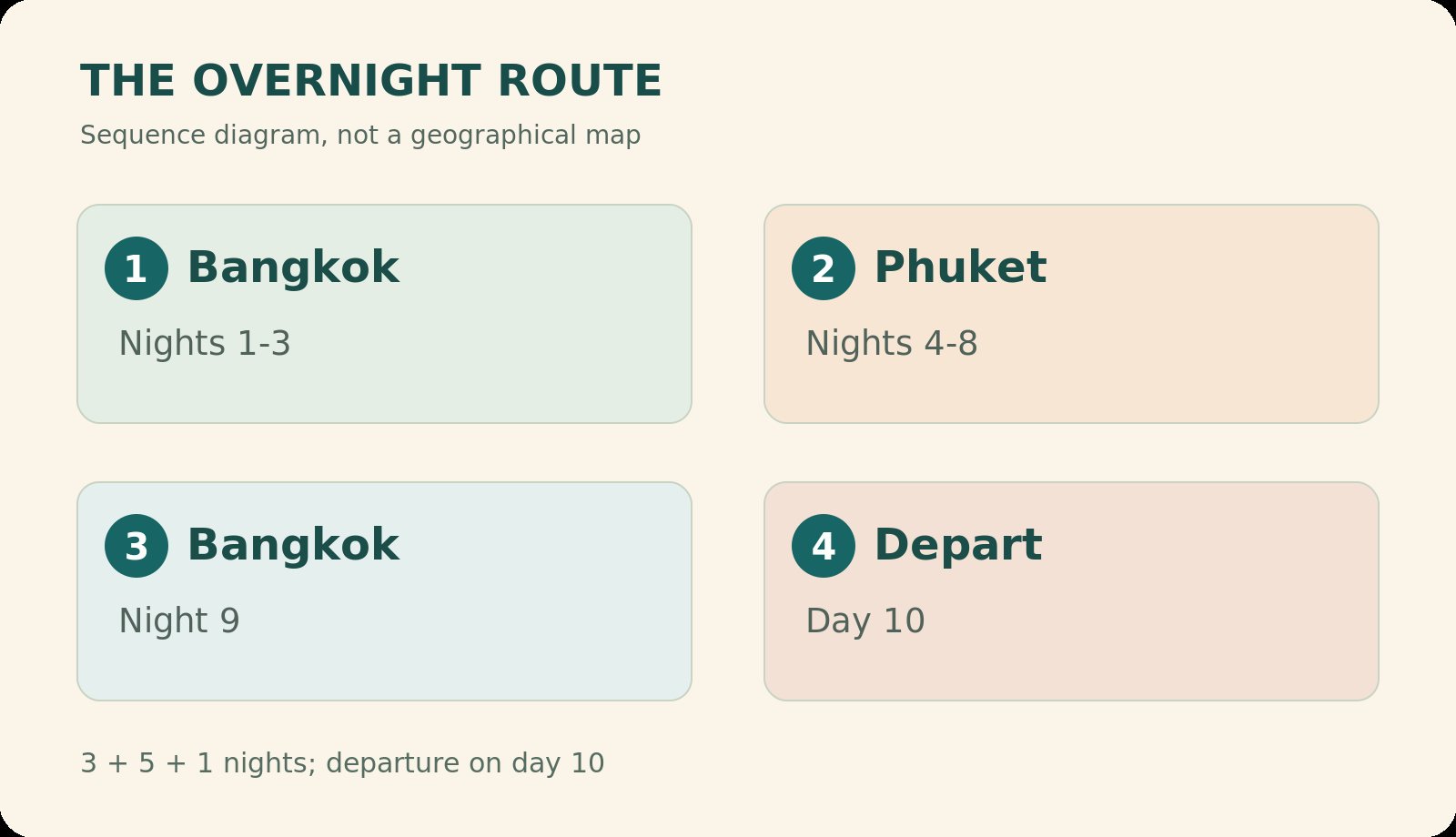
This version uses three initial Bangkok nights, five Phuket nights and one final Bangkok night. It is designed around international flights using Bangkok, with a simple alternative for a ticket that departs from Phuket. Arrival, domestic travel and departure all sit inside the ten-day calendar.
The daily suggestions are research-led choices rather than a record of first-hand visits. They prioritise sensible grouping, a useful beach base and flexibility. That means the boat outing is optional, the Old Town visit follows the real weekday, and the last full coastal day is available for whatever turned out to be most enjoyable.
Core contrast
City + coast
Two full initial Bangkok days, then four full Phuket days.
Hotel rule
One Phuket base
Visit another area without moving rooms unnecessarily.
Marine choice
One flexible outing
Select the boat format and keep a land-based fallback.
Departure option
Fly out of Phuket
Compare the complete open-jaw fare before booking.
The Bangkok and Phuket 10-Day Itinerary at a glance
A city opening and a proper beach block
Allocate nights 1 to 3 to Bangkok, nights 4 to 8 to one Phuket hotel, and night 9 to Bangkok before departure on day 10. That gives you two full initial city days and four full Phuket days, with arrival and transfer dates counted honestly. The last Bangkok night is deliberately separate from the sightseeing stay because its purpose is to simplify the journey home.
This route assumes your international ticket arrives and departs through Bangkok. When a suitable ticket allows you to fly into Bangkok and leave internationally from Phuket, keep the ninth night in Phuket instead. Compare the complete fare and ticket conditions before choosing; the saving is not simply the price of one domestic flight, because hotel, transfer and usable holiday time also change.
| Days | Overnight base | Nights | Purpose |
|---|---|---|---|
| 1-3 | Bangkok | 3 | Arrival, a temple cluster and a neighbourhood-led day. |
| 4-8 | Phuket | 5 | Fly south; beach, boat option, Old Town and an open day. |
| 9 | Bangkok | 1 | Return and sleep in the international departure city. |
| 10 | Departure | 0 | Leave from Bangkok; adapt for a Phuket international ticket. |
Why there is only one Phuket hotel
Five nights is enough to enjoy a beach base, explore the Old Town and consider one boat excursion. It is not necessary to move between several beaches to experience them. Changing rooms can consume the same afternoon you hoped to spend beside the sea, especially when checkout and check-in times do not align.
The selection below prioritises contrast, practical transport and room to change plans. It is a research-led route rather than a claim to have personally tested each activity. Use it as a sequence of decisions, then choose the exact hotel and excursion that meet your needs.
Choose Phuket for the holiday you actually expect
Swimming and sunshine are different questions
A bright morning does not establish safe swimming conditions. Phuket's west-coast beaches face seasonal sea changes, and local warnings take precedence over any monthly recommendation. The FCDO specifically advises respecting beach warnings and red flags. This itinerary therefore keeps a pool or land-based alternative available rather than treating every coastal day as guaranteed swimming time. [1]
For a beach-first trip, I would initially compare dates in the drier part of the Andaman year, then check current forecasts. Travelling in the wetter period can still suit someone interested in restaurants, hotel downtime and town visits, but it is a different purchase from a holiday that depends on repeated boat trips. Regional conditions are more useful than a generic best-month label. [2]
Build the flexibility into the hotel choice
A pleasant covered terrace, a usable pool and nearby food become more valuable when the sea is uninviting. Read recent reports about room condition and construction as well as photographs of the beach. Check whether the pool is genuinely suitable for your group, including depth and any supervision requirements.
Avoid booking a single non-refundable marine outing as the centrepiece of the whole stay. Choose an operator with clear weather and cancellation terms, keep more than one possible date, and be prepared for the excursion not to happen. A refund does not replace the lost experience, so the rest of the holiday needs to stand on its own.
Where to stay in Bangkok and on Phuket
A Bangkok address that supports two full days
For the opening stay, shortlist a well-connected central neighbourhood or a practical riverside address. The room should let you reach your planned temple day without making every meal a transport project. Check the route on foot from the station or pier to the hotel entrance, not merely the distance shown in a search filter.
An attractive rate can be poor value when it requires several paid rides every day. Conversely, paying a large premium for a view makes less sense when you will spend most of the two full days outside. Compare a few similarly cancellable room options and include breakfast only when it fits the way you expect to eat.
Select a Phuket area before a property
Kata and Karon are reasonable starting points for a first beach-led visit; TAT places both on Phuket's west coast. Kamala may appeal to travellers seeking a different beach-village base, while Patong is an option for those who actively want a busier evening scene. These are starting hypotheses to test against the exact street and room, not universal judgements about every hotel. [4]
Old Town works best when food and architecture outweigh daily beach access. A northern beach base can simplify some airport journeys but may make other outings longer. Do not use the word Phuket as though it describes one compact resort: the location of the hotel determines the shape of the stay.
| Area to investigate | Planning emphasis | Check before booking |
|---|---|---|
| Kata / Karon | Start a west-coast beach shortlist | Check the precise beach entrance, traffic and current swimming advice. |
| Kamala | Compare a different beach-village routine | Check evening walking and room-level noise. |
| Patong | Prioritise a busier evening setting | Choose the street and room carefully when sleep matters. |
| Old Town | Focus on food and historic streets | Budget separately for beach journeys. |
| Northern coast | Consider an airport-nearer beach stay | Check the distance to the outings you actually want. |
Ask whether the advertised beach access involves steps, a road crossing or a hotel shuttle. For a hillside room, establish how you return after dinner and whether the property provides transport. Sea view, beachfront and easy swimming access are three different claims, and none should be inferred from the others.
Day 1: get to Bangkok, then stop travelling
Remove unnecessary first-day bookings
After the international journey, make the hotel the only appointment that matters. A pre-booked transfer can be useful for a family or late arrival, but use a clear meeting point and know what happens if the flight is delayed. Alternatively, compare the official airport transport options with your arrival time and luggage. Suvarnabhumi's authority lists rail, taxis and other road services. [5]
Keep the first evening local. Find an easy meal, take a short walk if you feel comfortable, and prepare for tomorrow. There is little value in paying a deposit for a sunset experience that depends on immigration queues and traffic being kind.
Check the basics while you still have energy
Save the hotel address, identify a convenient breakfast option and make sure both travellers have access to booking documents. A practical arrival routine reduces the chance that one flat phone disrupts the next morning.
With an early arrival, ask about room access rather than assuming it. With a very late arrival, tell the property in advance so the reservation is not treated as a missed check-in. These details are particularly useful on a short itinerary, where losing half a day to an avoidable misunderstanding has a noticeable effect.
Day 2: one Bangkok temple cluster
Decide how much architecture you want
Make the Grand Palace and Wat Phra Kaew the morning's principal visit, or choose Wat Pho as a less expansive starting point. Check each attraction's own visitor information before leaving the room. The palace has specific clothing restrictions, so pack suitable long clothing and sleeves rather than planning to solve the problem at the entrance. [6] [7]
For a first visit, a guide can add context and simplify the order of stops. Read the inclusions carefully: transport, tickets and a guide are not automatically bundled into every product carrying the same attraction name. Choose a realistic start time and avoid combining the visit with an elaborate breakfast on the other side of the city.
Finish the afternoon before it becomes an endurance test
After lunch, decide whether to visit a second temple, take a short permitted river journey or return to the hotel. The point of the Bangkok opening is to enjoy a different side of Thailand from the beach block, not to exhaust yourself before flying south.
An evening view of the river can be enjoyable without buying a full dinner cruise. Compare the experience you want with the fixed departure time and meal format. During transport disruption or poor weather, an ordinary restaurant near the hotel is a perfectly good replacement. Keep the expensive bookings for experiences you would still choose without the photograph.
Day 3: food, local streets and a slower afternoon
Let lunch give the day a direction
Choose a food-focused neighbourhood outing rather than another full monument circuit. Chinatown is one possibility, but the useful task is selecting a manageable area and understanding what you are ordering. A few interesting dishes with time between them usually make a better day than a long list of viral stops linked by taxis.
A guided walk can help with ingredients and navigation. Before booking, disclose dietary requirements and ask what can genuinely be accommodated. Check the tour's meeting point against your hotel, then leave enough time to arrive without rushing through a busy station or market.
Keep the second half of the day adaptable
For an indoor-oriented alternative, consider the Jim Thompson House museum and a nearby meal. Its official information explains the guided visit and access limitations, including stairs in the main house. Do not label it fully accessible simply because it offers a cultural alternative to outdoor sightseeing. [8]
Leave a useful block for packing and checking the flight south. Confirm baggage before online check-in and photograph any important luggage labels or receipts. Tomorrow includes an airport journey and a Phuket transfer, so the last Bangkok evening is better spent near the room than at a distant venue with an uncertain journey back.

Day 4: fly to Phuket and reach your beach base
Buy the transfer day, not just the flight
When comparing Bangkok to Phuket flights, start with the departure airport. Then add luggage, transport to that airport, required arrival time and the road journey after landing. A fare that is slightly cheaper but departs from the less convenient airport may not be the better overall choice.
As a planning allowance, keep roughly five to eight hours free between leaving the Bangkok hotel and settling into the Phuket room. This is not an airline schedule or a promise about traffic; it is space in the diary for the whole transfer. Use the actual carrier requirements and current local advice to refine it.
Match ground transport to the exact destination
Phuket airport information distinguishes buses serving different areas and other ground-transport choices. A bus headed towards Phuket Town is not automatically a direct service to your beach hotel. Compare the stop, operating time, remaining walk and luggage handling before choosing it purely on price. [9]
A booked car can make sense for several travellers or an awkward hotel location. Obtain the driver meeting instructions, waiting policy and vehicle capacity. Include child-seat requirements or mobility equipment in the original request rather than mentioning them only at the curb.
Once checked in, visit the beach to understand the surroundings, not to prove the holiday has started by entering the water. Look at flags, identify convenient food and ask the hotel about current conditions. The first Phuket evening should be light enough that a delayed flight does not ruin it.
Day 5: use the beach you chose
Give the base a fair chance
Spend the first full coastal morning near the hotel. Learn where to walk, where shade is available and where you can buy an ordinary lunch. Travellers sometimes choose a beach for its appeal and then immediately book four excursions away from it; the accommodation premium only makes sense if you use the location.
Keep valuables and travel documents out of a casual beach bag. Plan how the group will manage belongings while anyone swims, and use the hotel's secure storage where appropriate. A waterproof pouch should not become the only protection for irreplaceable documents.
Let conditions decide the afternoon
When swimming is advised against, choose the pool, a short neighbourhood outing or a long lunch. Do not assume a different section of the same exposed beach solves the problem. Local flags and advice matter more than another visitor saying they were in the water earlier. [1]
This is also the right day to discuss a possible boat excursion with the operator. Ask about the predicted sea conditions, boat type, time afloat and the alternative if a stop is unavailable. Keep day 6 and another date as candidates instead of turning the first available departure into an obligation.
Day 6: one considered boat trip, or none
Choose scenery before choosing an itinerary name
Phang Nga Bay is the natural comparison for limestone scenery, mangroves and a bay-focused outing. TAT identifies landmarks including Khao Phing Kan and Khao Tapu in the wider area. It is a different objective from choosing a trip mainly for open-water swimming or a particular island beach. [10]
Ask how much of the excursion is spent in the vehicle, on the main boat and at each activity. A long attraction list can conceal a tightly managed day with little freedom. Check whether transfers, park charges, food, guide support and any kayaking activity are included, and obtain the cancellation terms before paying.
Do not let a paid ticket overrule the sea
The operator should make the operational safety decision, but you still need to assess whether the format suits your group. Anyone concerned about motion sickness, pregnancy, mobility or a medical condition should seek appropriate advice and ask the operator about restrictions before booking. Do not rely on a reassuring photograph of a flat sea.
If the trip is cancelled, move the Old Town visit forward or enjoy another local day. Avoid booking a substitute boat at the pier simply because another seller says they will depart. A weather cancellation is not a challenge to find a less cautious operator.
Day 7: Phuket beyond the resort strip
Explore a compact section of Old Town
Use a town visit to change the rhythm after several days around the beach. TAT's Old Town guide describes the historic streets around Thalang, Dibuk, Phang Nga, Yaowarat, Krabi and Soi Romanee. Pick a short connected loop, allowing time for a museum, shop or cafe that genuinely interests you. [11]
Arrange the outward and return journey before leaving the resort. A one-way fare tells you little about the full cost of the afternoon, and a distant pickup can be awkward during busy periods. Travellers staying in Old Town can reverse the emphasis and use another day for a selected beach visit.
Match a market visit to its actual day
The tourism authority describes the Sunday walking street on Thalang Road. That means you need to check your calendar: day 7 of this itinerary could fall on any weekday. Move the town visit within the Phuket block when the market is a priority, but do not sacrifice the final departure buffer to make it fit. [11]
Choose lunch or dinner as the anchor rather than treating food as a snack grabbed between photo stops. Ask about unfamiliar dishes and order gradually. Leave time to sit down under cover if the weather changes; Old Town is a real neighbourhood, not an indoor attraction unaffected by rain.
Day 8: the day you will be glad you did not overbook
Repeat the best part of the stay
Use the final full Phuket day for the beach, restaurant or neighbourhood you enjoyed most. This is the margin that allows a boat day to move, a tired traveller to recover or a family to have a completely ordinary pool afternoon. It is not a missing section of the itinerary.
A cooking class is an option when a structured activity appeals. Compare the menu and location, ask how much is hands-on and establish whether the meal is included. A class near the hotel may be more useful than a celebrated one that creates another long drive.
Keep a short private outing truly short
A tailored drive can work for travellers who want a viewpoint or one additional area without joining an all-day tour. Ask for a realistic route and agree waiting time, return time and any admission costs. Avoid a shopping-heavy package disguised as a flexible sightseeing service.
Before dinner, prepare tomorrow's luggage and confirm airport transport. That leaves the final evening free to enjoy rather than turning it into a hurried search for missing documents. A short route becomes noticeably easier when practical jobs happen before everyone is tired.
Days 9 and 10: separate the domestic flight from going home
Day 9 is the return to Bangkok
Fly back on day 9 and sleep in Bangkok before the international departure. A later domestic flight gives more Phuket time but less room to respond if it is disrupted, so weigh the trade-off rather than choosing solely by fare. Keep the hotel cancellation and transport arrangements compatible with the flight.
The last night's address should reflect day 10. An early flight may favour an airport-serving hotel; a late flight may justify returning to a familiar city property. Ask which airport a shuttle serves, how often it runs and whether advance reservation is required. A hotel name containing airport is not sufficient evidence.
Day 10 stays deliberately simple
Check out at a time that allows the required airport procedures and a sensible road or rail margin. A final breakfast is easier to manage than a last-minute attraction. Keep any remaining shopping close to the hotel and stop before it threatens the departure plan.
For an international departure directly from Phuket, remove the day 9 Bangkok flight and remain at the same Phuket hotel. The open-jaw adaptation gives Phuket six nights, from night 4 through night 9, after the three initial Bangkok nights. Departure is still on day 10. Check those dates against the amended international ticket before extending the room booking.
What to do when the weather changes the whole week
Replace the objective, not just the booking
When several days are wet or sea conditions are poor, stop trying to recreate a dry-season beach programme. Prioritise a comfortable hotel, good meals, a cooking session and a town visit with sheltered stops. The point is to enjoy the conditions you have, rather than spend each morning cancelling the same plan.
Check whether an attraction is genuinely suitable in that weather. A hillside viewpoint, waterfall or exposed walking route may be a poor substitute during heavy rain. A driver is not a guarantee that every road or stop is appropriate; listen to local restrictions and be prepared to remain close to the hotel.
Protect optional spending
Reserve weather-sensitive activities on terms you understand, and keep a small amount of the budget uncommitted. That gives you room to choose a worthwhile indoor experience instead of being locked into refunds and arguments. Save written confirmations and the operator's contact details before departure from the hotel.
This planning approach also helps in hot conditions. Move outdoor walking earlier, avoid stacking strenuous activities and use the room or shaded space during the least comfortable part of the day. A realistic climate response improves the trip more than insisting that every itinerary line must happen on its original date.
A realistic way to price nine nights
Separate shared rooms from individual spending
The following is a constructed budget model prepared on 5 October 2026, not a set of live hotel or airline quotes. It assumes one adult sharing a double or twin room, nine hotel nights, two domestic flights and ten calendar days of ordinary food spending. International airfare, insurance, any visa costs, alcohol, shopping and exceptional disruption are outside the calculation.
| Cost assumption | Economical example | Comfort example | Upgraded example |
|---|---|---|---|
| Bangkok: room / night (4 nights) | 1,200 | 2,600 | 4,800 |
| Phuket: room / night (5 nights) | 1,600 | 3,500 | 6,500 |
| Accommodation total (one adult sharing a room) | 6,400 | 13,950 | 25,850 |
| Food assumption / person / day | 500 | 1,000 | 1,700 |
| Food total (10 days; 1 adult) | 5,000 | 10,000 | 17,000 |
| Domestic flight allowance | 2,800 | 5,000 | 8,000 |
| Local / island transport allowance | 2,200 | 3,800 | 6,500 |
| Selected activity allowance | 2,500 | 5,000 | 9,000 |
| MODEL TOTAL before contingency | 18,900 | 37,750 | 66,350 |
| Illustrative 15% contingency, rounded up to THB 100 | 2,900 | 5,700 | 10,000 |
| MODEL + contingency | 21,800 | 43,450 | 76,350 |
Room rates are per room; the per-person total uses half. Food and activities are already per person. Keeping those units visible matters when comparing this holiday with a package price, because a room rate copied into every traveller's budget can double-count a substantial expense.
Spend on the location you will use
For a beach-led stay, a practical room near the chosen beach can be worth more than a larger room far away. However, a beachfront premium is less useful when the hotel has no suitable swimming alternative during rough conditions. Compare the property against your expected daily routine, not its category badge.
One carefully selected boat trip and one town experience may be enough. Booking several similar excursions often increases transport fatigue more than variety. Keep a contingency for a changed flight, additional luggage or a necessary transfer, and avoid funding upgrades by removing the final-night buffer without understanding the risk.
Booking details that make the trip easier
Confirm documents before non-refundable payments
Check the entry conditions that apply to your passport and circumstances. The Thai authorities decide permission to enter; the official Digital Arrival Card is an arrival form rather than a visa. Keep the first accommodation address and onward travel details available when completing the applicable formalities. [12] [13]
Arrange insurance for the actual activities you intend to do. A general beach holiday and a trip involving diving, hired motorcycles or other specific activities may need different cover. Read the wording and obtain clarification from the insurer rather than assuming that a tour operator's description settles the question.
Keep the phone useful without depending on it
A compatible eSIM can help with maps and contacting a driver, but compare it with your existing plan. Check when validity begins, how much data is included and whether voice calls are part of the product. Store airport, hotel and booking details offline even after arranging mobile data.
Carry a small day bag with water, weather protection and any essential medication. Keep temple clothing accessible during Bangkok days and dry items separate after a beach outing. Before flights, check the carrier's baggage rules for the fare you purchased; luggage requirements can differ between the international ticket and the domestic sectors.
Adjustments for different travelling styles
Families and slower-paced travellers
Keep the two main bases and reduce the activity count. A child-friendly pool and an easy walk to food may justify a less fashionable hotel. Ask about the real room layout, bedding and pool arrangements rather than assuming that a family label guarantees suitability.
On travel days, book a vehicle that accommodates everyone and the luggage comfortably. A modest saving is less valuable if it creates a difficult multi-stage journey while tired. For boat trips, check minimum ages and physical restrictions directly, and choose a land-based day when the format is unsuitable.
Food-first, beach-first or nightlife-first
Food-focused travellers can give Bangkok a fourth initial night and reduce Phuket to four nights, while retaining the final Bangkok stay. Beach-first travellers can keep the standard five-night Phuket block and leave Bangkok's second full day deliberately light. Neither change requires a third destination.
For nightlife, choose the hotel area with care and examine recent noise comments at room level. Staying close to the evening activity can simplify the journey back, but sleeping directly above it is a separate choice. The useful question is not which beach is best in general; it is which address makes your own morning and evening routine easiest.
Two sample days that show where the time goes
A Bangkok day with a visible pause
As an illustrative rhythm, use an early breakfast, one main cultural visit in the morning, a seated lunch and a deliberately smaller afternoon. The precise start depends on the attraction's current opening arrangements and your hotel location. Do not copy a time from this guide as though it were an admission slot.
Allow the afternoon to end at the room before dinner. That break creates time to cool down, change and decide what you still feel like doing. Without it, a modest evening plan can feel like the fifth stop of a continuous tour. Travellers who prefer fewer transitions can stay in the same district for an earlier meal and return once.
The useful rule is to identify which part is optional before setting out. A second temple, a river ride or a browsing stop can be dropped without damaging the day. A prepaid activity with a fixed start is harder to remove, so keep those commitments limited and geographically compatible.
A Phuket day with only one journey out
For a coastal day, try a local morning, lunch near the hotel and one selected outing in the afternoon or evening. That pattern leaves more time at the base than repeatedly crossing the island for breakfast, a viewpoint, another beach and dinner. It also makes the transport spending easier to predict.
A town-focused day works in the opposite way: travel once, have the meal and exploration in the same area, then return. Ask the driver where pickup will be practical if the main street becomes busy. Keep the agreed meeting point in both phones and allow time to reach it without running through crowds.
For a boat excursion, consider the whole day committed even when the advertised time on the water looks shorter. Shared hotel pickups, pier organisation and the final road journey are real parts of the experience. Leave dinner simple enough that a late return does not create another problem.
When the group wants different things
Not every traveller needs to join every optional outing. A person who wants hotel downtime can stay behind while others take a suitable short trip, provided practical arrangements are clear. Agree how you will stay in touch, who holds the room access and where you will meet afterwards. This often preserves enjoyment better than negotiating every hour as one inseparable group.
Where this route succeeds, and where it does not
The advantages
Bangkok and Phuket offer a clear contrast without repeated intercity moves. The coastal block includes enough time for the beach, a cultural outing and one changeable marine day. Keeping a single Phuket hotel also makes it easier to move activities around weather and rest needs.
The return night in Bangkok suits travellers with independently booked domestic and international tickets. It is a visible use of time and money rather than an optimistic assumption hidden in the itinerary. A genuine international departure from Phuket can improve the plan further by removing that return journey.
The limitations
This is not an island-hopping itinerary and it does not include northern Thailand. Adding Chiang Mai would require a different allocation and another flight. Similarly, moving between several islands inside the five-night coastal block would reduce the flexibility that makes this version work.
Phuket location choices are important, and transport spending can rise when the room is far from the experiences you choose. The route also cannot promise swimming or a boat trip in any particular week. Travellers who would find a land-based coastal stay disappointing should prioritise season and cancellation terms before bargain hunting.
Mistakes that make ten days feel shorter
Counting Phuket arrival as a full beach day
Day 4 contains a flight, airport procedures, a road transfer and hotel access. An evening walk is a bonus; a prepaid afternoon excursion is a risk. Keep the full activity programme for day 5 onwards, when you know how the group feels and what the local conditions are like.
Confusing a beach name with the hotel entrance
A property can advertise the right area while sitting on a steep road or well away from the sand. Examine the map, recent access comments and the route to food. Ask the property a direct question about walking access rather than interpreting a wide-angle photograph optimistically.
Booking the wrong sort of boat experience
A scenery-led bay excursion, an open-water snorkelling trip and a fast multi-island circuit are not interchangeable. Choose the activity first, then compare boat types and durations. A famous place name should not override concerns about comfort, time afloat or the operator's weather policy.
Removing the buffer to rescue an overfilled schedule
An extra beach afternoon is appealing, but a tight separate-ticket connection can create a much larger problem. Simplify an optional outing before making the journey home dependent on perfect timing. Where a properly ticketed through-connection is available, assess its terms rather than assuming all connections work the same way.
Bangkok and Phuket planning questions
Is three nights in Bangkok and five in Phuket enough?
Yes for a focused first visit, remembering that the remaining ninth night is the Bangkok departure buffer. Three initial Bangkok nights create two full sightseeing days, while five Phuket nights create four full coastal days. That is enough for variety, but not enough to include every major excursion without sacrificing ordinary beach time.
Should I visit Phuket before Bangkok?
Reverse the order when the international flights genuinely support it or a fixed event makes it useful. However, a Bangkok arrival followed by an independently booked immediate flight to Phuket introduces a connection decision at the start. Compare the whole ticket structure and avoid treating the reversal as a purely aesthetic choice.
Can I stay in Phuket Old Town instead of at a beach?
Yes, particularly for a food- and architecture-led visit. Price and plan the beach journeys separately, because the town stay does not provide the same daily routine as walking out near the sand. Travellers who want to swim most mornings are more likely to benefit from a suitable coastal address.
Do I need a hire car or scooter?
Neither is required for the standard route. Use airport transport, booked vehicles or suitable bus services and choose an area where ordinary meals are convenient. A self-drive decision should involve licence, insurance, road confidence and parking checks, not simply the desire to avoid a quoted taxi fare.
Is a Phi Phi visit essential?
No. The itinerary works with a Phang Nga Bay excursion, a different suitable boat trip or no boat day at all. Choose according to the experience you want and current access and sea conditions. Adding a famous island only because it appears on a checklist can produce a long day that does not match your interests.
What happens if the Sunday market is on another itinerary day?
Move the Old Town visit within the Phuket stay when convenient. The table numbers dates relative to arrival, not weekdays. Do not book an excursion elsewhere on the assumption that the market will operate on a different evening; verify the current schedule before arranging transport. [11]
Can I use this itinerary for a honeymoon?
Yes, by reducing organised activities and choosing room and location details carefully. Keep a relaxed meal or spa session as a flexible highlight rather than adding a new hotel every few nights. A more secluded island extension would be a different route, with additional boat logistics and weather dependence.
How should I handle an early flight home?
Choose the final hotel and transfer around the exact departure airport and check-in requirements. Confirm breakfast or a takeaway option only after the transport is settled. It is better to lose a leisurely final morning than to create pressure around a flight that is expensive or difficult to replace.
Keep the contrast, lose the unnecessary hotel moves
Begin with Bangkok's temples and neighbourhood food, then settle into one Phuket base long enough to enjoy it. Use the first coastal day locally, select one weather-appropriate excursion and keep the final full day flexible. The town visit supplies variety without requiring another suitcase move.
Before confirming the trip, compare an international departure from Phuket with the return-to-Bangkok version. Once the flights are chosen, make every hotel date and transfer match that decision. A good nine-night plan is clear enough that either traveller can explain where you sleep, how you get there and what happens when conditions change.
That clarity is what makes this Bangkok and Phuket combination feel like a holiday rather than a transport exercise. Leave room for an unplanned lunch, a repeat beach walk and an afternoon that does not need to justify itself with another booking.
Sources and fact-checking notes
The route and recommendations are research-led planning judgements. Public sources below were checked for this editorial review on 05 October 2026. Transport availability, admission arrangements, park access and local conditions can change. Budget figures are constructed examples with explicit assumptions, not live quotes or guaranteed costs. The original scene illustrations are conceptual rather than documentary location photographs.
- FCDO: Thailand safety and security Water-safety guidance and other current precautions.
- Thai Meteorological Department: regional weather Current regional forecasts and warning links; not a guarantee for future dates.
- FCDO: Thailand warnings and insurance Current travel warnings; check again before travel.
- Tourism Authority of Thailand: Kata and Karon beaches Geographical beach context; swimming decisions must follow current local warnings.
- Airports of Thailand: Suvarnabhumi ground transport Official airport transport choices; confirm current services and meeting points.
- Grand Palace: official practical information Visitor arrangements, dress restrictions and direct admission information.
- Wat Pho: official contact and visitor information Check current temple access directly before a visit.
- Jim Thompson House: official visitor information Guided main-house visits and published access limitations.
- Airports of Thailand: Phuket airport Ground-transport options and airport information; check live operating details.
- Tourism Authority of Thailand: Ao Phang Nga Bay landscape, islands and landmarks; individual excursion programmes vary.
- Tourism Authority of Thailand: Phuket Old Town Historic streets and the described Sunday walking street; confirm the date-specific arrangements.
- FCDO: Thailand entry requirements British-passport guidance; other nationalities must check their own applicable conditions.
- Thai Immigration Bureau: Digital Arrival Card instructions Official arrival-form guidance; the form is not visa permission.
Illustrations in this article were created for Taylor’s Trailblazing Travels. Third-party photographs, where used, are credited beside the image or in the source list.