

Koh Lanta itinerary · 2026
Koh Lanta Itinerary 2026: A Realistic 5-Day Plan for Beaches, Old Town and Island Trips
A slower five-day island plan for beaches, Old Town, mangroves, a movable sea day and a protected departure.
Koh Lanta works best when the sea day can move and the final connection remains protected.
Koh Lanta looks compact on a map, yet the decisions that shape a good stay are spread along a long island. The official Tourism Authority of Thailand Ko Lanta overview describes Koh Lanta Yai as more than 30 kilometres long, with nine beaches and a paved road running north to south. Saladan handles many arrivals in the north, the main sunset beaches run down the west coast, Old Town faces east, and Mu Ko Lanta National Park anchors the far south. A hotel that is perfect for quiet resort time can therefore be inconvenient for dinners, boat pickups or a pre-dawn transfer.
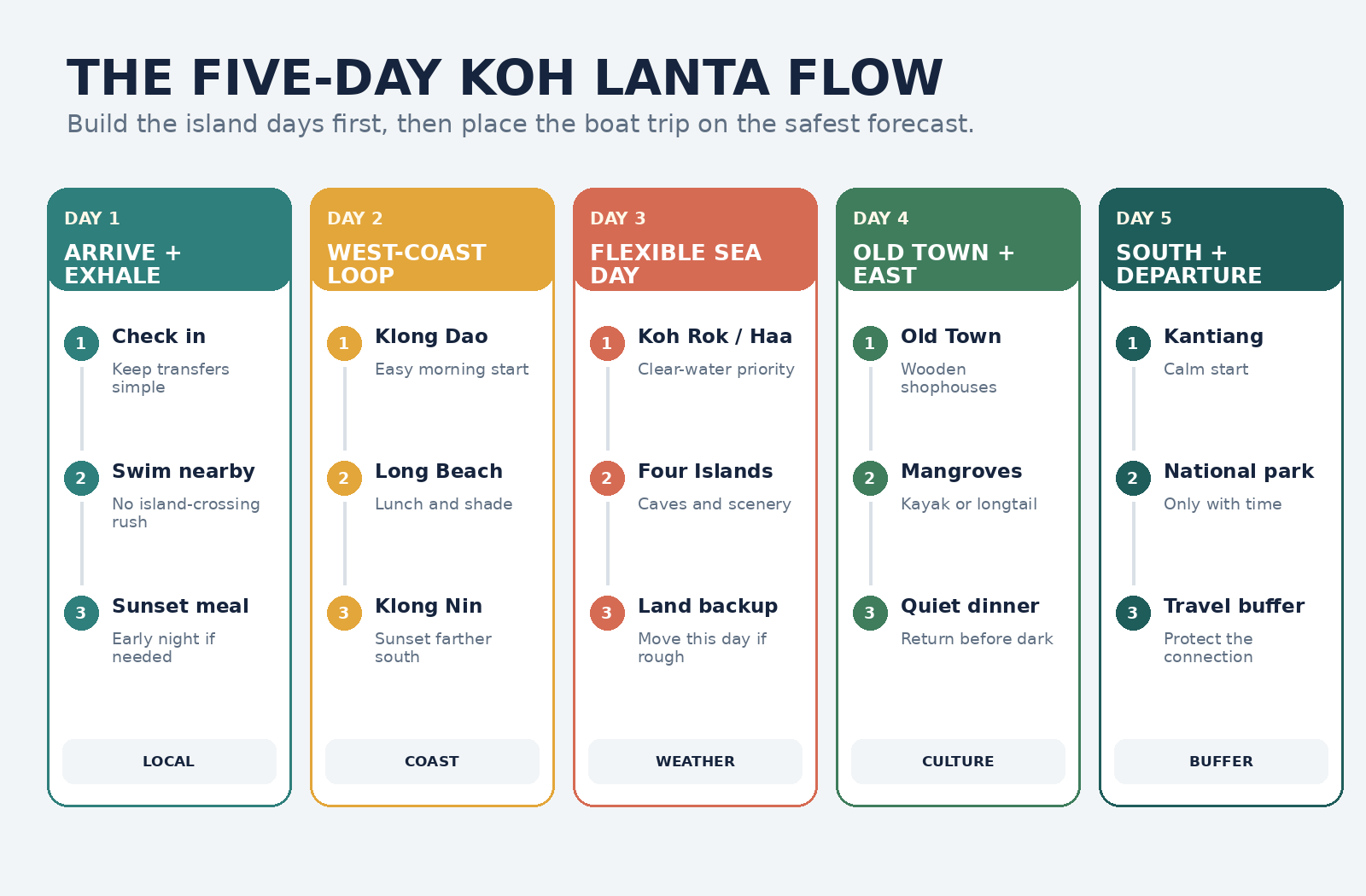
This Koh Lanta itinerary is built around those distances rather than a checklist of every beach. It gives the first day to arrival, the second to the west coast, the third to a sea trip that can move with the forecast, the fourth to Old Town and mangroves, and the fifth to the southern beaches or a protected departure plan. The result is active enough to feel worthwhile, although it still leaves space to swim, eat slowly and change course when the Andaman Sea does not cooperate.
Koh Lanta also fits naturally into a wider trip. The Thailand islands guide helps compare it with livelier or more compact islands, while the two-week Thailand itinerary shows where a five-night Lanta stay can sit within a longer route. In practice, Lanta is strongest when you want roads, several beaches and local communities without the constant intensity of a large resort centre.
This guide contains carefully selected affiliate links. Taylor’s Trailblazing Travels may earn a commission when a reader books or buys through one of them, at no extra cost to the reader. Links are included only where they support a genuine transport, accommodation, activity, connectivity or packing decision.
Ideal first stay
Five nights gives one sea day, two island days and useful weather or transfer flexibility.
Best first base
Long Beach balances restaurants, sand, tour pickups and reasonable access in both directions.
Easiest with children
Klong Dao keeps arrival transfers shorter and everyday facilities close at hand.
Best quiet base
Klong Nin suits slower evenings; Kantiang and the far south trade convenience for scenery.
How many days do you need on Koh Lanta?
Five nights is the practical sweet spot for a first visit. Three nights can work when Koh Lanta is one stop in a fast island route, but the arrival and departure days reduce the time available. Seven nights feels noticeably more relaxed because a cancelled boat trip, a wet afternoon or an unexpectedly good beach no longer forces a difficult choice.
Three nights: enough for a taste
A three-night stay usually provides one west-coast day and one major choice between a boat trip, Old Town or the national park. Therefore, it works best for travellers arriving before lunch and leaving after breakfast rather than losing both edge days to long transfers. Base yourself in Klong Dao or Long Beach so that every meal and pickup does not require another journey.
Five nights: the strongest first-time balance
With five nights, each day can have one clear purpose. You can keep the sea trip movable, use Old Town as a slower recovery day and still see the south without racing between coves. In addition, a late shared van or weather cancellation becomes an inconvenience rather than the event that consumes half the holiday.
Seven nights or longer: a true island holiday
A week suits families, divers, remote workers and travellers who want repeated beach afternoons. It also makes a split stay possible: for example, four nights on Long Beach followed by three nights around Klong Nin or Kantiang. However, moving hotels is worthwhile only when the second base changes the feel of the trip; shifting a few kilometres merely creates packing and check-in work.
| Stay length | What fits comfortably | What usually gets cut | Best base strategy |
|---|---|---|---|
| 3 nights | One coast day plus one major excursion | Either Old Town, the south or the sea day | One north or central base |
| 5 nights | West coast, flexible sea day, Old Town, mangroves and the south | Very little, provided the departure day is protected | Long Beach or Klong Dao for most first visits |
| 7 nights | Full five-day plan plus two slow or specialist days | Nothing essential; add diving, cooking or another beach | One base or a meaningful north-and-south split |
| 10 nights+ | Several sea days, diving, family downtime and weather flexibility | Only activities that do not suit the season | Consider two bases, but keep transfer days light |
Karen’s planning perspective
For a first visit, I would book five nights on Long Beach and resist the urge to split hotels. The island is long, but one well-positioned base plus two planned driver days is often calmer than repacking midway through a short stay. I would split the trip only when a far-south resort is a deliberate holiday experience rather than a cheaper room that happens to look attractive online.
Koh Lanta five-day itinerary overview
The sequence below is a framework rather than a contract. Day 3 is labelled as the sea day because it sits neatly in the middle; nevertheless, move it to Day 2 or Day 4 when the operator and marine forecast indicate better conditions. The land days can switch with almost no loss.
| Day | Morning | Afternoon | Evening | Main booking decision |
|---|---|---|---|---|
| 1 | Arrive and transfer to your base | Local beach and practical orientation | Sunset dinner close to the hotel | Only the airport, ferry or road transfer |
| 2 | Klong Dao or Long Beach | Klong Nin, a viewpoint or one quiet cove | Return before dark or use a driver | Driver if you do not have suitable transport |
| 3 | Koh Rok and Koh Haa, Four Islands or diving | Continue the selected sea day | Easy meal and early night | Reputable operator, inclusions and weather terms |
| 4 | Lanta Old Town | Thung Yee Peng mangroves or east-coast community visit | West-coast sunset or quiet dinner | Kayak, long-tail boat or driver if wanted |
| 5 | Kantiang Bay and the south | National park only when time allows | Pack or make the onward transfer | Departure buffer before any flight or ferry |
What should be fixed in advance?
Fix the long-distance arrival, accommodation and any high-priority boat or diving activity. By contrast, local beach stops, Old Town time and most dinners do not need a rigid schedule. This distinction matters because Koh Lanta is enjoyable precisely when the day can stretch around weather, appetite and energy.
What should remain flexible?
Keep at least one land day uncommitted until the marine outlook is clear. Likewise, avoid prepaying a sunset experience on arrival day or a long southern loop before an early departure. A simple local afternoon is not wasted time here; it is part of the destination’s appeal.
Where to stay on Koh Lanta for this itinerary
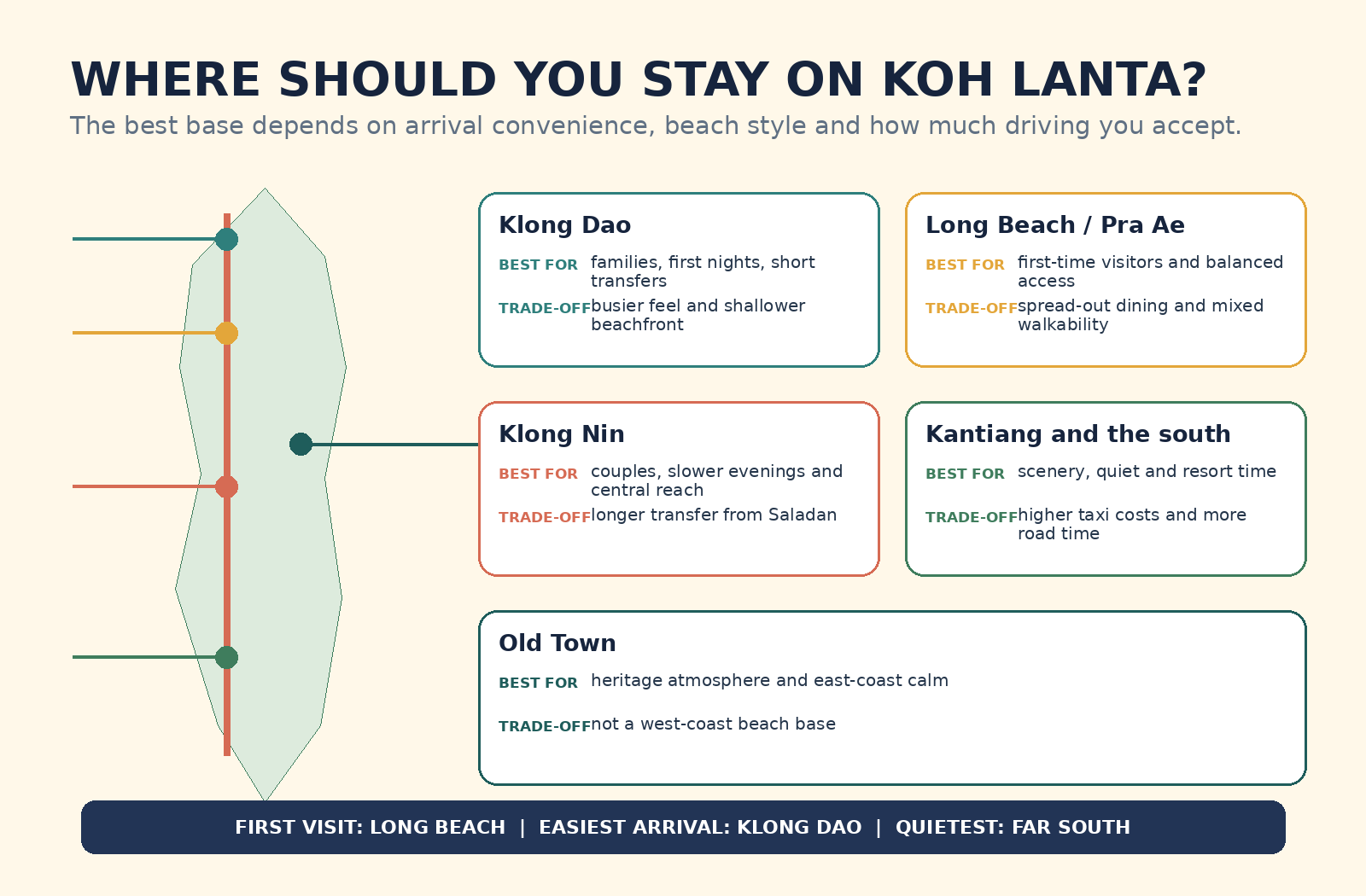
The best area is not simply the prettiest beach. It is the place that reduces the trips you care about most. North-coast accommodation shortens the Saladan transfer, central west-coast accommodation balances access, and far-south hotels create seclusion while increasing taxi time and cost.
Klong Dao: easiest for arrivals and families
Klong Dao lies close to Saladan and keeps practical errands simple. The broad, shallow-feeling beach environment and nearby dining make it a forgiving choice with younger children or a late arrival. However, travellers seeking a secluded island atmosphere may find the northern end more developed than the central or southern coast.
Long Beach and Pra Ae: best all-round first base
Long Beach offers the strongest overall balance for this route. It has a long west-facing beach, a broad accommodation range, useful dining clusters and manageable pickup times for tours. Because the area is spread out, check the exact property position rather than assuming every Long Beach hotel sits beside the same restaurant strip.
Klong Nin: relaxed evenings and mid-island reach
Klong Nin suits travellers who want a smaller, calmer evening scene without moving to the remote south. It also shortens Day 5 compared with the northern beaches. The trade-off is a longer arrival from Saladan and fewer easy north-coast options when you want a quick journey to the pier.
Kantiang Bay and the far south: scenery over convenience
The far south works when the resort and landscape are part of the holiday. It is less suitable when you expect to eat in different areas every night or join early pickups that begin in the north. Before booking, ask the property how tour transfers work and what a one-way taxi to Saladan or Long Beach normally costs.
Lanta Old Town: atmosphere rather than a sunset-beach base
Old Town provides timber shophouses, a working waterfront and a quieter east-coast rhythm. It can make a memorable one- or two-night addition to a long stay. Still, it is not the obvious base for a first five-day beach itinerary because the classic west-coast swimming and sunset areas require a cross-island drive.
| Area | Best for | Beach and evening feel | Transfer trade-off | My use for a first trip |
|---|---|---|---|---|
| Klong Dao | Families, late arrivals and simple logistics | Broad beach, practical and relatively lively | Shortest from Saladan; longer to the far south | Excellent when convenience leads |
| Long Beach / Pra Ae | Most first-time visitors | Long sunset beach with varied dining | Balanced rather than shortest for any one area | Best all-round choice |
| Klong Nin | Couples and slower evenings | Compact, relaxed and central-south | Longer from Saladan but easier for Day 5 | Strong quiet alternative |
| Kantiang / far south | Resort time, scenery and seclusion | Quiet coves and fewer independent choices | Longest pickups and departure transfers | Choose only when remoteness is intentional |
| Old Town | Heritage atmosphere and east-coast calm | Waterfront rather than west-coast beach life | Cross-island travel for beaches and sunsets | Visit by day or add to a longer split stay |
Compare Koh Lanta accommodation by exact area
Open the map before paying. Check the beach access, distance to restaurants, cancellation terms, room layout and whether the quoted rate includes breakfast and taxes.
Five decisions to make before booking the itinerary
1. Decide whether this is a sea-led or land-led season
From roughly November to April, travellers usually find the broadest selection of passenger-boat and snorkelling options. During the southwest monsoon months, some routes reduce or pause and rough conditions can cancel small-boat plans. Therefore, a wet-season visit should be built around beaches, Old Town, mangroves, food and flexible resort time, with any sea trip treated as a bonus.
2. Choose the gateway before choosing the first hotel night
Krabi Airport is the usual gateway for most itineraries. Phuket, Phi Phi, Trang and Koh Lipe can also connect, although route availability changes by season. Once the gateway is fixed, check whether the transfer reaches the hotel door or ends at Saladan Pier, because a cheap headline ticket can become less attractive after the final taxi is added.
3. Choose one base that solves most days
A well-placed base removes repeated decisions. Long Beach solves the widest range of first-trip needs, while Klong Dao is easier with children or a late arrival. Instead of booking the most remote property first and solving transport later, estimate the cost of two dinners, a boat pickup and the departure journey before paying.
4. Select a sea-day priority and a land backup
Choose whether clear-water snorkelling, limestone scenery or diving is the main goal. Then choose the land day that will replace it if the sea is unsuitable. This approach prevents a cancellation from creating an empty day and makes it easier to accept a safety decision without arguing with the operator.
5. Protect the final connection
Before adding the national park to Day 5, work backwards from check-in at the airport or pier. Include hotel pickup, vehicle-ferry queues, road traffic, check-in and a weather margin. If the connection matters, move the south-coast loop earlier and use the final morning close to the hotel.
The booking order that prevents expensive changes
Book the flight or inter-island route first, then accommodation with appropriate cancellation terms, then the airport or pier transfer. After that, reserve the one activity you would genuinely regret missing. Leave local taxis, ordinary meals and most beach time flexible.
How to get to Koh Lanta in 2026
There is no commercial airport on Koh Lanta. Most travellers fly to Krabi and continue by road and vehicle ferry, while high-season passenger services can connect Phuket, Phi Phi and islands farther south. The Thailand transport guide explains the wider network, but the Lanta-specific question is whether the ticket is genuinely door to door.
From Krabi Airport: shared van or private car
A shared minivan is usually the best-value default. Allow roughly two and a half to four hours to a west-coast hotel because waiting, ferry queues and multiple drop-offs vary. A private vehicle costs far more, yet it can be worthwhile for a family, a late arrival or a far-south property because you control the departure and stop pattern.
Current listings should be checked for the exact date and hotel zone. Use 12Go’s Krabi Airport to Koh Lanta search to compare shared and private options, then confirm luggage, child-seat requests, final drop-off and the latest pickup instructions before paying.
From Krabi Town or Ao Nang
Road transfers operate through much of the year and are usually the dependable choice when the sea is unsettled. Seasonal passenger boats may feel more scenic, although they can involve hotel-to-pier transfers and a second taxi after Saladan. In practice, compare the complete hotel-to-hotel time rather than only the advertised sailing time.
From Phuket
High-season ferries and speedboats can connect Phuket with Koh Lanta, often through or near Phi Phi. The fastest advertised sailing is not always the most comfortable option in chop, and baggage handling can be exposed to spray. Outside the strongest operating season, an overland connection through Krabi may be more reliable even though it takes longer.
From Koh Phi Phi
Phi Phi and Koh Lanta form a logical island combination in the main boat season. Nevertheless, the schedule can change with demand and weather, and the final arrival may still require a hotel transfer from Saladan. Keep waterproof protection around electronics and avoid booking a non-refundable activity immediately after the crossing.
From Koh Lipe or the Trang islands
The south-to-north Andaman route is highly seasonal. Operators publish different monsoon and high-season timetables, so a route that appears in a general search may not operate on your month or direction. Before building Koh Lipe and Lanta into one itinerary, verify the live operator schedule, through-ticket handling and the backup overland route.
| Starting point | Typical planning time | Common choice | Main advantage | Main caution |
|---|---|---|---|---|
| Krabi Airport | About 2.5-4 hours to most west-coast hotels | Shared minivan or private car | Year-round practical gateway | Drop-off time grows with ferry queues and hotel order |
| Krabi Town / Ao Nang | About 2.5-4.5 hours door to door | Road transfer or seasonal passenger boat | Easy addition to a Krabi trip | Pier transfers can erase the apparent boat-time saving |
| Phuket | About 3-6+ hours depending on route | Seasonal ferry/speedboat or overland transfer | Useful island combination | Sea service and comfort vary with season and weather |
| Koh Phi Phi | About 1-2.5 hours including pier formalities and hotel transfer | Passenger ferry or speedboat | Logical short island hop | Schedules reduce or change outside high season |
| Koh Lipe / Trang islands | Half day or longer | Seasonal through-boat route | Scenic multi-island journey | Do not assume year-round operation |
Compare direct transport before finalising the itinerary
Search the exact date in both directions. A connection that works southbound may have a different departure window northbound, and a hotel transfer may not be included.
Day 1: arrive, unpack and learn your local area
The best arrival-day sequence
Check in, drink water, confirm the next day’s transport and walk only the nearest useful stretch. Find a pharmacy or convenience shop, locate two dinner options and check how dark the approach to the hotel becomes. After that, swim or watch sunset if conditions are suitable. This modest sequence is more useful than crossing the island for a landmark.
When you are staying in Klong Dao
Use the broad local beach as the entire afternoon plan. Families can inspect shade, swimming conditions and the easiest route between the room and dinner. Meanwhile, adults can confirm whether the property is genuinely walkable to the restaurants shown on the map or whether a short taxi will still be needed.
When you are staying on Long Beach
Choose one direction and walk until the next headland or restaurant cluster rather than trying to cover the whole beach. Long Beach is long enough that the atmosphere changes. Therefore, this first walk doubles as practical research for the evenings ahead.
When you are staying in Klong Nin or farther south
Keep dinner near the property and arrange the Day 2 driver before dark. A late arrival plus an unfamiliar southern road is not the moment to improvise transport. Likewise, check whether the hotel restaurant closes early in the quieter season.
Do not prepay the first sunset
A flight delay, vehicle-ferry queue, missed boat or shared-van drop-off order can consume the afternoon. Keep Day 1 free of non-refundable cruises, classes and cross-island dinners. The first sunset is better treated as a welcome bonus than a timed appointment.
A useful first evening
Order a simple meal, note the tide and ask the accommodation how current sea conditions are affecting tours. If the room lacks drinking water or a safe charging setup, solve that now. Then sleep early; the west-coast loop is more enjoyable before the road and beaches become hot.
Day 2: a realistic west-coast beach loop
The west coast is not a race through named beaches. Pick a northern or central start, one long lunch stop and one southern finish. Two beaches with proper swimming time usually produce a better day than six ten-minute photographs.
Start at your home beach
Begin with the simplest swim of the trip. Early light, lower heat and a short walk make the morning forgiving. Once you have seen the local beach at its best, travel south rather than spending the first hour inside a taxi.
Klong Dao and Long Beach
Klong Dao is convenient for a gentle walk and family logistics, while Long Beach offers a longer open sweep of sand. Travellers staying in one area do not need a dedicated stop in the other unless they want to compare bases for a future trip. Instead, use the time for a café, massage or a slower swim.
Klong Khong and Klong Nin
Klong Khong has a relaxed roadside and beachfront scene, although rocky sections can affect swimming at lower tide. Klong Nin is the stronger all-round lunch and sunset candidate for many visitors. Check the actual shoreline before entering, because sand, rocks and currents vary along each bay.
Add one cove or viewpoint
Choose one stop around Nui, Kantiang or another southern cove that suits the day’s conditions. Some access roads are steep or rough, and parking may not be obvious. Therefore, a driver can add more value than a self-drive scooter when the group wants to swim rather than spend the day watching the road.
Return before the road becomes the activity
If you are driving yourself, turn back before dusk. If you have a driver, agree whether waiting time and sunset are included. Southern distances look modest on a phone screen, yet darkness, rain and sand on the road change the journey quickly.
| Route style | Suggested stops | Best for | Approximate active time | Main compromise |
|---|---|---|---|---|
| Easy north-central day | Home beach, Long Beach and Klong Nin | Families and first-time visitors | 6-8 hours | Does not reach the most dramatic far south |
| Balanced central-south day | Long Beach, Klong Nin and Kantiang | Couples and mixed groups | 7-9 hours | Needs organised transport or confident driving |
| Slow single-area day | One beach, long lunch, massage and sunset | Jet lag, children or poor weather | 4-7 hours | Less geographic coverage but more actual holiday time |
| Full southern coast day | Klong Nin, Kantiang, Bamboo Bay and viewpoint stops | Scenery-focused travellers | 9-11 hours | Too much when combined with the national park |
A better beach-loop rule
Stop when the beach is working. If the sea is calm, the shade is comfortable and lunch is good, remain there. Moving simply because another name appears on the route is how a relaxed island day becomes a transport exercise.
Day 3: choose one sea day and keep a land backup
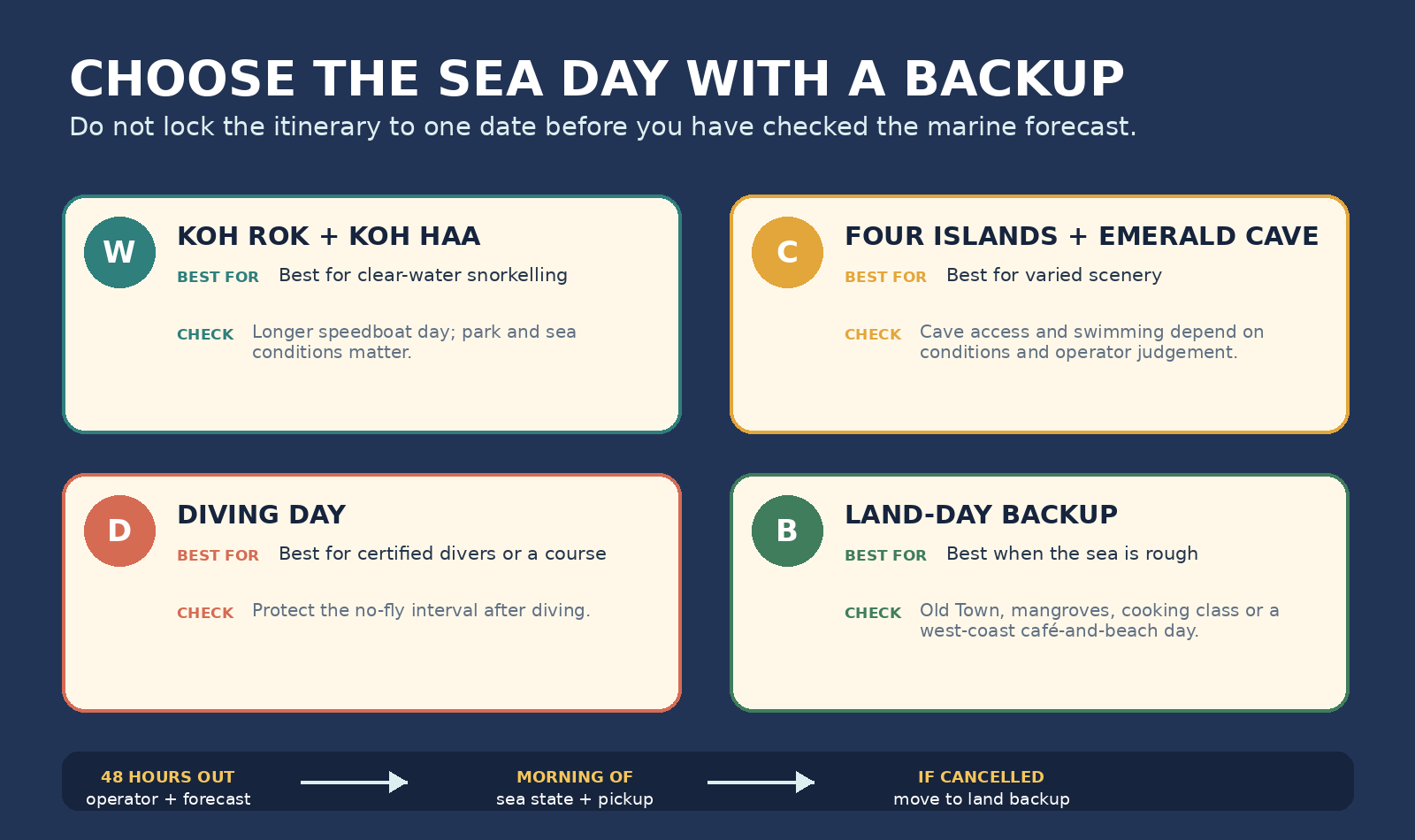
Koh Lanta’s offshore options are a major reason to visit, but they should never be treated as guaranteed calendar entries. The correct trip depends on the open season, swell, visibility, operator, boat type, passenger mix and how much time you tolerate on a speedboat.
Option A: Koh Rok and Koh Haa
Choose this for a water-led day where snorkelling quality matters more than variety of land stops. Current activity listings commonly describe seven- to nine-hour outings with hotel pickup, equipment and lunch, although inclusions differ. Because the crossing is exposed, travellers prone to seasickness should ask about boat type, passenger numbers and the operator’s cancellation process.
Option B: Four Islands and Emerald Cave
The Four Islands route usually combines limestone scenery, several swim or snorkel stops and the Emerald Cave experience when access is safe. It can feel more varied than Koh Rok, yet it may also feel busier and more scheduled. Ask whether the park fee, cave entry decision, life jackets, lunch and hotel pickup are included rather than assuming every product uses the same format.
Option C: a diving day
Certified divers may prioritise Koh Haa, Hin Daeng, Hin Muang or another site selected for the conditions and experience level. Beginners should distinguish a pool-based try dive, a full introductory experience and a multi-day certification course. Moreover, any diving plan must be coordinated with the onward flight or ascent to altitude; the no-fly interval is addressed later in this guide.
Option D: the no-boat alternative
Move Old Town and the mangroves into this slot, take a cooking class, book a spa treatment or build a café-and-beach day near the hotel. This is not a consolation prize. In rough conditions, it is the itinerary working as designed.
| Sea-day choice | Best for | Typical planning length | Broad price allowance | Questions before payment |
|---|---|---|---|---|
| Koh Rok + Koh Haa | Clear-water snorkelling and beach time | 7-9 hours | About 1,800-3,500 THB per adult | Park fee, boat type, passenger cap, pickup zone and cancellation terms |
| Four Islands + Emerald Cave | Limestone scenery and varied stops | 6-9 hours | About 1,000-2,500 THB per adult | Long-tail or speedboat, cave access, park fee and return time |
| Two- or three-dive day | Certified divers | 8-11 hours | About 3,000-6,000+ THB depending on site and equipment | Certification, equipment, insurance, site choice and no-fly timing |
| Private boat | Families or groups wanting control | Flexible | Often 8,000-20,000+ THB per boat | Fuel, park fees, route limits, shade, toilet and weather refund |
| Land-day alternative | Rough sea, short stay or non-swimmers | 4-8 hours | About 500-2,500 THB | Transport, class or activity inclusions and return after dark |
Compare the sea-day format rather than only the headline price
Read the full inclusion list and recent operator information. A lower price may exclude the park fee or use a longer transfer; a premium price does not automatically mean a smaller group.
Who should reconsider a speedboat day?
Pregnant travellers, very young children, people with significant back or mobility problems and anyone who struggles badly with boat motion should read the operator restrictions carefully. Likewise, a traveller who cannot climb a boat ladder or swim confidently should ask how boarding and water entry work before payment. The honest alternative may be a private land day, not a different speedboat.
Day 4: Lanta Old Town and the east coast
Thailand’s government tourism portal describes Lanta Old Town as a long-established community with historic wooden buildings and waterfront restaurants. The day gives the itinerary a cultural and geographic contrast after the west-coast beaches.
Arrive before lunch
Walk the main street before the hottest part of the day, but do not treat the area as a decorative shopping set. Look down the side lanes, notice the relationship between the shophouses and sea, and give yourself time to sit. Although the centre is compact, a two-hour sprint misses the reason to come.
Choose lunch for the view and menu, not only the platform
Waterfront restaurants can be memorable, yet a sea-facing deck does not guarantee the right food for every traveller. Read the menu, ask about spice and allergies, and confirm the kitchen’s understanding rather than relying on a translated card alone. During quieter months, opening days may change.
Add Thung Yee Peng mangroves
The Tourism Authority of Thailand places Thung Yi Pheng on Koh Lanta’s east coast around seven kilometres from Saladan. Its March 2026 guide says the community rowing trip should be reserved at least one day ahead and lists morning and evening departures. When checked, self-arrival prices were 850 THB for the 05:30-07:30 morning trip and 750 THB for the 16:30-18:00 evening trip; options with community transport were higher. It also listed two-person kayak hire from 08:00 to 16:00 at 400 THB per kayak. Reconfirm the programme, tide, transfer zone and price directly because these are dated official anchors rather than a permanent tariff.
Set the right wildlife expectations
Mangroves are working habitats, not guaranteed wildlife shows. You may see monkeys, birds or mudflat life, but sightings depend on tide, time and luck. Therefore, select the activity for the landscape and community interpretation rather than a promise of close animal encounters.
Return west for sunset only when it makes sense
The east coast does not offer the classic west-facing sunset, so many itineraries cross back to Long Beach or Klong Nin. However, an unhurried Old Town dinner can be the better choice if you have a driver and prefer a quiet evening. Do not add the return merely to collect another photograph.
Compare mangrove and east-coast activities
Check whether the experience uses a kayak or boat, how much paddling is expected, whether hotel pickup reaches your area and how wildlife interactions are managed.
Day 5: Kantiang Bay, the far south and Mu Ko Lanta National Park
The south is greener, quieter and more dramatic, but the final kilometres take longer than the map suggests. Use this as a full day only when the departure is the following morning or later. If you are leaving that afternoon, stay close to the hotel and move the southern loop to Day 2.
Begin around Kantiang Bay
Kantiang makes a sensible breakfast or early swim stop because it combines scenery with some practical facilities. Check the beach and flag conditions before entering the water. Afterwards, decide whether the day continues to Bamboo Bay and the park or whether a long lunch is the better use of the remaining time.
Use Bamboo Bay as a choice, not an obligation
Bamboo Bay can feel much quieter than the central coast. Nevertheless, road and sea conditions should control the visit. A rough swimming day is still worthwhile for the landscape, but there is no prize for forcing a swim or continuing south when the group is tired.
At Mu Ko Lanta National Park
The Laem Tanod area is associated with the lighthouse, beaches and nature trails. The official Department of National Parks maintains the park information and entrance-fee datasets, yet the fee table itself is based on a June 2023 release and the opening-and-closure dataset was last updated in January 2026. Operating conditions can still change. Therefore, check the latest park notice, opening time, trail status and admission shortly before setting out rather than relying on an old screenshot.
The park’s official system also lists a separate Koh Rok visitor zone for accommodation, camping and diving-related activity. That reinforces an important planning point: offshore park experiences and the Lanta Yai headquarters are not the same visit, even though both sit within Mu Ko Lanta National Park.
Keep food and bags away from monkeys
Do not feed wildlife or leave snacks visible. Secure sunglasses, loose bottles and small bags before walking near visitor areas. In addition, step back rather than trying to recover an item from an animal at close range; ask a ranger for help.
The protected departure-day version
When a ferry or flight leaves later on Day 5, use the morning for the home beach, brunch and packing. Agree the pickup in writing, save the driver’s contact and leave a margin for road and vehicle-ferry delays. A final relaxed swim is a better ending than watching airport check-in close from the back of a taxi.
National-park planning allowance
Recent secondary visitor information has commonly listed a foreign-adult admission around 200 THB and a child admission around 100 THB. Treat those figures only as a planning allowance. The official Department of National Parks dataset and the park itself control the current fee, and vehicle charges or activity fees may be separate.
A shorter three-day Koh Lanta itinerary
Three full days require sharper choices. The version below assumes you have separate arrival and departure nights. When the three days include travel, remove either the sea day or the south rather than compressing all four areas.
| Day | Core plan | What to omit | Reason |
|---|---|---|---|
| 1 | Home beach, Long Beach and Klong Nin | Far-south national park | Understand the island without a punishing first day |
| 2 | Sea day if conditions are suitable; Old Town if not | Second paid excursion | Keep the weather-sensitive priority movable |
| 3 | Old Town plus mangroves, or Kantiang plus national park | Whichever half of the island matters less | One focused final day is better than crossing twice |
When the sea day is the priority
Book the sea day with a realistic cancellation policy, then make Day 1 and Day 3 land days that can swap. If poor weather removes the boat trip, use Old Town and mangroves rather than searching for another operator willing to depart in marginal conditions.
When beaches and culture matter more than boats
Skip the offshore excursion and divide the time between the west coast, Old Town and the south. This version is especially sensible in the monsoon season, with young children or for travellers who dislike speedboats.
A relaxed seven-day Koh Lanta itinerary
Two additional days should create slack rather than two more dawn starts. Add a genuine rest day and one specialist interest: diving, cooking, a private driver, another snorkelling trip or a move to a far-south resort.
| Day | Plan | Why it earns a place |
|---|---|---|
| 1 | Arrival and local beach | Absorbs transfer uncertainty |
| 2 | West-coast loop | Shows the island’s main beach character |
| 3 | Flexible sea day | Uses the best available forecast |
| 4 | Completely slow day near the base | Prevents the holiday becoming a tour schedule |
| 5 | Old Town and Thung Yee Peng | Adds community and east-coast context |
| 6 | South coast and national park | Gives the long route a full day |
| 7 | Cooking class, diving, second sea day or departure buffer | Matches the traveller rather than repeating the same activity |
Should you split the accommodation?
A four-night Long Beach plus three-night Kantiang split can work when the final resort is part of the experience. Conversely, a move from Klong Dao to Long Beach adds little geographic benefit. Calculate checkout, taxi and lost beach time before deciding.
Should you add a second sea day?
Only when the first trip leaves a genuinely different priority. For example, a snorkelling day and a certified dive day are distinct; two similar speedboat tours may not be. Leave at least one quieter day between long boat outings if motion and sun exposure tire you.
A rainy-season Koh Lanta itinerary that still works
Rainy season does not mean continuous rain, but it does mean greater uncertainty, fewer operating businesses and a higher chance that offshore plans disappear. Build the trip from dependable land experiences first. Then add the sea only when conditions and a reputable operator support it.
Five-day wet-season structure
| Day | Primary plan | Heavy-rain fallback |
|---|---|---|
| 1 | Arrival and local beach walk | Café, massage, supplies and early dinner |
| 2 | Short west-coast loop | One sheltered area and a long lunch |
| 3 | Old Town and east-coast communities | Cooking class or spa if roads and rain are poor |
| 4 | Mangroves, kayaking or a land activity | Flexible indoor or hotel day |
| 5 | South coast only if roads and park access are suitable | Home beach, brunch and protected departure |
Choose the hotel more carefully
A room with covered outdoor space, a usable pool, an on-site restaurant and walkable alternatives becomes more valuable. In addition, check recent renovation and closure notices, because quiet-season maintenance can affect facilities.
Use lower prices without overbooking
Accommodation may be cheaper, yet a low non-refundable rate is not automatically good value if plans remain uncertain. Select sensible cancellation terms and avoid stacking prepaid outdoor activities. The best bargain is flexibility, not simply the lowest nightly number.
Getting around Koh Lanta without wasting the holiday
Local taxis and songthaew-style vehicles
These are useful for dinners, beach changes and one-way journeys, but prices are often negotiated rather than metered. Agree the total fare, number of passengers, waiting time and final destination before starting. Also save the return contact when staying in a quiet area.
Private driver for the west coast, Old Town or the south
A driver is usually the best value for a group that wants several stops. It removes parking stress and allows everyone to swim or have a drink. However, define the hours, route, waiting time and any overtime rate in advance so that a relaxed sunset does not create an awkward argument.
Scooter rental: freedom with a serious responsibility
Rent only when you hold the correct licence, your insurance covers the vehicle and you already have meaningful riding experience. Southern gradients, rain, sand, potholes and unfamiliar traffic are not a suitable training course. Wear a proper helmet, avoid night riding and photograph the vehicle before leaving.
Rental car: useful for families, but not effortless
A car offers shade, luggage space and child-seat potential. Nevertheless, drivers must be comfortable with left-side traffic, narrow roads, animals, motorcycles and limited parking. Confirm insurance excess, licence requirements and who is permitted to drive.
Walking: area-specific rather than island-wide
Some stretches around Klong Dao, Long Beach and Klong Nin are walkable for meals. Yet roads may lack continuous pavements, lighting can be limited and heat changes the practical distance. Check the exact hotel surroundings in street-level imagery and recent reviews rather than assuming a one-kilometre walk is pleasant.
| Transport | Best use | Planning cost | Advantages | Limitations |
|---|---|---|---|---|
| Local taxi / songthaew | Dinner, one-way beach change and short trips | Agree locally; often several hundred THB depending on distance | No driving responsibility | Negotiated fare and uncertain late availability |
| Private driver | Old Town, west-coast loop or national park day | Often 2,000-4,500+ THB for a half/full day | Flexible for groups and luggage | Needs a clear route and waiting agreement |
| Scooter | Independent travel for experienced licensed riders | Often 200-400+ THB per day plus fuel and insurance considerations | Maximum freedom | High consequence when skills, licence or cover are inadequate |
| Rental car | Families and multi-stop days | Often 1,000-2,500+ THB per day | Shade, child gear and weather protection | Parking, road confidence and insurance details |
| Hotel transport | Pier, dinner and organised excursions | Varies by property | Simple and accountable | May cost more or operate only at set times |
Food and evening planning on Koh Lanta
Match dinner to the base
Klong Dao and Long Beach offer the broadest independent choice, Klong Nin has a smaller relaxed cluster, and far-south resorts may rely more heavily on hotel dining. Therefore, a room rate should be assessed alongside the cost and effort of reaching dinner.
Look beyond beachfront tables
A sea view can be lovely, but roadside family restaurants, Muslim-Thai cooking, southern dishes, noodle shops and local markets often add more variety. When Koh Lanta is paired with a city stay, the Bangkok travel guide helps plan the contrasting city days before or after the island; on Lanta itself, leave room for family-run restaurants and local markets rather than booking every meal in advance.
Vegetarian, vegan and allergy planning
Vegetarian wording does not automatically remove fish sauce, oyster sauce or shrimp paste. A serious allergy requires direct discussion, translated information and an emergency plan; it cannot be guaranteed by a tour listing or a single phrase. When cross-contact is a severe risk, choose simpler dishes and accommodation with a kitchen or reliable communication.
Keep at least two evenings local
Long transfers for dinner are rarely the best use of a short stay. Instead, use one special meal in Old Town or another area, then keep the remaining evenings near the room. This also makes the day-trip schedule more resilient when return times move.
Optional food and cooking experiences
A cooking class can be a strong rough-sea alternative. Check the menu, market component, transport, class size and whether the provider can safely handle your dietary needs.
How much does a five-day Koh Lanta trip cost?
Budgets depend most on accommodation, private transport and sea activities. The Thailand travel budget guide provides wider country context; the table below focuses on the island portion and assumes two travellers sharing a room.
Typical daily planning ranges
| Cost area | Budget approach | Mid-range approach | Comfort approach |
|---|---|---|---|
| Room per night | 800-1,800 THB | 2,000-5,000 THB | 5,500-15,000+ THB |
| Food per person per day | 500-900 THB | 900-1,800 THB | 1,800-3,500+ THB |
| Local transport per day | 200-600 THB | 600-1,500 THB | 1,500-4,500+ THB |
| One sea activity per person | 1,000-1,800 THB | 1,800-3,500 THB | Private or premium options vary widely |
| Arrival transfer per person | Shared van often 400-800 THB | Shared or private split by group | Private transfer often several thousand THB per vehicle |
Five-night trip scenarios for two people
| Style | Accommodation | Food and local travel | Activities and transfers | Broad island total |
|---|---|---|---|---|
| Value-focused | 4,000-9,000 THB | 6,000-10,000 THB | 5,000-10,000 THB | About 15,000-29,000 THB |
| Comfortable mid-range | 10,000-25,000 THB | 10,000-18,000 THB | 10,000-20,000 THB | About 30,000-63,000 THB |
| Higher-comfort | 27,500-75,000+ THB | 18,000-35,000+ THB | 18,000-45,000+ THB | About 63,500-155,000+ THB |
Costs that are easily missed
- The final taxi from Saladan when a ferry ticket ends at the pier.
- National-park admission, vehicle fees or marine-park fees excluded from a tour.
- Private transfer supplements for Kantiang or other far-south hotels.
- Child seats, extra luggage or late-arrival charges.
- Restaurant taxes, service charge, drinks and hotel breakfast.
- Laundry, pharmacy purchases, cash-machine fees and replacement transport after a cancellation.
Where to save without damaging the trip
Save by staying in a walkable area, sharing one driver day and choosing one excellent paid sea experience. By contrast, the cheapest remote room can increase taxi spending, while three low-priced tours may deliver less satisfaction than one good trip plus two free beach days.
The best order for booking a Koh Lanta trip
- Fix the international and domestic travel dates.
- Confirm the route into and out of Koh Lanta for the actual season.
- Choose the base and book accommodation with suitable cancellation terms.
- Reserve the arrival transfer, especially for a late flight or far-south hotel.
- Book one high-priority sea, diving or cooking activity with clear weather terms.
- Arrange a driver for the south or Old Town only when your transport plan requires one.
- Leave normal meals, massages and beach stops flexible.
- Recheck the weather, park status and transport 48 hours before each critical movement.
Why this order works
Each step protects the one before it. A sea tour is easy to move when the hotel and transport are already secure; a hotel is harder to change after several pickups have been tied to it. Likewise, departure-day activities should never dictate the connection home.
Read cancellation terms in local time
Note the cut-off time, time zone and weather wording. Some products refund only when the operator cancels, not when a traveller dislikes the forecast. Therefore, understand who makes the decision and how a rescheduled trip affects the rest of the itinerary.
Forty-eight-hour recheck
Confirm the arrival or departure pickup, current marine outlook, park status, tour meeting point and hotel’s latest contact. Take screenshots of essential vouchers for offline use, but rely on the live provider message when it supersedes an older confirmation.
What to pack for Koh Lanta: useful product comparisons
Pack for heat, water, uneven access and sudden rain rather than for staged photographs. The full Thailand packing list covers the country; these are the items that earn particular value on Lanta.
| Item | Best use | What to look for | Advantages | Limitations |
|---|---|---|---|---|
| 5-10 litre roll-top dry bag | Boat spray and separating wet items | Welded seams, secure roll closure and comfortable strap | Simple protection and beach utility | Not guaranteed for prolonged submersion |
| Waterproof phone pouch | Rain, pier handling and surface photographs | Reliable seal, touch response and independent flotation strap | Small and inexpensive | Test before every use; poor seals fail |
| Reef or water shoes | Rocky entries, hot sand and boat ladders | Grip, drainage and secure heel | Protects feet without heavy boots | Not a substitute for checking currents or hazards |
| UPF rash vest | Snorkelling and long sun exposure | Comfortable close fit and high coverage | Reduces sunscreen use in the water | Still requires protection for exposed skin |
| Compact power bank | Long tour and transfer days | Recognised safety certification, airline-compliant capacity and short cable | Keeps maps and messages available | Must normally travel in cabin baggage on flights |
| Light rain layer | Boat spray and monsoon showers | Packable, breathable and long enough for a scooter passenger only when safely used | Useful year-round | A jacket cannot make unsafe weather suitable |
| Secure small wallet or cross-body bag | Cash, room key and phone | Closeable compartments and comfortable strap | Reduces loose items on boats and around wildlife | Avoid overfilling or leaving it unattended |
Compare practical island gear
Choose simple, tested equipment rather than novelty travel products. Read dimensions and recent reviews, then test every seal before the trip.
Connectivity and offline backups
A working data connection helps with driver messages, maps and weather updates. Compare plans in the Thailand SIM and eSIM guide, or review Airalo’s Thailand eSIM options. Still, download the island map and save hotel details offline because signal and battery can fail at the same time.
Koh Lanta weather and sea conditions
Use seasons as a planning guide, not a guarantee
The broad dry-season and monsoon pattern helps choose the type of trip, although it cannot guarantee a particular week. The best time to visit Thailand guide explains regional differences, while the Thai Meteorological Department’s Krabi page includes a Ko Lanta observing station and current provincial information.
Outer-island access changes in the monsoon season
The Tourism Authority of Thailand Ko Lanta page says smaller islands around Mu Ko Lanta National Park, including Koh Rok and Koh Haa, are typically closed from May through October. Treat that as a planning rule rather than a promise about an exact reopening date. Park notices, operator schedules and current marine conditions decide what is actually available during your stay.
Wave forecasts matter more than a rain icon
A dry-looking phone forecast can still coincide with uncomfortable or unsafe sea conditions. In May 2026, an official TMD advisory warned of around two-metre waves in the lower Andaman Sea and higher waves in thunderstorms. That does not describe every monsoon day; instead, it demonstrates why marine warnings and operator judgement matter.
Use a three-stage sea-day check
- Forty-eight hours out: review the provincial and marine outlook, then ask the operator about likely operation.
- The evening before: confirm pickup and whether the route or boat type has changed.
- On the morning: accept a cancellation or route change when the captain, park or authorities judge conditions unsuitable.
Do not chase a gap in a thunderstorm
If lightning, strong gusts or rapidly darkening skies affect the area, leave exposed beaches and viewpoints. A brief gap on radar is not permission to pressure a boat operator or continue a self-drive route. Wait in a substantial building and follow local warnings.
Weather flexibility is part of the itinerary
The sea day has not failed when it moves. The itinerary succeeds when a rough-water day becomes Old Town, mangroves or a local beach and the boat trip shifts to calmer conditions.
Swimming safety and hazardous marine life
Obey red flags and lifeguard instructions
Beach conditions vary by season, tide and location. Enter only where the sea appears suitable and local warnings allow it. The current FCDO Thailand safety guidance specifically advises care around coastal swimming and strong riptides, particularly during monsoon conditions.
Portuguese man-of-war warning
In June 2026, the Department of National Parks reported Portuguese man-of-war at Laem Tanod and raised red-flag restrictions. Its official warning explains that the tentacles can remain dangerous even after the organism is stranded or dead. Do not touch a blue or purple float or tentacle on the beach; move away and alert a ranger or lifeguard.
What to do around a strong current
Prevention is better than improvisation: swim near other people, stay within your ability and do not use an inflatable as a safety device. If caught in a rip, conserve energy, avoid fighting directly against the current and attract attention. Local conditions and lifeguard directions take priority over generic advice.
Snorkelling is not automatically low risk
A life jacket, buddy and guide are useful even for a confident pool swimmer. Avoid standing on coral, do not follow wildlife away from the group and keep track of the boat. Moreover, tell the guide about medical conditions and do not enter when you are exhausted, unwell or affected by alcohol.
Road, cave and wildlife safety
Driving licence and insurance
Confirm the licence category and policy terms before renting. A shop willing to hand over a scooter does not prove that the rider is legal or insured. The financial and medical consequences of an accident can be severe, so use a driver when any part of the licence, skill or cover is uncertain.
Avoid unnecessary night riding
Lighting, road edges, animals and wet surfaces are harder to judge after dark. Therefore, finish the southern loop before dusk or keep a driver for the evening. A sunset stop should include the journey home, not only the view.
Khao Mai Kaew Cave requires realistic expectations
The cave is an adventure activity rather than a polished level walkway. Official tourism information describes rock crevices and cave formations. Before going, ask about ladders, crawling, footwear, guide arrangements, weather closure and suitability for children, claustrophobia or mobility limitations. Skip it when the answer does not match the group.
Do not encourage monkeys
Keep food hidden, maintain distance and never use food to obtain a photograph. Feeding changes behaviour and can create conflict for later visitors. Likewise, do not try to touch, corner or retrieve an object from an animal.
Save emergency contacts
Thailand’s Tourist Police publish hotline 1155. General police is 191 and emergency medical assistance is commonly reached on 1669. Save the accommodation number and insurer’s assistance line as well, then seek immediate local help for a serious injury, breathing difficulty or suspected marine sting.
Diving, snorkelling and flying after Koh Lanta
Protect the no-fly interval
Divers Alert Network recommends a minimum surface interval of 12 hours after one no-decompression dive and 18 hours after multiple dives or multiple days. It advises substantially longer after dives requiring decompression stops. These are minimum guidelines, not a guarantee, and individual dive professionals or medical advice may be more conservative.
Do not place diving on the final day by habit
Put the dive day early enough that the flight interval is comfortable even if the schedule runs late. If the onward journey involves altitude by road, ask the dive operator whether that also affects the plan. A final beach or Old Town day is easier to move than an airline ticket.
Never fly with possible decompression symptoms
Pain, unusual fatigue, weakness, numbness, breathing difficulty, dizziness or neurological symptoms after diving require urgent professional assessment. Do not board a flight and hope the symptoms disappear. Contact the dive operator, emergency services and an appropriate diving-medicine resource.
Koh Lanta itinerary with children
Choose Klong Dao or the right part of Long Beach
The easiest family base reduces transfers, keeps dinner nearby and offers a pool or shade for midday. Klong Dao often suits younger children, while Long Beach can work well when the exact property is close to food. Check room occupancy carefully; a room called a family room may still rely on a sofa bed or require a second unit.
Choose the boat by child, not by marketing
Read the minimum age, seating, shade, toilet, ladder and life-jacket details. A full-day speedboat may be too loud, hot or bumpy for a young child even when the operator technically accepts them. A private long-tail boat is not automatically safer; exposure, boarding and weather still matter.
Use one major activity every other day
Alternate a boat, driver or culture day with a slow beach or pool day. As a result, missed naps and late returns do not accumulate into an exhausted final day. Keep snacks and water secured from monkeys rather than carried openly.
Plan medical needs before the south
Carry regular medicines, know the nearest suitable clinic and retain a transport plan. Far-south seclusion increases the time needed to reach larger facilities. Travel insurance should cover the family’s activities and potential transfer costs.
Koh Lanta for couples and solo travellers
For couples: spend on one shared experience
A private driver, high-quality small-group boat or a far-south resort can add more value than daily paid activities. Klong Nin offers a relaxed evening atmosphere, while Kantiang suits couples who actively want seclusion. However, check the cost of independent dining before choosing a remote hotel.
For solo travellers: base choice matters more
Long Beach or Klong Dao makes it easier to find meals and shared pickups without arranging a vehicle each time. A sociable guesthouse or small resort may be more useful than an isolated villa. Nevertheless, keep transport details private, avoid walking unlit roads alone and tell the accommodation when heading out on a remote route.
Use shared tours selectively
Shared boat, cooking and mangrove trips can be practical ways to meet people. Read the pickup zone and cancellation terms, then avoid booking every day simply to create company. A local café, beach walk or group class often provides enough structure without exhausting the itinerary.
Accessibility and reduced-mobility planning
Verify the route from room to beach
A beachfront property may still include steps, sand, steep ramps or separate buildings. Ask for photographs or precise details about room access, bathroom layout, pool entry, restaurant route and vehicle drop-off. General accessibility labels are not detailed enough for a confident decision.
Boat boarding can be the hardest part
Long-tail boats and speedboats may require stepping through water, climbing from a pier or using a narrow ladder. Contact the operator before payment and explain the exact assistance or equipment required. If safe boarding cannot be confirmed, choose Old Town, mangroves by suitable boat or a private driver day instead.
The lighthouse view and trails are not the same experience
Some visitors may enjoy the park’s coastal scenery without completing a steep or uneven trail. Ask the park or driver what can be reached from the vehicle area. Likewise, do not assume that a photo of a viewpoint proves step-free access.
Heat and fatigue change practical mobility
Plan shorter outdoor blocks, air-conditioned breaks and door-to-door transport. Morning visits often work better than midday. Above all, build a route that remains enjoyable when one stop is removed.
Responsible travel on Koh Lanta
Protect coral and marine life
Do not stand on coral, chase animals, remove shells or feed fish. Use a rash vest to reduce the amount of sunscreen entering the water, and follow the operator’s reef instructions. A guide who prevents damaging behaviour is adding value, not reducing fun.
Keep mangrove visits quiet and local
Choose community-led activities where possible, keep distance from wildlife and avoid operators that use food to force close encounters. Mangroves protect coastlines and support nursery habitat; they should not be treated as an amusement park.
Reduce single-use waste
Refill water where safe systems are available, carry a reusable bottle and say no to unnecessary bags and straws. Still, hygiene and safe drinking water come first; responsible travel does not mean risking illness to avoid one container.
Dress and behave for the community you are visiting
Beach clothing belongs on the beach. Cover up in Old Town shops, villages, religious spaces and transport. Ask before photographing people, especially during work or worship, and support businesses without turning residents into scenery.
Koh Lanta itinerary pros and cons
Why Koh Lanta works well
- Several distinct beaches and bases create choice without changing islands.
- Road access makes land days possible when the sea is unsuitable.
- Old Town and mangroves add community and ecological context.
- The island supports families, couples, divers and longer slow stays.
- Krabi provides a practical air gateway for most visitors.
The trade-offs to understand
- The island’s length creates repeated transport costs when the base is poorly chosen.
- Some passenger routes and offshore activities are seasonal.
- Small-boat days can be rough, tiring or cancelled.
- Road safety becomes a major issue for inexperienced scooter riders.
- Far-south seclusion can limit dining, pickups and quick medical access.
- Rainy-season business closures reduce spontaneity in quieter areas.
Who is most likely to enjoy it?
Koh Lanta suits travellers who like beaches but do not need constant nightlife, accept moderate road journeys and value a flexible pace. It is less suited to someone seeking a compact pedestrian island, guaranteed high-season boat schedules in every month or a dense late-night entertainment district.
Ten common Koh Lanta itinerary mistakes
Choosing the cheapest remote hotel
A low room price can create expensive taxis and difficult meal planning. Price the journeys before paying.
Fixing the sea day to one date
Move it to the best suitable conditions and keep a land-day substitute ready.
Booking two similar speedboat trips
Sun, spray and motion fatigue accumulate. Choose distinct experiences or add a slow day.
Learning to ride a scooter on the island
Rain, gradients and unfamiliar traffic make this a poor place for first lessons.
Treating Saladan as the final destination
Confirm the hotel transfer; far-south properties can be a substantial additional journey.
Adding the national park before a flight
The road, vehicle ferry and airport check-in need a protected margin.
Ignoring tide and shoreline conditions
A named beach can swim differently by tide, season and exact section.
Assuming every tour includes park fees
Read the inclusions, pickup zone, meal, equipment and cancellation wording.
Leaving dinner transport until dark
Quiet areas may have fewer vehicles. Arrange the return before setting out.
Forcing the original plan in poor weather
Changing to Old Town, mangroves or a local beach is good judgement, not a failed holiday.
Frequently asked questions about a Koh Lanta itinerary
Is five days enough for Koh Lanta?
Yes. Five days is enough for a west-coast beach loop, one flexible sea day, Old Town and mangroves, plus the far south or a protected departure day. Seven nights is better for families, divers or travellers who want several completely slow days.
Where should first-time visitors stay on Koh Lanta?
Long Beach is the best all-round first base because it balances beach quality, restaurants, tour pickups and access in both directions. Klong Dao is easier for families and late arrivals, while Klong Nin is a quieter alternative.
What is the best month for Koh Lanta?
December to March generally offers the easiest broad combination of drier weather and operating sea trips. November and April can also work, although conditions vary. From May into October, build a land-led plan and expect reduced or cancelled boat services.
Can I visit Koh Lanta during rainy season?
Yes, provided you accept changing weather, some business closures and fewer dependable offshore routes. Choose a good hotel base, keep activities flexible and use Old Town, mangroves, food, spas and local beach time as the core itinerary.
How do I get from Krabi Airport to Koh Lanta?
A shared minivan is the usual value option, while a private car is easier for families, late arrivals and far-south hotels. Confirm that the fare includes vehicle-ferry crossings and delivery to the exact accommodation rather than ending at Saladan.
Do I need to book the Koh Lanta transfer in advance?
Advance booking is sensible for high season, late flights, large groups, child-seat requests or a remote hotel. Travellers arriving early with a flexible schedule may find shared options locally, but should still know the last practical departure.
Do I need a scooter on Koh Lanta?
No. Taxis, hotel vehicles and private drivers can cover the itinerary. Rent a scooter only with the correct licence, suitable insurance and genuine prior riding experience; the island is not a safe training environment.
Which is better: Koh Rok or the Four Islands?
Koh Rok and Koh Haa generally suit travellers prioritising clear-water snorkelling, while the Four Islands route offers varied limestone scenery and the Emerald Cave when access is safe. Choose according to season, sea state, boat type and personal comfort.
Are Koh Rok and Koh Haa open all year?
Do not assume so. Park access, seasonal schedules and sea conditions can restrict trips. Check the current Department of National Parks information and the operator shortly before booking and again before departure.
Is Lanta Old Town worth visiting?
Yes, especially when you want a cultural and east-coast contrast to the beach resorts. Allow time for the wooden shophouses, waterfront and lunch, then add Thung Yee Peng only if the day remains unhurried.
Can I stay in Lanta Old Town instead of the west coast?
You can, but it changes the trip. Old Town is atmospheric and quiet rather than a classic sunset-beach base. For a first five-day holiday, most travellers will find Long Beach, Klong Dao or Klong Nin more convenient.
Is Koh Lanta good for families?
Yes. Klong Dao and suitable parts of Long Beach offer convenient food, shorter transfers and family-oriented accommodation. Choose the boat trip according to the child’s age, motion tolerance and boarding ability rather than the operator’s promotional description.
Is Koh Lanta good for solo travellers?
Yes, particularly when based in Long Beach or Klong Dao near food and shared pickups. A sociable guesthouse, group activity and pre-arranged late transport can make the stay easier without requiring a packed schedule.
How much money should I budget for five nights?
For two people excluding international flights, a value-focused island stay may fall around 15,000-29,000 THB, a comfortable mid-range trip around 30,000-63,000 THB, and a higher-comfort trip can exceed 63,500 THB. These are planning allowances, not guaranteed live prices.
Can I visit Mu Ko Lanta National Park on departure day?
Only when the onward connection is late and the route leaves a generous buffer. For an early or important flight or ferry, move the park earlier and use the final morning near the hotel.
How long should I wait to fly after diving?
Divers Alert Network recommends at least 12 hours after one no-decompression dive and at least 18 hours after multiple dives or multiple days of diving. A substantially longer interval is prudent after decompression dives. Follow the dive professional and medical advice for your circumstances.
What should I do if a boat tour is cancelled?
Use the prepared land-day backup: Old Town, Thung Yee Peng, a cooking class, spa, local beach or driver loop. Ask whether the trip can move to another day or be refunded under the booking terms, but do not search for an operator willing to ignore unsafe conditions.
How far in advance should I book Koh Lanta accommodation?
Book earlier for Christmas, New Year, school holidays and high-demand beachfront family rooms. Outside peak dates, cancellation flexibility is often more valuable than paying early for the lowest non-refundable rate.
The Koh Lanta route I would choose
Base: Long Beach for five nights
For a first visit, I would choose a carefully located Long Beach property with food within a practical walk. It gives the itinerary the best balance and avoids treating every dinner as a taxi journey. Klong Dao would replace it when travelling with younger children or arriving late.
Days: one coast, one sea, one east and one south
I would keep Day 1 local, use Day 2 for the west coast, place the sea trip on the calmest suitable day, visit Old Town and Thung Yee Peng on the remaining land day, then see Kantiang and the park only when the departure timing allows. This plan creates four different versions of Koh Lanta without crossing the island repeatedly.
Spend: one good boat or driver day
I would spend on the experience that removes the most friction: a reputable sea trip, a private driver for a group or a transfer that reaches the hotel door. Meanwhile, I would save by walking to dinner, keeping two beach days simple and resisting duplicated tours.
The rule that matters most
The itinerary should bend before safety, weather and the departure connection do. When the sea is rough, move to land. On wet roads, shorten the loop. Before an important onward transfer, remain near the hotel. That flexibility is not a compromise; it is the reason the five-day plan works.
Sources and fact-checking
Destination, park, weather, transport, entry, safety and diving information was checked on 10 September 2026. The sources below prioritise Thai government, national-park, meteorological, immigration, airport, emergency-service and diving-medicine information. Commercial schedules and prices are used only as current planning evidence and should be reconfirmed for the exact date.
Official destination, park and weather sources
- Tourism Authority of Thailand: official Ko Lanta destination overview.
- TAT Newsroom: Ko Lanta Green Destinations recognition, March 2026.
- Thailand government tourism portal: Koh Lanta, Old Town, Thung Yee Peng, Laem Tanod and diving overview.
- Thailand government: Mu Ko Lanta regenerative-tourism and hermit-crab restoration project.
- Tourism Authority of Thailand: Thung Yi Pheng community activities, times and 2026 prices.
- Mu Ko Lanta Koh Rok visitor zone — Department of National Parks.
- National-park opening and closure dataset — Department of National Parks.
- National-park entrance-fee dataset — Department of National Parks.
- Laem Tanod Portuguese man-of-war warning, June 2026 — Department of National Parks.
- Thai Meteorological Department: Krabi weather, seven-day forecast and marine links.
- Thai Meteorological Department: lower-Andaman wind and wave advisory, May 2026.
- Department of Airports: official Krabi Airport information.
Transport, entry, safety and planning sources
- Tigerline Ferry: published monsoon and high-season timetables.
- 12Go Asia: Krabi Airport to Koh Lanta current route search.
- GetYourGuide: current Koh Lanta Koh Rok and Koh Haa activity search.
- Viator: current Koh Lanta Four Islands and Emerald Cave activity search.
- Divers Alert Network: official flying-after-diving guidance.
- Current Thailand warnings and insurance — UK Foreign, Commonwealth and Development Office.
- Thailand safety and security — UK Foreign, Commonwealth and Development Office.
- Emergency numbers in Thailand — UK Foreign, Commonwealth and Development Office.
- Thailand Tourist Police: official contact information and hotline 1155.
- World Health Organization Thailand: road-safety context.
- Thailand Immigration Bureau: Thailand Digital Arrival Card official FAQ. Submission timing, one-entry validity, family submissions and traveller requirements.
- Thai Meteorological Department: live shipping forecast. The 10 September 2026 forecast was checked as a dated example of why wave height and thundershowers matter before a sea day.
Illustrations in this article were created for Taylor’s Trailblazing Travels. Third-party photographs, where used, are credited beside the image or in the source list.
Traveller experiences
Share your experienceYour first-hand knowledge can help another traveller plan with more confidence. Share what you experienced, including anything you would change.
These are traveller contributions, separate from Taylor’s Trailblazing Travels’ editorial research. Contributions are reviewed before publication; a first-hand confirmation is not independent verification.
Be the first to share what you learned.
No traveller experiences have been approved for this article yet. Tried a similar route? Tell us what worked and what you would change.
Your journey, someone else’s useful tipTried a similar route? Tell us what worked and what you would change.Share a first-hand experience · no account needed
Your itinerary experience
Practical details, balanced views and small discoveries are all welcome. Please describe your own trip and avoid sharing someone else’s personal information.
Spotted something that’s changed?Help us keep this guide accurate. Reports stay private.Private report
Report an update
Tell the editorial team what appears to have changed. Reports stay private and are reviewed before any editorial decision; sending a report does not change this article.