Chinatown vs Riverside: Where Should You Stay in Bangkok?
Choose a Bangkok base by the journeys, room and evenings you actually want.
Chinatown vs Riverside is not simply a choice between street food and a beautiful view. It is a decision about how your Bangkok day begins, how often you return to your room, and what happens when the boat you expected to use has finished running. A hotel can be excellent yet still be the wrong base for the journeys you intend to make.
Choose the area around Yaowarat and MRT Wat Mangkon when exploring food streets on foot is central to the trip. Choose a carefully located riverside hotel when the room, pool and river setting are part of the holiday itself. However, do not book somewhere labelled Riverside until you have checked its bank, nearest pier, rail connection and evening return route. Chinatown has a relatively recognisable centre; Riverside stretches across several quite different pockets. [1][2][3]
This comparison is research-led rather than a claim of personal stays. The recommendations weigh repeat journeys, room requirements, likely evening plans and the usefulness of hotel facilities. They are not a ranking by star rating or commission. Hotel examples illustrate location trade-offs, while the final choice should be made against your actual dates and room conditions.
Start around Yaowarat
Look for a usable walk to Wat Mangkon and a room that suits your need for quiet.
Check the Sathorn Pier pocket
A river setting plus BTS access can work for a mixed itinerary.
Compare the actual beds
Occupancy, daylight and the midday return matter more than a district label.
Riverside is not one place
Confirm the bank, shuttle times and late-night road alternative.
Chinatown vs Riverside: make the first decision
Start with your last activity of the day
Think about where you expect to be after dinner. When the answer is usually a Chinatown food street, staying nearby removes an extra journey precisely when you may be tired. The attraction is not that you must eat from street stalls every evening. Rather, you can explore for an hour, return to the room, and come back out without treating dinner as an expedition.
Conversely, a riverside stay makes sense when your ideal ending is a terrace, a poolside pause or a meal at your hotel. In that case, spending slightly longer reaching a daytime attraction may be a reasonable exchange. A room with a view is only good value when you are there to enjoy it; paying for one and returning after midnight each day buys relatively little.
Compare two actual hotels, not two labels
Draw up one Chinatown candidate and one riverside candidate. For each, write the first useful transport stop, the route to your main sightseeing area, and a realistic way back after dinner. Include waiting and walking rather than only the time spent on a train or boat. Then compare the room itself: natural light, bed layout, lift access, breakfast and cancellation conditions.
That exercise often changes the answer. A well-positioned riverside property beside a useful rail connection may be easier than a cheaper Chinatown room deep inside a lane. Equally, a central Yaowarat hotel can beat an attractive river resort whose shuttle does not suit your evening plans. Location quality exists within both areas, not only between them.
| Priority | Chinatown / Yaowarat | Riverside |
|---|---|---|
| Food streets at the door | Investigate a room near Yaowarat and Wat Mangkon. | Expect a separate outing unless your chosen pocket is genuinely close. |
| A hotel-focused afternoon | Check room light, noise and any facilities you will use. | Can be attractive when you intend to spend time by the river. |
| Rail access | Measure the actual walk to Wat Mangkon. | Strong near some pockets; weaker at shuttle-dependent properties. |
| Late return | Plan the route to the actual entrance. | Check the last relevant boat and a land-based alternative. |
| Room value | Compare all-in terms for the same party. | Do not pay for a view or facility you will rarely use. |
Editorial comparison, not a ranking of every hotel. Transport and room conditions require a property-specific check.
Understand the map before choosing Riverside
Chinatown is close to the river, but not identical to it
Yaowarat, Song Wat and Talat Noi belong to a connected old-city landscape, yet they are not interchangeable hotel locations. The Tourism Authority identifies Yaowarat as Chinatown's food and commercial focus and names Wat Mangkon as its MRT access. A river-facing room further south can still involve a separate walk or ride to the busiest food streets. [1]
Use a walking route, not the straight-line distance on a booking map. Look for the actual hotel entrance, main crossings and a sensible route after dark. A little more distance on a clear pavement may be preferable to a shorter route through confusing service alleys, especially with bags or a pushchair. Never assume a waterside edge forms a continuous public promenade.
Divide the river into usable pockets
For this guide, think in four practical groups: the Sathorn Pier and Saphan Taksin area; Si Phraya and nearby historic streets; the west bank around Khlong San and ICONSIAM; and properties farther along the river that rely more heavily on their own shuttle or road transport. These are planning groupings, not official administrative boundaries.
A west-bank hotel may be close to an attraction across the water but distant by road. A lower-river resort may provide an enjoyable boat connection yet be inconvenient for repeated room breaks. Meanwhile, a hotel near Sathorn Pier can combine river travel with the BTS. Ask which version of Riverside you are actually buying before weighing it against Chinatown. [3][5][6]
Staying around Yaowarat and Wat Mangkon
The advantage is a neighbourhood outside the door
Chinatown is the stronger research-led choice for travellers who want unstructured food exploration. Instead of reserving every evening, you can walk out, see what appeals and change direction. The area has established restaurants as well as street-side dining, so the experience need not depend on finding one particular stall. However, individual businesses have their own opening patterns; do not assume every advertised food stop operates nightly. [1]
A short hotel-to-station walk is particularly useful on a hot or wet day. When comparing rooms, treat that walk as a daily task rather than a sightseeing stroll. You may be happy to wander a neighbourhood for an hour but far less happy to carry luggage over the same route immediately after a flight.
Check the room's quieter side
Atmosphere at street level and comfort inside are separate questions. Ask whether your room faces the street, an internal courtyard or another building. Request information about recent nearby building work, restaurant music, lift position and sound insulation. Reviews can suggest a pattern, but only the property can confirm which room category you are booking.
Natural light deserves its own check. Shanghai Mansion, for example, explicitly describes its rooms as windowless with decorative tinted glass. That can be perfectly acceptable for a short atmospheric stay, but it is not the same product as a bright room overlooking a quiet courtyard. Someone planning afternoon rest, remote work or recovery from jet lag may value that distinction more than a decorative lobby. [7]
The Sathorn Pier and Saphan Taksin pocket
Riverside with a useful land connection
This is the first riverside pocket I would investigate for a mixed sightseeing visit. The reason is practical: river boats and the BTS can both be part of the plan. Shangri-La identifies its proximity to Saphan Taksin, with the exact walk varying by hotel wing. That is a useful example of why an entrance or building wing matters more than the centre point of a large property on a map. [8]
The benefit is flexibility, not instant access to everywhere. To reach some old-city places, the river may be useful. For a modern shopping day, the BTS may be simpler. For an early departure with heavy luggage, a car may still be the least complicated choice. A transport-rich base lets you select the tool for each journey instead of forcing every trip onto water.
Do not confuse nearby districts with nearby stations
Sathorn is also the name of a much wider city district and business area. A hotel advertising Sathorn need not be near Sathorn Pier, and a hotel advertising river access need not be a comfortable walk from Saphan Taksin. Search the actual entrance and station together before assuming the connection works.
For a couple spending three nights, this pocket can offer a useful compromise: a river setting without making every evening depend on a private shuttle. Nevertheless, check whether the room rate includes the facilities you intend to use, which building contains your room, and whether breakfast involves a different part of the property. Large hotels can contain surprisingly different accommodation experiences.
Si Phraya, Talat Noi and the in-between choice
A compromise can be better than either extreme
Some visitors want historic streets and river access without sleeping on the busiest part of Yaowarat. In that situation, investigate the Si Phraya and Talat Noi side of the broader area. Treat this as a separate shortlist rather than assuming every property marketed under Chinatown offers the same surroundings. The aim is to find a room that supports the particular combination of walking, dining and boat travel you want.
The compromise has a cost. You may gain a quieter immediate setting or a river outlook but lose the convenience of an MRT entrance nearby. Establish your land-based fallback before booking. Ask the hotel where it would direct a guest returning from Siam in heavy rain, and how a taxi should locate the entrance.
Test your walking tolerance honestly
A route that looks appealing during a cool morning may feel different after dinner. Consider pavement continuity, traffic crossings, lighting and whether you are comfortable following directions through a working neighbourhood. Travel with someone whose walking pace is slower than yours? Use their likely pace when deciding what counts as nearby.
This pocket works particularly well as a deliberate choice for people who enjoy exploring between stops. It is less convincing when booked simply because a search result claims both Chinatown and Riverside. Before paying, write a one-sentence reason for choosing the exact address. If that reason still depends on being close to everything, return to the map and make the transport trade-off explicit.
West-bank hotels and the ICONSIAM connection
A different bank changes the journey
A hotel on the west bank is not automatically inconvenient. It simply requires a different mental map. Millennium Hilton's own information places it beside ICONSIAM and within a short walk of the Gold Line. That illustrates a combination of river setting, indoor dining and a rail route that can work well when planned deliberately. However, reaching the wider BTS network involves the relevant connection rather than a direct walk into central Siam. [5][3]
Look at both the boat and land options. A hotel shuttle may be the pleasant route on a clear afternoon, while rail or a taxi could be the fallback when river operations change. Compare the entire journey rather than treating the crossing alone as the transfer time.
Choose it for the stay you actually want
This side can suit travellers who plan to spend some time at the hotel and appreciate nearby indoor facilities. Families may value having several meal choices in a manageable area; couples may prefer a river outlook over immediate access to the food streets. Yet neither advantage removes the need to confirm the room arrangement or evening transport.
For an itinerary built around several Chinatown dinners, count each return journey. The river on the map is not a footpath. A hotel that feels conveniently opposite your destination at lunchtime may require a different route home later. Decide in advance whether that inconvenience is minor, acceptable or enough to favour a room on the same side as your evening plans.
Hotels farther along the river: inspect the shuttle
A private boat is a service, not a permanent bridge
Chatrium's published information describes guest shuttle connections to Sathon Pier and ICONSIAM. That is useful, but the existence of a shuttle does not answer the questions that determine your stay: first departure, last return, frequency, capacity and what happens during disruption. Ask for the current timetable covering your dates rather than relying on an old photograph in a review. [6]
Also ask where boarding takes place. Returning to the correct pier is different from returning to a nearby shopping-centre entrance. In a busy area, saving a clear meeting-point image on your phone can prevent an unnecessary search just before the last departure.
Work out the missed-boat alternative
Write down the road route as a fallback and budget time for it. You do not need to predict the exact taxi fare months ahead; you need to know that the alternative exists and remains acceptable. Check whether a late restaurant booking would routinely put you outside the shuttle's operating pattern.
Properties farther from rail can still be excellent choices for a resort-style city break. They become poor value when selected for the appearance of convenience they do not provide. A guest planning a pool afternoon and hotel dinner is buying a different holiday from someone leaving at breakfast and returning late every night. Match the accommodation to that distinction rather than assuming one location is universally superior.
Compare the sightseeing journeys you will repeat
Old-city days and modern-city days ask different things
For a temple-focused day, group the sights around their actual entrances and river crossings. Wat Pho and the Grand Palace sit in the old-city area, while Wat Arun is across the river. Chinatown can connect to that area by MRT and a walk; a riverside hotel may make a boat-based approach attractive. Neither base eliminates queues, dress requirements or the need for a shaded break. [9][10][11][2] [12]
A shopping or gallery day changes the calculation. The useful journey becomes your room to the BTS or MRT interchange and then to the chosen venue. Someone visiting the modern city repeatedly should not choose a boat-dependent hotel only because it looks close to the historic centre.
Use a three-journey comparison
Before booking, compare the hotel to your principal temple visit, your principal evening meal area and your main shopping or indoor stop. Add the likely airport departure. There is no need to optimise every possible attraction; these repeated journeys will usually reveal the stronger base.
For planning, allow extra time for platform access, ticket purchase, pier waits and the last walk. These are editorial allowances, not published transport durations. A route with one change may still be pleasant; a route with several small uncertainties can become tiring when repeated. Choosing the simpler return journey is often more useful than saving a few minutes on a single outward trip.
Arriving from BKK or Don Mueang
Decide with luggage, not only with a rail map
Suvarnabhumi and Don Mueang are different airports with different rail arrangements. BKK has the Airport Rail Link; Don Mueang connects with the Red Line. Neither means that every Chinatown or riverside hotel has a one-train journey from arrivals. Use the airport named on your ticket, then work out the interchanges and final approach to the hotel. [13][14][15]
For two travellers with light bags, rail may be an appealing way to avoid some traffic uncertainty. For a larger group, a late arrival or substantial luggage, compare a suitably sized car. The question is not whether rail is cheaper in isolation, but whether the whole transfer fits your arrival energy and luggage load.
Specify the entrance in the booking
When arranging a car, provide the hotel's full name and address, not simply Chinatown or Riverside. Confirm which airport, terminal, flight and arrival date the booking covers. Ask whether waiting, tolls, extra stops and the intended luggage capacity are included. A vehicle described as fitting four passengers may not fit four large suitcases as well.
For the return, leave enough time for the airline's check-in requirements and possible road delays. A riverside address does not make an airport transfer a boat journey, and an early flight may fall outside the useful rail timetable. Arrange the departure around the actual flight rather than trying to preserve the cheapest possible ground-transport combination.
Compare room value without inventing nightly rates
Build an all-in comparison
Hotel prices change with dates, room category, occupancy, flexibility and meal inclusions. Instead of presenting a misleading fixed Chinatown-versus-Riverside price gap, compare two live quotes on the same basis. Add taxes where applicable, breakfast for everyone, an extra bed when required, and any transport you expect to buy repeatedly. Record the quote date with your own comparison.
A lower room price can disappear once you add costs that the other option includes. Conversely, a riverside premium can be entirely reasonable when it replaces a separate experience you genuinely wanted, such as a relaxed afternoon with a river view. Avoid assigning value to a pool, lounge or breakfast that you will never use.
Price your time as a practical resource
Imagine the cheaper hotel adds a 25-minute journey in each direction when you return for an afternoon break. That is 50 minutes each day, or 150 minutes across three days. These are illustrative calculations, not measured hotel journeys. The point is to make the trade-off visible before a small saving starts dictating the whole holiday.
Cancellation flexibility is another separate product. A refundable room may be valuable while flights or travel companions remain uncertain. Compare the cancellation deadline in the property's local time and check whether payment is immediate or later. Do not assume two listings bearing the same hotel name have identical conditions, included services or room allocations.
Check what happens between checkout and departure
For a final evening flight, ask whether you can leave bags after checkout and whether a shower or changing facility remains available. A hotel pool is less useful on departure day when the room is no longer yours and no practical changing arrangement exists. Conversely, an agreed late checkout may make a higher room rate worthwhile for that particular day.
Check this before treating the hotel as the afternoon base. A request for late checkout is not confirmation, and a charge may depend on availability. Keep a backup plan that does not require returning to an unavailable room. This final-day detail can favour either Chinatown or Riverside depending on the property's actual service, rather than the neighbourhood's reputation. It also helps you compare the room rate with the complete stay you are buying, including the hours after the last night.
Food, evenings and quieter alternatives
Chinatown is an option, not an endurance test
A Chinatown stay gives you the freedom to try several small stops, but you do not have to spend every evening standing in a queue. Identify a seated fallback before hunger decides for you. Travellers with dietary restrictions should confirm ingredients directly; a dish's appearance or an English menu label does not settle every question about sauces, stock or cross-contact.
Plan one substantial meal rather than buying a succession of snacks because the itinerary says to sample everything. You can return on another evening, which is one of the strongest arguments for sleeping nearby. When a particular stall is closed or too busy, enjoy the neighbourhood rather than treating the visit as unsuccessful. [1]
Riverside dinners need the return journey too
A dinner cruise and a hotel terrace meal solve different problems. The cruise gives you a scheduled experience; the terrace offers more freedom to leave when you choose. Before booking a cruise, check the departure pier, reporting time, meal arrangements and end time. Do not assume it boards beside your accommodation simply because both are on the river.
A paid food walk can be worthwhile when you want context, help ordering or a structured introduction. Compare walking distance and dietary handling before the number of tastings. Meanwhile, travellers who dislike crowds can plan an earlier seated dinner and a short look at the streets, rather than rejecting Chinatown entirely or forcing themselves through an unsuitable late-night tour.
Families, older travellers and access needs
The room can matter more than the district
For families, confirm the maximum occupancy of the exact room, the bedding arrangement and whether children have their own sleeping space. A room sold as a family option might contain one large bed and a sofa rather than the layout you expect. Request written confirmation of connecting rooms when that is essential; a preference is not a guarantee.
A hotel near a useful station can make a midday rest practical. Alternatively, a larger riverside room and a pool may justify planning fewer trips out. The best option depends on whether your family prefers one substantial excursion or several shorter outings. Do not apply an adult city-break pace to a child who still needs a predictable nap.
Verify the complete accessible route
A lift in the hotel does not confirm step-free access to the places you intend to visit. Ask about the entrance, bathroom, shower, doorway widths and the route to transport. Boats can involve moving surfaces and changes in level; a short crossing is not automatically an easy crossing. Confirm assistance and suitability with the operator rather than relying on a generic accessibility symbol.
For anyone who needs regular seated breaks, compare the immediate surroundings as carefully as the room. A nearby cafe, reliable pickup point or indoor place to wait can be more useful than an impressive view. Leave enough flexibility to choose a taxi when a planned walk becomes uncomfortable. Budgeting for that option is practical preparation, not a failure to use public transport.
Two sample stays that favour different bases
Three nights built around food and old streets
For a food-focused couple, I would start with a room near Wat Mangkon and a manageable walk to Yaowarat. Use the first evening for a simple seated meal close to the hotel, the next morning for an old-city visit, and the following afternoon for another part of Bangkok. Leave the second or third evening unbooked so the neighbourhood can be explored without an appointment.
The advantage is repetition without effort. You can return to a street that appealed, eat earlier when tired, or finish dinner without organising a cross-city ride. On the river day, enjoy the river as an excursion rather than paying for a view on nights when you expect to be elsewhere.
Four nights with downtime and a celebration
For travellers planning a pool afternoon, a special dinner and a less hurried pace, I would investigate a riverside property with a verified transport connection. Keep the first full day for the old-city cluster, the second for the hotel and nearby area, and the third for a modern-city outing. That gives the accommodation a meaningful role in the itinerary.
Book the celebration around the property's actual setting and service rather than a district name. A terrace reservation, an appropriate room and an uncomplicated journey home matter more than fitting multiple paid experiences into one evening. These sample stays demonstrate priorities, not ready-made hotel endorsements; switch the area when your own repeat journeys point elsewhere.
Is a split stay worth the disruption?
Usually not for a very short visit
On a two- or three-night Bangkok stay, changing hotels can consume the very time you hoped to save. You have to pack, check out, move bags, wait for the next room and learn a new local route. Even when the drive is short, the transition can break an otherwise useful sightseeing day into awkward fragments.
For that reason, choose one base and visit the other neighbourhood. A Chinatown evening does not require a Chinatown hotel, and a river excursion does not require a riverside room. The purpose of choosing a base is to make the trip easier, not to ensure you sleep beside every place on the itinerary.
A longer stay can support two different experiences
A split becomes more defensible when the trip has two genuinely different phases, such as several active city days followed by a slower hotel-focused finish. Arrange the change on a day without a timed attraction and confirm luggage storage at both properties. Keep valuables, medicines and essential documents with you while the room is unavailable.
Also consider two separate Bangkok visits at the beginning and end of a Thailand trip. Chinatown on the first visit and Riverside on the return can provide variety without moving halfway through a short stay. However, check the final airport transfer before committing to the more distant property. A beautiful last evening loses some of its appeal when the departure logistics require an unnecessarily early start.
Pros and cons of each base
Where this works well
Chinatown
Food and old streets close to the room; useful MRT access when well located.
Riverside
A memorable setting and a slower stay when the hotel facilities are used.
Trade-offs to allow for
Chinatown
Noise, windows and walking routes vary between properties and room categories.
Riverside
Shuttle dependence or a cross-river return can complicate repeated outings.
How to weigh the advantages
Chinatown's main strength is access to a distinctive food-and-street environment, especially when your hotel is genuinely convenient for both Yaowarat and the MRT. Its drawback is that immediate street energy may conflict with your preferred room environment. Choose a property that solves the noise, daylight and access questions rather than expecting the whole district to behave uniformly.
Riverside's main strength is the possibility of combining accommodation with a memorable setting and a slower rhythm. Its weakness is geographic ambiguity. The difference between a rail-connected river pocket and a shuttle-dependent hotel can be more important than the difference between Riverside and Chinatown itself.
Neither option removes the need for careful sightseeing planning. A hotel location is a starting point, not a substitute for grouping attractions and allowing breaks. Give greatest weight to the feature you will use repeatedly. A daily benefit usually matters more than a one-off advantage that appears impressive in a booking description.
Common mistakes that change the experience
Booking the marketing label
The first mistake is assuming that Chinatown means a short walk to Wat Mangkon or that Riverside means a public pier outside the door. Check both claims against the entrance you will use. Then look at the actual room category: windows, bed type, view and occupancy should be confirmed independently of the property's headline description.
Another mistake is comparing a breakfast-included flexible rate with a cheaper non-refundable room-only offer. That is a comparison of different products. Write the total payable for the same people and dates, then decide which extra services genuinely matter. Do not let a discount badge make the decision before you know the cancellation conditions.
Forgetting the end of the day
People often research how to reach a restaurant and forget how they will return. Save the relevant hotel address, a suitable pickup point and the current shuttle information. Keep enough phone charge to access them, and make offline copies of essential details rather than assuming a data connection will always be available.
Finally, avoid booking every evening. A neighbourhood base becomes more useful when you leave room to enjoy it. The best argument for Chinatown is weakened by three dinners elsewhere; the best argument for a riverside hotel is weakened by an itinerary that keeps you away all day. Buy the stay you intend to have, not the stay suggested by the most attractive photograph.
Frequently asked questions
Is Chinatown or Riverside better for a first Bangkok visit?
Chinatown is a strong choice for a visitor whose evenings revolve around food streets and who books near Wat Mangkon. Riverside can work better for someone seeking a hotel-focused break, particularly near a useful rail or pier connection. There is no need to choose the more famous label. Compare the journeys you expect to repeat and the room conditions you require, then select the address that supports them.
Can I walk from Chinatown to Riverside?
Parts of Chinatown are close to the river, but Riverside covers a much larger area. Walking to a nearby river street is not the same as walking to every riverside hotel. A property on the opposite bank or farther south may need a boat, train or car. Check a real pedestrian route to the exact entrance; do not use a straight line across the water as a measure of convenience.
Is Riverside always quieter?
No. A riverside room may face boat traffic, an event venue, a restaurant terrace or another source of sound. Chinatown hotels can also have quieter rooms away from the busiest street frontage. Ask about your particular category and recent conditions. Neither a river view nor a side-street address is a guarantee of silence, especially when a good night's sleep is central to the trip.
Do all riverside hotels have a free shuttle boat?
Do not assume that they do. Some properties advertise guest shuttle services, while others depend on public boats, rail or road transport. Even where a shuttle exists, its destinations and timetable vary. Ask the hotel for the current schedule and a clear boarding location. Check the late-return alternative before arranging dinner elsewhere, particularly when staying across the river from your evening destination. [6]
Which area is better without taxis?
Investigate hotels close to the transport you will actually use. Wat Mangkon gives a Chinatown stay MRT access, while the Saphan Taksin pocket can combine BTS and river journeys. A farther-river property may make you more dependent on shuttles. Complete taxi avoidance should not become an uncomfortable rule, however: allow an occasional car for luggage, difficult weather or a journey that is disproportionately complicated by public transport. [2][3]
Should I book a room with a river view?
Pay for one when you expect to enjoy it from the room, balcony or included facilities. Check whether the listing means a full river view, a partial view or access to a shared terrace. Compare the upgrade with other uses of the same money. For an active itinerary, breakfast, a better bed arrangement or flexible cancellation may contribute more than scenery you only see briefly.
Can a family stay in Chinatown comfortably?
Yes, provided the room and immediate surroundings suit the family. Confirm occupancy, sleeping arrangements, lift access and the walk to transport. Plan early meals and a seated fallback rather than relying entirely on busy food streets. A larger riverside room may still be preferable for a family spending substantial time at the hotel, but the district name alone does not determine family suitability.
What should I ask before choosing a hotel?
Ask which entrance is used for arrival, the nearest practical transport stop, room orientation, window arrangement, confirmed bedding and total occupancy. For a riverside property, add shuttle times and the late-night land route. For either area, check breakfast conditions and the cancellation deadline. Clear answers to these questions are more valuable than a vague assurance that the hotel is central or convenient for everything.
Final recommendation: choose the evening you want
For a short, food-led city stay, start your search around Yaowarat with a manageable walk to Wat Mangkon. For a slower visit in which the hotel is part of the experience, choose Riverside only after checking its precise pocket and transport. The Sathorn Pier area is worth investigating for a mixed itinerary; farther-river properties need a more deliberate shuttle-and-road plan.
Above all, compare two real rooms for your actual party rather than comparing district reputations. Write down how you will get out in the morning, how you will return after dinner, and why the room suits the hours in between. When those three answers are convincing, you have a much stronger basis for booking than a skyline photograph, an attractive discount or a promise of being close to everything.
Sources and fact-checking notes
Research reviewed 3 October 2026. Venue charges and ordinary schedules are dated examples; current closures, weather and operator instructions take precedence. Suggested durations and spending allowances are editorial planning judgements, not guaranteed journey times or live quotes.
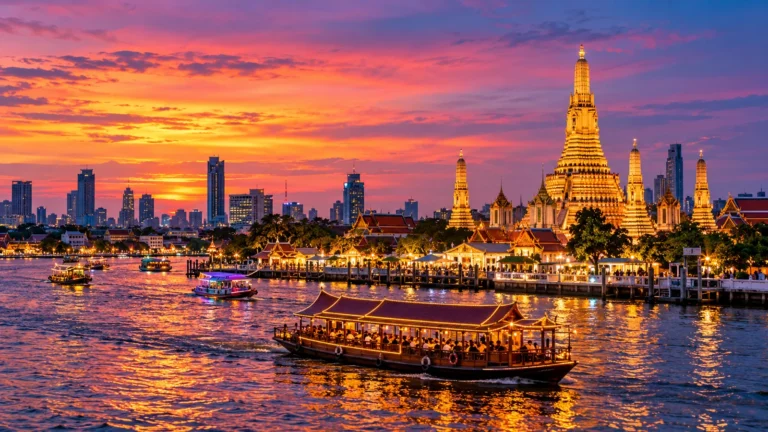
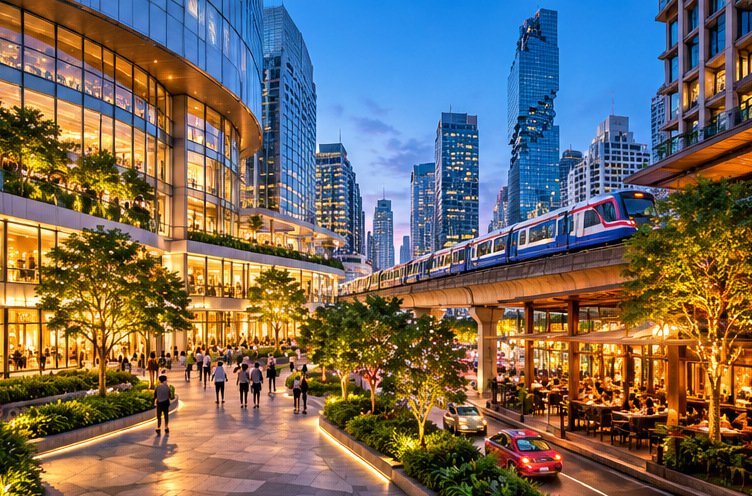
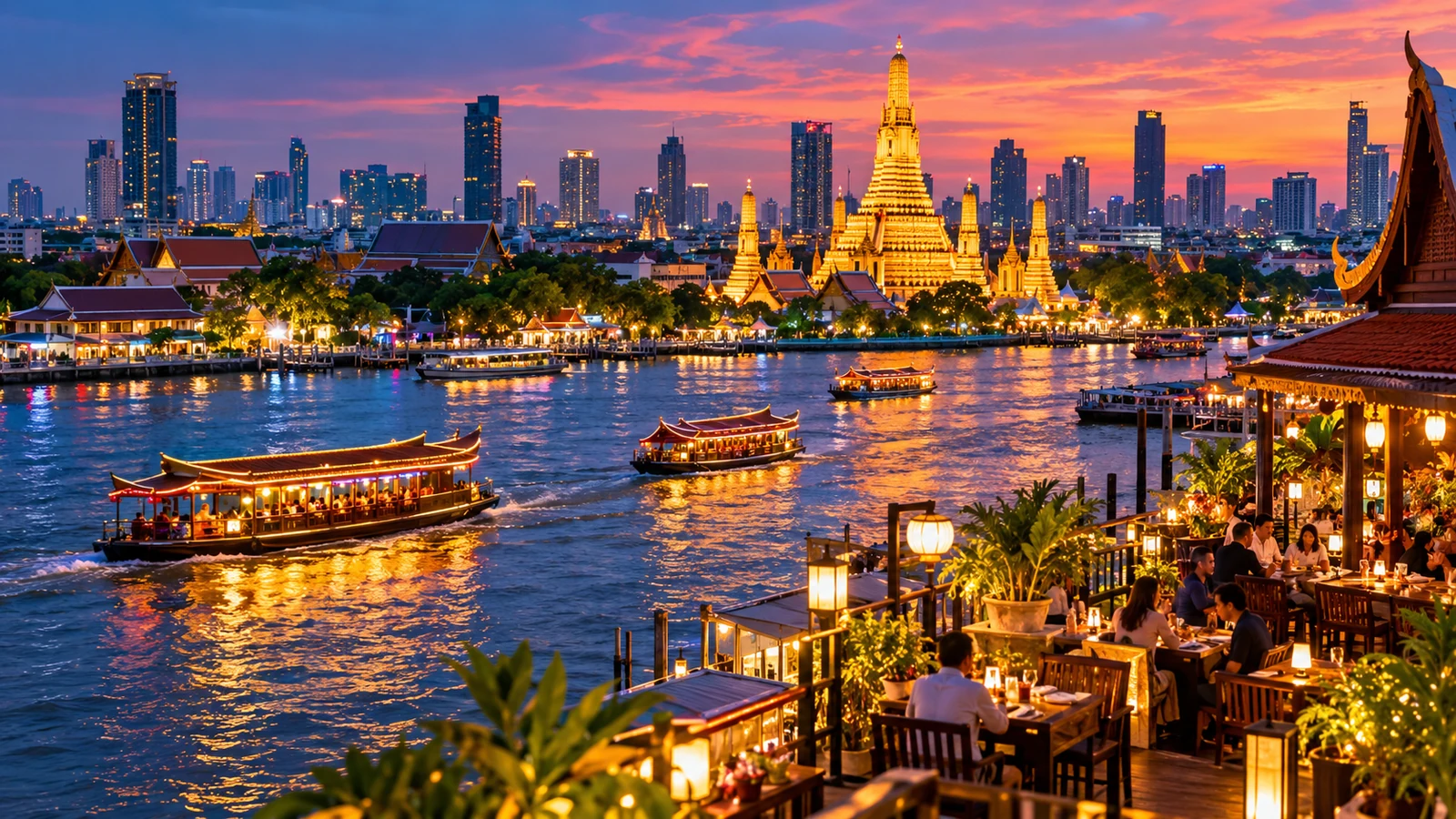
Illustrations are original, generated, Bangkok-inspired scenes. They are not documentary photographs, verified views from a named hotel or exact route maps.
- Tourism Authority of Thailand: China Town Yaowarat, food venues and MRT Wat Mangkon access.
- BEM: MRT system map Station locations and network connections; not a door-to-door journey guarantee.
- BTS: official route map BTS interchange and station planning.
- FCDO: Thailand travel warnings Flooding warning reviewed 3 October 2026. Check fresh advice before using normal-condition plans.
- Millennium Hilton Bangkok: official location overview West-bank setting, ICONSIAM proximity and Gold Line access.
- Chatrium Riverside: guest shuttle boat Advertised links to Sathon Pier and ICONSIAM; obtain the current timetable for your dates.
- Shanghai Mansion: official accommodation information Location and the property statement that rooms are windowless; no room rate was quoted.
- Shangri-La Bangkok: transport information Proximity to Saphan Taksin and difference between hotel wings; old fare examples are not used.
- The Grand Palace: visitor schedule Ordinary hours and THB 500 charge; current calendar overrides usual access.
- Wat Pho: official visit plan THB 300 admission, published visitor hours and under-120-cm child exemption. The contact page separately starts at 08:30; plan an 08:30 or later arrival.
- Tourism Authority of Thailand: Wat Arun main listing Main listing shows THB 200 and 08:00-18:00; confirm the gate charge.
- The Grand Palace: practical information Official dress requirements and admission information.
- Airports of Thailand: BKK transport guide Airport Rail Link and landside transport. Times in the itinerary are separate editorial allowances.
- Airports of Thailand: Don Mueang Airport identity, facilities and onward-transport information.
- SRT Electrified Train: Red Line network Don Mueang and Krung Thep Aphiwat on the Red Line.
Illustrations in this article were created for Taylor’s Trailblazing Travels. Third-party photographs, where used, are credited beside the image or in the source list.