Koh Phi Phi Itinerary 2026: A Realistic 3-Day Island Plan
Two nights, one full island day and a departure plan that does not gamble the next flight.
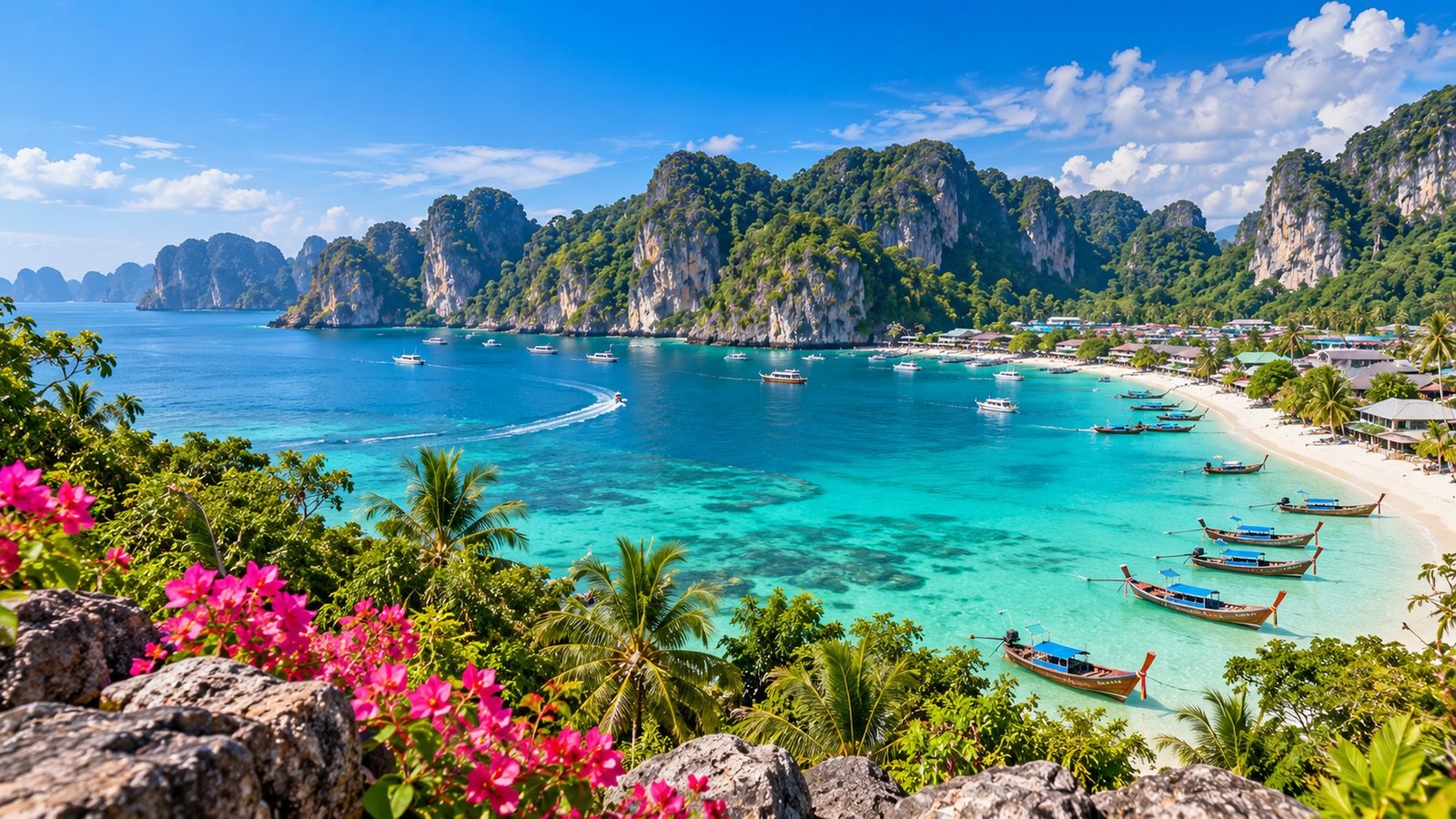
Original generated destination illustration inspired by Phi Phi; not an exact geographic view or a photograph of a specific tour.
A Koh Phi Phi itinerary needs to begin with the boats, not the beach photographs. Reaching the island, finding your hotel and returning to the mainland occupy real parts of the trip. Three calendar days can still make a rewarding introduction, provided you accept that only the middle day is completely free for an excursion.
This plan keeps the structure straightforward: arrive on Phi Phi Don, get your bearings and consider the viewpoint; spend the second day on one suitable boat outing; then leave on day three without an ambitious activity hanging over the departure. Maya Bay is treated as a managed beach visit, not a swimming promise, and accommodation is compared by how it affects those movements.
The route is a researched planning framework rather than a bookable package. Published ferry examples are dated, weather can alter access, and the most useful adaptation may be removing a stop or adding a night. Use the choices below to create a visit that fits the wider holiday instead of borrowing time from its next connection.
Near Tonsai
Simplifies luggage, restaurant choices and local tour meeting points.
One boat day
Compare the actual vessel, route, park fees and restrictions.
Maya Bay: no swimming
Reopening does not remove conservation or safety rules.
A mainland night
Avoid relying on a same-day ferry and critical flight connection.
Koh Phi Phi itinerary: what three days really means
Two nights, one full island day
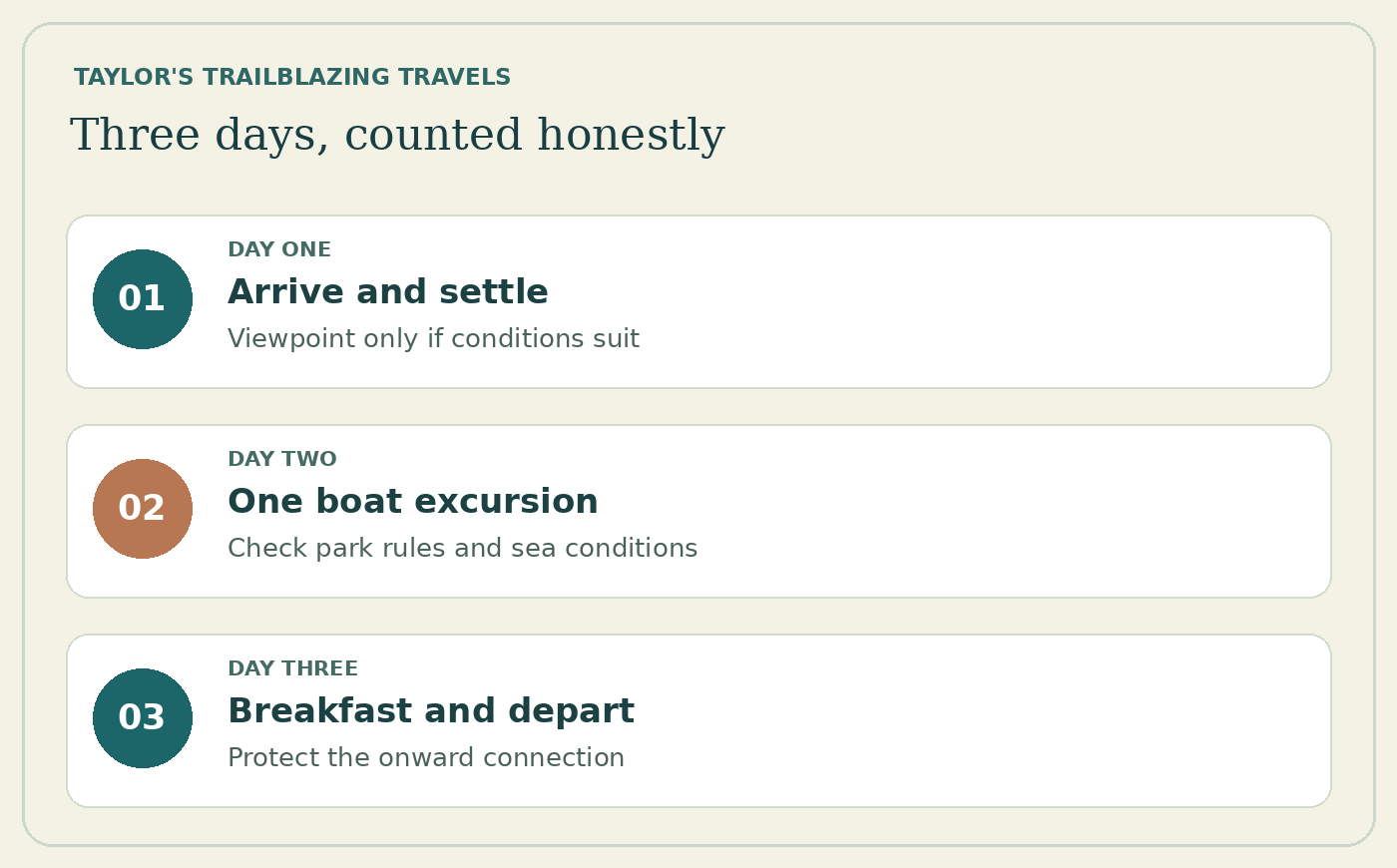
This Koh Phi Phi itinerary assumes that you reach the island during the first half of day one, sleep there on nights one and two, and leave on day three. That gives you one completely free day between two travel days. It does not provide three full sightseeing days, and pretending otherwise is the easiest way to create an exhausting island visit.
The default plan is deliberately simple: settle into Phi Phi Don and walk to a viewpoint on day one, take one carefully chosen boat excursion on day two, then have a relaxed breakfast before returning to the mainland on day three. If you arrive late, remove the viewpoint rather than racing uphill. If the sea is unsuitable, replace the excursion instead of treating your booking as a reason to ignore conditions.
What this route prioritises
The plan was constructed by comparing the island's geography, published ferry connections, current Maya Bay guidance and the practical difference between central and remote accommodation. It favours a walkable base for a short first visit and keeps the main excursion away from the departure morning. These are research-led planning decisions, not a claim of personal guiding or a guarantee that every listed activity will operate. [1][2][3][4]
| Day | Main plan | Night | What stays optional |
|---|---|---|---|
| 1 | Morning mainland crossing; settle in; suitable-weather viewpoint | Phi Phi Don | Viewpoint and extra beach walking |
| 2 | One Phi Phi-origin boat excursion | Phi Phi Don | Extra stops, sunset extension and strenuous swimming |
| 3 | Breakfast, checkout and mainland crossing | Mainland if protecting a flight | No timed island excursion |
Constructed itinerary, 7 October 2026. Arrival and departure are travel days, not full sightseeing days.
For three full days on the island, arrive before the first day begins and leave afterwards, normally requiring additional nights. Travellers who want diving, several remote beaches or a genuine weather buffer should add time rather than squeeze those activities into this two-night version. Phi Phi rewards choosing a few experiences well more than repeatedly crossing the same bays to complete a list.
Understand Phi Phi Don, Phi Phi Leh and your arrival pier
Your hotel island and your excursion island are different
Phi Phi Don contains the principal settlement, accommodation and ferry arrivals. By contrast, Phi Phi Leh is the smaller island associated with Maya Bay and other boat-excursion scenery; it is not where this itinerary places your hotel. The similar names make this distinction worth checking before booking a tour that appears to begin 'in Phi Phi'. [1]
The central village sits between Tonsai Bay and Loh Dalum, with walking routes connecting accommodation, restaurants and tour meeting points. For a two-night stay, this compact arrangement is useful even if you choose a quieter room towards the edge. Nevertheless, being on Phi Phi Don does not mean that every resort is a straightforward walk from the central pier.
Tonsai and Laem Tong are not interchangeable
Andaman Wave Master's published Phuket route distinguishes Tonsai arrivals from Laem Tong services. Its displayed examples take longer to reach Laem Tong, which illustrates why the destination pier matters as much as the island name. Confirm the full pier and the hotel's onward transfer before purchasing a ticket. [2]
A remote-beach hotel can be excellent for a longer stay, but it adds an extra question to almost every movement: how do you get between your room and the place the activity starts? Do not assume a tour meeting in Tonsai includes collection from another bay. On a short itinerary, those arrangements can consume both time and flexibility.
Getting there from Phuket or Krabi
Use a real sailing to anchor day one
For a concrete example checked on 7 October 2026, Andaman Wave Master displayed a Phuket Rassada departure at 08:30 reaching Tonsai at 10:30, alongside an afternoon sailing. The corresponding listed standard adult one-way fare was THB 700. These are dated operator examples, not a promise of availability on your date or a complete hotel-to-hotel journey. [2]
A morning arrival leaves room for lunch, check-in and a gentle afternoon. However, you must also reach the mainland pier and complete the operator's check-in process. I would normally sleep on the relevant mainland the previous night rather than pair an arriving flight with an optimistic ferry connection. The extra night belongs in the wider holiday plan, not invisibly inside the island's two nights.
Affiliate link. Check the exact option, total price, inclusions and cancellation terms before booking.
Choose the mainland gateway that fits the wider route
Krabi can be a sensible gateway when you are already based around Krabi Town or Ao Nang, whereas Phuket may fit an international arrival or a stay elsewhere on that island. Compare the departure pier, transfer coverage, vessel and luggage conditions rather than assuming that every result headed 'Krabi' begins beside your accommodation. A pier-to-pier ticket and a hotel pickup product are different purchases.
Affiliate link. Check the exact option, total price, inclusions and cancellation terms before booking.
Before paying, check whether the operator permits your luggage, how boarding works and what happens if weather disrupts the service. Larger ferries and speedboats involve different seating and ride characteristics, but neither vessel type guarantees a smooth crossing. Follow the operator's restrictions and government safety advice rather than relying on another traveller's description of a calm day. [5]
Keep the first afternoon replaceable
Do not book a timed island activity immediately after the scheduled arrival. Waiting for luggage, finding the hotel and checking in can take longer than expected. A loose afternoon allows you to recover from the journey and confirm the next day's excursion properly. If everything runs smoothly, the reward is extra beach or café time, not an obligation to insert another transfer.
Day one: arrive, get oriented and climb only if conditions suit
Late morning and lunch: make the island manageable
After arrival, go to your accommodation or its agreed luggage point. Confirm the route back to the pier, ask where your tour meeting point is and check whether the room can be used immediately. Then have lunch and a break before making a decision about the afternoon. Carrying your full luggage around the village while trying to sightsee is rarely a good start.
Use the first walk to locate practical essentials rather than hunt for every attraction. Save the hotel pin offline, identify where you can refill or buy drinking water and establish an easy dinner option. If anyone in your group is tired or overheated, shorten the walk. An itinerary should absorb an ordinary travel-day slump without the rest of the holiday falling apart.
Afternoon: the main viewpoint rather than every viewpoint
A local operator's route guidance describes a stepped climb from the village followed by paths towards the viewpoint platforms. It suggests roughly 30–45 minutes for the climb and about 1.5–2 hours for the wider outing; treat those as route-planning estimates, not your personal walking time. The same guidance warns about slippery surfaces and an unlit descent. [6]
For this itinerary, choose the main viewpoint outing rather than automatically continuing to the furthest platform. Wear footwear with grip, carry water and leave enough daylight for the return. If the steps are wet, your footing is uncertain or the heat feels excessive, skip it. A photograph is not worth turning a short holiday into an avoidable injury.
The viewpoint charges are separate from marine-park fees, and individual platforms may have separate admission arrangements. Carry small cash and confirm the current charge at the entrance; this guide does not treat inconsistent online fee descriptions as a guaranteed price. Also keep food packed away and do not encourage monkeys towards people for a photograph. [5][6]
Evening: choose your preferred noise level
For a quiet night, have dinner near your hotel and check how the room is positioned relative to music venues. For a more social evening, stay mindful that the next day may involve an early boat meeting. A two-night island visit does not need both evenings to become late nights; the boat day is much more enjoyable when you have slept and can eat breakfast comfortably.
Before bed, confirm the excursion's meeting location, time and contact method. Check what the operator includes, put cash and essential documents in a dry compartment, and leave valuables you do not need securely at the accommodation. These small preparations are more useful than adding another stop to the following day's schedule.
Day two: one well-chosen boat excursion
Select the route before the most attractive photograph
The core boat-day idea is Phi Phi Leh scenery with authorised stops around Maya Bay, a suitable swimming or snorkelling location and time to enjoy the journey. Do not assume that every advertised island name means a landing. Some sites are viewed from the boat, some depend on conditions, and others may be substituted or omitted. Read the detailed itinerary and the operator's limitations. [3][7]
A shorter morning excursion leaves the afternoon available for rest, while a longer trip may add more distant stops or a sunset element. Neither format is automatically better. For first-time visitors with only two nights, I would usually favour a clear, manageable route over the longest possible list of attractions. Ask how much time is actually spent travelling between stops.
Affiliate link. Check the exact option, total price, inclusions and cancellation terms before booking.
Private long-tail or shared speedboat?
A private long-tail can offer greater control over pace and time at approved stops, but it does not override park rules or weather restrictions. A shared speedboat may cover a broader route, although boarding, ride comfort, group size and the operator's health exclusions deserve attention. Private does not automatically mean safer, and a faster boat does not automatically mean a less tiring day.
Ask about shade, toilets, drinking water, properly sized life jackets and assistance when entering the water. In addition, identify the operating company rather than relying entirely on the marketplace name. Travellers with back problems, pregnancy or other relevant conditions should read the actual operator restrictions and seek appropriate professional advice where needed; do not treat this itinerary as medical clearance. [5][7]
A good boat day also works for a non-swimmer
Tell the operator before payment when someone will not be snorkelling. Ask whether they can remain comfortably aboard, whether shade and seating remain available during the stop and whether any advertised landing still requires entering the water. A person staying on the boat should not become an unexpected problem for the crew halfway through the itinerary. Equally, a life jacket does not turn an unsuitable water entry into the right activity for everyone.
Look at the day's balance from that traveller's perspective. A route dominated by repeated snorkelling stops may provide much less interest than a shorter scenic circuit with an authorised beach visit. This is not a reason to pressure a companion into swimming; it is a reason to choose a product that suits the whole group. Agree in advance that opting out of a stop is acceptable and does not need to be justified repeatedly.
Sunset options need a different evening expectation
A sunset or after-dark extension changes more than the photographs. It can mean additional time on the water, a later meal and a different return arrangement for guests staying outside the central area. Check the actual finishing location and the hotel's transfer options before selecting it. A listing's mention of bioluminescence is not a guarantee of what you will see, nor a reason to enter dark water beyond your confidence or the operator's safety limits. [7]
For a two-night visit, the shorter daytime option may leave a more enjoyable final evening. Choose the longer version because its whole format appeals to you, not because a sunset appears to be a free extra. Whichever you select, keep the return date separate from the mainland departure and avoid a tight reservation immediately afterwards.
Compare the second offer properly
An alternative marketplace can be useful when the first listing is unclear, but match departure island, duration, vessel, park fees and hotel collection. A Phuket-origin day trip is not a substitute for a Phi Phi-origin excursion simply because both visit Maya Bay. Equally, a cheaper offer may exclude the fee or transport that the other includes.
Affiliate link. Check the exact option, total price, inclusions and cancellation terms before booking.
Return with enough time to shower, eat and organise your bags without rushing. I would avoid making an expensive, non-refundable dinner reservation immediately after a boat's advertised return. Sea journeys and group excursions can finish later than expected, and a relaxed final evening is part of the value of staying overnight rather than visiting on a mainland day tour.
Maya Bay in 2026: access is not the same as swimming
The current reopening information
Current operator guidance reports that Maya Bay reopened on 1 October 2026 after the seasonal August–September closure. A Thai PBS report during the closure also described the 2026 conservation period. That supports planning a possible October visit, but it does not guarantee admission on any particular day: park decisions, sea conditions and operational restrictions remain decisive. [3][4][8]
The essential rule is straightforward: do not plan to swim at Maya Bay. Treat it as a managed beach visit and follow the ranger's directions about where visitors may stand or walk. Swimming and snorkelling, when conditions and the route allow them, take place elsewhere. Avoid using a tour photograph or an old travel story as permission to enter restricted water. [3][7]
Fees and inclusions need an explicit answer
TAT's Phi Phi information and current operator guidance list a foreign-adult marine-park fee of THB 400 and a child fee of THB 200. Those figures were checked on 7 October 2026. Before buying a tour, confirm whether the applicable fee is included, which admissions the ticket covers and what identification or payment is required. Do not automatically add the fee again when it is already included. [1][3]
Park admission is not the same charge as a viewpoint ticket, a local pier collection or an optional transfer. Ask for an itemised explanation when the listing simply says 'fees extra'. With children, establish the applicable age conditions directly instead of assuming a hotel or airline's child definition carries over to park admission.
Keep the conservation rules central
Stay on the permitted route, take rubbish back with you and do not touch or stand on coral at snorkelling stops. Wildlife sightings are not guaranteed, and guides should not need to feed animals to create them. If a stop feels crowded or the water entry is beyond your ability, remaining aboard or choosing an alternative is a perfectly reasonable decision. [5][7]
Day three: depart without gambling the next flight
A final morning that leaves margin
Have breakfast, check the room carefully and settle any outstanding bill before collecting your luggage. Reconfirm the departure pier and check-in deadline, then walk or transfer there with time to spare. Keep the final morning free of a boat excursion, a long beach walk or an activity that depends on a promised return time.
For an operator example checked on 7 October 2026, Andaman Wave Master displayed Tonsai-to-Phuket departures at 11:00 and 14:30, each with a published two-hour crossing. Its standard adult one-way fare was THB 700. These figures are useful for understanding the day, but your ticket and current operator notice take precedence. [9]
Affiliate link. Check the exact option, total price, inclusions and cancellation terms before booking.
Returning towards Krabi
The operator's booking display also showed Tonsai-to-Klong Jilad examples at 10:30 and 15:30, with two-hour scheduled crossings and a THB 450 standard adult fare when checked on 7 October 2026. Confirm the current vessel and any changes for your date. From Klong Jilad, the road journey to a hotel or airport remains an additional leg. [10]
Affiliate link. Check the exact option, total price, inclusions and cancellation terms before booking.
A morning sailing usually leaves more recovery space if an ordinary delay occurs, but it does not protect against a major disruption. Decide what your onward booking can tolerate before choosing the sailing. The last possible boat can be an acceptable choice for a flexible mainland evening, yet a poor choice when the next commitment is expensive and fixed.
Protect the wider holiday
For an international departure or another critical connection, my recommendation is to sleep on the mainland before the flight. This is a planning buffer, not an airline rule and not a guarantee against every disruption. Build the airport transfer and check-in deadline separately; arriving at Phuket's pier is not the same as arriving at the terminal.
Where the wider trip cannot absorb a missed sailing, reconsider whether an island stay belongs immediately before that flight. A beautiful two-night stop loses much of its appeal when its final morning becomes a stressful countdown. Move Phi Phi earlier in the holiday or protect the departure with enough mainland time to make the risk acceptable to you.
Where to stay for this specific three-day plan
Central Tonsai: convenience with a noise check
For the default itinerary, I would choose accommodation within a manageable walk of Tonsai's arrival and meeting points. That simplifies luggage, dinner and the boat excursion. However, being central does not require choosing the room closest to nightlife. Check recent location descriptions and ask the property about nearby music and the room's position before paying.
Affiliate link. Check the exact option, total price, inclusions and cancellation terms before booking.
A room at the edge of the central area can be a useful compromise if its route is clear and manageable. Ask whether luggage assistance is available and whether the entrance involves steps. For a short stay, those details often matter more than a small difference in room size or a swimming pool you may only use once.
Long Beach: attractive when you accept the transfer question
Long Beach offers a different setting from the village, but the walk should not be treated as a flat, all-weather promenade. A local operator's route description includes rocky sections and tide-sensitive stretches, with a typical walking allowance longer than a quick stroll. A boat alternative can be useful, although availability, weather and price should be agreed locally. [11]
Affiliate link. Check the exact option, total price, inclusions and cancellation terms before booking.
For two nights, choose Long Beach because you want to spend meaningful time there, not simply because it looks quieter on a map. Confirm how you will reach a Tonsai tour meeting early in the morning and return after dinner. If those movements feel cumbersome, a central base plus one beach visit is the more practical arrangement.
Laem Tong and other remote bays: better for a different rhythm
Remote-beach accommodation can be the right decision for a longer, resort-focused stay. For this itinerary, it introduces transfers that must be coordinated with both arrival and excursion plans. Some ferry services reach Laem Tong, but that does not establish that every service or tour will collect you there. [2]
Affiliate link. Check the exact option, total price, inclusions and cancellation terms before booking.
I would normally extend the visit before choosing this version. With additional nights, the quieter setting becomes part of the holiday rather than an obstacle between timed activities. Ask the hotel to explain the complete arrival and departure process, including what happens when sea conditions affect the usual landing arrangement.
A realistic two-night budget
Separate confirmed tickets from your own allowances
A useful budget has five parts: two nights' accommodation, mainland-island transport, local transfers, the boat excursion with any extra fees, and food or incidental spending. Do not quote a single 'Phi Phi cost' without saying whether it is per person, per room or per couple. Private charters and shared hotel rooms make those units especially important.
| Item | Simple scenario | More comfortable scenario | Basis |
|---|---|---|---|
| Two hotel nights | THB 3,000 | THB 6,000 | Assumed room totals; not hotel quotes |
| Return mainland boats for two | THB 2,000 | THB 2,800 | Budget allowances; replace with actual route fares |
| One excursion each | THB 3,000 | THB 5,000 | Assumed group-trip totals; not private charter quotes |
| Park allowance if excluded | THB 800 | THB 800 | Two foreign adults at listed THB 400; remove if included |
| Meals and incidental spending | THB 2,400 | THB 4,200 | Combined allowance for the island stay |
| Local transfer reserve | THB 600 | THB 1,200 | Not a guaranteed taxi-boat fare |
| Illustrative total | THB 11,800 | THB 20,000 | Excludes flights and mainland hotel nights |
Constructed 7 October 2026, not a bookable quotation. Two adults, two nights, one excursion each. Park allowance must not be counted twice.
The scenario amounts in the table were constructed on 7 October 2026, not obtained as a bookable package. They show the arithmetic of a trip for two adults sharing one room, with two nights, return transport and one excursion each. Replace every assumed amount with your own quotes. When a tour includes park admission, remove the separate allowance instead of counting it twice.
Where spending tends to expand
A remote hotel can introduce extra local boat transfers, while a low advertised excursion price can leave park fees or pickup outside the total. Meals and drinks also vary considerably according to where and how you eat. Decide how much flexibility you want for an unplanned dinner or replacement activity instead of allocating every available baht before arrival.
Carry a modest cash reserve separate from your main wallet, but avoid carrying more valuables on a boat than you need. Keep copies of paid confirmations and know which charges remain outstanding. A budget works best when it helps you make calm decisions, not when it encourages you to ignore an unsafe transfer or unsuitable activity because it has already been paid for.
Change the plan when rain or rough seas intervene
Wet on land and unsafe at sea are different situations
A shower during a village walk may only call for a café break. Thunderstorms, strong wind or rough water can change whether a boat outing should operate at all. On 7 October 2026, TMD's outlook warned that waves could exceed two metres in thundershowers in both the Andaman Sea and the Gulf. Treat that as an illustration of why daily forecasts matter, not a permanent forecast for your visit. [13]
Follow current local advice and the operator's restrictions. If a trip is cancelled, use the written cancellation process rather than trying to arrange an informal replacement solely to preserve the itinerary. Another boat agreeing to go does not, by itself, demonstrate that conditions are suitable.
A useful land-based fallback
On an unsettled day, keep to the central area, have an unhurried meal and use any appropriate hotel facilities. A viewpoint outing only belongs in the fallback if the path and weather are suitable; rain does not turn a steep, slippery climb into a safer substitute for a cancelled boat. A beach walk also needs conditions checked locally.
With two nights, you may not be able to recover a missed excursion. Accept that limitation before booking rather than assuming you can move everything to departure morning. Travellers who would be deeply disappointed to miss the boat day should add at least another night or select a longer stay with genuinely spare time, while recognising that even more nights cannot guarantee the weather.
Make the route work for your travel style
Couples and solo travellers
Couples can choose one special meal and leave the other evening flexible, keeping the excursion as the principal shared activity. A solo traveller may find a small-group boat trip sociable, but should still inspect meeting arrangements, safety equipment and cancellation terms. In both cases, paying for an elaborate remote room makes less sense when almost all daylight hours are spent elsewhere.
Families and travellers with access needs
For young children, choose a realistic boat duration and confirm life-jacket sizes before reserving. Check any minimum age or health restrictions in the actual product, as marketplace listings differ. Do not assume that a family can simply board a replacement vessel if its arrangements are unsuitable. A shorter outing and a convenient hotel may create a better holiday than a crowded full-day circuit. [5][7]
Anyone needing step-free access should obtain specific information about ferries, piers, accommodation and tour boarding. General statements such as 'easy island transport' do not establish accessibility. Ask about each transfer point and decide whether the full chain works, not merely whether the room has an accessible bathroom.
Divers and travellers wanting several beaches
Diving deserves its own schedule and a qualified operator's guidance, including advice about onward flying. Do not insert a dive between the default excursion and a flight simply because the calendar appears to have space. Similarly, several remote beaches need more nights or a different itinerary emphasis. Choose the experience that matters most and give it sufficient time. [5]
Pack for two nights and a boat day
Keep luggage manageable
A compact bag makes pier movements, hotel walks and local transfers easier. Pack light clothing, a dry change for the boat day, footwear with grip and a layer for air-conditioned transport. Protect documents and electronics from spray, but do not rely on an untested pouch as the only protection for something essential. Keep medication and important travel documents with you rather than buried in checked luggage.
For the excursion, ask what is supplied before carrying duplicate equipment. Water, a hat and sun protection are useful, but operator guidance and park restrictions should determine what is allowed. Keep loose belongings secured and avoid taking unnecessary jewellery or large sums of cash onto the boat. [5][7]
Save the essentials before the signal matters
Download your booking confirmations, the hotel location and the excursion meeting point before leaving the mainland. A compatible eSIM may help with messages and changes, but check activation, coverage and device requirements. Some plans are data-only, so keep another way to contact a business that needs a telephone call.
Affiliate link. Check the exact option, total price, inclusions and cancellation terms before booking.
Offline information is especially helpful when you arrive tired, the battery is low or mobile reception is inconsistent. Share the departure plan with your companion and keep the operator's contact details accessible. A few minutes of preparation can remove more friction than adding another travel app at the pier.
Pros and cons of this two-night version
Why it is a sensible first introduction
The plan provides island evenings, a principal boat day and a chance to see the central landscape without repeatedly changing accommodation. It also keeps the excursion separate from the mainland departure. For travellers who want a taste of Phi Phi rather than a long resort holiday, that balance can be more satisfying than either a rushed day tour or an overfilled stay.
What you give up
There is only one fully flexible day, so the weather buffer is limited. Remote hotels require more coordination, and there is little room for diving or several additional outings. The plan is therefore strongest when you accept those constraints from the start. It is not designed to prove that every famous bay can be visited in one short holiday.
Advantages
Includes island evenings without a long hotel stay.
The main excursion is separate from departure morning.
A central base limits repeated local transfers.
Trade-offs
Only one full day means limited weather recovery.
Remote resorts complicate short-stay movements.
Diving and several extra outings need more time.
Common mistakes that make a short stay harder
Booking the wrong departure island
Read the first line of the excursion's meeting instructions. A tour leaving Phuket cannot be joined from your Phi Phi hotel unless the operator explicitly offers that arrangement. Likewise, a ferry reaching Laem Tong is not the same as one arriving at Tonsai. Match each booking to the place you will physically be, not merely to the destination photographs.
Treating departure morning as spare excursion time
An advertised short tour can still finish late, and collecting luggage afterwards introduces another dependency. Keep the final morning simple. If an activity is important enough to shape the trip, give it a proper day or add a night rather than balancing it against the last comfortable boat to the mainland.
Confusing a scenic stop with a safe swimming opportunity
Maya Bay is not a swimming stop, wildlife is not a guaranteed attraction and not every accessible beach has conditions suitable for your group. Let current restrictions and your ability determine participation. A good itinerary leaves room to say no without making the rest of the trip feel wasted. [3][5]
Frequently asked questions
Are three days enough for Koh Phi Phi?
Three calendar days and two nights are enough for a focused introduction with one boat excursion and time around Phi Phi Don. They are not three full activity days. Add nights for a quieter resort stay, diving or a stronger chance to reschedule around weather. The default route deliberately avoids claiming more usable time than it provides.
Should I stay overnight or visit from Phuket?
Stay overnight when island evenings, a slower start and a Phi Phi-origin excursion matter. A mainland day tour can be simpler when you do not want another hotel move. Compare the total travel time, departure point and tolerance for a long boat day. Neither approach is inherently superior; they solve different travel priorities.
Can I swim at Maya Bay after the 2026 reopening?
No: this guide treats Maya Bay as a managed beach visit, not a swimming location. Current operator guidance continues to describe a swimming prohibition. Follow the park's instructions on the day and choose authorised swimming or snorkelling stops elsewhere when conditions permit. A reopening announcement does not remove conservation rules. [3][7]
Can I fly internationally on the afternoon I leave Phi Phi?
I would not build this itinerary around that connection. Boat disruption, the pier-to-airport transfer and airline check-in deadlines create a chain with limited recovery options. Sleeping on the mainland beforehand is the more resilient planning choice. It is a recommendation rather than an airline requirement, and you should still allow an appropriate airport margin.
Is Long Beach walkable from Tonsai?
A walking route exists, but local route guidance describes rocky and tide-sensitive sections. It is not a universally easy luggage route or an all-weather promenade. Ask the hotel about conditions and boat arrangements, particularly after rain or at higher tides. For this short itinerary, central accommodation removes that repeated transfer question. [11]
What should I book first?
Establish your mainland arrival and departure nights, then choose the island hotel and matching ferries. Next, reserve a suitable excursion with clear cancellation terms and check its meeting point against your hotel. Leave the first afternoon and final morning flexible. This order protects the transport structure before you commit to optional activities.
Final recommendation: keep the middle day for the sea
For a first two-night visit, stay within practical reach of Tonsai, use day one to settle in and attempt the viewpoint only in suitable conditions, then give day two to one clearly described boat excursion. On day three, leave without a timed activity hanging over the departure. That creates a genuine island visit without disguising travel days as unlimited sightseeing time.
The best upgrade is usually another night, not another stop on the boat itinerary. Extra time gives you more freedom over weather, rest and hotel choice. When two nights are all you have, keep the plan modest and protect the mainland connection; the scenery does not need an overloaded schedule to feel worthwhile.
Sources and fact-checking
The route was checked against official tourism and safety information, ferry operator pages and current local operator guidance. Maya Bay reopening information is attributed to current reports, not a guarantee of access. Ferry prices and times are dated examples; all constructed budgets are labelled separately.
- 01Tourism Authority of Thailand – Phi Phi DonIsland geography and listed foreign visitor park fees.Checked 7 October 2026.
- 02Andaman Wave Master – Phuket to Phi PhiDated Tonsai and Laem Tong sailing and fare examples.Checked 7 October 2026.
- 03Simba Sea Trips – Maya Bay reopening guidanceOperator reporting of 1 October 2026 reopening and continuing visitor restrictions.Checked 7 October 2026.
- 04Tisland Travel – October 2026 reopening reportSecond operator report on the 2026 conservation closure and reopening.Checked 7 October 2026.
- 05FCDO – Thailand safety and securityBoat, swimming, wildlife and diving safety guidance.Checked 7 October 2026.
- 06Phi Phi Paradise – viewpoint routeLocal operator route description, walking allowances and surface warnings.Checked 7 October 2026.
- 07GetYourGuide – Phi Phi-origin snorkel excursionExample of departure-point, itinerary and participant restrictions to compare; not an availability guarantee.Checked 7 October 2026.
- 08Thai PBS – 2026 Maya Bay conservation periodPublic broadcaster report on the August-September closure.Checked 7 October 2026.
- 09Andaman Wave Master – Phi Phi to PhuketPublished return sailing and fare examples.Checked 7 October 2026.
- 10Andaman Wave Master – Phi Phi to Krabi booking displayDated Klong Jilad arrival examples and standard fare.Checked 7 October 2026.
- 11Phi Phi Paradise – Long Beach walking routeLocal operator description of rocky and tide-sensitive route sections.Checked 7 October 2026.
- 12TAT – beaches and island seasonsSeasonal context: different coasts have different weather patterns.Checked 7 October 2026.
- 13Thai Meteorological Department – current forecastDated 7 October 2026 sea and rainfall warnings; recheck before travel.Checked 7 October 2026.
Illustrations in this article were created for Taylor’s Trailblazing Travels. Third-party photographs, where used, are credited beside the image or in the source list.