Krabi to Koh Lanta 2026: Shared Van, Ferry or Private Taxi?
A practical door-to-door comparison of shared vans, private transfers, seasonal boats and self-drive routes, with realistic timings, costs and flight buffers.
Shared vans from about 300 THB
Wet-season route covered
Getting from Krabi to Koh Lanta is straightforward once the route matches your real starting point. The confusion begins when a ticket simply says “Krabi” even though the pickup could be Krabi Airport, Krabi Town, Ao Nang, Railay, Klong Muang or Tubkaek. Each creates a different pickup chain, luggage handover and final cost.
This guide compares shared minivans, private cars or vans, seasonal passenger boats and self-drive journeys door to door. It also explains the mainland vehicle ferry, Koh Lanta hotel zones, realistic flight buffers and the booking questions that prevent an apparently cheap transfer becoming awkward.
The planning examples were refreshed against operator pages, current route results, official weather material and travel guidance on 7 September 2026. Prices and schedules are therefore dated examples rather than promises, and personal-style recommendations are research-led planning judgement rather than claims of first-hand travel with every provider.
Shared road minivan with the hotel drop confirmed
Private car or van with luggage and child-seat details agreed
Direct seasonal boat when weather and luggage suit it
The road route uses one vehicle ferry, then Siri Lanta Bridge
Krabi to Koh Lanta transport at a glance
The overland route is not “road only”. Vehicles drive south through Krabi Province, board one short vehicle ferry from the mainland to Koh Lanta Noi, then use Siri Lanta Bridge to reach Koh Lanta Yai. Older guides sometimes describe two ferry crossings, but the second crossing was replaced by the bridge. The vehicle normally remains the same throughout a private transfer; with shared products, the operator may or may not change vans.
What a current route search shows
A live 12Go route search checked in September 2026 displayed a broad mixture of vans, taxis and seasonal boats, with the cheapest headline options around 399 THB. That is useful evidence that the route is busy and competitive, but the cheapest price does not automatically include your airport terminal, hotel pickup, southern Koh Lanta drop, large luggage or flexible cancellation.
| Option | Useful planning time | Typical 2026 planning cost | Works year-round? | Usually best for |
|---|---|---|---|---|
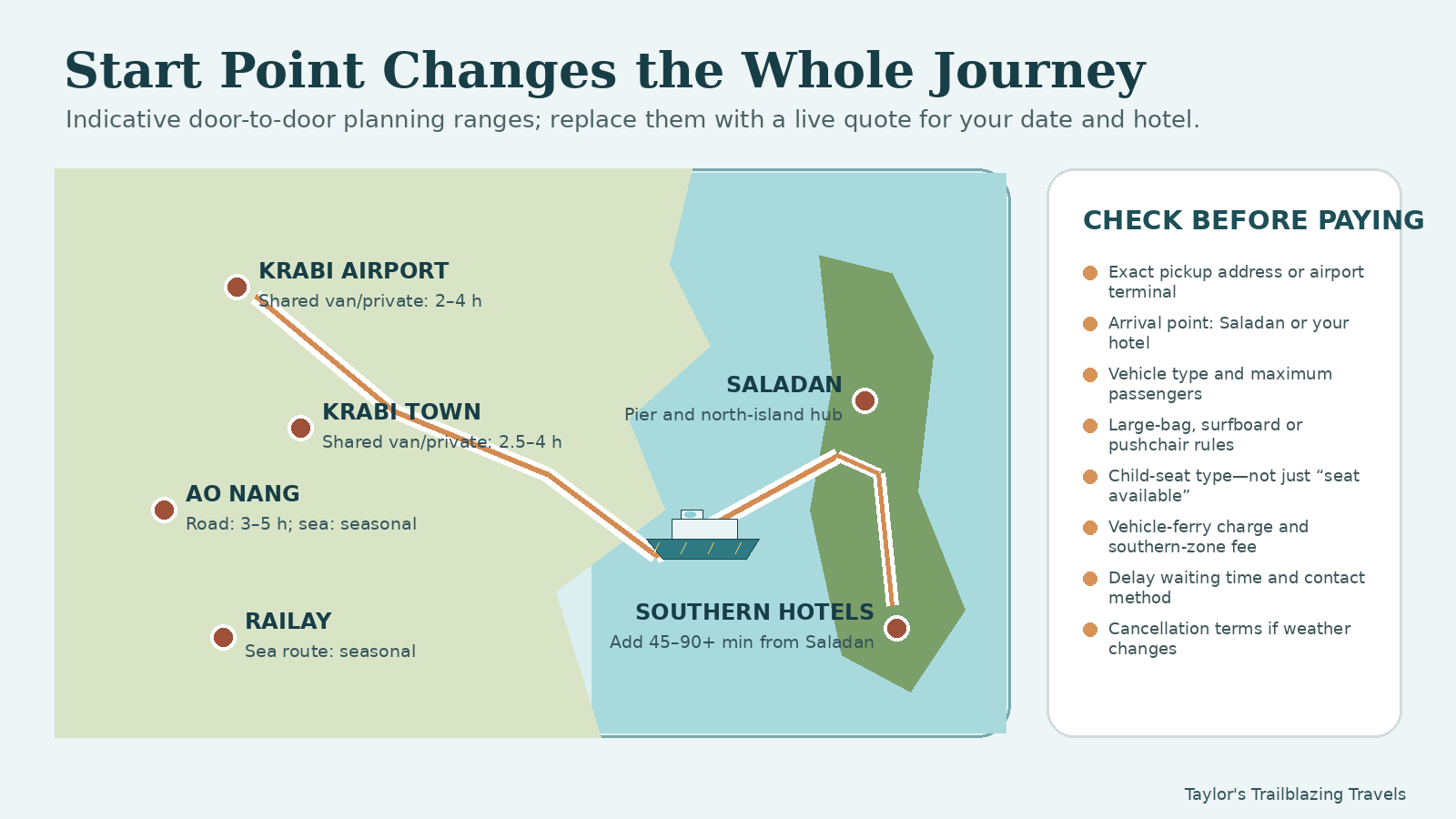
| Shared minivan | 2.5–4 hours; sometimes longer | About 300–700 THB per person | Yes, subject to the vehicle ferry and road conditions | Solo travellers, couples and modest budgets |
| Private car or van | About 2–3 hours to many hotels | Roughly 2,000–3,500 THB per vehicle | Yes, with late-night restrictions or supplements possible | Families, groups, late arrivals and early flights |
| Seasonal passenger boat | 2–4 hours door to door | About 550–1,300 THB per person | No; schedules vary by operator and sea conditions | Ao Nang or Railay departures with light luggage |
| Self-drive | 2.5–4 hours plus stops and queues | Rental, fuel, ferry and insurance costs | Yes, within the normal vehicle-ferry operating window | Properly licensed, confident drivers using a car on Koh Lanta |
These are planning ranges, not quotations. Your starting point, hotel zone, vehicle class, season and booking conditions can change the total.
Start with the correct Krabi departure point
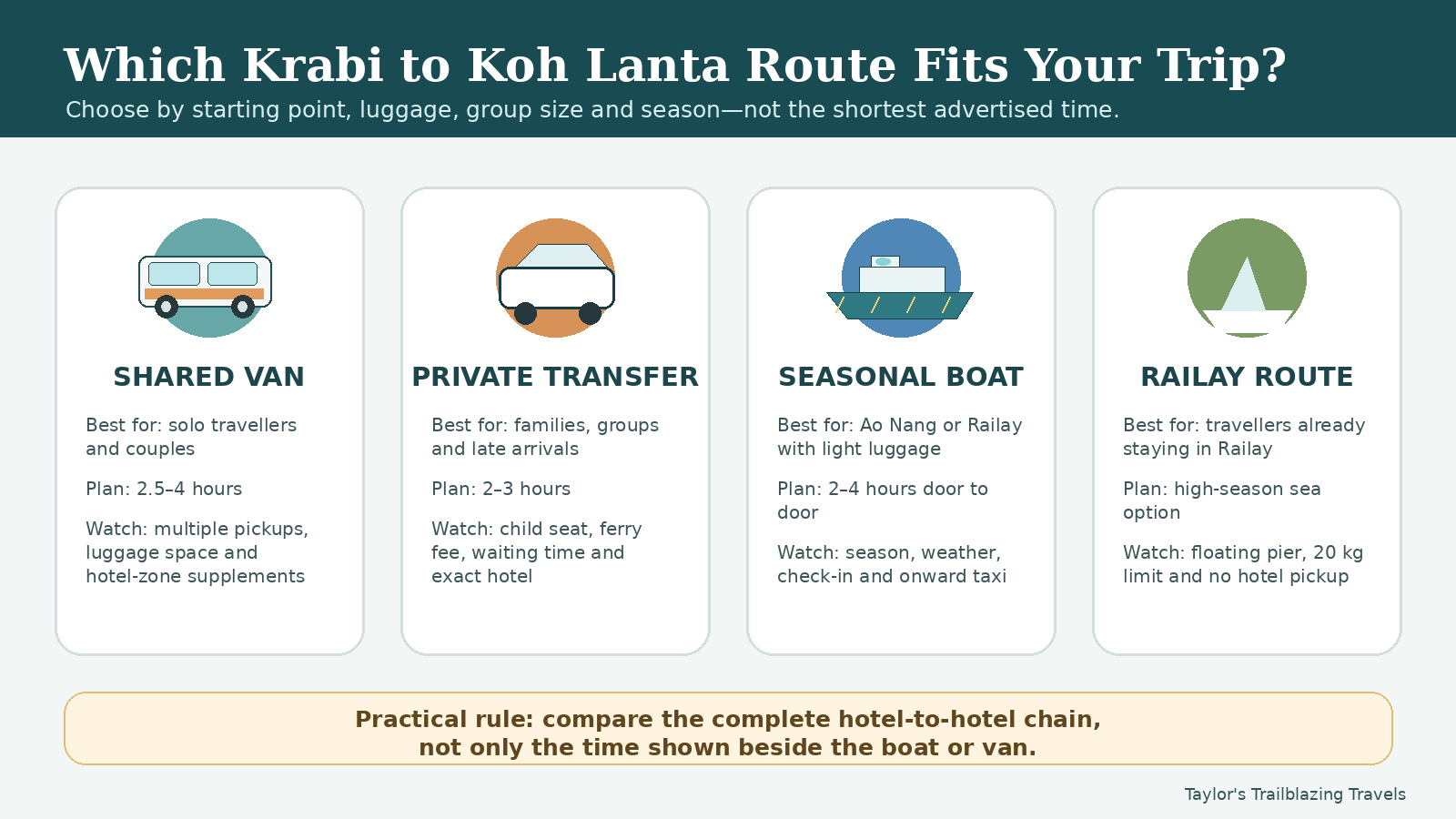
“Krabi” is a province, a town, an airport and a destination label used by booking websites. Before comparing prices, write down the first physical place where you need to be collected. A 450 THB product from Krabi Bus Terminal is not a bargain if you must first pay for a taxi from Ao Nang and travel in the wrong direction.
Krabi Airport to Koh Lanta
Krabi International Airport is the simplest gateway for many overseas visitors. Shared vans and private transfers can collect at the terminal and continue through to a Koh Lanta hotel. Current listings commonly show 2–3 hours for a private vehicle and around 2.5–4 hours for shared transport. The private option saves time by avoiding unrelated hotel pickups and waiting for additional passengers.
After an international arrival, immigration, bags and a delayed flight can consume the margin between landing and the final shared departure. Ask for the latest accepted flight-arrival time, where the driver will wait, how long they remain after a delay and which telephone or messaging number will work in Thailand.
Krabi Town and Krabi Bus Terminal
Krabi Town suits travellers who stayed overnight, arrived by long-distance bus or want a less expensive departure point than a beach resort. Some shared vans collect from town hotels; others use the bus terminal or a specific office. Check the map pin, not just the written name. A ticket that begins at the bus terminal may be cheaper because it removes the operator’s hotel-pickup circuit.
Allow extra time if your accommodation is on the riverfront or outside the central pickup zone. The driver may collect local passengers or parcels, and some shared vans make several stops before the vehicle ferry. That does not necessarily mean the service is poor, but it does mean a three-hour estimate should not be treated as a fixed appointment.
Ao Nang to Koh Lanta
Ao Nang offers the widest choice: year-round road transfers plus seasonal boat services. In the wet season, the road option is normally the sensible default. During the drier sailing season, a passenger boat may be attractive when it includes hotel pickup and you are staying near the main Ao Nang zone.
The direct Aonang Travel route page checked in September 2026 displayed an 08:30–12:00 van product at 550 THB but marked it closed for the selected low-season date. That contradiction is exactly why travellers should use the date-specific booking result, not a page headline saved months earlier.
Railay to Koh Lanta
Railay has no road connection. A road-based journey therefore begins with a local boat to Ao Nang or Ao Nam Mao, followed by a vehicle to Koh Lanta. When the direct seasonal boat is running, it can remove that backtracking and usually provides the cleanest route from Railay.
The Aonang Travel Railay–Koh Lanta page checked in September 2026 listed Railay East Floating Pier check-in, a 10:45 departure, a 12:45 arrival, 700 THB for adults, 500 THB for children, a 20 kg luggage limit and no operation from 1 May to 10 November. Those details are a current operator example rather than a guarantee across every company or future date.
Klong Muang and Tubkaek
These quieter beach areas lie north-west of Ao Nang, so a pickup can begin with a long sweep through resort zones before the vehicle turns south. A shared transfer may still be good value, but the real door-to-door time can exceed an airport or town departure. Ask whether the price includes your exact resort and whether you will change vehicles in Ao Nang or Krabi Town.
For a wider look at the region, pair this transfer guide with the Ao Nang versus Railay comparison and the Ao Nang versus Railay comparison.
Private car or van: when the extra cost earns its place
A private transfer is not only a luxury product. It can be the better-value solution for a family or group because the price is per vehicle rather than per passenger. It also reduces the chance that a delayed pickup, crowded van or long hotel-drop sequence damages the first or last day of the holiday.
Who benefits most
- Families who need a child seat, luggage space and a comfort stop.
- Groups of three to eight who can divide one vehicle price.
- Travellers arriving late in the afternoon or leaving for a morning flight.
- Anyone staying at Kantiang Bay, Klong Jark, Bamboo Bay or another far-south property.
- People carrying diving equipment, a folding wheelchair, golf clubs or bulky cases.
- Travellers who value one named meeting point and direct communication.
Child seats and vehicle size
“Child seat available” is not enough information. State the child’s age, approximate height and weight, then ask for a photo or written confirmation of the seat type. A booster is not a substitute for a rear-facing infant seat. Also confirm that the selected car still has enough boot space once the seat and every suitcase are loaded.
Flight-delay terms
Some private products track the flight and include a stated waiting period; others begin charging after the booked time. The live route marketplace and current transfer listings show several private operators, but inclusions differ. Record the flight number, terminal, passenger name and working WhatsApp number in the booking.
Private-transfer examples
Current GetYourGuide listings advertise direct private transport between Krabi Airport and Koh Lanta hotels with a published duration near two to two-and-a-half hours, while a Viator listing describes two to three hours and includes the short car-ferry stage during normal operating hours. These are commercial product descriptions, not official transport guarantees, so check the exact hotel, ferry charge, waiting time and luggage limit at checkout.
Private-transfer advantages
- Direct timing and one hotel drop.
- More practical with children or mobility needs.
- Group pricing can be competitive.
- Better control over luggage and stops.
Private-transfer limitations
- Expensive for one traveller.
- Late-night ferry access may involve restrictions or extra cost.
- A “private van” still needs the exact vehicle confirmed.
- Cancellation terms can be strict.
Seasonal ferry and speedboat: scenic, but not automatically easier
Passenger boats appeal because Koh Lanta is an island, yet the sea route is not always the most logical transfer. A boat ticket can require a hotel pickup, pier check-in, luggage handling, a weather-dependent crossing and a separate taxi from Saladan. By contrast, the road transfer may keep you in one vehicle until the hotel.
Ao Nang boat options
High-season schedules can include direct speedboats or combined hotel-pickup products. Published durations vary from just over two hours between piers to roughly three-and-a-half hours when hotel collection is included. The boat may call at another island or use a transfer vessel, so the fastest-looking product deserves a close look at the itinerary.
If the booking begins at Nopparat Thara Pier, add travel from your hotel and the check-in requirement. If it begins at an Ao Nang hotel-transfer zone, confirm whether your property is actually inside that zone. A Klong Muang or Tubkaek pickup may require a supplement or earlier collection.
Railay boat options
Railay is the clearest case for choosing the seasonal boat. The direct sailing avoids loading bags into a local longtail, transferring to a road vehicle and then crossing the car ferry. However, Railay East Floating Pier can still involve a moving pontoon, steps and exposed sections. Pack so that one person can control each bag.
Krabi Airport or Town by sea
A “ferry” product sold from the airport is normally a combined shuttle and boat, not a vessel leaving the runway area. It may drive to a coastal pier before joining a speedboat. That can be enjoyable in calm high-season weather, but it adds a handover and costs more than many road vans. Check whether the operator is offering a genuine passenger boat for your date or simply describing the vehicle-ferry crossing.
What the 2026 timetables show
Tigerline’s official timetable page publishes separate May–September monsoon and October–April schedules. Aonang Travel’s direct Railay page states seasonal operation and a 20 kg luggage limit. Together, they confirm the central planning rule: use a live date search and operator confirmation rather than a static “daily ferry” statement.
Passenger-boat advantages
- Potentially scenic and efficient from Railay.
- Saladan is convenient for north-island stays.
- Avoids the main road and vehicle-ferry queue.
- Can feel like the first island experience.
Passenger-boat limitations
- Seasonal and weather dependent.
- Pier transfers may erase the time saving.
- Hard luggage is awkward on small boats.
- South-island hotels still require a long road transfer.
Self-drive to Koh Lanta
Driving can work well when you want a car for the island and are properly licensed, insured and comfortable with local roads. Thailand drives on the left. The route uses the mainland vehicle ferry to Koh Lanta Noi, then Siri Lanta Bridge to Koh Lanta Yai. You do not drive onto a passenger ferry bound for Saladan.
Documents and insurance
Confirm the licence and International Driving Permit requirements for the vehicle class, and make sure the rental company explicitly allows the car onto Koh Lanta. Read the exclusions for tyres, underbody damage, flood water and unsealed roads. The UK FCDO Thailand travel advice highlights significant road risk and the importance of suitable insurance.
Vehicle-ferry timing
Current local and transfer listings commonly place the normal vehicle-ferry window at roughly early morning until around 22:00. Treat that as indicative only. Public holidays, maintenance, weather and queues can change access, and some commercial products mention expensive after-hours arrangements. Confirm directly before planning a late-night drive.
Is a rental car worth it?
A car is useful for families, rainy days and hotels away from restaurant clusters. It is less compelling when you will spend most days on boat tours or beside one beach. Compare the full rental cost, insurance and parking with a private transfer plus selected local drivers. The Koh Lanta island guide helps show how often you would genuinely use the vehicle.
High season versus monsoon season
Koh Lanta remains accessible throughout the year, but the balance of transport changes. Road vans and private cars are the dependable backbone. Passenger ferries and speedboats expand during the drier Andaman season and reduce or stop during the southwest monsoon.
| Period | Road transfer | Passenger boat | Planning adjustment |
|---|---|---|---|
| November–February | Frequent, but peak queues are possible | Widest choice on many routes | Book popular dates and compare cancellation terms |
| March–April | Reliable; hot conditions | Generally active, exact end dates vary | Carry water and avoid assuming every seasonal route runs to 30 April |
| May–October | Main practical option | Reduced, rerouted or closed on many services | Choose road transport and keep a flexible arrival plan |
| Transition weeks | Normally available | Operator-by-operator changes | Recheck within 48 hours and again on the morning |
Rain is not the only issue
A rainy icon does not by itself close a route. Wind, wave height, thunderstorms and visibility matter more to a passenger boat. The Thai Meteorological Department publishes a Krabi province forecast and a seven-day outlook that includes Andaman wave information. In the Thai Meteorological Department outlook issued at 05:00 on 7 September 2026, lower-Andaman waves were forecast at about 1–2 metres and above 2 metres in thundershowers. That dated example shows why a generic rain icon is not enough for a sea-transfer decision.
Road disruption still happens
Wet-season road travel avoids the open-sea crossing, but heavy rain can still slow traffic, flood low sections and lengthen the ferry queue. Leave daylight and contingency time. Flexible hotel cancellation is more useful than squeezing every connection to its minimum.
For a region-by-region weather explanation, see the best time to visit Thailand and best time to visit Thailand guide guides.
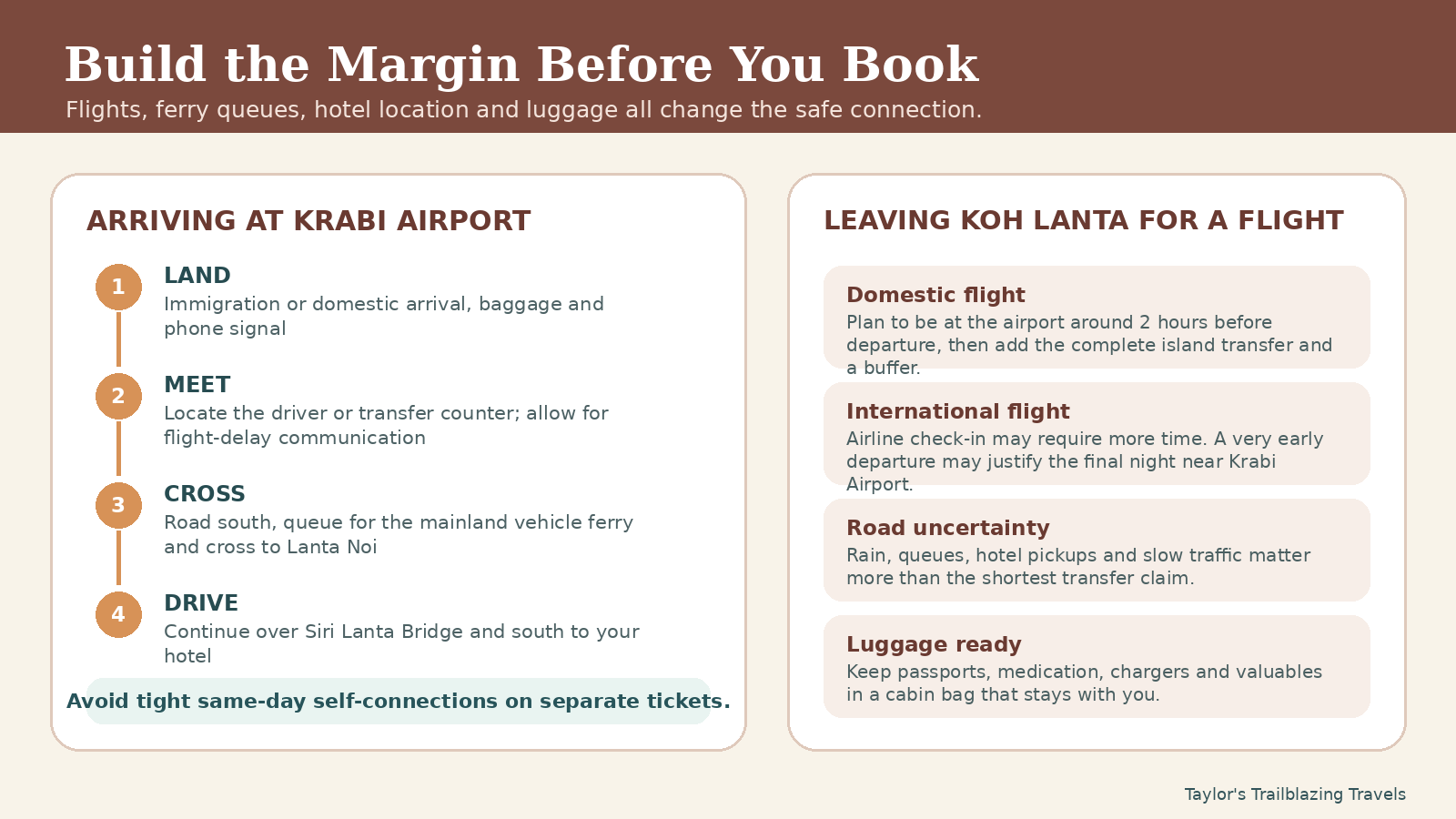
Landing at Krabi Airport and travelling the same day
Same-day travel is normal, but the safe connection depends on the arrival time and booking type. A private driver can wait and leave when you are ready. A shared service has a collection window and may stop accepting passengers well before the vehicle ferry’s final crossing.
Domestic arrival
With cabin baggage, a domestic arrival can move quickly. Checked luggage, a remote stand or a delayed flight changes that. Do not book a van whose pickup time matches the scheduled landing time. Give yourself enough margin to leave the aircraft, collect bags, use the cash machine if needed and find the correct representative.
International arrival
Immigration and baggage make the result less predictable. Provide the flight number and passport name to the transfer company. A private transfer with flight tracking is more robust than the final shared departure, particularly when your hotel lies south of Klong Nin.
Late-afternoon and evening flights
An arrival after roughly 16:00 deserves direct confirmation before you commit. Some current route marketplaces display evening private vehicles, but shared options narrow. If the driver cannot guarantee the crossing and hotel arrival, a night in Krabi or Ao Nang may be the calmer and cheaper solution.
| Scheduled landing | Planning approach | Why |
|---|---|---|
| Before 11:00 | Shared van or private transfer | Good daylight margin and several backup choices |
| 11:00–14:30 | Shared option possible; confirm final pickup | Still workable, though a delay reduces choice |
| 14:30–17:00 | Private transfer becomes more attractive | Fewer shared departures and less recovery time |
| After 17:00 | Written private confirmation or mainland overnight | Do not build the trip around an assumed late vehicle ferry |
This is a conservative planning framework, not an operator timetable.
Koh Lanta to Krabi Airport: how much time should you leave?
The return journey deserves more margin than the arrival because a missed flight is expensive. Work backwards from the airline’s own bag-drop or check-in deadline, then add the full hotel-to-airport transfer and a buffer. Do not use a best-case “two hours” for a shared van from a far-south hotel.
Domestic flights
As a practical baseline, many travellers aim to reach Krabi Airport about two hours before a domestic flight. Add at least three to four hours from a northern or central Koh Lanta hotel for a shared service, and more from Kantiang or the far south. A private vehicle may be faster, but still needs a ferry and road margin.
International flights
Follow the airline’s stated check-in time, which may be longer. Separate onward tickets require still more protection because the airline is unlikely to rebook you when an unrelated island transfer is late. Travel insurance should match that connection structure.
Very early flights
For a departure before roughly 10:00, seriously compare the cost of a final night near Krabi Airport. A pre-dawn private transfer may be possible, but it relies on the ferry, driver and hotel reception all working exactly as arranged. The airport night also removes the temptation for unsafe speed on dark roads.
Where will you arrive on Koh Lanta?
Passenger boats usually finish at Saladan Pier. Road transfers may finish at Saladan, a local office or the accommodation. Because Koh Lanta Yai stretches a long way south, the difference matters. A ticket to “Koh Lanta” is not necessarily a ticket to every resort.
Saladan and Klong Dao
Saladan is the north-island commercial and pier area. Klong Dao is the nearest major beach, making it convenient for families and short stays. A Saladan-only boat ticket is least troublesome here because the final taxi is short.
Long Beach, Klong Khong and Klong Nin
Long Beach is a common first-time base and often lies inside standard shared-drop zones. Klong Khong and Klong Nin add time but remain practical. Confirm whether the fare reaches the exact hotel entrance; small lanes can be excluded from a generic beach-zone promise.
Kantiang Bay, Klong Jark and Bamboo Bay
Southern hotels are scenic but can add an hour or more from Saladan, depending on traffic and the property entrance. Supplements are common. A private transfer becomes more appealing because it avoids waiting through every northern drop before the long final drive.
Lanta Old Town and the east coast
Old Town is on the east coast, away from the main west-coast hotel corridor. Some operators treat it as a separate zone or require a change. Ask for the full address and map pin in writing. Do not assume a Saladan-to-hotel statement automatically covers an east-coast villa.
| Area | Approximate road time from Saladan | Transfer implication |
|---|---|---|
| Saladan / Kaw Kwang | 5–15 minutes | Best fit for pier-only tickets |
| Klong Dao | 10–20 minutes | Often included in standard drop zones |
| Long Beach / Phra Ae | 15–30 minutes | Common shared-transfer destination |
| Klong Khong | 25–40 minutes | Check side-road access |
| Klong Nin | 35–55 minutes | Shared drop sequence becomes noticeable |
| Kantiang Bay | 60–90 minutes | Private transfer can save substantial time |
| Far south | 75–110 minutes | Confirm supplement and reception hours |
| Old Town / east coast | 35–60 minutes | May be outside standard west-coast zones |
Times are broad planning ranges. Weather, road works, traffic, stops and the exact property entrance can change them.
Luggage, children and accessibility
The ideal bag depends on whether the trip stays inside one road vehicle or passes through Railay and a passenger boat. A hard case is excellent in airports and private cars. A soft duffel or backpack is easier on sand, floating pontoons and narrow speedboat steps.
Normal suitcases on a shared van
One medium case and a small personal bag are usually manageable, but “one bag” can mean a strict size limit. Current traveller reviews on route marketplaces repeatedly mention crowded luggage areas. Ask before paying for a second large case rather than assuming the driver will fit it on the day.
Railay and speedboat luggage
The direct Railay operator example publishes a 20 kg limit and an excess charge. More importantly, passengers must handle the bag through the floating-pier environment. Keep electronics in a sealed inner bag and avoid a case that one person cannot lift over a gap.
Surfboards, dive equipment, bicycles and pushchairs
Oversized items need written acceptance and often a supplement. Provide dimensions, not only a description. A folding pushchair may fit a private SUV but consume the luggage area once a child seat is installed. Diving cylinders should be rented locally rather than transported casually.
Travelling with children
Bring water, a snack, wipes and one change of clothes into the cabin. A private transfer makes toilet and meal stops easier. For shared transport, choose a morning or early-afternoon departure so an unexpectedly slow hotel-drop circuit does not finish after bedtime.
Mobility and reduced movement
A road transfer is generally easier than beach or floating-pier boarding, but the vehicle height, ferry ramp and hotel entrance still matter. Ask whether a wheelchair can remain assembled, whether the passenger can transfer into the seat and whether the destination has steps. A generic accessibility icon does not answer those questions.
Realistic 2026 cost comparisons
Live prices change with demand, exchange rates, pickup zones and vehicle class. The most useful comparison is the total for the travelling party. A 500 THB shared seat looks cheap until four people pay it, add luggage and then buy a long taxi from Saladan.
| Traveller setup | Option worth pricing first | Planning total | Reason |
|---|---|---|---|
| One adult, one bag | Shared minivan | 300–700 THB | Private vehicle premium is difficult to justify |
| Two adults, two cases | Shared van, then compare private | 800–1,400 THB shared; roughly 2,000–3,500 THB private | Value versus direct timing |
| Family of four | Private SUV or van | Roughly 2,300–4,000 THB per vehicle | Child seats, one stop and direct hotel drop |
| Four friends | Private vehicle | About 575–1,000 THB each when divided | Can approach a premium shared product |
| Railay couple in high season | Direct seasonal boat | About 1,000–1,800 THB total plus final taxi | Avoids local boat and road backtracking |
| Late airport arrival | Private transfer or Krabi overnight | Compare the complete cost of both | A missed connection can exceed the hotel price |
Costs that disappear from the headline
- Ao Nang, Klong Muang or Tubkaek hotel collection.
- A far-south or east-coast Koh Lanta supplement.
- Large luggage, sports equipment or an extra seat for bags.
- A child seat or larger vehicle class.
- Airport delay waiting after the included period.
- A Saladan-to-hotel taxi after a passenger boat.
- Cancellation or amendment fees.
- An overnight stay when the final same-day connection is unrealistic.
Use the Thailand travel budget guide to place the transfer inside the full holiday cost rather than treating it as an isolated purchase.
What to check before booking
A clear booking is one where another person could identify the entire journey from the confirmation. “Krabi to Koh Lanta, 500 THB” is not enough. The details below prevent most misunderstandings.
Departure details
- Exact airport terminal, hotel, bus terminal, office or pier.
- Pickup time versus departure time and the allowed collection window.
- Driver meeting sign, counter name and working contact number.
- Latest accepted flight landing for a shared service.
Arrival details
- Saladan Pier, a transfer office or the precise accommodation.
- Included hotel zones and the supplement for the south or east coast.
- Whether another vehicle takes over after the ferry.
- Expected arrival range rather than a promise to the minute.
Vehicle and luggage details
- Car, SUV, minivan or shared public van.
- Maximum passengers after child seats are fitted.
- Number, size and weight of bags.
- Acceptance of pushchairs, wheelchairs or sports equipment.
Money and changes
- Ferry charges, tolls and hotel-zone fees included in the final price.
- Cancellation deadline and weather policy.
- Delay waiting allowance and missed-service procedure.
- Who to contact when the driver or passenger cannot find the meeting point.
Useful gear for this transfer
The route does not require specialist equipment. A few inexpensive items become useful when the journey includes rain, a floating pier or several hours without easy access to the main suitcase. Choose by the wider Thailand itinerary rather than buying a product for one afternoon.
| Item | Useful when | Advantages | Drawbacks | Buying check |
|---|---|---|---|---|
| 20–30 litre roll-top dry bag | Railay, speedboats and wet-season transfers | Protects a change of clothes and electronics from spray | Bulky if used only as an inner pouch | Look for welded seams and a comfortable strap |
| Waterproof phone pouch | Tickets, maps and driver messages near water | Small and inexpensive | Touchscreens and cameras can be awkward through plastic | Test the seal with tissue before travel |
| Digital luggage scale | Seasonal boat limits and domestic flights | Avoids guessing at 20 kg | Another small device to carry | Choose an easy-to-read display and replaceable battery |
| Soft 35–45 litre duffel | Mixed boat, van and island travel | Easier to lift than a large hard case | Less protection and organisation | Check airline dimensions and a stable shoulder strap |
| Compact power bank | Flight delays and driver communication | Keeps maps and messages available | Must follow airline cabin-baggage rules | Use a clearly labelled capacity from a reputable seller |
What not to rely on
A water-resistant zippered duffel is not a submersible dry bag. A phone pouch should be tested before it contains a phone. Likewise, a cheap power bank with no readable capacity marking can create problems at airport security. Buy fewer items, then test them at home.
For the wider trip, use the Thailand packing list rather than carrying every possible contingency.
Phone signal, cash and documents
A working phone number or data connection is valuable because pickup windows change and drivers often use messaging apps. Save the voucher, hotel map pin and operator number offline. Screenshots help when the airport Wi-Fi disconnects or a confirmation page will not reload.
SIM or eSIM
Install or arrange mobile data before leaving the airport if possible. The Thailand SIM and eSIM guide explains local and travel eSIM choices. A travel eSIM can be convenient for arrival messages, although the underlying Thai network and plan conditions should be checked at purchase.
Cash
Carry some Thai baht for food, a local taxi or an unexpected supplement, but do not hand over extra money without understanding the reason. Confirm the final price in writing whenever possible. Saladan has services, yet an ATM problem is inconvenient after a long journey.
Documents
Keep passports, insurance details, prescriptions and onward flight information in the cabin bag. Do not pack them under other passengers’ cases. The Thailand entry requirements guide covers broader arrival documentation.
Weather, road and boat safety
No transport mode is risk-free. The sensible response is not to assume that every van is dangerous or every ferry unsafe; it is to use established providers, read the terms, respond to official weather information and decline a service that visibly concerns you.
Before a passenger boat
- Check the current Krabi and Andaman forecast, not only a generic rain icon.
- Follow cancellation or rescheduling instructions when the operator stops the service.
- Keep exits clear and know where the life jackets are stored.
- Protect passports and electronics from spray.
- Avoid sitting in prohibited or exposed areas during rough conditions.
Before a road transfer
- Use the seat belt when available.
- Do not pressure the driver to recover a late schedule through speed.
- Choose a private stop rather than climbing out beside fast traffic with children or heavy bags.
- Keep valuables with you during comfort stops.
- Tell the provider about mobility or medical needs before travel.
Official help
The Tourist Police contact page lists the 1155 hotline. Save the hotel, transfer provider, airline and insurer details as well. The FCDO Thailand guidance should be checked alongside travel insurance before departure.
Krabi to Koh Lanta route pros and cons
Each route solves a different planning problem. The decisive comparison is not simply price against speed; it is how many handovers, waiting points and unconfirmed final legs remain after the ticket is bought.
Shared road minivan
- Usually the best-value door-to-door choice for one or two travellers.
- Runs through the wet season and handles normal suitcases more easily than a beach boarding.
- Can take longer because of pickup rounds, ferry queues and several hotel drops.
Private car or van
- Best control over flight waiting, luggage space, child seats and the final hotel drive.
- Group pricing can narrow the per-person gap substantially.
- Costs more for solo travellers and still depends on the vehicle-ferry operating window.
Seasonal passenger boat
- Can be the cleanest route from Railay and an enjoyable option in settled high-season weather.
- Often finishes at Saladan, so a separate hotel transfer may still be needed.
- Weather, pier check-in and seasonal closures make it less forgiving around flights.
Self-drive
- Gives flexibility on Koh Lanta and can work well for families staying away from village centres.
- Requires the correct licence, insurance and confidence with local road conditions.
- Parking, ferry queues and rental restrictions remain the driver’s responsibility.
Common Krabi to Koh Lanta mistakes
1. Booking “Krabi” without checking the start point
Airport, Town, Ao Nang, Railay and Tubkaek are not interchangeable. A cheap ticket can create an expensive taxi to the meeting point.
2. Assuming every transfer ends at the hotel
Passenger boats often finish at Saladan. Some vans use a transfer office. Read the endpoint and included hotel zones.
3. Treating a passenger ferry as year-round
Road access continues, but many direct sea services are seasonal. Check the exact date and operator timetable.
4. Counting only the boat time
Hotel pickup, pier check-in, luggage loading and the Saladan taxi can make the sea route slower door to door.
5. Booking the final shared van after a late flight
A delayed arrival can remove the backup. Use a private vehicle with waiting terms or stay on the mainland.
6. Leaving too little time for the return flight
Work backwards from airline check-in, then add the complete island transfer and a realistic buffer.
7. Not declaring large luggage
A crowded van cannot create boot space at the airport. Provide the number and size of cases before booking.
8. Requesting a child seat without specifying the type
Age, height and weight determine the correct restraint. Confirm the seat and vehicle capacity in writing.
9. Choosing a far-south hotel without pricing the final leg
Kantiang and Bamboo Bay can add time and supplements. That location may still be worth it, but include the transfer in the decision.
10. Believing the cheapest non-refundable ticket is automatically best
Flights, weather and sea schedules move. A flexible fare can cost less than replacing an unusable booking.
Which route suits your trip?
Solo traveller landing at noon
Choose a shared airport-to-hotel minivan with a clear pickup window and one-bag allowance. Keep a screenshot of the voucher and avoid a Saladan-only product unless the hotel is nearby.
Couple staying in Railay in January
Price the direct seasonal Railay boat first. It may be easier than carrying bags to a local longtail, driving south and using the car ferry. Confirm the 20 kg allowance and the final Saladan taxi.
Family of four arriving at 15:30
A private van with the correct child seats is usually the calmest choice. Confirm flight tracking, ferry fees and the final hotel zone. Compare the total with four shared seats rather than comparing one seat with one vehicle.
Two travellers staying near Bamboo Bay
Shared transport may remain cheaper, but a private transfer can save a long hotel-drop circuit and remove the southern-zone supplement uncertainty. Ask both providers for the final total.
Backpacker in Krabi Town during August
Use a year-round shared road van from the bus terminal or town pickup. Do not build the day around a high-season passenger-ferry timetable.
Traveller with a 09:00 flight from Krabi
Stay near Krabi Airport the night before unless a private provider gives a credible written plan. The mainland hotel may be the cheaper form of insurance against a ferry or road delay.
The best Krabi to Koh Lanta transfer is the one that still works when the flight is late, the bag is heavier than expected and the hotel is farther south than the booking headline suggests.
Frequently asked questions
What is the easiest way to get from Krabi to Koh Lanta?
A pre-booked shared minivan is the easiest value choice for most solo travellers and couples. A private transfer is easier for families, groups, late arrivals and southern hotels. Both use the mainland vehicle ferry and Siri Lanta Bridge.
How long does Krabi to Koh Lanta take?
Plan about 2.5–4 hours from Krabi Airport or Town to many hotels. A private car can be faster, while shared pickups, ferry queues and far-south drops can extend the journey.
How much is Krabi to Koh Lanta?
Shared road transfers commonly sit around 300–700 THB per person as a planning range. Private vehicles commonly cost roughly 2,000–3,500 THB, depending on capacity and hotel zone. Seasonal boats vary widely, so use a live date search.
Is there a direct ferry from Krabi to Koh Lanta?
Seasonal passenger-boat products operate from selected Krabi-area piers and pickup points, especially around Ao Nang and Railay. Many “ferry” products include a road shuttle first, and schedules change by season.
Does the minivan go on a ferry?
Yes. The overland route normally uses one short vehicle ferry from the mainland to Koh Lanta Noi, followed by the bridge to Koh Lanta Yai. Passengers usually remain in the vehicle unless staff instruct otherwise.
Are there two car ferries to Koh Lanta?
No. Older guides may describe two crossings. Siri Lanta Bridge now connects Lanta Noi and Lanta Yai, so the standard road route uses one mainland vehicle ferry and then the bridge.
Can I travel from Krabi to Koh Lanta in rainy season?
Yes. Shared vans and private road transfers operate year-round, subject to conditions. Direct passenger boats reduce or stop on many routes during the southwest monsoon.
Is the Ao Nang to Koh Lanta ferry year-round?
No single timetable should be treated as year-round. Direct sea services are commonly seasonal, while road vans continue. Check the date-specific operator result.
How do I get from Railay to Koh Lanta?
During the sailing season, a direct boat from Railay East can be the simplest route. Outside that period, take local transport to a mainland road pickup and continue by van or private car.
Can a transfer take me to any Koh Lanta hotel?
Not automatically. Standard zones often cover Saladan through Klong Nin, while Kantiang, Klong Jark, Bamboo Bay and Old Town may carry a supplement or require a separate arrangement.
Should I book Krabi to Koh Lanta in advance?
Advance booking is sensible for airport arrivals, families, groups, high-season dates and private vehicles. A walk-up van may exist, but pre-booking clarifies the meeting point and hotel drop.
What happens if my flight is delayed?
It depends on the product. Private transfers may track the flight and include waiting time. A shared van can leave without you. Read the delay terms and provide the flight number.
Can I take a large suitcase?
Usually, but declare the number and size of bags. Shared vans have limited space, and passenger boats may publish a weight limit or excess charge.
Is a private transfer worth it for two people?
It depends on arrival time, luggage and hotel location. Shared transport is cheaper, but a private vehicle can justify its premium for a late flight or far-south hotel.
What is the safest route with young children?
A private vehicle with the correct child restraints gives the greatest control over stops and luggage. Confirm the seat type, vehicle capacity and ferry charge before payment.
How early should I leave Koh Lanta for Krabi Airport?
Work backwards from the airline check-in deadline, then add three to four hours for a shared transfer from many hotels plus a buffer. Far-south hotels and early flights need more protection.
Where do passenger boats arrive?
Many arrive at Saladan Pier on northern Koh Lanta. Your hotel may still be 10–90 minutes away by road, depending on the area.
Final recommendation: which route should you book?
For one or two travellers landing in the morning or around midday, I would book a shared airport-to-hotel minivan with a clear luggage allowance and cancellation policy. The road route is not glamorous, yet it keeps the journey simple and works outside the passenger-boat season.
For a family, a group, a late flight or a hotel south of Klong Nin, I would compare private transfers immediately. Once the per-person shared cost, hotel supplement and extra waiting are added, the gap can be smaller than expected. From Railay in the drier season, however, I would check the direct passenger boat first because it avoids the awkward mainland backtrack.
Whichever route you choose, book the hotel before the transfer, use the exact starting point, and leave more time for the return flight than the shortest listing suggests.
Sources and fact-checking notes
- Tourism Authority of Thailand: Ko Lanta destination information
- Tourism Authority of Thailand: Krabi destination information
- Krabi International Airport official minisite
- Thai Meteorological Department: Krabi forecast
- Thai Meteorological Department: seven-day and marine outlook
- Aonang Travel: Railay to Koh Lanta route
- Aonang Travel: Ao Nang to Koh Lanta route
- Aonang Travel: Krabi Airport to Koh Lanta product page
- Tigerline Ferry official timetable page
- 12Go live Krabi to Koh Lanta route search
- Thailand Tourist Police contact page
- UK FCDO Thailand travel advice
Commercial operator pages are included to show current products, schedules and terms. They are not government guarantees. Prices and operating times should be reconfirmed for the exact date.