Koh Tao Itinerary 2026: A Realistic 5-Day Plan for Diving, Snorkelling and Beaches
A practical island plan that balances diving, snorkelling, beaches, ferry recovery and a sensible buffer before onward travel.
2026 transport checks
Diver + non-diver options
Koh Tao is compact on a map, yet a rushed plan quickly becomes tiring. Ferries dictate when you arrive, steep roads separate several bays, dive boats leave early and a full snorkelling circuit can occupy most of a day. This Koh Tao itinerary therefore follows one simple rule: schedule the sea-dependent experience first, leave room for changing conditions and avoid turning the final day into a race between a dive boat, a ferry and a flight.
The route works for first-time divers, certified divers and travellers who want beaches and snorkelling without taking a course. The diving version is most comfortable with five nights because a beginner course can take roughly two-and-a-half to four days. Four nights can work for a non-diver, although the extra night adds valuable weather protection. Tourism Authority of Thailand also asks visitors to treat Koh Tao as a fragile ecosystem: look rather than touch, and leave coral, turtles and other marine life alone. [1]
Five nights for a first visit
Sairee or Mae Haad
Island snorkelling or Koh Nang Yuan
Every arrival and departure is by sea
How many days do you need on Koh Tao?
Five days is the practical first-visit sweet spot. Three nights may be enough for one snorkelling tour and a beach day, but a delayed ferry or rough-sea cancellation can remove half the trip. Four nights works when you are not learning to dive. However, a full beginner course needs a wider window because classroom work, confined-water skills and open-water dives are performance based, not simply a fixed excursion that ends at a set time.
| Length | What fits comfortably | Main compromise | Best for |
|---|---|---|---|
| 3 nights | One boat day, one local beach or viewpoint day | Very little weather protection | A short island add-on |
| 4 nights | Snorkelling, two beach areas and one land day | Tight for a full dive course | Non-divers and certified divers doing limited dives |
| 5 nights | A multi-day course or two dive days, snorkelling, bays and a buffer | Still requires sensible priorities | Most first-time visitors |
| 7+ nights | A relaxed course, repeat dive sites and genuine rest time | Higher room and food cost | Learners, keen divers and slow travellers |
Where to stay on Koh Tao
The best area is the one that reduces the journeys you will make after dark. Sairee and Mae Haad offer the easiest mix of food, shops and dive-centre access. Chalok Baan Kao is calmer, while east-coast and southern bays exchange convenience for immediate water and scenery. A room that looks isolated and peaceful online may require a paid pickup each time you want dinner elsewhere.
| Area | Best for | Practical advantages | Trade-offs | Choose it when |
|---|---|---|---|---|
| Sairee | Sunset, restaurants, social atmosphere | Broadest evening choice; many dive operators nearby | Some parts are lively and noisy | You want to walk to dinner and keep plans flexible |
| Mae Haad | Ferry convenience and short stays | Near the main pier, practical shops and transfers | Less of a beach-holiday feel in the busiest parts | Your arrival or departure timing is awkward |
| Chalok Baan Kao | A quieter village base | Good access to southern bays; calmer evenings | Fewer late-night choices; hills between areas | You prefer relaxed evenings over nightlife |
| Tanote or Hin Wong | Immediate east-coast water access | Dramatic scenery and quiet mornings | More dependent on hotel transport or confident legal riding | Most days will be spent near the same bay |
| Shark Bay area | Resort-style seclusion and shore time | Convenient for a slower beach stay | Eating and moving elsewhere can cost more | You value the room and bay more than town access |
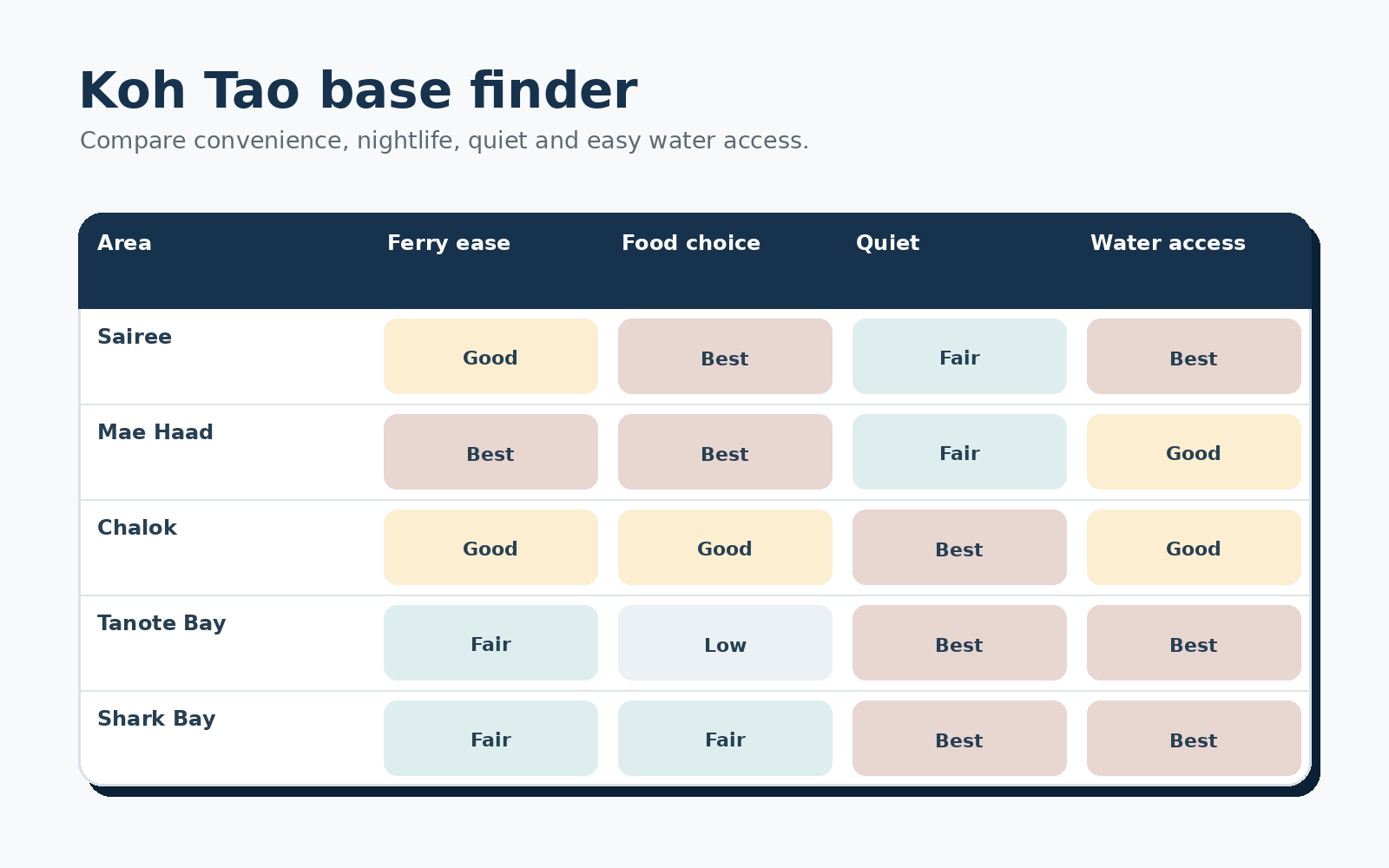
For a first trip, the research-led choice is usually Sairee without staying directly beside the loudest nightlife, or Mae Haad when the ferry connection matters more than sunset. Before paying, ask the property whether pier collection is included, whether the final approach involves steep steps and how late its transfer service operates. Those three answers often matter more than a small difference in room price.
For the wider island decision, see the Thailand islands guide. It helps place Koh Tao against other stops rather than treating every island as interchangeable.
Koh Tao five-day itinerary overview
| Day | Morning | Afternoon | Evening | Weather alternative |
|---|---|---|---|---|
| 1 | Ferry arrival and check-in | Nearby beach, paperwork and orientation | Early meal and sunset | Stay close to Mae Haad or your hotel |
| 2 | Full island snorkelling or dive-course start | Continue the boat route or skills session | Quiet dinner and early night | Course theory, café time or a land viewpoint |
| 3 | Diving, course dives or Koh Nang Yuan | Second water session | Easy evening near your base | Move the major water activity to Day 4 |
| 4 | Viewpoint in cooler hours | Chalok, Tanote or another selected bay | Flexible final dinner | Extra dive day or sheltered beach |
| 5 | No-dive buffer, beach or errands | Ferry departure or final slow afternoon | Onward travel or final night | Keep free for anything displaced by weather |
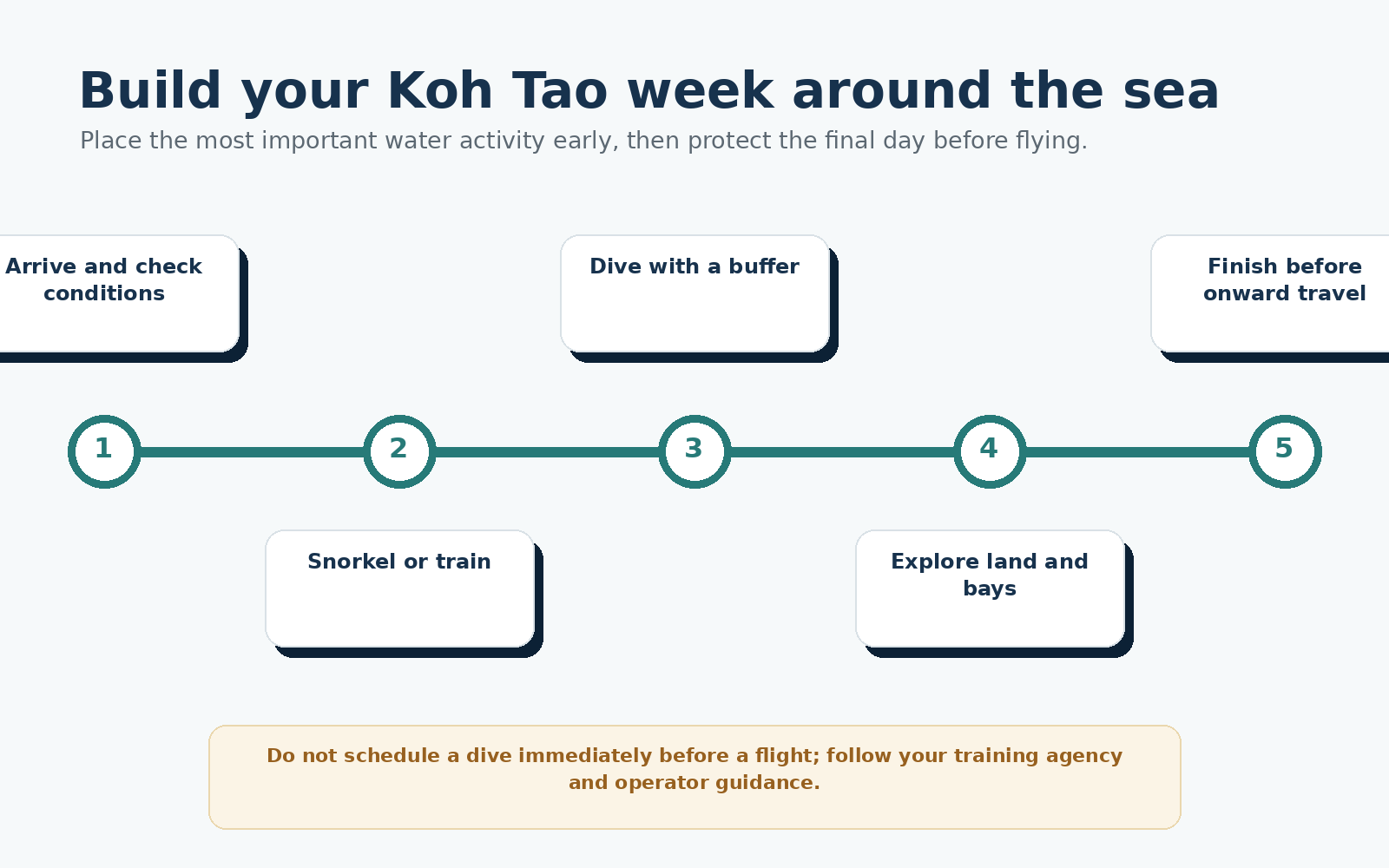
Certified divers can swap Days 2 and 3 for two separate dive days. Non-divers can use Day 3 for Koh Nang Yuan, then keep Day 4 for a self-directed bay day. The sequence matters less than the safety margin: put the activity you would be most disappointed to miss near the beginning, and leave the final day adjustable.
Day 1: arrive, check conditions and stay near your base
Ferry arrival is not the moment for an ambitious island circuit. An overnight bus can leave you dehydrated, short of sleep and less steady than usual, while a choppy crossing may do the same. Check in, eat something substantial and learn the walk between your room, the nearest main road and the place you intend to meet tomorrow’s pickup.
A sensible first-afternoon sequence
- Confirm tomorrow’s pickup time and exact meeting point before leaving reception.
- Check the Thai Meteorological Department marine forecast and the operator’s messages.
- Buy water, cash and any motion-sickness supplies before shops close.
- Walk only the nearest beach or waterfront rather than crossing the island.
- Settle the evening with an early meal, particularly before a morning dive or snorkelling departure.
Visit a dive centre before paying for a course
A polished sales desk does not answer the important questions. Ask who will teach the course, the maximum student-to-instructor ratio, which parts are completed in a pool or confined water, what happens if a student needs more time and whether equipment, learning materials, certification and boat fees are included. Current UK travel advice also recommends checking operator credentials, insurance conditions, equipment, oxygen availability and the ability to transfer an injured diver for specialist treatment. [4]
Day 2: island snorkelling or a low-pressure dive introduction
For non-divers, a full island snorkelling circuit is the clearest introduction to Koh Tao because road access alone does not reveal the coastline. Routes commonly combine Koh Nang Yuan with several bays, although the order and exact stops change with wind, visibility, crowding and safety decisions. A current GetYourGuide example checked for this guide listed a seven-hour trip with pickup from most Koh Tao hotels, lunch and snorkelling equipment; it also identified an additional Koh Nang Yuan fee. Treat every inclusion and fee as live information and recheck the checkout page.
How to choose a snorkelling trip
| Option | Usually suits | Advantages | Trade-offs |
|---|---|---|---|
| Shared full-day boat | First visits and solo travellers | Multiple bays, equipment and a structured route | Larger group and less control over timing |
| Small-group boat | Nervous swimmers and travellers wanting more support | More guide attention and easier questions | Usually costs more and can sell out |
| Private longtail | Couples, families and groups | Flexible pace and selected bays | Price rises sharply for one or two people; weather still controls the route |
| Shore snorkelling | Confident swimmers staying beside a suitable bay | Low cost and no boat schedule | Conditions, entry points and supervision vary |
A well-run trip should provide a clear safety briefing, correctly fitting masks, flotation for anyone who wants it and honest guidance about currents. Wildlife sightings can never be guaranteed. Choose the boat for its support and route management rather than promises of turtles or sharks.
Marine etiquette that protects the experience
- Do not stand on coral, chase turtles, feed fish or remove shells.
- Keep fins clear of the seabed when entering shallow water.
- Use a flotation aid rather than grabbing coral when tired.
- Take reusable water where the operator allows it and keep all packaging on the boat.
- Follow the guide’s instruction when a site is changed or closed for conditions.
Tourism Authority of Thailand specifically describes the island as a fragile ecosystem and asks visitors not to litter or touch marine life. [1]
Day 3: diving, dive training or Koh Nang Yuan
Day 3 is the main diving day in the standard route. Certified divers can book a two-dive session, while beginners may be completing confined-water skills or open-water dives. Site selection should follow the instructor’s assessment of current, visibility, boat traffic and experience level. A famous site is not a good choice when the conditions or group are wrong.
What different dive options actually mean
| Option | Typical commitment | What it is | Planning implication |
|---|---|---|---|
| Introductory experience | About one day | A supervised first experience; not a full certification | Useful for testing comfort, but medical screening still matters |
| Open Water course | Roughly 2.5–4 days in checked examples | Theory, confined-water skills and open-water dives leading to entry-level certification | Book five nights and avoid a fixed flight immediately afterwards |
| Certified fun diving | Half day or full day | Guided dives for already certified divers | Bring certification details and discuss recent experience |
| Refresher | Often part of a day | Skills review before normal fun diving | Sensible after a long break or when confidence is low |
Public 2026 course examples
The table below is a price snapshot, not a ranking or recommendation. It shows why travellers should compare inclusions rather than relying on an island-wide ‘standard price’. Each figure was publicly listed and checked on 6 September 2026; contact the centre for the current total and prerequisites.
| Published example | Open Water price | Listed duration | Important detail shown online |
|---|---|---|---|
| Big Blue Diving | 12,000 THB | 2.5 days | Five dives and an 18 m maximum depth were listed |
| Black Turtle Dive | 12,950 THB | 3–4 days | A one-day introductory experience was listed at 4,400 THB |
| Simple Life Divers | 11,000 THB | 3 days | Materials, equipment and certification were stated as included |
Seven questions worth asking before you enrol
- What is the maximum number of students per instructor in my actual class?
- Will one instructor remain with the group throughout the course?
- Where are confined-water skills completed, and what happens in poor weather?
- How is rental equipment inspected, serviced and replaced?
- Is oxygen carried on the boat, and who is trained to use it?
- What medical form is required, and when would a doctor’s clearance be needed?
- What is the written rescheduling or refund policy if conditions stop the course?
The cheapest figure can become poor value if certification fees, materials, equipment or extra training time sit outside the headline price. Conversely, the highest figure does not automatically guarantee smaller groups. Ask for the full written package and compare like with like.
Non-diver alternative: Koh Nang Yuan
Travellers who skipped the Day 2 circuit can use Day 3 for Koh Nang Yuan. Aim for an early departure when possible, carry only what you need and confirm the current entry rules and fee before travelling. The viewpoint climb is exposed and can feel much harder in midday heat, so water and footwear matter. If the sea is rough, move this day rather than forcing the crossing.
Day 4: viewpoints, southern bays and a slower land day
After a full water day, choose one land route rather than trying to collect every viewpoint. Start in the cooler morning, then pair it with a single bay. A southern plan might combine Chalok with a nearby beach; an east-coast plan can focus on Tanote or Hin Wong; a western plan can remain closer to Sairee and Mae Haad. Short map distances are deceptive because gradients, heat and road surfaces change the effort.
A realistic no-scooter version
- Ask the hotel for a fixed-price outward and return transfer before leaving.
- Choose a bay with food, shade and facilities so you do not need several separate journeys.
- Keep the driver’s contact details and confirm the return time in writing.
- Carry enough cash for a changed pickup plan, but do not rely on finding an ATM at a remote bay.
Should you rent a scooter?
| Potential advantage | Corresponding risk or condition |
|---|---|
| Freedom to reach several bays | Only useful when you are correctly licensed, insured and genuinely experienced |
| Lower cost over repeated journeys | Damage disputes, steep roads and medical costs can outweigh the saving |
| Flexible return time | Darkness, rain and fatigue increase difficulty |
| Easy luggage movement | Riding with luggage reduces control and may not be covered by insurance |
UK travel advice states that Thailand has a high number of motorcycle accidents, that riders need the correct licence and international permit, and that riding without a valid licence can invalidate insurance. It also notes that helmets are required by law. [4] When those conditions are not met, a taxi or hotel transfer is the sensible choice, even if it costs more.
Day 5: keep the buffer, enjoy a final beach and protect onward travel
The final day is intentionally light. Use it for a nearby beach, a café, laundry, souvenir shopping or a ferry departure. If weather displaced an earlier activity, this is the last safe place to move it only when it does not conflict with diving or the onward connection. Avoid booking a distant bay that depends on a single return pickup shortly before the ferry.
Flying after diving
Divers Alert Network recommends a minimum pre-flight surface interval of 12 hours after a single no-decompression dive and at least 18 hours after multiple dives in a day or diving over multiple days. It advises substantially longer than 18 hours after dives requiring decompression stops, and also notes that longer intervals further reduce risk. [6] These are minimum recommendations, not a promise that a particular itinerary is safe. Follow your training, dive computer, operator and medical advice, and never fly with symptoms that could indicate decompression illness.
How to get to Koh Tao in 2026
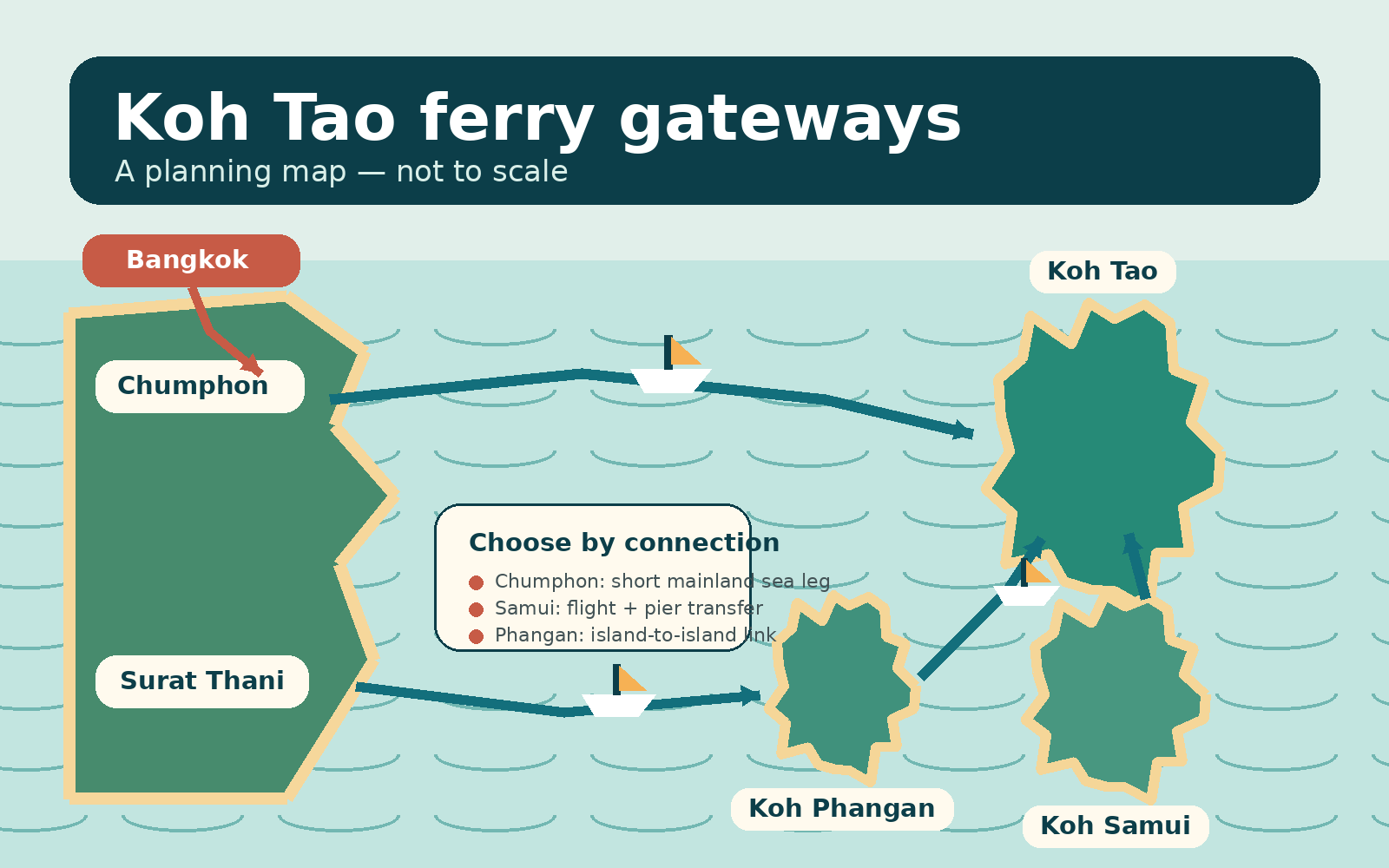
Koh Tao has no airport, so every route finishes by sea. Tourism Authority of Thailand notes that the island is geographically closer to Chumphon and identifies boat travel from Chumphon as a strong approach. [1] The best gateway nevertheless depends on the rest of your trip: Chumphon works well from Bangkok, Koh Phangan is easy for a Gulf-island sequence, and Koh Samui is useful when a flight removes a long land journey.
Current operator examples
The examples below come from Lomprayah’s 2026 timetable, effective 25 August 2026. They are useful for planning shape, not a guarantee for your date. Confirm the operating day, pier, check-in time, vessel type, luggage conditions and transfer inclusion before paying. [2]
| Starting point | Example departure-arrival | Listed fare | Planning note |
|---|---|---|---|
| Bangkok Pinklao | 21:00-08:30 bus and ferry | 850 THB | Overnight option; a 21:30 catamaran combination was also listed |
| Chumphon, Thung Makham Noi Pier | 06:00-08:30 ferry; 07:00-08:45 catamaran; 13:15-15:00 catamaran | 450–750 THB | Useful after a train, flight or mainland stay; add transfer time to the pier |
| Koh Phangan | 08:30-09:30 catamaran; later services also listed | 600 THB for the 08:30 example | Straightforward Gulf-island connection, but festival periods need earlier booking |
| Koh Samui, Pralarn Pier | 10:00-13:30 ferry or 11:30-14:15 catamaran | 700-850 THB | Check airport-to-pier time separately |
| Koh Samui, Nathon Pier | 11:00-14:15 or 15:00-17:45 catamaran | 850 THB | The correct pier matters; Samui has several |
Which route should you choose?
- From Bangkok on a lower budget: compare an overnight combined ticket with a train or flight to Chumphon plus the pier transfer.
- From Koh Phangan: use a direct island ferry and avoid creating a mainland detour.
- From Koh Samui: select the sailing first, then calculate the airport or hotel transfer to the named pier.
- From southern mainland routes: compare the total door-to-door journey, not only the ferry segment.
For a wider explanation of trains, buses, domestic flights and ferry connections, use the transport in Thailand guide. Travellers building a longer route can also place Koh Tao inside the two-week Thailand itinerary.
Weather, sea conditions and the best time to use this itinerary
No month guarantees flat water or clear visibility. Broad seasonal patterns help with expectations, but they are not booking promises: Koh Tao’s day-to-day conditions can differ from mainland Thailand and from Koh Samui. Use the Thai Meteorological Department marine forecast for the travel day, and treat the ranges below as planning shorthand rather than a forecast. [3]
| Period | Planning approach | What to protect |
|---|---|---|
| January–April | Often the easiest period to plan around, although heat builds and rough-water days still occur. | Shade, hydration, early viewpoint starts and a movable boat day |
| May–September | A mixed Gulf-season pattern: many workable days, with showers and short-notice sea changes still possible. | Flexible cancellation terms and one land-based fallback |
| October–December | Use stronger disruption margins, particularly from late October through the wetter north-east monsoon period. | An extra ferry buffer before a flight and daily TMD marine checks |
Rain does not automatically ruin Koh Tao. A passing shower can suit a café, course theory or a slow afternoon. Rough seas are different because they affect ferries, boat comfort and site access. When a qualified operator changes the route, accept the change rather than pressuring staff to follow the advertised sequence.
A simple weather-proofing method
- Place the most important boat or dive day on Day 2 or Day 3.
- Keep Day 4 capable of becoming the replacement water day.
- Use accommodation with reasonable cancellation terms when travelling in a less settled period.
- Avoid separate non-refundable ferry and flight bookings with a narrow connection.
Koh Tao budget and the right booking order
Room prices and tour rates move with demand, so the most useful budget is a planning range rather than one headline total. The figures below are editorial working estimates for one person and exclude international flights. They assume five nights, ordinary meals, sensible local transfers and one paid non-diving water activity; a full dive course is shown separately.
| Travel style | Room per night | Food and local movement per day | Five-day working total before course |
|---|---|---|---|
| Budget | 700-1,400 THB | 900-1,400 THB | About 9,000-16,000 THB |
| Mid-range | 1,800-3,800 THB | 1,300-2,300 THB | About 17,000-32,000 THB |
| Comfort-focused | 4,000-9,000+ THB | 2,000-3,500+ THB | About 31,000-66,000+ THB |
A beginner Open Water course adds roughly 11,000-12,950 THB in the checked public examples. Private tuition, accommodation packages, specialty courses and extra training can change the total. A shared snorkelling boat is far cheaper than a private longtail for one or two travellers, whereas a private boat can become reasonable when several people split the price.
Book in this order
- Fix the ferry that connects sensibly with the wider Thailand route.
- Choose the base around walking, evening food and transport rather than a generic ‘best hotel’ list.
- Contact dive centres before booking a short, non-refundable stay.
- Reserve flexible accommodation for the full number of nights required.
- Add a snorkelling trip only after checking how it fits the dive course or no-fly interval.
- Protect the final ferry and flight with a realistic buffer.
The Thailand travel budget guide provides a broader framework for accommodation, food and transport costs across the country.
What to pack: useful product choices rather than a long shopping list
Koh Tao packing is mostly about water protection, sun exposure and footwear that can handle boats and steep approaches. Bring less than you think, because carrying a hard suitcase across pier ramps and into a pickup is rarely enjoyable. The complete Thailand packing list covers the wider trip; the items below solve specific island problems.
| Item choice | Advantages | Limitations | Best for |
|---|---|---|---|
| Tour-provided mask and snorkel | No luggage and normally included | Fit and condition vary | One-off snorkelling |
| Personal silicone mask | Known fit and hygiene | Takes space and still needs careful packing | Frequent snorkellers or difficult facial fit |
| 5-10 litre dry bag | Useful for phone, towel and documents around spray | Not a certified underwater housing | Day boats and beach transfers |
| Waterproof phone housing | Allows protected surface use | Seal quality and depth rating vary | Photos near the water, only within manufacturer limits |
Phone data on the island
A working phone helps with pickup messages, weather checks and last-minute ferry changes. Coverage still varies by bay and building, so download essential tickets and hotel details before travelling. The Thailand SIM card and eSIM guide explains the main options. Travellers who prefer an eSIM can also check current Thailand eSIM packages through Airalo.
Pros, cons, safety and common itinerary mistakes
The strengths of a five-day Koh Tao stay
- Enough time for a serious water activity without making every day a boat day.
- Several distinct bases, from lively Sairee to quieter southern and eastern bays.
- A useful place to learn or refresh diving when the operator and course fit are right.
- Easy onward pairing with Koh Phangan or Koh Samui.
The trade-offs to accept
- Every arrival and departure depends on the sea.
- Steep roads make a poorly chosen base inconvenient.
- A compressed certification course can consume most of a short visit.
- Ferry delays and no-fly requirements complicate tight flight connections.
Six mistakes that cause most avoidable problems
Booking the cheapest dive course without checking inclusions
Compare group size, instructor continuity, medical screening, equipment, oxygen, certification fees and the written weather policy.
Treating a remote room as transport-free
Ask exactly how you will reach dinner, the dive centre and the pier after dark.
Riding without the correct licence, insurance or experience
Use a taxi or hotel transfer when any one of those conditions is missing.
Putting the priority boat trip on the last morning
Move it to Day 2 or Day 3 and leave Day 5 as the recovery slot.
Flying too soon after diving
Build the no-fly interval before purchasing the flight, then remove a dive if the timetable changes.
Assuming a ferry delay is someone else’s connection problem
Separate tickets usually leave the risk with the traveller, so add an overnight when the flight is important.
Emergency numbers to save offline
| Service | Number |
|---|---|
| General emergency / police | 191 |
| Ambulance | 1669 |
| Fire | 199 |
| Tourist Police | 1155 |
Save the numbers, your insurer’s assistance line and the hotel address as a screenshot. In a serious incident, contact the provider and insurer as soon as practical. [5]
Frequently asked questions
Is five days enough for Koh Tao?
Yes. Five days allows a snorkelling circuit or diving, one dedicated land-and-bay day, and a final buffer. Five nights is more comfortable for a beginner course; four nights can work for non-divers with flexible ferry plans.
Is Koh Tao worth visiting if I do not dive?
Yes. A full island snorkelling trip, Koh Nang Yuan, viewpoints, Sairee sunset and quieter bays can fill the itinerary. The island’s tourism culture is strongly connected to diving, but a traveller does not need to enrol in a course to justify the visit.
Where should a first-time visitor stay?
Sairee suits travellers who want restaurants, sunset and social choice. Mae Haad is easiest for the ferry. Chalok is calmer, while remote bays are best for travellers who are happy to stay local or arrange transfers.
Can I complete an Open Water course in five days?
Often, yes. Checked 2026 operator examples listed roughly 2.5 to four days. However, the course is performance based and weather can interfere, so book five nights and avoid a fixed flight immediately after the last scheduled dive.
How much does diving cost on Koh Tao in 2026?
The public examples checked for this guide listed Open Water courses from 11,000 to 12,950 THB. Compare the complete package because materials, equipment, certification, accommodation and extra training time may be handled differently.
Should I book a Koh Tao snorkelling tour in advance?
Advance booking is sensible in busy periods, especially for a small group or private boat. Retain flexibility when the weather is uncertain, and check the cancellation terms, pickup area, island fees and equipment inclusions before paying.
Is it safe to rent a scooter on Koh Tao?
The roads can be steep and motorcycle accidents are a serious risk. Rent only when you have the correct licence and permit, suitable insurance, real riding experience and a proper helmet. Otherwise use taxis or hotel transfers.
How long should I wait before flying after diving?
Divers Alert Network gives minimum recommendations of 12 hours after one no-decompression dive and 18 hours after multiple dives in a day or over multiple days. Longer intervals reduce risk, and decompression dives require more conservative planning.
What is the easiest way to reach Koh Tao from Bangkok?
A combined overnight bus-and-ferry ticket is simple, while a train or flight to Chumphon can offer more control. Compare total door-to-door time, the mainland transfer, check-in margin and arrival energy rather than only the cheapest fare.
Can I connect a Koh Tao ferry directly to a flight?
It is possible, but a short self-transfer is risky because sea and road delays can occur. For an important or long-haul flight, place an overnight on Koh Samui or the mainland between the ferry and departure.
Recommended version of this Koh Tao itinerary
Book five nights, stay in Sairee or Mae Haad for the first visit, and make Day 2 or Day 3 the priority water day. Divers should speak to more than one centre before committing and should preserve Day 5 as a no-dive buffer. Non-divers can use the same structure by replacing the course with a snorkelling circuit and Koh Nang Yuan.
The plan succeeds because it accepts Koh Tao’s limits. Ferries can move, bays are not all easy to connect, and safe dive schedules matter more than squeezing in one additional viewpoint. A flexible day is not wasted time; it is what allows the rest of the itinerary to work when the sea does not follow the brochure.
Sources and fact-checking
Ferry examples, course prices and marketplace inclusions were checked on 6 September 2026. They are dated planning examples, not price guarantees. Recheck the operator, official forecast and current UK travel advice before paying.
- Tourism Authority of Thailand – Ko Tao. Destination context, Chumphon access, motorbike caution and marine-environment guidance.
- Lomprayah 2026 timetable. Operator examples for Bangkok, Chumphon, Koh Phangan and Koh Samui services; timetable effective 25 August 2026.
- Thai Meteorological Department – Shipping Weather Forecast. Official marine forecast for checking wind, waves, thunderstorms and warnings before ferry or boat travel.
- UK Foreign, Commonwealth & Development Office – Thailand safety and security. Current advice on diving, boat travel, swimming and motorcycle risk.
- UK Foreign, Commonwealth & Development Office – Getting help in Thailand. Emergency numbers: 191, ambulance 1669, fire 199 and Tourist Police 1155.
- Divers Alert Network – Flying After Diving. Minimum pre-flight surface-interval guidance for recreational diving.
- Big Blue Diving – published course information. Publicly listed Open Water price and duration example checked on 6 September 2026.
- Black Turtle Dive – diving course prices. Publicly listed introductory and Open Water course examples checked on 6 September 2026.
- Simple Life Divers – PADI Open Water course. Publicly listed course price, duration and inclusion example checked on 6 September 2026.
- Thai Meteorological Department — Thailand climate information. Background climate context used alongside the live marine forecast; seasonal labels remain approximate.
Illustrations in this article were created for Taylor’s Trailblazing Travels. Third-party photographs, where used, are credited beside the image or in the source list.