Thailand culture guide · 2026
12 Best Temples in Thailand for 2026: Routes, Dress Rules and Honest Tips
Routes, dress rules, timings and honest visitor tips for choosing the right temple experiences.
The strongest temple itinerary mixes royal compounds, working monasteries, mountain settings, contemporary art and historic ruins.
Thailand has tens of thousands of Buddhist temples, yet a useful first-trip shortlist is not simply the twelve buildings that appear most often on social media. A royal compound in Bangkok, a working Lanna monastery in Chiang Mai, a contemporary art project in Chiang Rai and a field of brick ruins in Ayutthaya offer completely different experiences. Treating them as interchangeable usually produces an exhausting itinerary and very little understanding of what you have seen.
This guide narrows the choice by asking what each stop adds to a wider Thailand route. It explains the practical details that often decide whether a temple visit feels rewarding: the best sequence, realistic time on site, dress requirements, heat, stairs, transport, photography restrictions and whether an organised tour solves a real problem. Current official visitor information was checked on 10 September 2026, although opening arrangements and admissions can still change for ceremonies, conservation work and public holidays.
Best temples in Thailand: quick answer
The best temples in Thailand for a first trip are Wat Phra Kaew, Wat Pho, Wat Arun and Wat Saket in Bangkok; Doi Suthep, Wat Phra Singh and Wat Chedi Luang in Chiang Mai; Wat Rong Khun and Wat Rong Suea Ten in Chiang Rai; Wat Mahathat in Ayutthaya and Sukhothai; and Wat Chalong in Phuket. Choose six to eight that fit your route rather than trying to visit all twelve in one holiday.
Some booking links may earn Taylor’s Trailblazing Travels a commission at no extra cost to you. They are included only where transport, accommodation, a tour, mobile data or practical clothing solves a genuine planning problem.
Best first temple
Wat Pho is easier to absorb than the Grand Palace and pairs naturally with the river.
Best northern route
Doi Suthep plus Wat Pha Lat, then Wat Phra Singh and Wat Chedi Luang on a separate Old City walk.
Best ruins
Sukhothai for a spacious cycling day; Ayutthaya for the easiest historic-capital trip from Bangkok.
Time to allow
One full Bangkok temple day, one Chiang Mai mountain half-day, one Old City half-day and one historic park day.
How this list of the best temples in Thailand was chosen
The shortlist is intentionally route-based. A temple earns its place by being historically important, visually distinctive, culturally meaningful or especially useful for understanding a region. It also needs to fit a realistic journey. That is why Bangkok has four entries while an isolated photogenic site may not appear at all: the four Bangkok stops can be connected in one day by walking, river ferry and a short transfer.
Official royal, temple, tourism-authority, UNESCO and Fine Arts Department information was used for opening arrangements, admission and heritage context. Where an official page does not publish a dependable current fee, this guide gives a planning allowance and tells you to check at the gate. That approach is less dramatic than printing a single number, but it is more useful than repeating an old price copied across dozens of travel sites.
Choose the temple experience before choosing the temple
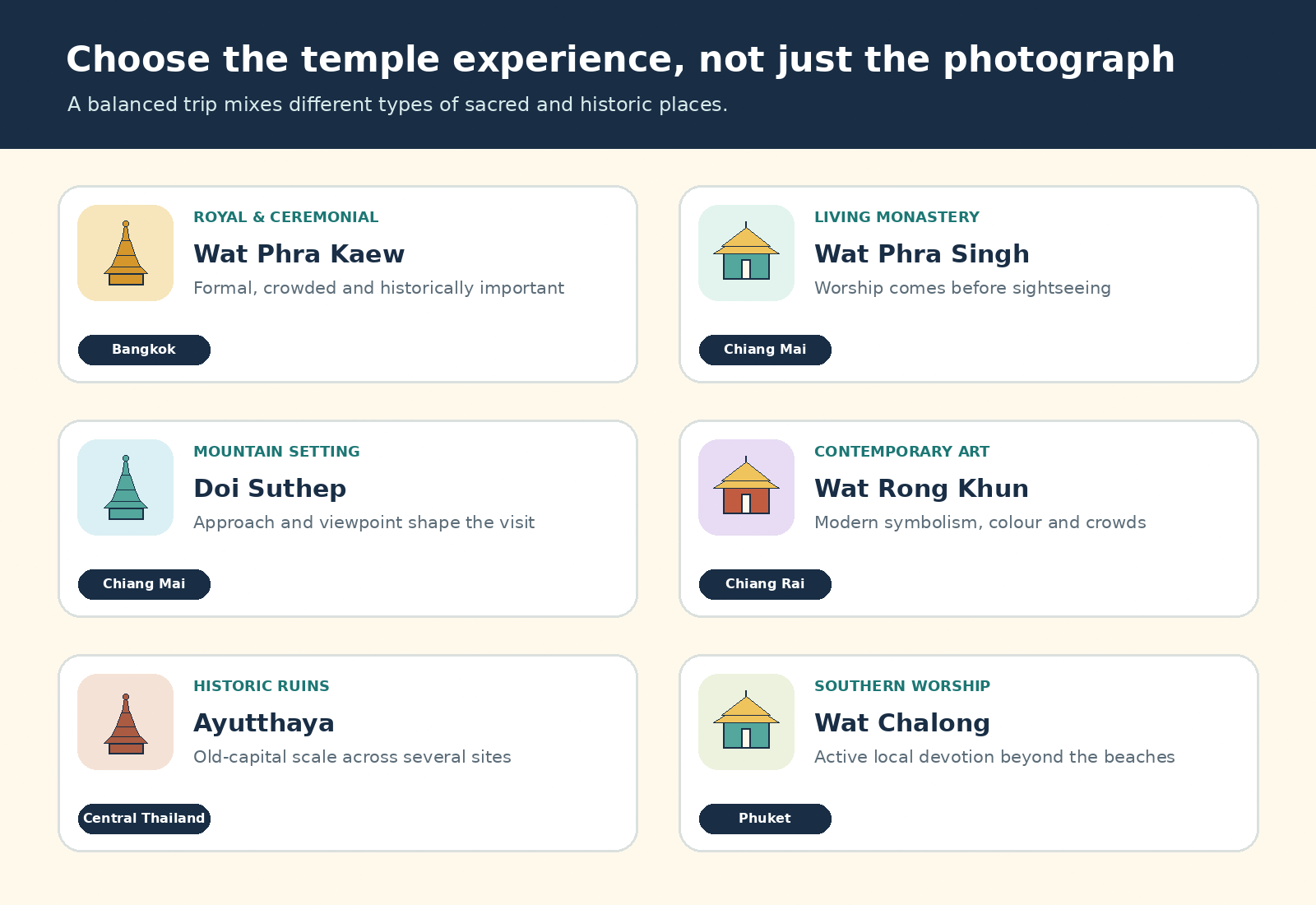
A simple way to avoid temple fatigue is to decide which experiences you want, then select one or two examples of each. Royal ceremony, Lanna architecture, mountain atmosphere, modern Buddhist art and historic ruins do not compete for the same role. For a two-week Thailand itinerary, three temple-focused days spread across the trip are usually more memorable than squeezing temples into every morning.
| Experience | Best choice | Why it stands out | Main trade-off |
|---|---|---|---|
| Royal and ceremonial | Wat Phra Kaew and the Grand Palace | Nationally significant compound, ornate architecture and the Emerald Buddha | Highest admission, strictest dress checks and heavy crowds |
| Living Bangkok monastery | Wat Pho | Reclining Buddha, broad grounds, inscriptions and an easier pace than the palace | Still busy from late morning |
| River landmark | Wat Arun | Distinctive riverside prang and one of Bangkok’s best cross-river views | Steep steps, exposed heat and changing fee information |
| Mountain temple | Doi Suthep | Golden chedi, pilgrimage setting and views above Chiang Mai | Road bends, stairs and weather can affect the visit |
| Lanna Old City | Wat Phra Singh and Wat Chedi Luang | Two contrasting monasteries within an easy walk | Details blur if too many smaller temples are added |
| Contemporary Buddhist art | Wat Rong Khun | Unusually direct symbolism and a site still evolving under its artist | Can feel more like a headline attraction than a quiet monastery |
| Historic ruins | Sukhothai or Ayutthaya | Landscape-scale understanding of Thailand’s former capitals | Needs a full day and more movement than one compact temple |
| Southern active worship | Wat Chalong | A meaningful cultural stop within a Phuket holiday | Not worth crossing the island solely for a quick photograph |
The 12 best temples in Thailand compared
| Temple | Base | Best for | Allow | 2026 planning note |
|---|---|---|---|---|
| 1. Wat Phra Kaew | Bangkok | Royal scale and national significance | 2-3 hours with palace | Official foreign admission 500 THB; arrive before the main heat |
| 2. Wat Pho | Bangkok | First-time understanding and reclining Buddha | 1.5-2 hours | Official visitor price 300 THB; open later than most headline sights |
| 3. Wat Arun | Bangkok | River views and architecture | 60-90 minutes | Budget about 200 THB and verify the gate price |
| 4. Wat Saket | Bangkok | Old-city views and a quieter contrast | 60-90 minutes | 344-step spiral route; add only if weather and energy suit |
| 5. Doi Suthep | Chiang Mai | Mountain pilgrimage atmosphere | 2.5-4 hours from city | Small foreign admission; transport costs more than entry |
| 6. Wat Phra Singh | Chiang Mai | Lanna halls, murals and living worship | 45-75 minutes | Some areas may charge a modest foreign admission |
| 7. Wat Chedi Luang | Chiang Mai | Monumental ruined chedi and Old City history | 45-75 minutes | Budget a small foreign fee and check current access |
| 8. Wat Rong Khun | Chiang Rai | Contemporary symbolism and design | 75-90 minutes | Foreign admission reported at 200 THB in 2026; verify before travel |
| 9. Wat Rong Suea Ten | Chiang Rai | Active blue-and-gold contemporary temple | 45-60 minutes | Generally free with donations welcome |
| 10. Wat Mahathat, Ayutthaya | Ayutthaya | Iconic ruins within an easy Bangkok extension | 2-4 hours in central park | Fine Arts Department ticket options cover multiple ruins |
| 11. Wat Mahathat, Sukhothai | Sukhothai | Cycling through a complete historic landscape | Half to full day | Central and outer zones use separate or combined tickets |
| 12. Wat Chalong | Phuket | Southern Thai worship and local context | 45-75 minutes | Free entry; ceremonies and firecrackers can change the atmosphere |
The four best temples in Bangkok
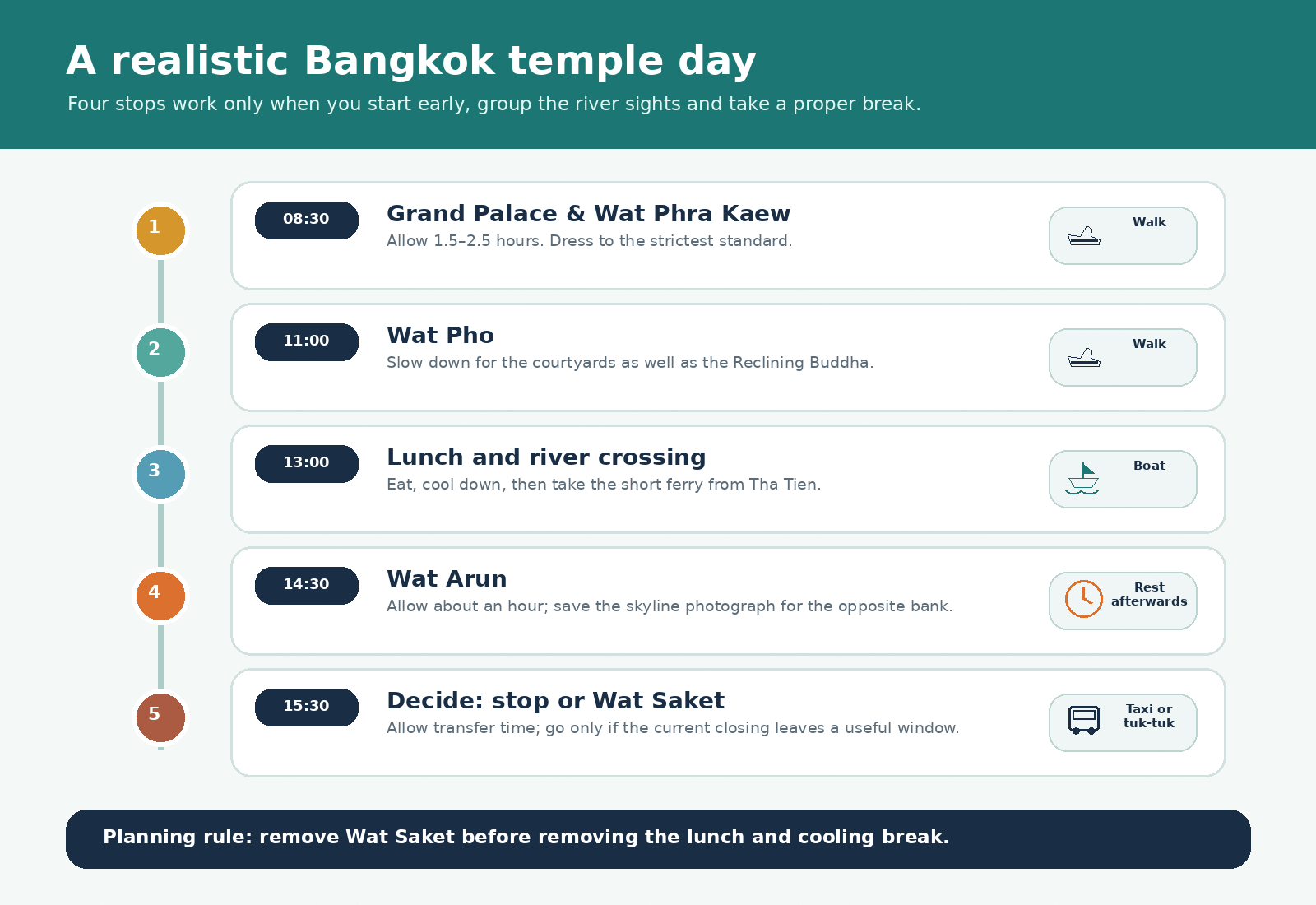
Bangkok is the easiest place to see several major temples without changing hotels. The efficient order is Grand Palace and Wat Phra Kaew first, Wat Pho second, Wat Arun across the river third, then either stop or continue to Wat Saket. Starting with Wat Saket because it opens early may look clever on a map, yet it risks reaching the Grand Palace after the best morning window.
1. Wat Phra Kaew and the Grand Palace: best for royal scale
Wat Phra Kaew, the Temple of the Emerald Buddha, sits inside the Grand Palace compound and is the most formal visit in this guide. The experience is less about one enormous image than the density of detail: gilded surfaces, guardian figures, murals, rooflines and the controlled movement of visitors through a nationally significant site. Give it your freshest hour rather than placing it after two other temples.
The official Grand Palace website lists foreign admission at 500 THB, including Wat Phra Kaew and the Queen Sirikit Museum of Textiles. It gives daily opening of 08:30-16:30 and ticket sales until 15:30, while also warning that schedules can change.[1] Arrive before 09:00 when possible, check the official schedule that morning, and do not build a non-refundable onward booking around an assumed closing time.
Dress rules are stricter here than at many temples. The official list rejects sleeveless tops, short or tight trousers, torn clothing, mini-skirts and several other casual styles.[1] A scarf over an unsuitable outfit should not be treated as a guaranteed solution. Wear opaque trousers or a below-knee skirt and a proper sleeved top from the start. Children under the published height threshold may enter free, but families should check the current FAQ before buying online.[2]
2. Wat Pho: best first temple for most visitors
Wat Pho is often described only as the home of the Reclining Buddha, which understates the value of the wider compound. Its courtyards, stupas, inscriptions and active religious spaces give first-time visitors more room to observe how a large Bangkok monastery works. The pace is easier than at the Grand Palace, and the shaded corners make it a better place to pause rather than simply tick off a famous image.
Official visitor information lists daily opening from 08:00 to 19:30 and foreign admission of 300 THB, with children under 120 centimetres admitted free.[3] That later closing time creates flexibility: travellers with only one Bangkok afternoon can visit Wat Pho after another attraction, although individual halls may feel different near closing. Allow at least 90 minutes; two hours is more comfortable if you enjoy architecture or want to read the interpretation.
Shoes come off before religious interiors, shoulders and knees should be covered, and respectful photography matters even when a room is crowded.[3] Women should avoid physical contact with monks. The temple’s association with traditional Thai medicine and massage is historically important, but do not assume a massage slot will be available without checking the official service arrangements.
3. Wat Arun: best for a Bangkok river landmark
Wat Arun works because the approach is part of the visit. Cross from the Wat Pho side by local ferry, watch the prang grow across the river, then turn back towards the old city from the temple grounds. Its porcelain-decorated central tower looks delicate from a distance but feels massive close up. The steep accessible levels demand sensible shoes and a willingness to move slowly.
Tourism Authority of Thailand material lists the temple as opening daily from 08:00 to 17:30.[4] Wat Arun’s own contact page publishes different hours for individual areas and still displays an older, lower prang fee, so the official pages do not provide one fully consistent current answer.[20] Carry 200 THB as a cautious foreign-adult planning allowance, then confirm the gate price and check which areas remain open at the time you intend to visit. That wording is deliberate: a planning allowance is more honest than presenting an uncertain online fee as fixed.
Late afternoon gives warmer light, although it can also bring queues and intense reflected heat. Morning is better when you intend to climb. Sunset photographs are often strongest from the opposite bank rather than from inside the grounds, so a traveller focused on the skyline may prefer to visit earlier and return to the riverside later.
4. Wat Saket: best quieter Bangkok contrast
Wat Saket’s Golden Mount offers a different rhythm from the river temples. A spiral path rises through bells, greenery and small viewpoints before reaching the golden chedi. Tourism Authority of Thailand describes 344 steps and lists opening from 08:00 to 17:00.[4] The climb is gradual rather than technically difficult, but humidity makes it feel more demanding than the number suggests.
Add Wat Saket when you have a genuine spare 90 minutes, not because the route graphic contains a fifth stop. It works especially well in the cooler late afternoon or on a second Bangkok morning. In heavy rain, extreme heat or poor air quality, the open climb loses much of its appeal. A small foreign admission is normally collected for the upper area; carry cash and verify the current amount at the entrance.
For neighbourhoods, rail, boats, airports and a complete three-day plan, use the Bangkok travel guide for first-time visitors. It explains why the old city should be treated as one geographic cluster rather than crossed repeatedly from Sukhumvit.
The best temples in Chiang Mai
Chiang Mai needs two different temple plans. The mountain route to Doi Suthep is a half-day excursion with road travel, viewpoints and weather exposure. The Old City route is a slow walk between Wat Phra Singh and Wat Chedi Luang, with smaller monasteries added only when they offer a genuine contrast. Combining everything into one continuous tour is possible, although it often turns the temples into a blur of gold roofs.
5. Wat Phra That Doi Suthep: best mountain temple
Doi Suthep is not simply a viewpoint with a temple attached. It is an important pilgrimage site overlooking Chiang Mai, approached by a naga staircase or a funicular-style lift. The golden chedi is the visual centre, yet the atmosphere depends on timing. Early morning can bring cooler air and a quieter courtyard; later visits may be busier but provide clearer city views when haze and cloud cooperate.
Tourism Authority of Thailand maintains an official attraction page for the temple and also places it within broader Chiang Mai cultural routes.[5] Transport is the main planning cost. A shared red songthaew is usually the budget choice, while a private driver or guided half-day becomes more attractive for two to four people who want to include Wat Pha Lat and control the pace. Expect roughly 30-45 minutes each way from the Old City in ordinary conditions, longer in traffic or rain.
The staircase is around 300 steps, depending on how the count is described. It is manageable for many visitors but slippery in rain and tiring in midday heat. The lift is useful for limited mobility, although it does not make every part of the compound step-free. A modest foreign admission and separate lift charge may apply, so carry small cash and check the current board rather than relying on a years-old screenshot.
6. Wat Phra Singh: best for refined Lanna architecture
Wat Phra Singh anchors the western end of Chiang Mai’s old-city spine. Its appeal is not the size of the compound but the quality of the Lanna details: layered roofs, gilded decoration, carved timber, murals and the smaller Viharn Lai Kham. It also remains an active monastery, so a visit can shift quickly from quiet observation to chanting, offerings or a local ceremony.
Tourism Authority of Thailand identifies Wat Phra Singh as one of Chiang Mai’s key historic attractions.[7] Allow 45-75 minutes and arrive before large city tours when possible. Some parts of the complex may carry a modest foreign visitor charge while the broader grounds remain accessible; the exact arrangement can change, so check the sign at the entrance.
The most useful pairing is with Wat Chedi Luang via Ratchadamnoen Road. The walk is roughly 10-15 minutes without stops, although cafés, smaller temples and the Sunday Walking Street route can make it much slower. During Songkran and major Buddhist dates, ordinary sightseeing assumptions may not apply because Wat Phra Singh becomes a focus of religious and civic activity.
7. Wat Chedi Luang: best for scale and visible history
Wat Chedi Luang provides the architectural contrast that makes an Old City temple walk worthwhile. Its great brick chedi is partly ruined rather than polished, so age and damage are visible. The structure once held the Emerald Buddha and still dominates the surrounding compound. Stand back before circling it; the relationship between the chedi, elephants and surrounding halls is clearer from a little distance.
Tourism Authority of Thailand lists the temple as a principal Chiang Mai attraction.[8] A small admission is commonly charged to foreign visitors, and opening is generally from early morning into early evening, but confirm the current board locally. Forty-five minutes is enough for a focused visit; allow longer if monk-chat activity is operating or if a service is taking place.
Wat Chedi Luang is easy to over-photograph and under-understand. A short visit to the Chiang Mai City Arts and Cultural Centre before or after the temple can provide useful context for the old city’s rulers, walls and Lanna identity. The centre’s official site should be checked for current exhibitions and opening arrangements.[9]
For most independent travellers, stay inside or close to the Old City for the walking temples, then book a separate mountain transfer. Compare accommodation on Booking.com or Agoda, but judge a hotel by walkability and quiet at night rather than distance to a single temple pin.
Chiang Rai’s best contemporary temples
Chiang Rai’s headline temples are modern projects, not ancient survivors. That distinction matters. Their bright surfaces, dramatic sculpture and accessible symbolism make them easy to enjoy, yet they should not be read as a summary of traditional Thai temple architecture. A balanced day combines the White Temple with the Blue Temple and, when time allows, Wat Huay Pla Kang or another active religious site.
8. Wat Rong Khun: best for contemporary Buddhist symbolism
Wat Rong Khun, usually called the White Temple, is the work of Thai artist Chalermchai Kositpipat. Its white surfaces and mirrored fragments are only the first layer. The bridge, hands, guardians, murals and deliberately surprising modern references turn the visit into a sequence about desire, suffering and the path away from attachment. It is still being developed, so the site should be approached as a living artistic project rather than a frozen monument.
Tourism Authority of Thailand provides official attraction context for Wat Rong Khun.[10] The temple lies south of central Chiang Rai, making a taxi, driver, songthaew or tour more practical than walking. Khaosod English reported that foreign admission increased to 200 THB from 1 January 2026 and includes the Cave of Art, while visitors aged 70 or over and children under 120 centimetres remain free.[21] Because the change is recent and access arrangements can evolve, check the current official or on-site notice before setting out.
Arrive near opening for softer light and fewer group arrivals. Photography is allowed in many exterior areas but not inside the main prayer hall. The bridge is one-way and staff keep visitors moving, so decide on your photograph before crossing rather than stopping the queue. Allow 75-90 minutes if you want the gallery and details, not 20 minutes for the front façade.
9. Wat Rong Suea Ten: best active contemporary counterpoint
Wat Rong Suea Ten, the Blue Temple, uses deep blue, gold and white on a more compact site north of central Chiang Rai. It feels immediately spectacular, although the best reason to include it is contrast. The interior is a functioning prayer space, and the seated white Buddha changes the mood after the busier sculptural journey through Wat Rong Khun.
Tourism Authority of Thailand lists the temple as a Chiang Rai attraction.[11] Entry is generally free with donations welcome, and a focused visit takes about 45 minutes. Early morning is quieter; late afternoon can produce richer exterior colour. Cover shoulders and knees, remove shoes for the hall and keep voices low even when other visitors are treating the room as a photography location.
The Blue Temple is much closer to the city centre than the White Temple. A private driver can therefore run south to Wat Rong Khun, return through the city for lunch, then continue to Wat Rong Suea Ten and Wat Huay Pla Kang. That route is usually better than jumping between isolated rides, particularly when three or four people share the vehicle.
A realistic Chiang Rai temple day
| Time | Stop | Why this order works | Planning note |
|---|---|---|---|
| 08:00-09:30 | Wat Rong Khun | Best chance of cooler light before the largest groups | Confirm opening and current foreign admission |
| 10:00-11:00 | Baan Dam or coffee break | Prevents the day becoming three visually intense temples without context | Choose Baan Dam only if contemporary art interests you |
| 11:30-12:30 | Lunch in Chiang Rai | Keeps food flexible rather than relying on attraction cafés | Allow for driver waiting time |
| 13:00-14:00 | Wat Rong Suea Ten | Compact active temple after the main crowds | Donation and respectful interior visit |
| 14:30-16:00 | Wat Huay Pla Kang | Adds scale, hill views and a different active complex | Lift and internal access can have separate arrangements |
TAT’s wider Chiang Rai itinerary supports treating the province as more than a single White Temple excursion.[12] Travellers coming from Chiang Mai can compare buses and transfers through 12Go Asia. For an early start, one or two nights in Chiang Rai is more relaxed than a very long return day from Chiang Mai. Compare stays on Booking.com or Agoda.
Ayutthaya or Sukhothai: the best historic temple landscapes
Ayutthaya and Sukhothai are not single-temple visits. They are former capitals whose monasteries, reservoirs, roads and royal spaces make sense as landscapes. Wat Mahathat is the anchor in each park, but the day becomes worthwhile only when it includes several ruins and enough time to understand how the city was organised. The right choice depends less on which photograph you prefer and more on where the rest of your route goes.
10. Wat Mahathat, Ayutthaya: best historic day trip from Bangkok
UNESCO describes the Historic City of Ayutthaya as the remains of the second Siamese capital, founded in 1350 and destroyed in the eighteenth century.[13] Wat Mahathat lies near the centre of the island and is famous for the Buddha head held within tree roots, but the ruined prangs, aligned Buddha images and surrounding foundations are the stronger reason to spend time here.
The Fine Arts Department’s current English visitor map lists daily park access from 08:00 to 18:00 and publishes foreign ticket options for individual sites and a multi-site pass.[14] At the time of checking, individual admission was shown as 80 THB and the flat-rate option as 300 THB. Older official pages may display lower figures, so use the live park board as the final authority.
Wat Mahathat deserves 45-60 minutes, yet a complete central loop needs at least three hours. Add Wat Ratchaburana, Wat Phra Si Sanphet and Wihan Phra Mongkhon Bophit. Then choose either a riverside ruin such as Wat Chaiwatthanaram or a slower lunch and museum visit. A bicycle suits confident riders in cooler weather; a tuk-tuk, private driver or guided minivan is usually better in midday heat, heavy rain or with limited mobility.
11. Wat Mahathat, Sukhothai: best for a full cycling day
UNESCO’s Sukhothai listing covers the historic town and associated centres that developed during the first Kingdom of Siam in the thirteenth and fourteenth centuries.[15] Wat Mahathat is the central park’s great ceremonial complex, with lotus-bud chedis, standing Buddhas, columns and reflecting water. The open landscape lets the architecture breathe in a way that crowded city compounds cannot.
Fine Arts Department information divides the park into central and outer zones with separate schedules and ticket options. The current English page lists central-zone foreign admission at 200 THB, north and west zones at 120 THB each, and a combined 400 THB option; hours vary by zone and Saturday evening arrangements can differ.[16] Because those details have changed over time, check the official map again before travel.
A bicycle is the classic choice for the central zone because distances are gentle and much of the route is separated from fast traffic. Nevertheless, heat changes the calculation. Start near opening, carry water, take a shaded lunch break and use an electric cart or driver if anyone in the group is uncomfortable cycling. Stay until later light when possible; the monuments gain depth as the sun drops and day-trippers leave.
Ayutthaya vs Sukhothai: which should you choose?
| Decision | Ayutthaya | Sukhothai | Better choice when… |
|---|---|---|---|
| Access | About 1-2 hours from Bangkok, depending on train or road traffic | Longer transfer from Bangkok or Chiang Mai; airport and bus options | Ayutthaya wins for a short Bangkok extension |
| Landscape | Ruins spread through a living modern city | More spacious, park-like central zone | Sukhothai wins for a calm cycling day |
| Best visit length | One day; overnight improves early and late light | At least one night; two for outer zones | Choose according to available nights |
| Movement | Tuk-tuk, driver, bicycle or tour | Bicycle, electric cart, driver | Sukhothai is easier for casual cycling |
| Headline image | Buddha head in tree roots | Wat Mahathat reflected across water | Do not choose solely for the photograph |
| Route fit | Bangkok and central Thailand | Bangkok-Chiang Mai overland journey | Use the park that reduces backtracking |
An overnight stay removes the pressure to race back before dark. Compare Ayutthaya rooms on Booking.com or Agoda. For Sukhothai, compare Bangkok connections or Chiang Mai connections, then check accommodation on Booking.com or Agoda.
The Thailand two-week itinerary helps place Bangkok, a northern city and a historic capital in a route without excessive backtracking. For trains, buses, flights and transfers, use the transport in Thailand guide.
12. Wat Chalong: the best temple to add to a Phuket route
Wat Chalong, formally Wat Chaitaram, is Phuket’s most important well-known Buddhist temple and a useful cultural counterweight to beaches, viewpoints and boat trips. It honours revered monks associated with the local community and remains an active place of worship. Visitors may hear firecrackers from a brick structure as devotees give thanks, while the upper levels of the main chedi hold relic-related displays and views across the compound.
Tourism Authority of Thailand maintains an official attraction page for Wat Chalong.[17] Entry is generally free, although donations are welcome. A focused visit takes 45-75 minutes. Dress modestly, remove shoes where required and give worshippers space around the statues and offering areas. The fact that many tours stop here does not turn the temple into a costume backdrop.
Wat Chalong is best paired with southern Phuket: Big Buddha access when officially open and safe, Karon Viewpoint, Phuket Old Town, Rawai or Promthep Cape. Road traffic can be slow, so crossing from Mai Khao or Bang Tao solely for a 30-minute visit is poor use of a holiday day. Build it into a wider southern-island route or visit from Kata, Karon, Chalong or Phuket Town.
For base selection and realistic drive times, read the best areas to stay in Phuket guide. Compare Phuket accommodation through Booking.com when the temple is one element of a wider island plan rather than the only reason for the stay.
Thailand temple etiquette and dress rules
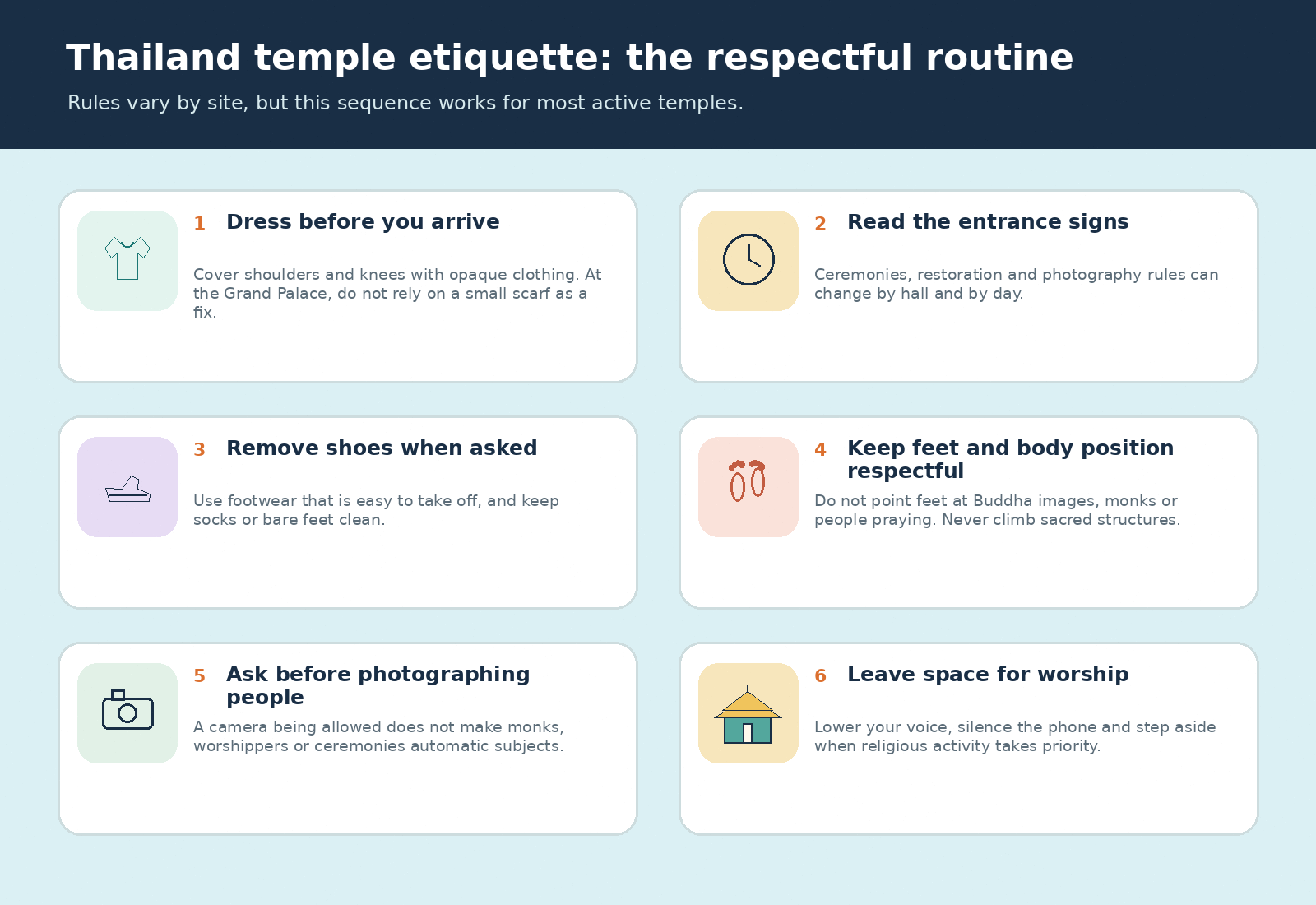
Temple etiquette is less intimidating than it first appears. Most mistakes come from rushing: visitors reach the doorway, discover their shoulders are uncovered, carry shoes into the wrong area, then focus so hard on the rules that they stop observing what local worshippers are doing. Use the same routine at every site and apply the stricter Grand Palace standard whenever you are uncertain.
Cover shoulders, chest and knees
Opaque clothing that covers the shoulders and knees is the safest general standard for all genders. At the Grand Palace, loose full-length trousers and a sleeved top are the sensible default because its published exclusions are more detailed than the common ‘shoulders and knees’ summary. A thin scarf can help at some smaller temples but should not be your only plan for Wat Phra Kaew.
Remove shoes, hats and sunglasses when the space requires it
Shoe racks, rows of footwear and signs usually mark the boundary. Slip-on shoes save time, although comfort matters more than speed because temple days involve hard paving, stairs and long walks. Keep socks clean if you prefer not to walk barefoot. Hats and sunglasses should come off in prayer halls unless a health or accessibility need makes that impractical.
Keep feet and body position respectful
Feet are culturally treated as the lowest part of the body. Do not point them towards Buddha images, monks or people sitting nearby. When sitting on the floor, tuck your legs to one side or kneel in a position you can hold comfortably. At low sacred images, avoid standing directly over them for a photograph.
Photography permission is specific, not universal
A camera being allowed in the courtyard does not mean it is allowed inside every hall. Look for signs, watch staff instructions and never use flash near worship or fragile murals. Avoid blocking doorways, prayer lines and processions. Drones require separate legal and site permission; the Grand Palace explicitly identifies its area as a no-drone zone.[1]
Treat monks and ceremonies as real life, not performance
Do not interrupt chanting, alms-giving, funerals, ordinations or private prayer for a photograph. Women should not touch monks or hand objects directly to them; place an item down or follow the monk’s instruction. A ceremony may close part of a hall without notice, and that is not poor attraction management. Worship takes priority.
Donations are voluntary unless a ticket is stated
A posted foreign admission is a ticket, not a donation. Elsewhere, donation boxes support the temple but should not be confused with a mandatory fee. Small notes are useful for flowers, candles or respectful donations, although visitors should not copy a ritual they do not understand simply because it looks photogenic. When uncertain, observe quietly or ask a guide.
What to wear and carry on a Thailand temple day
The best temple clothing is ordinary clothing you can wear for the rest of the day. A special ‘temple outfit’ that is too hot, transparent in sunlight or awkward on stairs solves one rule and creates three new problems. Choose breathable fabrics, secure pockets and pieces that dry quickly after rain. Neutral colours are practical, but there is no need to dress entirely in beige.
| Item | Useful features | Pros | Watch-outs | Comparison link |
|---|---|---|---|---|
| Lightweight travel trousers | Opaque fabric, loose knee movement, zipped pocket, fast drying | Works at strict sites and on overnight transport | Very thin fabric can become transparent; wide hems drag on wet steps | Compare travel trousers |
| Sleeved overshirt | Breathable, full shoulder coverage, easy to layer | Turns a vest or T-shirt into a more suitable outfit | Must genuinely cover the shoulder and not be sheer | Compare lightweight overshirts |
| Compact umbrella | UV/rain use, wind-resistant frame, wrist strap | Useful for exposed ruins and sudden showers | Close it before entering halls and avoid crowding others | Compare compact umbrellas |
| Secure crossbody bag | Zipped compartments, fits shoes bag and water, sits close to body | Keeps hands free on stairs and boats | Oversized bags become awkward in crowded interiors | Compare travel crossbody bags |
| Comfortable slip-on shoes | Grippy sole, broken-in upper, quick removal | Faster at repeated shoe-off entrances | Easy removal is useless if the shoe causes blisters | Compare slip-on walking shoes |
A practical temple-day packing list
- Refillable water bottle, especially for Ayutthaya, Sukhothai, Wat Arun and Doi Suthep.
- Small notes and coins for local ferries, modest admissions, lockers, offerings or toilets.
- Sun protection that can be removed quickly indoors: hat, sunscreen and sunglasses.
- A light rain layer or compact umbrella during wetter months.
- A small reusable bag for carrying shoes when racks are crowded or wet.
- Phone data, offline map and screenshots of hotel details in case a driver needs the Thai place name.
- Prescribed medication and any mobility support you normally use; do not rely on every site being step-free.
The Thailand packing list expands this into clothing for cities, beaches, rain and onward travel. For mobile navigation, compare local SIM and eSIM choices in the Thailand SIM card and eSIM guide; travellers who prefer an eSIM can also check current Airalo Thailand plans before departure.
Four realistic Thailand temple itineraries
The routes below show how the shortlist works in practice. They leave time for transport, shade, meals and the fact that a temple visit is slower when you read, observe and remove shoes rather than moving from one photograph to the next. Start times should change with weather, ceremonial closures and personal energy.
Bangkok: one concentrated temple day
| Time | Plan | Why it is realistic |
|---|---|---|
| 08:15 | Reach the Grand Palace entrance | Allows ticket and dress checks near opening |
| 08:30-11:00 | Grand Palace and Wat Phra Kaew | Enough time for the compound without racing |
| 11:10-12:40 | Wat Pho | Short walk and a different, more spacious monastery |
| 12:40-13:40 | Lunch and water break | Prevents the hottest part becoming a forced march |
| 13:45-15:15 | Ferry and Wat Arun | River crossing breaks up the day |
| 15:30 onward | Stop, or continue to Wat Saket if conditions suit | Treats the fifth stop as optional rather than compulsory |
Chiang Mai: two contrasting half-days
Use the first morning for Doi Suthep and Wat Pha Lat with a driver, songthaew or guided route. Return for lunch and keep the afternoon light. On the second morning, walk from Wat Phra Singh to Wat Chedi Luang, adding Wat Phan Tao only when the group still wants another architectural layer. This split protects the mountain visit from Old City fatigue and makes each temple easier to remember.
Chiang Rai: one day from a Chiang Rai base
Start at Wat Rong Khun near opening, return towards the city for lunch, then visit Wat Rong Suea Ten and Wat Huay Pla Kang. A private driver gives the most control, while a small-group tour can reduce negotiation and navigation. Avoid adding the Golden Triangle unless that region is a genuine priority; the detour can turn a temple-focused day into many hours in a vehicle.
Historic capital: choose one full day, not two rushed halves
From Bangkok, Ayutthaya is the efficient choice. Stay overnight if you want quiet morning ruins and a less hurried late afternoon. Between Bangkok and Chiang Mai, Sukhothai is a stronger landscape experience but needs more route planning and at least one night. Trying to include both on a short first trip usually duplicates the historic-ruin role while taking time away from northern or southern Thailand.
Temple costs, transport and accommodation
Temple admissions are usually a small part of the total day. The expensive elements are private transport, long-distance travel, accommodation chosen solely for one early start and guided tours whose inclusions are unclear. Budget the complete day rather than comparing only entrance fees. Cash remains useful even when major sites accept cards or online booking.
Current official fees and sensible planning allowances
| Site | Published or planning amount | Confidence | What to recheck |
|---|---|---|---|
| Grand Palace and Wat Phra Kaew | 500 THB foreign adult | Official current listing | Daily schedule and ticket cutoff |
| Wat Pho | 300 THB foreign adult | Official visitor listing | Hall access and service arrangements |
| Wat Arun | Budget about 200 THB | Planning allowance due to inconsistent online figures | Gate price and last admission |
| Wat Saket | Budget about 100 THB | Planning allowance | Upper-mount access and festival changes |
| Doi Suthep | Small temple fee plus optional lift | On-site arrangement can vary | Lift operation, admission and road conditions |
| Wat Phra Singh / Wat Chedi Luang | Budget 40-50 THB each | Modest local fee range | Which halls or compounds are ticketed |
| Wat Rong Khun | Reported 200 THB foreign admission in 2026 | Recent change; verify | Included art areas and last entry |
| Wat Rong Suea Ten / Wat Chalong | Generally free; donations welcome | Common current arrangement | Ceremony or restricted-area access |
| Ayutthaya Historical Park | 80 THB individual site or 300 THB multi-site option | Current Fine Arts Department English listing | Which ruins the pass covers |
| Sukhothai Historical Park | 200 THB central; 400 THB combined option | Current Fine Arts Department English listing | Zone hours, bike/cart fee and Saturday schedule |
Typical total day budgets
| Day | Independent planning range | Guided planning range | Main variable |
|---|---|---|---|
| Bangkok big three | 1,100-2,000 THB per person | 1,800-4,500+ THB | Palace ticket, food, boat/taxi and tour inclusions |
| Doi Suthep and Wat Pha Lat | 250-900 THB per person | 900-2,500+ THB | Shared songthaew versus private or guided vehicle |
| Chiang Rai temple circuit | 500-1,500 THB per person | 1,200-3,500+ THB | Number sharing the car and how far the route extends |
| Ayutthaya from Bangkok | 700-1,800 THB per person | 1,300-3,500+ THB | Train class, local tuk-tuk, lunch and river-cruise return |
| Sukhothai park day | 600-1,500 THB excluding long-distance travel | 1,500-3,500+ THB | Bike/cart/driver and number of zones |
| Wat Chalong within Phuket | 0-1,000 THB per person | 1,000-3,000+ THB | Whether it is part of a driver or island tour |
Booking long-distance transport
For Bangkok-Chiang Mai rail and bus comparisons, use 12Go Asia and then confirm operator details, station names and luggage rules. The transport in Thailand guide explains why the cheapest listing is not always the best connection. Leave a buffer after historic-park days; heat, rain and local transfers make a last-minute station dash a poor finish.
Choosing where to sleep
Stay near the experience that benefits from an early start. In Bangkok, that may mean old-city or riverside access for one temple morning, although a rail-connected base can be better for the rest of the stay. In Chiang Mai, the Old City supports walking; in Chiang Rai, a central hotel simplifies dinner and driver pickup. Sukhothai travellers should distinguish New Sukhothai from accommodation near the historical park before booking.
| Base | Best area logic | Useful comparison links |
|---|---|---|
| Bangkok | Old City/riverside for temple priority; BTS/MRT area for a broader city trip | Booking.com or Agoda |
| Chiang Mai | Inside or just outside the Old City for walking temples | Booking.com or Agoda |
| Chiang Rai | Central base for food and early driver pickup | Booking.com or Agoda |
| Ayutthaya | Historic-island edge or river area for early/late ruins | Booking.com or Agoda |
| Sukhothai | Near historical park for sunrise and cycling; New City for more ordinary services | Booking.com or Agoda |
For a wider cost framework, see the Thailand travel budget guide. Weather can change outdoor ruins and mountain views more than it changes indoor sightseeing, so also check the best time to visit Thailand guide and the official Thai forecast close to the day.[18]
Pros and cons of building a Thailand trip around temples
| Advantages | Trade-offs |
|---|---|
| Temples connect architecture, religion, history and ordinary community life in one visit. | A rapid checklist can create temple fatigue and reduce sacred spaces to photo stops. |
| Many major sites are inexpensive compared with theme parks or long excursions. | Transport, heat and strict timing can cost more energy than the admission suggests. |
| Bangkok and Chiang Mai offer several strong temples within compact areas. | Headline sites attract crowds, and quiet worship may be difficult at peak times. |
| Historic parks add cycling, landscape and archaeology to a city-heavy itinerary. | Ayutthaya and Sukhothai need a full day and can feel punishing in midday sun. |
| A guided visit can reveal symbolism and historical context that signage misses. | Some tours are built around shopping stops, rushed photography or vague inclusions. |
| Temple days can work across many budgets and ages when the route is adjusted. | Stairs, shoe removal, uneven surfaces and limited shade create accessibility challenges. |
When a temple-heavy itinerary works
A temple-focused route suits travellers interested in art, history, architecture, religion, photography and slow observation. It also works well when the trip moves through Bangkok, northern Thailand and one historic capital, because each region contributes a visibly different tradition. The route becomes weaker when every stop is chosen for a similar gold-and-red interior or when temples displace all food, nature and neighbourhood time.
When to reduce the list
Cut the list for very young children in extreme heat, limited mobility, short island-focused holidays or travellers who enjoy temples only in small doses. A single well-timed Wat Pho visit can add more to a Bangkok stay than five rushed compounds. Likewise, one Sukhothai cycling day can replace several individual temple stops because the park already provides architecture, landscape and history together.
Common Thailand temple mistakes
Starting too late
The Grand Palace, exposed ruins and mountain roads are least forgiving once heat and crowds build. Put the most rule-bound or outdoor stop first.
Wearing a scarf as the whole dress plan
A wrap may help at some temples, but the Grand Palace’s official restrictions are more specific. Wear suitable trousers or skirt and a sleeved top.
Believing a stranger who says a site is closed
Check the official schedule or entrance. Closure scams often redirect visitors towards shops, boats or tuk-tuk circuits.
Booking a tour by title alone
Read every stop, admission, meal, pickup area and shopping visit. ‘Bangkok temples’ can describe very different products.
Treating active worship as theatre
Do not interrupt prayer, chanting, funerals, ordinations or offerings. A restricted hall is not an inconvenience to argue about.
Adding too many similar temples
After the third comparable hall, details merge. Replace quantity with a museum, food stop, river ride or quiet neighbourhood walk.
Ignoring the return journey
A final ruin at sunset is not relaxing when the train, bus or driver departs immediately afterwards. Build a realistic exit buffer.
Choosing footwear only for easy removal
Slip-on shoes still need grip and cushioning. Wat Arun steps, Golden Mount paving and historic parks punish flimsy soles.
Honourable mentions worth adding to the right route
A list of twelve cannot represent every region or style. The following temples are useful additions when they fit the journey, but none is a mandatory detour for every first-time visitor.
| Temple | Where | Why add it | Why it missed the main 12 |
|---|---|---|---|
| Wat Traimit | Bangkok Chinatown | Famous solid-gold Buddha and easy pairing with Yaowarat | Best when Chinatown is already in the plan; less varied as a standalone temple day |
| Wat Benchamabophit | Dusit, Bangkok | Elegant marble architecture and quieter grounds | Less convenient to combine with the old-city big three |
| Wat Pha Lat | Doi Suthep road, Chiang Mai | Wooded setting and a contemplative contrast | Best as part of the Doi Suthep route rather than a national top-12 standalone stop |
| Wat Huay Pla Kang | Chiang Rai | Large hilltop complex and strong views | Often mislabelled online and better understood within a Chiang Rai circuit |
| Wat Phra That Lampang Luang | Lampang | Exceptional fortified Lanna compound | Requires a Lampang route or deliberate detour |
| Wat Phra Mahathat Woramahawihan | Nakhon Si Thammarat | Major southern pilgrimage temple with deep regional importance | Less convenient for the most common first-trip route |
| Wat Yai Chai Mongkhon | Ayutthaya | Large reclining Buddha and rows of seated images | Included naturally in an Ayutthaya park day rather than listed separately |
| Wat Si Chum | Sukhothai north zone | Memorable enclosed seated Buddha | Best seen as part of a complete Sukhothai itinerary |
Frequently asked questions about Thailand temples
What is the most famous temple in Thailand?
Wat Phra Kaew, inside Bangkok’s Grand Palace, is usually the most nationally significant and widely recognised temple for first-time visitors. Wat Arun, Wat Pho, Doi Suthep and Wat Rong Khun are also internationally famous, although each offers a different experience.
How many temples should I visit on a first trip to Thailand?
Six to eight carefully chosen temples across two or three regions is enough for most first trips. In practice, that might mean Bangkok’s big three, two Chiang Mai temples, one Chiang Rai temple and either Ayutthaya, Sukhothai or Wat Chalong. Quality and contrast matter more than the total.
Can I wear shorts in Thai temples?
Do not rely on shorts being accepted. Knees and shoulders should generally be covered, and the Grand Palace publishes stricter restrictions that make loose full-length trousers or a below-knee skirt the safer choice. Rules can be enforced differently by site and building.
Do men and women follow the same temple dress rules?
Both should wear modest, opaque clothing that covers shoulders and knees. Site-specific rules can be more detailed. Women should also avoid physical contact with monks and follow local instructions for passing objects or sitting near monastic areas.
Do I have to remove my shoes at every Thailand temple?
Shoes are normally removed before entering prayer halls and other marked sacred interiors, but not necessarily across an entire outdoor compound. Follow signs, shoe racks and local behaviour. Slip-on shoes help, provided they are comfortable and grippy.
Is Wat Arun or Wat Pho better?
Wat Pho is the better first temple when you want a broad monastery experience, interpretation and the Reclining Buddha. Wat Arun is better for river atmosphere, exterior architecture and views. They are close enough to visit together, which is usually the strongest choice.
Is Ayutthaya or Sukhothai better?
Ayutthaya is better for an easy day trip or overnight extension from Bangkok. Sukhothai is better for a spacious cycling day and a quieter historic landscape, but it requires more travel. Choose the park that fits the route rather than trying to include both on a short trip.
Do I need a tour to visit Thailand’s temples?
No. Bangkok’s big three, Chiang Mai Old City temples and the central zones of the historic parks can be visited independently. A tour or private driver adds value for historical interpretation, mountain routes, dispersed Chiang Rai sites, mobility needs or travellers who prefer door-to-door logistics.
Can I take photographs inside Thai temples?
Photography rules vary by temple and by room. Exterior photography is widely allowed, while flash, tripods or all photography may be prohibited inside specific halls. Read signs, follow staff and never photograph worshippers closely without permission.
What is the best time of day to visit Thai temples?
Early morning is usually best for the Grand Palace, exposed historic parks, Doi Suthep and Wat Rong Khun because temperatures are lower and crowds often smaller. Late afternoon can suit Wat Arun views and some ruins, but closing times and return transport must be checked first.
Are Thailand’s temples accessible for wheelchair users?
Accessibility varies sharply. The Grand Palace publishes accessibility information, while many older compounds include thresholds, stairs, uneven paving and shoe-removal areas. Contact the site or tour provider in advance, describe the exact mobility need and do not assume a lift makes the whole complex step-free.
How much cash should I carry for a temple day?
For a Bangkok big-three day, 1,500-2,000 THB per person comfortably covers current admissions, local transport, water and a meal, excluding an expensive tour. Elsewhere, several hundred baht is usually enough for admissions and local costs, but carry extra for transport changes and avoid displaying a large amount.
The temple route I would recommend for a first Thailand trip
For a first two-week route, I would keep the temple plan deliberately selective. Begin with the Grand Palace and Wat Phra Kaew, Wat Pho and Wat Arun in Bangkok. In Chiang Mai, split Doi Suthep and Wat Pha Lat from the Old City pair of Wat Phra Singh and Wat Chedi Luang. Then choose one additional layer: Chiang Rai for contemporary art, Sukhothai for a cycling landscape, Ayutthaya for the easiest historic-capital day or Wat Chalong when Phuket is already in the itinerary.
That plan produces royal, living-monastery, river, mountain, Lanna and historic or contemporary experiences without turning the holiday into a temple endurance test. It also leaves room for food, markets, nature and ordinary neighbourhoods, which help explain the country around the monuments. The final decision should always favour route logic: the best temple is the one that adds a new dimension without forcing a wasteful detour.
Sources and fact-checking method
Visitor information was checked on 10 September 2026 against official royal-household, temple, Tourism Authority of Thailand, UNESCO, Thai Fine Arts Department, weather and government-advice sources. Admissions, opening hours, ceremonies, conservation work and transport can change after publication. When two official pages conflict, the live entrance notice and the most recent official schedule should take priority.
- The Grand Palace – practical visitor information. Official foreign admission, opening hours, ticket cutoff, transport, dress restrictions and no-drone rule.
- The Grand Palace – visitor FAQ. Official ticket validity, child-height concession, online booking and visitor guidance.
- Wat Pho – plan your visit. Official admission, opening hours, dress, footwear, photography and conduct guidance.
- Tourism Authority of Thailand – five Bangkok temples. Official tourism context and published visitor hours for Wat Arun and Wat Saket.
- Tourism Authority of Thailand – Wat Phra That Doi Suthep. Official attraction context for Chiang Mai’s mountain temple.
- Tourism Authority of Thailand – self-driving Chiang Mai. Official route context linking Wat Pha Lat and Doi Suthep.
- Tourism Authority of Thailand – Wat Phra Singh. Official attraction context for the Old City royal monastery and Lanna heritage.
- Tourism Authority of Thailand – Wat Chedi Luang. Official attraction context for Chiang Mai’s great chedi and temple compound.
- Chiang Mai City Arts and Cultural Centre. Official municipal heritage context useful before interpreting Lanna temples and the Old City.
- Tourism Authority of Thailand – Wat Rong Khun. Official tourism context for Chiang Rai’s White Temple.
- Tourism Authority of Thailand – Wat Rong Suea Ten. Official tourism context for Chiang Rai’s Blue Temple.
- Tourism Authority of Thailand – four-day Chiang Rai route. Official regional route context for combining Chiang Rai cultural attractions.
- UNESCO – Historic City of Ayutthaya. World Heritage status, historical significance and site context.
- Fine Arts Department – Ayutthaya Historical Park map and visitor information. Current park opening information and published foreign visitor ticket options checked for this guide.
- UNESCO – Historic Town of Sukhothai and Associated Historic Towns. World Heritage status, historical significance and protected-area context.
- Fine Arts Department – Sukhothai Historical Park map and visitor information. Current zone hours and published foreign visitor ticket options checked for this guide.
- Tourism Authority of Thailand – Wat Chalong. Official tourism context for Phuket’s important active Buddhist temple.
- Thai Meteorological Department – seven-day forecast. Official weather and warning information for outdoor temple days.
- UK Foreign, Commonwealth & Development Office – Thailand safety and security. Current travel-safety context covering roads, transport, insurance and local conditions.
- Wat Arun – official contact and opening information. Temple-published opening arrangements for individual areas and evidence that official visitor pages do not present one fully consistent schedule or current fee.
- Khaosod English – White Temple 2026 admission change. Reported foreign admission increase to 200 THB from 1 January 2026, Cave of Art inclusion and published age and child-height concessions.
- The Grand Palace – official schedule. Current daily schedule and warning that calendar details may change.
Illustrations in this article were created for Taylor’s Trailblazing Travels. Third-party photographs, where used, are credited beside the image or in the source list.