Koh Chang Itinerary 2026: A Realistic 5-Day Island Plan
A weather-smart route through west-coast beaches, Koh Rang waters, rainforest, quieter eastern villages and the ferry details that shape the whole trip.
Beaches, reef and rainforest
Ferry and budget planning
Koh Chang is large enough to feel adventurous, yet its roads, ferry and weather make a slow plan far more useful than a crowded checklist.
This Koh Chang itinerary 2026 is designed for a first visit of five days and four nights, with one important rule: the boat trip moves to the calmest forecast day. The route gives the west coast enough time to breathe, keeps Khlong Phlu Waterfall separate from the sea day and treats the east coast as a deliberate outing rather than an easy detour.
The plan is research-led rather than a claim of personal travel. It combines current transport information, official safety and entry guidance, recent price checks and the practical geography of an island where the main road does not form a complete loop. As a result, transfer time is shown honestly and changeable figures are labelled as September 2026 planning ranges.
Travellers with five nights can give Day 5 fully to Salak Khok or Salak Phet and leave on Day 6. With four nights, Day 5 should remain a departure buffer unless the return ferry is late enough to leave a safe margin.
Klong Prao
Central for Khlong Phlu, broad beaches and short rides north or south, without the busiest White Sand atmosphere.
Kai Bae plus Koh Rang
Use Kai Bae for the west-coast viewpoint, then choose the clearest safe boat day for reefs around Koh Rang.
Shared van and one base
A through-ticket from Bangkok and four nights in one area removes extra taxi journeys and hotel changes.
The island road is not a loop
West and east coast plans do not connect around the far south. Repeated cross-island days waste time and money.
This version assumes four nights on the island. It works best when Day 1 reaches the hotel by mid-afternoon and Day 5 has no same-day long-haul flight. Travellers arriving late should add a fifth night rather than borrowing time from the boat day.
| Day | Main area | Core plan | Weather or timing rule |
|---|---|---|---|
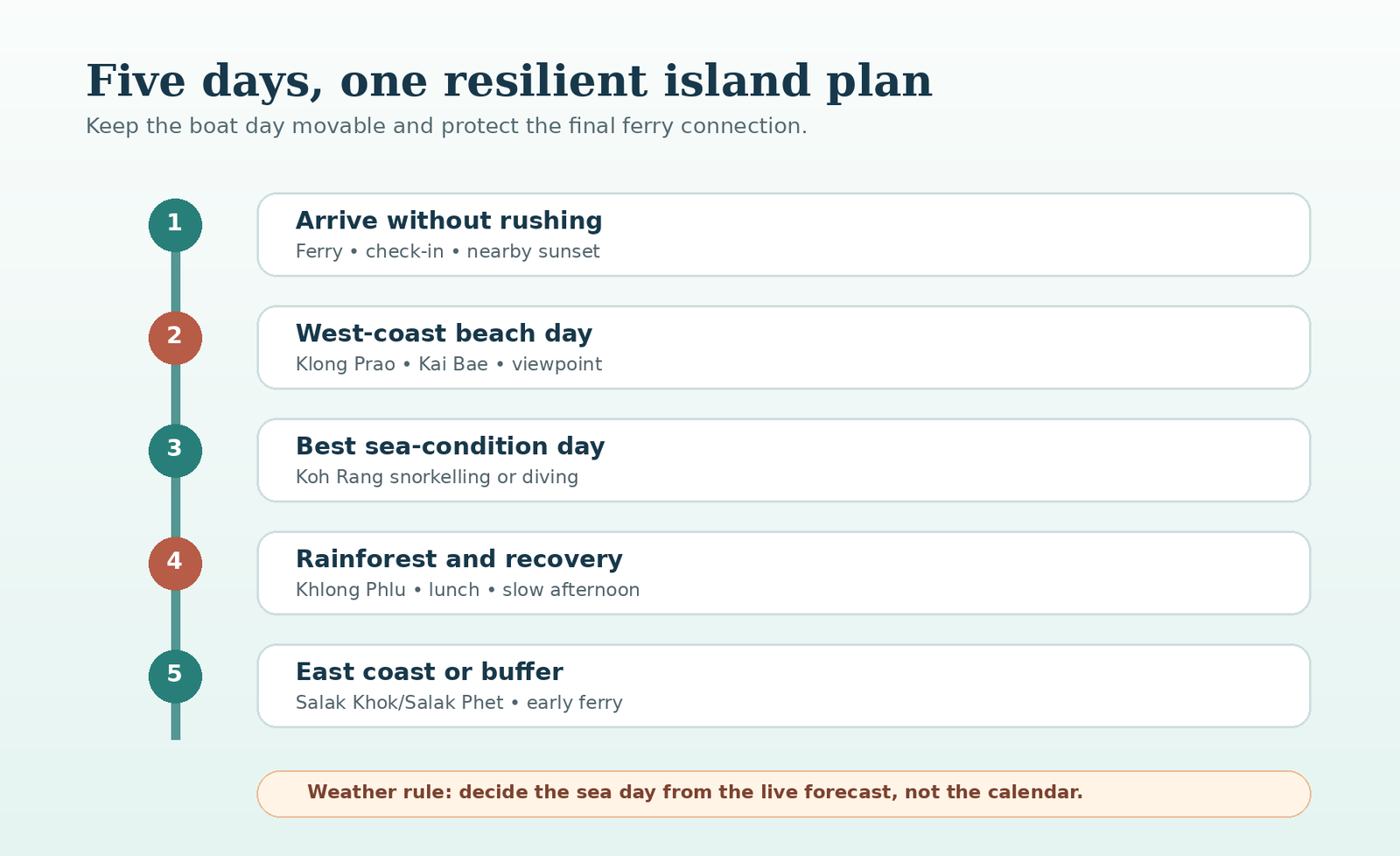
| 1 | Ferry and west-coast base | Arrive, check in, orientate locally and choose a nearby sunset. | No fixed activity attached to the transfer. |
| 2 | Klong Prao and Kai Bae | Beach morning, relaxed lunch, viewpoint and an easy evening. | Swap with Day 4 after heavy rain. |
| 3 | Koh Rang or southern islets | Full-day snorkelling, diving or a private boat chosen by sea conditions. | Move this to the calmest safe forecast day. |
| 4 | Khlong Phlu and central west coast | Early waterfall walk, lunch, then pool, massage, café or beach time. | Follow park instructions after heavy rain. |
| 5 | East coast or departure route | Salak Khok or Salak Phet with a driver, or a protected ferry departure. | Do not risk the final mainland connection. |
The order is a framework, not a promise
A calendar cannot know whether the sea will be calm on Tuesday. Check the Thai Meteorological Department, the operator’s morning decision and local flags, then move the marine day accordingly. The beach, waterfall and slow-afternoon elements are deliberately easier to swap.
Who should add another night
Add a fifth island night when travelling with children, arriving after 15:00, depending on public transport, planning a dive day or combining Koh Chang with Koh Mak or Koh Kood. The extra night does not need another attraction; it protects the activities already worth doing.
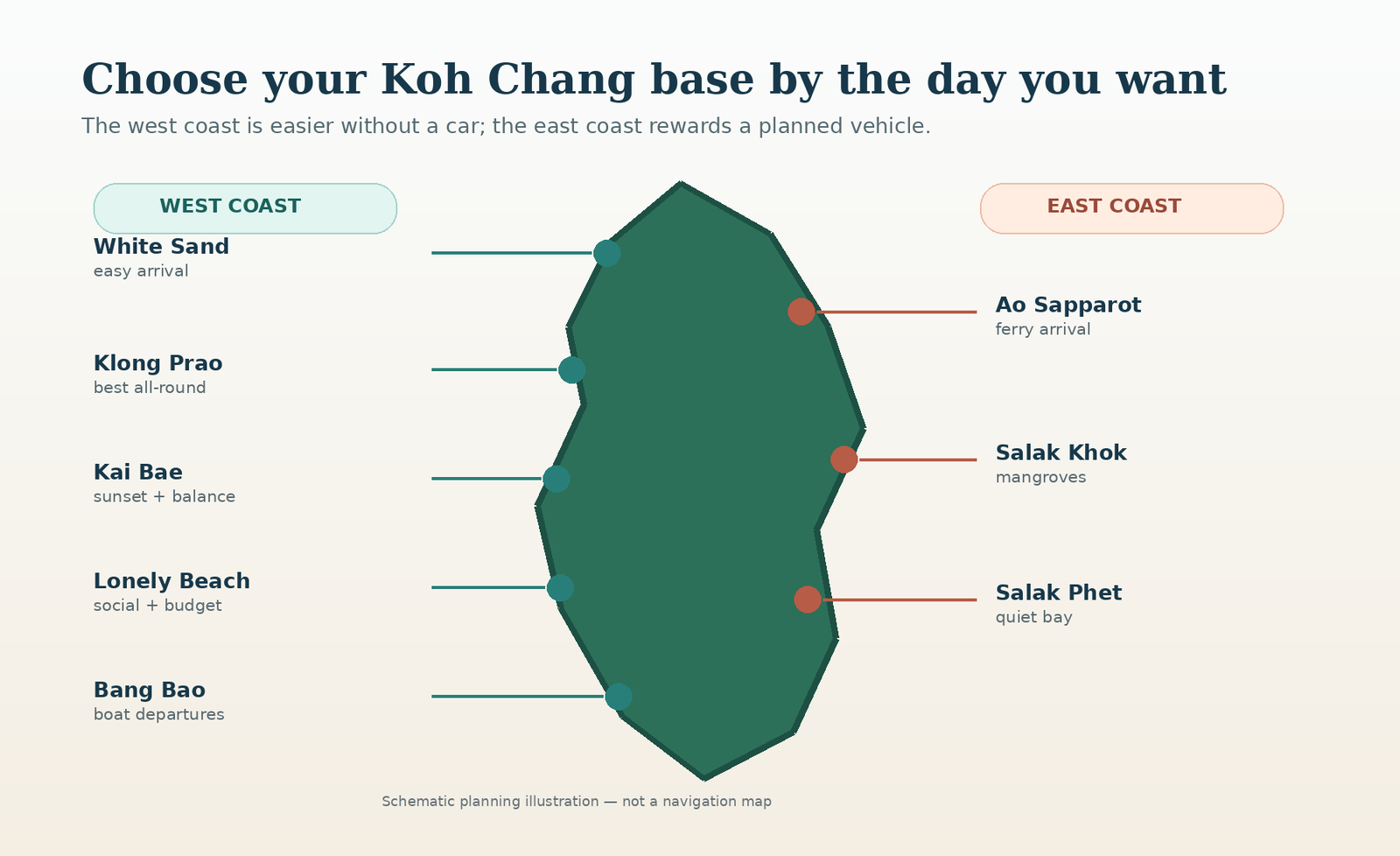
One well-chosen west-coast base is more useful than two check-ins. Klong Prao is the strongest all-round answer, while Kai Bae suits travellers who want more evening choice and a scenic viewpoint close by.
| Area | Best for | Why it works | Main trade-off |
|---|---|---|---|
| White Sand Beach | Short stays, first-night ease and plentiful services | Closest major resort strip to the ferry, with shops, food and frequent shared taxis. | Busiest feel and less central for southern boat piers. |
| Klong Prao | Most first-time couples and families | Long beach, central location and straightforward access to Khlong Phlu. | Some resorts sit far apart, so check the exact map pin. |
| Kai Bae | Restaurants, sunsets and a livelier walkable base | Balanced position between Klong Prao and the southern coast, with the viewpoint nearby. | Hillier road sections begin south of the village. |
| Lonely Beach and Bailan | Social evenings and lower-cost rooms | More informal atmosphere and access to the southern half of the west coast. | Longer, steeper road from the ferry and variable nightlife noise. |
| Bang Bao and Klong Kloi | Boat-focused stays and a slower southern mood | Useful for departures from Bang Bao and relaxed beach time after day-trippers leave. | Expensive or infrequent rides to northern sights. |
| East coast | Quiet stays, self-drivers and repeat visitors | Closer to mangroves, communities and a less developed shoreline. | Limited public transport and no road around the far south to Bang Bao. |
Check the pin, not only the beach name
A property can use a familiar beach label while sitting inland, up a steep lane or several kilometres from the part of the village you expected to walk. Before paying, check the exact map position, the route to sand, whether breakfast is nearby and the price of a return ride after dinner.
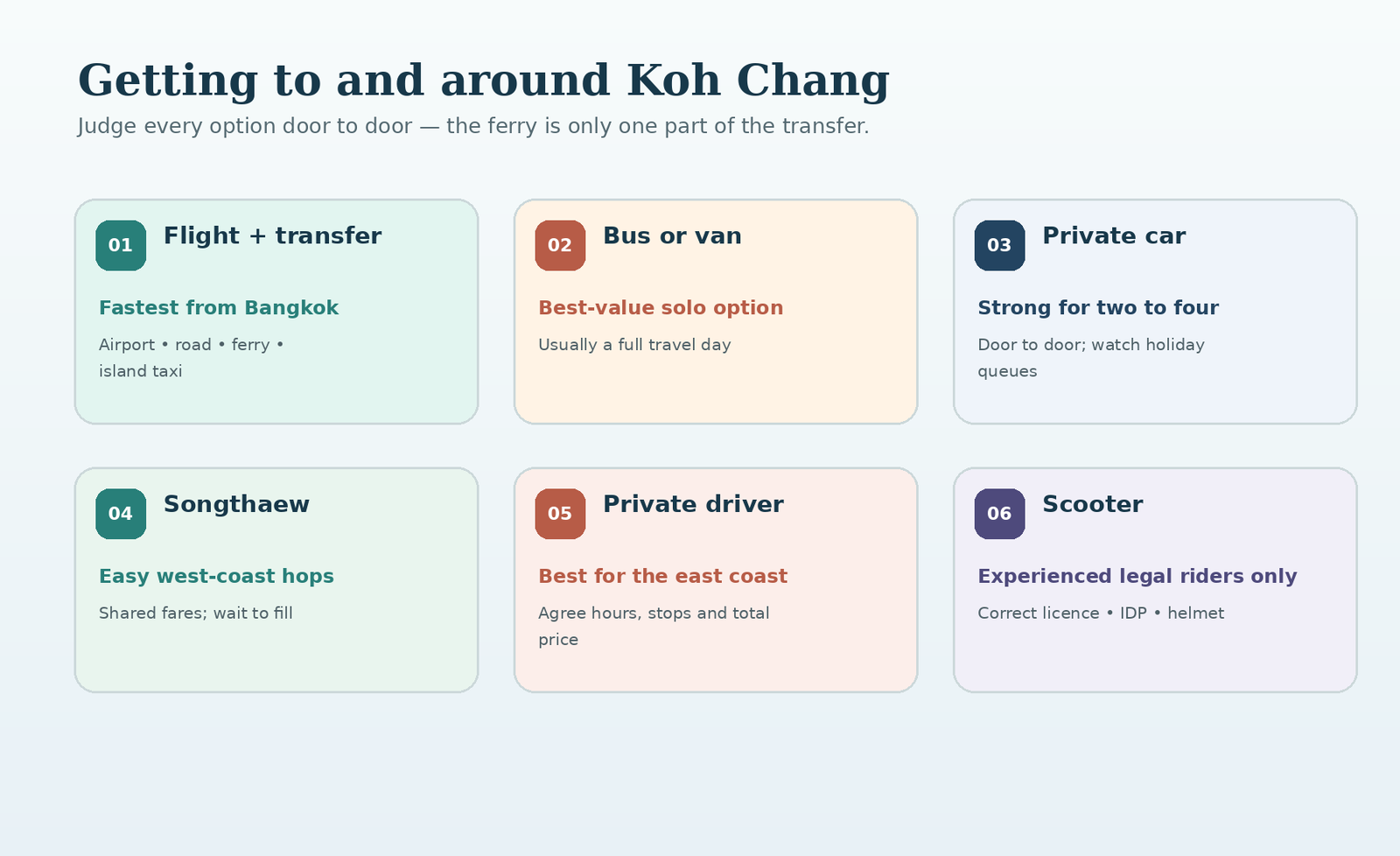
Koh Chang has no passenger airport. Every route finishes with a road journey to Trat’s coast, the vehicle ferry to Ao Sapparot and a final island transfer. A 30-minute crossing can therefore sit inside a six-to-ten-hour travel day.
Choose the Bangkok route by door-to-door time
The principal 2026 service runs between Ao Thammachat on the mainland and Ao Sapparot on Koh Chang. A current local timetable lists departures from about 06:30 to 18:30, often hourly outside peak periods and more frequently when busy. It also reports that the former Trat Ferry/Centrepoint operation remains suspended, so old articles describing two normal alternatives can create a costly detour.[3]
| Option | Planning time | Best for | What to verify | Typical 2026 range |
|---|---|---|---|---|
| Flight to Trat plus transfer | About 4.5–7 hours door to door | Short trips and travellers prioritising time | Flight day, baggage, pier connection and last ferry | Often 4,000–9,000+ THB per person |
| Combined bus/van and ferry | About 6–10 hours | Solo travellers and value | Exact Bangkok pickup, hotel drop-off and ferry inclusion | About 850–1,100 THB in live September searches |
| Private road transfer | About 5–7 hours before peak queues | Two to four people, families and bulky luggage | Ferry fare, tolls, hotel zone and waiting policy | Roughly 3,900–7,000 THB per vehicle |
| Self-drive car | About 5–8+ hours | Confident drivers planning the east coast | Rental permission, ferry queues, insurance and night driving | Rental, fuel, tolls and ferry priced separately |
Planning ranges checked in September 2026; live fares change by date, vehicle, baggage and pickup point. A 12Go search showed several through-options from Bangkok, while Bangkok Airways continued to publish Bangkok–Trat schedules for selected dates.[5][6]
Entry checks for British travellers
Rules can change faster than an itinerary. On the 11 September 2026 check, FCDO guidance said a full British-citizen passport needed six months’ validity after arrival and at least one blank page. It also said the visa-exemption stay would be up to 30 days for entries from 15 September 2026, while every foreign arrival must complete the free Thailand Digital Arrival Card online within three days before arrival. Other nationalities need their own official check.[7]
Trat’s border context needs a live check
Koh Chang itself was not within the FCDO’s current 20-kilometre land-border exclusion on the research date. However, advice around the Thailand–Cambodia border had changed during 2025 and 2026. Read the current warning before travelling overland in Trat, especially when adding a Cambodian crossing rather than simply visiting the island.[8]
Day 1 is successful when you reach the right hotel, eat well and finish without another long vehicle journey. The island’s steep, twisting road south of Kai Bae makes a late cross-island dash a poor opening decision.
Reach the hotel and reset
Take the waiting songthaew or pre-arranged transfer from Ao Sapparot. Confirm the fare before boarding, keep valuables with you and expect the vehicle to wait until enough passengers are travelling in the same direction.
Stay within one beach area
Walk the nearby sand, find drinking water and check tomorrow’s pickup arrangements. White Sand, Klong Prao and Kai Bae each have enough food and services for an unplanned first evening.
Choose the sunset by your base
White Sand offers the easiest arrival-day beach when staying in the north. Klong Prao gives more room and a softer resort mood, while Kai Bae works well when the hotel is already south of Klong Prao. The Kai Bae viewpoint is attractive, but only add it when transport back is clear and daylight remains generous.
Do not spend the evening relocating
Changing hotels after one night looks efficient on a map, yet it creates packing, checkout, taxi and check-in time. For a five-day stay, remain in one west-coast base unless the second hotel is the main purpose of the trip.
Koh Chang’s west coast works best as two or three connected experiences, not a beach-counting exercise. Start near your base, move once after lunch and protect the late afternoon for the viewpoint or a long swim.
Morning: Klong Prao at an unhurried pace
Begin before the strongest heat with a walk or swim close to the hotel. Klong Prao is long enough that the exact section matters: river mouths, resort frontage and access lanes can change the feel. Follow flags, ask about currents and keep away from channels used by boats or kayaks.
Midday: use shade rather than another transfer
Take a proper lunch, café break or pool interval through the hottest hours. This is also the moment to reconfirm the next morning’s marine pickup. A second distant beach at noon rarely adds more than road time and sun exposure.
Late afternoon: Kai Bae and the viewpoint
Move south to Kai Bae when the road and weather are clear. The village adds restaurants and a livelier evening without requiring the longest road journey to Lonely Beach or Bang Bao. Visit the viewpoint with enough daylight to cross the road carefully and arrange the return before sunset crowds disperse.
Evening: pick one food area
White Sand’s food stalls suit travellers based nearby; Klong Prao is useful for simple local meals and takeaways; Kai Bae offers a broader walkable mix. A realistic allowance is roughly 60–150 THB for a simple local main, 150–350 THB for a market-style evening and more for seafood sold by weight. Check the menu and price before ordering large seafood plates.
The strongest snorkelling is normally reached by boat around Koh Rang and southern islets rather than assumed from every main-island beach. The route, vessel and sea state matter more than the number of advertised stops.
| Choice | Planning price | Advantages | Trade-off | Best for |
|---|---|---|---|---|
| Large wooden boat | About 690–900 THB | Good value, lunch often included and steadier than a small speedboat | Long day, larger group and slower transfers | Budget first-timers |
| Speedboat | About 1,000–1,500 THB | Faster access and more time in the water on a suitable day | Harder ride in chop and less shelter | Confident swimmers short on time |
| Private boat | From about 7,500 THB per boat | Flexible pace and useful for families or groups | High total cost and still weather-dependent | Groups valuing control |
| Scuba diving | Operator and qualification dependent | More depth, instruction and wreck or reef options | Needs appropriate credentials, insurance and safety checks | Certified divers or a proper introductory programme |
September 2026 planning examples; park entry, pickup, equipment, meals and insurance treatment vary. Recent guides placed many Koh Rang trips around these ranges and commonly listed a separate 200 THB foreign-adult park fee.[13]
Ask five questions before paying
- Which islands or reef zones are planned, and can the route change for conditions?
- Is the national-park fee included or collected separately?
- How many guests are carried, and what flotation equipment is available?
- Are hotel pickup, lunch, drinking water and snorkelling equipment included?
- What happens when the operator cancels or shortens the trip for weather?
For divers, safety checks are part of the booking
Ask to see the operator’s credentials, confirm oxygen and emergency arrangements, inspect equipment and read the diving section of your insurance. FCDO guidance specifically advises checking instructor qualifications, equipment condition and the plan for medical transfer.[8]
Leave the evening easy
A full boat day can involve early pickup, sun, motion and several hours in the water. Plan dinner near the hotel and avoid attaching a long private taxi booking to the return time. Delays are ordinary when conditions or boarding points change.
The waterfall day is deliberately shorter than the boat day. Go early, judge the path and water on arrival, then use the afternoon for recovery rather than forcing a second major excursion.
Morning: reach the park near opening
Recent 2026 visitor information lists Khlong Phlu at about 08:00–16:30, with a roughly 600-metre forest approach and a foreign-visitor fee of 200 THB for adults and 100 THB for children. Use those as planning anchors, not guarantees; the official park notice and staff instruction take priority.[10][11]
What to carry
- Grippy footwear rather than smooth pool sandals
- Water, insect repellent and a compact towel
- Cash for entry and local transport
- A dry bag or waterproof pouch for valuables
- Swimwear only when swimming is permitted
- A light layer for the shaded, damp trail
Afternoon: choose the recovery you actually need
Lunch around Klong Prao keeps the road short. Afterwards, choose one: pool time, a beach walk, a massage, a café or a nap. Travellers who still have energy can visit a nearby temple or shop for snacks, but there is no planning prize for turning the recovery day into another island circuit.
The east coast feels different from the resort-heavy west, but limited public transport means it deserves a driver or self-drive plan. With only four nights, protect the mainland connection before adding it.
Five nights on Koh Chang
Use a half or full day for Salak Khok’s mangrove waterways, Salak Phet Bay and a community lunch, then depart on Day 6.
Four nights on Koh Chang
Choose one east-coast stop only when luggage, ferry timing and onward travel leave a wide margin. Otherwise, make Day 5 the transfer.
Salak Khok: mangroves and community pace
Tourism Authority of Thailand material describes Salak Khok as a fishing community surrounded by mangroves, with local “gondola” or ruea mard boat experiences. Confirm operating days and arrange transport in advance; this is not a place to assume a west-coast songthaew will be waiting.[2]
Salak Phet: quiet bay and a slower lunch
Salak Phet suits travellers who value scenery and village rhythm more than a packed attraction list. Pair the bay with one nearby community or short nature stop, then return before dark. The east-coast road is not a shortcut to Bang Bao because the far-southern route does not connect.
Departure-day maths
Work backwards from the final mainland requirement. Include the hotel-to-pier drive, possible queue, ticket purchase, ferry loading, crossing and mainland transfer. During Thai public holidays, vehicle queues can add hours, so a same-day flight or international connection needs a much larger buffer than the scheduled sailing suggests.[3]
Continuing to Koh Mak or Koh Kood
Direct island-hopping boats are most straightforward in the higher season, while low-season patterns narrow and may use different operators or mainland connections. A current timetable source describes several high-season links from Bang Bao and Kai Bae, with reduced options outside that period. Confirm the exact pier and luggage transfer before booking accommodation on the next island.[15]
Shared songthaews cover the main west-coast corridor and meet many ferry arrivals. They are useful, but they are not a frequent island-wide bus network and the east coast has far fewer services.
| From Ao Sapparot to | Published shared fare | Planning note |
|---|---|---|
| White Sand or Pearl Beach | 50 THB | Most straightforward northern arrival; departures may wait for passengers. |
| Chai Chet | 60 THB | Check whether the hotel lies off the main road. |
| Klong Prao | 70 THB | Ask for the exact resort stop; the beach area is long. |
| Kai Bae | 80 THB | Fare commonly applies to the central resort zone. |
| Lonely Beach | 100 THB | Steeper road and longer journey south. |
| Bailan | 120 THB | Confirm the late-evening return rather than assuming. |
| Bang Bao | 150 THB | Useful for boat departures, but early pickups may be easier through the operator. |
| Klong Kloi | 200 THB | Southern beach with a more limited return pattern. |
Published local fares checked in September 2026; treat them as a guide and confirm before boarding. Private hire, late journeys, low passenger numbers and hotel detours cost more.[12]
When a private driver is better value
Use a driver for the east coast, several separated stops, mobility needs, a family group or a departure-day route with luggage. Agree the total price, hours, waiting time and finish point in writing. A low headline fare can become expensive when every stop is treated separately.
Scooters are not the default answer
Koh Chang’s bends, gradients, wet leaves, sand and changing visibility punish inexperience. Current FCDO advice says drivers need the correct UK entitlement, a 1968 International Driving Permit and insurance that covers the vehicle; helmets are required by law. An automatic scooter is still a motorcycle for licensing and insurance purposes.[8]
The ranges below are per person for five days and four nights, assume two people share a room and exclude international flights. They are planning allowances checked against September 2026 transport, accommodation and activity examples, not guaranteed quotations.
| Category | Budget | Mid-range | Comfortable |
|---|---|---|---|
| Four nights’ accommodation share | 1,400–3,200 THB | 3,600–9,000 THB | 10,000–24,000 THB |
| Bangkok return transfer | 1,700–2,400 THB | 2,500–5,500 THB | 5,000–12,000 THB |
| On-island transport | 500–1,200 THB | 1,200–3,500 THB | 3,500–9,000 THB |
| Food and non-alcoholic drinks | 1,800–3,000 THB | 3,000–6,000 THB | 6,000–12,000 THB |
| Activities and entry | 900–2,000 THB | 1,500–4,500 THB | 4,500–12,000 THB |
| Working total | 6,300–11,800 THB | 11,800–28,500 THB | 29,000–69,000 THB |
Where the budget moves most
Accommodation and the Bangkok transfer create the largest swing. A private car can be sensible for three or four people even when it looks expensive beside one van seat. Likewise, a beachfront winter room can cost several times a simple inland bungalow, while food remains comparatively easy to control.
Costs people forget
- Ferry tickets or vehicle charges when they are not included in a through-transfer.
- Park fees charged separately from snorkelling, diving or waterfall transport.
- Private late-night songthaews when shared services have thinned out.
- Cash withdrawals, card conversion, baggage and airport transfers around a Trat flight.
- A mainland hotel when the last ferry or onward connection is missed.
November to February is the easiest broad window for calmer seas and lower humidity, while March and April are hotter. May to October can be greener, quieter and cheaper, but rain, rough water and local closures require more flexibility.
| Period | Likely advantage | Main risk | Best adjustment |
|---|---|---|---|
| November–February | Generally easier beach and boat planning | Higher room prices and holiday demand | Book the hotel earlier but keep the marine day movable. |
| March–April | Warm sea and fewer winter crowds outside holidays | Heat, humidity and Songkran demand | Start outdoor days early and protect midday shade. |
| May–July | Green scenery and lower rates | Rain, changing marine trips and reduced services | Choose refundable rooms and a strong land-day menu. |
| August–October | Quiet island and dramatic rainforest | Heavier rain, rough seas, flooding and slippery roads | Add buffer time and accept that a boat day may not run. |
Thai Meteorological Department outlooks for 2026 highlighted abundant rain and periods of heavy to very heavy rainfall in Thailand’s eastern region during late wet-season months. The same department publishes live seven-day forecasts and marine warnings, which are more useful for the boat decision than a generic monthly sunshine chart.[9]
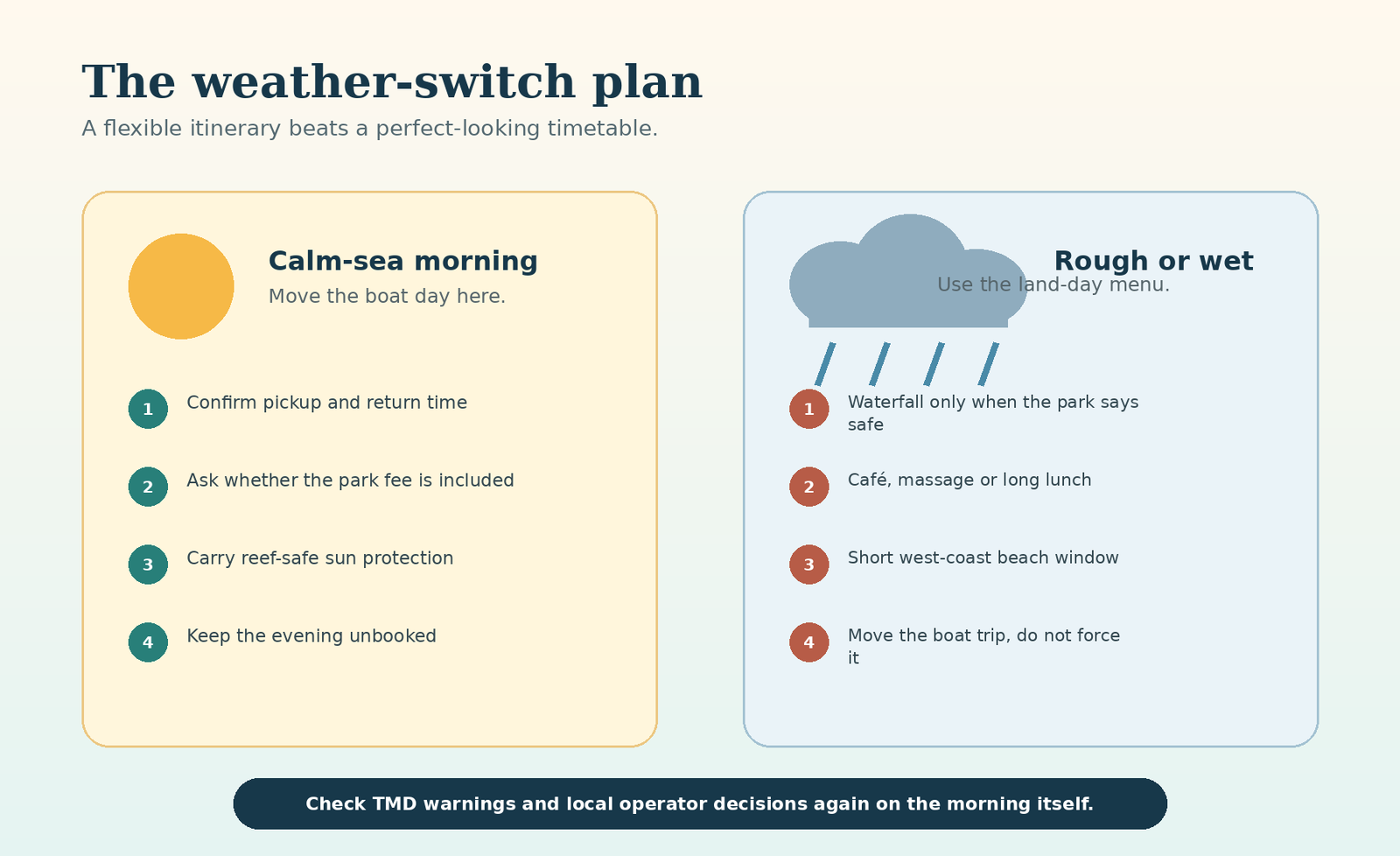
A rainy icon does not cancel the whole day
Rain may arrive in intense bursts, but it can also persist or trigger unsafe water conditions. Separate inconvenience from risk: a shower may call for lunch and a later beach walk, while a marine warning, red flag, closed waterfall or flooded road means changing the plan.
Book flexibility where weather has leverage
Prioritise cancellation terms for the boat trip, the final mainland connection and low-season accommodation. A slightly higher flexible rate can be better value than a cheaper booking that forces a dangerous or miserable day.
Why this itinerary works
- One base keeps the holiday calm and reduces taxi costs.
- Five days can combine beach, reef, rainforest and a community experience.
- The boat day can move without losing the waterfall or west-coast plan.
- Accommodation covers simple bungalows through high-end resorts.
- Koh Chang feels greener and less urban than many larger Thai resort islands.
What may frustrate you
- The Bangkok transfer uses most of a day in each direction.
- Public transport is useful on the west coast but weak on the east.
- Steep roads make scooters a serious decision rather than a casual convenience.
- Wet-season weather can remove the headline boat activity.
- The ferry timetable does not protect a tight flight connection.
Who will enjoy Koh Chang most
Choose it for a mixed island holiday with rainforest, beaches and enough services to stay comfortable. Travellers who want walkable nightlife every night, direct flights to the beach or effortless island-wide transport may prefer a different base.
Who should consider Koh Kood or Koh Mak instead
Koh Kood suits a more resort-and-beach-focused escape, while Koh Mak is smaller and often easier to understand at a slower pace. Koh Chang wins when variety matters and the longer road network feels like an advantage rather than a burden.
The simple correction
Use one west-coast base, one booked boat day that can move, one planned driver day if the east coast matters and one protected departure margin. That four-part framework prevents most avoidable problems.
How many days do you need in Koh Chang?
Five days and four nights is a useful minimum for a first visit when arrival is early enough. Five nights is better when coming from Bangkok, diving, travelling with children or giving the east coast a proper day.
Is five days in Koh Chang too long?
No. One boat day, one waterfall day, a west-coast day and two transfer or flexible days fill the time naturally. The trip feels long only when every day repeats the same beach or the hotel location is poorly matched to your interests.
Where should a first-time visitor stay?
Klong Prao is the best all-round base for most first-time visitors. Kai Bae is stronger for a walkable evening atmosphere, while White Sand is simplest for a short stay close to the ferry.
Can you visit Koh Chang without renting a scooter?
Yes. Shared songthaews, operator pickups, hotel transfers and a private driver can cover this itinerary. Budget more for the east coast and confirm late-evening transport rather than relying on a vehicle appearing.
Can you book the Koh Chang vehicle ferry in advance?
The main Ao Thammachat–Ao Sapparot service is generally bought at the pier rather than reserved online. Current local information says tickets are sold for the day and cash is useful, so ignore third-party claims unless the operator itself confirms a genuine booking channel.
How much is the ferry in 2026?
Because fares changed in April 2026 and were linked to fuel costs, allow roughly 90–130 THB per adult foot passenger and 200–280 THB for a standard car as a planning range. Check the current pier board before travel.
What is the best month for Koh Chang?
December to February usually gives the easiest overall combination of drier weather and calmer marine planning, although Christmas, New Year and school-holiday dates cost more. November and March can offer a useful balance when the forecast cooperates.
Is Koh Chang worth visiting in rainy season?
It can be rewarding for green scenery, quiet beaches and lower prices. However, the itinerary must work without a boat trip, and travellers should accept possible ferry delays, closed swimming areas and slippery roads.
Is Koh Chang good for snorkelling?
Yes, especially on boat trips towards Koh Rang and nearby islets. Main-island shore conditions vary, so choose the route from current visibility and sea conditions rather than expecting clear reef water from every beach.
Is Koh Chang suitable for families?
Yes, particularly from a central resort with a pool, breakfast and easy road access. Choose a larger, steadier boat when appropriate, avoid late transfers and add a fifth night so children are not moved through a major journey every day.
How much cash should you carry?
Carry enough baht for the ferry, songthaews, park fees, markets and a backup meal or taxi. Cards are accepted at many hotels and larger restaurants, but relying on them for pier tickets or small local services is risky.
Can Koh Chang be combined with Koh Kood or Koh Mak?
Yes. Direct inter-island boats are easiest in higher season, while low-season journeys may have fewer sailings or require a mainland connection. Confirm the exact pier and add a buffer before any flight.
Is Koh Chang affected by Thailand–Cambodia border warnings?
On the 11 September 2026 check, Koh Chang itself was not inside the FCDO’s 20-kilometre land-border exclusion. Advice has changed, though, so read the current government warning before travel, especially for an onward land crossing.
What should you do when the boat trip is cancelled?
Move Khlong Phlu to a safe morning, take a slow lunch, use the hotel pool, book a massage or explore one nearby beach area. Do not replace a marine cancellation with an improvised scooter circuit in heavy rain.
Book one base around Klong Prao or Kai Bae, then commit only to the parts that benefit from advance planning: the Bangkok transfer, accommodation and one reputable marine operator with sensible cancellation terms. Keep the order of Days 2 to 4 flexible until the live forecast is clear.
For four nights, treat Day 5 as the return journey and regard any east-coast stop as a bonus. For five nights, give Salak Khok or Salak Phet the time it deserves, ideally with a driver who has agreed the whole route. Either way, avoid the temptation to prove value by crossing the island repeatedly.
The strongest version of Koh Chang is not the one with the most pins. It is the one that reaches the ferry without panic, puts the reef on the safest day, respects rainforest conditions and leaves enough unplanned time to enjoy the beach you travelled so far to see.
This guide was rebuilt from the supplied Koh Chang draft and checked against current sources on 11 September 2026. Transport fares, ferry operations, park access, weather, border advice, entry rules and commercial prices can change. Readers should use the linked operator or authority for a final check close to travel.
Where primary sources did not publish a complete English price table, recent local transport and booking sources were used as dated planning evidence. Conflicting 2026 ferry prices are shown as a range rather than forced into a false single figure. Area choices and pacing recommendations are research-led planning judgements, not claims of a first-hand stay.
Source list
- Tourism Authority of Thailand: Koh Chang destination overview and activities.
- Tourism Authority of Thailand: Salak Khok community and ruea mard boat experience.
- Koh Chang Ferries: September 2026 timetable, crossing, ticket method and queue notes.
- Nation Thailand: approved April 2026 ferry fare changes and fuel-linked context.
- 12Go: live September 2026 Bangkok–Koh Chang route examples and journey times.
- Bangkok Airways: current flight schedule search, including Bangkok–Trat when operating.
- UK FCDO: Thailand passport, visa exemption and Digital Arrival Card requirements.
- UK FCDO: Thailand road, motorcycle, sea, swimming and rainy-season safety guidance.
- Thai Meteorological Department: current seven-day forecast and marine warnings.
- Mu Ko Chang National Park official page: current local notices and closures.
- Thai Holiday Guide: July 2026 park fee and waterfall opening examples.
- I Am Koh Chang: shared songthaew fare guide, updated September 2026.
- Out Thailand: 2026 snorkelling routes, trip ranges and separate park-fee context.
- Booking.com: current Koh Chang accommodation examples used to sense-check price bands.
- Koh Chang Ferries: September 2026 seasonal boats to Koh Mak and Koh Kood.
Illustrations in this article were created for Taylor’s Trailblazing Travels. Third-party photographs, where used, are credited beside the image or in the source list.