Japan • Where to stay
Where to Stay in Kyoto: Best Areas for First-Time Visitors
Choose the journeys you want to make easy, then choose the room that fits.
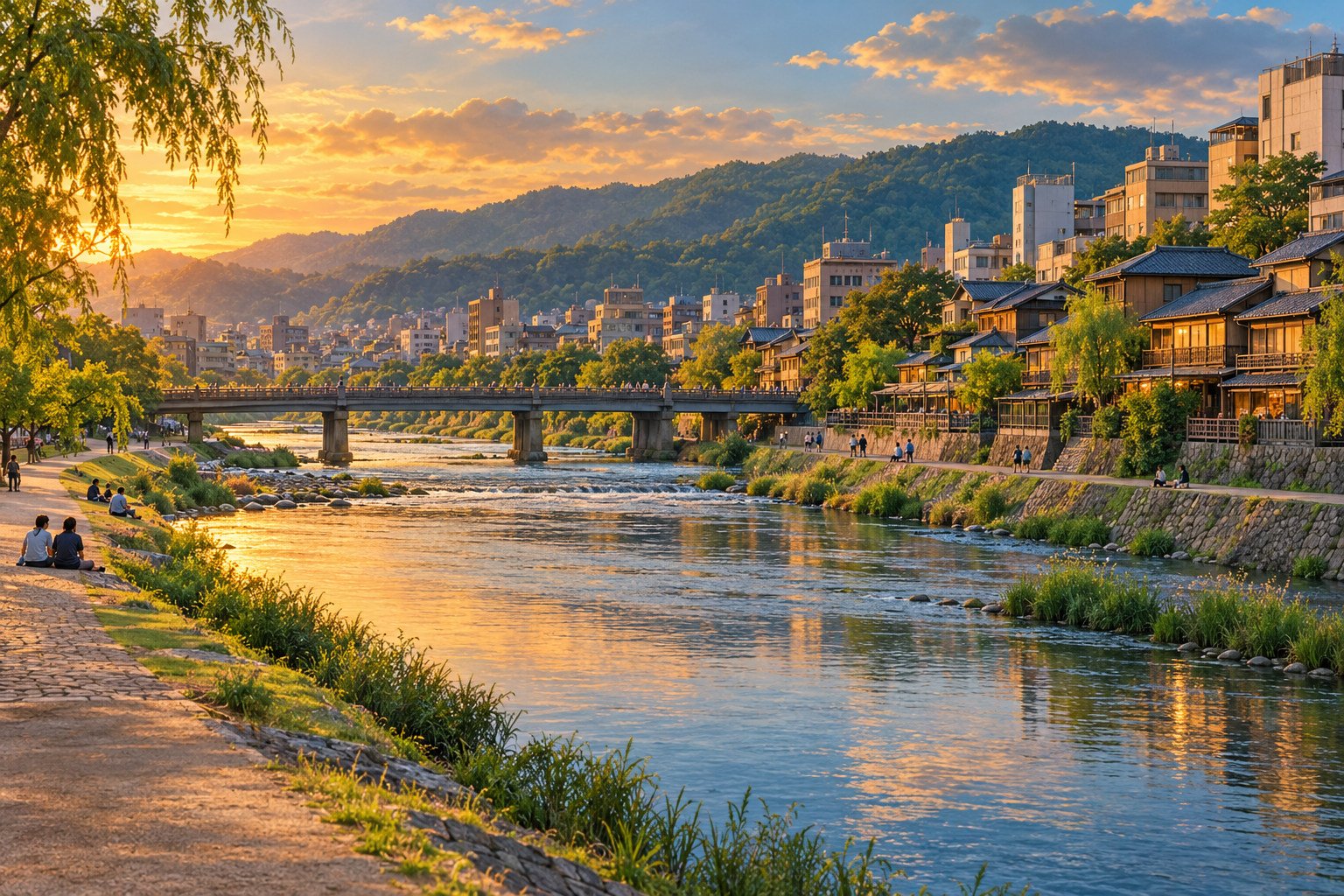
AI-created editorial illustration inspired by the Kamo River and Kyoto’s eastern hills; an imagined city scene, not a photograph or a hotel view.
For a first visit to Kyoto, start with Shijo–Karasuma or the downtown Kawaramachi–Sanjo area. These are useful starting points for balancing sightseeing with meals and evenings out. Kyoto Station becomes the stronger choice when rail arrivals, early departures or several day trips dominate your plans. The city’s different railway networks make the exact station more useful than a vague “central Kyoto” label.[1]
The decision is less about finding one district that wins every comparison and more about choosing the inconvenience you can comfortably repeat. An extra transfer once on arrival may be worthwhile; an awkward journey back for a child’s afternoon rest may matter every day. This research-led guide compares those choices and uses published room details to narrow the hotel search. The properties are examples to investigate, not hotels Karen has personally stayed in or tested.
This article contains affiliate links. If you make a booking or purchase through them, Taylor’s Trailblazing Travels may earn a commission at no extra cost to you. Recommendations are based on the planning needs discussed in this guide.
Balanced first visit
Shijo–Karasuma
A practical starting point when you want both the Karasuma subway and Hankyu access, without making the railway station the centre of every evening.[1]
Dinner and evening walks
Kawaramachi–Sanjo
Shortlist here if returning to a downtown restaurant district on foot is a daily priority. Check the exact street and room orientation for noise.
Several train departures
Kyoto Station
Give luggage and repeated JR trips more weight. Choose the correct side of the station for your arrival and hotel entrance.[1][2][13]
Space for a family
Karasuma Oike
Compare apartment layouts as well as location. A room with four separate sleeping places solves a different problem from a compact twin with child sharing.[5]
Match an area to the way you will use Kyoto
Begin with two areas, then compare real properties. The recommendations below are editorial judgements based on transport geography and different traveller needs; they are not price rankings or claims that every hotel in a district behaves alike.
Six areas, with the compromise that comes with each choice
Scroll the table sideways to compare every column.
| Area | Choose it for | What to check before committing |
|---|---|---|
| Shijo–Karasuma | A balanced stay using the north–south subway and Hankyu; a useful first shortlist. | Shijo is the subway station; Karasuma is the connected Hankyu station. Time the walk from the exit you will actually use, especially with luggage.[1] |
| Downtown Kawaramachi–Sanjo | Meals, shopping and evenings near the river, with Hankyu or Keihan useful according to the precise location. | A hotel near Kyoto Kawaramachi is not next to JR Kyoto Station. A nightlife-facing room and a quieter side street can offer different stays. |
| Kyoto Station | Shinkansen or HARUKA arrivals, early trains and several JR day trips. | North/Central Exit and south/Hachijo are different approaches. Include the station crossing when comparing the airport bus stop or Shinkansen gates with your hotel.[1][2][13] |
| Karasuma Oike / Nijo | A subway-based stay or an apartment with more usable living space. | Karasuma Oike is the two-subway interchange. Nijo is a separate JR/subway station farther west; do not treat the whole area as one doorstep.[1][5] |
| Gion / Higashiyama | Repeated time in the eastern streets, temples and evening atmosphere. | A hotel near Gion-Shijo or Sanjo has a different rail relationship from an address on the Kiyomizu approaches. Test the slope and final walk, not just the district name.[1] |
| Arashiyama | A stay deliberately centred on the western district, with time there before or after a day visit. | Accept extra cross-city journeys. JR Saga-Arashiyama, Hankyu Arashiyama and Randen Arashiyama are distinct stations; book for the route you intend to use.[22] |
Choose by your repeated task
For a couple heading out again after a rest, downtown evenings may outweigh a simpler arrival. For a family, an appropriate room near a usable station may beat a smaller room beside a famous street. For a traveller making several JR day trips, Kyoto Station earns its convenience repeatedly. If stairs or walking distance are a constraint, the building entrance and step-free station route should decide the shortlist.
Give everyday journeys more weight than a single arrival
Take a hypothetical four-night stay with three full sightseeing days. Compare a more central hotel with a station-area alternative. Assume the central option saves ten minutes on each routine hotel journey but adds twenty minutes on arrival and twenty on departure. These are model inputs, not measured journeys.
If sightseeing and dinner form one continuous outing, there are six routine one-way legs across the three days: six × ten minutes saves sixty minutes. Subtract the forty-minute arrival/departure penalty and the net saving is only twenty minutes.
If you return to the hotel and go out again every evening, there are twelve routine legs. The same calculation becomes 120 − 40 = eighty minutes saved. An afternoon nap can create a similar extra return. Do not count a restaurant stop twice when it is already part of the day’s outing.
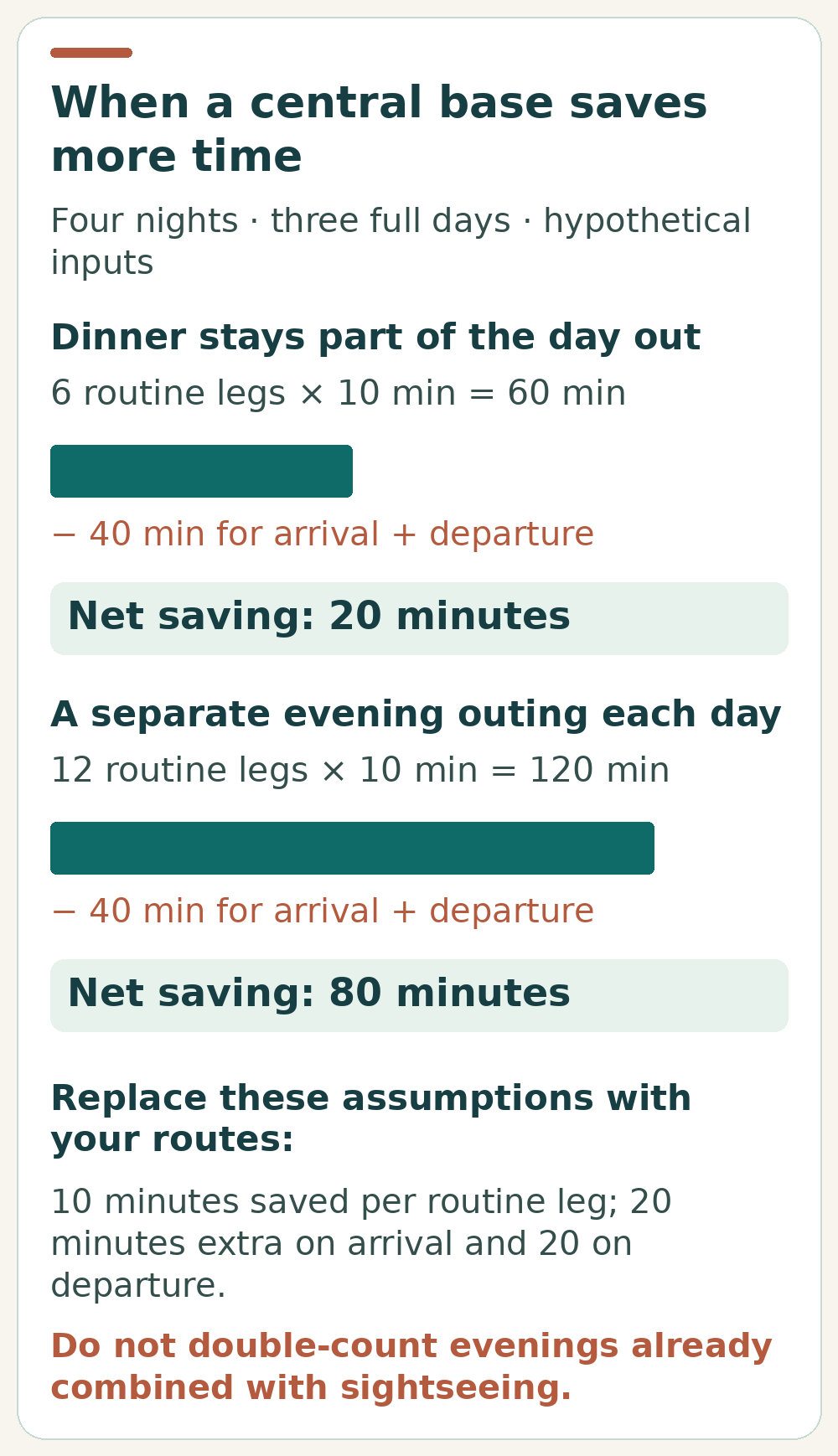
To use this for your trip, enter two actual hotel addresses into a journey planner and compare the same three destinations at the times you expect to travel. Add station access, transfers and the final walk. Keep the hotel-price difference separate: an eighty-minute saving does not tell you what that time is worth to your party.
A split stay within Kyoto is useful when the second hotel creates a specific experience, such as two nights centred on Arashiyama or a ryokan evening. Otherwise, packing, luggage storage and a second check-in can consume the convenience you hoped to gain. For a first visit with only a few nights, one well-chosen base is usually the more workable starting assumption.
Choose the actual room, not just the hotel name
These four examples demonstrate different solutions. Compare identical dates, guest ages, meal plans and cancellation conditions on the hotel’s own site and the linked booking page. No live room price, date-specific availability or cheapest-provider claim is implied.
Daiwa Roynet Hotel Kyoto Ekimae PREMIER — for the north side of Kyoto Station
The hotel publishes a four-minute walk from JR Kyoto Station’s Central Exit. Its PORTA underground approach closes overnight, so a late arrival still needs an above-ground route.[2] The Standard Double is 18.2 m² for one or two occupants, with no extra bed or cot; the 23.7 m² Standard Twin also has no extra bed. The 36.2 m² Executive Twin has a published capacity of up to four. Select the actual four-person arrangement rather than assuming every “twin” can accommodate a family.[3]
Two dated cautions matter: breakfast service is scheduled to stop from 18 December 2026 until around mid-March 2027 for restaurant work.[2] On 30 January 2027, planned hotel-wide maintenance brings a 09:00 check-out and 17:00 check-in, with utilities unavailable during the outage. Confirm current arrangements for those dates.[4]
Compare Kyoto Ekimae PREMIER room plans on Booking.com.
MIMARU Kyoto Shinmachi Sanjo — for a family apartment near Karasuma Oike
The published station walk is five minutes. Its 40 m² One-Bedroom Family Apartment lists two single beds, one bunk bed, a kitchen/dining area and an in-room washer-dryer. The booking system counts guests aged seven and over as adults; the room’s “four adults / two children” allowance includes children aged six and under without additional beds. Two adults and two children aged seven or over therefore use the four main sleeping places.[5]
This is a useful comparison with booking two smaller rooms: check the four-person total and whether everyone is happy with the bunk. A larger floor area does not guarantee the privacy of two bedrooms. The separate “Japanese Apartment for 5” configuration is scheduled to stop accepting reservations after 23 October 2026; the family apartment described here is a different category.[5]
Compare Shinmachi Sanjo apartment choices on Agoda.
Tokyu Stay Kyoto Sakaiza — for downtown evenings and laundry
This property is by Kyoto Kawaramachi and the Shinkyogoku shopping street, making it a useful downtown example rather than a JR-station hotel.[6] Its 24 m² Superior Twin accommodates two, while the also-24 m² Deluxe Twin accommodates three. Both list a washer-dryer, microwave and kitchenette. The larger 48 m² Stay Premier is listed for two people: extra floor space does not automatically create extra permitted occupants.[7]
Choose it when laundry and an easy return from downtown meals matter. For a family, enter every child and check the exact occupancy accepted by the selected plan; the room label alone is not permission for bed sharing. Ask about room position if evening street sound is a concern.
Compare Tokyu Stay Sakaiza plans on Booking.com.
Hotel Resol Kyoto Shijo Muromachi — for a compact stay near Shijo–Karasuma
The ordinary Double is 15 m²; the Twin is 20–21 m² with two 110 cm-wide beds and capacity for one or two people.[8] The hotel publishes a two-minute walk from subway Shijo Exit 6 and four minutes from Hankyu Karasuma Exit 26. Those figures start at the named exits, not at your train door.[9]
Its FAQ permits preschool children to share a parent’s bed without a child accommodation charge, provides no extra bedding for that arrangement and says cots are unavailable.[10] That makes bed width a real decision, not a small-print detail. It is a compact-room example for one or two adults; compare family alternatives when each child needs a separate sleeping place.
Compare the whole stay, including Kyoto’s tax
Kyoto’s accommodation tax changed on 1 March 2026. It is charged per person, per night, using the accommodation charge rather than the headline total for the room. The tax base includes the service charge but excludes meals and consumption tax.[11]
Kyoto City accommodation tax: rates applying from 1 March 2026
Scroll the table sideways to compare every column.
| Taxable accommodation charge per person, per night | City tax per person, per night |
|---|---|
| Below ¥6,000 | ¥200 |
| ¥6,000 to below ¥20,000 | ¥400 |
| ¥20,000 to below ¥50,000 | ¥1,000 |
| ¥50,000 to below ¥100,000 | ¥4,000 |
| ¥100,000 or more | ¥10,000 |
Here is a worked comparison, using hypothetical taxable room charges split equally between two adults staying four nights. At ¥35,000 per room per night, each person’s charge is ¥17,500: city tax totals ¥3,200 for the stay. At ¥40,000 per room per night, each person’s charge is ¥20,000: city tax totals ¥8,000. The room-charge difference is ¥20,000 over four nights, with another ¥4,800 difference in city tax. The combined difference is therefore ¥24,800 before any difference in consumption tax or meals. These are arithmetic examples, not current hotel offers.[11]
For a family or a meal-inclusive ryokan plan, ask how the taxable charge is allocated. Do not simply divide a package total containing dinner by the number of guests. If a booking website or travel agent has already collected the accommodation tax, it should not be collected a second time at the property.[11]
A fair quote comparison
Compare the total for every occupant, the actual bed arrangement, meals, city tax, cancellation deadline and payment currency. Add journeys or breakfasts you would otherwise buy. A lower nightly headline may cease to be the better option if it requires a second room or a taxi you expect to take repeatedly.
Check the station names and the final part of the journey
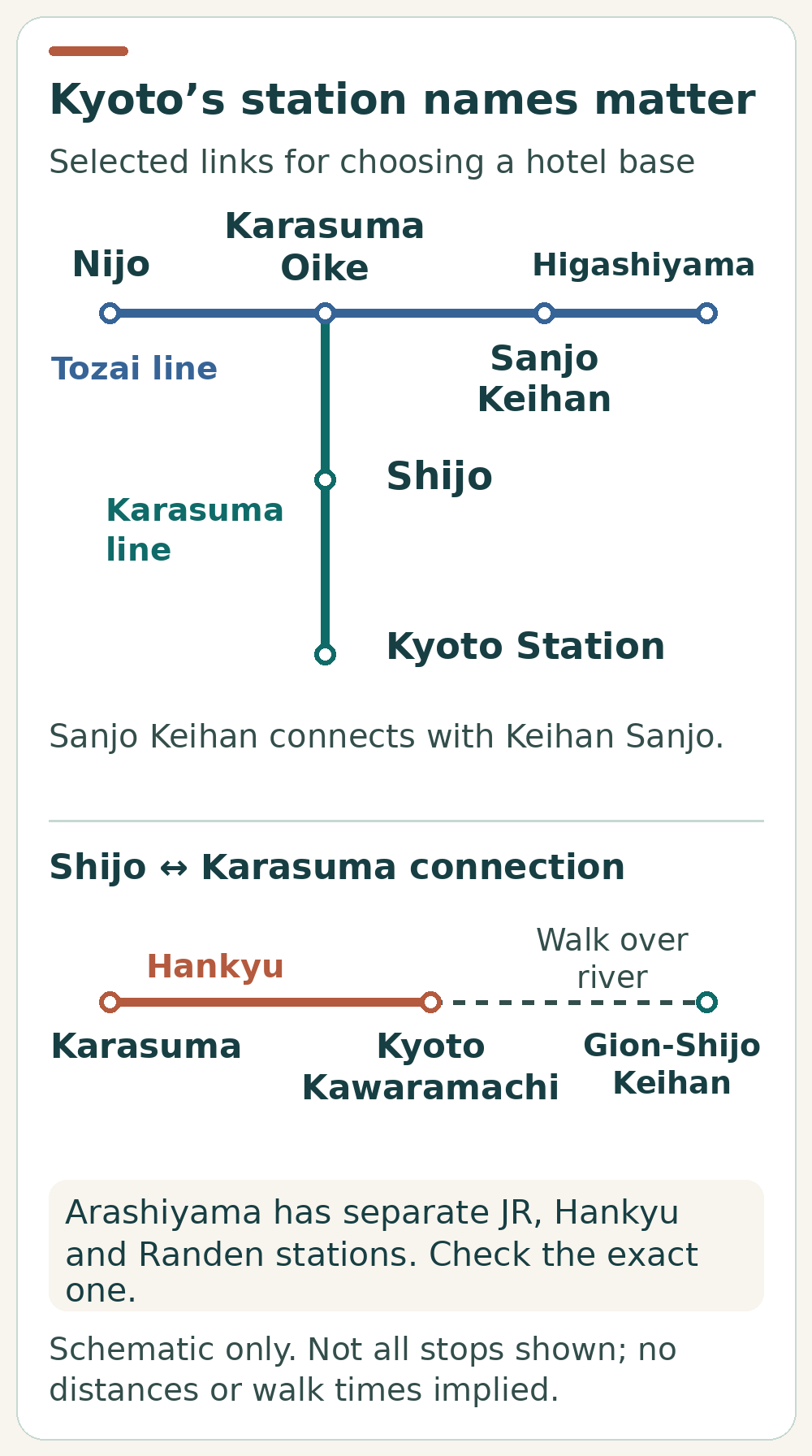
Kyoto Station, subway Shijo, Hankyu Karasuma, Hankyu Kyoto Kawaramachi and Keihan Gion-Shijo are not interchangeable. Hankyu’s Kyoto Kawaramachi and Keihan’s Gion-Shijo are connected by a pedestrian transfer across the river.[20][21] The Karasuma subway runs north–south through Kyoto Station and Shijo to Karasuma Oike, where it meets the east–west Tozai line. Hankyu and Keihan serve different corridors from JR; an IC card makes payment easier but does not turn separate operators into one inclusive fare.[1]
Arriving from Kansai International Airport
HARUKA provides a direct rail service to Kyoto Station. The discounted JR-WEST HARUKA One-way Ticket is a particular product with eligibility and use conditions, not the universal walk-up fare. Check those conditions and the selected train before paying.[12] From Kyoto Station, the Karasuma subway is useful for Shijo and Karasuma Oike; for a hotel well away from a station, compare the final transfer with a taxi for your whole party.[1]
The airport limousine bus uses Kyoto Station’s Hachijo side. KATE gives a typical 85–90 minutes between that stop and Kansai Airport Terminal 1; Terminal 2 has a different timing, and road conditions can cause delays. The airport-bound direction requires a reservation under the operator’s published arrangements. Check your direction and terminal separately.[13]
For an English-language comparison of bookable transport, check Kansai Airport Station–Kyoto options on 12Go alongside the operator’s offer. Confirm whether the product is a train ticket, pass, bus or private vehicle, what must be exchanged, and the final fee. A transport listing does not establish that a quoted duration includes immigration or the walk to your hotel.[12][15]
Arriving at Itami, or coming by intercity train
Itami is a different airport from Kansai International. Hankyu Kanko Bus operates its Kyoto route via Kyoto Station Hachijo; some services extend to other Kyoto stops, so check the specific departure rather than assuming every bus reaches downtown.[14] If arriving by Shinkansen, choose a hotel approach that suits the gates you use and the luggage you carry. A property advertised as “Kyoto Station” may still be on the opposite side of the building from your arrival.
Plan the accessible route, not the shortest line on a map
A published two-minute walk normally begins at a named exit. It does not include finding a lift, crossing a station or taking a longer step-free route. Ask for the hotel’s accessible entrance, room layout and bathroom details when those are essential. For a stroller, compare the full everyday route and luggage arrangement before accepting a room simply because it has a family label.
Use paid help where it improves your stay
A direct airport arrival
A family arriving late, or a group with substantial luggage, may prefer a prebooked vehicle to several transfers. This private Osaka-airport-to-Kyoto arrival transfer on Viator lists service from either Kansai International or Itami to Kyoto accommodation. Enter the correct airport, flight and hotel; confirm luggage capacity, child seats where needed, waiting allowances and any late-arrival charge for your chosen option. The listing states automatic cancellation if you do not meet the driver within ninety minutes after an international flight arrives, or sixty minutes after a domestic arrival; allow for immigration and baggage, and check how delays are handled before booking. Compare its whole-party quote with rail or bus plus the last journey to the hotel.[16]
A sightseeing day with fewer transport decisions
If one day involves widely separated sights, a private Kyoto highlights tour with hotel pick-up on GetYourGuide offers a different convenience from choosing a hotel near one railway line. Its listing includes a guide and transport between locations; confirm the exact pick-up address, admissions and pace. It is described as unsuitable for wheelchair users and people with mobility impairments, so a vehicle does not by itself establish accessibility. Independent rail travel remains a sensible option when the route fits your party.[17]
Finding the hotel and changing plans
Save the entrance location, Japanese address and booking confirmation offline. If your existing roaming arrangement does not suit the trip, check Airalo and select Japan for an eSIM option. Compare the current data allowance and validity, and check the exact handset is eSIM-compatible and carrier-unlocked before buying. The Japan packages consulted are data products; do not assume a local voice number is included.[18][19]
Resolve the choices that can change the booking
Is Kyoto Station a poor choice for a first visit?
No. It is a strong choice when several journeys begin there, when an early departure matters, or when a suitable room offers better value after transfers are included. Its weakness for some itineraries is the repeated return to downtown evenings. Compare the pattern of your days instead of treating “station area” as a verdict.
Should the cheapest area decide the search?
Use actual dates and room types. A district label cannot establish the cheapest acceptable stay. Start with two areas that work, then compare the full-party total. Widen the search if the saving is worth the additional journey; reject a nominal bargain if the accepted occupancy or bed arrangement is wrong.
Is Gion automatically the most atmospheric place to sleep?
Choose an eastern base when being there repeatedly is part of the trip you want. A property name containing “Gion” does not promise a historic building, a quiet street or a short walk to your train. A downtown hotel can still let you visit the eastern districts without making their final approach part of every journey.
Should a family book one apartment or two hotel rooms?
Price both for the actual adults and children. Compare separate sleeping places, toilets, usable living space and the bedtime routine. Two rooms may offer more privacy; one apartment may make meals and laundry easier. Connecting rooms need confirmation as a bookable arrangement, not simply a request that two independently booked rooms will be adjacent.
What should be confirmed before paying?
Confirm the exact property and entrance, dates, all guest ages, room category and bedding, tax and meals, cancellation deadline, payment terms, late-arrival process and any announced works. For the hotel examples here, that includes the specific winter maintenance dates at Kyoto Ekimae PREMIER and the room category being offered at MIMARU. Then keep the confirmation and the hotel’s contact details available offline.[2][4][5]
If the wider route is still changing, decide Kyoto’s place in the holiday before locking in a non-refundable room. The Japan trip-length guide helps set that sequence; the Japan budget planner for UK travellers helps keep accommodation within the whole-trip budget.
Sources and planning notes
This is a research-led guide. Hotel operators, transport providers and official destination information were checked on 18 October 2026. Published specifications and service notices can change; live prices and availability depend on the dates and room or ticket selected. Worked examples identify their assumptions.
- Getting around Kyoto by subway and train — Kyoto City Tourism Association.
- Daiwa Roynet Hotel Kyoto Ekimae PREMIER: access and current notices — Daiwa Roynet Hotels.
- Kyoto Ekimae PREMIER room categories — Daiwa Roynet Hotels.
- 30 January 2027 power outage and altered arrival/departure times — Daiwa Roynet Hotels.
- MIMARU Kyoto Shinmachi Sanjo: rooms, child categories, facilities and access — MIMARU.
- Tokyu Stay Kyoto Sakaiza: location and facilities — Tokyu Stay.
- Tokyu Stay Kyoto Sakaiza: room capacities and equipment — Tokyu Stay.
- Hotel Resol Kyoto Shijo Muromachi: rooms — Hotel Resol.
- Hotel Resol Kyoto Shijo Muromachi: station exits — Hotel Resol.
- Hotel Resol Kyoto Shijo Muromachi: child sharing and cot policy — Hotel Resol.
- Kyoto accommodation tax rates effective from 1 March 2026 — Kyoto City.
- HARUKA One-way Ticket: coverage, eligibility and fares — JR-WEST.
- Kansai Airport–Kyoto Station bus stops, timings and reservations — Kansai Airport Transportation Enterprise.
- Itami Airport–Kyoto bus route and timetable — Hankyu Kanko Bus.
- Kansai Airport Station–Kyoto bookable transport listings — 12Go.
- Private arrival transfer from Osaka airports to Kyoto — Viator.
- Private Kyoto highlights tour with hotel pick-up and transport — GetYourGuide.
- Japan eSIM packages — Airalo.
- Checking device compatibility and carrier unlocking — Airalo Help Centre.
- Pedestrian interchange between Hankyu Kawaramachi and Keihan Gion-Shijo — Keihan Railway.
- Kyoto-kawaramachi HK86: official station information — Hankyu Railway.
- Access to Saga and Arashiyama by three different railway approaches — Kyoto City Tourism Association.
Illustrations in this article were created for Taylor’s Trailblazing Travels. Third-party photographs, where used, are credited beside the image or in the source list.