Japan Travel Guide for First-Time Visitors: How to Plan Your First Trip
Choose the right places, book in a sensible order and leave room to enjoy the journey.
- A first trip, thoughtfully planned
- A 13-night route framework
- For UK-based travellers
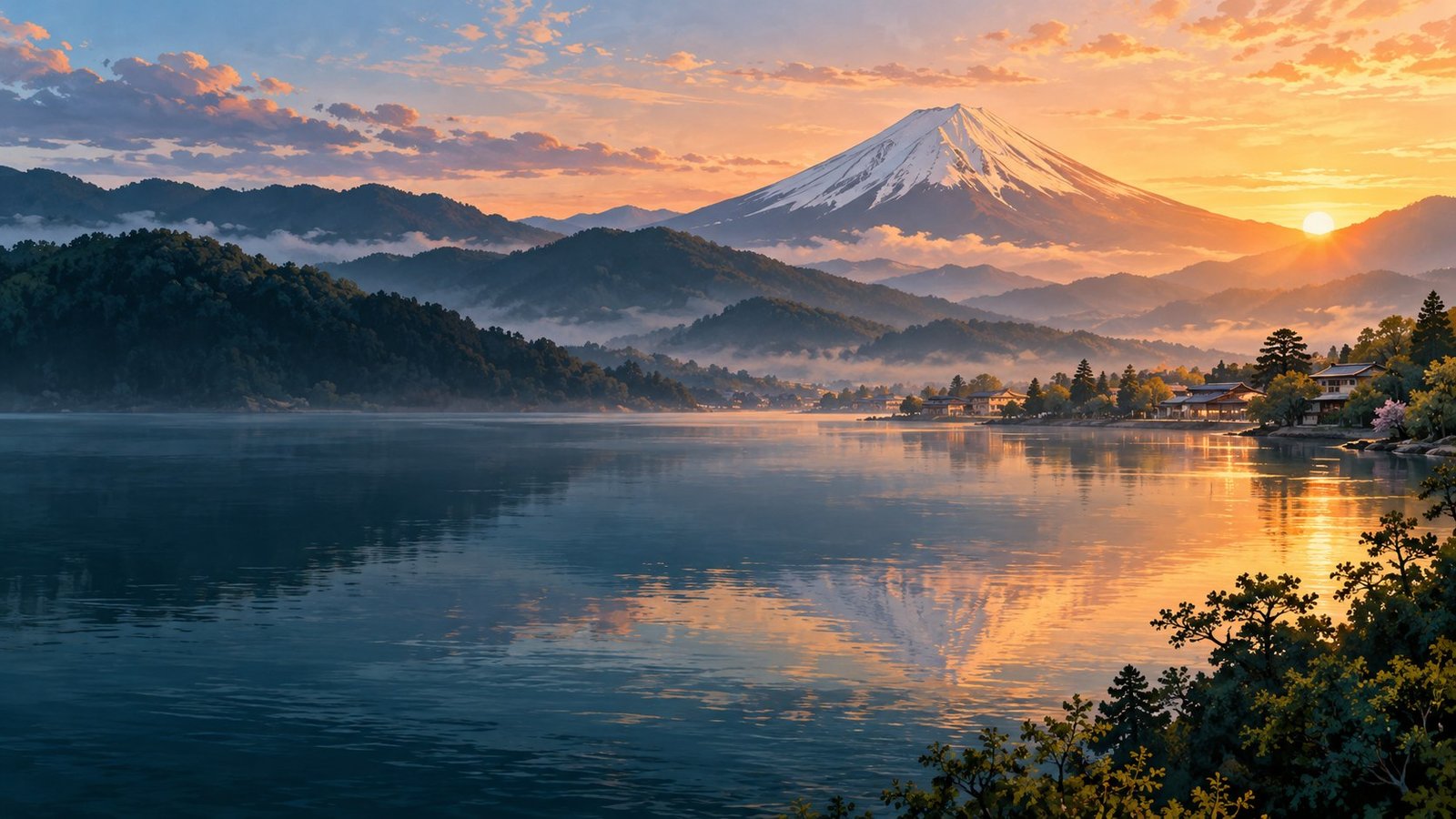
AI-generated editorial illustration inspired by Mount Fuji and the Fuji Five Lakes; an imagined scene, not a photograph of a verified viewpoint.
A good first Japan trip starts with a few firm choices: what you most want to experience, how many nights you can spend away and how much moving between places you are comfortable doing. A long list of attractions is useful only after those decisions fit together.
This Japan travel guide for first-time visitors puts the planning in order. It uses Tokyo and Kansai as a practical starting point, with alternatives for a shorter break or a trip centred on nature. The route and booking priorities are editorial planning suggestions, supported by the official sources below.
Choose a foundation
Tokyo and Kansai offer a useful first-trip combination; one region can be enough for a week.
Count the nights
The example counts fourteen calendar days in Japan and thirteen paid accommodation nights.
Protect your time
Treat a change of hotel as a journey with packing, transfers and check-in around the train ride.
Book the constraints
Entry checks and the one experience your trip depends on come before a rigid daily timetable.
Start your first Japan trip with three decisions
Write down your three priorities in plain language: perhaps neighbourhood walks and food, historic places and gardens, or a city stay with one rural escape. Then name what you are willing to leave out. That second list prevents a manageable holiday becoming a string of rushed transfers.
Next, count calendar days in Japan separately from annual leave and flight dates. Japan is nine hours ahead of GMT and does not change its clocks: the difference is eight hours when the UK uses British Summer Time. An overnight flight may arrive on the following local date. Use the actual times on your flight search. [1]
Finally, decide your preferred pace. If changing hotels feels tiring, two longer stays may suit you better than five short ones. JNTO also suggests a single base for trips of a week or less, with a broader Tokyo–Kansai route possible around ten days to two weeks. [3]
Choose one daily priority, one nearby optional activity and a realistic place to eat. Leave the optional activity removable. That is a useful planning unit for a first visit.
Check the essentials before paying for the trip
For a full British citizen passport, GOV.UK says the passport must cover the whole stay and have a blank page; Japan does not require an extra six months of validity for this type of visit. [2]
British citizens making ordinary short tourist visits are generally visa-exempt, with initial landing permission normally up to 90 days. Admission remains at the discretion of Japan’s immigration authorities. Check the official guidance for your precise passport, purpose and circumstances; living in Britain alone does not determine eligibility. [14]
Medicines need a separate check: a UK prescription does not by itself establish that a drug or quantity may be brought into Japan. Review the Ministry of Health, Labour and Welfare’s personal-import guidance before booking if you depend on medication, and allow time for any permission required. [15]
Arrange suitable travel insurance as soon as possible after booking. Read what it actually covers, including any medical conditions, activities and cancellation reasons relevant to you. [16] If you need accessible rooms, step-free journeys or a specific dietary arrangement, ask the accommodation or operator precise questions before committing.
Keep the first night’s address, arrival transfer and a way to contact the hotel accessible offline. A complicated arrival followed by an inflexible evening reservation is an avoidable start.
Choose dates for the region and experience you want
Japan’s seasons vary considerably between northern Hokkaido, central Honshu and southern Okinawa. A national label such as “spring” is a starting point, rather than a promise of the same weather everywhere. [4]
| Period | Why consider it | What to allow for |
|---|---|---|
| Spring | Milder conditions and the possibility of blossom. | Variable flowering dates and strong demand around popular viewing periods. |
| Summer | Festivals and a different outdoor atmosphere. | Rainy-season conditions in many areas, followed by heat and humidity; plan indoor breaks. |
| Autumn | Cooling conditions and seasonal colour. | Foliage timing varies; weather disruption can still affect travel. |
| Winter | A city trip or a holiday deliberately built around snow. | Shorter daylight and region-specific cold or snow; check each destination. |
These are broad climatic patterns drawn from JNTO’s weather guidance. Check the actual regional forecast and operating conditions nearer departure. [4]
Golden Week in late April–early May, Obon around mid-August and the New Year holiday period can put pressure on trains and accommodation. Compare the complete hotel and transport cost before assuming a particular month is cheaper. [3]
If blossom, skiing or a particular festival is the main reason for travelling, let that interest choose the region and date window. If it is only a bonus, avoid making the whole trip depend on a sight that weather can change.
Choose bases that reflect your interests
Tokyo and Kansai make a useful starting pair because they offer different experiences along a major rail corridor. Within Kansai, Kyoto, Osaka and Nara can be combined for historic sites, city life and food. JNTO’s regional itinerary provides the geographical foundation; the base choices below are an editorial assessment. [5][6]
| Your main priority | Start with | The trade-off |
|---|---|---|
| Large-city neighbourhoods, shopping and contemporary culture | A longer Tokyo stay, with a second base only if time allows. | Less time for temples, gardens and regional travel elsewhere. |
| Historic places, gardens and quieter mornings | Tokyo plus Kyoto. | Choose daily areas carefully rather than repeatedly crossing a city. |
| Food evenings and a flexible Kansai stay | Tokyo plus Osaka, or Osaka alone on a shorter trip. | Day trips to Kyoto or Nara use part of each day travelling. |
| A broad cultural introduction with fewer hotels | Tokyo and one Kansai base. | Keeping Kyoto and Osaka as separate bases is optional, not essential. |
| Fuji views and a slower scenic stay | Build in the Fuji Five Lakes if the route and season suit. | Mountain visibility is weather-dependent; allow a reason to enjoy the area even without the view. |
Lake Kawaguchi is one of the established places to look towards Mount Fuji, but clear conditions matter. Do not treat one fixed excursion as a guaranteed mountain-view appointment. [13]
Choose the station before the room
For each hotel shortlist, check the actual entrance, walking route from the station, luggage access and likely evening journeys. “Near a station” is less useful than knowing whether that station serves the places you plan to visit. Check room size, bed configuration, cancellation terms and whether local accommodation taxes are included.
For a short visit, an ordinary room in the right place can be a better choice than a more impressive room that adds a daily commute. Compare the cost of that commute for every person in the booking.
A workable 13-night framework for a first visit
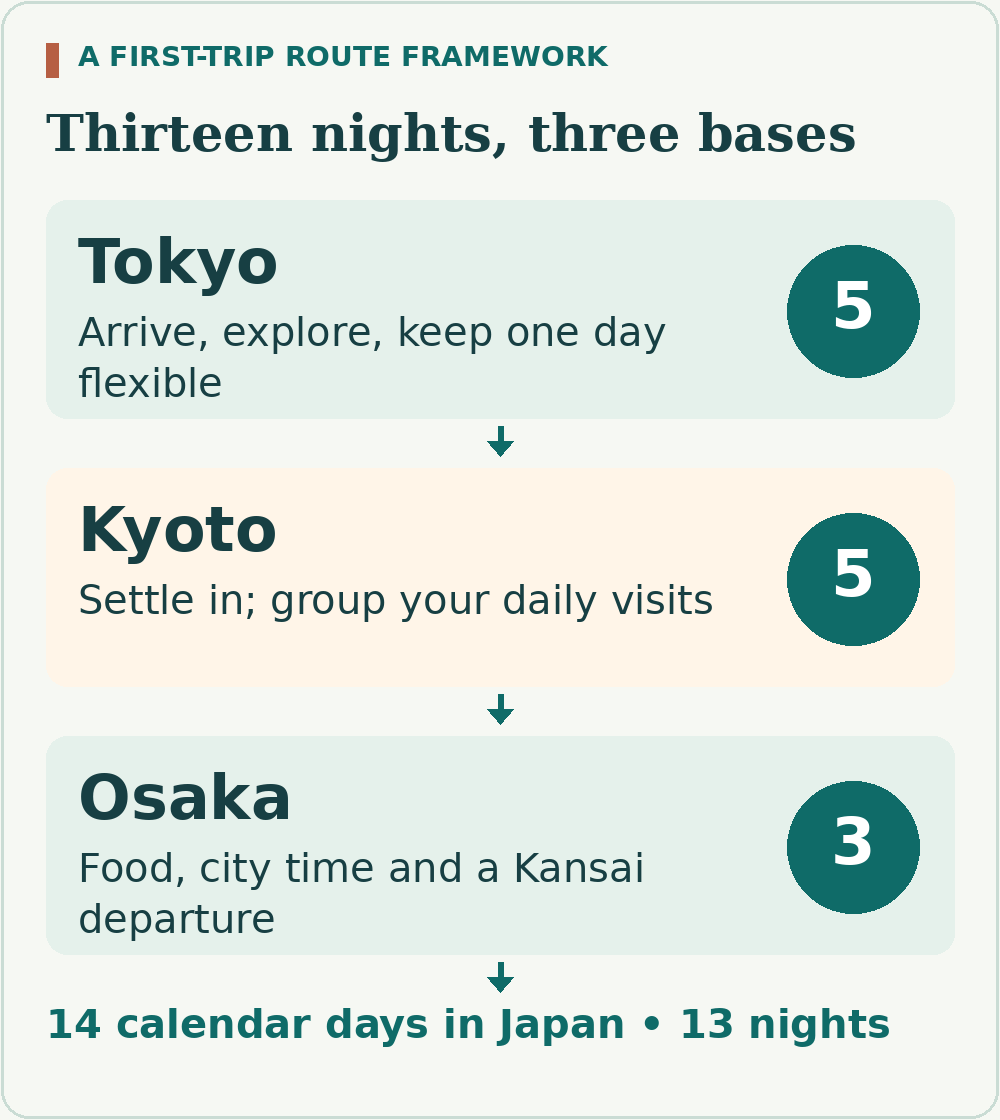
This suggested route assumes arrival in Tokyo on day 1, departure from Kansai on day 14 and thirteen paid nights. It is a framework to adapt after checking your flight and rail options, rather than a live bookable itinerary. The three bases have a clear purpose and leave several days free of hotel changes.
| Japan dates | Sleep in | A sensible use of the stay |
|---|---|---|
| Days 1–5 | Tokyo · 5 nights | Arrival, three full city days, then a flexible city or day-trip day. |
| Days 6–10 | Kyoto · 5 nights | Travel on day 6; use the following days for grouped city visits and one optional excursion. |
| Days 11–13 | Osaka · 3 nights | Transfer on day 11, then two days chosen for food, city interests or a nearby excursion. |
| Day 14 | No overnight stay assumed | Travel to Kansai Airport and depart at your booked flight time. |
Allow roughly half a day for the Tokyo-to-Kyoto hotel move as a planning margin, even though the fastest Shinkansen journey is around two hours between the main stations. Your hotel transfers, station navigation, service choice and bag drop are extra. [6]
If you prefer two bases, use five Tokyo nights and eight nights in one Kansai base. If your international ticket requires returning to Tokyo, move the final overnight stay there and price the extra rail journey. Avoid treating a long return transfer on departure day as spare sightseeing time.
For a 10-day trip, reduce the framework to two bases and fewer optional outings. For a week, make one region the trip. A longer holiday is an opportunity to slow down or add one coherent region; it does not create an obligation to visit everywhere.
Keep local travel and long-distance tickets separate
Think of transport as three different decisions: airport to hotel, travel within each base and the journeys between bases. Each has a different price, ticket and luggage question.
Use a rechargeable IC card where it is accepted
Cards such as Suica and PASMO can simplify many local journeys and small purchases on participating services. They store money; they are not unlimited national rail passes. Check the card’s coverage, validity and refund rules. Do not assume that having a local IC card is the same as having a reserved long-distance train ticket. [8][6]
Price the route before deciding on a pass
List the trains you actually intend to take, the dates and the applicable fares. Compare those with the relevant pass’s price and coverage. The nationwide Japan Rail Pass has different durations and current prices can differ by purchase channel; Nozomi and Mizuho require an additional special ticket when using that pass. A pass should serve the itinerary you want, rather than make you add journeys to justify buying it. [7]
Reserve for the traveller and the luggage
Use the operator’s own rules for your exact service. On the Tokaido–Sanyo–Kyushu Shinkansen, larger baggage may require a seat with an oversized baggage area. Measure the bag’s length, width and height, then check the published thresholds and reservable space. A general seat being available does not necessarily mean the required luggage space is available. [9]
For a crucial departure, check the station name carefully, including whether the booking uses a “Shin-” station. Keep the ticket instructions offline and leave time to identify the correct operator’s gates. During designated peak periods, Nozomi services run with reserved seating only. [6]
Build a whole-trip budget and book in the right order
Separate costs paid once from costs repeated each day. Your working total should include flights, accommodation by room and night, meals, local travel, intercity journeys, experiences, insurance, UK airport access, connectivity and a contingency. Check local taxes and whether they are already included before adding them again.
For two people sharing, divide the actual room bill between them. For a solo traveller, use the actual solo room quote; do not automatically halve a twin-room price. Keep shopping and exceptional experiences as separate choices so they do not disappear into a vague daily allowance.
Compare two complete flight-and-route options: arriving and leaving through Tokyo, and arriving in Tokyo and leaving through Kansai. The second option can save a return journey, but only the actual airfare, hotel and transfer totals tell you whether it is better value.
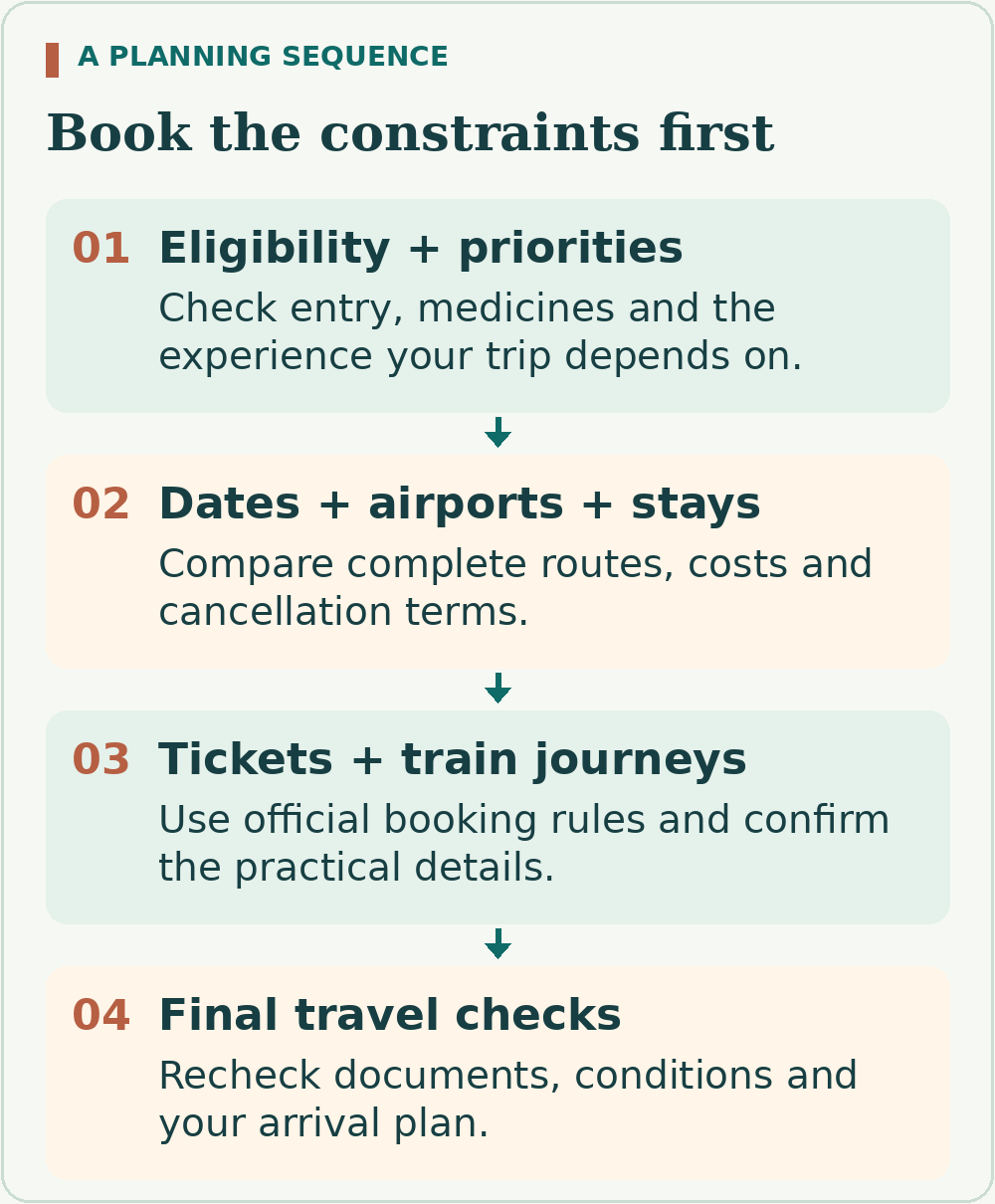
| Decision | Check before committing | Keep flexible where possible |
|---|---|---|
| Travel window and trip-defining experience | Entry eligibility, time away and the experience’s official dates or ticket-release rules. | Alternative dates or a substitute experience. |
| Flights and hotel bases | Arrival/departure airports, total nights, complete route cost and cancellation terms. | Refundable room options while the route is still forming. |
| Timed attractions and rail | Official booking channels, correct dates, eligibility and luggage or assistance needs. | Uncommitted parts of each day. |
| Final practical details | Arrival transfer, documents, phone connection, money access and current travel conditions. | A workable alternative if the first choice is disrupted. |
If one attraction is the reason for the journey, check its release process before making non-refundable commitments. Otherwise, make a shortlist of alternatives and avoid scheduling every day around a scarce ticket.
Make money, connectivity and everyday travel easier
Carry a payment fallback
International cards are widely useful, but acceptance and phone-payment compatibility vary. Keep some yen for places that do not accept your card and for payment failures. Check your own bank’s charges and cash-withdrawal limits. [10]
Sort out data before you need directions
Compare your UK roaming terms with an eSIM or another connection option. Before buying an eSIM, check that the particular phone is eSIM-compatible and carrier-unlocked, and read the plan’s validity, data allowance and activation trigger. Some plans start on installation; others start on connection to a supported network. [12]
Airalo is one option to compare. Check the Japan plan’s details and your handset before purchasing; a general eSIM search is not a guarantee of coverage everywhere.
Prepare a small offline kit
Save your first hotel address, flight details, essential booking instructions and emergency contacts. Japan commonly uses two-flat-pin plugs, so check your plug adaptor and each appliance’s voltage rating. Tap water is generally safe to drink. [1]
Keep your arrival day simple: reach the hotel, find an easy meal and identify the nearest useful transport stop. A relaxed first evening is a practical choice when sleep and body clocks are unsettled.
Travel considerately and leave room for change
Read signs before taking photographs, entering small streets or approaching a cultural site. In Kyoto, the city specifically asks visitors not to follow or stop geiko and maiko, and not to photograph them without permission, to respect photography restrictions and to keep roads and pavements clear. A neighbourhood remains somewhere people live and work. [11]
Group sightseeing geographically and keep the next move manageable. If queues, heat or rain change the day, a nearby alternative is more useful than a second attraction across the city. For mountain views or outdoor plans, keep an indoor or low-travel option available.
Follow official weather and transport notices if conditions deteriorate. Do not squeeze in a distant final excursion simply because its advertised train time looks short. For an emergency in Japan, the official tourism guidance gives 110 for police and 119 for fire or ambulance. [1]
Four mistakes to catch before departure
- Counting flight days as full sightseeing days.
- Booking hotels before checking where the route begins and ends.
- Buying a pass without comparing the journeys actually planned.
- Scheduling a ticketed activity immediately after a flight or complicated transfer.
Questions that can change your plan
Can I plan a first Japan trip independently?
A route based around major cities can be planned independently using official transport and attraction information. If booking systems, language, access needs or a specialised experience make part of the trip difficult, use an operator or guide for that part. There is no need to make the entire holiday either fully organised or entirely do-it-yourself.
Do I need a different hotel for every place I want to see?
No. Treat a base as somewhere to sleep and return to comfortably. Compare the round-trip travel of a day visit with the packing and check-in involved in changing hotels. A place becomes a stronger overnight candidate when you want its early mornings, late evenings or several nearby experiences.
Should I book every meal and attraction before leaving?
Reserve the limited-capacity experiences that matter to you and check any dietary or access arrangement in advance. Keep ordinary meals and several blocks of the day flexible. Make sure an unbooked alternative would still be an enjoyable use of your time.
What should I do next after choosing a route?
Put the stops and nights into the Trip Itinerary Planner, then check every transfer, booking condition and cost with the actual provider. The planner organises a route; it does not confirm reservations or travel eligibility.
Make the decision that fits your trip
Start with your dates, your three priorities and a route with a small number of bases. For a balanced first trip, Tokyo and Kansai provide a useful framework; for a shorter or more specialised visit, a single region can be the stronger choice. Keep the commitments that make the holiday possible, and leave enough open time for the places you have chosen.
How this guide was researched
This guide combines official entry, tourism and transport information checked on 17 October 2026 with an original base-selection framework, booking-dependency table and illustrative 13-night route. Time allowances and preferences are planning judgements, not claims of a personally tested itinerary. Check live fares, room availability, conditions and entry guidance again before booking.
Sources
Official guidance and operator information reviewed on 17 October 2026. Recheck time-sensitive details for your own travel dates.
- JNTO — First-time visitor information
- GOV.UK — Japan entry requirements
- JNTO — Tips for planning a trip to Japan
- JNTO — Weather and geography
- JNTO — The Kansai trio: Kyoto, Nara and Osaka
- JR Central / SmartEX — Shinkansen booking and travel overview
- Japan Rail Pass — Types, purchase channels and prices
- JNTO — IC travel cards
- SmartEX — Taking baggage onboard
- JNTO — Cashless payments in Japan
- Kyoto City Tourism Association — Responsible travel
- Airalo — Japan eSIM compatibility and activation guidance
- JNTO — Places to view Mount Fuji
- Embassy of Japan in the UK — Temporary Visitor visa and visa exemption
- Ministry of Health, Labour and Welfare — Bringing medicines for personal use into Japan
- Foreign, Commonwealth & Development Office — Foreign travel insurance
Illustrations in this article were created for Taylor’s Trailblazing Travels. Third-party photographs, where used, are credited beside the image or in the source list.