Japan · Kyoto · Temples and shrines
Kyoto’s Temples and Shrines: How to Choose Which to Visit
Choose your main interest, stay within a sensible area and leave enough time to notice the details.
Kyoto’s temples and shrines offer quite different kinds of visits. Kiyomizu-dera has its hillside wooden stage; Kinkaku-ji centres on a golden pavilion and pond; Ryoan-ji asks you to spend time looking at a carefully composed rock garden. A satisfying choice starts with which of those experiences interests you most.[1][2][3]
For a first visit, choose one main site and a nearby stop that adds something different. This guide compares the principal choices by what you will see, the area they belong to, admission cost and walking demands. Its pairings and time allowances are editorial planning suggestions, intended to help you fit religious sites into a wider Kyoto stay without spending the whole day moving between them.
Taylor’s Trailblazing Travels may earn a commission when you book or buy through an affiliate link in this guide, at no extra cost to you. This helps fund the research and upkeep of the site.
Choose the experience
Views, pavilion architecture, garden design and shrine worship give you different reasons to visit. Start with the one you care about most.
Pair within an area
Southern Higashiyama, the north-west and the eastern canal district each support a different visit. Treat them as separate choices when time is short.
Price the actual areas
List the gardens and buildings you intend to enter before comparing prices. Optional areas can change what a temple visit costs.
Protect time to pause
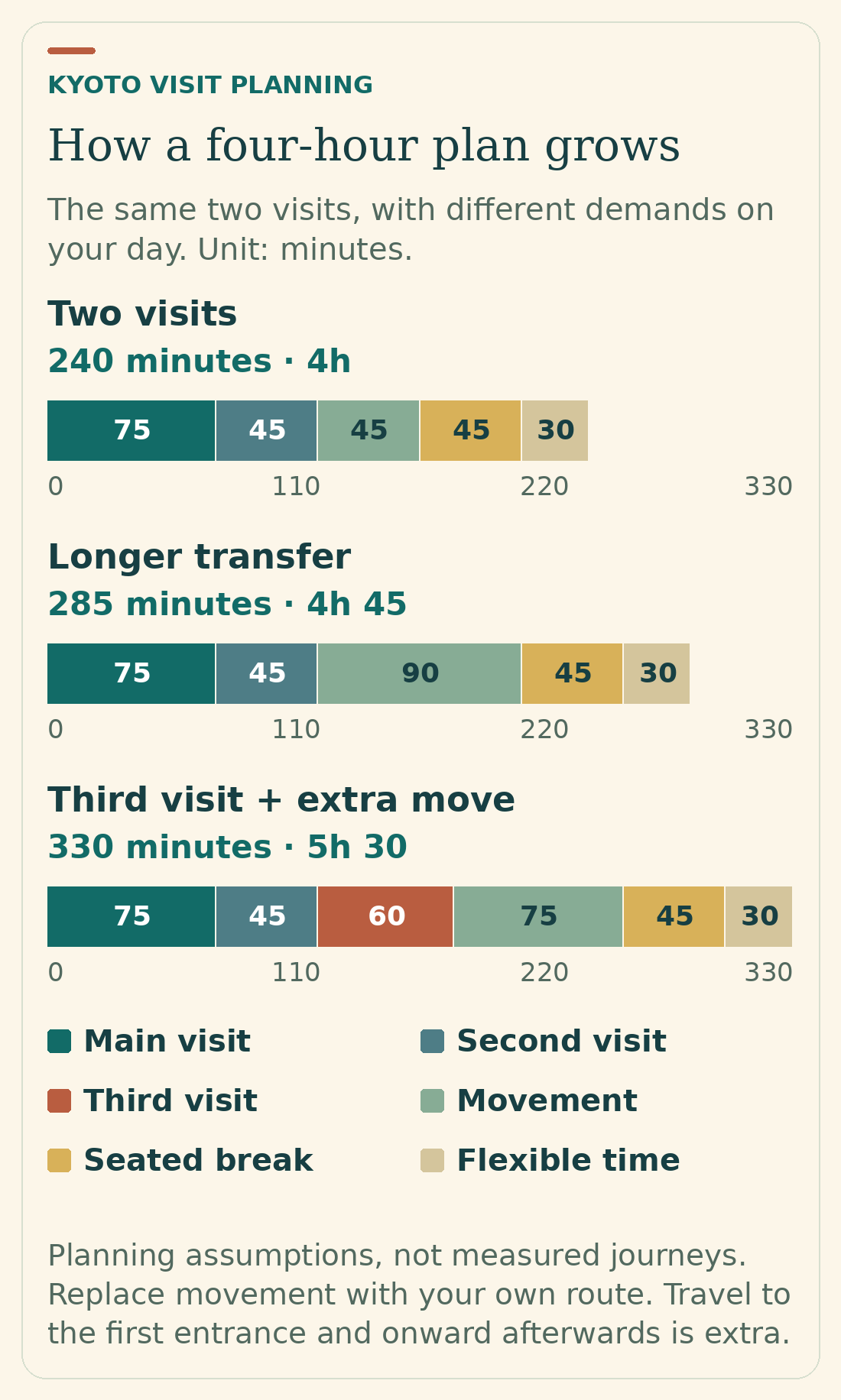
A four-hour plan can become five and a half hours when you add a third visit and another transfer. Build in that time before adding the stop.
Choose Kyoto temples and shrines by what you want to see
The selection below weighs three things: the main experience, how well it combines with the surrounding area, and the effort required to enjoy it. The best choice for someone interested in garden design may be quite different from the best first introduction to Kyoto.
Swipe or scroll sideways to read every column.
| Your priority | Start with | Why it fits | Main trade-off |
|---|---|---|---|
| A temple with a memorable setting | Kiyomizu-dera | Wooden stage, hillside setting and views.[1] | The approach is part of the walking effort. |
| One striking architectural focal point | Kinkaku-ji | The Golden Pavilion within its pond-and-garden composition.[2] | Less variety if you want several contrasting spaces. |
| Concentrated attention to garden design | Ryoan-ji | A dry rock garden that rewards looking slowly.[3] | Less suited to someone seeking constant movement or many separate attractions. |
| A varied garden circuit | Ginkaku-ji | Shaped sand, planting, water and a hillside viewing route.[4] | Ordinary admission centres on the garden; buildings have different access rules.[11] |
| Choice within a larger temple complex | Nanzen-ji | Choose the Hojo garden or a separate Sanmon gate visit.[12] | Decide which paid areas interest you before buying. |
| A shrine alongside a Higashiyama visit | Yasaka Shrine | A Gion-area shrine with free ordinary worship access.[6] | It offers a different experience from a paid temple garden. |
| A shrine with a wooded approach | Shimogamo Shrine | The Tadasu-no-mori woodland is part of the visit.[14] | Allow time for the approach instead of treating it as a quick photograph. |
If two choices appeal equally, use the rest of that day’s plan as the tie-breaker. A site that fits naturally into your area is often the better use of limited time. Interest still comes first: travelling farther for the garden you most want to study can be a sensible decision.
Pick the temple that earns the largest share of your time
Kiyomizu-dera for a broad first introduction
The Main Hall’s wooden stage projects over the hillside, while the route around the grounds offers other views of the hall and Kyoto. The temple is dedicated to Kannon, so its buildings and worship spaces deserve attention alongside the panorama.[1]
Choose Kiyomizu-dera if you want a visit with both architectural presence and a sense of setting. It also gives a mixed-interest group several things to notice. Someone can enjoy the structure, another the views, and another the religious details. Allow enough time for the approach and the grounds; a hurried stage photograph makes poor use of that effort.
Kinkaku-ji and Ryoan-ji for two different ways of looking
Kinkaku-ji’s gold-covered upper storeys and pond create a strong focal point. Ryoan-ji’s dry garden works through the arrangement of stones and surrounding space.[2][3] Together they make a useful comparison: first examine a building within a landscape, then a landscape with very few elements.
For garden enthusiasts, this is the strongest pairing in the guide. For someone who enjoys a short look but rarely lingers, Kinkaku-ji alone may be sufficient. Do not add Ryoan-ji merely to increase the total: its value depends on wanting to pause and observe. A simple question helps while you are there: how does the composition change when you alter where you look from?
Ginkaku-ji for the garden around the pavilion
The sculpted sand formations, pond and hillside route give Ginkaku-ji more to consider than its pavilion’s name suggests.[4] Ordinary visits are to the garden. The pavilion itself is not open to visitors; access to other buildings is offered through particular special openings.[11]
Choose it when you want to move through a garden and see changing arrangements of foreground and background. If your main interest is entering historic rooms, check a specific opening before committing. Garden admission alone will not deliver that experience.
Nanzen-ji when you want to choose individual elements
Nanzen-ji combines substantial temple buildings with gardens and the brick Suirokaku aqueduct. The Hojo’s dry garden is a distinct paid visit; Sanmon has a separate charge.[5][12]
For this guide’s eastern pairing, choose the Hojo garden after Ginkaku-ji. That gives you a clear comparison between a garden circuit and a more concentrated stone composition. Add Sanmon only if the gate visit itself interests you and your energy allows. Buying every available ticket is not necessary to make the visit worthwhile.
Add a shrine for a different kind of visit
Temples belong to Buddhist traditions; shrines belong to Shinto. This distinction helps explain why a shrine makes a useful companion to a temple visit, even when both occupy attractive grounds.[15] Choose the second stop for a different experience, rather than expecting the same layout or worship practices.
Yasaka for southern Higashiyama; Shimogamo for woodland
Yasaka Shrine suits a day around Gion and southern Higashiyama. Ordinary worship access is free and available around the clock.[6] This flexibility makes it useful after a temple with a fixed closing time. Allow time to observe respectfully instead of using the grounds only as a shortcut.
Shimogamo is the stronger choice when the approach is part of what you want to enjoy. Tadasu-no-mori extends around the shrine north of the meeting of the Kamo and Takano rivers, with access from Demachiyanagi.[14] Treat it as a separate wooded outing or part of time spent in that area. The shrine’s inner Romon area currently opens at 06:30 and closes at 17:00, subject to rituals; a woodland walk does not imply that every shrine area remains open.[13]
When Fushimi Inari or Tenryu-ji should take priority
Choose Fushimi Inari if the main attraction for you is a torii-lined walk on Mount Inari.[25] Decide how much walking you want before attaching another district to the day. The choice of lower visit, turnaround point or longer mountain walk deserves its own plan.
If you are already planning Arashiyama, Tenryu-ji offers a garden visit there, with an additional charge for its halls.[26] It can fill your main temple slot for that outing. There is little reason to cross Kyoto for another garden solely because it appears on a general shortlist.
Build a district pairing and test the time budget
The allowances below start at the first site and exclude your journey there and onwards. Adjust them for the time you want to spend looking and your walking pace.
Three combinations with different purposes
For southern Higashiyama, start with Kiyomizu-dera and continue towards Yasaka Shrine and Gion. Kyoto City’s own walking guidance connects these places.[16] A planning allowance of three to four hours gives room for two visits and a break; shopping, a long lunch or extra temple stops need additional time. An early start can be useful, but choose it for your group’s pace and interests.
In the north-west, pair Kinkaku-ji with Ryoan-ji. The official prefecture listings place them in the same local cluster.[9] Allow roughly three to four hours including a local transfer and a pause. Compare the two gardens while their details are still fresh, then choose a different sort of activity for the remainder of the day.
In eastern Kyoto, pair Ginkaku-ji with Nanzen-ji’s Hojo garden if you want a longer walk as well as two visits. The city’s access guidance describes the walking approach from Keage towards Ginkaku-ji through the Philosopher’s Path area.[17] Allow four to five hours for this combination, with more time if you linger along the canal. This is the pairing to shorten in uncomfortable weather or when walking itself is not part of the appeal.
A four-hour model you can adjust
Use the following example to test a proposed pair. These are deliberately chosen planning allowances, not measured queue times or a timetable for a particular route. Start the calculation at the first entrance; add travel from your accommodation and the journey onwards separately.
Swipe or scroll sideways to read every column.
| Part of the outing | Allowance | Purpose |
|---|---|---|
| Main temple | 75 minutes | Time to look beyond the main photograph. |
| Second visit | 45 minutes | A smaller contrasting experience. |
| Local movement | 45 minutes | Walking or a transfer between stops. |
| Meal or seated break | 45 minutes | Protect a proper pause. |
| Flexible allowance | 30 minutes | Entry, toilets, slower progress or an unhurried look. |
| Total | 240 minutes / 4 hours | Excludes getting to the first entrance and travelling onwards. |
If the movement allowance doubles from 45 to 90 minutes, the same visits become a 285-minute outing: four hours and 45 minutes. If you instead add a 60-minute third visit and 30 minutes of extra movement, the original plan becomes 330 minutes: five and a half hours.
This arithmetic gives you a practical stopping rule. When a third site will push against closing time or remove the only seated break, keep the second visit as the endpoint. When you have a full day and all three sites strongly interest you, extend the plan openly. Do not try to recover an extra hour by assuming every visit and transfer will run at its quickest.
Compare admission costs and check the right calendar
Swipe or scroll sideways to read every column.
| Site or paid area | Adult admission | Hours to plan around |
|---|---|---|
| Kiyomizu-dera | ¥500 | Opens 06:00; closing time varies by season and special opening.[7][18] |
| Yasaka Shrine | Free ordinary worship access | Worship access 24 hours; this does not describe office services.[6] |
| Kinkaku-ji | ¥500 | 09:00–17:00.[8] |
| Ryoan-ji | ¥600 | March–November 08:00–17:00; December–February 08:30–16:30.[9] |
| Ginkaku-ji garden | ¥1,000 | Entry March–November 08:30–17:00; December–February 09:00–16:30.[10][11] |
| Nanzen-ji Hojo garden / Sanmon | ¥600 each | Normally 08:40–17:00 March–November, to 16:30 December–February; last admission 20 minutes before closing.[12] |
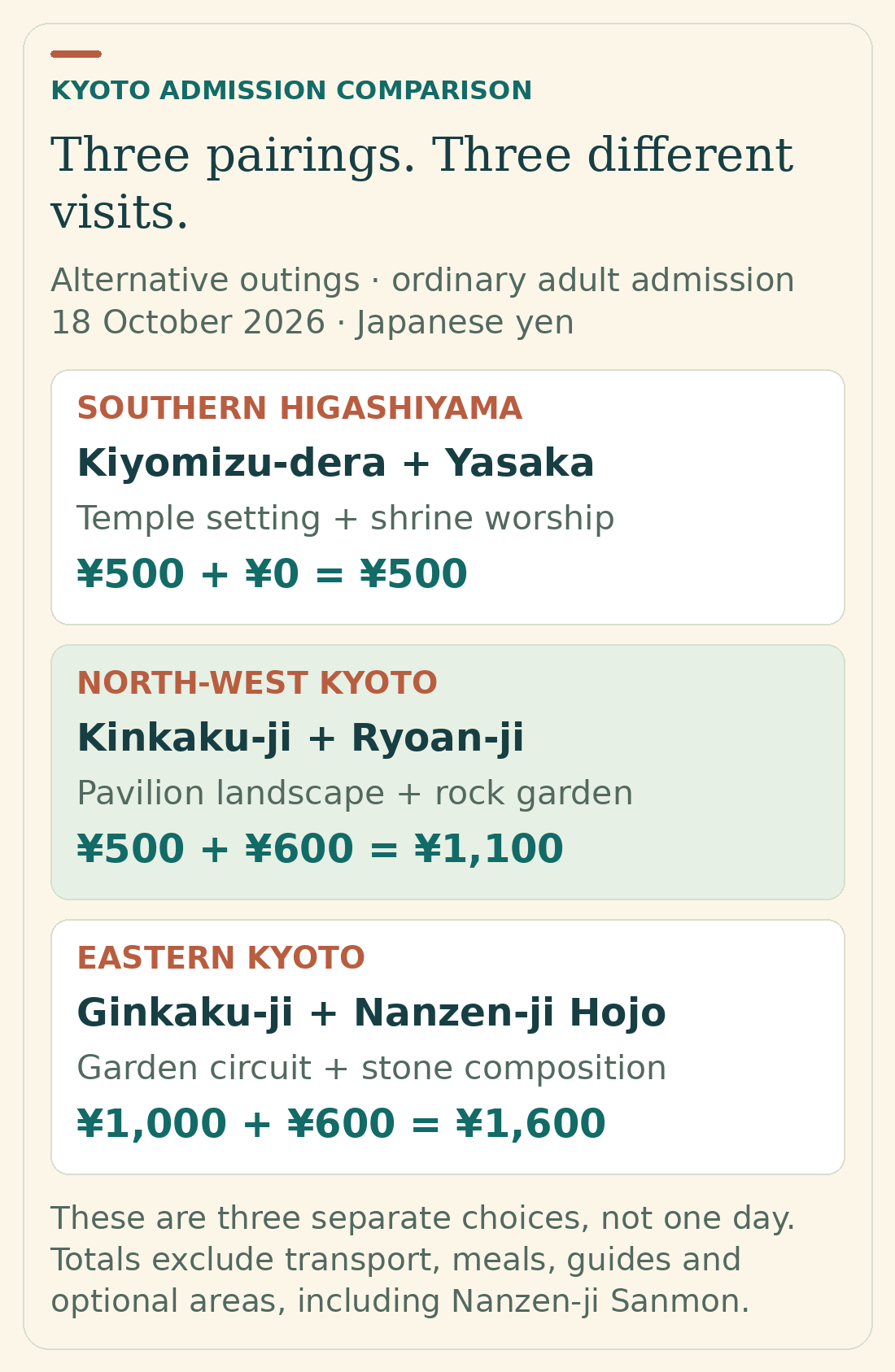
At these prices, Kinkaku-ji plus Ryoan-ji costs ¥1,100 per adult; Ginkaku-ji plus Nanzen-ji’s Hojo costs ¥1,600. The difference is ¥500 per person, or ¥1,000 for two adults. Choose between them primarily for the experience and location. [8][9][10][12] Paying for another cross-city journey to save a small admission difference may defeat the purpose.
Kiyomizu-dera plus ordinary worship access at Yasaka totals ¥500 per adult. At Nanzen-ji, adding Sanmon to the Hojo increases those two admissions to ¥1,200. [6][12][18] Price the areas you intend to enter, especially when a listing combines an ordinary visit with an optional garden or special opening.
Current exceptions that can change the choice
Nanzen-in, the subtemple within Nanzen-ji, has a renovation closure scheduled through spring 2027. There is a published exception: its garden opens specially from 1–30 November 2026, with adult admission of ¥500. The main Nanzen-ji precinct, Hojo garden and Sanmon continue operating separately. Check the notice for the area you want; a Nanzen-in closure is not a closure of the whole complex.[19][20]
Nanzen-ji’s ordinary paid visiting areas close from 28–31 December. For late-autumn evening plans, Kiyomizu-dera advertises special night visits from 21–30 November 2026.[12][21] Choose a particular published opening instead of assuming that ordinary daytime admission or hours apply after dark. Recheck the relevant official page close to your date, especially for special buildings and religious events.
The Japan trip cost guide puts these admission choices alongside the wider accommodation, food and transport budget.
Adjust the choice for walking, weather and access
A famous hillside temple is not automatically unsuitable for wheelchair users, and a garden should not automatically be treated as step-free. Select the particular experience and route first. The current official information gives several useful distinctions:
- Kiyomizu-dera publishes barrier-free routes to its public areas and provides route maps at Todoroki-mon. It has no wheelchair loan service. Plan the approach as well as the temple route.[7]
- Kinkaku-ji’s accessible path reaches the Golden Pavilion. Steps affect the onward garden route, so wheelchair and pushchair users return towards the entrance from that point.[27]
- At Ryoan-ji, the prefecture’s visitor information says staff guide wheelchair users to view the rock garden. It also records a tactile miniature garden and Braille information.[9]
- For Nanzen-ji, the prefecture records partial wheelchair access to the precinct and Hojo, with assistance needed for steps; Sanmon is not wheelchair accessible.[5]
For a traveller who wants the main visual experience with less walking, Kinkaku-ji can therefore be a useful starting point. For a wheelchair visit centred on Ryoan-ji’s garden, contact the temple about the assisted route. These are reasons to investigate a particular choice, rather than guarantees about every surface or an individual’s needs.
Change the connecting journey when the weather changes
The gardens and approaches in these combinations still involve time outdoors. In steady rain, shorten the district walk and give the main site more of the available time. In heat, retain the seated break and reduce the number of stops. Wet steps and slopes also change what counts as a comfortable pace.
If avoiding outdoor exposure is essential, reconsider the temple-focused half-day itself. A list of attractive gardens cannot provide the same sort of shelter as an indoor attraction. For a mixed group, agree beforehand that anyone can shorten the second visit without turning it into a failed itinerary.
Decide whether a guide would improve the visit
Kiyomizu-dera and Kinkaku-ji do not require advance reservations for ordinary visits, according to Kyoto City’s tourist information service.[22] You can make these choices independently. A guide becomes useful when you want help understanding architecture, garden composition or religious context, or when agreeing a manageable route in advance would make the day easier.
Two guided formats for different interests
For a garden-focused day, compare the six-hour Kyoto Japanese Gardens private tour on GetYourGuide. The listing offers a licensed guide and a customisable route. Suggest the north-west garden pairing as the starting point for discussion, and agree any additions with the guide. This is a walking tour with an on-foot meeting; a private vehicle is not included. Confirm admission and local transport costs for the route you agree.[23]
For a shorter mixed visit, compare Viator’s private Kyoto tour with a licensed local guide. The listing currently offers four-, six- and eight-hour versions; the four-hour option describes two or three chosen sites. Request a nearby temple-and-shrine pair if that is your priority. Transport and attraction entry cost extra, and the standard meeting is on foot. Select the intended duration and read its conditions before booking.[24]
Neither format removes the need to choose. A long list of possible attractions on a custom tour page is a menu to discuss, not a promise that every place fits into the day. Send the guide your main interest, the two sites you most want, walking constraints and the time you must finish. Confirm the agreed itinerary and meeting details before relying on it.
Give worship and other visitors room
Follow the site’s signs and staff instructions, keep voices low and avoid blocking people who are praying. Where shoes must come off, be ready to remove them; observe any photography restrictions inside buildings. JNTO’s visitor guidance distinguishes shrine prayers, which commonly include clapping, from temple prayer, where it is unnecessary.[15]
At Kiyomizu-dera, tripods, monopods and drones are prohibited; the temple also asks visitors not to eat or drink while walking outside its cafés and teahouses.[7] More generally, build the visit around looking and learning. Allowing someone else a clear view or space to worship is part of a successful day.
Questions before you go
Can children enjoy a temple or rock-garden visit?
Choose a short, specific way of looking: notice how a building meets the landscape, compare stone arrangements, or sketch something afterwards. Follow with movement and a break. A child who dislikes sitting quietly may enjoy a garden circuit more than a long stop studying one composition; the adult interest does not have to determine every minute.
Should a specialist garden visit be booked differently?
Check the exact site before adding it to a flexible day. Kyoto City specifically identifies Saiho-ji, also called Koke-dera, as requiring advance reservation. A specialist garden can be the main reason for an outing, but it needs its own booking plan rather than an assumed walk-in slot.[22]
Is a late-arrival afternoon still useful?
Yes, if you work backwards from the last admission and allow enough time for the visit itself. When the paid temples you want no longer fit, Yasaka’s around-the-clock worship access offers a different possibility near Gion.[6] Save the garden requiring unhurried daylight attention for another day, and check office hours separately if you want a particular service.
Make your choice
For a first temple-focused half-day, start with Kiyomizu-dera and Yasaka Shrine. Choose Kinkaku-ji and Ryoan-ji instead if garden design is the stronger interest. With more time and an appetite for walking, use Ginkaku-ji and Nanzen-ji as a separate eastern outing.
Once you have chosen the pair, check the exact paid areas, the relevant opening notice and the journey between them. Keep a third site optional until those pieces fit comfortably.
Sources
Official visitor information and the identified booking listings were consulted for this guide. Prices and dated operating information were checked on 18 October 2026; recheck the relevant venue and your selected ticket before travelling.
- Kiyomizu-dera: buildings and grounds
- Kinkaku-ji: official garden and building guide
- Kyoto City: Ryoan-ji and its rock garden
- Ginkaku-ji: official garden and building guide
- Kyoto Prefecture Tourism Federation: Nanzen-ji
- Kyoto Prefecture Tourism Federation: Yasaka Shrine
- Kiyomizu-dera: visitor FAQ and accessible routes
- Kinkaku-ji: admission and visiting hours
- Kyoto Prefecture Tourism Federation: Ryoan-ji fees and access
- Ginkaku-ji: admission and visiting hours
- Ginkaku-ji: public areas and visitor FAQ
- Nanzen-ji: admission, hours and year-end closures
- Shimogamo Shrine: official opening information
- Kyoto Prefecture Tourism Federation: Tadasu-no-mori
- JNTO: shrine and temple traditions
- Kyoto City: Kiyomizu-dera, Yasaka Shrine and Gion walking route
- Kyoto City: access to Ginkaku-ji and the Philosopher’s Path
- Kyoto Prefecture Tourism Federation: Joju-in special opening and separate Kiyomizu-dera admission
- Nanzen-ji: Nanzen-in renovation closure extended to spring 2027
- Nanzen-ji: November 2026 special openings
- Kyoto City: Kiyomizu-dera autumn evening visits in 2026
- Kyoto City Tourist Information: which temples need reservations
- GetYourGuide: Kyoto Japanese Gardens Private Tour with Licensed Guide
- Viator: Kyoto customised tour with a licensed local guide
- Fushimi Inari Taisha: the mountain and its torii paths
- Tenryu-ji: garden, halls and current visitor information
- Kinkaku-ji: wheelchair routes and visitor FAQ
Illustrations in this article were created for Taylor’s Trailblazing Travels. Third-party photographs, where used, are credited beside the image or in the source list.