How Many Days Do You Need in Japan? Choosing the Right Trip Length
Compare the time you can take with the time your route will actually leave you.
- 7, 10, 14 or 21 days
- Count nights and transfers
- An original time-budget model
AI-generated editorial illustration of a train journey through rural Japan; the landscape and route are imagined, not a verified railway view.
The useful question is how many days your version of Japan needs. A week can work well for one region. Two weeks allow a broader first trip. Three weeks create room for another region or a more relaxed pace, provided the extra cost and time away remain comfortable.
Choose the duration before filling it with destinations. This guide compares what different trip lengths leave available after arrival, departure and hotel moves, so a longer list of stops does not quietly consume the holiday.
7 days · 6 nights
A focused introduction to one region. Best when time away is limited and the wish list is short.
10 days · 9 nights
Two main bases can work, with clear priorities and limited extra travel.
14 days · 13 nights
More time for Tokyo and Kansai, pauses and one or two flexible excursions.
21 days · 20 nights
Space for slower stays or one coherent extension, rather than a rush around the whole country.
How many days in Japan fit the trip you want?
JNTO’s planning guidance suggests one base for a trip of a week or less and a Tokyo–Kyoto–Osaka combination for around ten days to two weeks. The comparisons here take that broad starting point and add explicit overnight and transfer assumptions. [1]
| Length | A sensible shape | Why choose it? | What to leave out |
|---|---|---|---|
| 7 days / 6 nights | One Tokyo or Kansai base, with a limited number of nearby outings. | A compact city or cultural trip with little hotel administration. | A distant second region added just to see more of the map. |
| 10 days / 9 nights | Tokyo plus one Kansai base. | A varied first taste without needing a full fortnight in Japan. | Multiple one-night stays and a separate overnight for every day-trip destination. |
| 14 days / 13 nights | Two or three bases, with time to revisit an area or change a weather-dependent day. | A broader first visit with some breathing space. | An assumption that every additional attraction must fit. |
| 21 days / 20 nights | Longer stays in the main bases, or one connected regional extension. | More depth, rest days and flexibility. | Unrelated northern and southern add-ons without pricing their travel days. |
A shorter trip is preferable when its cost and time away are comfortable and its scope is honest. A longer trip earns its place when the additional days buy something you value: an extra region, a slower pace, specialist activities or room to adapt.
Count calendar days, nights and annual leave separately
Arrival on the 1st and departure on the 14th is fourteen calendar days in Japan but thirteen accommodation nights, assuming an ordinary overnight stay between each date. It is not fourteen full sightseeing days.
The UK-to-Japan date change is another source of confusion. Japan stays on GMT+9 throughout the year, making it eight hours ahead of the UK during British Summer Time and nine hours ahead during GMT. The flight’s local arrival date, rather than the day you leave home, starts the Japan count. [2]
Before deciding between “one week” and “two weeks”, write four dates: leaving home, arriving in Japan, departing Japan and returning home. Add a recovery day at home if it matters for work or family commitments. Derive annual leave from that actual calendar; do not assume all flight patterns use the same number of days.
Use nights when booking accommodation, calendar dates when checking entry permission and flight dates, and usable time when deciding how much sightseeing fits. The three totals answer different questions.
Estimate the sightseeing time your route leaves available
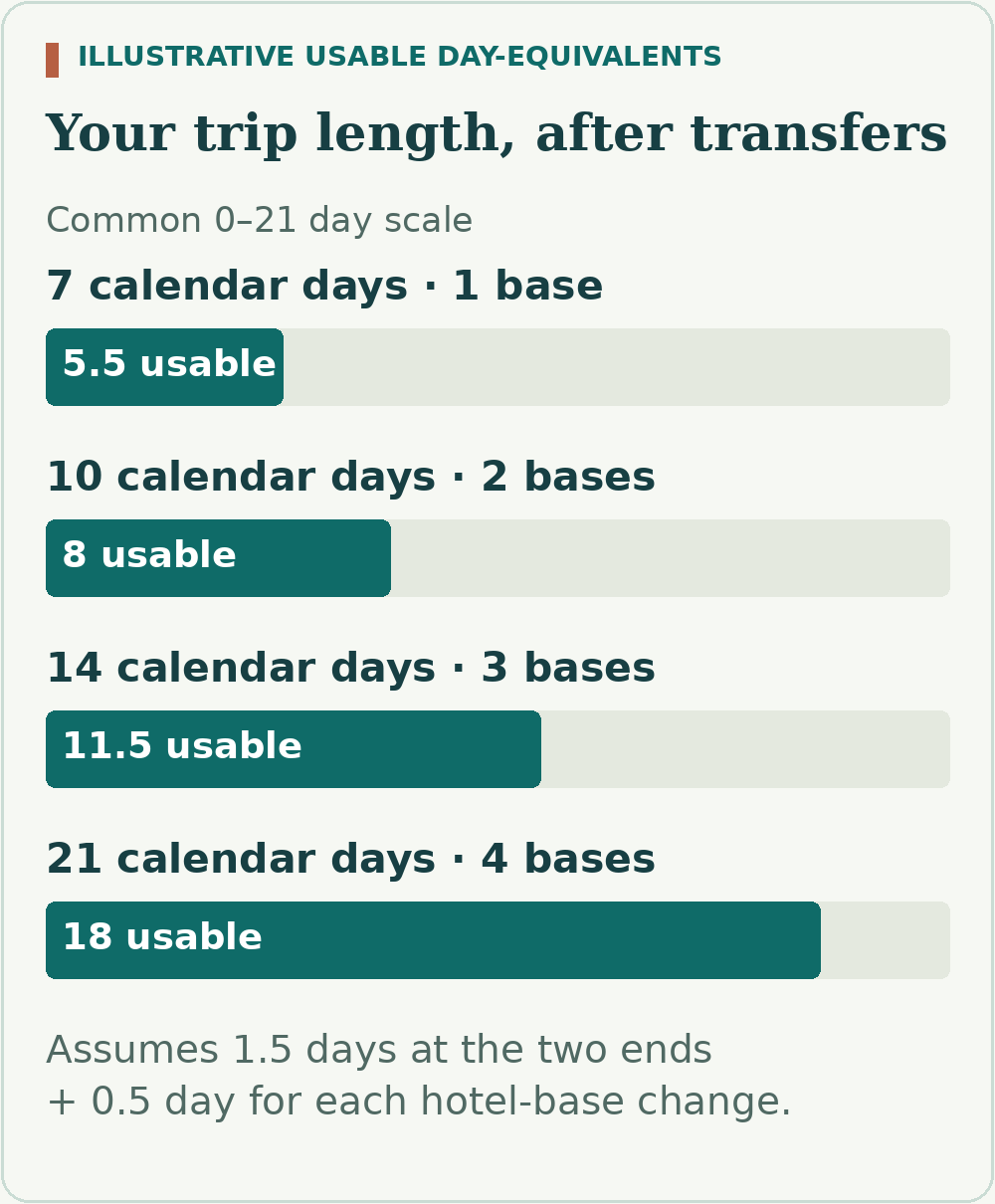
A simple model makes hotel changes visible. It does not predict tiredness or guarantee a particular amount of sightseeing. Start with the calendar days in Japan, reserve one and a half days in total for the time lost around arrival and departure, then reserve half a day for each change of hotel base.
The boundary allowance assumes the arrival and departure dates each leave roughly a quarter-day of usable time: together they retain half a day out of two calendar dates. If your flights leave no useful time at either end, subtract another half-day. If the actual flight times are better, adjust the allowance rather than treating the example as a rule.
Think of a day-equivalent as a rough block of daytime sightseeing. Count every move between accommodation stays, including a return to a city already visited.
Usable day-equivalents = calendar days − 1.5 − (0.5 × hotel-base changes)
| Japan stay | Bases assumed | Base changes | Usable equivalent |
|---|---|---|---|
| 7 days | 1 | 0 | 5.5 days |
| 10 days | 2 | 1 | 8.0 days |
| 14 days | 3 | 2 | 11.5 days |
| 21 days | 4 | 3 | 18.0 days |
The half-day allowance is a deliberately simple planning assumption. It can be too much for a nearby move with light luggage and too little for a rural connection, domestic flight, assistance requirement or disruption. Day-trip travel also consumes sightseeing time within the usable total; it has not been deducted again in this table.
Why a short train ride is only part of a hotel move
The official SmartEX overview describes Tokyo–Kyoto as around two hours by the fastest Shinkansen. Your room is not at the platform: packing, getting to the station, finding the train, the onward local journey and leaving bags all matter. [3]
As a separate illustrative example, 45 minutes to reach a station, 30 minutes to navigate and wait, a 150-minute rail allowance, 45 minutes at the far end and 30 minutes for bag drop add up to five hours. The 150 minutes is a model input, not a quoted timetable. Replace all five inputs with the route you are considering.
Choose seven days for a focused regional trip
With six nights, the most useful decision is usually which region to concentrate on. Staying in Tokyo can give you time for several different neighbourhoods and an optional nearby outing. Staying in Kyoto or Osaka can support a Kansai-focused visit, with the exact balance depending on whether your priorities are historic places, food or evenings in the city.
Kyoto, Nara and Osaka form a well-established regional combination in JNTO’s itineraries. That supports considering them together; it does not mean all three need separate hotel bookings. [4]
For a week, build the plan around three days you particularly want, then protect the remaining time for arrival, departure and flexibility. A pair of distant overnight bases can be made to fit on paper, but it asks a compact holiday to carry an extra transfer and a second settling-in process.
Choose a week when it is what your circumstances comfortably allow and one region would feel worthwhile. Consider extending when the whole purpose is to combine Tokyo with Kyoto and you would resent choosing between them. Adding days should solve that actual priority rather than satisfy a belief that a short Japan trip is invalid.
Choose ten days when two main bases are enough
Nine nights can support a deliberate Tokyo–Kansai introduction. One example is five nights in Tokyo and four in Kyoto or Osaka. Use the second base to organise the region, rather than changing hotels again for every place you visit.
This length suits someone who wants contrast and can accept leaving out a distant extension. On the illustrative model, one base change leaves eight day-equivalents. Adding three more hotel moves would take another day and a half from that allowance without extending the holiday.
Decide what earns a whole day: a particular collection, a slower neighbourhood walk, a food experience or a nearby excursion. If most days already contain two widely separated priorities, reduce the list before reducing rest or meal time.
A flight into Tokyo and out of Kansai can avoid a return leg if the fares and connections suit. If both international flights use Tokyo, budget for returning there and consider a final Tokyo night. That changes the hotel and time model, so do not keep quoting the two-base total unchanged.
Choose fourteen days for a more forgiving first visit
Thirteen nights are a useful starting point when you want both Tokyo and Kansai with some flexibility. A straightforward split is Tokyo five nights, Kyoto five nights and Osaka three nights. If fewer moves matter more, keep Tokyo for five nights and spend eight in a single Kansai base.
These alternatives show what the additional days can buy. Two bases leave more uninterrupted time in each place. Three bases let you experience different evenings and early starts without travelling back each night. Neither wins automatically.
Leave one or two days open enough to move an outdoor plan or revisit somewhere that interests you. If you are travelling with children, managing fatigue or allowing extra time for access arrangements, those quieter blocks have a purpose; they are not gaps to fill.
The extra four calendar days over a ten-day trip do not all disappear into complexity. With the table’s assumptions, moving from two bases in ten days to three bases in fourteen days increases usable time from eight to eleven and a half day-equivalents: an extra three and a half. Keep the same two bases and the full four additional days remain available in the model.
Choose twenty-one days for depth or one coherent extension
Twenty nights can change the character of a holiday. You can keep the main route and spend longer in fewer places, or add a connected region with enough nights to justify getting there. The extra week is especially useful when a specialist interest needs slower transport, an early start, recovery time or weather flexibility.
For a route continuing west from Kansai, Hiroshima is one possible extension along the wider corridor shown in JNTO’s Golden Route material. Choose it because its museums, history or surrounding area interest you, and check the actual onward and departure journeys. [5]
A sample allocation is Tokyo six nights, Kyoto six, Hiroshima three and Osaka five: twenty nights across four bases. It is intentionally a nights framework rather than a sightseeing schedule. If the final airport is Tokyo, redesign the final nights and add the return transfer.
Do not use “three weeks” to justify unrelated additions at both ends of the country. A domestic flight or a slower regional connection may take most of a day once the complete journey is counted. Use actual provider timings before choosing a far-flung extension.
For some travellers, the stronger twenty-night plan is simply two long city stays and a few carefully chosen excursions. The useful measure is the quality of the days, not the number of hotels.
Adjust the duration for the way you travel
| Your constraint | A useful adjustment | Why it helps |
|---|---|---|
| Children, fatigue or access arrangements | Use fewer bases and protect rest or assistance time. | The same number of places may need a different daily pace. |
| Limited budget | Price the extra nights before extending; compare a shorter trip in fewer places. | Additional days bring real accommodation and living costs. |
| Outdoor or seasonal priorities | Allow a movable day or an alternative experience. | Weather and seasonal timing may change what is possible. |
| One scarce ticket is the main purpose | Check official release and booking conditions before fixing the whole trip. | The headline duration matters less than whether the key experience fits. |
| Strong dislike of packing and transferring | Extend stays rather than adding hotels. | Longer visits can become easier without becoming wider. |
Climate varies across Japan, and spring or autumn conditions in one region do not promise the same experience elsewhere. Give a weather-dependent plan the relevant regional forecast and an alternative; extra days improve flexibility but cannot guarantee conditions. [6]
The cost of adding four days
If you retain the same route, moving from ten to fourteen calendar days normally adds four accommodation nights, four days of meals and local spending, and any extra activities. Compare:
Extra cost = 4 × your nightly accommodation share + 4 × your daily meals and local-travel allowance + extra intercity transport, activities or fees
This is a calculation framework, not a price quote. Replace each input with your actual plans. If your daily allowance already includes activities or fees, add only costs not already covered there. If that extra cost would force you to cut the experiences you most value, ten well-chosen days may be the better holiday.
Use a final three-question test before booking
- Can each essential experience fit without relying on arrival day, departure day or a rushed connection?
- Does the number of bases still leave the usable time you want after realistic transfers?
- Can you comfortably afford the entire stay, including the additional nights and a contingency?
If all three answers are yes, you have a defensible duration. If time is the problem, remove a base or add days. If cost is the problem, reduce distance and hotel changes before assuming the answer must be a more expensive trip.
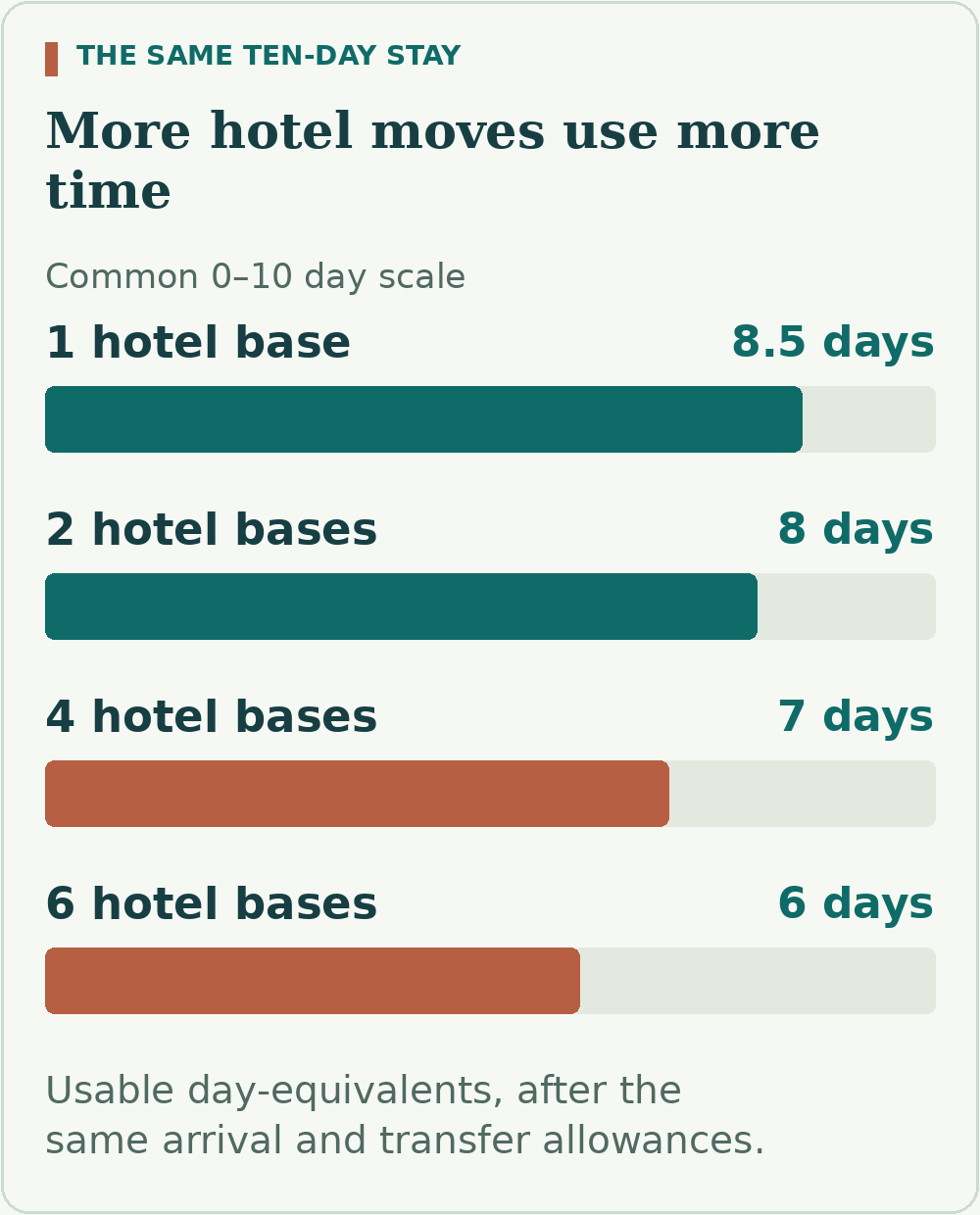
The chart shows the trade-off inside a ten-day stay using the same arrival/departure allowance and half a day per hotel move. Keeping one base leaves 8.5 day-equivalents, two bases leave 8.0, four leave 7.0 and six leave 6.0. It does not claim one base offers the same variety as six; it shows the time you exchange for that variety.
Place the preferred stops and nights in the Trip Itinerary Planner. Then check the actual transport and booking conditions. The planner can organise your choices; it does not confirm that every proposed connection is feasible.
Questions that can change your plan
Is five days in Japan worth considering?
Five calendar days can suit a single-city visit or a stop within a wider journey if the flight times, cost and your priorities make sense. It is a different proposition from trying to combine several regions. Count the usable time at both ends before committing to a long journey for a very short stay.
Is fourteen nights the same as two weeks in Japan?
Fourteen nights usually spans fifteen calendar dates from arrival to departure. A fourteen-calendar-day stay usually contains thirteen nights. Travel companies may use “two weeks” differently, so check the actual dates and accommodation count.
Should a day trip count as another base?
No. A base change means moving where you sleep. Day trips still use travel time, but that time sits inside the sightseeing allowance unless you deduct it separately. Do not subtract it twice.
How much should I allow for jet lag?
There is no reliable personal allowance that works for everyone. Keep arrival day and the first morning light, then adjust for your flight, sleep and experience of long-haul travel. The time model is a route-planning aid rather than a prediction of how quickly you will adapt.
Make the decision that fits your trip
Choose seven days for a focused region, ten for a deliberate two-base introduction, fourteen when a broader first trip and some flexibility matter, and twenty-one when the extra time has a clear purpose. Then count the real nights and transfers. The right duration is the one that gives your essential experiences enough room within the time and money you can comfortably commit.
How this guide was researched
The duration recommendations and time-budget model are original editorial planning tools informed by JNTO and rail-operator guidance checked on 17 October 2026. The model assumes 1.5 days lost around arrival and departure, plus 0.5 day per hotel-base change. It is not a measured average or personally tested itinerary. Replace these assumptions with your actual flights, transfers and needs.
Sources
Official guidance and operator information reviewed on 17 October 2026. Recheck time-sensitive details for your own travel dates.
Illustrations in this article were created for Taylor’s Trailblazing Travels. Third-party photographs, where used, are credited beside the image or in the source list.