Aomori Travel Guide: Culture, Coast and Northern Japan
Start with the city’s festival art and archaeology, then choose one direction into the wider prefecture.
- Start with · Aomori city
- Suggested core · 2 full days
- Key distinction · Aomori ≠ Shin-Aomori
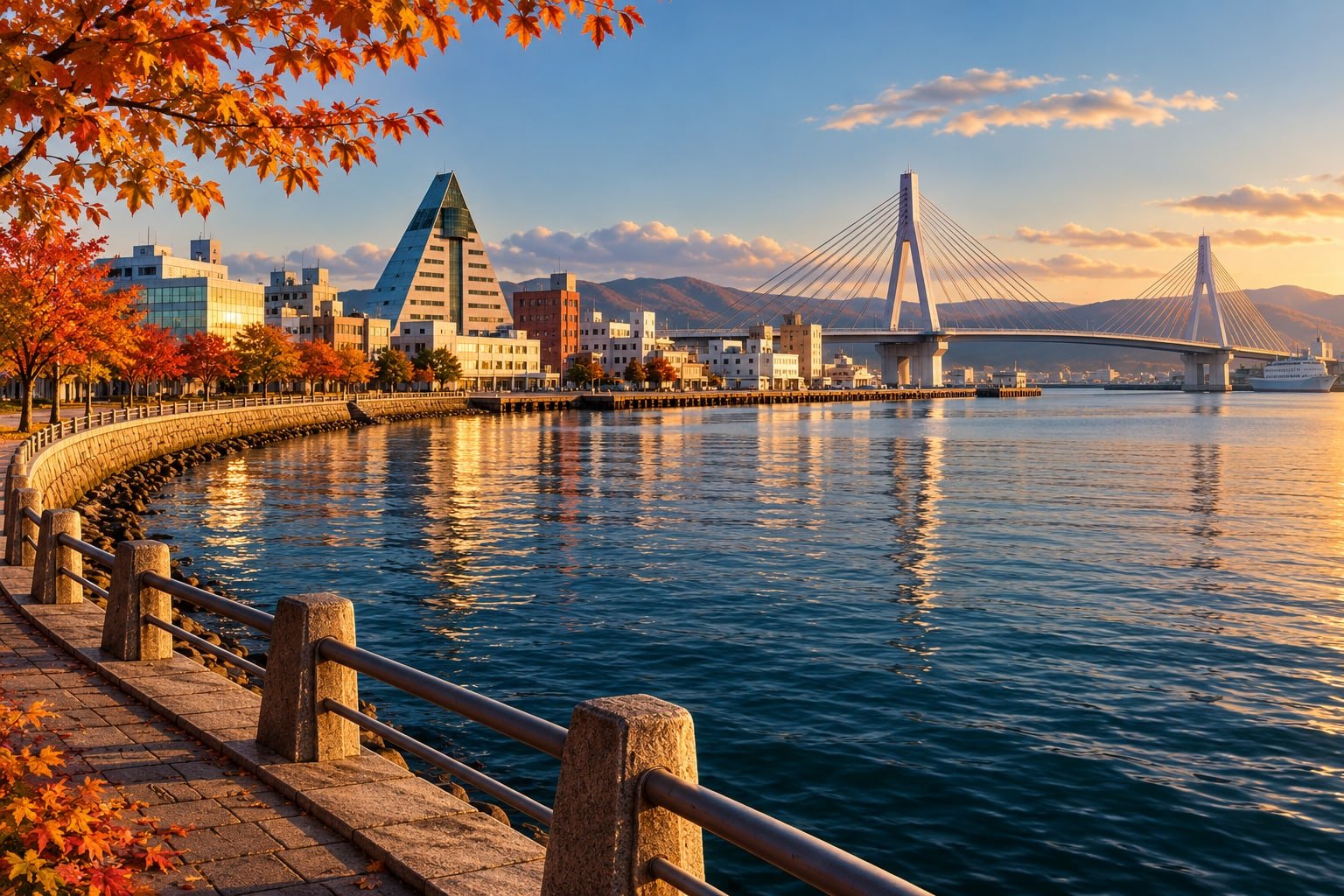
AI-generated editorial illustration inspired by Aomori’s waterfront; architectural details and the viewpoint are illustrative, not a verified photographic view.
Aomori can mean a compact city stay or a much larger journey around northern Honshu. The prefecture has separate gateways at Aomori, Hirosaki and Hachinohe; its mountains and different coastlines do not form one convenient city sightseeing circuit.[1]
Start with festival art, archaeology and food in Aomori city, then choose a direction. This guide compares the stays that work with limited time, explains the current constraints at Hirosaki and Oirase, and gives the coast enough space to be more than a view through a train window.
This guide contains affiliate links. If you book or buy through them, Taylor’s Trailblazing may earn a commission at no extra cost to you.
Separate city and prefecture
A waterfront museum day and a peninsula journey demand different plans. Choose the extension before deciding the number of hotel nights.
Count the time between buses
At Oirase, the gap between arrival and your workable return is the real sightseeing window. Protect a selected short walk.
Match the base to the coast
Aomori suits Mutsu Bay, Hachinohe suits the Pacific shore, and the Gono Line rewards an onward journey along the Sea of Japan.
Check season before booking
Winter changes through-buses and mountain access. Hirosaki’s keep closure is a separate long-term issue, not just a winter restriction.
Choose your base before choosing every attraction
Aomori Station is the useful default for the waterfront and ordinary city evenings. Shin-Aomori is the Shinkansen interchange; it is a different station, with a short local train connection to the centre. Check both names when reading a hotel or transport listing.[1][2]
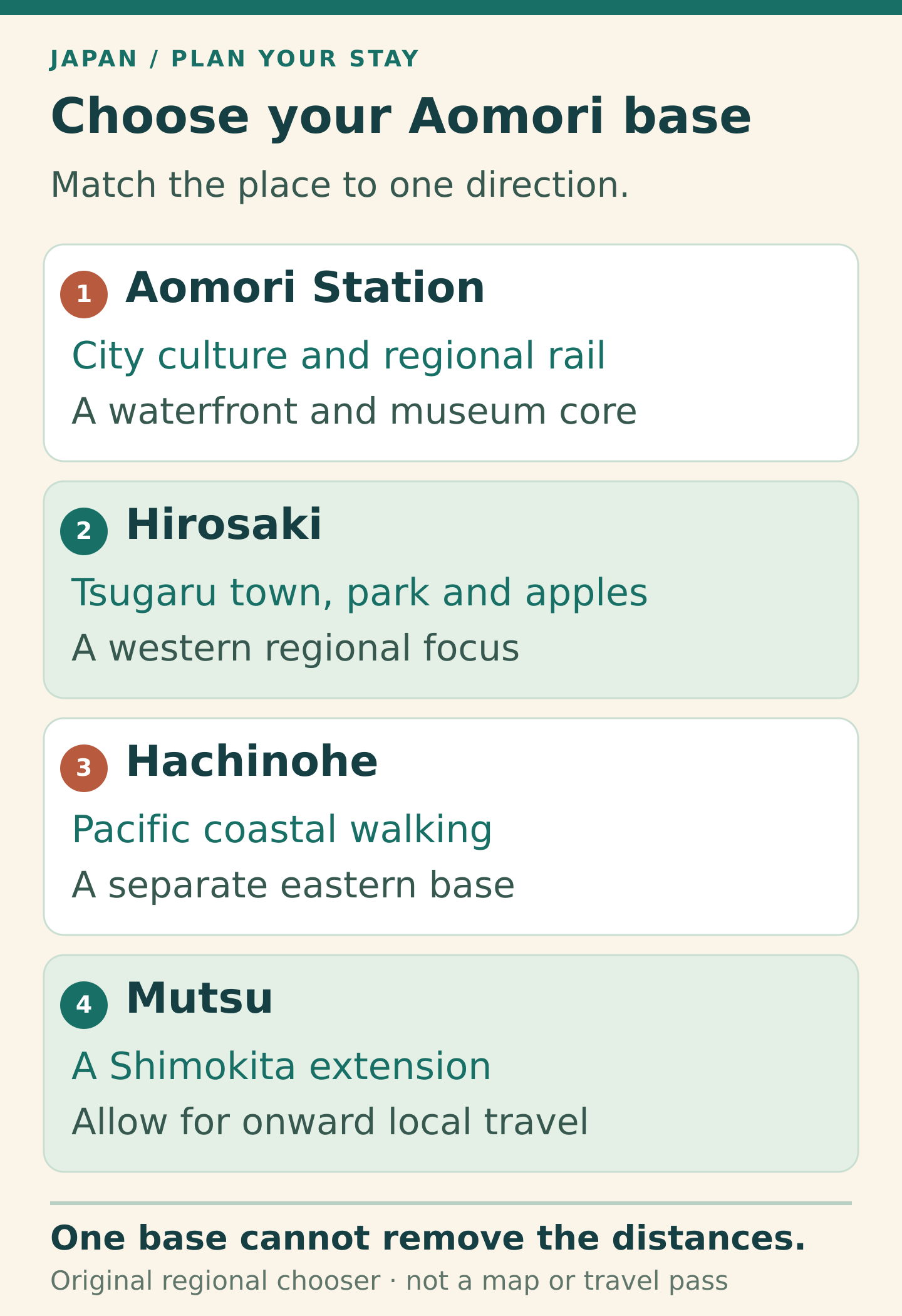
| Base | Use it for | Trade-off |
|---|---|---|
| Aomori Station | Festival culture, waterfront food, archaeology and regional rail connections. | Mountain and peninsula trips still require their own transport plan. |
| Hirosaki | Castle park, apple culture and a stay focused on western Tsugaru. | Check whether your hotel suits the station or the park; these are separate locations. |
| Hachinohe | A Pacific coast extension using the Hachinohe Line. | Hachinohe Station is the Shinkansen hub; Hon-Hachinohe serves the city centre.[27] |
| Mutsu | A planned Shimokita extension rather than repeated city returns. | Select specific sights and check seasonal access; distances across the peninsula add up.[28] |
Compare Agoda’s Aomori accommodation search with Booking.com’s Aomori accommodation search for the city core. If most of your extra time is in Tsugaru, compare Agoda’s Hirosaki search and Booking.com’s Hirosaki search before automatically returning to Aomori every night. Check the exact hotel entrance, room size, luggage storage, meal plan and total cancellation cost for the same dates.[3][4][5][6]
A split stay earns its extra packing when it puts the next morning where you want to be. For a short city-and-Hirosaki visit, one base can still be simplest. For several coastal stops or a peninsula tour, keeping the same room becomes less useful if it requires retracing the entire journey each evening.
Aomori city: festival art, the waterfront and a proper meal
Wa Rasse makes the festival understandable
Nebuta Museum Wa Rasse displays full-sized floats used in Nebuta, with interpretation of their construction, history and performance. Start here to understand the celebration outside festival week. Give the craftsmanship and the programme’s demonstrations time, rather than treating the floats as a quick photo stop.[7]
The adult ticket currently costs ¥620. The museum normally closes on 9–10 August for the changeover period and on 31 December–1 January; September–April opening ends at 18:00, with a later summer close. Check the programme if a particular demonstration is important.[7]
Use the waterfront as a connected neighbourhood
A-FACTORY, close to the station, combines local food shopping with apple cider and juice production. It suits a tasting, a food souvenir or a break by the bay. Its purpose is different from Wa Rasse: allow a shopping or eating pause rather than planning another major museum visit.[8]
Choose the preserved Hakkoda-Maru ferry if maritime history interests you. Its connection with the former rail-ferry crossing gives the waterfront historical context, and the ship carried trains as well as people. Check the seasonal opening calendar before adding it to a winter day.[11]
Make the market an early meal
At the Furukawa market’s Nokkedon, buy meal tickets, use them for rice and your chosen toppings, then eat in the market’s seating areas. Look around before spending all your tickets so that the bowl suits your appetite and budget. Ask about the ingredients of cooked dishes as well as raw seafood.[9]
Plan this for breakfast or lunch. The market is normally closed on Tuesdays; the current calendar includes earlier Monday finishes. Check the actual date rather than assuming every stall will still be serving near the end of the afternoon.[10]
An unhurried city day can run from a market meal to Wa Rasse, followed by the waterfront and one additional interest. If you prefer a local historical explanation, compare Viator’s six-hour Aomori tour with a licensed guide. It is a customised walking tour, with transport fares, admissions and meals extra. Agree the open sites you want in advance; this product does not include Hirosaki or a private vehicle.[17]
Give archaeology and art a separate block of time
Sannai-Maruyama changes the timescale of the trip. Its remains and reconstructed pit dwellings and large timber structures help explain a Jomon settlement; the buildings you walk around are interpretive reconstructions rather than surviving prehistoric houses. The site forms part of the Jomon Prehistoric Sites in Northern Japan, inscribed on the World Heritage List in 2021.[12][13]
Start with the interpretation, then look at the excavated and reconstructed areas with that context. The current adult admission is ¥500, following the April 2025 revision. The fourth Monday of the month is normally a closure day, moving to the next day when it is a public holiday; the year-end closure and other scheduled closures also need checking.[14]
Aomori Museum of Art makes a useful partner. Its collection and the architecture deserve time beyond the well-known Aomori Dog sculpture. Adult collection admission is currently ¥700, with special exhibitions priced separately. The outdoor passage to the sculpture closes when winter snow accumulates and in adverse conditions, although the work can be viewed from inside the museum.[16]
Allow a substantial half-day for one venue and a slower five-to-six-hour block for both, including travel, walking between entrances and a meal; these are editorial allowances. Buses from Aomori Station to Sannai-Maruyama take around 30–40 minutes, so the pair is not a casual waterfront detour. Check each entrance and the return stop rather than assuming neighbouring grounds connect directly.[15]
With only one full day in Aomori, choose either this deeper archaeology-and-art programme or the more compact waterfront day. With two, give each its own space and retain the option to change their order around museum closures.
How many days? Compare the time you can actually use
| Stay | Complete days available | Sensible emphasis |
|---|---|---|
| 2 nights | 1 full day | Choose the city waterfront or archaeology and art. Add a major regional excursion only if that is the main reason for coming. |
| 3 nights | 2 full days | A city day plus Hirosaki or a dedicated Oirase day; or keep both days in Aomori for the fuller cultural programme. |
| 4 nights | 3 full days | The two-day city core and one chosen extension. |
| Longer stay | Depends on arrival and departure | Move towards your chosen coast or peninsula when that reduces repeated travel. |
Earlier arrival or later departure changes those options. Count hours before choosing the nights, and use the wider guide to how many days you need in Japan if this is one stop in a longer route.
Hirosaki is comparatively flexible: one current JR local service takes 45 minutes from Aomori to Hirosaki Station. Add station waiting and the onward walk or bus to the park, but the journey still leaves room for a substantial town visit. Verify the actual trains you intend to use; 45 minutes is an example, not every service’s running time.[2]
What an Oirase day leaves for walking
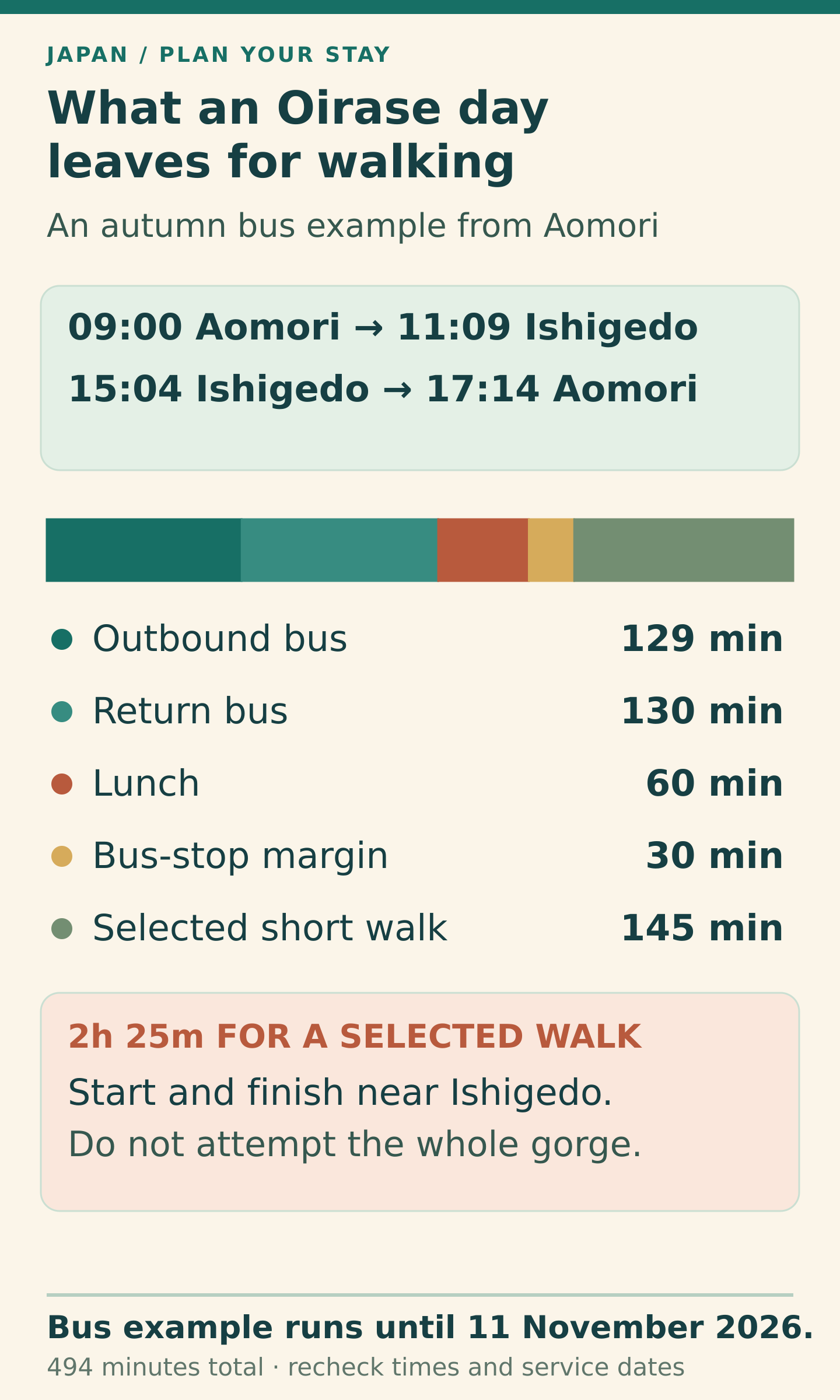
The autumn 2026 JR Bus timetable offers this illustrative pair through 11 November: Aomori 09:00 to Ishigedo 11:09, then Ishigedo 15:04 to Aomori 17:14. That creates a 494-minute day with 259 minutes on buses and 235 minutes between arrival and departure at the gorge.[18]
| Component | Minutes | Basis |
|---|---|---|
| Outbound bus | 129 | Published autumn service |
| Return bus | 130 | Published autumn service |
| Meal break | 60 | Editorial allowance |
| Bus-stop margin | 30 | Editorial allowance |
| Selected short walk | 145 | Time remaining |
| Total day | 494 | 8 hours 14 minutes |
The 145 minutes support a selected short walk or an out-and-back from Ishigedo. They are not enough to promise the entire gorge and a Lake Towada visit. A longer walking ambition calls for an earlier service, an overnight nearer the gorge or a different transfer plan. Check the latest trail conditions, leave the return margin intact and remember that a published unreserved service is not a seat guarantee.
This is why a three-night stay needs a clear priority. Choosing Oirase for one of two full days is reasonable, but it displaces a substantial city or Hirosaki day. Trying to add the lake, ropeway and another region to that same independent bus outing defeats the purpose of going to walk.
Hirosaki and western Tsugaru: town, apples and a different kind of day
Hirosaki Castle’s keep is closed inside for conservation. The closure began on 24 November 2025; the city’s current forecast extends into the 2032 financial year, which runs from April 2032 to March 2033. This is a works forecast, not a confirmed reopening date. Exterior access and views change as the building and surrounding works progress. Plan a park-and-town visit, and check the current work notice before expecting an unobstructed castle view.[22][38]
That limitation changes the reason to go, rather than removing every reason for a Hirosaki day. Choose time in the park, food and the wider town when those interests appeal in their own right. If entering the keep is your main objective, the trip currently cannot deliver it.
Hirosaki City Apple Park provides a more direct connection with the region’s apples through orchard paths, apple products and seasonal picking. Picking is usually offered from early August into mid-November, subject to growing conditions. It needs its own local journey, so choose it as a priority rather than adding it after a full park-and-town circuit.[23]
For a hands-on food day in western Tsugaru, view the Mutsu-Tsuruta market and home-cooking experience on GetYourGuide. This is a 4.5-hour private experience meeting at Mutsu-Tsuruta Station on the Gono Line, not in Aomori city or at Mutsu in Shimokita. The listing offers an English-speaking host, a plant-based menu, ingredients, equipment and the meal; travel to the station is extra, and it is not wheelchair-accessible. Confirm dietary details and rail connections before booking.[30]
Give that experience the centre of its day. Pairing a long cooking session with a rushed castle circuit and several coastal stops would make each less rewarding.
Choose a coast: three very different journeys
Asamushi: the shorter Mutsu Bay outing
Asamushi-Onsen is about 20 minutes from Aomori by the Aoimori Railway. The station area gives access to the hot-spring town, a footbath and the shore of Mutsu Bay. It is the easier choice when you want a coastal pause or a hot-spring night without committing a whole day to distant travel.[25]
For a bath visit, check whether the chosen property admits day guests, the hours and any reservation or tattoo policy. For an overnight stay, compare the meal plan and room view as carefully as the address. A short rail journey does not remove the need to check the return departure.
The Gono Line: make the journey part of the trip
JR East’s Resort Shirakami follows the Sea of Japan side on the Gono Line, with services linking Akita to Aomori or Hirosaki. All seats are reserved and an operating calendar applies. Check the specific train rather than assuming every departure runs the whole route every day.[24]
This works especially well as an onward leg towards Akita or a stay along the western coast. Decide whether your priority is the railway scenery or time off the train. Repeated stop-offs need compatible onward departures, and a scenic journey should not be squeezed between two large city programmes.
Hachinohe and Tanesashi: the Pacific walking choice
For a different coast, use Hachinohe as a regional base. The Hachinohe Line connects the Shinkansen station, the city-centre area at Hon-Hachinohe and Tanesashi-Kaigan. At Tanesashi, grassy shore and rocky sections form part of the Michinoku Coastal Trail; the information centre is a sensible place to choose a walk suited to the weather and available time.[27][26]
Pick a short section with a known return train or bus instead of assuming the whole coastal trail belongs in one afternoon. An overnight in Hachinohe becomes useful when you want both coastal walking and the city’s evening, especially if your onward Shinkansen journey already uses that gateway.
When Oirase, Hakkoda or Shimokita deserves more of the trip
The Oirase calculation above favours one clear walking objective. A day containing both the gorge and Lake Towada is easier with a longer window or transport arranged around the stops you want. Check where you will finish walking before choosing the return bus; a stop name matters more than the broad destination “Oirase”.
If you want several nature stops without organising each rural connection, compare the Oirase, Towada and Hakkoda vehicle day trip on GetYourGuide. The verified listing is a nine-hour vehicle outing with transport included. Its English service uses a driver’s translation tools, so it should not be confused with a full English-language interpretive guide. Check the exact meeting point, ropeway and optional cruise charges, mobility arrangements and the weather alternative for your selected date.[21]
Hakkoda Ropeway can be a separate outing when mountain conditions are favourable. The operator warns of weather suspensions and annual maintenance in early November, and snow can obscure summit paths well into late spring. Treat an ordinary ropeway visit and a mountain walk as different decisions; a working lift does not establish that your proposed walking route is suitable.[20]
Shimokita deserves a dedicated extension. Its sights are spread across the peninsula: Osorezan is a sacred place near Lake Usori in the Mutsu area, while Cape Oma and Hotokegaura pull a trip towards different coastal stops. Choose two or three priorities and check their seasonal opening and transport before deciding whether to drive, arrange transfers or stay in Mutsu.[28][29]
The practical test is whether you can describe the route from the day’s final sight to the night’s accommodation. If that connection depends on an unconfirmed bus or a taxi you assume will be waiting, settle it before adding another attraction.
Season and weather change the route
Aomori Nebuta takes place annually from 2–7 August, with different arrangements for the final day. If the festival is your main reason for coming, confirm the programme and accommodation together. Wa Rasse is the year-round cultural alternative, subject to its own short closure periods.[32][7]
For autumn, choose the area as carefully as the month. The prefecture’s 2026 reports distinguish higher Hakkoda slopes from Oirase and Lake Towada: they do not reach their best colour simultaneously. Use current local reports and weather rather than a fixed “peak foliage” date when deciding which outing gets the clearest day.[33]
From 12 November 2026, JR Bus suspends the through-service from Aomori to Oirase and Lake Towada for winter. The winter Hakkoda-go runs to Sukayu instead, through 31 March 2027. Boarding from Aomori or Shin-Aomori requires an advance reservation under the published arrangement; the return is unreserved. A bus to Sukayu does not continue through to the lake.[19]
Winter therefore favours a city-based cultural plan with a carefully checked mountain outing, or a specialist winter trip whose actual transfers are confirmed. Do not carry the autumn Oirase timetable into a snow-season itinerary. Check the ropeway’s live status and return transport before leaving the city.[20]
Arrival, local connections and practical preparation
The Tohoku Shinkansen arrives at Shin-Aomori; use the local connection for Aomori Station and the waterfront. If arriving by air, the airport gives roughly 35 minutes for the bus to Aomori Station, before waiting and hotel walking time. Keep that distinction in mind when comparing a flight, a train and the available part of your arrival day.[1][37]
You can compare Tokyo–Aomori transport on 12Go alongside direct railway or airline booking. Check the actual arrival station or airport, total fees, baggage terms, seat reservation and ticket collection. A route search labelled “Aomori” is a starting point for comparison, not confirmation that every option arrives beside your hotel.[36]
For local travel, save the specific return departure before leaving, especially outside the cities. A rail pass can be useful on a longer itinerary, but compare its valid routes and price with the journeys you have selected; it cannot compensate for a bus that does not operate in your season.
If your existing roaming plan is unsuitable, open Airalo and select a Japan eSIM and compare validity, allowance and activation conditions. Check that the phone supports eSIM and is network-unlocked. Download maps, booking details and rural timetables as well: a data plan is not a guarantee of reception at every mountain or coastal stop.[34][35]
Use ordinary preparation to suit the route: shoes comfortable for the planned walking, layers and rain protection. Winter requires a different clothing and ground-condition judgement from a summer museum day. Confirm steps, boarding and walking surfaces with the actual operator if these affect your access needs.
Costs: notice when transport becomes the main expense
| Component | Current amount | Why it matters |
|---|---|---|
| Wa Rasse | ¥620 | City festival interpretation.[7] |
| Sannai-Maruyama | ¥500 | Current fee; older pages may still show ¥410.[14] |
| Aomori Museum of Art collection | ¥700 | Special exhibitions separate.[16] |
| Aomori–Ishigedo return bus | ¥2,820 each way / ¥5,640 return | Transport alone is a substantial part of an independent Oirase day.[18] |
| Hakkoda Ropeway return | ¥2,200 | Add travel to the ropeway and any other activities.[20] |
The three listed city admissions add to ¥1,820, spread over whichever days you choose. By comparison, the illustrative Oirase bus return costs ¥5,640 before food. The experiences serve different interests; the useful lesson is to budget regional transport separately from modest city admission fees. Add your actual rail journeys, meals and accommodation before judging the total.
If you stay in Hirosaki, its accommodation tax is ¥200 per person per night from 1 December 2025, irrespective of room price, subject to statutory exemptions. This is a Hirosaki city tax, not a figure to apply automatically to every Aomori-prefecture hotel. Check what your booking has collected.[31]
Book the component that fixes the route first: festival accommodation, a particular coastal train, a remote stay with a transfer, or a guided day. Keep ordinary city visits flexible around their closure days. Review the route as part of the site’s Japan guide for first-time visitors before committing to a chain of short hotel stays.
Your Aomori questions answered
Is Aomori worth visiting outside Nebuta Festival?
Yes, if festival art, archaeology, local food or a northern coastal route appeals. Wa Rasse explains the festival through real floats and interpretation outside festival week. A city stay also gives time for Sannai-Maruyama and the Museum of Art without trying to fit them around the parades.[7]
Are Aomori and Shin-Aomori the same station?
No. Shin-Aomori is the Shinkansen interchange and Aomori Station serves the central waterfront. A short local rail connection links them; allow waiting and platform-transfer time in addition to the train ride.[1][2]
Can you visit Hirosaki Castle in 2026?
You can plan a visit to the park and town, but not the keep interior: it is closed for conservation, with the city’s current forecast extending into the financial year that ends in March 2033. A definite reopening date is not confirmed. Consult the city’s latest notice for exterior viewing and local access changes.[22][38]
Can you reach Oirase from Aomori in winter by the same bus?
No. The published Aomori through-service to Oirase and Lake Towada stops for winter from 12 November 2026. The winter service ends at Sukayu. Arrange an explicitly confirmed winter alternative if the gorge is essential to your trip.[19]
Do you need a car in Aomori?
You can follow the city, Hirosaki, Asamushi and rail-based coastal choices in this guide without a car. Rural days need closer planning around timetables, and Shimokita may suit arranged transfers or a driving trip with an overnight base. Choose the route first, then assess transport for each leg.[2][25][27][28]
Choose the plan that fits your trip
Give Aomori city enough time to establish the region’s culture, then spend the remaining days in one chosen direction. Hirosaki suits a town-and-apple extension, Asamushi a shorter bay pause, and Oirase a deliberate full-day commitment. For a longer coast or peninsula journey, move your base when it gives the following day more time where you want to be.
How this guide was researched
This guide uses official prefectural, municipal, museum and transport information and checked activity and accommodation landings, reviewed on 17 October 2026. The stay scenarios and time calculations are original planning judgements with stated assumptions. Operator notices take precedence over older translated pages; no first-hand visit or personal photography is claimed.
Sources and checks
Official, operator and relevant booking information checked on 17 October 2026. Opening arrangements, fares and availability can change; recheck the linked source for your travel dates.
- Aomori Prefecture — regional access and gateways
- JR East — October 2026 local train 654M
- Agoda — Aomori accommodation search
- Booking.com — Aomori accommodation search
- Agoda — Hirosaki accommodation search
- Booking.com — Hirosaki accommodation search
- Nebuta Museum Wa Rasse — official visitor information
- Aomori Prefecture — A-FACTORY
- Aomori Nokkedon — how the rice-bowl system works
- Aomori Nokkedon — current market calendar
- Aomori Prefecture — Aomori and Hirosaki itinerary
- Sannai-Maruyama — archaeological remains and reconstructions
- Sannai-Maruyama — World Heritage information
- Sannai-Maruyama — official admission revision
- Sannai-Maruyama — current access
- Aomori Museum of Art — official visiting information
- Viator — Aomori private tour with a licensed guide
- JR Bus Tohoku — autumn 2026 Oirase and Towada timetable
- JR Bus Tohoku — winter service change from 12 November 2026
- Hakkoda Ropeway — official operating and access FAQ
- GetYourGuide — Oirase, Towada and Hakkoda vehicle day trip
- Hirosaki City — current castle conservation project
- Aomori Prefecture — Hirosaki City Apple Park
- JR East — Resort Shirakami
- Aomori Prefecture — Asamushi Onsen
- Aomori Prefecture — Tanesashi coastal trail
- Visit Hachinohe — regional and local transport
- Aomori Prefecture — Shimokita peninsula itinerary
- Aomori Prefecture — Osorezan
- GetYourGuide — market and home cooking at Mutsu-Tsuruta
- Hirosaki City — accommodation tax
- Aomori Nebuta Festival — official dates and programme
- Aomori Prefecture — autumn 2026 foliage report
- Airalo — Japan eSIM plans
- Airalo — device compatibility
- 12Go — Tokyo to Aomori transport comparison
- Aomori Airport — access and transfer information
- National Diet Library — Japanese financial-year dates
Illustrations in this article were created for Taylor’s Trailblazing Travels. Third-party photographs, where used, are credited beside the image or in the source list.