Japan • Where to stay
Where to Stay in Gion and Higashiyama: Atmosphere Versus Access
Choose the right street, then the right room: six stays and a practical test for eastern Kyoto.
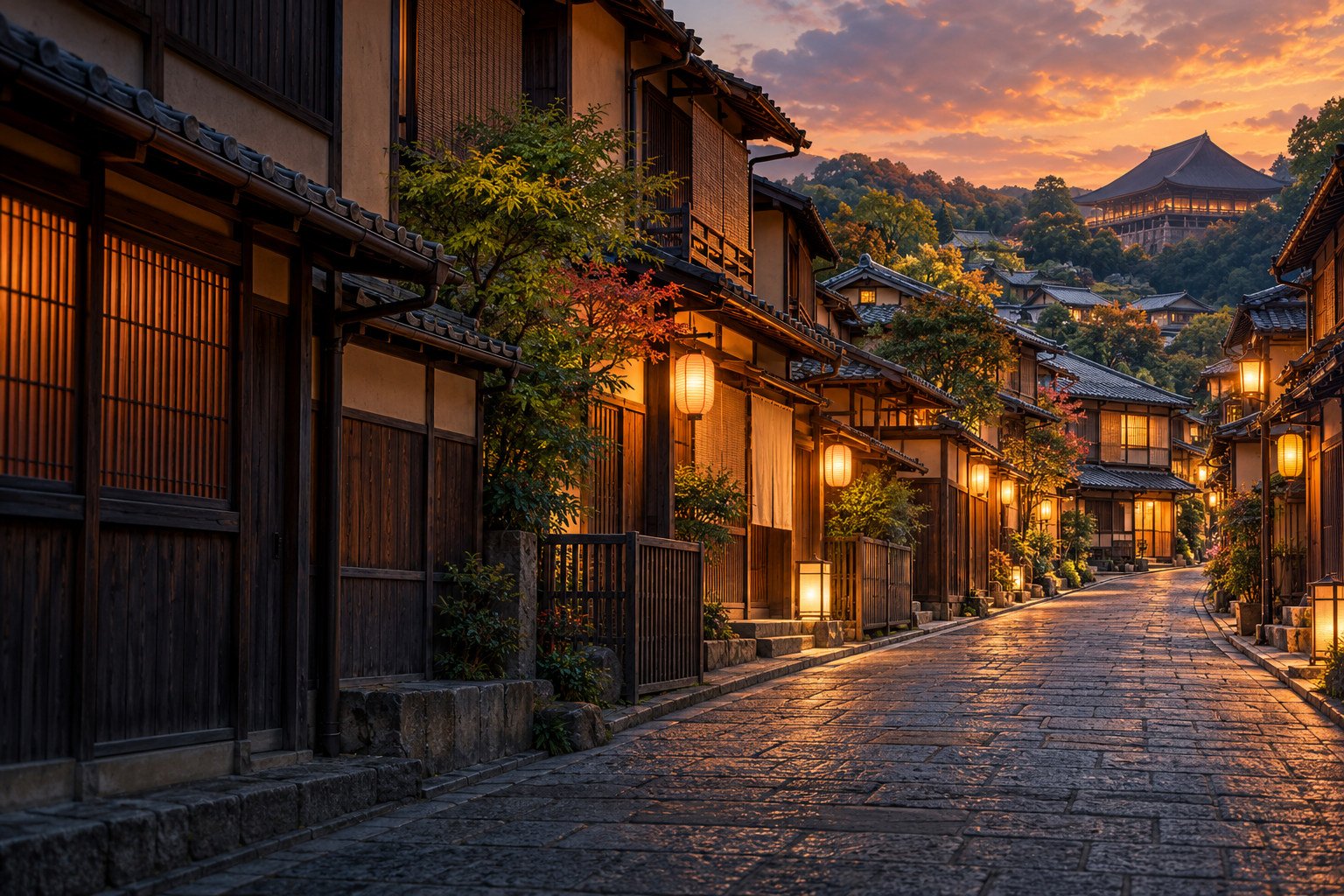
AI-created editorial illustration inspired by Gion and Higashiyama; the lane and distant temple viewpoint are imagined.
Staying in Gion or Higashiyama makes most sense when you want eastern Kyoto to be part of your mornings and evenings, as well as your sightseeing day. The useful choice is the exact pocket: a room close to Gion-Shijo, an inn on Shinmonzen, a hotel beside Kenninji, or a base farther up the Kiyomizu approaches.
This research-led guide compares those locations with northern Higashiyama and Okazaki, then tests six real properties against luggage, repeat journeys and room rules. Recommendations are editorial judgements based on published information, checked on 18 October 2026; they are not reports of personal stays.
This article contains affiliate links. If you make a booking or purchase through them, Taylor’s Trailblazing Travels may earn a commission at no extra cost to you. Recommendations are based on the planning needs discussed in this guide.
Frequent trips and hotel returns
Start at the Gion-Shijo or Sanjo rail edge. Count the walks you will repeat for sightseeing, dinner and a midday rest.
Early and late eastern walks
Consider the Kiyomizu approaches. Arrange the luggage journey first, then leave time to enjoy staying locally.
A quieter hotel-led evening
Compare an interior Gion hotel or a ryokan with meals. Check the arrival deadline and dinner arrangements before fixing your train.
Northern temples and museums
Look around Higashiyama station and Okazaki. Match the specific address to the Tozai line; “Higashiyama” covers more than the southern lanes.[3]
Choose the eastern pocket before the hotel
The table is an editorial selector, rather than a ranking of whole neighbourhoods. Stations and published hotel access provide the anchors; the better choice depends on where your days end.
Four practical bases within eastern Kyoto
Scroll the table sideways to compare every column.
| Choose it for | What changes the decision | |
|---|---|---|
| Gion-Shijo to Sanjo, including western Shinmonzen | Evenings in Gion with a rail connection nearby. Kyoto Granbell and Gion Yoshi-ima illustrate different accommodation styles in this belt.[1][15] | A side-street or courtyard room may suit your sleep better than a street-facing room. Check the entrance and station exit, rather than the straight-line pin. |
| Interior Gion: Hanamikoji, Kenninji and Yasaka-dori | Making the local streets part of the stay. The Celestine sits on Yasaka-dori and offers a free Kyoto Station shuttle.[2] | The shuttle can solve arrival; later rail journeys still involve the hotel–station walk. |
| Kodaiji and the Kiyomizu approaches | Staying close to the lanes you want to explore before or after your main sightseeing day. Q-beh and Seiryu offer very different versions.[9][12] | Some scenic routes include hills and steps. A convenient hotel vehicle entrance can matter more than proximity to a photographed lane.[4] |
| Northern Higashiyama and Okazaki | A base oriented towards Heian-jingu, museums and Nanzenji, with Higashiyama or Keage on the Tozai line as useful anchors.[3][4] | Measure the walk to the appropriate station. The Hotel Higashiyama has a short station approach, but its official lift route still includes gentle slopes.[5] |
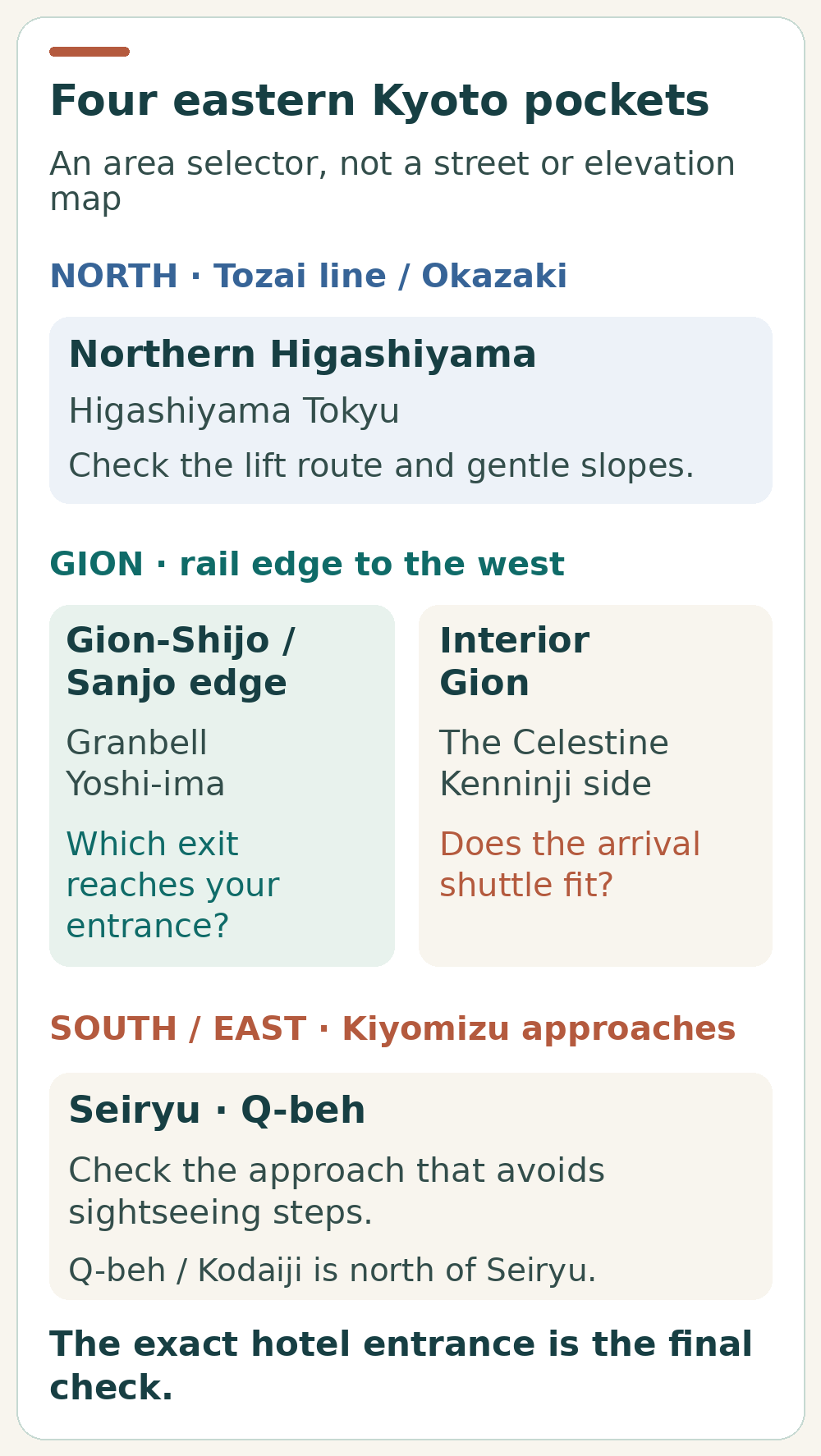
Do not treat Higashiyama station as the station for every Higashiyama hotel. The city’s suggested sightseeing walk from there to Kiyomizu-dera passes several temples and the stepped southern lanes; it is an outing in its own right.[4] For a hotel near Kiyomizu, assess its own access instructions instead.
Count the journeys you will repeat
Separate the arrival problem from the daily one. A taxi or luggage delivery can remove a difficult first walk. It cannot change how often you return for a nap, fresh clothes or dinner. Before comparing room rates, list your likely hotel departures and returns.
Here is a deliberately simple comparison. Kyoto Granbell publishes a two-minute walk from Gion-Shijo Exit 6; The Celestine publishes about ten minutes from Gion-Shijo; The Hotel Higashiyama publishes four minutes from Higashiyama station.[1][2][5] If you make three hotel–station return journeys during the stay, those six walking legs become 12, 60 and 24 modelled minutes respectively.
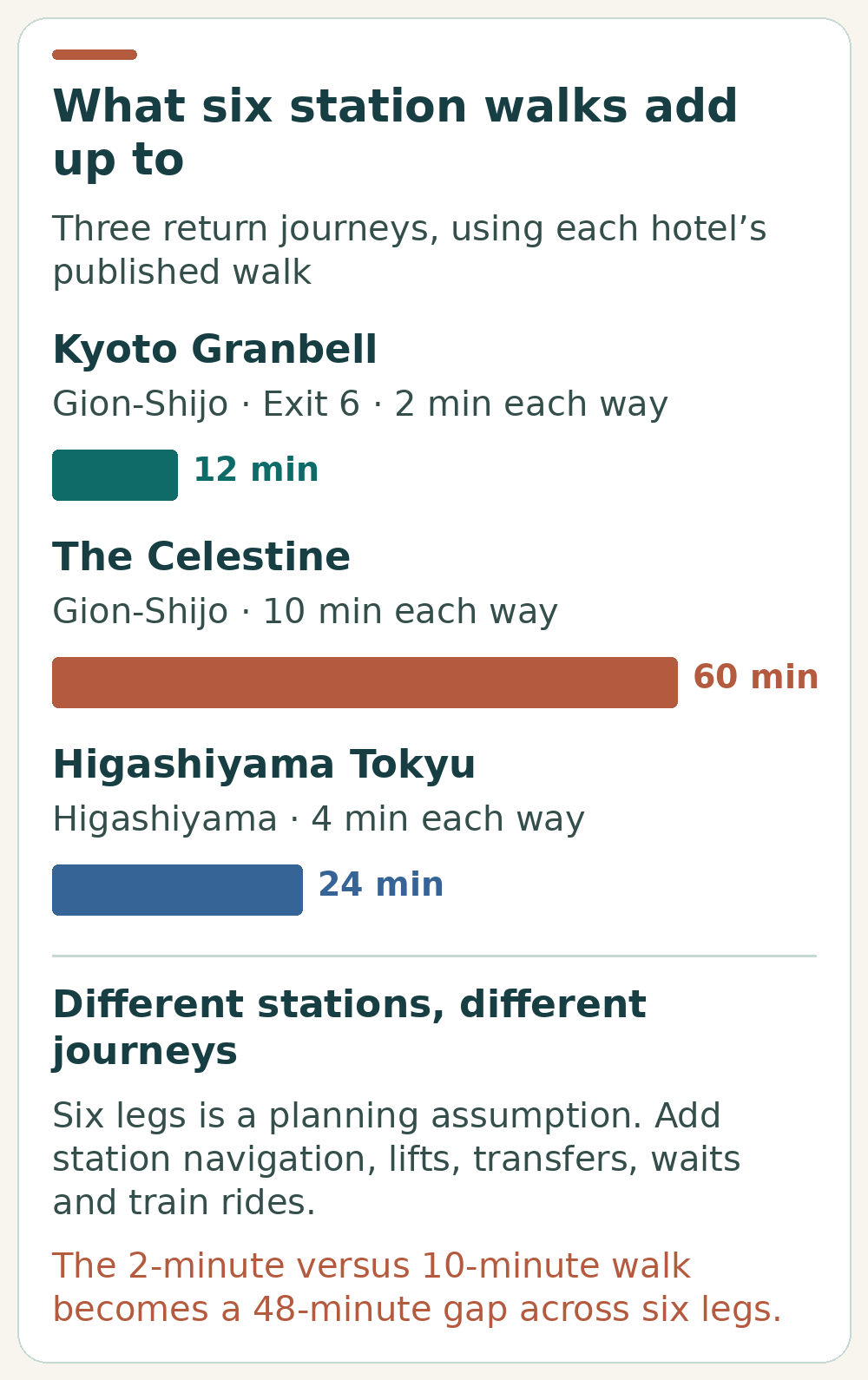
The six-leg scenario is an assumption, not a prediction of your itinerary. The starting figures are hotel estimates, not walks measured for this guide. They exclude time inside stations, trains, connections and waiting; the hotels also serve different station locations. For a lift route, use that route’s instructions instead of assuming the shortest advertised walk applies.
The useful result is the sensitivity: an extra eight minutes each way becomes 48 minutes over six legs. That may matter with a pushchair or repeated midday returns. If those walks are the part of Kyoto you came to enjoy, an interior address can be a sensible choice. If you will leave once and stay out all day, give the room and your evening plans more weight.
Six stays that change the atmosphere–access trade-off
These are contrasting candidates, not a price ranking. Enter the same dates, party ages and room requirements when comparing them; an attractive headline rate can describe a different room, meal plan or cancellation policy.
Kyoto Granbell Hotel: Gion access with a compact room
At 27 Yamatocho, this is a useful starting point for a couple or solo traveller who wants Gion-Shijo close by.[1] Room choice matters: the Moderate Twin is 17.6 m², while the Japanese Premier Twin is 23.3 m². The Moderate Double is on the first basement floor, so do not assume every room has the outlook shown in the exterior photographs.[6]
The hotel allows one child aged five or under to share existing bedding free; children aged six and above are charged separately. It has no connecting rooms.[7] For a family, confirm the actual sleeping arrangement before treating it as an easy extra-person option. You can compare Kyoto Granbell Hotel’s rooms on Booking.com.
Gion Yoshi-ima: traditional rooms with an earlier arrival commitment
Yoshi-ima is on Shinmonzen, giving a traditional inn option towards the Sanjo side of Gion.[15] Its official rooms page lists check-in from 16:00, with latest check-in at 19:00, and check-out by 10:00. The four-person, ten-tatami room is on the third floor and has no garden view; other categories have different outlooks.[13]
The inn describes breakfast and dinner served in the room.[14] Choose it when that style of evening is part of the trip, and confirm that your selected rate includes the meals you want. Ask about floor access and the agreed dinner time before booking a late arrival. You can check Gion Yoshi-ima’s room and meal plans on Booking.com.
The Celestine Kyoto Gion: an interior base with help on arrival
The Celestine’s Yasaka-dori address is a useful example of why a hotel can change the area calculation: it offers a free Kyoto Station shuttle, while Gion-Shijo remains about a ten-minute walk.[2] A large public bath and an on-site restaurant give reasons to spend part of the evening at the property.[16]
Consider it when you want the hotel to be a pause between local walks, rather than making repeated rail trips. Check the shuttle’s current timetable against your train; a departure that does not match your arrival has little practical value. The hotel also asks guests to contact it if arriving over two hours later than their stated arrival time.[16] You can compare The Celestine Kyoto Gion on Agoda.
The Hotel Seiryu Kyoto Kiyomizu: make the hillside stay part of the trip
Seiryu suits travellers deliberately choosing the Kiyomizu side. Its access page directs bus passengers to Kiyomizu-michi, followed by a published four-minute walk, and also gives taxi access from Kyoto Station.[9] That is a hotel approach, not an invitation to wheel luggage through every scenic staircase nearby.
Current official family guidance welcomes children aged 0–12 to share a bed free, limited to one child per bed, with cots available on request in limited numbers.[8] This is meaningful for a family, but free bed-sharing does not create an extra bed or unlimited room occupancy. Confirm your room category and meal inclusions, then compare The Hotel Seiryu Kyoto Kiyomizu on Booking.com.
Gion Ryokan Q-beh: traditional surroundings with simpler facilities
Q-beh is on the lanes near Yasaka and Kodaiji; its own approach map includes uphill directions.[12] This is a cost-conscious, hostel-style choice with shared facilities in most categories. The operator warns that sound carries through the wooden building; the JPN Style Ensuite is the exception to its shared-bathroom arrangement.[11]
There is no lift, no food service and no bathtub. Initial check-in is 15:00–21:00; after checking in there is no curfew, because guests receive a PIN for the night entrance.[10] Choose it for the setting and simpler stay, after deciding that stairs and the selected bathroom arrangement suit you. You can compare Q-beh’s private rooms and dormitory beds on Agoda.
The Hotel Higashiyama Kyoto Tokyu: northern interests with subway access
The full current name is THE HOTEL HIGASHIYAMA KYOTO TOKYU, A Pan Pacific Hotel. It is near Higashiyama station, useful for a northern Higashiyama and Okazaki emphasis.[3][5] Its official accessible-route instructions use the Exit 2 lift and identify gentle slopes on the approach.[5] Use that route to judge the approach alongside the hotel’s four-minute headline.
A reservable private spa is available separately: the published bathing-only rate for the Hou room is ¥6,000 for 60 minutes, checked on 18 October 2026. The listed capacity is two people, with a maximum of three.[17] Confirm a slot if private bathing is a reason for choosing the hotel. You can check The Hotel Higashiyama Kyoto Tokyu on Agoda.
Arriving on 22 October 2026? The Hotel Higashiyama has announced several afternoon shuttle cancellations because of Jidai Matsuri traffic restrictions. Check the dated operator notice before planning around its Kyoto Station connection.[18]
Plan the luggage journey separately
Save the hotel’s Japanese name, address and vehicle entrance before travelling. In the southern lanes, the most attractive sightseeing route can include steps: Kyoto’s own walking guide describes climbs between Ninenzaka, Sannenzaka and Kiyomizuzaka.[4] Ask the property which approach it recommends for wheeled luggage, a pushchair or limited mobility.
Use the rail line that serves your address
For the northern base, the city recommends the Karasuma subway from Kyoto Station, changing at Karasuma Oike to the Tozai line; Higashiyama serves the Heian-jingu side and Keage the Nanzenji side.[3] For the Keihan corridor, Kyoto’s official guidance includes the JR Nara line to Tofukuji and a transfer to Keihan.[20] Choose the final station for your hotel, rather than routing every eastern address through one bus stop.
At Gion-Shijo, use Keihan’s current station map when choosing exits.[19] Granbell’s two-minute headline uses Exit 6; The Celestine explicitly gives a route from the lift at Exit 7.[1][2] If you need step-free access, check the complete route from platform to room with the hotel.
Keep a straightforward arrival option
The Celestine and The Hotel Higashiyama publish station shuttle information.[2][5] Read the boarding location, service times and notices for the correct hotel. A taxi is also worth comparing for the luggage journey when it removes transfers or an uphill walk; road time remains subject to traffic. Kyoto’s tourism guidance warns that central bus approaches to the Kiyomizu area can be congested.[20]
If you arrive early, the official Hands Free Kyoto selector lists station-to-accommodation delivery and storage. Its guidance uses 14:00 as the station-delivery cut-off, but not every property is served; confirm the chosen operator’s deadline and acceptance before relying on it.[21] With a small ryokan, agree who will receive the bag.
Flying into Kansai Airport? You can compare Kansai Airport–Kyoto transport on 12Go, then compare the chosen service with your hotel’s arrival instructions.[22] For a through transfer, verify the exact drop-off, vehicle capacity and luggage allowance: a destination labelled “Kyoto” alone does not establish delivery to your hotel entrance.
Download the final approach for offline use. If you also want mobile directions, open Airalo and select Japan; check that your device is both unlocked and eSIM-compatible before buying.[23]
Compare the whole stay: bedding, meals and city tax
Start with the sleeping arrangement. Two adults and two children can mean two rooms, a larger room with separate bedding, or permitted bed-sharing. For example, Granbell’s free bed-sharing rule ends at age five, while Seiryu’s current rule extends to age twelve with one child per bed.[7][8] Put every child’s age into the booking and obtain confirmation if the room description is unclear.
Then compare meals you will actually use. A ryokan dinner has less value to you if you have already booked an evening food experience or expect to arrive late. At Yoshi-ima, room-served meals are part of the published offering, but the selected accommodation plan still needs to state what you are purchasing.[14] A room-only quotation and a dinner-and-breakfast quotation are not directly comparable.
Kyoto accommodation tax from 1 March 2026, checked 18 October 2026 [24]
Scroll the table sideways to compare every column.
| Taxable accommodation charge, per person per night | Tax, per person per night |
|---|---|
| Under ¥6,000 | ¥200 |
| ¥6,000 to under ¥20,000 | ¥400 |
| ¥20,000 to under ¥50,000 | ¥1,000 |
| ¥50,000 to under ¥100,000 | ¥4,000 |
| ¥100,000 or more | ¥10,000 |
The taxable charge includes service fees and excludes meals and consumption tax. Children are taxable when an accommodation charge is made for them; age alone does not create an exemption.[25] Ask the property how it has allocated a package price and whether the tax is already collected in your booking total.[24][25]
A hypothetical comparison: taxable lodging of ¥19,000 versus ¥21,000 per person per night puts two adults on different brackets. Over three nights, their accommodation tax is ¥2,400 versus ¥6,000. The ¥12,000 difference in lodging is therefore accompanied by another ¥3,600 in city tax. These are planning figures, not hotel quotations, and exclude meals and consumption tax.
Compare the payable total for identical dates and occupants, including any separate breakfast, bath reservation and transfer you intend to use. Finally, save the chosen rate’s cancellation deadline and penalty. Granbell’s own room page explicitly says cancellation conditions can differ by plan; do not substitute a general hotel policy for the terms attached to your reservation.[6]
Decide what you want the evening to contain
Staying locally is worthwhile when you will use the extra time: an unhurried walk, dinner nearby or an evening enjoying the hotel. Do not assume a historic street guarantees silence. Ask whether the room faces the road, an internal courtyard or shared circulation, and whether the building’s sound insulation suits a light sleeper. Q-beh explicitly describes sound travelling between parts of its wooden building.[11]
For guided context, WaRaiDo’s Gion night walk on GetYourGuide is a walk through the district with an English-speaking guide, meeting at the Gion Omoide Museum beside the Izutsu Yatsuhashi shop. Book it for interpretation of Gion’s culture; an encounter with a geiko or maiko is not guaranteed.[27] Fit the start time around your check-in or agreed ryokan dinner.
For a booked performance, the Gion Kagai Art Museum has afternoon Kyomai sessions of about 15 minutes, with two dances.[28] You can compare museum admission with a Kyomai dance performance on Viator, which lists both elements, against the museum’s own tickets.[28][29] Check the selected session and total; a photo session is a separate choice. This daytime option can leave your evening free for a ryokan meal.
Gion is a working neighbourhood. Follow street and property signs, use permitted routes and photograph only where allowed. Do not follow, stop or photograph geiko or maiko without permission, enter private property or block traffic.[30] The Southern Gionmachi guidance also makes clear that its streets are not pedestrian-only.[26] Your hotel booking does not give access to private lanes or neighbouring premises.
The final questions to ask before payment
- Which entrance should a taxi use, and can I reach the room without steps if needed?
- How many real beds or futons does this exact room provide for our party, and which children may share?
- Are breakfast and dinner included, what time are they served, and when must we first check in?
- Is the bath private to the room, reserved separately or shared, and can the required slot be confirmed?
- What is the total after city tax and planned extras, and what are this rate’s cancellation terms?
If you will make frequent rail trips, start with a suitable room near Gion-Shijo or Sanjo. If the room, dinner or surrounding lanes are a main experience, an interior or uphill stay can justify its extra approach. For a northern temple and museum focus, compare the Tozai-side address on its own merits. Let the journeys and the actual room decide which atmosphere is worth paying for.
Sources and planning notes
This is a research-led guide. Hotel operators, transport providers and official destination information were checked on 18 October 2026. Published specifications and service notices can change; live prices and availability depend on the dates and room or ticket selected. Worked examples identify their assumptions.
- Kyoto Granbell Hotel: access — Granbell Hotels & Resorts.
- Hotel The Celestine Kyoto Gion: access — Mitsui Fudosan Hotel Management.
- Comfortable access to Okazaki — Kyoto City Tourism Association.
- Walking through Kiyomizu and Higashiyama — Kyoto City Tourism Association.
- The Hotel Higashiyama Kyoto Tokyu: access and lift route — Tokyu Hotels.
- Kyoto Granbell Hotel: rooms — Granbell Hotels & Resorts.
- Kyoto Granbell Hotel: frequently asked questions — Granbell Hotels & Resorts.
- The Hotel Seiryu Kyoto Kiyomizu: child-friendly services — Seibu Prince Hotels & Resorts.
- The Hotel Seiryu Kyoto Kiyomizu: access — Seibu Prince Hotels & Resorts.
- Gion Ryokan Q-beh: frequently asked questions — Gion Ryokan Q-beh.
- Gion Ryokan Q-beh: information for first-time guests — Gion Ryokan Q-beh.
- Gion Ryokan Q-beh: official access map — Gion Ryokan Q-beh.
- Gion Yoshi-ima: rooms and check-in — Gion Yoshi-ima.
- Gion Yoshi-ima: meals — Gion Yoshi-ima.
- Gion Yoshi-ima: access — Gion Yoshi-ima.
- Hotel The Celestine Kyoto Gion: hotel usage guide — Mitsui Fudosan Hotel Management.
- The Hotel Higashiyama Kyoto Tokyu: private spa — Tokyu Hotels.
- 22 October 2026: partial suspension of Higashiyama hotel shuttle — Tokyu Hotels.
- Gion-shijo Station map, current from 1 April 2026 — Keihan Electric Railway.
- Comfortable access to Higashiyama and Kiyomizu-dera — Kyoto City Tourism Association.
- Luggage delivery and storage choices — Kyoto City Tourism Association — Hands Free Kyoto.
- Kansai Airport to Kyoto: transport listings — 12Go.
- What is an eSIM? Device requirements — Airalo.
- Kyoto City accommodation tax and rates from 1 March 2026 — Kyoto City.
- Accommodation-tax questions for guests: taxable charges — Kyoto City.
- Gion manners: a message from Southern Gionmachi — Kyoto City Tourism Association and Southern Gionmachi organisations.
- Night Walk in Gion: Kyoto’s Geisha District — GetYourGuide — WaRaiDo Guide Networks.
- Gion Kagai Art Museum: dance performances and photo sessions — Gion Kagai Art Museum.
- Kyomai dance and Gion Art Museum visit — Viator — Gion Kagai Art Museum.
- Four guidelines to follow when visiting Kyoto, 2 October 2026 — Kyoto City Tourism Association.
Illustrations in this article were created for Taylor’s Trailblazing Travels. Third-party photographs, where used, are credited beside the image or in the source list.