Japan • Where to stay
Where to Stay in Namba: Accommodation and Station Areas
A good Namba address begins with the station you will actually use.
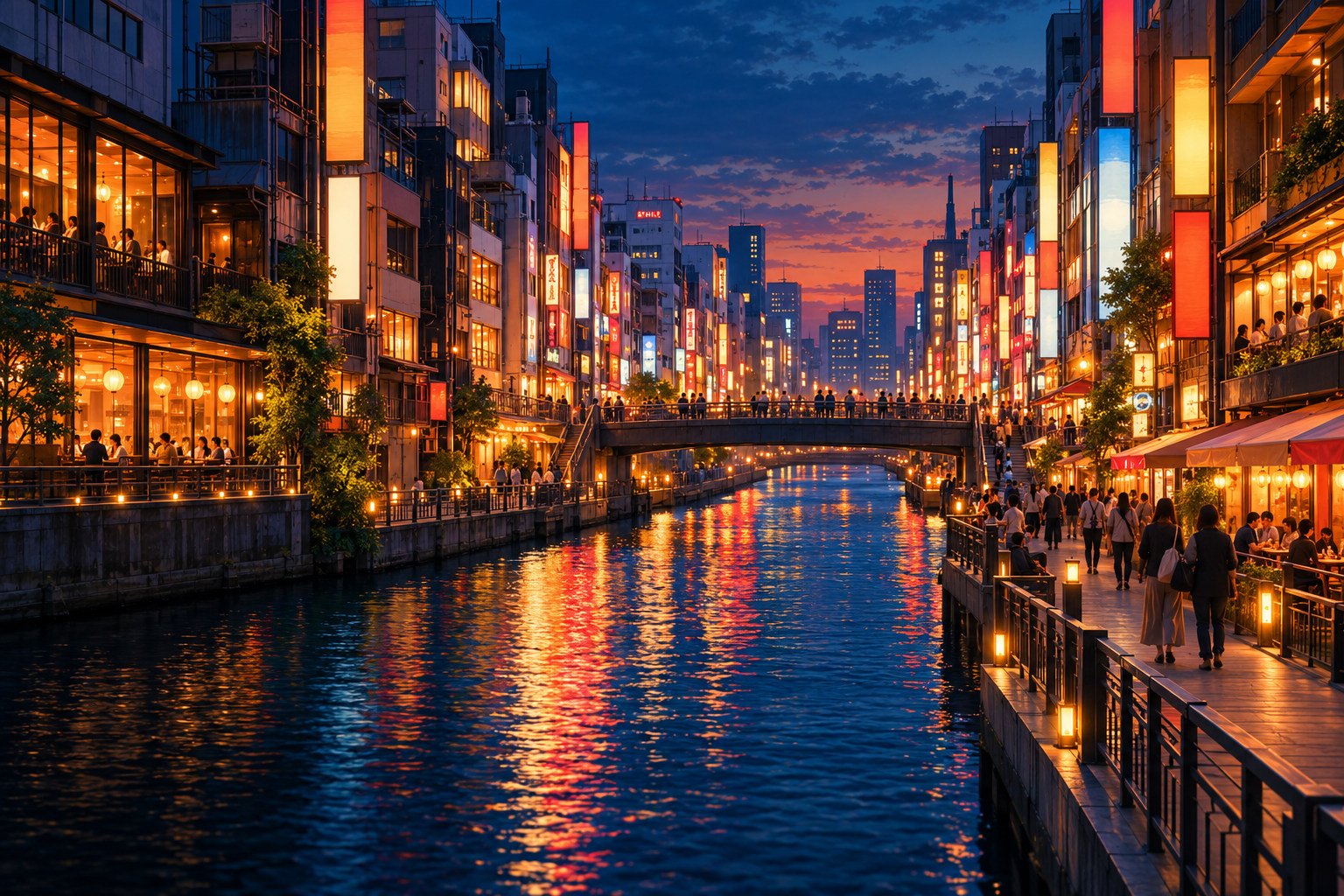
AI-created editorial illustration inspired by Namba and Dotonbori; the canal, signs and buildings are imagined, not a hotel photograph or an exact location.
When deciding where to stay in Namba, start around Nankai Namba and the southern Midosuji subway exits if a Kansai Airport rail arrival matters. Choose the Dotonbori end for repeated evening walks, or the JR Namba/OCAT side when that is where your actual journeys begin. These places share the Namba name but are different station approaches.[1][2][3][18]
A hotel can be two minutes from one Namba gate and fifteen from another. That difference matters with luggage, but the room still has to work: a connecting twin, a three-bed hotel room and an apartment with bunk beds solve different problems. This guide uses operator maps and published accommodation details, checked on 18 October 2026. The stays are research-led examples, not properties Karen has personally visited or tested.
This article contains affiliate links. If you make a booking or purchase through them, Taylor’s Trailblazing Travels may earn a commission at no extra cost to you. Recommendations are based on the planning needs discussed in this guide.
Airport train comes first
Nankai Namba side
Make the luggage journey short. Swissôtel sits above the terminal; compact hotels and serviced apartments provide alternatives nearby.[2][8][12]
Walk home after dinner
Dotonbori / north Midosuji
Prioritise the evening route, while checking your room’s street exposure. The nearest useful subway exit may beat the nearest airport-rail gate.[18]
JR or coach departures
JR Namba / OCAT
Choose the western side when its transport genuinely fits. Check the whole itinerary before assuming a JR station is automatically best.[3]
Separate sleeping places
Choose the room, then its approach
Compare a confirmed connecting pair with a family apartment. A Namba North address can place you nearer Yotsubashi Station.[13][17]
Where to stay in Namba for your daily routine
Use these as search pockets, not official hotel-zone boundaries. The recommendations are editorial judgements based on station access and the examples below. There is no district-wide promise of quiet rooms, low prices or step-free access.
Five Namba search pockets and the journeys they suit
Scroll the table sideways to compare every column.
| Search pocket | Start here when… | Accept this trade-off | Check first |
|---|---|---|---|
| Nankai terminal and Nambanaka | Kansai Airport rail and easy luggage handling lead the decision. | The canal or western JR entrance may be farther than the hotel’s headline walk. | Nankai gate and the hotel’s street or lift entrance.[2][8][12] |
| Central Midosuji / subway exits | Several days involve the north–south subway, alongside local evenings. | A nearby exit is not the platform; the correct gate depends on your direction and access needs. | M20 access, rather than an unspecified “Namba subway” label.[1][5] |
| JR Namba / OCAT, to the west | Your checked routes repeatedly use JR Namba or an OCAT coach. | Nankai airport trains arrive across the wider complex. | Coach terminal or JR entrance, then the separate Nankai walk.[3][14] |
| Dotonbori / northern Midosuji | Walking back after dinner matters more than being above the airport train. | Busy streets, room orientation and late-evening noise deserve attention. | Actual entrance and bedroom outlook; Cross Hotel’s published approaches differ by station.[18] |
| Minamihorie / Namba North | A family apartment suits your party and Yotsubashi access works. | The property name can sound closer to Nankai than it is. | Nearest named station: MIMARU Namba North lists Yotsubashi Exit 5.[17] |
For a short stay with an early airport departure, give a simple luggage route more weight. For four nights with several returns to the room, give the repeated approach more weight. If every suitable room in your preferred pocket is too expensive, widen the search one pocket at a time and compare the additional journey against the whole-stay saving.
Separate the stations before comparing hotel distances
Nankai Namba, Osaka-Namba and JR Namba are distinct railway stations. Osaka Metro also has three Namba lines: Midosuji M20, Sennichimae S16 and Yotsubashi Y15. They connect through the wider complex, but the walking links do not make every gate equally useful.[1][2][3][4]
Swipe sideways to read the full planning graphic.
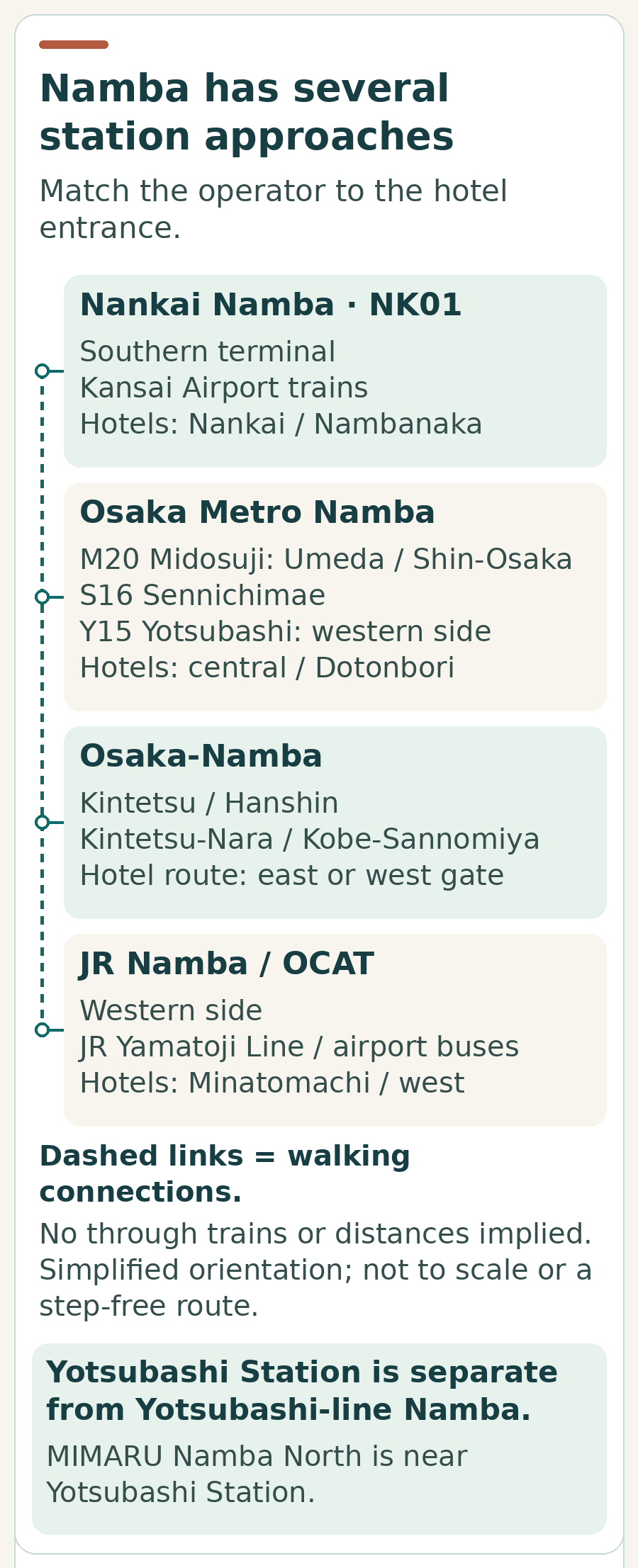
Namba station names, services and the approach to check
Scroll the table sideways to compare every column.
| Name to save | Main use for this hotel search | Location detail that changes the choice |
|---|---|---|
| Nankai Namba, NK01 | Kansai Airport trains; Nankai and Koya-line journeys. | The terminal has a third-floor north gate and second-floor central/south gates. Use your hotel’s specified route.[2] |
| Osaka Metro Namba, M20 | Midosuji services through Shinsaibashi, Umeda, Shin-Osaka and Tennoji. | Choose the north or south approach to suit the hotel, then locate the lift route if needed.[1][5] |
| Osaka Metro Namba, S16 / Y15 | Sennichimae or Yotsubashi services. | Yotsubashi access lies towards the western side. A Midosuji walking claim is not a Yotsubashi walking claim.[1][3] |
| Osaka-Namba, Kintetsu / Hanshin | Services towards Kintetsu-Nara and Kobe-Sannomiya. | East and west gates lead into different approaches; check the actual service and destination.[4][6] |
| JR Namba / OCAT | JR Yamatoji-line access and the separate coach terminal. | JR Namba connects to OCAT at basement level. A train platform and an airport-bus boarding point remain different destinations.[3] |
Kintetsu’s official transfer guide illustrates the scale: it allows eleven minutes from the centre of its Osaka-Namba platform to Nankai’s nearest gate, compared with five to Midosuji’s nearest gate. Those are normal transfer indications, not extra time already included in your hotel’s street-exit claim, and not guarantees for a lift route.[4]
The lift route can change the useful gate
Osaka City’s illustrated access guidance states that Osaka-Namba’s east side has no platform lift; its lift route uses the west gate. Osaka Metro publishes separate barrier-free paths, including routes to street-level building lifts. Follow the current operator guidance for your platform and ask the hotel for its accessible entrance. An escalator symbol does not establish a step-free journey.[1][7]
Six stays that solve different accommodation problems
These examples were selected for different entrances, room arrangements and travel routines. They are not a ranking by guest review score, and no date-specific rates or availability were checked. Compare the named room category and all occupants on the hotel’s own site as well as the booking service.
Swissôtel Nankai Osaka: a hotel above the airport-rail terminal
The useful feature is the Nankai connection. The hotel publishes a two-minute route from the third-floor north ticket gate to its lobby, compared with fifteen minutes from JR Namba’s gate. Its Swiss Executive Triple has three beds, making it a specific option to investigate for three travellers rather than assuming any twin accepts an extra adult.[8][9]
There is a current qualification: sixth-floor lobby renewal is scheduled from 20 August 2026 to March 2027, with temporary closures and changing venue hours. THE LOUNGE is separately closed from 2–29 October 2026. Ask how works affect arrival and the facilities included in your rate; THE LOUNGE is a different venue from the Swiss Executive Lounge.[10][11]
Compare Swissôtel Nankai rooms on Booking.com and compare the total with nearby properties if you will rarely use the hotel’s additional facilities.
Sotetsu Fresa Inn Osaka-Namba: compact rooms or a confirmed connecting pair
The 11.77 m² Double has a 140 cm bed; the 17.1 m² Twin has two 120 cm beds. Its Connecting Twin is a named arrangement of two 17.1 m² rooms with an internal door and four beds, accommodating up to four guests. That is a meaningful alternative to squeezing four people into one room.[13]
The hotel gives one minute from Exit 7 or two from Exit 5, where it identifies an escalator. Its entrance is beside FamilyMart, with reception reached by lift on the second floor. The shortest published approach includes steps, so request a suitable alternative if you cannot use them.[12] Be careful to select this Fresa Inn: the similarly named Sotetsu Grand Fresa Osaka-Namba instead lists access from Nipponbashi Exit 6.[28]
See Sotetsu Fresa Inn Osaka-Namba room options; compare the complete connecting category with two independently sold twins.
Hotel Monterey Grasmere Osaka: the western JR/OCAT end
The hotel publishes one minute from JR Namba, a connecting passage from Yotsubashi Exit 30, and ten minutes from Nankai’s third-floor north or second-floor central exit. It is a logical shortlist for western departures; it is less compelling solely on the basis of a Nankai airport arrival.[14]
The 26 m² Triple uses a twin room plus an extra bed. The main beds are 120 × 203 cm; the extra bed is shorter at 110 × 188 cm. Three adults therefore get separate sleeping places but not three identical beds. Preschool children may share under the hotel’s conditions; school-age children are charged the adult rate.[15]
Check Hotel Monterey Grasmere Osaka on Agoda, matching the Triple rather than a two-person twin price.
Fraser Residence Nankai Osaka: a separate bedroom and laundry
For a longer stay, a separate living area can matter more than being directly above a platform. The One Bedroom Executive is 40–44 m² with a kitchen and washer-dryer; the operator describes capacity up to three adults and one child. Double and twin bedroom configurations differ, so have the hotel confirm the additional sleeping arrangement and your child’s eligibility before relying on that maximum.[16]
Nankai’s own station guide places Fraser Residence two minutes on foot from its terminal, although that is an indicative station walk rather than an accessible route description.[2] Check Fraser Residence Nankai apartment plans if cooking, washing clothes or an earlier child’s bedtime would improve the stay.
Cross Hotel Osaka: Dotonbori access with a clearer room choice
Cross Hotel’s official approaches are three minutes from Exit 14, ten from Nankai Namba and fifteen from JR Namba. Its location suits a traveller who expects to walk around the northern dining and shopping area repeatedly.[18]
The Standard Twin is 27 m² for one or two guests, with two 110 × 200 cm beds. A bigger floor area does not turn it into a three-adult booking. Ask about street exposure if you are noise-sensitive, and buy a specified view category if a particular outlook is essential.[19]
Compare Cross Hotel Osaka rooms, checking the room title and permitted occupancy before comparing the price.
MIMARU Osaka Namba North: family space towards Minamihorie
The Family Apartment provides 39–41 m², two singles and a bunk bed, a kitchen and dining space. It lists four adults plus up to two children aged six or under sharing existing bedding; guests aged seven or over count as adults. There is coin laundry, not an in-room washer-dryer in this category.[17]
Its nearest published station approach is three minutes from Yotsubashi Exit 5. This is an apartment choice on Namba’s north-western fringe, not an above-Nankai location. See MIMARU Osaka Namba North apartments on Agoda if four separate sleeping places and shared living space justify the approach.
Count the walks you will repeat, not just arrival day
The following calculation uses two hotels’ published access figures to show how the preferred end of Namba can change. Swissôtel lists two minutes from Nankai and fifteen from JR Namba; Grasmere lists ten and one respectively. The endpoints are those published by each hotel: this is an initial comparison, not a measurement from a train seat to a bedroom.[8][14]
Assume you arrive and depart using Nankai, creating two airport-station approaches. Add only journeys that your checked itinerary genuinely makes through JR Namba, counting an outward and return walk separately.
Swipe sideways to read the full planning graphic.
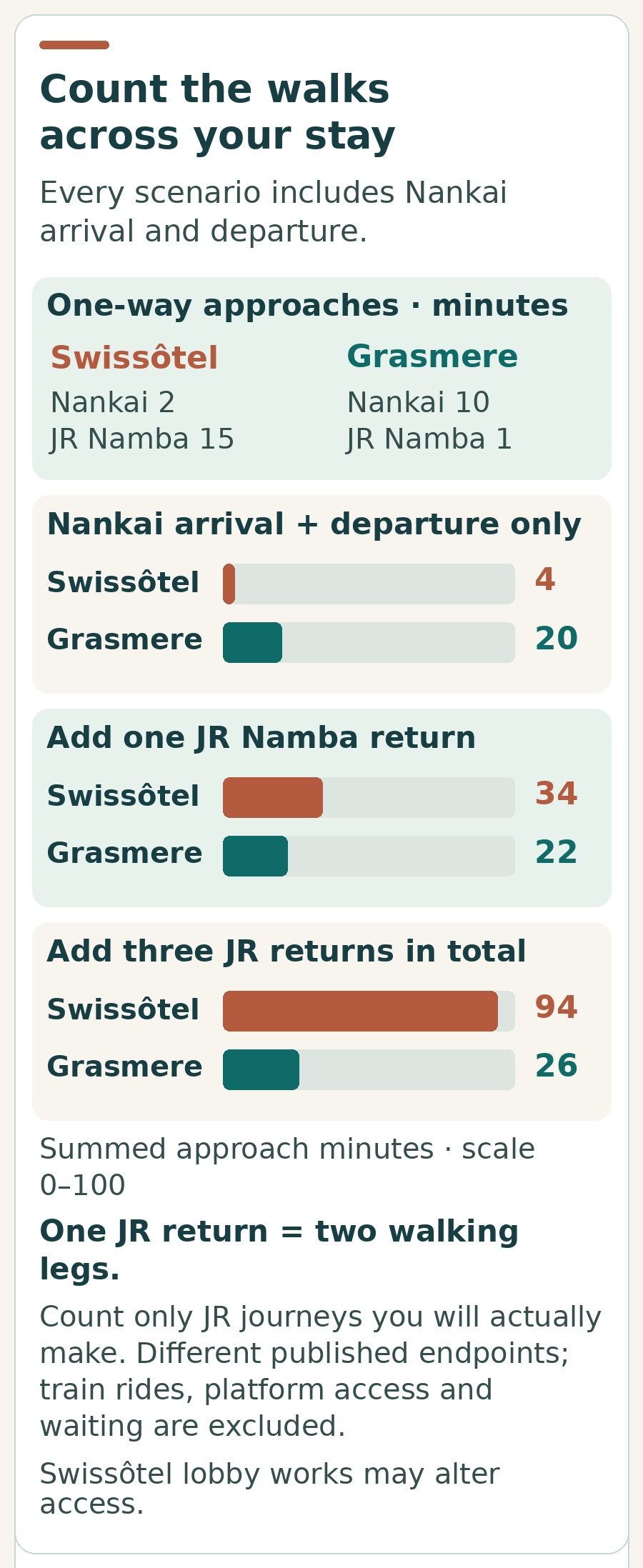
Summed published hotel approaches for three assumed journey patterns — minutes; each includes Nankai arrival and departure
Scroll the table sideways to compare every column.
| Journeys counted | Swissôtel published-approach total | Grasmere published-approach total |
|---|---|---|
| Nankai arrival + departure only | 2 × 2 = 4 minutes | 2 × 10 = 20 minutes |
| Plus one JR Namba return journey | 4 + (2 × 15) = 34 minutes | 20 + (2 × 1) = 22 minutes |
| Plus three JR Namba return journeys in total | 4 + (6 × 15) = 94 minutes | 20 + (6 × 1) = 26 minutes |
On these inputs, one JR return is enough to reverse the Nankai-only result; three create a 68-minute difference in the summed approaches. That is a reason to investigate the western hotel, not to choose a less suitable railway simply to validate it.
Adjust the calculation for the person making the journey
Add platform access, lift waits, traffic crossings, reception-to-room time and any diversion separately. Swissôtel’s lobby works can also affect its published route. If your step-free approach adds an assumed five minutes on every one of eight legs, that contributes another forty minutes. This is a sensitivity example, not a reported Namba delay.[10]
Run the same count for your real restaurant, meeting point or subway gate. A hotel near the airport train may still win when you have heavy bags, even if the arithmetic favours another location: minutes alone do not measure the difficulty of carrying luggage.
Match the airport and onward journey to the correct entrance
Kansai International Airport: Nankai rail or an OCAT bus
Nankai’s Rapi:t connects Kansai Airport with Nankai Namba; its advertised minimum is 34 minutes. That is a train time, excluding immigration, luggage collection, the wait for your service and the hotel approach.[20] Check the complete ticket requirements: Rapi:t requires both the basic fare and limited-express ticket, although a package can include both.[29]
The airport bus arrives at Namba OCAT on the western side. KATE gives approximately fifty minutes from Terminal 1 to OCAT and forty-eight minutes in the reverse direction, with extra time for Terminal 2. The checked adult single fare is ¥1,400 and the route operates first come, first served without reservations. Allow for road delays, queues and the published timetable, especially for an early flight.[21]
For an English-language comparison, compare Kansai Airport–Osaka transport on 12Go. This is a citywide route search: select the actual Nankai Namba, OCAT or hotel destination, and check whether the offer is rail, coach, shared van or private vehicle. Compare its total and redemption rules with the operator. Do not read “Osaka” as a guarantee that the ticket reaches your chosen Namba entrance.[27]
A private arrival when the final walk is the problem
A family with several bags may reasonably prefer a direct vehicle. This private Kansai Airport–Osaka arrival transfer on Viator lists Terminal 1 or 2 collection and hotel/apartment drop-off. It states up to ninety minutes’ included waiting and one suitcase plus one carry-on per traveller. Confirm the flight, exact entrance, whole-party luggage capacity, child seats or wheelchair needs, and what happens after a flight delay or airport change.[24]
Shinkansen arrivals, Nara and Kobe
For a Shinkansen arrival at Shin-Osaka, the Midosuji line reaches Namba directly. Check the final subway gate rather than selecting JR Namba merely because your intercity ticket is a JR ticket.[5] For Nara or Kobe, look at Osaka-Namba’s Kintetsu/Hanshin services and the gate your hotel uses. Verify the particular train and destination; the operator’s departures distinguish Kintetsu-Nara from Kobe-Sannomiya.[6]
Itami is a separate airport. Use its own transport search and the named stop in your ticket; neither a Kansai Airport transfer nor the word “Namba” establishes where an Itami service will drop you.
Compare the sleeping arrangement and the full-stay cost
Make a shortlist for the people travelling, not the room label. For two adults, decide whether sharing a double is acceptable. For three adults, compare the actual third bed: Grasmere’s is a shorter extra bed, whereas Swissôtel sells a dedicated three-bed Executive Triple.[9][15]
For four people needing separate sleeping places, Sotetsu’s Connecting Twin and MIMARU’s Family Apartment create a useful comparison. The first supplies two rooms with an internal connecting door; the second keeps the party together around a kitchen and dining area. A connecting booking provides a different bedtime and privacy arrangement from a bunk-bed apartment, even when both provide four beds.[13][17]
Check the ages entered, who shares existing bedding, whether a cot or extra bed is guaranteed, and whether the family needs one living space or separate bedrooms. For a guest unable to use an upper bunk, a four-person capacity is not sufficient evidence of four suitable sleeping places.
Allow for Osaka’s accommodation tax
For stays from 1 September 2025, the prefecture’s per-person, per-night tax is zero below a ¥5,000 taxable accommodation charge; ¥200 from ¥5,000 to below ¥15,000; ¥400 from ¥15,000 to below ¥20,000; and ¥500 at ¥20,000 or more. A booking-site prepayment may exclude it. Ask the property for the taxable charge and whether the tax has already been collected.[22]
For example, two adults staying four nights with each person in the ¥200 band incur ¥1,600 in total; at ¥500 each, the total is ¥4,000. These are tax calculations, not hotel quotes. Compare all nights, meals, tax, cancellation terms and payment currency, then add transfers you expect to buy. The Japan budget guide for UK travellers helps keep the accommodation decision within the wider holiday budget.
Questions worth settling before you pay
Does “Namba North” mean the Nankai station’s north gate?
No. A property name describes its own location or brand identity. MIMARU Osaka Namba North is near Yotsubashi Station. Use the exact address and access instructions to avoid mixing it up with another similarly named property.[17]
Should a late-night diner choose the canal frontage?
Choose it when being there repeatedly is a benefit you value. Ask which street the bedroom faces and whether a quieter orientation can be confirmed. A nearby block may retain a walkable evening route without making a particular outlook essential; neither choice guarantees silence.
Does a connected hotel eliminate the walk?
No. A connection can reduce exposure to weather, but there may still be corridors, lifts, gates and a separate lobby. Compare the complete route for your arrival time, especially when an entrance passes through another building. Save an alternative street approach in case the usual connection is unavailable.
What belongs in the final confirmation?
Record the exact hotel and room category, all guest ages and beds, access requirements, arrival time, tax and meal inclusions, cancellation deadline and payment conditions. Ask about luggage storage if your sightseeing day begins before check-in or continues after checkout. For Swissôtel dates during the announced renewal, confirm the affected facilities directly.[10][11]
For most first Namba stays, begin with the Midosuji/Nankai edge and change that choice only when a better room or a repeated route justifies it. Set the Osaka nights within the wider holiday before committing to a restrictive rate: the Japan trip-length guide helps with that next decision.
Sources and planning notes
This is a research-led guide using hotel, transport and destination sources linked below. Time-sensitive rules have been reviewed, but not every property detail or website can be independently checked. Reconfirm the exact room, route, final price and current notices for your own dates; worked examples state their assumptions.
- Namba M20: connected lines, station map and barrier-free routes — Osaka Metro.
- Nankai Namba: gates, lines and nearby Fraser Residence — Nankai Electric Railway.
- OCAT access and its JR Namba connection — Osaka City Air Terminal.
- Osaka-Namba station map and defined transfer times — Kintetsu Railway.
- Midosuji line stations and main transport connections — Osaka Metro NiNE.
- Osaka-Namba departure directions — Kintetsu Railway.
- Lift route from Osaka-Namba using the west gate — Osaka City.
- Swissôtel Nankai Osaka: gate-to-lobby walking routes — Swissôtel Nankai Osaka.
- Swiss Executive Room Triple: three-bed configuration — Swissôtel.
- Sixth-floor lobby renewal, August 2026 to March 2027 — Swissôtel Nankai Osaka.
- THE LOUNGE closure, 2–29 October 2026 — Swissôtel Nankai Osaka.
- Sotetsu Fresa Inn Osaka-Namba: exits and illustrated entrance routes — Sotetsu Hotels.
- Sotetsu Fresa Inn Osaka-Namba: double, twin and connecting rooms — Sotetsu Hotels.
- Hotel Monterey Grasmere Osaka: station and OCAT approaches — Hotel Monterey.
- Hotel Monterey Grasmere Osaka: Triple room and child policy — Hotel Monterey.
- Fraser Residence Nankai: One Bedroom Executive capacity and facilities — Frasers Hospitality.
- MIMARU Osaka Namba North: room layouts, child ages and station access — MIMARU.
- Cross Hotel Osaka: station-specific walking approaches — Cross Hotel Osaka / ORIX Hotels & Resorts.
- Cross Hotel Osaka: Standard Twin size, beds and occupancy — Cross Hotel Osaka / ORIX Hotels & Resorts.
- Rapi:t route, minimum journey time and limited-express ticket information — Nankai Electric Railway.
- Kansai Airport–Namba OCAT: timetable, fares and boarding policy — Kansai Airport Transportation Enterprise.
- Accommodation tax for guests in Osaka Prefecture — Osaka Prefectural Government.
- Dotonbori and Namba food tour: meeting point and dietary exclusions — GetYourGuide.
- Private Kansai Airport–Osaka arrival: collection, luggage and waiting terms — Viator / Holiday in Japan.
- Japan data eSIM packages — Airalo.
- Checking eSIM capability and carrier unlocking — Airalo Help Centre.
- Kansai Airport–Osaka transport listings — 12Go.
- Sotetsu Grand Fresa Osaka-Namba: distinct property by Nipponbashi Exit 6 — Sotetsu Hotels.
- Rapi:t ticket requirements and combined digital ticket — ANA / ANA X.
Illustrations in this article were created for Taylor’s Trailblazing Travels. Third-party photographs, where used, are credited beside the image or in the source list.