Japan • Where to stay
Where to Stay Near Kyoto Station: Hotel Location Guide
Choose the right exit, a usable route and a room that fits your whole party.
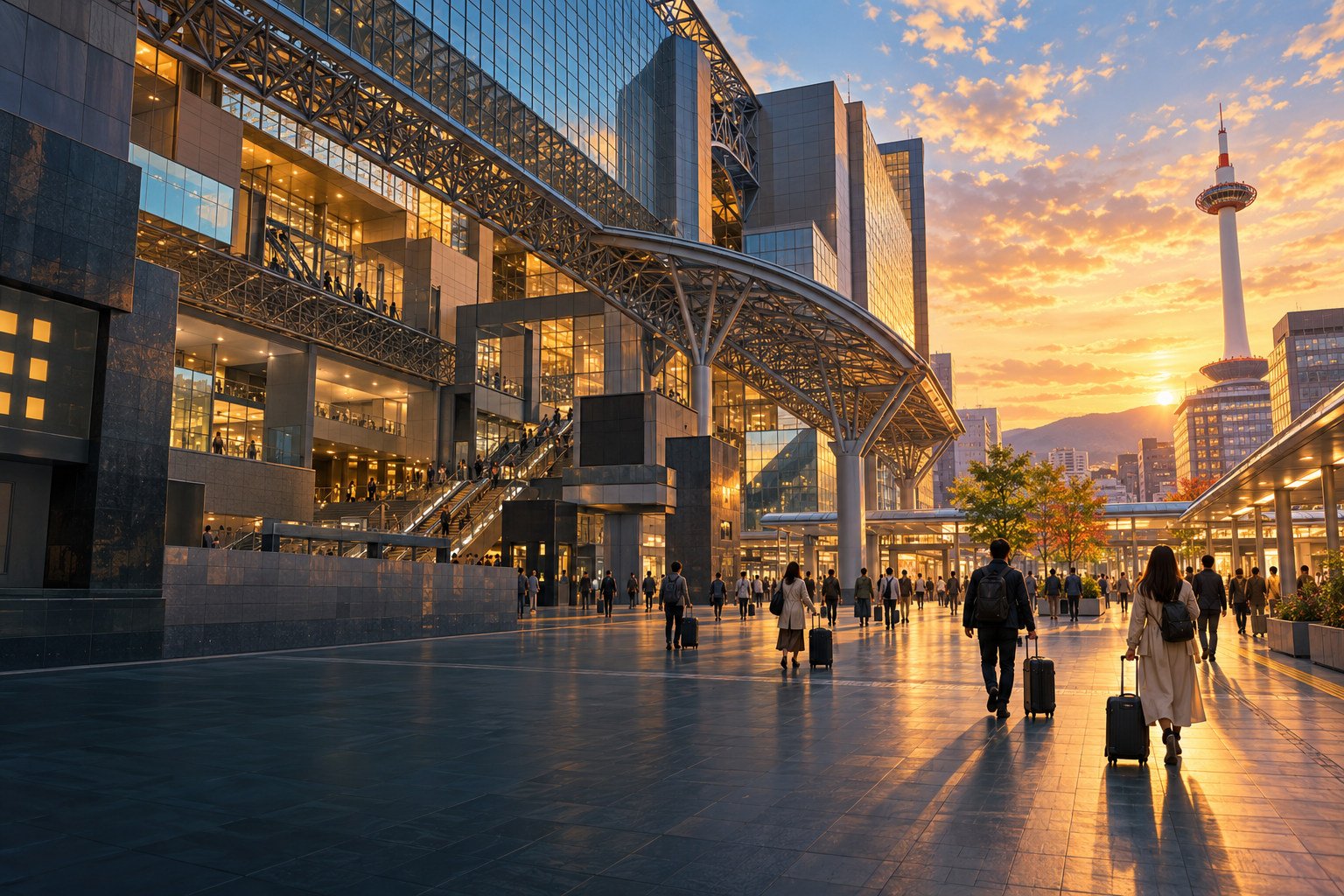
AI-created editorial illustration inspired by Kyoto Station’s north-side forecourt; the architecture and viewpoint are imagined, not a hotel photograph or a gate map.
The best place to stay near Kyoto Station depends on which entrance you will use repeatedly. Start with your train gate or meeting point, then check the route to the hotel door and the exact room layout. A pin beside the tracks cannot tell you whether you will cross the station, use stairs or wait for a shuttle.
This guide compares the station’s north Karasuma side, south Hachijo side and western edge after you have chosen Kyoto Station as your base. The hotel and station comparisons draw on the linked operator material; verify current room and access terms for your dates. These are researched choices, not personal-stay recommendations.
This article contains affiliate links. If you make a booking or purchase through them, Taylor’s Trailblazing Travels may earn a commission at no extra cost to you. Recommendations are based on the planning needs discussed in this guide.
A short rail stop
Match Miyako City Kintetsu to the Shinkansen Central or Kintetsu gate. Its standard double is 16m²: transfer convenience comes with a compact room.[5][7]
North-side commitments
Granvia’s lobby connects through the station. Daiwa’s PORTA approach is useful in rain, but closes from 23:30 to 07:00.[2][10]
Four individual beds
MIMARU offers two singles and a bunk unit in 40m². Miyako Hachijo offers 46m², with extra beds required to reach four.[14][15]
A hotel with a shuttle
RIHGA Royal’s five-minute ride can become 24 minutes with a missed departure. Check the clock and your earliest outing before relying on it.[17]
Choose the part of Kyoto Station you will actually use
Karasuma is the north side, facing Kyoto Tower; Hachijo is the south side. Those labels help you orientate yourself, but they do not divide the railway systems neatly. Conventional JR services, the Shinkansen, Kintetsu and the subway have different gates and connections within the complex. In particular, JR’s Central Gate and the Shinkansen Central Gate are different places.[1]
A hotel location selector for Kyoto Station
Scroll the table sideways to compare every column.
| Location | Start here when… | Check before booking |
|---|---|---|
| Inside the station complex | Your priority is an internal approach: Granvia for its north-side lobby connection; Miyako City Kintetsu for the Shinkansen Central/Kintetsu approach.[2][5] | Which gate your train uses, the hotel’s level and the route with lifts. |
| North / Karasuma | You will repeatedly use the north Central Gate or a confirmed north-side meeting point. Daiwa adds an underground PORTA connection.[10] | Underground opening hours and a street-level alternative. |
| South / Hachijo | A specific room or south-side commitment favours Miyako Hachijo or MIMARU; choose Hachijo versus Hachijo East deliberately.[13][15] | The actual exit, crossings and airport-bus boarding point. |
| Western edge | RIHGA Royal’s room or facilities suit your stay and its station walk is acceptable.[16] | The shuttle timetable, capacity and your route when it is not running. |
Swipe sideways to read the full planning graphic.
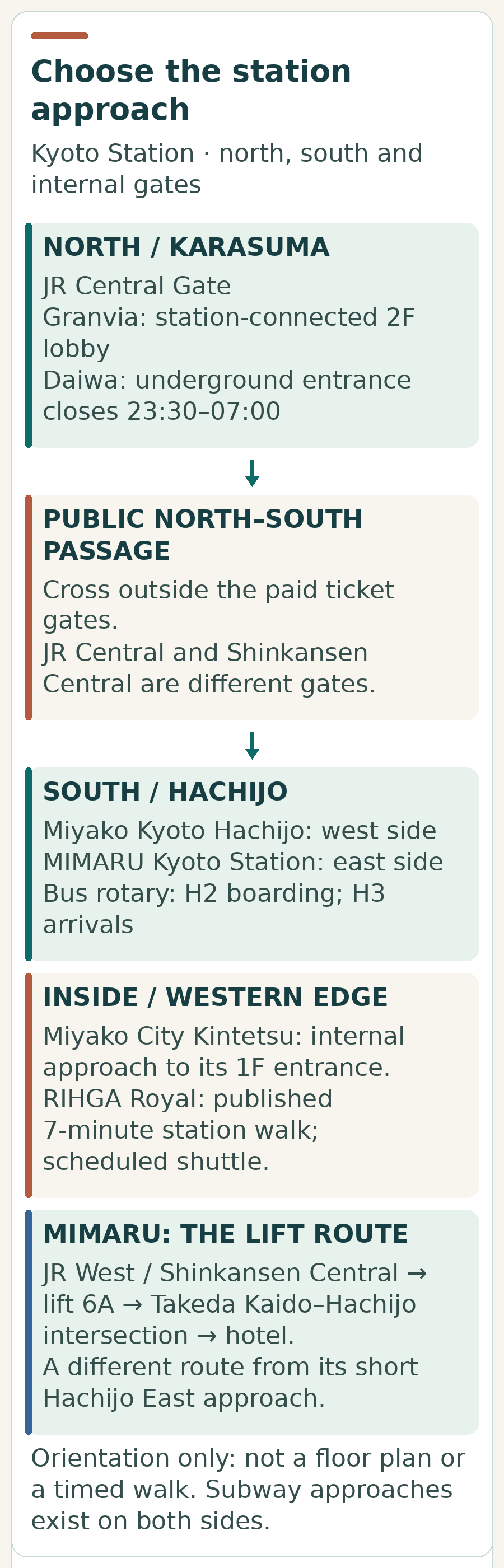
Use four tests in order: the room must fit everyone; the route must work with your luggage or mobility needs; the location must suit your repeated outings; then compare the full price. A one-night couple arriving and departing by Shinkansen has a different problem from a family returning for an afternoon rest on three successive days.
A two-minute walk needs a named exit and a usable route
Published hotel walking times generally start at a named station exit, not at your train door. Add the platform-to-gate route, lifts where needed, road crossings and the journey from hotel entrance to reception. Hotel Granvia’s official approach from JR Central Gate goes up to its second-floor lobby. Miyako City Kintetsu’s standard directions from the Shinkansen Central Gate use an escalator down beside the Kintetsu gate to the first-floor hotel entrance.[2][6]
For a concrete example of the difference, MIMARU publishes a two-minute walk from Hachijo East Exit. Its separate universal-design map sends people arriving at JR West Gate or the Shinkansen Central Exit via lift 6A and the Takeda Kaido–Hachijo intersection. That is a different route; the two-minute headline does not establish its duration. Download that map before arrival if you need a route designed around lifts and gentler crossings.[3][15]
You can cross between north and south using the public station passage without buying a rail ticket. The station map also shows conventional JR and subway access beyond the north Central Gate, so a south-side hotel does not automatically mean crossing the entire building for every journey. Follow the gate for your service, then your hotel’s own directions.[1][2]
Ask about the complete route
If stairs are a barrier, send the hotel your arrival service and ask for the current step-free route from its platform or gate to reception, plus the suitable room category. A nearby lift on a map does not confirm an uninterrupted route or an accessible bathroom. Save the reply and map offline.
Six hotel and room examples with different advantages
These are distinct starting points for a shortlist, not a price ranking. Room categories matter more than a hotel’s headline occupancy: one “family” option has fixed bunks, another needs extra beds, and a compact double still has only one bed.
Specific room categories to compare on the same dates
Scroll the table sideways to compare every column.
| Hotel and category | Published layout | Best reason to shortlist |
|---|---|---|
| Hotel Granvia Kyoto — Superior Twin Tower View | 34m²; two 115 × 210cm beds; occupancy two.[4] | More room for a couple or two friends, with an internal station connection. |
| Miyako City Kintetsu Kyoto Station — Double | 16m²; one 161 × 195cm bed; occupancy two.[7] | A short Shinkansen or Kintetsu stay where the approach matters most. |
| Daiwa Roynet Kyoto Ekimae PREMIER — Standard Twin | 23.7m²; two 110 × 203cm beds; stated capacity one or two, without an extra-bed option.[11] | A north-side twin with an underground approach during opening hours. |
| Miyako Hotel Kyoto Hachijo — South Wing Family Room | 46m²; two standard beds; up to four guests with extra beds.[14] | A larger room when you prefer additional beds to bunks. |
| MIMARU Kyoto Station — Family Apartment | 40m²; two singles and one two-berth bunk; kitchen and dining table.[15] | Four separate sleeping places and space for simple meals. |
| RIHGA Royal Hotel Kyoto — Regular Floor Superior Twin | 27m²; two 120 × 195cm beds; a third guest uses a sofa bed.[18] | A western option for a couple or three people who accept the walk. |
Hotel Granvia Kyoto: space within the station
Granvia suits travellers who value a larger conventional twin and a station-connected lobby. Choose the actual Tower View category if that view matters; the regular Superior Twin has a different specification. The internal connection reduces street navigation, but you still have a station route and a hotel lift journey.[2][4]
Check the two-person Tower View category on Booking.com, then compare the same room and cancellation terms on Agoda.
Miyako City Kintetsu Kyoto Station: prioritise the rail approach
The hotel publishes about one minute from the Kintetsu gate or Shinkansen Central Gate. That is useful for a short rail stop, provided the 16m² double works for your bags and sleeping preferences. Its ordinary approach includes an escalator, so request the lift route when necessary.[5][6][7]
Look for the compact Double on Booking.com or Agoda; enter both guests before judging the displayed price.
Daiwa Roynet Hotel Kyoto Ekimae PREMIER: a north-side underground connection
Daiwa publishes four minutes from JR Central Exit and an underground PORTA connection. The Standard Twin is a useful two-bed comparison; the cheaper-looking Standard Double may instead be an 18.2m² room with one bed. Neither standard category offers an extra bed, so compare the exact category rather than the hotel’s lowest search result.[10][11]
Compare Standard Twin plans on Booking.com and Agoda, checking the room category and breakfast arrangements for your dates.
Miyako Hotel Kyoto Hachijo: a larger family room south of the station
This is a different hotel from Miyako City Kintetsu. Its published approach is two minutes from Hachijo Exit. The South Wing Family Room includes a sitting area and a bathroom with a separate washing area; book the required extra-bed arrangement explicitly. “Sleeps four” does not mean four standard beds are waiting in every reservation.[13][14]
Enter everyone’s ages and the required extra beds when comparing family-room plans on Booking.com and Agoda.
MIMARU Kyoto Station: fixed family sleeping places
The Family Apartment gives two people single beds and two people bunk berths, with a kitchen and dining table. That is a clear starting point for two adults and two older children if everyone is comfortable with the bunk arrangement. The hotel has coin laundry, rather than a washer-dryer in this apartment. Hachijo East is the relevant short-walk exit.[15]
Price the Family Apartment on Booking.com and Agoda with the same occupants and bunk-bed arrangement.
RIHGA Royal Hotel Kyoto: make the walk acceptable first
RIHGA Royal publishes a seven-minute station walk and a free shuttle. Its Regular Floor Superior Twin adds a sofa bed for the third guest; it is not three identical beds. Choose it for the room and the whole stay, then treat the shuttle as an option governed by a timetable. Do not confuse this property with RIHGA Gran Kyoto.[16][18]
For three people, look for a Superior Twin plan including the sofa bed on Booking.com or Agoda; compare its full stay total with your other shortlist options.
Put a free shuttle on the clock
RIHGA Royal is a useful case study because the hotel publishes enough detail to test its five-minute shuttle claim. Hotel departures run every 20 minutes from 09:05 to 19:05, at :05, :25 and :45 past the hour. Station departures run from 09:15 to 19:15. The bus carries 17 passengers and can be delayed by traffic or weather.[17]
The following is an original timetable calculation, not an observed journey. Assume you are ready in the hotel’s shuttle waiting area at the stated time, the next bus has space, it leaves on schedule and the ride takes the published five minutes. Exclude hotel-room-to-waiting-area time and all walking after the Hachijo shuttle stop.
What a five-minute ride can require before you reach the station stop
Scroll the table sideways to compare every column.
| Ready at hotel | Next departure | Wait + ride | At Hachijo stop |
|---|---|---|---|
| 09:02 | 09:05 | 3 + 5 = 8 minutes | 09:10 |
| 09:06 | 09:25 | 19 + 5 = 24 minutes | 09:30 |
| 13:24 | 13:25 | 1 + 5 = 6 minutes | 13:30 |
| 20:00 | No remaining hotel departure | Use a walking route or arrange another option | Not modelled |
Swipe sideways to read the full planning graphic.
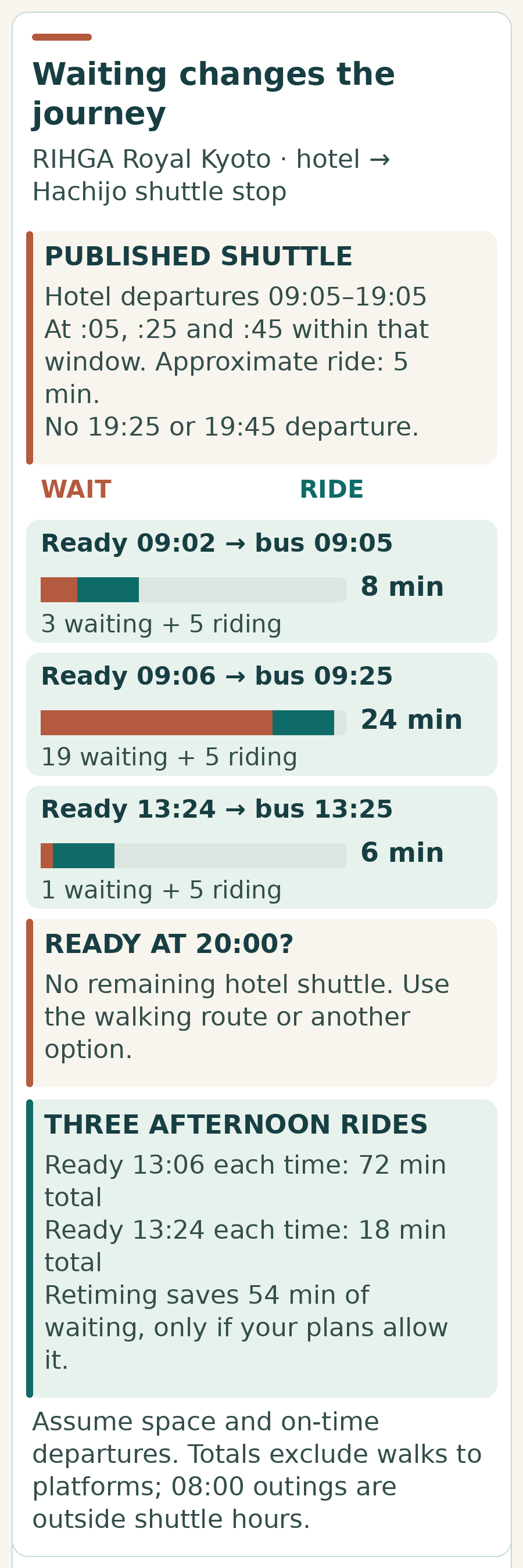
Now apply it to a four-night stay with three full days. Suppose each day includes an 08:00 outing and another departure after a hotel rest. The three early outings cannot use this shuttle. If the three afternoon departures are each at 13:06, their waiting and riding total 72 minutes: 57 waiting and 15 riding. If your schedule genuinely permits being ready at 13:24 instead, the same three rides total 18 minutes: three waiting and 15 riding. That removes 54 minutes of waiting at the stop; it does not make a fixed appointment 54 minutes earlier.
The hotel’s published seven-minute walk is a separate station-access benchmark, not a timed walk to every platform or the same endpoint as the shuttle. Its airport-bus instructions give a 14-minute walk to H2. Those two figures alone show why “near Kyoto Station” needs a destination. Add the correct gate or bus-stop route before comparing this hotel with an internal station property.[16]
Match the hotel to the airport route and meeting point
For Kansai Airport, the HARUKA is a direct JR limited express to Kyoto; it is not the Shinkansen. The airport limousine has a Kyoto Station Hachijoguchi service, with Kyoto departure boarding at H2 and arrivals at H3. Choose your transport first and then check its arrival or boarding location, rather than assuming every airport connection brings you to the same side.[19][20][21]
You can compare Kansai Airport–Kyoto transport options on 12Go, then check the chosen listing’s operator, terminal, arrival point, baggage terms and final price against the official HARUKA information or airport-bus timetable. A route comparison page does not establish that every listed option suits your flight or hotel.[19][20][22]
A booked tour can also change which station side is convenient. GuideMe Japan’s Kyoto Early Morning Tour lists the north, ground-floor Central Ticket Gate as its meeting point. If that guided public-transport itinerary suits your plans, check its route and meeting instructions on Viator. The listing says it is not wheelchair or stroller accessible, so it is not a universal family option.[23]
For a different style of outing, Japan Visionary Tour’s Nara, Fushimi Inari and Arashiyama bus tour on GetYourGuide has Kyoto and Osaka departure options. Select the city and return option you actually want, then verify the current meeting pin: the listing makes the meeting point option-dependent. It also excludes wheelchair users and people with mobility impairments. Do not select a hotel from a generic “Kyoto Station pickup” label.[24]
Keep the hotel address, entrance photograph and lift map offline. If mobile data would help you check directions after arrival, compare Airalo eSIM options and select Japan; first confirm that your phone is eSIM-compatible and carrier-unlocked, and check the selected plan’s activation rules. This supports navigation but does not replace a saved route.[25][26]
Check beds, the full stay total and date-specific notices
For a family of two adults and two ten-year-olds, enter all four guests and their ages before comparing prices. MIMARU’s two singles and bunk unit are one sleeping arrangement; Miyako Hachijo’s family room with two extra beds is another. A double room allowing young children to share existing beds is not an equivalent four-bed quote.[14][15]
Compare the final amount for the same dates, occupants, breakfast, bedding and cancellation terms. Kyoto’s accommodation tax is charged per person per night using the taxable accommodation charge; meals and consumption tax are excluded, while service and certain room-related charges are included. Children are taxable when an accommodation charge applies, regardless of age.[27]
For a transparent illustration, assume four paying guests stay four nights and each person’s taxable nightly accommodation charge is at least ¥6,000 but below ¥20,000. At the current ¥400 band, the accommodation tax is 4 × 4 × ¥400 = ¥6,400 for the stay. This is an example, not a hotel quote: use the property’s allocation and add it only if your displayed total excludes it.[27] Our Japan trip-cost guide helps place that full hotel bill in the wider holiday budget.
Two current booking checks
Miyako City Kintetsu lists daytime fifth-floor preparation work for 1–31 October 2026 and a main renovation phase planned for 7 December 2026–28 February 2027. Check its current notice if afternoon rest matters. Daiwa Roynet Kyoto Ekimae PREMIER lists its breakfast restaurant as closed from 18 December 2026 until a planned reopening around mid-March 2027. Confirm the service available on your own dates.[9][12]
Late access deserves a separate check. Daiwa’s underground entrance closes from 23:30 to 07:00, so save its surface approach. The Kintetsu Hachijo entrance in front of Miyako City Kintetsu is locked from 23:45 to 05:00; the hotel tells arriving or returning guests to use the intercom to the right of the entrance. That is an access procedure, not a hotel curfew.[8][10]
The final decisions that prevent an awkward booking
Must I stay north for JR trains or the subway?
No. Use the station’s map for your actual platform and gate. South-side hotels can suit these journeys, and choosing the wrong entrance can cancel out a short map distance.[1]
Does a station connection guarantee a step-free arrival?
No. The published standard approach may use escalators or stairs. Confirm the lift route and room needs separately; MIMARU’s universal-design route is a useful example of why a hotel’s accessible approach can differ from its shortest walking directions.[3][6]
Is the free shuttle enough reason to choose the western edge?
Only if its hours and waiting times fit your real days. If you plan early starts, late returns or fixed appointments, judge RIHGA Royal on the walk and room first.[16][17]
For the cleanest shortlist, a short rail stop points towards Miyako City Kintetsu; more twin-room space within the station towards Granvia; a north-side underground approach towards Daiwa; four distinct sleeping places towards MIMARU or a correctly configured Miyako Hachijo family room. RIHGA Royal earns its place when its room and western approach suit the stay. Whichever you choose, save one precise arrival route and check one fully specified room quote before paying.
Sources and planning notes
This is a research-led guide using hotel, transport and destination sources linked below. Time-sensitive rules have been reviewed, but not every property detail or website can be independently checked. Reconfirm the exact room, route, final price and current notices for your own dates; worked examples state their assumptions.
- Kyoto Station guide map — JR West.
- Kyoto Station Building: station and nearby-facility directions — Kyoto Station Building.
- Universal Design Route to MIMARU Kyoto Station — MIMARU.
- Hotel Granvia Kyoto: Superior rooms — JR-West Hotels / Hotel Granvia Kyoto.
- Miyako City Kintetsu Kyoto Station: access — Miyako Hotels & Resorts.
- Miyako City Kintetsu Kyoto Station: train arrival directions — Miyako Hotels & Resorts.
- Miyako City Kintetsu Kyoto Station: Double room — Miyako Hotels & Resorts.
- Miyako City Kintetsu Kyoto Station: access during station night closure — Miyako Hotels & Resorts.
- Miyako City Kintetsu Kyoto Station: room renovation notice — Miyako Hotels & Resorts.
- Daiwa Roynet Hotel Kyoto Ekimae PREMIER: access and underground entrance hours — Daiwa Roynet Hotels.
- Daiwa Roynet Hotel Kyoto Ekimae PREMIER: guest rooms — Daiwa Roynet Hotels.
- Daiwa Roynet Hotel Kyoto Ekimae PREMIER: breakfast restaurant renovation notice — Daiwa Roynet Hotels.
- Miyako Hotel Kyoto Hachijo: access — Miyako Hotels & Resorts.
- Miyako Hotel Kyoto Hachijo: South Wing Family Room — Miyako Hotels & Resorts.
- MIMARU Kyoto Station: room layouts, amenities and access — MIMARU.
- RIHGA Royal Hotel Kyoto: location and transport access — RIHGA Royal Hotels.
- RIHGA Royal Hotel Kyoto: free shuttle timetable — RIHGA Royal Hotels.
- RIHGA Royal Hotel Kyoto: Regular Floor Twin rooms — RIHGA Royal Hotels.
- HARUKA: Kansai Airport connections — JR West.
- Kansai Airport–Kyoto limousine bus timetable — Kansai Airport Transportation Enterprise.
- Kyoto Station Hachijoguchi airport-bus boarding point — Kansai Airport Transportation Enterprise.
- Kansai Airport to Kyoto transport comparison — 12Go.
- Kyoto Early Morning Tour with English Speaking Guide — Viator / GuideMe Japan.
- Kyoto/Osaka: Nara, Fushimi Inari Taisha, Arashiyama Bus Tour — GetYourGuide / Japan Visionary Tour.
- Japan eSIM options — Airalo.
- What is an eSIM? Device compatibility requirements — Airalo.
- Kyoto City accommodation tax: guest questions on taxable charges and current rates — Kyoto City.
Illustrations in this article were created for Taylor’s Trailblazing Travels. Third-party photographs, where used, are credited beside the image or in the source list.