Tokyo or Kyoto: Which Should You Spend More Time In?
Give the extra day to the experience you would otherwise have to miss.
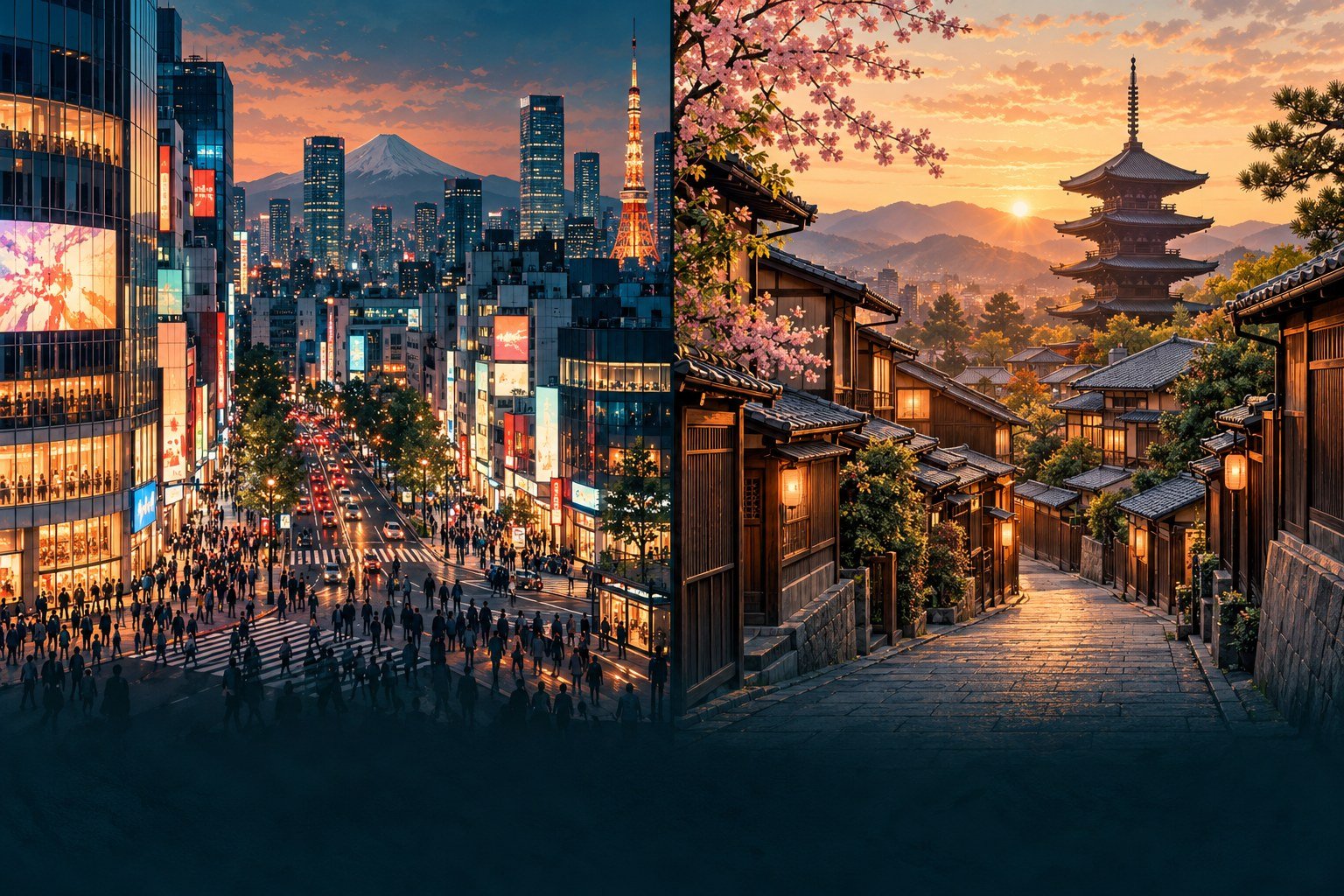
Original AI-assisted editorial illustration of Tokyo and Kyoto; a composite, not a photograph.
A Tokyo or Kyoto decision becomes easier when you stop counting famous sights and start counting the days you can actually use. Tokyo offers a broad spread of neighbourhoods, shopping, museums and contemporary culture; Kyoto rewards time for historic districts, gardens and a less hurried look at its temples. Both contain much more than those shorthand descriptions. [1][2]
For a first visit with seven nights reserved for these two cities, four nights in Tokyo and three in Kyoto is a sensible starting point. Treat it as an editable plan. Your arrival airport, two or three non-negotiable experiences and appetite for early starts should decide whether the spare night changes sides.
This guide contains affiliate links. Taylor’s Trailblazing Travels may earn a commission when you book or buy through them, at no extra cost to you.
Planning decision 01
Balanced first visit
Start with four Tokyo nights and three Kyoto nights; then adjust for your priorities.
Planning decision 02
Temple and garden focus
Move the extra night to Kyoto if it protects another area or a slower morning.
Planning decision 03
Shopping and city culture
Give Tokyo the extra day when it removes a rushed cross-city dash.
Planning decision 04
Count the travel day
A fast train still needs station access, boarding time and a hotel transfer.
Tokyo or Kyoto: the decision at a glance
The table describes planning priorities, not a verdict that one city is better. Tokyo has historic neighbourhoods and temples, while Kyoto is a working modern city with shopping, museums and lively evenings. [1][2]
| Your priority | Lean towards | What the extra day buys |
|---|---|---|
| Fashion, anime, specialist shopping and different city districts | Tokyo | A separate neighbourhood day instead of squeezing shops between major sights. |
| Gardens, traditional streets and several temple areas | Kyoto | Time to linger and divide the city into manageable geographical groups. |
| A varied plan with indoor fallbacks | Tokyo | More room to rearrange museums, shopping and other indoor activities around the weather. [3] |
| Quiet early walks and the atmosphere around historic sites | Kyoto | Another early start without having to arrive from somewhere else. [6] |
| One special timed booking | The city with that booking | A schedule that protects the experience and its travel time. |
| A mixture of interests with no clear winner | Keep the split close | Two contrasting stays, with fewer regrets about the city given too little time. |
Food alone is a weak tiebreaker: both cities can support an excellent food-focused visit. Decide whether you want to explore a particular neighbourhood, arrange a particular meal or spend time on a cooking or cultural experience. Give that activity a realistic slot; do not award an entire city a point for being “good for food”.
A useful test
Write down what the extra day would actually contain in each city. If one side has a specific experience you care about and the other has a vague list of more sightseeing, the specific plan is usually the stronger choice.
Turn nights into days you can actually use
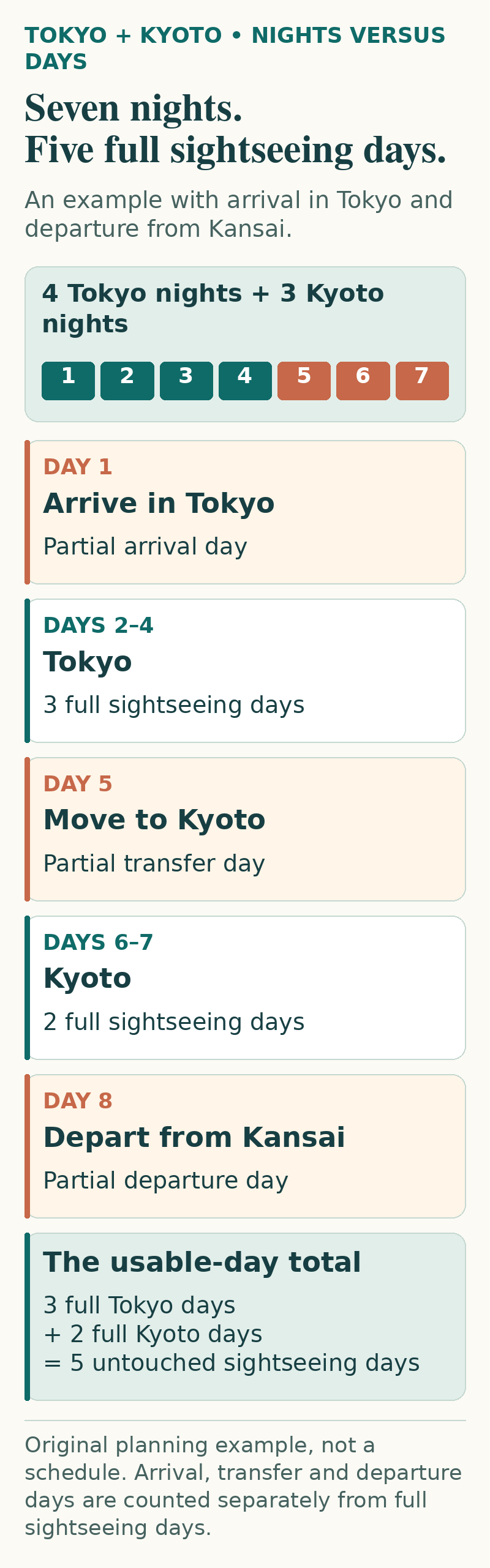
Seven nights do not mean seven full sightseeing days. In a simple eight-calendar-day trip, the first and last days are arrival and departure days. Moving between Tokyo and Kyoto uses part of another day. You can still enjoy those partial days, but do not budget them as uninterrupted sightseeing time.
Here is a deliberately conservative ledger for arriving in Tokyo, sleeping there for four nights, moving to Kyoto, sleeping there for three nights and departing from Kansai. The three full Tokyo days are days 2–4; the two full Kyoto days are days 6–7. Day 5 is the transfer day, with an optional later visit or neighbourhood walk.
| Nights available | Starting split | How to adapt it |
|---|---|---|
| 4 nights | Consider one city | A 2–2 split leaves just one untouched full day in each under the same arrival/transfer/departure assumptions. |
| 7 nights | Tokyo 4 / Kyoto 3 | Reverse it for a strong Kyoto preference; leave extra day trips out until the city days fit. |
| 8 nights | Tokyo 4 / Kyoto 4 | A useful even split when both cities have three clear full-day plans. |
| 10 nights | Tokyo 5 / Kyoto 5 | Shift to 6–4 or 4–6 for a clear preference, or allocate a day excursion without hollowing out the host city. |
If your homeward flight leaves Tokyo, count the return journey too. One seven-night option is three Tokyo nights, three Kyoto nights and a final Tokyo night before the flight. With arrival on day 1, moves on days 4 and 7 and departure on day 8, that leaves two untouched full days in each city. You now have two transfer days, so the same seven nights buy four full city days under this model, compared with five when departing from Kansai. A late first arrival may contribute little beyond dinner and sleep; make the ledger with your actual local flight dates.
For the wider trip-length decision, use the guide to how many days to spend in Japan. This comparison concentrates on dividing the time you have already set aside for these two bases.
Back to top ↑When Tokyo deserves the extra day
Your interests lead to different neighbourhoods
Tokyo is particularly persuasive when your shortlist includes shopping and youth culture around Shibuya and Harajuku, the older streets around Asakusa, and museums or specialist interests around Ueno and Akihabara. These are distinct areas rather than one compact walking circuit. [1]
Give each day a geographical centre. A shopping-heavy western-city day and an eastern-city history or museum day are more coherent than crossing Tokyo repeatedly to touch every headline attraction. If a museum, shopping district or exhibition is the part you most want to linger over, an extra day protects that time.
You need flexibility for weather or different energy levels
Tokyo’s official tourism guide identifies museums, indoor entertainment, department-store browsing and other rainy-day alternatives. [3] That makes Tokyo a useful place for a flexible spare day, especially if the group includes someone who tires of outdoor sightseeing. Check the opening day and booking conditions of the particular attraction; “indoors” does not mean “available whenever you arrive”.
This is a planning advantage, not a promise that Tokyo is effortless. Large stations, walking between entrances and full trains can still make a supposedly light day tiring. Choose a hotel-to-first-stop route you can manage and leave gaps between fixed bookings.
A day trip is central to your reason for going
A full day in Nikko or a Kamakura and Enoshima excursion uses one of the days allocated to the Tokyo base. With only three full Tokyo days, taking both excursions leaves just one full day for Tokyo itself. That arithmetic may be acceptable for a repeat visitor; it is a poor accidental outcome for someone expecting an expansive first Tokyo stay.
Do not add a day trip simply because the train makes it possible. First decide whether it offers more value to you than the Tokyo day it replaces.
Back to top ↑When Kyoto deserves the extra day
You want atmosphere as well as famous sights
Kyoto’s appeal includes traditional townhouses, historic streets, gardens, craft and food traditions, as well as the temples and shrines on a first-time shortlist. [2] Those interests often benefit from slowing down. An extra day can provide the breathing room to stay in one area instead of turning a garden visit into a brief stop before the next cross-city journey.
Build one day around eastern Kyoto, a separate block around Arashiyama if it matters to you, and another chosen area or experience. Those groupings are editorial planning suggestions. The city has several railway networks, and the useful line depends on your start and destination; it is not necessary to route every journey through Kyoto Station. [4]
You are willing to use mornings thoughtfully
Kyoto’s tourism board promotes exploring at different times of day, including early morning. [6] Staying locally gives you more opportunities to choose a quieter start. It does not mean every ticketed temple opens at dawn, nor that any popular location will be empty. Check the specific opening time and respect residents, access restrictions and photography signs.
If an early visit is a priority, do not book a late evening and an ambitious dawn start on consecutive days throughout the stay. An additional Kyoto night is valuable when it lets you spread those choices across the trip.
You have several different cultural interests
Kyoto earns more time when your plans move beyond collecting temple names: for example, a garden-focused day, a craft or tea experience, and an unhurried historic-neighbourhood walk. It earns less extra time when the group is already likely to lose interest after two major sites. Choose by your curiosity rather than the length of a generic must-see list.
Keep a Kyoto city day separate from a day elsewhere in Kansai. Visiting Osaka or Nara from a Kyoto hotel may be practical, but it does not add time spent exploring Kyoto.
Back to top ↑Allow for the complete Tokyo–Kyoto move
JR Central describes Tokyo to Kyoto as about 130 minutes by a fast Shinkansen service. [5] That is the rail journey, not the time from leaving one hotel to being ready to explore beside the next. Use the actual train you choose when finalising the plan.
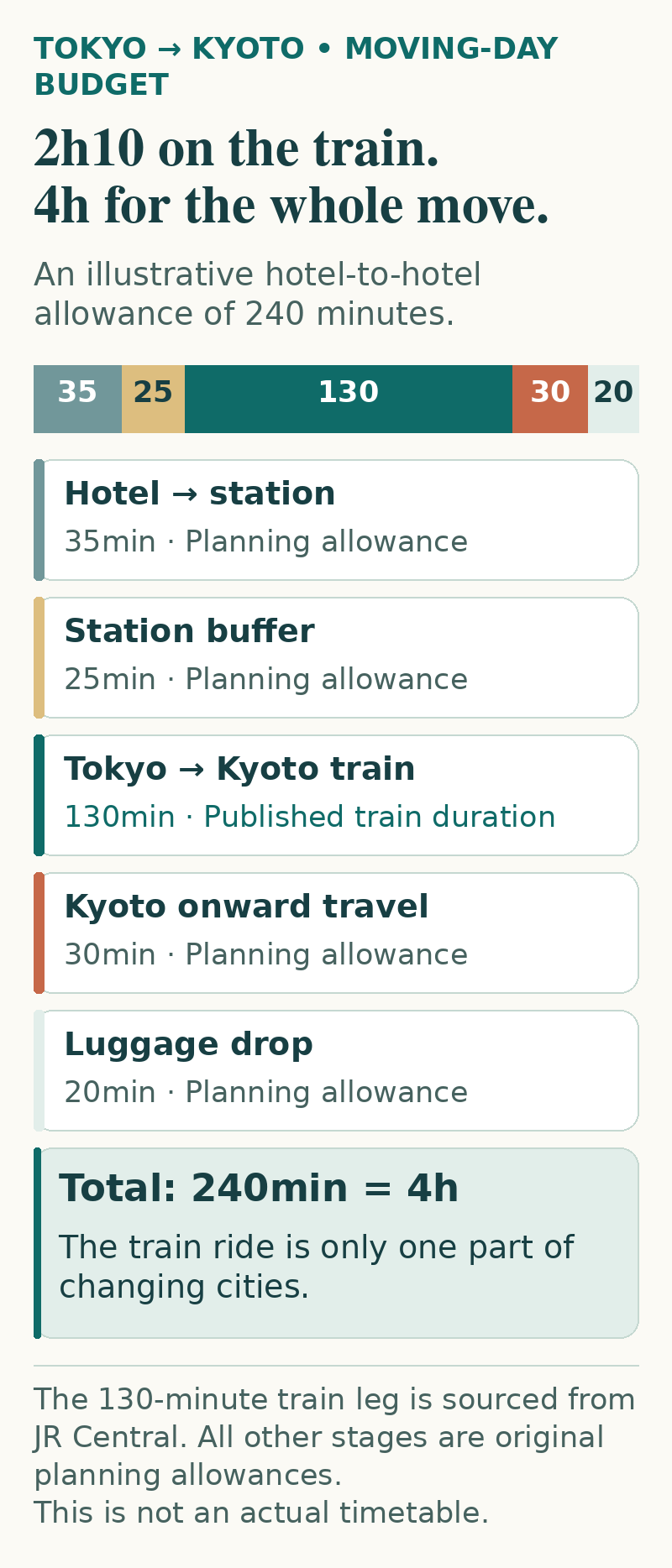
The example allocates 35 minutes from the hotel to the departure station, 25 minutes for navigating the station and boarding, 130 minutes on the train, 30 minutes onward in Kyoto and 20 minutes for leaving luggage. That adds to 240 minutes. A different hotel, slower service, access need or busy station can change it substantially.
Leaving luggage is not the same as checking into a ready room. Ask your accommodation about storage and check-in arrangements. A relaxed walk or one flexible attraction after the move is easier to protect than several timed tickets close together.
Compare the journey before fixing the night split
SmartEX is an official booking route for the Tokaido Shinkansen. You can also compare the Tokyo–Kyoto options listed by 12Go, including relevant rail and coach offers. [8][9] Check the exact stations, departure date, ticket-collection instructions, cancellation terms and complete price. An overnight coach changes the sleep and luggage plan; it is not a like-for-like replacement for a daytime fast train.
Do not assume a national rail pass will save money simply because you are visiting two cities. Compare its actual included journeys with the individual tickets your route needs.
Back to top ↑Compare the cost of your actual dates
There is no reliable universal answer that Tokyo or Kyoto will be cheaper for your stay. The fair comparison is the same dates, number of people, room arrangement, cancellation flexibility and location standard. A lower room rate can lose its appeal if the address adds transfers to every day.
Include local accommodation taxes in the total. Kyoto’s revised tax applies from 1 March 2026 and is charged per person, per night, according to the taxable accommodation charge. For the ¥6,000 to under ¥20,000 band, the rate is ¥400. Two adults staying three nights in that band therefore add ¥2,400 in Kyoto tax; the applicable band is based on the charge for each person, not simply the room total. Higher bands have higher rates. [7]
Tax bands published for stays from 1 March 2026. Ask the property how the taxable accommodation component is calculated and whether the displayed total already includes it. The example is a calculation, not a hotel quote.
Price the two bases on equal terms
Use city searches to find a shortlist, then check the exact address and transport route. These links open general Tokyo or Kyoto accommodation results; they do not select travel dates or guarantee rooms.
A city-search result is the start of choosing a hotel, not the end. Confirm bed configuration, room size, luggage storage, any stairs or access constraints and the final payable amount before committing. For the wider spending plan, see the Japan budget guide for UK travellers.
Back to top ↑Three travellers, three sensible answers
A first-time couple with seven nights and mixed interests
Start with Tokyo four nights and Kyoto three. Protect three full Tokyo days and two full Kyoto days under the earlier arrival and departure assumptions. Keep the transfer afternoon flexible. If the Kyoto shortlist contains three genuinely different full-day plans, reverse the split; if it mostly repeats similar temple visits, keep the extra day in Tokyo.
A traveller drawn to gardens, architecture and traditional streets
Choose Tokyo three nights and Kyoto four from the same seven-night pot. Use the Tokyo days for the parts of the capital you most want to see, then let the Kyoto stay breathe. This suits someone willing to group visits sensibly and get out early sometimes. It is less suitable if shopping, contemporary attractions or Tokyo-based day trips are central to the holiday.
A family or group with strong shopping and contemporary-culture interests
Tokyo five nights and Kyoto two can be an honest preference-led choice, but recognise the consequence: the two Kyoto nights leave only one untouched full day, plus whatever fits after the move. Choose a focused Kyoto visit rather than promising a comprehensive city tour. If two full Kyoto days matter, move a night back or extend the total.
These scenarios are not numerical city ratings. They use the same limited nights and show what changes when the priority changes. Ask every traveller to name one experience they would be disappointed to miss before settling the split.
Back to top ↑Make the split workable before you book
- Enter your arrival and departure cities and local dates first.
- Set aside nights for any other destinations. Divide only the nights genuinely left for Tokyo and Kyoto.
- Put the intercity journey into the calendar, including hotel and station time.
- Allocate your two or three most important experiences to geographically sensible days.
- Check opening days and ticket requirements before buying rooms with restrictive cancellation terms.
- Leave space for rest, weather changes and simply enjoying a neighbourhood.
The free trip itinerary planner can organise places and nights. Enter excursions as day visits and inspect the resulting plan yourself; the planner does not verify timetables or route feasibility.
Save hotel addresses and the first station journey offline. If your existing mobile plan will not provide suitable data in Japan, browse Airalo’s eSIM options and select Japan. Airalo lists Japan plans; check your device compatibility, unlock status, coverage, data allowance and activation rules before purchase. [10]
Back to top ↑Questions that can change the split
Can I visit Kyoto as a day trip from Tokyo?
It is possible with suitable trains, but about 130 minutes each way on fast services already means roughly four hours twenty minutes on trains alone. [5] Add local journeys and station time before deciding whether a long excursion meets your expectations. For a first Kyoto visit, staying overnight usually protects a much better balance of visiting time and effort.
Does Tokyo need more days because it is larger?
Only if your interests use that breadth. A larger city does not automatically earn more of a short holiday. Compare your actual full-day plans and their geography; a traveller with a focused Tokyo shortlist and a deep interest in Kyoto’s gardens may sensibly choose the opposite split.
Should bad weather make me switch cities?
A changeable forecast alone is a weak reason to rebuild a booked trip. Keep flexible indoor alternatives and review conditions close to the visit. Tokyo has a broad menu of indoor options; Kyoto’s official guide suggests the Kyoto Aquarium and Kyoto Manga Museum for escaping rain. The relevant question is which alternatives your group would enjoy. [3][11]
Does a day in Osaka count as a Kyoto day?
It counts as a night in Kyoto if that is where you sleep, but it is an Osaka sightseeing day. Keep the two columns separate. Otherwise a five-night Kyoto booking can look generous while leaving very little time inside Kyoto itself.
Back to top ↑Give the extra night a clear job
For a balanced first visit, begin with four Tokyo nights and three Kyoto nights from a seven-night allowance, or an even split when you have eight. Then give the extra night to a specific experience, a needed slower day or a useful flight arrangement.
Tokyo deserves more time when the range of city interests is what excites you. Kyoto deserves more when the pleasure lies in lingering, choosing several distinct areas and making room for early walks. A good split is the one whose days still look appealing after the transport, arrival time and hotel logistics have been added.
Back to top ↑Sources and research
Editorial review: 18 October 2026. The official references below support the key planning information; check changing fares, opening arrangements and services for your own travel dates.
- JNTO — Tokyo destination guideNeighbourhood identities and broad cultural interests.
- JNTO — Kyoto destination guideHistoric districts, traditional culture and city areas.
- GO TOKYO — Rainy-day activitiesOfficial indoor alternatives; individual opening and booking rules vary.
- Kyoto Travel — Getting around KyotoCity transport networks and planning links.
- JR Central — Kyoto by ShinkansenAbout 130 minutes Tokyo–Kyoto on fast services; hotel transfers are additional.
- Kyoto Travel — Morning and nightExploring at different times of day; specific site access must be checked.
- Kyoto City — Accommodation-tax revision FAQJapanese official source; rates applying from 1 March 2026.
- SmartEX — Official Shinkansen reservationsOfficial reservation service and operational information.
- 12Go — Tokyo to KyotoRoute-comparison destination; no specific dates, inventory or prices are quoted here.
- Airalo — Japan eSIM optionsProvider information; suitability depends on the device and chosen plan.
- Kyoto Travel — Seasonal informationThe city’s official guide names Kyoto Aquarium and Kyoto Manga Museum as indoor options during rain.
Illustrations in this article were created for Taylor’s Trailblazing Travels. Third-party photographs, where used, are credited beside the image or in the source list.