Nara Park and the Deer: Visiting Safely and Respectfully
Choose your encounter, leave space for the deer and make the day fit your group.
- Free park entry
- 150-minute park plan
- Wild deer, year-round
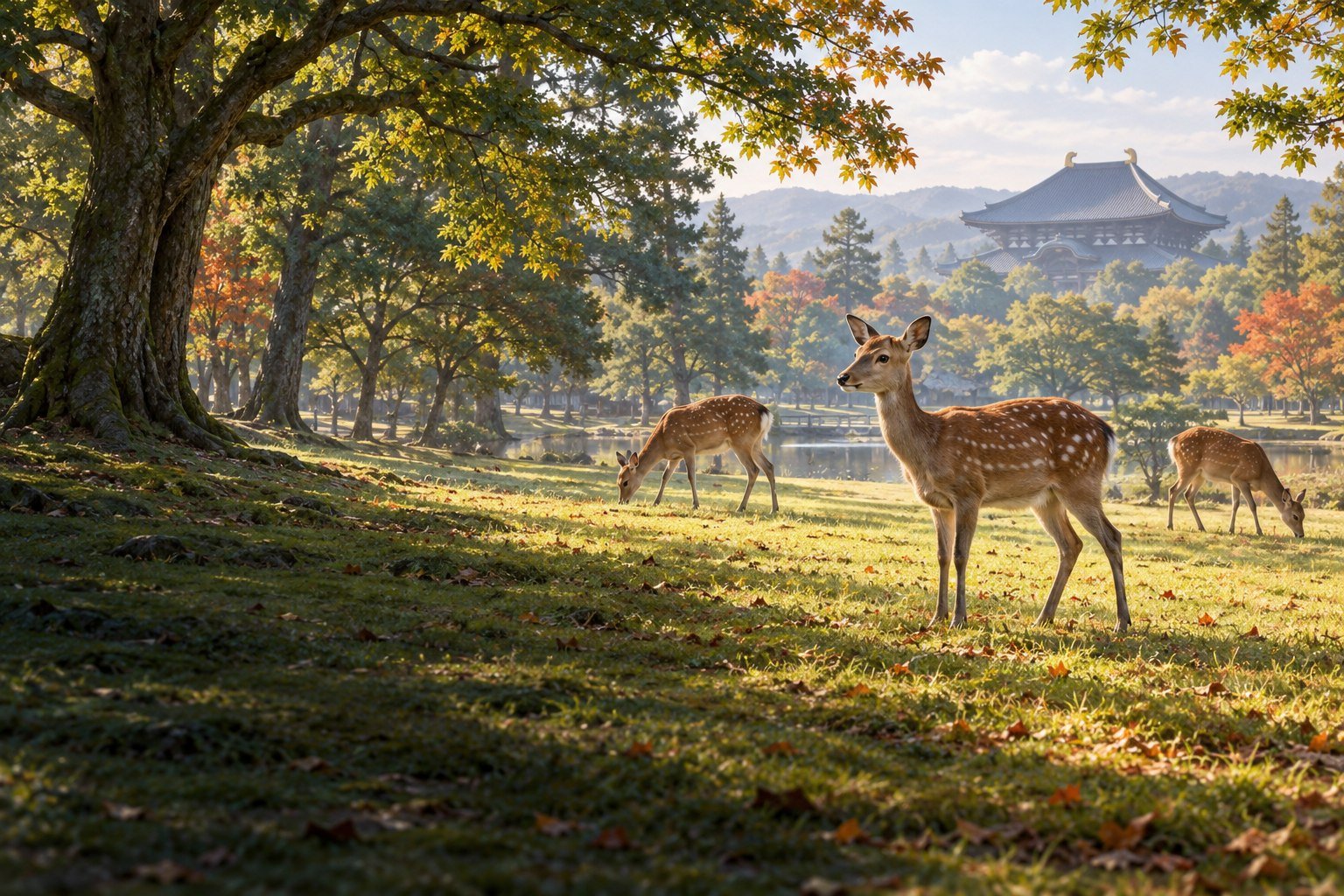
AI-generated original editorial illustration inspired by Nara Park; it is not a documentary photograph or a guaranteed wildlife encounter.
The most useful decision at Nara Park comes before buying crackers: does everyone in your group actually want to feed the deer? Watching them graze and move through the park is a worthwhile visit in its own right.
Nara’s wild sika deer are protected as National Natural Monuments and historically associated with Kasuga Taisha. [1] A respectful plan gives them room and gives you time to notice what is happening around you.
Taylor’s Trailblazing Travels may earn a commission when you book or buy through links in this guide, at no extra cost to you. This helps support the site’s research and upkeep.
Keep attention available
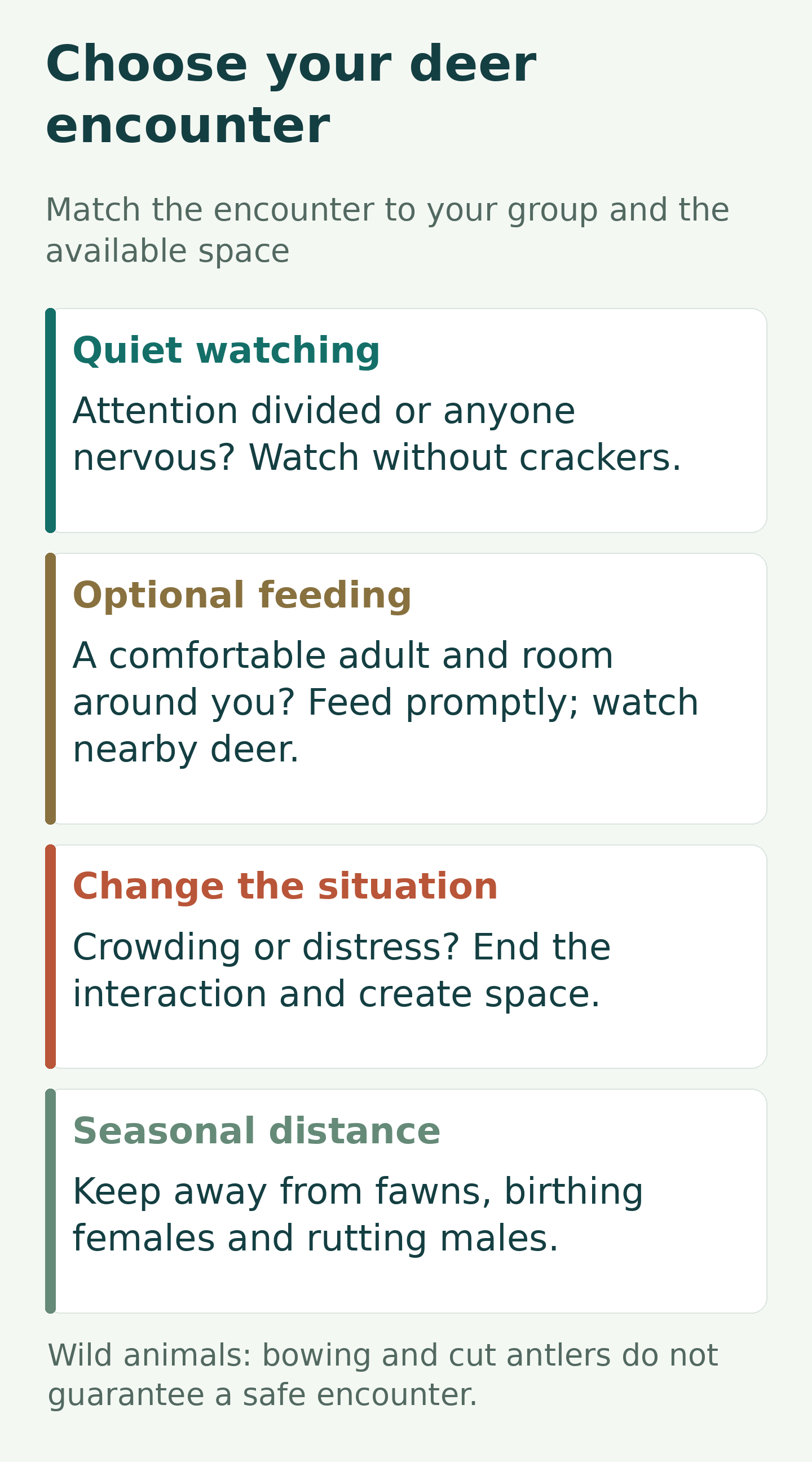
If you are juggling a child, bags and a phone, make this a watching visit. Feeding needs your attention.
Adjust the walking allowance
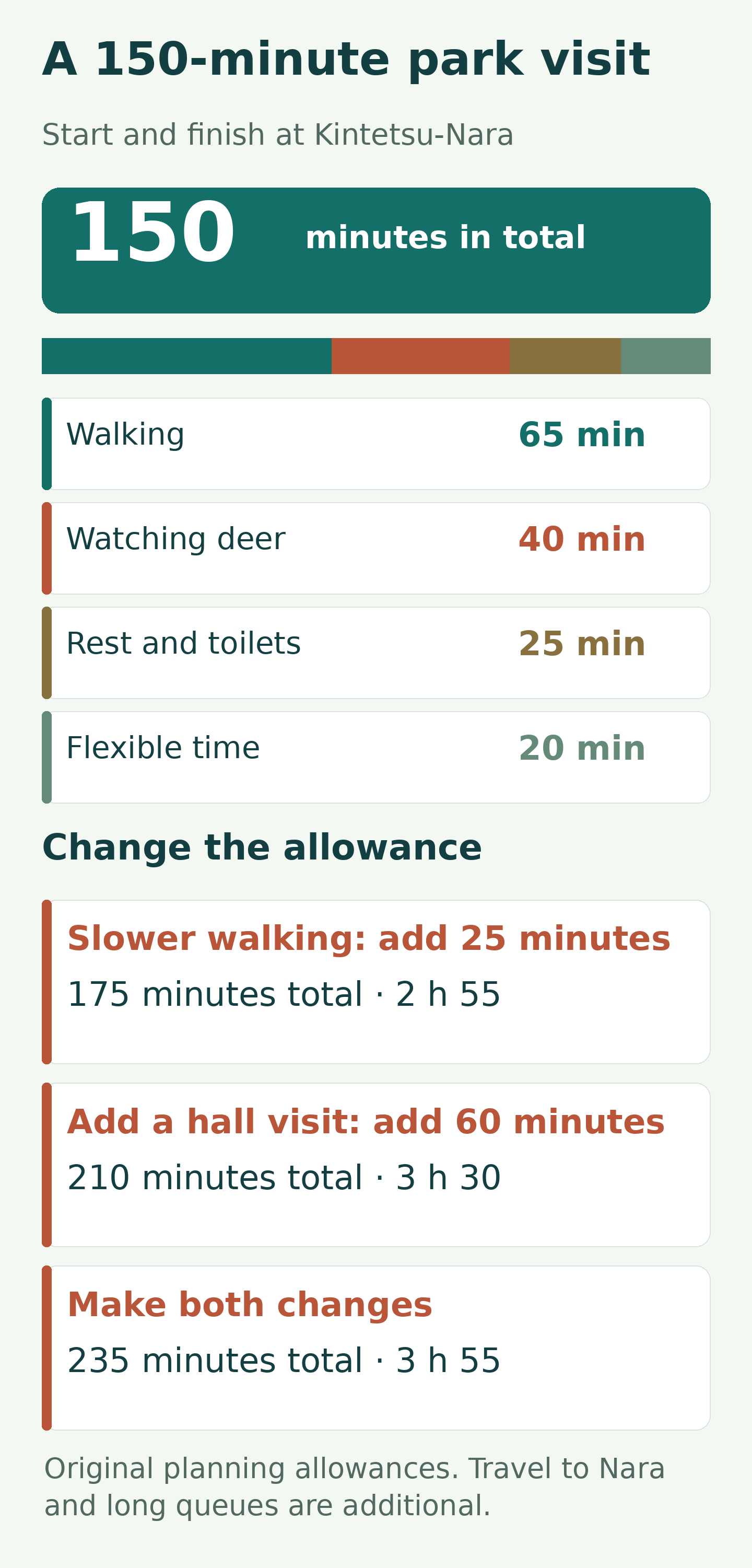
Our 150-minute plan becomes 175 minutes if the walking takes 90 minutes instead of 65.
Separate the admission costs
Park entry, crackers and a temple interior are separate decisions. Budget only for the parts you want.
Give seasonal space
Leave fawns and birthing females alone; keep away from males during the autumn rut. Details below.
Choose the encounter that fits your group
A bow is not a safety test. The Nara Deer Preservation Foundation warns that apparently friendly deer can still cause serious injuries, including by striking with their antlers or knocking people over. Withholding a cracker or pretending to have food can excite them and provoke aggressive behaviour. [3]
Use the choice below before approaching a cracker seller. These are practical judgements about attention and comfort, rather than a prediction of any individual animal’s behaviour. Watching is the sensible default when one adult would otherwise be managing both the food and a nervous child.
Use your camera’s zoom and leave deer room to move away. Avoid touching, holding or grabbing antlers, in line with prefectural guidance. [1]
If you feed the deer, keep it simple
Feed only designated deer crackers (shika senbei); human food is unsuitable. Official guidance checked 18 October 2026. [1]
Budget ¥200 for a standard bundle of ten crackers: this is the city tourism organisation’s published price, also reported by Mainichi in June 2026. Check the seller’s price and stock on the day; buying a bundle is optional. [7][8]
- Before starting, secure your bag, paper map and loose belongings, and keep human food packed away. Take packaging and other rubbish away with you. [1]
- Give the cracker promptly. Do not make the deer repeat a bow for a photograph, hold food back to tease it or pretend your empty hand contains a treat. [3]
- Watch the deer around you as well as the one in front. Young children should be accompanied by an adult; wait if the space around you already feels crowded. [4]
- When you really have no crackers left, spread both empty hands, as the foundation’s feeding leaflet advises. Keep paying attention: this gesture is not a guarantee that a deer will move away. [4]
If an encounter starts to feel unmanageable, stop trying to photograph or feed and calmly create space. Do not hold on to an interaction merely to finish the packet. Wash your hands promptly if you have touched a deer. [3]
Build a park visit with time to pause
For a first visit focused on the deer, use a loop from Kintetsu-Nara through Noborioji-enchi, Ukigumo-enchi and Tobihino, then return west. Noborioji is the western approach to the park; Ukigumo is a central open area. [5] Tobihino is the broad grassy area beside the main approach to Kasuga Taisha. Deer move freely, so treat these as places to look, not guaranteed sightings. [10]
The official Nara sightseeing map shows how these areas fit together. Follow the public paths and signs on the ground. The timings here are my planning allowances, not measured walking times or an official route. [9]
| Leg | Allow | Purpose |
|---|---|---|
| Kintetsu-Nara → Noborioji-enchi | 10 minutes | Reach the western park and settle into the visit. |
| Noborioji → Ukigumo-enchi, through the museum area | 15 minutes | Move towards the central open spaces. |
| Ukigumo-enchi → Tobihino | 15 minutes | Include a grassy area by the shrine approach. |
| Tobihino → Kintetsu-Nara | 25 minutes | Return without adding a temple interior or hill climb. |
Swipe or scroll sideways to read the full table.
The total is 65 minutes walking + 40 minutes watching + 25 minutes for a rest and toilet stop + 20 minutes of flexibility = 150 minutes. Rail journeys to Nara are outside this allowance.
What changes the total?
If your group needs 90 minutes for the walking, the same pauses make the visit 175 minutes. Adding a 60-minute Great Buddha Hall visit makes the original plan 210 minutes; slower walking plus that addition makes it 235 minutes. A long queue can exceed the spare 20 minutes, so do not squeeze the hall into a fixed train deadline.
With substantially less time, stay around the western park and return from there. The useful compromise is a smaller area with unhurried stops. Decide on the temple extension only after checking how the group feels and how much time remains.
Choose your arrival point and separate the costs
The city tourism organisation gives an eight-minute walk from Kintetsu-Nara to Nara Park and 20 minutes from JR Nara. These describe reaching the park, not reaching every attraction inside it. From JR Nara it also lists an approximately seven-minute outer-loop bus ride to Kencho-mae. Access details checked 18 October 2026. [6]
Use the Kintetsu network and route-search page for the train part of a journey from Osaka-Namba or Kyoto. [13] If a bus would make the day easier, use Nara Kotsu’s current city route map to match your intended area with the stop, including Todaiji Daibutsuden/Kasugataishamae for the central temple-and-shrine approach. [11]
If you are comparing a rail pass or private transfer for a wider trip, 12Go has Osaka–Nara pass and transfer options and Kyoto–Nara pass and transfer options. Those pages mix passes and private vehicles; inspect the actual product, coverage and total price. Use the rail operator for an ordinary train’s route and fare. [19][20]
What does the park visit cost?
The park’s published entry price is ¥0, with year-round, 24-hour access; individual buildings and visitor services set their own hours. [5] Tōdai-ji currently lists the Great Buddha Hall at ¥800 per adult and ¥400 for children aged 6–12. Its hours are 07:30–17:30 from April to October and 08:00–17:00 from November to March. Fees and hours checked 18 October 2026. [14]
| Choice | Example cost | What the figure covers |
|---|---|---|
| Watch the deer | ¥0 | Park entry only. |
| Park + crackers | ¥200 | One standard bundle, shared if you wish. |
| Park + Great Buddha Hall | ¥800 | One adult’s hall admission. |
| Park + hall + crackers | ¥1,000 | One adult admission and one bundle. |
Swipe or scroll sideways to read the full table.
For two adults, one child aged 6–12 and one shared bundle, the same optional hall visit is 2 × ¥800 + ¥400 + ¥200 = ¥2,200. These calculations exclude transport, meals, guides and other paid buildings; they do not assume that every person buys crackers.
Adjust for children, mobility and the season
Small children are closer to a deer’s head height, which the foundation identifies as a particular risk for rushing and headbutting. Keep an adult actively supervising; a photograph should not absorb the only available adult’s attention. [3] For a nervous child, someone with limited balance or a visitor who cannot easily step aside, I would choose observation without feeding and leave a generous gap from gatherings around cracker sellers.
The foundation identifies mid-May to June as the birthing season, when females can be defensive, and September to November as the rut. Do not approach fawns or birthing females, and stay away from males during the rut. Cut antlers do not make a rutting male safe to approach. Seasonal advice checked 18 October 2026. [2]
Choose daylight for easier observation and road crossings. In heat, heavy rain or poor visibility, shorten the loop and preserve the rest allowance. Wear shoes with reliable grip and carry drinking water. Around park roads, stay alert: the foundation warns that deer can move suddenly into traffic. [2]
For a wheelchair, walking aid or pushchair, use Nara City’s Nara Park accessible-facilities list to identify facilities to check, then confirm the entrances and paths you need with the venue. It is a facility inventory, not a promise that the entire loop is step-free. [12] The park office also publishes a toilet map and location list, including the station area and Noborioji-enchi. [5]
Download your map before arriving. If you need mobile data for maps and translation, explore Airalo’s eSIM store and select Japan; its Japan page currently lists data-only plans. [23] Check that your phone supports eSIM and is network-unlocked before buying. [24]
When a guide or an overnight stay helps
A guide is worth considering when you want religious and historical context alongside the deer, or someone else to organise a group’s sequence of stops. Book for that service; the deer remain wild and the same precautions apply.
A combined shrine-and-temple walk
GetYourGuide’s Nara: Great Buddha, Kasuga Shrine & Sacred Deer Tour is listed as three hours. The advertised inclusions cover the Great Buddha Hall, Kasuga Taisha’s special worship area and deer crackers. Transport to the meeting point and hotel collection are excluded. Check the selected option’s group format, meeting point and language before paying. [17]
A private walk for your own group
Viator’s Nara World Heritage Private Tour is a three-hour alternative including the Great Buddha Hall, park, Ukimido and Kofukuji. It lists entrance fees, a guide and one packet of crackers. The meeting place is the free rest area at Tōdai-ji Museum; the standard finish is Kintetsu-Nara. Confirm the current arrangement with the operator. [18]
Both listings say they are unsuitable for wheelchair users. Check the walking demands and selected booking terms against your group’s needs; a private booking does not establish an accessible route. Tour details checked 18 October 2026. [17][18]
An overnight stay for a less compressed visit
Stay overnight if reducing onward-travel pressure is worth the extra room cost, especially when adding other Nara sights. Compare Nara accommodation on Booking.com with Nara accommodation on Agoda. Both links open city searches. Use the same dates and room requirements, compare the full payable amount and cancellation terms, and inspect the map before choosing. [21][22]
If someone is bitten, or a deer needs help
For a bite that breaks the skin, wash the wound with soap and warm water, gently dry it and cover it with a clean dressing. Apply firm pressure with a clean cloth or dressing for heavy bleeding. NHS guidance recommends urgent medical advice for bites on hands, feet, face or head, signs of infection, contamination, or a tetanus vaccination more than ten years ago; large or deep wounds and bleeding that will not stop need emergency care. Medical guidance checked 18 October 2026. [15]
In Japan, call 119 for an ambulance. The Japan Visitor Hotline, 050-3816-2787, offers English-language help with illness, accidents and travel problems 24 hours a day. Use local medical services for assessment; the hotline is a source of assistance, not a substitute for emergency treatment. Contact details checked 18 October 2026. [16]
For an injured or sick deer, contact the Nara Deer Preservation Foundation on 0742-22-2388; its published contact hours are 08:30–17:15. It directs night-time deer traffic accidents to Nara Police on 0742-20-0110. Give the location and let the rescuers handle the animal. Contacts checked 18 October 2026. [2]
Questions before you go
Do the deer depend on visitors buying crackers?
No. The city tourism organisation describes a natural diet including grass, leaves and acorns, with crackers as a supplementary treat. There is no need to feed deer to make your visit worthwhile. [7]
Can I bring a dog?
Prefectural guidance requires dogs to stay on a lead, rules out long leads and forbids actions that startle deer. [1] If managing the dog will make it difficult to keep space from them, choose a different walking area.
Choose enough space, then enough time
For a first visit, I would start with the 150-minute park plan and decide about crackers only after seeing how the group feels. Keep the Great Buddha Hall as a deliberate extra. A visit that leaves everyone comfortable, with time to watch the deer’s ordinary behaviour, is a better use of the day than an encounter prolonged for a photograph.
Sources and research
Sources checked on 18 October 2026. Recheck opening times, prices, access arrangements and booking conditions for your travel date.
- Nara Prefecture — Protecting the Sacred Nara Deer (official English guidance, issued 15 August 2024)
- Nara Deer Preservation Foundation — visitor awareness, seasonal cautions and emergency contacts
- Nara Deer Preservation Foundation — preventing injuries involving deer
- Nara Deer Preservation Foundation — deer-cracker feeding leaflet
- Nara Park Office — park information, open areas and toilet locations (updated 9 October 2026)
- Nara City Tourism Association — Nara Park access
- Nara City Tourism Association — deer feature (information dated March 2025)
- Mainichi Shimbun — Nara deer-cracker supply report, 22 June 2026 (syndicated full article)
- Nara City Tourism Association — official Nara sightseeing map
- Nara City Tourism Association — Tobihino
- Nara Kotsu — Nara city bus route map, April 2026
- Nara City — accessible facilities in the Nara Park area
- Kintetsu Railway — network map, station information and route search
- Tōdai-ji — official opening hours and admission fees
- NHS — animal and human bites (reviewed 27 October 2025)
- Japan National Tourism Organization — Japan Visitor Hotline and emergency numbers
- GetYourGuide — Nara: Great Buddha, Kasuga Shrine & Sacred Deer Tour
- Viator — Nara World Heritage Private Tour, product 416969P3
- 12Go — Osaka to Nara options
- 12Go — Kyoto to Nara options
- Booking.com — Nara accommodation search
- Agoda — Nara accommodation search
- Airalo — Japan eSIM plans
- Airalo — device compatibility
How this guide was researched
The encounter choices and time budgets are editorial planning judgements based on official deer guidance and the city sightseeing map. Walking allowances are estimates rather than timed field measurements; the calculations show how changing those assumptions changes the visit. Booking pages establish advertised arrangements, not personal testing or guaranteed availability.
Illustrations in this article were created for Taylor’s Trailblazing Travels. Third-party photographs, where used, are credited beside the image or in the source list.