Japan • Where to stay
Where to Stay in Osaka: Best Areas for First-Time Visitors
Choose a base by the journeys you repeat, the room your group needs and the total cost of the stay.
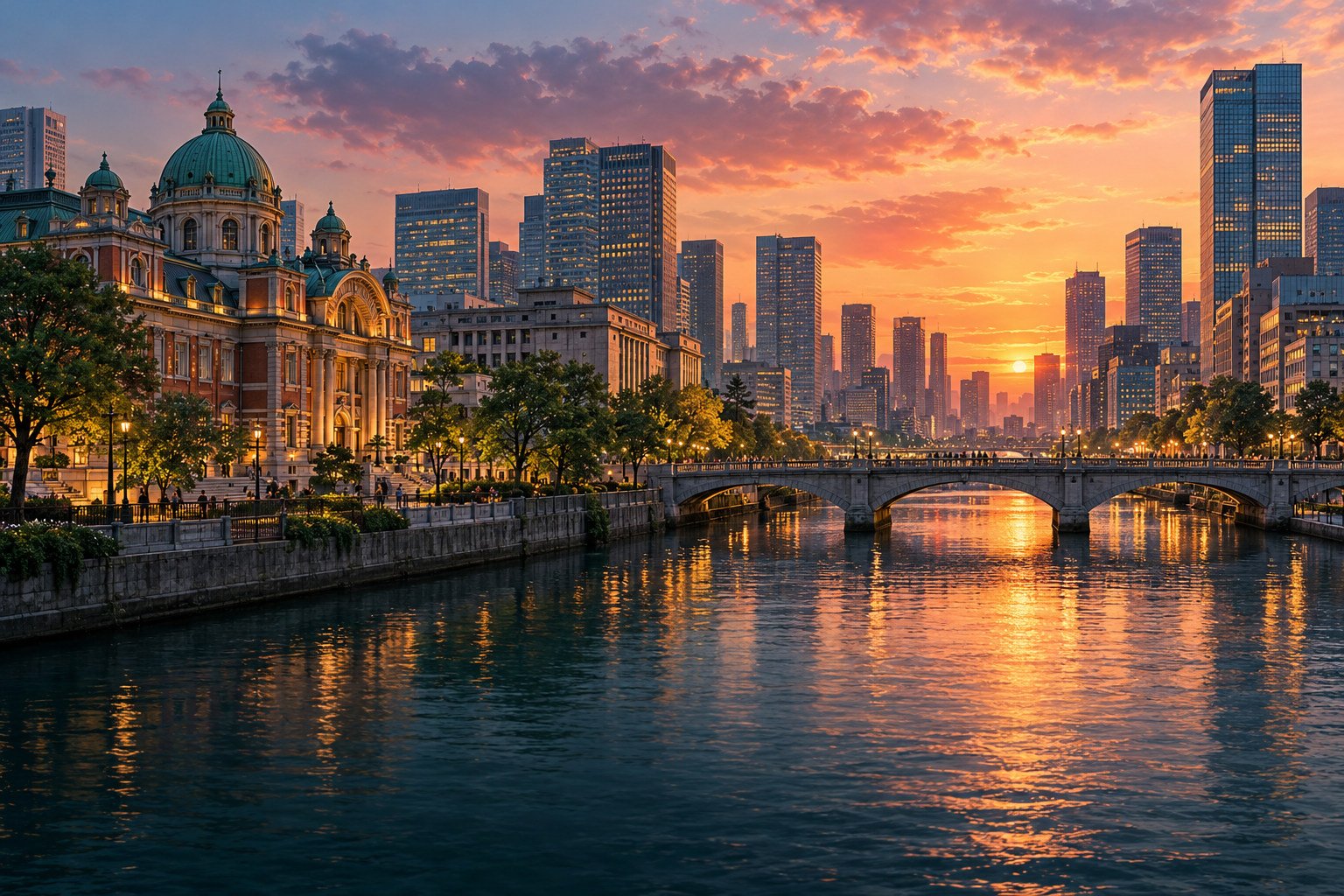
AI-created editorial illustration inspired by Osaka’s rivers and civic skyline; the buildings and viewpoint are imagined, not a hotel photograph or a promised view.
Where to stay in Osaka depends less on the best-looking map pin than on where you will go each day. Namba and Shinsaibashi bring Minami evenings close to home; Osaka Station and Umeda reward a different pattern of rail outings. Hommachi, Tennoji, Shin-Osaka and Universal City each solve a more particular accommodation problem.[1][2]
This guide compares those decisions across the city. It then tests two hypothetical journey patterns and six real hotel room examples, so you can shortlist a location without overlooking the number of beds, the station entrance or the full price. Recommendations are based on published information and explicit planning assumptions.
This article contains affiliate links. If you make a booking or purchase through them, Taylor’s Trailblazing Travels may earn a commission at no extra cost to you. Recommendations are based on the planning needs discussed in this guide.
Evenings on foot
Start in Minami, then check the real walk home and the bedroom’s street exposure.
Several rail outings
Compare Umeda with the station you repeatedly use; Osaka and Shin-Osaka are separate.
Three or four guests
Filter by beds and child ages before choosing between a twin, triple or apartment.
Park-centred stay
Universal City can simplify a park day; include the effort of any hotel move.
Where to stay in Osaka: match the area to your days
Start with two candidates: Namba/Shinsaibashi for evenings in Minami, or Osaka Station/Umeda for a trip organised around northern rail connections. Osaka’s tourism bureau distinguishes the northern Kita area from southern Minami; neither label identifies a particular station entrance or guarantees a quiet bedroom.[1][2]
Six bases, six different reasons to book
Scroll the table sideways to compare every column.
| Base | Choose it for | Main compromise |
|---|---|---|
| Namba / Shinsaibashi | Food, shopping and returning on foot after a Minami evening | Exact street and station matter; lively surroundings may be a poor match for an early bedtime |
| Osaka Station / Umeda | Several rail outings plus shops and restaurants around a major hub | Large station complex; measure the approach to the operator you need |
| Hommachi | A central Metro base between the main northern and southern districts | Less reason to stay here solely for doorstep nightlife |
| Tennoji / Abeno | Southern Osaka, JR airport access and a room that wins on the total quote | Further along the Midosuji line from northern rail departures |
| Shin-Osaka | An early Shinkansen departure or repeated use of that station | A single arrival rarely justifies every subsequent city journey |
| Universal City | A park-centred stay, especially when an early start and short return matter | An outlying rail base for a holiday dominated by other districts |
The useful middle ground
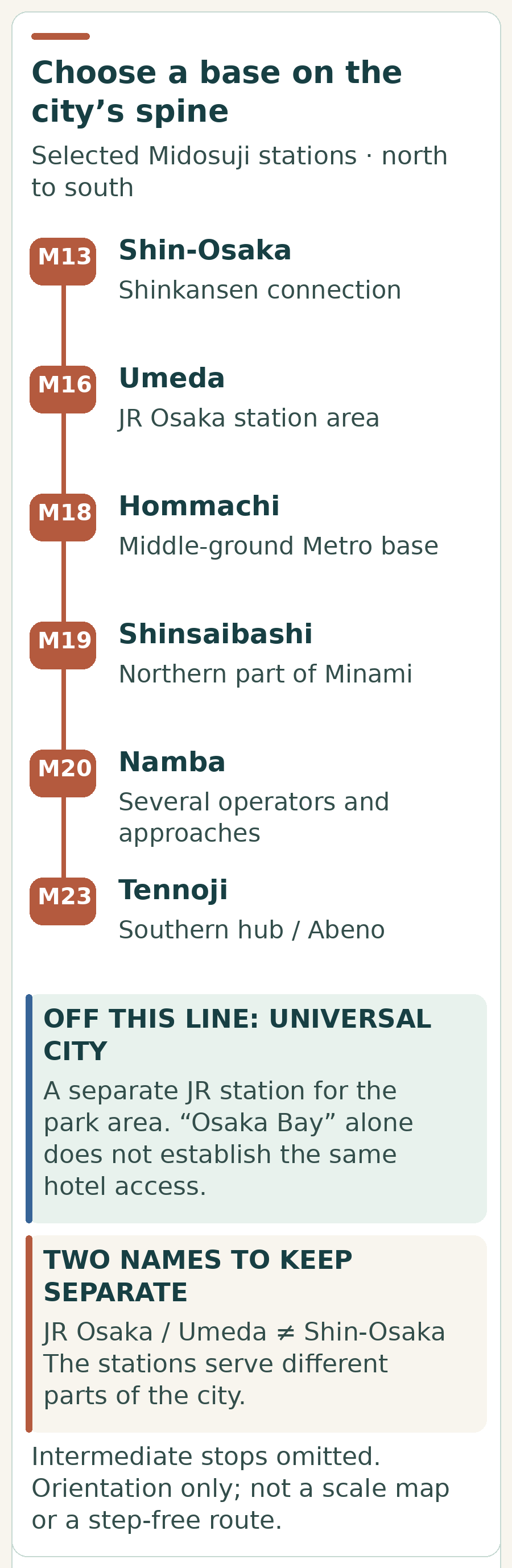
Hommachi sits between Umeda and Namba on the Midosuji line and also has Chuo and Yotsubashi line connections. It is worth comparing when your days are spread across the city and you are content to travel for a particular dinner. Treat “quieter” as a room-and-street question: ask about road exposure, glazing and current works rather than buying an area label.[1]
Tennoji/Abeno deserves a place on the shortlist when southern Osaka and the JR airport route suit your plans. It is not automatically the budget answer: the useful comparison is the actual eligible room, cancellation terms and full stay cost. At the other extreme, Universal City solves the specific problem of a park morning and tired return; “Osaka Bay” on a booking filter is too broad to establish that advantage.[3][16]
Swipe sideways to read the full planning graphic.
Which traveller needs which filter?
A couple planning late dinners should start with the walking route home. Friends need the bed configuration before the district ranking. Families should filter for every child’s age and an acceptable sleeping arrangement, then compare locations. For reduced mobility, use a named lift route and confirm the room’s actual access features directly; a short advertised station walk establishes neither.[7][9]
A repeat-journey test that can change the answer
One airport arrival attracts attention because it comes with luggage. A return trip repeated three times can have more influence on the holiday. The following original model shows how to make those repetitions visible, using Osaka Metro’s published Midosuji station sequence.[1]
Two hypothetical patterns, with equal numbers of journeys
Pattern A is city-focused: three separate return visits to Namba, one to Umeda and one to Tennoji. Pattern B uses Shin-Osaka repeatedly: three returns there, one to Umeda and one to Namba. Each contains ten one-way legs. Count a separate evening only when you genuinely return to the hotel between outings; do not turn one continuous sightseeing day into several imaginary return trips.
Each unit is one interval between consecutive stations on this line. For a return journey, double the difference between the two station numbers. For example, Umeda M16 to Namba M20 is four intervals each way: three such returns contribute 24. Add the other selected journeys to compare bases on the same terms.[1]
Original station-interval totals; fewer units means less travel along this line, not a promised journey time
Scroll the table sideways to compare every column.
| Base | Pattern A: city outings | Pattern B: repeated Shin-Osaka |
|---|---|---|
| Shin-Osaka M13 | 68 | 20 |
| Umeda M16 | 38 | 26 |
| Hommachi M18 | 26 | 38 |
| Shinsaibashi M19 | 20 | 44 |
| Namba M20 | 14 | 50 |
| Tennoji M23 | 32 | 80 |
Swipe sideways to read the full planning graphic.
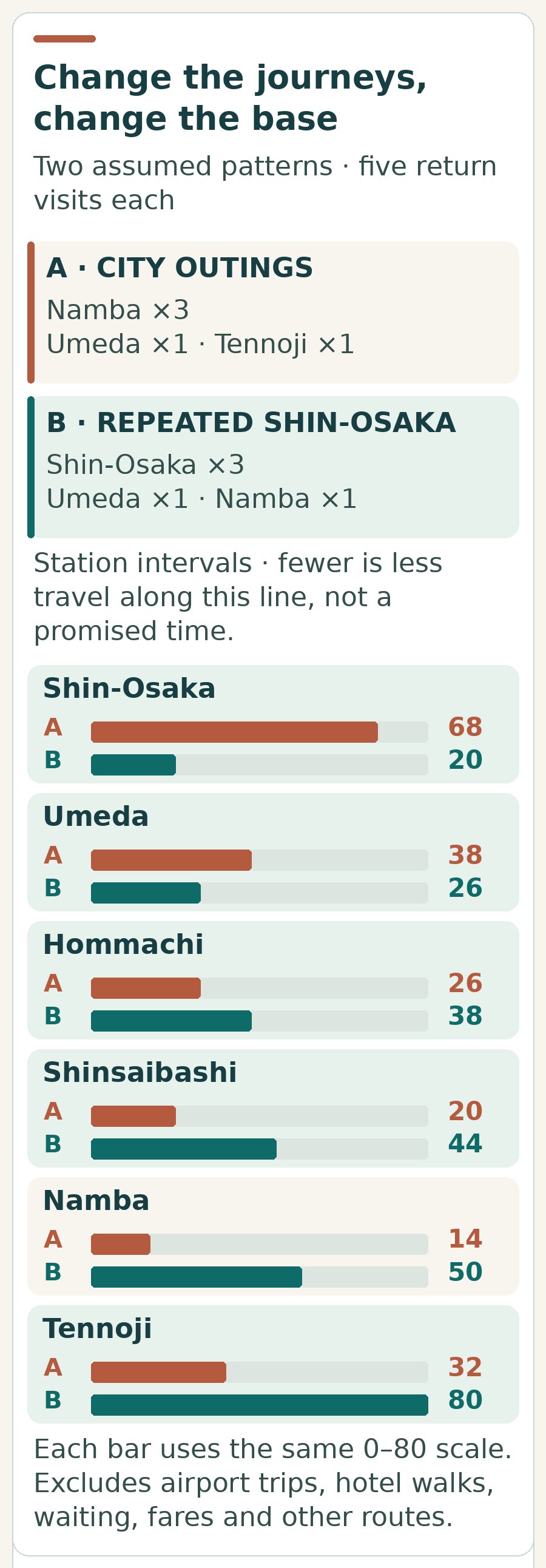
Namba leads Pattern A at 14 intervals; Shin-Osaka leads Pattern B at 20. Hommachi’s middle position is a compromise rather than an automatic winner. That reversal is the point: a hotel can be convenient for one itinerary and awkward for another without either review being wrong.
Use this as a first filter
The model excludes hotel walks, station interiors, waiting, fares, luggage, airport journeys and alternative rail routes. Intervals vary in length and travel time. It does not compare Universal City, which is off this line. For your final two hotels, run the actual door-to-destination journeys at the times you intend to travel, including the last return.
If three rail outings are consuming most of a short Osaka stay, also ask whether Osaka is the right overnight base for all of them. The Japan trip-length guide helps place those nights within the wider route before you make a non-refundable booking.
Six hotel examples, chosen for a specific job
These are researched accommodation examples, not reports of personal stays. Room names matter more than the property’s maximum-guest filter: the table identifies a particular category, and availability must be checked for your dates and full party. Compare the same occupancy, room, inclusions and cancellation terms across providers.
Room suitability before a price comparison
Scroll the table sideways to compare every column.
| Hotel | Base | Specific room example | Best reason to investigate |
|---|---|---|---|
| Hankyu RESPIRE Osaka | Umeda | Standard Triple: 25 m²; three beds | Three adults who prioritise the northern hub [5][6] |
| MIMARU Shinsaibashi East | Eastern Shinsaibashi | Family Apartment: 38 m²; two singles plus a bunk | Four main sleeping places and a kitchen [7] |
| Osaka Excel Hotel Tokyu | Hommachi | Superior Twin (Triple): 32.9 m²; extra bed for third guest | A central Metro compromise for up to three [8][9] |
| Osaka Marriott Miyako | Tennoji / Abeno | Regular Superior: 38 m²; listed capacity two | A spacious couple’s room near southern rail links [10][11] |
| remm Shin-Osaka | Shin-Osaka | Twin: 20.6 m²; two beds | A station-focused stay for two [12][14] |
| Hotel Universal Port Vita | Universal City | Vita Deluxe Twin: 35–37 m²; maximum four | Park access, with exact bedding to confirm [15][16] |
Hankyu RESPIRE Osaka: three beds near the northern hub
The Standard Triple has three 98 × 196 cm beds within 25 m², with the bath and toilet separated. That gives three friends a clear sleeping arrangement, although luggage space still deserves scrutiny. The hotel quotes three minutes from JR Osaka’s third-floor Bridge Exit and five from Midosuji Umeda. These are station-access estimates, not platform-to-lobby timings.[5][6]
Choose it for repeated use of the northern hub. Check the exact name when comparing results: Hankyu RESPIRE and Hankyu GRAN RESPIRE are different properties.
Check Hankyu RESPIRE on Booking.com · Compare the same hotel on Agoda.
MIMARU Osaka Shinsaibashi East: an apartment for four
The 38 m² Family Apartment provides two single beds and a bunk bed, plus a kitchen and dining space. It has one bathroom and no washing machine inside the room; the property lists coin laundry. Children aged seven and above count as adults, while its stated allowance for younger children concerns sharing existing beds, not extra sleeping places.[7]
This is a useful family or friends option when four proper places matter more than a compact hotel room. Its published three-minute station approach is to Nagahoribashi, so check your actual route if the day starts on the Midosuji line.[7]
Check Shinsaibashi East on Booking.com · Compare its apartments on Agoda.
Osaka Excel Hotel Tokyu: a room-led Hommachi compromise
The Superior Twin (Triple) is 32.9 m², with two 111 × 205 cm beds and an additional 110 × 196 cm bed for a third guest. The third bed changes the usable floor space; select the three-person plan rather than assuming every twin reservation includes it.[8]
The hotel’s two-minute walk starts at Hommachi Exit 13. Its directions identify Exit 18 for a lift and a hotel lift to the reception on the 16th floor. If you need a step-free approach, plan that route separately from the headline walking time.[9]
See Osaka Excel Hotel Tokyu on Booking.com · Compare Tokyu room plans on Agoda.
Osaka Marriott Miyako: more room for two in Abeno
The Regular Floor Superior is 38 m² but has a listed capacity of two, with twin or king arrangements. Its generous size therefore does not make it interchangeable with MIMARU’s four-person apartment. The hotel occupies high floors of Abeno Harukas, near JR and Metro Tennoji and Kintetsu Osaka-Abenobashi.[10][11]
It makes most sense when the room itself, the southern location and the total quote justify the spend. Compare the direct rate too: Marriott advertises a Harukas 300 entry privilege for specified direct booking channels. Do not assume a third-party room plan includes the same benefit.[11]
Check Marriott Miyako on Booking.com · Compare Marriott Miyako on Agoda.
remm Shin-Osaka: remove friction from a rail morning
The hotel has a direct connection to the Shinkansen Central Gate; its published approaches also distinguish the conventional JR East Gate and Metro North Gate. Those details are useful when your booking involves an early departure.[14]
For two people, compare the 20.6 m² Twin, with two 110 cm-wide beds, against the 14.4 m² Economy Double with a single 130 cm-wide bed. The latter has a shower rather than the Twin’s bathtub. A lower quote may therefore be buying a materially different sleeping and bathroom arrangement.[12][13]
Check remm Shin-Osaka on Booking.com · Compare remm’s room types on Agoda.
Hotel Universal Port Vita: keep a park day simple
The Vita Deluxe Twin is listed at 35–37 m² for up to four guests; confirm the precise bedding for your party. This is Universal Port Vita, not the neighbouring Universal Port hotel with a different room catalogue.[15]
The hotel’s directions give a roughly two-minute approach from JR Universal City and specifically recommend turning left after the station gate for the route without stairs; the right-hand route includes steps. That is a more useful luggage detail than the word “nearby”. A short park approach can justify staying here when the park shapes the trip, but compare the cost of a hotel move if it occupies only one day.[16]
Check Universal Port Vita on Booking.com · Compare Universal Port Vita on Agoda.
Choose the arrival station, then the hotel entrance
Kansai Airport: Namba is not the only direct rail choice
Nankai’s Rapi:t connects Kansai Airport with Nankai Namba. JR West’s HARUKA serves Tennoji, Osaka and Shin-Osaka as well as Kyoto. Consequently, an airport arrival alone does not settle the Namba-versus-Umeda question: compare the whole arrival, including the walk to the actual hotel and the train that runs at your flight’s arrival time.[3][4]
Do not apply Kansai Airport advice automatically to Itami. Before booking an unusually early departure or late arrival, check the relevant airport, last or first service, terminal access and your hotel’s late check-in arrangements. An accommodation map cannot establish that a flight connection is feasible.
Osaka, Shin-Osaka and Namba are not interchangeable labels
JR Osaka sits in the Umeda area. Shin-Osaka is a separate station on the Midosuji line with the Shinkansen connection. Within Namba, Nankai, Metro, Osaka-Namba and JR Namba have distinct gates and approaches. Save the operator and exit as well as the station name, particularly if a transfer or tour asks you to meet at one specific location.[1][4][14]
Arriving from Tokyo? You can compare Tokyo-to-Osaka transport on 12Go as one booking comparison, then verify the service’s actual departure and arrival terminals, luggage terms and total price. A Tokyo-to-Osaka results page covers a corridor, not one universal Osaka arrival point.[23]
Save a usable arrival note
Keep the hotel’s Japanese name and address, its named entrance, the operator and exit you intend to use, and the late-arrival contact details offline. Ask for a lift route when needed. A screenshot of a map pin alone leaves the hardest part of a large station unresolved.
Compare the full stay, including Osaka’s room tax
Use the same dates, guests and ages for every quote. Compare the price for all required rooms, then add breakfast you intend to buy, bedding supplements, local tax where excluded and any extra journeys created by the location. A refundable room may be worth more than a small saving while your itinerary is unsettled.
Osaka accommodation tax per person, per night; current bands checked 18 October 2026 [17]
Scroll the table sideways to compare every column.
| Taxable accommodation charge | Local tax |
|---|---|
| Below ¥5,000 | ¥0 |
| ¥5,000 to below ¥15,000 | ¥200 |
| ¥15,000 to below ¥20,000 | ¥400 |
| ¥20,000 or more | ¥500 |
The tax is assessed against the accommodation charge per person, excluding consumption tax and separately chargeable meals. Osaka’s guidance explains how a room charge is allocated between occupants; a nominally free breakfast does not create a meal amount that can simply be deducted. Ask the hotel how a family or bundled plan is allocated rather than dividing a headline total blindly.[18]
A threshold can change the difference between two quotes
Suppose two adults stay four nights and the taxable room charges are ¥28,000 or ¥30,000 per night. These are invented comparison inputs, not hotel offers. Dividing by two gives ¥14,000 or ¥15,000 per adult: local tax is ¥200 or ¥400 each per night. The room-charge difference is ¥8,000 over the stay, while the tax difference adds ¥1,600. The combined difference is ¥9,600 before any difference in consumption tax or meals.[17][18]
Do not automatically add the tax again if the final quote already includes it. Keep the original yen totals, and compare the card or payment provider’s actual GBP conversion and fees when you pay. The Japan budget guide for UK travellers helps assess this hotel difference against the rest of the trip.
Five checks before committing
- Every traveller is included, with the correct child ages and a confirmed bed arrangement.
- The exact room is non-smoking if required, and its bathroom and laundry facilities match your needs.
- The cancellation deadline is recorded with its time zone, plus any deposit or advance-payment condition.
- The entrance and lift route work at your intended arrival time.
- Current refurbishment notices and any requested quiet-room position have been checked directly.
Book optional help around the base you choose
A guided walk can be useful on a first Minami afternoon, especially if you would prefer someone else to organise the stops. The Dotonbori street-food tour on GetYourGuide lists a meeting point outside Starbucks TSUTAYA EBISUBASHI. That is a named street meeting point, not an instruction to emerge from any Namba station. Its published restrictions say vegan and gluten-free requests cannot be accommodated; read the selected option’s food inclusions before booking.[19]
For a family or mixed-interest group, compare Osaka private and custom tours on Viator. This link opens a comparison category: check the individual operator’s starting district, length, walking demand, child policy and inclusions. A private booking only solves the pacing problem if its actual itinerary can be adapted to the group.[20]
Mobile data helps with exits, navigation and contacting a hotel when plans change. If your existing roaming allowance is unsuitable, browse Airalo and select Japan. The destination has country plans, but the phone must support eSIM and be network-unlocked. Check the selected plan’s validity, data allowance and activation instructions; keep the arrival note offline as a fallback.[21][22]
Last questions before choosing your Osaka base
Should I stay in Namba or Umeda for three nights?
For three nights largely spent eating and exploring Minami, start with Namba/Shinsaibashi and an acceptable walk home. If your full days repeatedly begin at northern rail connections, test Umeda first. Put the actual journeys into the repeat-journey exercise, then compare the final hotels rather than choosing solely by a district’s reputation.
Is a cheaper Shin-Osaka room a sensible city-break saving?
It can be, especially around a rail departure, but the saving needs to compensate for the journeys you add. Price the stay with the same bed and refund conditions, then check the early and late routes you will actually use. The station-focused location has a clear purpose; a single arrival is a weak reason to select it for several city-focused days.
Should one Universal Studios Japan day mean changing hotels?
Not automatically. Compare the return journey from your existing hotel with packing, checking out, moving luggage and checking in again. A park-side room becomes more persuasive when an early start, tired children or more park time makes that short approach especially valuable. Confirm the park plan before making a non-refundable hotel change.
Which district is guaranteed to be quiet or the cheapest?
None can be promised on the evidence of its name. Noise depends on the room, street, building and works; price depends on the dates, occupancy and rate conditions. Make those questions part of the hotel comparison rather than allowing an area stereotype to stand in for a quote.
The booking decision
Choose the two areas that suit your repeated journeys, discard rooms that fail the bed or access requirements, then compare the complete stay cost. For many first visits the final choice will be a Minami base for evenings or Umeda for rail-led days. Hommachi, Tennoji, Shin-Osaka and Universal City earn their places when they solve a particular part of your itinerary.
Sources and planning notes
This is a research-led guide using hotel, transport and destination sources linked below. Time-sensitive rules have been reviewed, but not every property detail or website can be independently checked. Reconfirm the exact room, route, final price and current notices for your own dates; worked examples state their assumptions.
- Osaka Metro station guide and line sequence — Osaka Metro.
- Osaka area introductions: Kita and Minami — Osaka Convention & Tourism Bureau.
- HARUKA destinations and ticket conditions — JR West.
- Rapi:t: Nankai Namba and Kansai Airport — Nankai Electric Railway.
- Hankyu RESPIRE Osaka: Standard Triple — Hankyu Hanshin Hotels.
- Hankyu RESPIRE Osaka: access — Hankyu Hanshin Hotels.
- MIMARU Osaka Shinsaibashi East: rooms, facilities and access — Cosmos Hotel Management / MIMARU.
- Osaka Excel Hotel Tokyu: Superior Twin (Triple) — Tokyu Hotels.
- Osaka Excel Hotel Tokyu: access and lift exit — Tokyu Hotels.
- Osaka Marriott Miyako: Regular Floor Superior rooms — Miyako Hotels & Resorts.
- Osaka Marriott Miyako: location and direct-booking privileges — Marriott International.
- remm Shin-Osaka: Twin Room — Hankyu Hanshin Hotels.
- remm Shin-Osaka: Economy Double / semi-double specifications — Hankyu Hanshin Hotels.
- remm Shin-Osaka: station-gate access — Hankyu Hanshin Hotels.
- Universal Port and Universal Port Vita: room specifications — ORIX Hotels & Resorts.
- Hotel Universal Port Vita: station and park approaches — ORIX Hotels & Resorts.
- Osaka accommodation tax: current rate bands — Osaka Prefectural Government.
- Osaka accommodation tax: charge allocation, meals and consumption tax — Osaka Prefectural Government.
- Dotonbori Street Food Tour: meeting point and dietary restrictions — GetYourGuide / DeepExperience.
- Osaka private and custom tour comparison category — Viator.
- Japan eSIM options — Airalo.
- eSIM device and network-unlock requirements — Airalo.
- Tokyo-to-Osaka transport comparison — 12Go.
Illustrations in this article were created for Taylor’s Trailblazing Travels. Third-party photographs, where used, are credited beside the image or in the source list.