How Much Does a Trip to Japan Cost? A UK Traveller's Budget Planner
A transparent budget in pounds and yen, with the assumptions you can change.
- 14 days in Japan / 13 nights
- All figures per person
- Three planning budgets
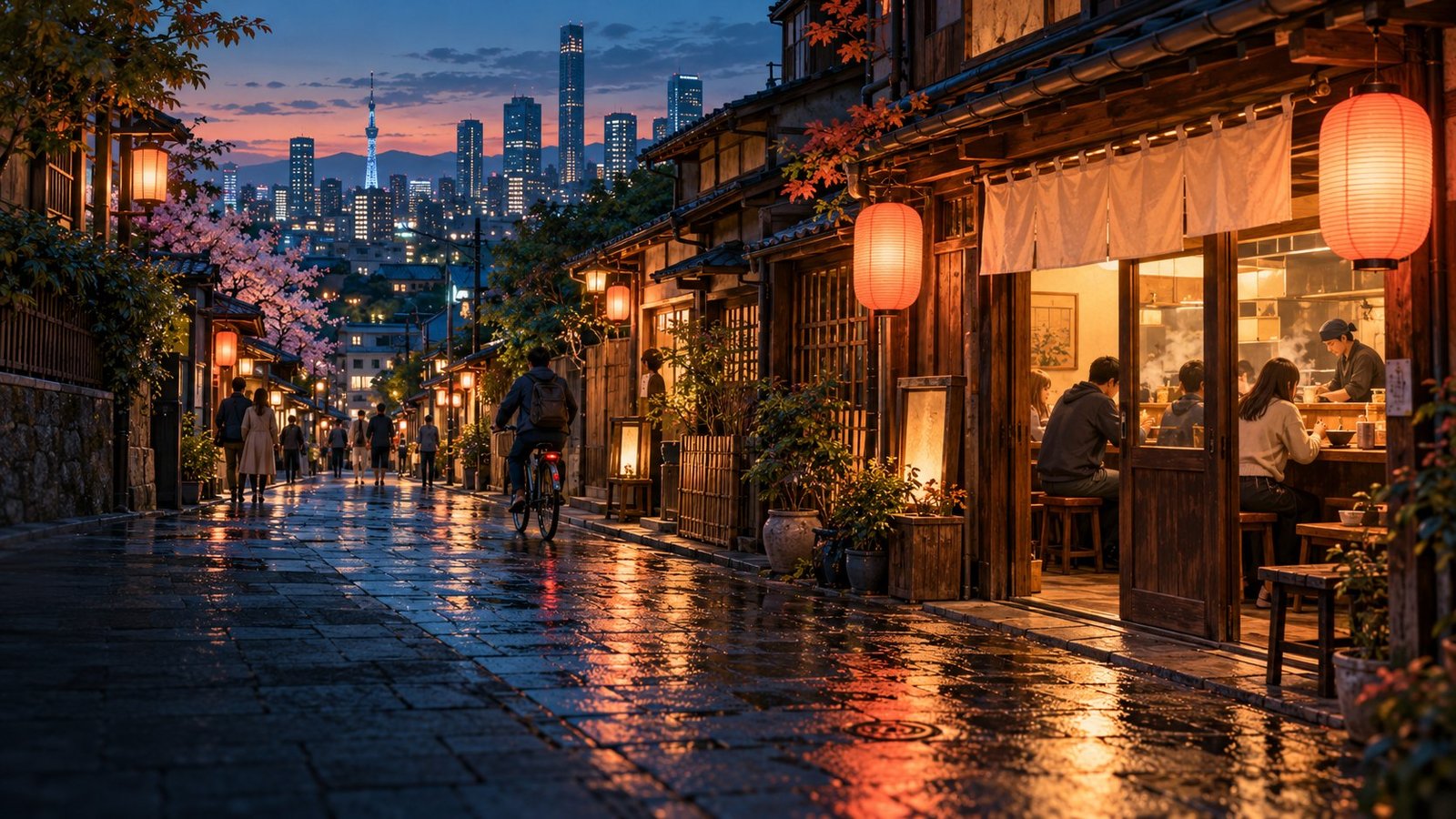
AI-generated editorial illustration of a Japanese food street; an imagined setting, not a photograph of a named neighbourhood or business.
A useful Japan trip cost starts with nights, room sharing and the journeys you will actually make. A daily spending figure on its own can leave out the two largest bills: getting there and somewhere to sleep.
This planner puts those bills back in. Its three original budget models show what is included, which figures are assumptions and how to replace them with your own quotes. No live flight fares or hotel availability are claimed.
Starting point
Around £2,600 per person for the moderate model; replace flights and hotels first.
Room sharing matters
The accommodation figures assume two paying adults share one room.
Count every journey
Price the route before buying a national rail pass.
Keep a reserve
10% of Japanese costs is set aside; it is separate from everyday spending.
Choose your assumptions before your budget
All three profiles use the same example: five nights in Tokyo, five in Kyoto and three in Osaka, arriving in Tokyo and leaving from Kansai. There is one Tokyo–Kyoto long-distance rail journey and no return to Tokyo. The 14 calendar days include arrival and departure days; international travel time is additional. Meals, local transport and attraction allowances cover all 14 days to avoid undercounting partial days.
| Style | Room target, per night | What the model is designed to cover |
|---|---|---|
| Lower spend | ¥5,000 each; ¥10,000 room | Simple private room, economical meals, public transport and selective paid sights. |
| Moderate | ¥9,000 each; ¥18,000 room | More room and location choice, ordinary restaurant meals and a broader activities budget. |
| Comfortable | ¥16,000 each; ¥32,000 room | Higher accommodation target, more dining freedom and paid experiences; no luxury-hotel guarantee. |
These room figures are spending targets, not checked room rates, star ratings or promises of availability. All three flight allowances assume economy travel. A dearer hotel does not require a dearer flight: choose each budget line separately to match your trip.
The currency comparison comes from the ECB’s 16 October 2026 rates of ¥177.82 and £0.84385 per euro. Dividing 177.82 by 0.84385 gives about ¥210.72 per pound. The calculations below use that rounded rate. This is a reference comparison, not a rate offered to travellers. [1]
Japan trip cost: the complete 14-day model
The first table keeps Japanese expenditure in yen so you can change the conversion rate without rebuilding the trip. All entries are original allowances; the dated operator price examples later in the guide help you test them.
| Japanese cost | Lower spend | Moderate | Comfortable |
|---|---|---|---|
| Accommodation: 13 nights × ¥5,000 / ¥9,000 / ¥16,000 | 65,000 | 117,000 | 208,000 |
| Meals and drinks: 14 days × ¥3,000 / ¥5,000 / ¥8,000 | 42,000 | 70,000 | 112,000 |
| Urban transport: 14 days × ¥800 / ¥1,200 / ¥1,800 | 11,200 | 16,800 | 25,200 |
| Attractions: 14 days × ¥1,000 / ¥2,000 / ¥3,500 | 14,000 | 28,000 | 49,000 |
| Intercity travel, airport transfers and modest day trips | 35,000 | 35,000 | 35,000 |
| Local accommodation taxes / mandatory fees allowance | 5,000 | 6,500 | 10,000 |
| Mobile data allowance | 2,500 | 3,500 | 5,000 |
| Laundry and small essentials allowance | 3,500 | 5,000 | 8,000 |
| Japanese-cost subtotal | 178,200 | 281,800 | 452,200 |
| Contingency: 10% of Japanese-cost subtotal | 17,820 | 28,180 | 45,220 |
| Japanese-cost total including contingency | 196,020 | 309,980 | 497,420 |
The 10% contingency applies to every Japanese-cost row above. It covers modest price changes and incidental overspending; it is not an emergency medical fund or a promise that a missed flight can be absorbed. It does not apply to the separate GBP flight, insurance or UK airport travel allowances.
| Cost | Lower spend | Moderate | Comfortable |
|---|---|---|---|
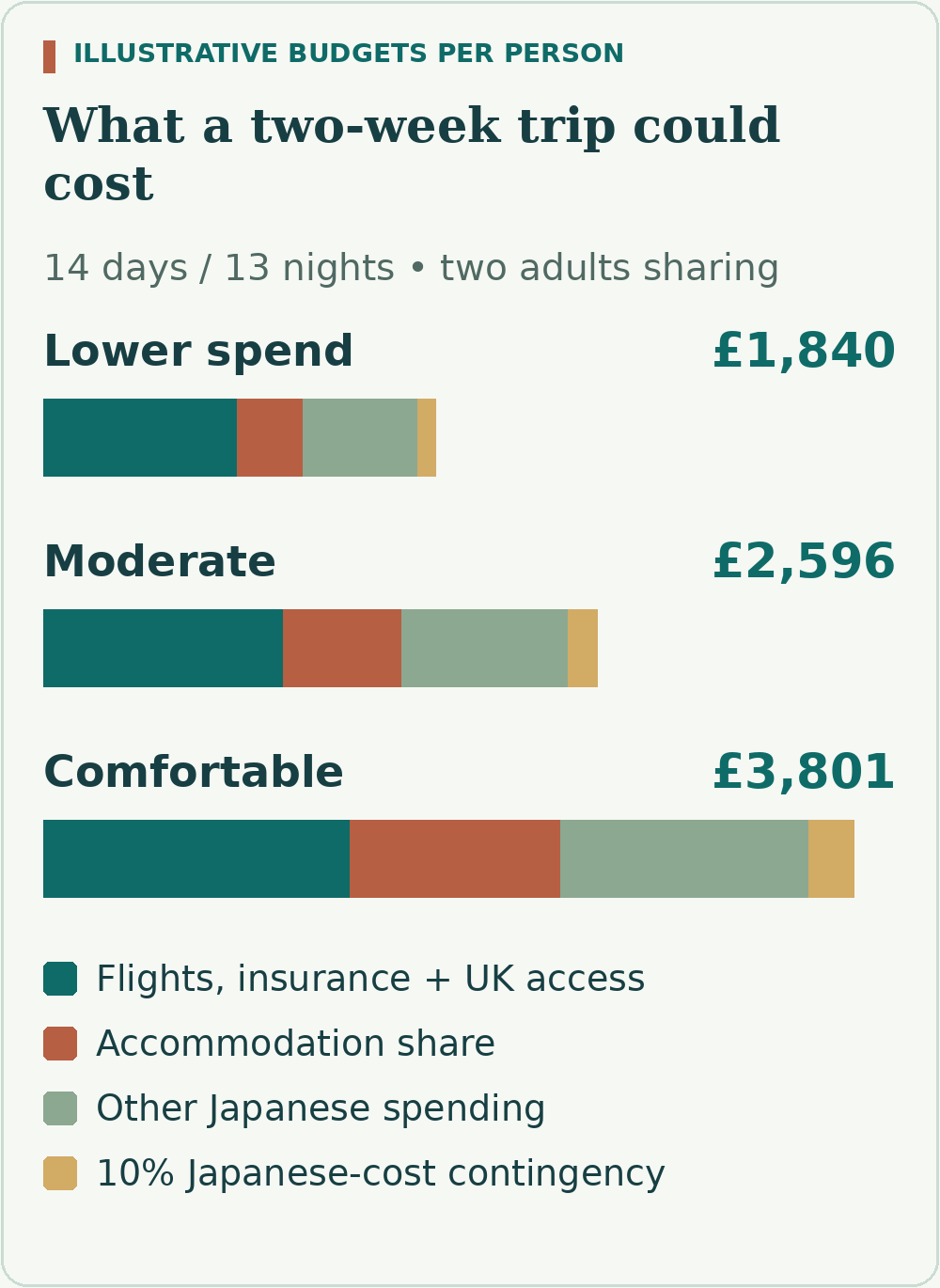
| Japanese costs, including contingency | £930 | £1,471 | £2,361 |
| Economy international flights | £800 | £1,000 | £1,300 |
| Travel insurance allowance | £50 | £65 | £80 |
| UK airport travel allowance | £60 | £60 | £60 |
| Total model budget | £1,840 | £2,596 | £3,801 |
For example, the moderate arithmetic is ¥281,800 + ¥28,180 = ¥309,980; divided by 210.72, that is £1,471.05. Add £1,000 + £65 + £60 to reach £2,596.05. Displayed GBP totals are rounded only at the end.
What does that mean per day?
| Daily measure | Lower spend | Moderate | Comfortable |
|---|---|---|---|
| Meals + urban transport + attractions | ¥4,800 / £23 | ¥8,200 / £39 | ¥13,300 / £63 |
| Those items + 13 nights of accommodation ÷ 14 | ¥9,443 / £45 | ¥16,557 / £79 | ¥28,157 / £134 |
Neither daily figure includes intercity travel, airport transfers, day trips, data, local fees, laundry, contingency, flights, insurance or UK airport travel. The first row is useful for everyday spending once major bookings are paid. The second helps compare the core cost of staying in Japan. Neither is the full holiday price.
Set room, food and activity limits that suit you
Accommodation and the solo adjustment
Compare the final total for the right number of people and nights. A room costing ¥18,000 is ¥9,000 each only when two adults split it. For a solo traveller paying the same full room price, the moderate model adds ¥117,000 over 13 nights. With the same 10% reserve, that is another ¥128,700, about £611, before any changed local tax. A smaller single room or a hostel bed could produce a different result; get an actual single-occupancy quote.
A special stay should replace a normal night in the model. If a ryokan costs ¥30,000 per person instead of the moderate ¥9,000, the initial increase is ¥21,000, not ¥30,000. Then deduct any meals already covered by that rate from your separate food budget.
Meals and drinks
The lower food target of ¥3,000 per day could be allocated as ¥500 for breakfast, ¥900 for lunch, ¥1,200 for dinner and ¥400 for drinks or snacks. Those are limits to work towards, not verified menu prices. The moderate and comfortable targets allow ¥5,000 and ¥8,000 daily respectively.
Casual restaurants, set meals and conveyor-belt sushi are among the budget dining options identified by Japan’s national tourism organisation. Check the menu before sitting down and price any special dinner separately. A daily average should include coffee, drinks and snacks as well as main meals. [2]
Attractions
The daily allowance is a pooled activities budget, not a requirement to buy a ticket every day. The moderate model gives you ¥28,000 for the whole stay. A major theme-park day, private guide or expensive tour may use a large share, so cost those priorities first.
There are also inexpensive paid options: Shinjuku Gyoen’s official standard adult admission is ¥500, about £2.40, checked on 17 October 2026. Mixing lower-cost visits with a few carefully chosen bookings gives the activities pot more room. [3]
Price the journeys before buying a rail pass
The ¥35,000 transport pot is an allowance for the airport transfers, Tokyo–Kyoto journey, Kyoto–Osaka move and modest day trips in this example. It is not an advertised through fare. Urban travel within each base is already in the daily transport row. An extra long-distance excursion or a return to Tokyo needs a fresh calculation.
For a local price anchor, Tokyo Metro lists its adult 24-hour ticket at ¥700, covering Tokyo Metro lines. It is not an all-operator Tokyo transport pass. Buy it only when your planned covered rides justify it; a stored-value card is a payment method, not automatically a discount. [4]
| Purchase | JPY | Approximate GBP |
|---|---|---|
| Tokyo–Kyoto, one-way Hikari, smartEX | ¥13,650 | £65 |
| Tokyo–Kyoto, one-way Nozomi, smartEX | ¥13,970 | £66 |
| 7-day national JR Pass: official online / overseas agency | ¥50,000 / ¥53,000 | £237 / £252 |
| 14-day national JR Pass: official online / overseas agency | ¥80,000 / ¥84,000 | £380 / £399 |
| 21-day national JR Pass: official online / overseas agency | ¥100,000 / ¥105,000 | £475 / £498 |
The point-to-point examples are from a smartEX operator fare sheet dated 1 April 2025, not live quotes for a future journey. Its standard service combines the basic fare and Shinkansen supplement, but conventional trains to or from the Shinkansen stations are charged separately. Reserved-seat fares vary by season and train type. [5] [6]
The national pass prices above differ by purchase channel. Overseas agency prices increased on 1 October 2026; official online prices were held unchanged for a limited period. Recheck the official table before buying. Nozomi and Mizuho journeys require the appropriate extra special ticket when using a national pass. [7] [8]
A simple break-even check
Even a hypothetical Tokyo–Kyoto return at the regular-season Hikari smartEX rate totals 2 × ¥13,650 = ¥27,300. Against the ¥50,000 online seven-day pass, you would need at least ¥22,700 more in covered journeys within its validity to reach the same spend. Our example makes that long-distance journey only once.
Add the eligible fares for your real travel dates, compare the appropriate pass price, then add any uncovered lines and supplements to the pass option. Do not add trips you do not want simply to make a pass appear worthwhile. A seven-day validity window and a 14-day holiday are different things; check when each covered journey actually falls.
Allow for local fees, insurance and omitted costs
Accommodation tax is a separate check
Kyoto’s revised accommodation tax took effect on 1 March 2026. The charge is per person per night: ¥200 below a ¥6,000 taxable accommodation charge, ¥400 from ¥6,000 to below ¥20,000, and ¥1,000 from ¥20,000 to below ¥50,000. Higher bands apply above that. The taxable charge includes applicable room service charges but excludes meals and consumption tax. [9]
For example, five nights in the ¥400 band add ¥2,000 per adult. The model’s local-fee row is a general allowance for charges not already in your quotes, not a calculated Kyoto, Tokyo and Osaka tax bill. Replace it with the actual charges for each stay. If accommodation tax was already paid through your booking, do not add it again. [9]
Check the final airfare, not just the headline
Japan’s National Tax Agency currently lists international tourist tax at ¥3,000 per departure, with a transitional ¥1,000 rate for qualifying tickets issued on or before 30 June 2026. Airlines normally collect it. Treat it as part of the final flight price in this model and check the fare breakdown before adding a separate charge. [10]
The £800, £1,000 and £1,300 flight entries are illustrative reserves, not researched sale fares. Replace them with an economy quote including the baggage and other services you need. Compare arriving and departing through different airports with a return to the same airport using the complete flight-plus-ground-transport cost.
Insurance and personal extras
The insurance figures are sample inputs, not premium estimates for your age, health or activities. Obtain a suitable quote and cover the whole time away, including transit. FCDO guidance recommends insurance that covers existing medical conditions and planned activities, and advises arranging it as soon as possible after booking. A small contingency is no substitute. [12]
The model excludes shopping, new luggage, premium-cabin flights, car hire, major specialist activities, visa or document costs where applicable, bank or currency-provider fees and any extra overnight stop outside Japan. Price these separately if relevant. Meals or hotels on international travel days may also need adding; the Japanese daily allowances cover days in Japan only.
Stress-test the budget before you commit
A few large changes can outweigh weeks of small savings. The following calculations alter one part of the moderate model at a time. They are independent scenarios, not charges to add together. Yen cost increases include the same 10% reserve; room changes exclude any resulting change in local tax.
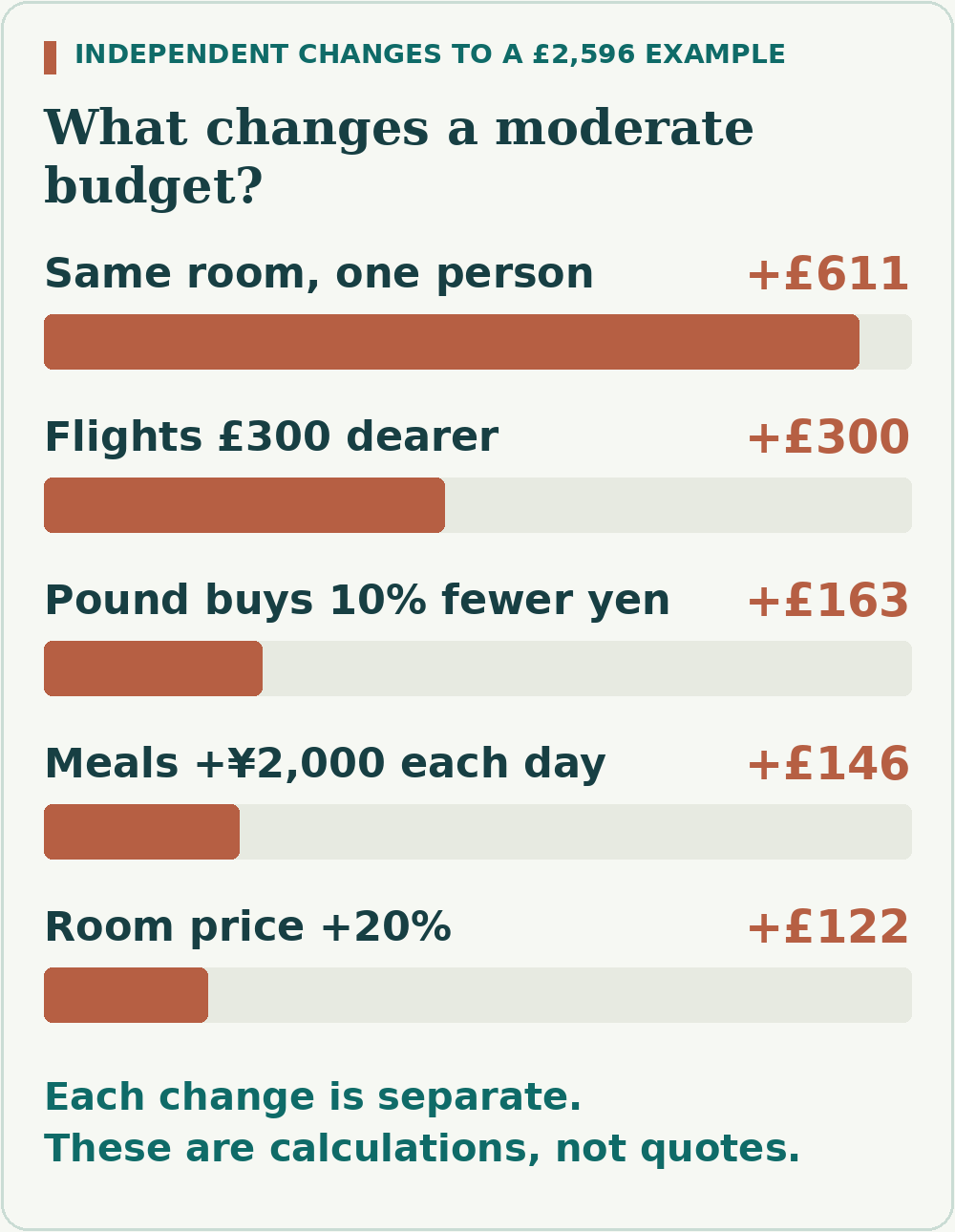
For example, a 20% rise in the room bill adds about £122 including the reserve. Increasing meals by ¥2,000 per day adds about £146. A £300 higher airfare adds exactly £300 because the Japanese contingency does not apply to it.
If the pound changes
| Currency scenario | Yen per £1 | Total model cost |
|---|---|---|
| Each pound buys 10% fewer yen | ¥189.648 | £2,760 |
| Dated reference conversion | ¥210.72 | £2,596 |
| Each pound buys 10% more yen | ¥231.792 | £2,462 |
A 10% fall in the number of yen each pound buys increases the sterling cost of the yen portion by about 11.1%. It adds about £163 to this moderate example, while GBP costs stay fixed. Totals and changes are rounded independently, so displayed differences may vary by £1. This is arithmetic, not a currency prediction. Amounts already paid at a fixed GBP price should stay fixed in your own calculation.
Dates and ways to save
JNTO identifies Golden Week, in late April and early May, as one of Japan’s busiest travel periods, with crowded trains and hotels. If your dates are fixed, obtain actual hotel and flight quotes before adopting a budget profile. For flexible plans, repeat the quotes for another date window rather than applying an invented seasonal percentage. [13]
- Change the room target or share accommodation before cutting every small meal or treat. Reducing a shared room by ¥4,000 per night saves ¥26,000 per person over 13 nights, about £123 before contingency.
- Compare the complete cost of your flight routing. A cheap return fare may require an extra long-distance journey and another paid night.
- Keep long-distance travel purposeful. The model’s three bases do not require buying a nationwide pass by default.
- Choose the paid experiences you care about most, then build the rest of the activities allowance around them.
- Get an insurance quote early. Reducing appropriate cover is not a sound way to meet a holiday budget.
Turn the model into your own quote worksheet
Start with the moderate column, replace flights and all 13 room nights, and then work down the remaining lines. Use the lower or comfortable targets only where they match the choices you actually want.
| Line | How to replace the model | Check before adding |
|---|---|---|
| Flights | Final fare for the actual UK departure and Japan arrival/departure airports. | Include required baggage, seats and taxes; add a transit hotel if needed. |
| Accommodation | Add every night’s actual room charge, then divide shared rooms by the number paying. | Check room versus person pricing and meal inclusions. |
| Transport | List airport transfers, intercity journeys, day trips and urban fares. | Remove a fare only when the pass you buy actually covers it. |
| Food and activities | Use daily food targets plus named ticket and tour prices. | Subtract meals or admissions already included elsewhere. |
| Taxes and small extras | Add local charges, data, laundry and other essentials. | Do not retain a general tax allowance as well as every actual tax. |
| Insurance and UK travel | Replace both with amounts appropriate to your circumstances. | Insure the whole time away, including international travel days. |
| Contingency | Choose a reserve; this model uses 10% of all Japanese costs. | Known expenses belong in the main budget; emergencies need separate arrangements. |
| Currency and payments | Convert only costs payable in yen, then add GBP costs and bank/provider fees. | Do not convert an already fixed GBP payment a second time. |
The working formula is: fixed GBP costs + (yen costs + chosen yen reserve) ÷ yen received per pound + any separate payment fees. Keep shared expenses separate until they have been divided fairly. Round the total at the end, not every transaction.
Mark each amount as already paid, still to pay or reserved for later. Money loaded onto an IC card and the purchases made using it are the same money: count the top-up or the spending, not both. Likewise, a cash withdrawal moves money into your wallet; the withdrawal and later purchases are not two separate holiday costs.
A budget total is not a cash-carrying recommendation. JNTO notes broad acceptance of international cards while acknowledging exceptions; it also points travellers to Japan Post Bank and Seven Bank ATMs. Keep a practical cash option and check your own card’s foreign-payment and withdrawal charges. [11]
Questions that can change your plan
Is £2,000 per person enough for two weeks in Japan?
It can fit the lower-spend model, which totals about £1,840 with its stated flight, shared-room and spending assumptions. That leaves roughly £160 beneath a £2,000 ceiling. A higher airfare, solo room or significant shopping could use that margin immediately. Test real quotes before treating £2,000 as sufficient.
What would the moderate model cost for a couple?
About £5,192 for two adults following the same assumptions, commonly rounded to a £5,200 planning figure. The room is already split within the per-person model, so multiply the per-person total by two rather than adding the full hotel bill again.
Can I use this budget for children?
Rebuild the lines affected by age, occupancy and appetite. A family room can have a different price from two adult shares, while child ticket rules vary by operator and attraction. Do not simply halve an adult total.
How much money is needed after flights and hotels are paid?
In the moderate model, meals, urban transport and attractions total ¥8,200 per day, about £39. Add any unpaid intercity journeys, airport transfers, day trips, data, local fees and small extras, and keep the contingency available. Subtract what you have already booked and paid for.
Make the decision that fits your trip
For a first costing exercise, use around £2,600 per person for this 14-day, 13-night shared-room model, then replace the airfare and accommodation with real quotes. If those two lines do not fit, change the trip or the budget before tightening the everyday spending allowance.
The useful number is the total for your own flights, rooms and journeys, with a reserve left over. Once those are settled, the yen budget gives you a practical guide to spending without having to reconsider every cup of coffee.
How this guide was researched
This is a research-led planning model, reviewed on 17 October 2026. Accommodation, food, general transport, data, flights, insurance and incidental amounts are explicit editorial assumptions, not live quotations or records of personal spending. Published operator fare-sheet examples and government fees were checked against the dated primary sources below. The prices are not live quotations. GBP comparisons use ¥210.72 per £1, rounded from the ECB’s 16 October 2026 cross-rate; bank fees and consumer conversion spreads are not included. Original totals and sensitivities use the stated inputs, with rounding at the end. Recheck prices, tax rules and exchange rates for your actual booking and travel dates.
Sources
Official guidance and operator information reviewed on 17 October 2026. Recheck time-sensitive details for your own travel dates.
- European Central Bank — euro reference exchange rates, 16 October 2026
- Japan National Tourism Organization — Guide to Traveling Japan on a Budget (dining options)
- Ministry of the Environment — Shinjuku Gyoen admission
- Tokyo Metro — 24-hour and one-day ticket coverage and prices
- smartEX — Ordinary reserved-seat fare table (operator-linked price sheet)
- smartEX — basic service and fare conditions
- Japan Rail Pass — types and prices by purchase channel
- JR Group — Japan Rail Pass price changes effective 1 October 2026
- City of Kyoto — accommodation tax guide from 1 March 2026
- Japan National Tax Agency — international tourist tax
- Japan National Tourism Organization — credit cards in Japan
- Foreign, Commonwealth & Development Office — foreign travel insurance
- Japan National Tourism Organization — Japan in May and Golden Week
Illustrations in this article were created for Taylor’s Trailblazing Travels. Third-party photographs, where used, are credited beside the image or in the source list.