Which Japanese Cities Should You Visit on Your First Trip?
Choose the experiences you want, then give each city a useful place in the trip.
- Eight city choices
- Interests before rankings
- Visits and hotel bases
AI-generated editorial illustration of an imagined Japanese cityscape; it is not a photograph or a map of a named destination.
A first trip to Japan does not need to include every famous city. A better starting point is the experience you most want: varied urban neighbourhoods, temples and gardens, food and nightlife, modern history or a particular region.
This guide compares eight cities with different roles in a first visit. The recommendations are editorial judgements based on those interests and the practical cost of moving around. Use them alongside the first-time Japan planning guide once your shortlist begins to take shape.
Start with a priority
Name the experience you would most regret missing.
Add a different experience
Explain what the next city contributes to your own trip.
Check the journey
Look at arrival, departure and local travel together.
Choose where to sleep
A worthwhile city visit need not require another hotel.
Choose cities by the experience you want
| City | Consider it for | The decision to make |
|---|---|---|
| Tokyo | Neighbourhood variety, museums, shopping and contemporary culture. [1] | Which areas deserve time within a substantial city stay? |
| Kyoto | Temples, gardens and living craft traditions. [2] | Do these interests deserve your main Kansai stay? |
| Osaka | Food, evening entertainment and a Kansai base. [3] | Will you stay for its evenings or make a shorter visit? |
| Nara | Temple history and the park area. [4] | Will a day visit from your existing base meet your plans? |
| Hiroshima | Peace history, with Miyajima as a separate nearby visit. [5] | Can you protect enough time for both experiences? |
| Kanazawa | Kenrokuen Garden, historic districts and traditional crafts. [6] | Does its own appeal justify the route through Hokuriku? |
| Sapporo | An urban starting point for a Hokkaido trip. [7] [8] | Will the northern region be a main part of the holiday? |
| Fukuoka | Food, yatai stalls and city culture in Kyushu. [9] | Does a western or Kyushu-focused journey fit your plans? |
The list deliberately includes different kinds of city choice. It is not an instruction to visit all eight, and a place outside it may be the right anchor if you have a particular personal interest.
Start by comparing Tokyo, Kyoto and Osaka
Tokyo: choose neighbourhoods within the city
Tokyo offers several distinct interests within one stay: museums around Ueno, Sensoji in Asakusa, shopping and street life in Shibuya, and specialist shops in Akihabara. Its appeal includes history as well as contemporary culture. [1]
Give Tokyo more time if your wish list spans several of those interests. Group each day around nearby areas and leave room for an ordinary meal or unplanned shop. A second afternoon in a neighbourhood you enjoy may contribute more than another long-distance move.
Kyoto: stay for the culture you actually want to explore
Kyoto is a strong choice when temple architecture, gardens, tea, crafts or traditional performance feature in your plans. The city’s official guide describes these as living cultural practices, alongside a varied food scene and contemporary arts. [2]
Choose a few specific places or activities before assigning nights. Then check their locations: the city should not be treated as a single compact attraction. A hotel’s position relative to your chosen visits matters more than a generic promise to be “central”.
Osaka: consider the evenings as well as the sights
Osaka’s food and nightlife are useful reasons to stay in their own right. Dotonbori and the wider Minami area are among its established evening districts, while the city also works as a base for exploring Kansai. [3]
Stay in Osaka if lingering over dinner and returning to your room afterwards matters. If your strongest interests are several Kyoto visits and one Osaka outing, a Kyoto base may be more convenient. Compare actual hotel-to-destination journeys and your intended return time before deciding.
Add Nara, Hiroshima or Kanazawa for a clear reason
Nara: a useful visit without another hotel
Nara Park and its surrounding temples and shrines, including Todai-ji Temple and Kasuga Taisha Shrine, make Nara a focused cultural addition to a Kansai stay. Both Kyoto and Osaka have rail connections to Nara. Kintetsu-Nara Station is closer to the park than JR Nara Station, so check the station named in your route. [4]
A day visit is the starting option in this guide. An overnight stay becomes more useful if you want additional time in the city or have plans beyond the main park area. Do not add a hotel merely because Nara has its own place on a city list.
Hiroshima: protect time for the subject
The Peace Memorial Museum and Atomic Bomb Dome give Hiroshima a distinctive role for readers interested in modern history. Miyajima, with Itsukushima Shrine, is a separate island visit involving a boat journey. [5]
Choose Hiroshima when these experiences matter enough to shape part of the route. For an unhurried visit to both, consider an overnight stay and divide the activities across your available days. This is a pacing recommendation, not a claim that a day trip is impossible. Count the onward journey as well as the journey in.
Kanazawa: choose its crafts and gardens on their own merits
Kanazawa combines Kenrokuen Garden, Nagamachi’s historic streets, traditional crafts and contemporary art. It has a direct Hokuriku Shinkansen connection with Tokyo; the rail route from Kyoto or Osaka uses a transfer at Tsuruga. [6]
It is a useful candidate when gardens, making things or smaller museums are priorities. Compare the complete route before adding it between other stays. Avoid choosing it simply as a supposedly quiet substitute for Kyoto: the worthwhile question is whether Kanazawa’s own places interest you.
Let Sapporo or Fukuoka lead a regional trip
Sapporo: a city stay within Hokkaido
Sapporo offers city activities around Odori Park, shopping streets and the Susukino entertainment district. It is also a starting point for travel around Hokkaido. [7]
Its official travel guide identifies flying as the most convenient way to reach the city, with New Chitose Airport serving connections from Japan’s major hubs. [8] Check the actual flight or rail itinerary, airport transfers and onward journey before attaching a brief Sapporo stop to a Tokyo–Kyoto trip.
Choose Sapporo early in planning if Hokkaido is one of your main reasons for travelling. Then research the season and transport for the particular outdoor places you want to see. A city hotel does not itself put you at a remote trail, ski area or national park.
Fukuoka: build around food and a western route
Fukuoka’s food scene includes ramen, other regional dishes and yatai food stalls, alongside the city’s historical and cultural interests. [9] It is a strong candidate when meals and time in Kyushu are central to the holiday.
If Tokyo and Kyoto already fill your available time, calculate what adding Fukuoka would displace. If Kyushu is the priority, allow it to shape the trip from the start instead of treating it as an extra after all the other bookings. Compare arrival and departure airports without assuming a particular direct flight from the UK exists.
Visit three cities without making three hotel stays
Consider a hypothetical six-night Kansai block in a longer holiday. You want to visit Kyoto, Osaka and Nara. The three arrangements below all allocate six hotel nights and include Nara as a day visit; they make different trade-offs about where you begin and end each day.
| Arrangement | Nights | Hotel changes within this block | When it helps |
|---|---|---|---|
| Kyoto base | Kyoto 6 | 0 | Most plans are in Kyoto; visit Osaka and Nara on separate outings. |
| Osaka base | Osaka 6 | 0 | Osaka evenings matter most; travel to Kyoto and Nara for selected visits. |
| Split stay | Kyoto 4 + Osaka 2 | 1 | You want mornings or evenings in both cities and accept packing and another check-in. |
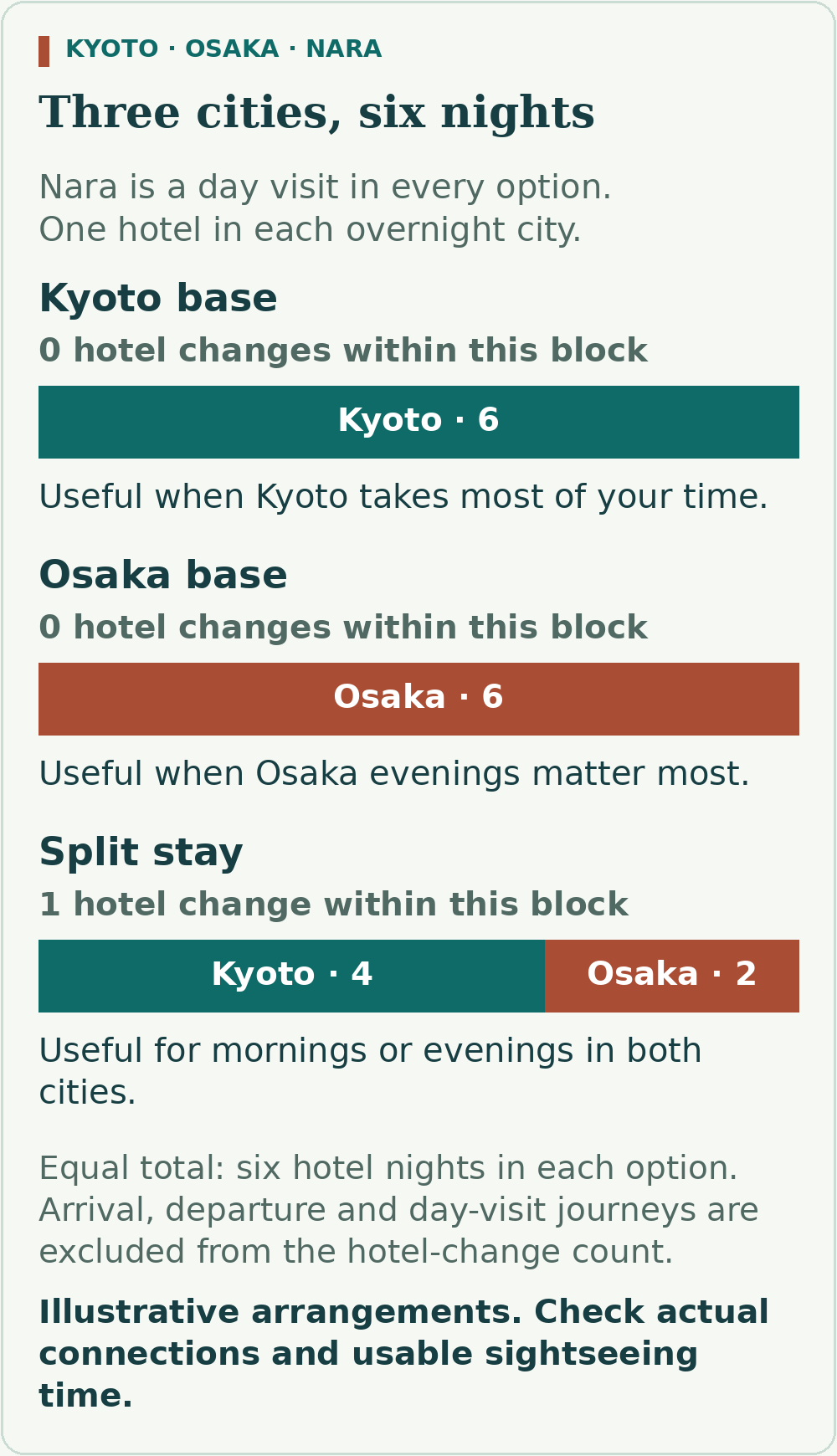
Each arrangement assumes one hotel in each overnight city. The count is simply the number of changes between the listed hotels. Arrival from elsewhere, departure from Kansai and travel on day visits are excluded. Zero hotel changes still involves local travel; repeated journeys to Kyoto could make the Osaka option less convenient for a Kyoto-heavy plan.
These are accommodation scenarios, not confirmed itineraries. Six nights do not automatically provide six full sightseeing days. Check your arrival and departure times, specific accommodation and transport connections before adopting one. For a whole-holiday pacing check, use the guide to how many days you need in Japan.
Make every extra city pass three questions
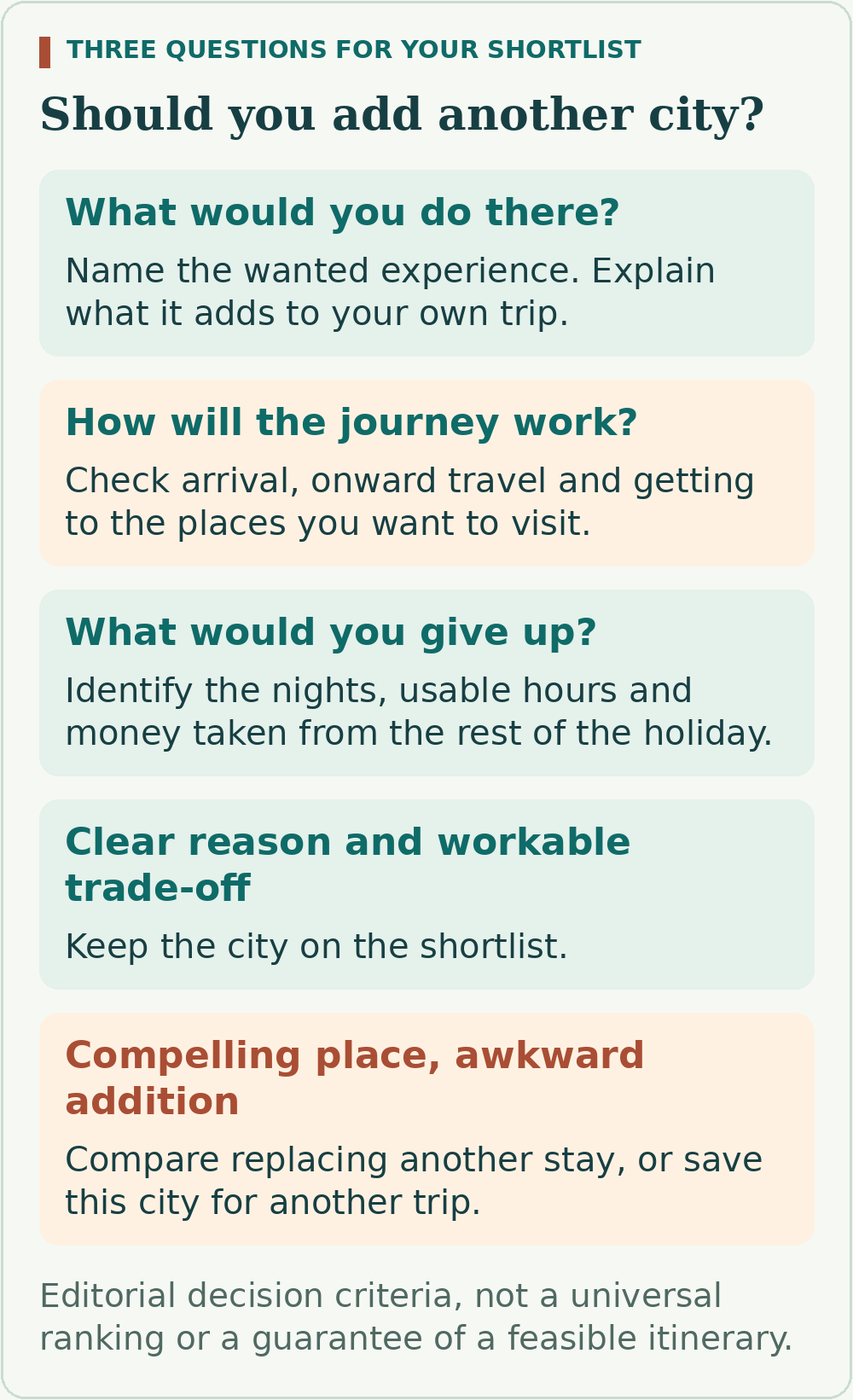
Use these three questions for each proposed addition. All three answers should be concrete before you turn the city into a booking.
- What would I do there? Name at least one wanted experience that is not already adequately served by the plan. This is about your interests, so two food cities can be justified if you want both.
- How will it fit the journey? Check where you arrive, where you leave next and how you reach the places you want to visit. Include station or airport transfers.
- What will I give up? Identify the nights, usable hours and money it takes from the rest of the holiday. Decide whether the addition is worth that exchange.
If the answer to the first question is only that the city appears on every list, keep it provisional. If the experience is compelling but the journey does not fit, consider replacing another stay instead of adding a further stop.
| Your main priority | Start by comparing | Question for the next addition |
|---|---|---|
| A broad introduction | Tokyo and Kyoto | Would Osaka or Nara provide a worthwhile visit from the Kansai stay? |
| Food and late evenings | Tokyo and Osaka; consider Fukuoka for a western trip | Are the places you want close enough to use your evenings well? |
| Gardens and crafts | Kyoto and Kanazawa | Do your chosen activities justify both stays and the route between them? |
| Modern history | Hiroshima alongside the main cities you want | Will the schedule leave time to engage with the museum and city? |
| A Hokkaido holiday | Sapporo and a researched regional route | Which mainland cities, if any, still fit without crowding the northern plans? |
Check the shortlist against your real trip
Once the cities have a purpose, check the few constraints that could change the decision.
- Dates and interests: confirm that the attractions, workshops or seasonal activities you care about operate during your visit.
- Usable time: account for long-haul arrival, check-ins, luggage and the journey to your departure airport.
- Travel budget: compare the cost of the complete route and accommodation, not only a headline room rate. The Japan budget guide helps separate those spending categories.
- Energy and access: consider the amount of walking, steps and transfers in the actual places you choose. A city name alone cannot establish that a route meets your needs.
- Weather alternatives: include something you would enjoy if your outdoor day cannot go ahead.
Leave an unallocated afternoon or another practical margin if the trip permits it. This gives you a way to adapt within a place you have chosen, instead of needing every connection and visit to run exactly as imagined.
Make the decision that fits your trip
Write a short city list with one sentence beside each place explaining why it belongs. Mark which are hotel bases and which are visits. Keep the cities with clear reasons and workable journeys, and remove any addition that weakens the experiences you most want.
How this guide was researched
This guide draws on official national and city tourism guidance, with an independent editorial review on 18 October 2026. The city roles and three-question selection test are editorial judgements; they are not a survey, universal ranking or account of a personally tested itinerary.
The six-night comparison holds the city list and total nights constant, then counts hotel changes within that block. It does not model fares, hotel availability or timed connections. Check current operator information and individual access requirements before booking.
Sources
Official guidance and operator information reviewed on 17 October 2026. Recheck time-sensitive details for your own travel dates.
Illustrations in this article were created for Taylor’s Trailblazing Travels. Third-party photographs, where used, are credited beside the image or in the source list.