Japan • Where to stay
Where to Stay in Downtown Kyoto: Kawaramachi and Sanjo
Find the right few streets for your room, railway and evenings out.
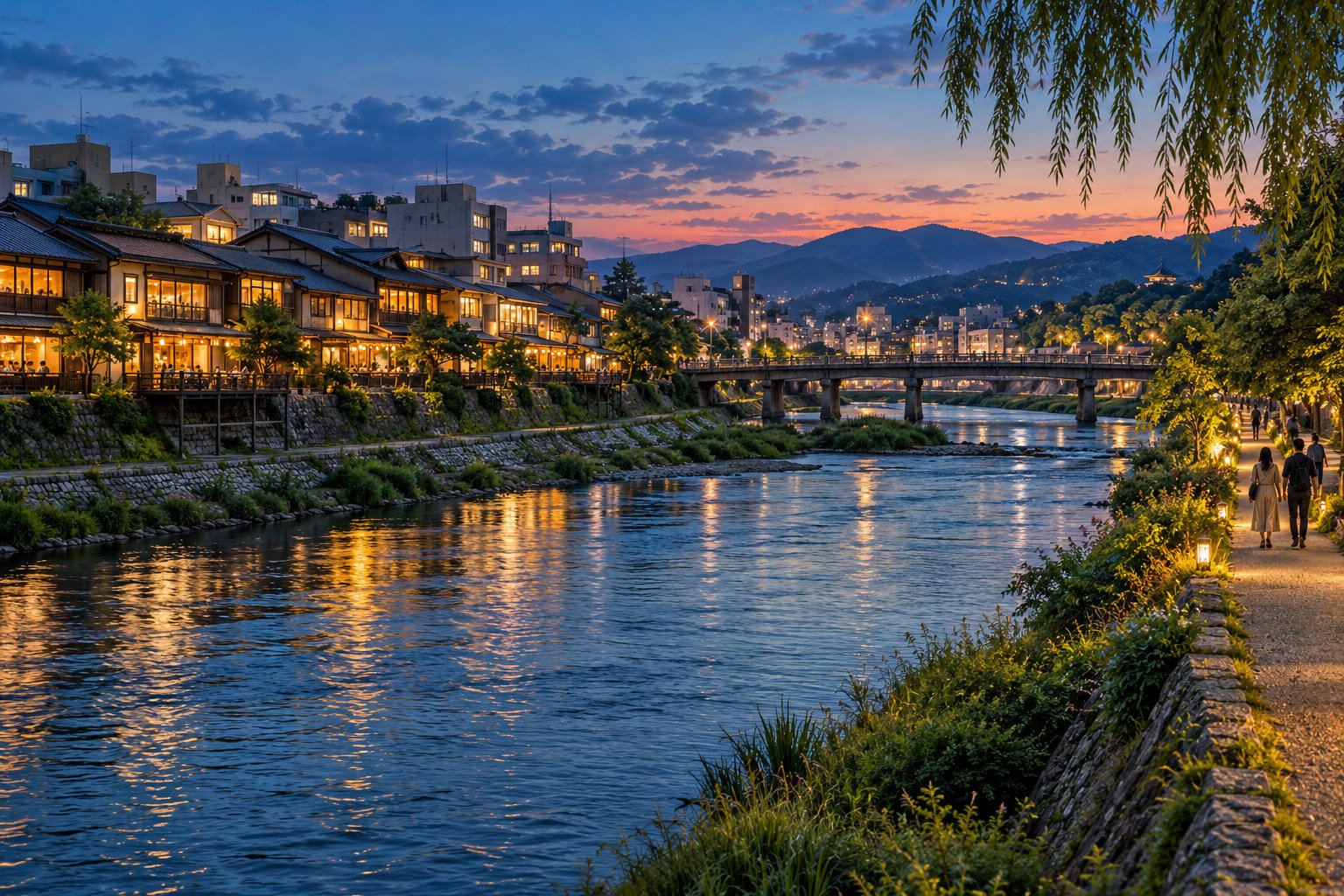
AI-created editorial illustration inspired by the Kamo River near downtown Kyoto; an imagined evening scene, not a photograph or a booked hotel view.
If you are deciding where to stay in downtown Kyoto, begin with the Shijo–Kawaramachi shopping area if Hankyu journeys and a central southern base matter most. Move towards Sanjo for convenient Keihan access and evenings around the river. The Oike side of downtown offers a different compromise: City Hall for the Tozai subway, or Karasuma Oike for both subway lines.[1][2][3]
Those places are close enough to appear in the same hotel search, yet their arrival routes and rooms solve different problems. This guide narrows the choice to four downtown pockets and five researched properties. It uses official room details and published hotel walks; Karen has not personally stayed in or inspected these hotels.
This article contains affiliate links. If you make a booking or purchase through them, Taylor’s Trailblazing Travels may earn a commission at no extra cost to you. Recommendations are based on the planning needs discussed in this guide.
Shops and Hankyu
Shijo–Kawaramachi
Start around the actual Kyoto-kawaramachi station. Subway Shijo is further west and belongs to a different network.[2][3][5]
River and evenings
Sanjo / Kiyamachi
Check the walk across to Keihan Sanjo, plus which street the room faces. A central address cannot guarantee a quiet bedroom.[7][9]
Tozai subway access
City Hall / Oike
Search using Kyoto Shiyakusho-mae, the station’s name. Compare a short walk after a transfer with a longer walk from Karasuma Oike.[11][14]
Separate bedrooms
Karasuma Oike edge
MIMARU SUITES Kyoto Central provides a researched two-bedroom option; its address is west of the Kawaramachi river corridor.[12]
Where to stay in downtown Kyoto: choose your pocket
Here, “downtown” means the Shijo, Sanjo and Oike corridors between the Karasuma side and the Kamo River. These are practical search areas rather than formal hotel districts. Kawaramachi is a street as well as part of a station name; its shopping association directs visitors to different stops along the corridor.[22]
Four downtown hotel pockets: editorial fit based on the linked station and hotel sources
Scroll the table sideways to compare every column.
| Strong reason to choose it | What to trade off | |
|---|---|---|
| Shijo–Kawaramachi | Hankyu Kyoto-kawaramachi; shopping and a southern downtown start | A hotel further west can be a longer walk to Keihan Gion-Shijo than its Kawaramachi name suggests.[2][5] |
| Sanjo / river-side streets | Keihan Sanjo and the northern end of the downtown evening area | Hankyu is further south. Ask about room orientation near evening venues.[7][9] |
| City Hall / Oike | Kyoto Shiyakusho-mae on the Tozai subway; useful for east–west travel | Reaching Kyoto Station by subway involves a change at Karasuma Oike, unless you walk there first.[3][11] |
| Karasuma Oike edge | Both subway lines and a verified multi-bedroom suite option | The riverside is no longer the immediate doorstep. Do not mistake an Oike address for a Sanjo Station address.[3][12] |
Shijo–Kawaramachi: convenient does not mean one station
This is the strongest starting point when your plan repeatedly uses Hankyu or you want to finish shopping near the hotel. A westward shift along Shijo can also make subway Shijo practical: Forza, for example, publishes four minutes from Kyoto-kawaramachi, seven from subway Shijo and eight from Keihan Gion-Shijo.[5] Choose which of those walks you actually expect to repeat.
Sanjo: inspect the river crossing and bedroom position
Sanjo works well when downtown dinners and the Keihan corridor shape your days. Resol and Cross both publish approaches from Keihan Sanjo’s Exit 6, as well as from City Hall’s underground shopping passages.[7][9] Check the entrance on the map and ask whether the available room faces a busy street. “High floor” and “quiet room requested” are useful questions, not acoustic guarantees.
Oike: separate the eastern and western choices
City Hall is on the Tozai line; Karasuma Oike is the interchange with the north–south Karasuma line.[3] Oakwood Oike and MIMARU SUITES Central demonstrate why these are separate searches: the former gives a two-minute walk from City Hall, while the latter gives three minutes from Karasuma Oike’s Exit 4-1.[11][12] Their everyday appeal depends on where you are going next.
Browse Agoda’s hotels near Shijo Kawaramachi. Treat this as an area search: open each property’s map and exact room category rather than assuming every result has the same railway access.
Decode the station names before choosing a hotel
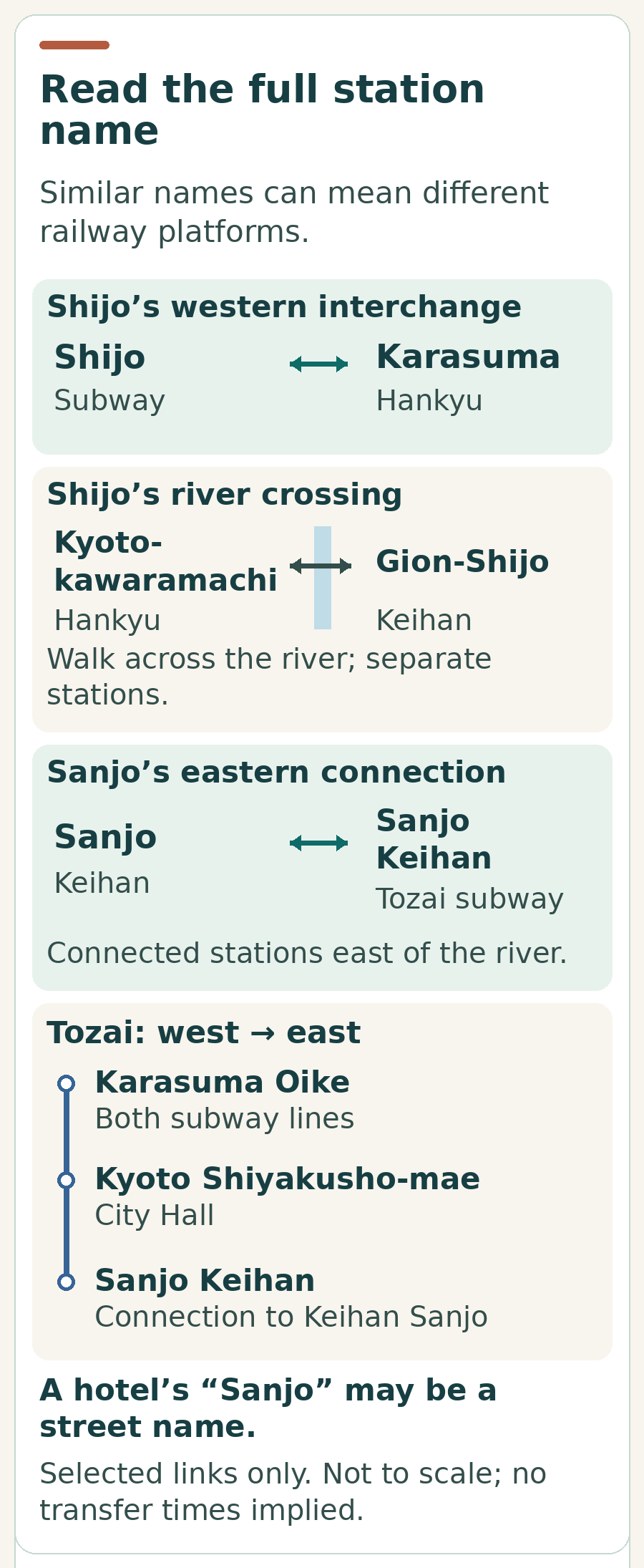
Use the railway operator and full station name in a route search. “Shijo”, “Kawaramachi” and “Sanjo” alone can send a traveller to the wrong starting point.
Swipe sideways to read the full planning graphic.
Similar names, different journeys
Scroll the table sideways to compare every column.
| Name you will see | What it actually means for a downtown stay |
|---|---|
| Kyoto-kawaramachi / Gion-Shijo | Hankyu’s terminus and Keihan’s station are separate. The operator shows a pedestrian interchange, rather than a same-platform transfer.[2][4] |
| Shijo / Karasuma | The subway and Hankyu use different names at the western Shijo interchange. Neither is Kyoto-kawaramachi.[1][3] |
| Sanjo / Sanjo Keihan | Sanjo is Keihan; Sanjo Keihan is the Tozai subway. They connect, but their platforms and railway services differ.[1][3] |
| Kyoto Shiyakusho-mae | This is City Hall station on the Tozai line. It is one station east of Karasuma Oike.[14][15] |
An exit number needs its full name
At City Hall, the official guide distinguishes station exits from exits in the connected Zest Oike shopping passages. “Exit 2” and “Zest Oike Exit 2” are different labels.[14] Save the complete hotel directions rather than only the numeral. Cross specifies Zest Oike Exit 2, while Resol specifies Zest Oike Exit 1.[7][9]
For a step-free approach, use the station’s lift route. The city identifies Karasuma Oike Exit 3-2 for its street lift, whereas MIMARU’s shortest published approach uses Exit 4-1.[12][15] Those are different starting points: ask for the accessible approach and allow for its actual length. A short advertised walk normally omits platform navigation, waiting for a lift and finding the reception entrance.
Five hotel examples, chosen for different room needs
These examples cover compact stays, three separate sleeping places, a larger family room, a studio and separate bedrooms. They are selected by location and published room arrangements, not ranked by review score. No date-specific availability or total room rate has been checked; compare the hotel’s direct offer with the booking service using identical occupants and cancellation terms.
Hotel Forza Kyoto Shijo Kawaramachi: three regular beds
The Casual Triple is 26.5m², accepts two or three guests and has three 100cm-wide beds. Its separate shower, toilet and washbasin may help a group get ready, but this category has no bathtub.[6] Choose it when three people want individual beds and the Shijo approach fits. The hotel connects to Exit 11 of the Shijo underground passage; that does not mean its reception sits beside a train platform.[5]
Check Forza’s room options on Booking.com.
Hotel Resol Kyoto Kawaramachi Sanjo: a compact solo or couple’s base
The Moderetto room is 16m² with one 140cm-wide bed for one or two guests. The standard Twin is 20m² with two 105cm-wide beds, also for two.[8] This is a useful comparison when sleeping centrally matters more than separate living space. Neither category supplies three adult sleeping places. The published approaches are three minutes from Sanjo Exit 6 and five from Hankyu Kyoto-kawaramachi Exit 3.[7]
Compare Resol Kawaramachi Sanjo on Booking.com.
Cross Hotel Kyoto: a bath and a more flexible twin
The 32m² Deluxe Twin accepts up to three guests: two 100 × 200cm beds, with a 100 × 190cm stacking bed for the third. A stacking bed pulls out from beneath a main bed; it is not a third full-length permanent bed. This category includes a bathtub with a separate washing area.[10]
For four, the 47m² Deluxe Family Twin uses two main beds plus stacking beds. The Japanese room page lists a ¥5,000 supplement per additional guest, including consumption tax and service but excluding accommodation tax. Ask whether the quote already includes it: one additional guest across four nights would be ¥20,000.[10] Avoid assuming the larger 37m² Deluxe Twin Plus sleeps three; its published capacity is two.[10]
See Cross Hotel Kyoto’s room categories on Booking.com.
Oakwood Hotel Oike Kyoto: select a studio for self-catering
Oakwood lists 18m² hotel rooms for two and a 30m² Studio Superior for a maximum of two. Its studios include a kitchen and an in-room washer-dryer; those facilities should not be assumed for the standard hotel room.[11] This makes the studio worth comparing for a longer solo or couple’s stay. Confirm the exact bed arrangement and housekeeping frequency in the offered plan.
Check Oakwood Oike studios on Booking.com.
MIMARU SUITES Kyoto Central: four beds behind two bedroom doors
The Two-Bedroom Suite for 4 has 85m², four single beds, two bathrooms, two toilets, a kitchen/dining area and a washer-dryer. MIMARU lists four adults plus up to two children aged six or under in its no-bed category; guests aged seven and above count as adults.[12] For a family wanting four separate beds, or two couples wanting bedroom privacy, that is a different proposition from sharing one large hotel room.
Its published approach is three minutes from Karasuma Oike Exit 4-1, or eleven from Hankyu Karasuma Exit 22.[12] Choose it because the extra rooms will be used, while accepting the western location. Compare MIMARU SUITES Kyoto Central on Agoda.
Count the walks your itinerary will repeat
First reject any room that fails your party’s essential needs: accepted occupancy, suitable beds, accessible bathroom where necessary and an acceptable total. Then compare the remaining locations. A room that cannot sleep everyone does not become suitable because it is two minutes nearer the railway.
A worked comparison for three travellers
Forza’s Casual Triple and Cross’s Deluxe Twin can both accommodate three, with the bedding and bathroom differences described above.[6][10] Their hotels publish the following walks:
Hotel-published walking inputs; train journeys, waits and platform navigation excluded. Reconfirm routes for your dates
Scroll the table sideways to compare every column.
| Hotel | Hankyu approach | Keihan approach |
|---|---|---|
| Forza Shijo Kawaramachi | 4 minutes: Kyoto-kawaramachi | 8 minutes: Gion-Shijo.[5] |
| Cross Hotel Kyoto | 7 minutes: Kyoto-kawaramachi Exit 1A | 4 minutes: Sanjo Exit 6.[9] |
Multiply each walk by how often you expect to use that railway. One return outing counts as two legs. The examples below use assumed journey counts, not a prescribed itinerary:
Swipe sideways to read the full planning graphic.
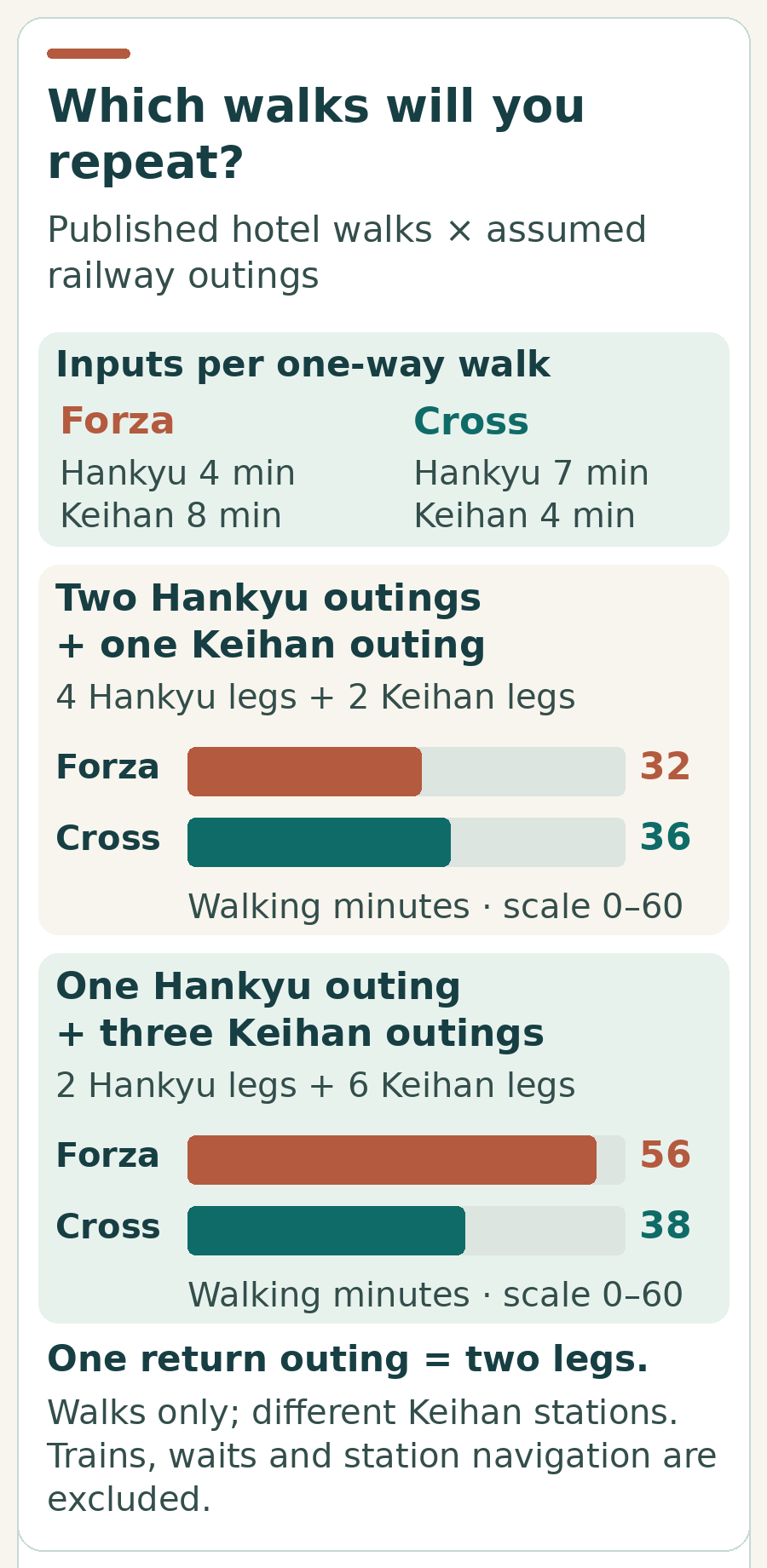
For two Hankyu return outings and one Keihan return outing, Forza totals (4 × 4) + (2 × 8) = 32 walking minutes; Cross totals (4 × 7) + (2 × 4) = 36. A four-minute difference across the stay is a weak reason to sacrifice the room arrangement you prefer.
Change the plan to one Hankyu return outing and three Keihan return outings. Forza becomes (2 × 4) + (6 × 8) = 56 minutes; Cross becomes (2 × 7) + (6 × 4) = 38. Cross now reduces the published walking total by eighteen minutes. The railway you use changes the result even though neither hotel has moved.
What this model can—and cannot—decide
This measures the amount of hotel-to-station walking, not total journey speed. The Keihan starting stations differ, so their train times, service choices and fares must be checked for the same destination. No walks were physically timed. Crowds, a slower pace, a different station exit and luggage can change the inputs.
As a sensitivity check, increasing every walking input by 50% changes the first comparison to 48 versus 54 minutes, and the second to 84 versus 57. Those are assumptions for testing a slower walking pace, not accessibility estimates. If the difference remains small, decide on the bath, bedroom separation, cancellation terms and whole-party price. If you need a step-free route, replace the inputs with that route before using the model.
Make the final arrival fit the address
From Kyoto Station
The Karasuma subway is the direct rail approach to Shijo and Karasuma Oike. City Hall and Sanjo Keihan require a change to the Tozai line at Karasuma Oike.[3] For a City Hall-side hotel, compare that transfer with walking from Karasuma Oike: Oakwood publishes seven minutes from the interchange and two from City Hall.[11] The shorter final walk must still repay the time spent changing lines and waiting.
For a hotel reached conveniently from Keihan, JR to Tofukuji and a change to Keihan is another operator-documented route from Kyoto Station.[4] Compare the complete trip to your actual entrance. A direct bus can be useful when it stops near that entrance, but the rail option is worth checking before committing to a road journey with luggage.
From Kansai International Airport
HARUKA runs between Kansai Airport and Kyoto Station. JR-WEST’s discounted HARUKA One-way Ticket has its own eligibility and use conditions.[16] After Kyoto Station, add the downtown journey described above. You can compare Kansai Airport Station–Kyoto options on 12Go alongside the operator’s offer; check the ticket or vehicle type, exchange requirements, final fees and named drop-off point. A Kyoto listing is not automatically a service to your downtown hotel.[17]
A group with several bags may find this private Osaka-airport-to-Kyoto arrival transfer on Viator useful. It offers hotel drop-off from Kansai International or Itami; enter the correct airport and compare the quote for the whole group. Check vehicle and luggage capacity, child-seat arrangements and delay handling. Its stated meeting window is ninety minutes after an international flight or sixty after a domestic arrival, after which the reservation is automatically cancelled if you have not appeared.[18] That condition matters more than a headline journey estimate.
Keep the evening practical
If an organised first evening would help, the three-hour Pontocho evening food tour on GetYourGuide combines a guided walk and food stops around Pontocho and Gion Shirakawa. Its meeting point is the Izumo-no-Okuni statue near Gion-Shijo Exit 5.[19] Confirm the meeting instructions, dietary requirements and walking suitability; do not choose a hotel on the assumption that “downtown tour” means hotel collection. An independent dinner is also a straightforward way to use a central base.
Save your hotel’s Japanese address, entrance pin and booking confirmation offline. For live route changes and translation, check Airalo and select Japan if your existing roaming plan is unsuitable. Check eSIM support, carrier unlocking, data allowance and validity before buying; do not assume a Japan data plan includes a local telephone number.[20][21]
Compare the full quote, then settle the remaining trade-offs
Include the current accommodation tax
Kyoto’s revised accommodation tax applies from 1 March 2026. It is charged per person per night, using the accommodation charge including service charges but excluding meals and consumption tax.[13]
Kyoto City tax per person, per night; checked 18 October 2026
Scroll the table sideways to compare every column.
| Taxable accommodation charge | City tax |
|---|---|
| Below ¥6,000 | ¥200 |
| ¥6,000 to below ¥20,000 | ¥400 |
| ¥20,000 to below ¥50,000 | ¥1,000 |
| ¥50,000 to below ¥100,000 | ¥4,000 |
| ¥100,000 or more | ¥10,000 |
For three adults over four nights, an equal taxable allocation of ¥15,000 per person per night means ¥4,800 in city tax; at ¥20,000 it becomes ¥12,000. These are illustrative allocations, not hotel prices. Ask the property how a family or package charge is allocated, and whether tax has already been collected by the booking service.[13]
Is Sanjo the better choice for every first visit?
No. It is a strong choice for the river and repeated Keihan use, but Shijo–Kawaramachi may fit a Hankyu-heavy plan better. For four travellers who need separate bedrooms, a western apartment can win despite a longer route to dinner. Use the actual room and repeated journeys to resolve the choice.
Can a hotel near nightlife still work for a light sleeper?
Possibly, but district-wide promises are unreliable. Ask about the offered room’s orientation, nearby late-night venues and any announced works. Read recent room-specific comments as supporting evidence, and use a refundable booking if noise uncertainty would otherwise make the choice uncomfortable.
Does “Sanjo” in the hotel name mean the river station?
Check the address. Sanjo-dori extends through the city, and a Sanjo-named property can sit towards Karasuma or further west. Look for an explicit route from Keihan Sanjo or subway Sanjo Keihan if that connection is the reason for choosing it; a street name alone is insufficient.[1][3]
Before paying
Confirm every guest’s age, the exact room and bed setup, bath or shower arrangement, complete station exit, reception access, check-in deadline, luggage storage, city tax and cancellation deadline. For a late airport arrival, tell the hotel when you expect to reach reception and check what happens if transport is delayed.
For an uncomplicated downtown shortlist, compare a Shijo–Kawaramachi room with a Sanjo room that fits the same party. Add an Oike option when its kitchen, bedroom separation or subway location solves a specific need. Then compare the whole stay in the Japan budget guide for UK travellers, and keep your nights consistent with the wider Japan trip-length plan.
Sources and planning notes
This is a research-led guide using hotel, transport and destination sources linked below. Time-sensitive rules have been reviewed, but not every property detail or website can be independently checked. Reconfirm the exact room, route, final price and current notices for your own dates; worked examples state their assumptions.
- Getting around Kyoto by subway and train — Kyoto City Tourism Association.
- Kyoto-kawaramachi HK86: official station information — Hankyu Railway.
- Subway line information and interchange stations — Kyoto Municipal Transportation Bureau.
- Kyoto-area interchanges with Keihan Railway — Keihan Railway.
- Forza Kyoto Shijo Kawaramachi: access and station walks — Hotel Forza.
- Forza Kyoto Shijo Kawaramachi: Casual Triple — Hotel Forza.
- Resol Kyoto Kawaramachi Sanjo: precise station exits — Hotel Resol.
- Resol Kyoto Kawaramachi Sanjo: room sizes and occupancy — Hotel Resol.
- Cross Hotel Kyoto: station approaches — Cross Hotel Kyoto / ORIX Hotels & Resorts.
- Cross Hotel Kyoto: Deluxe room capacities, stacking beds and supplements — Cross Hotel Kyoto / ORIX Hotels & Resorts.
- Oakwood Hotel Oike Kyoto: hotel rooms, studios and location — The Ascott Limited / Oakwood.
- MIMARU SUITES Kyoto Central: room layouts, guest ages and access — MIMARU.
- Kyoto accommodation tax from 1 March 2026 — Kyoto City.
- Kyoto Shiyakusho-mae: station exits and lift routes — Kyoto Municipal Transportation Bureau.
- Karasuma Oike: interchange levels, exits and lift route — Kyoto Municipal Transportation Bureau.
- HARUKA One-way Ticket: routes and conditions — JR-WEST.
- Kansai Airport Station–Kyoto transport listings — 12Go.
- Private arrival transfer from Osaka airports to Kyoto — Viator.
- Casual Pontocho evening food tour: route and meeting point — GetYourGuide / Arigato Travel.
- Japan eSIM plans — Airalo.
- Device compatibility and carrier restrictions — Airalo.
- Kawaramachi shopping street: visitor and transport information — Kawaramachi Shopping Street Promotion Association.
Illustrations in this article were created for Taylor’s Trailblazing Travels. Third-party photographs, where used, are credited beside the image or in the source list.