Nara Travel Guide: Beyond the Deer Park
Make time for temple art, Naramachi’s streets and the western capital sites, with a plan that respects the distances and closing times.
- Suggested time · Full day or 1 night
- Beyond the park · Naramachi + western temples
- Route rule · Choose a cluster
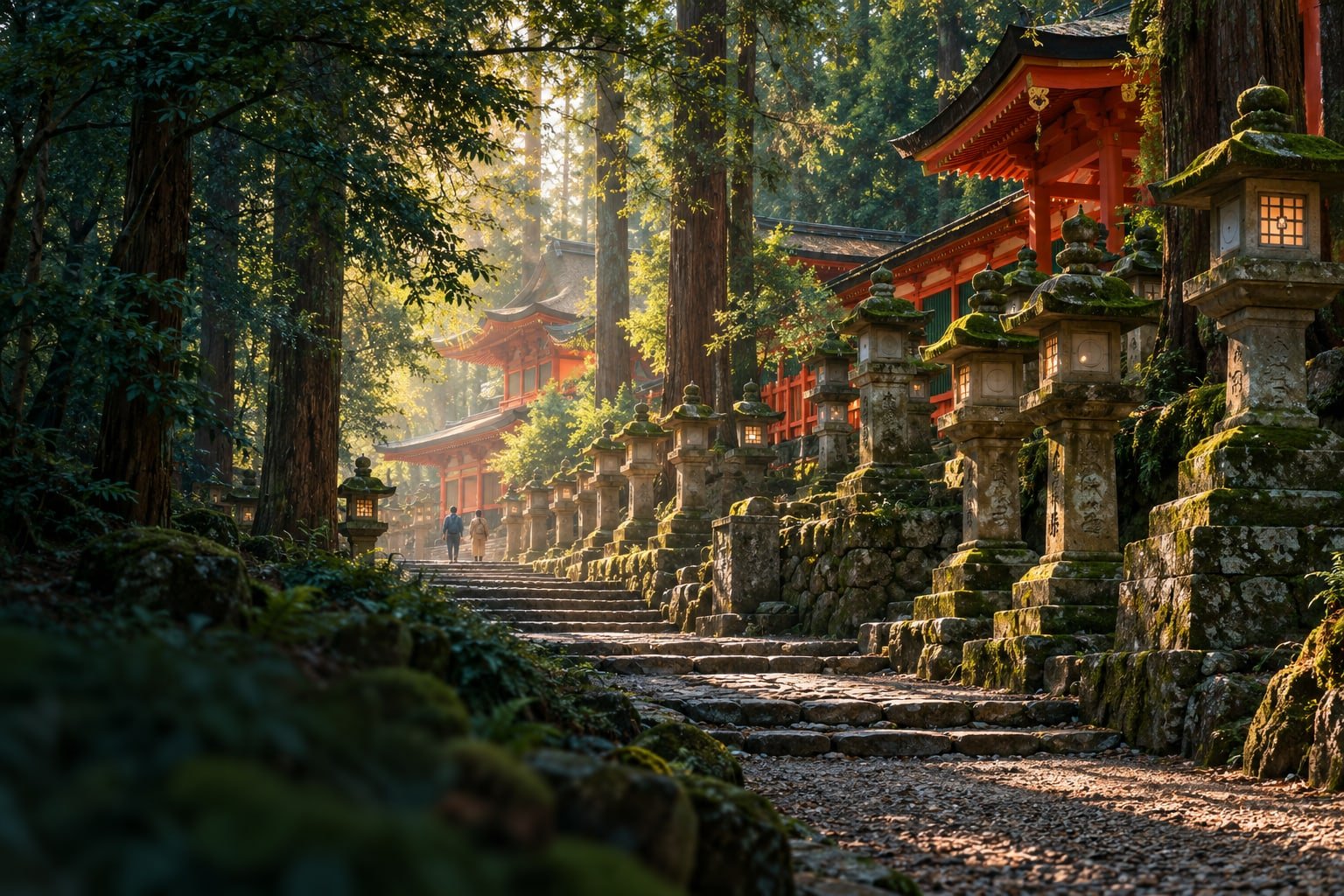
AI-generated editorial illustration inspired by Nara’s wooded shrine district; an imagined scene, not an exact photographed viewpoint.
Nara deserves a plan that continues after the deer photographs. Naramachi’s merchant streets grew around former temple land, while Nishinokyo and the palace area reveal another part of the old capital to the west. Those districts add more to a visit when they receive their own time.[1][2][3]
For a first visit, allow a full day for a selective eastern-temple route and Naramachi. Stay one night if you also want Yakushiji, Toshodaiji or the palace landscape without hurrying. This guide separates those choices and accounts for two major current disruptions: the Kofukuji pagoda restoration and the National Museum’s sculpture-hall closure.[10][13]
This guide contains affiliate links. If you book or buy through them, Taylor’s Trailblazing may earn a commission at no extra cost to you.
Keep the town in daylight
Reserve an afternoon block for Gangoji, a townhouse interior and a café. Streets alone after closing do not provide the same visit.
Choose your temple pair
Todai-ji and Kasuga offer a broad eastern introduction. Yakushiji and Toshodaiji suit a dedicated western architecture day.
Stay for the second cluster
One night is most useful when it makes the western temples or palace possible at a relaxed pace; a hotel change still costs time.
Check the actual interior
Restoration, exhibitions and worship affect what is open. A famous building name does not guarantee the display you expect.
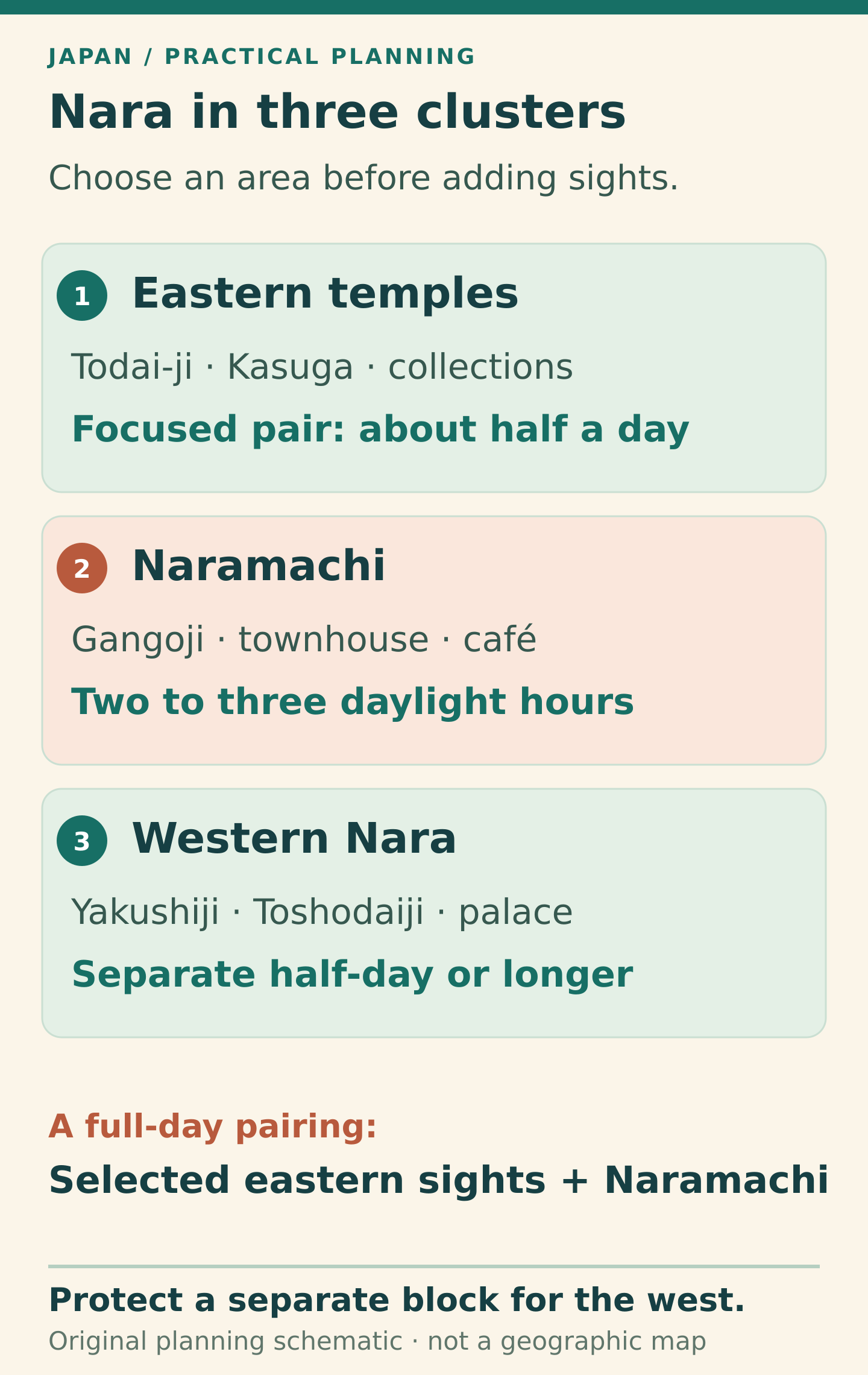
Understand Nara’s three sightseeing clusters
Think in clusters before drawing a route. The eastern temple-and-park district, Naramachi to the south of the central station area, and the western temples serve different interests. Naramachi is compact enough for an extended walk; western Nara needs a deliberate transport leg.[1][2]
| Cluster | What the visit is about | Time to protect |
|---|---|---|
| Eastern temples and park | Todai-ji, Kasuga Taisha, Kofukuji, gardens and selected collections. | About half a day for a focused pair; longer for art or gardens. |
| Naramachi | Gangoji, merchant-townhouse form, craft shops, cafés and local food. | Two to three daylight hours, including a break. |
| Western Nara | Yakushiji and Toshodaiji; the palace site as a further choice. | At least half a day for the temple pair; more if adding the palace. |
A half-day stop calls for one main temple and a nearby walk. A full day can combine a selective eastern route with Naramachi. An overnight stay earns its place when it opens a second day for the west, rather than merely adding another hotel check-in. These recommendations assume you want to enter buildings, pause and eat, not just pass their gates.
Naramachi: protect time for the town
Naramachi is the part of this itinerary most easily lost to “one more temple”. Its narrow streets, townhouses, shops and cafés give a different scale to the visit, and its relationship with Gangoji helps explain why the town and religious history belong together. Begin here before the interiors you want to see close.[1][3]
Start with Gangoji
Gangoji’s origins lie in Asuka; the temple moved into the Nara capital, and much of today’s Naramachi occupies its former precincts. Visit to connect the surrounding streets with their earlier religious setting. Avoid reducing the story to an “oldest temple” slogan, which obscures the distinction between an institution’s origins and the buildings seen today.[3]
The published visitor hours are 09:00–17:00, with last entry at 16:30. Adult admission is ¥700, rising to ¥800 during the autumn special exhibition, and the tourism listing specifies cash payment. Keep a little cash available and check exhibition dates if you are budgeting closely.[4]
Read a townhouse from the inside
Naramachi Koshi-no-Ie is a free reconstruction of a traditional townhouse, not an untouched historic house. It makes a useful architectural stop before returning to the streets. The published hours are 09:00–17:00; Monday closures, public-holiday exceptions and year-end closures mean the specific date needs checking.[5]
Choose one or two additional shops or craft spaces that interest you, then allow a proper café break. There is little benefit in treating every doorway as another sight to collect. A small, coherent visit can explain more than an hour spent searching for an allegedly hidden lane.
What to eat between visits
For a local lunch, look for kakinoha-zushi: salted fish with vinegared rice wrapped in persimmon leaves. Cha-gayu is rice porridge prepared with roasted tea, while narazuke are vegetables matured in sake lees. Yamato tea or mugwort mochi can make the afternoon break part of the local-food experience.[22]
Choose a meal format that suits the day: a simple lunch keeps temple time flexible, while a reserved set meal can be the reason to slow down. If you avoid fish or alcohol, ask specifically about sushi fillings, broth and sake-lees pickles. Confirm dietary needs with the restaurant rather than relying on the appearance of a dish.
Eastern Nara: choose the experience inside the gate
Todai-ji and Nigatsu-do
The Great Buddha Hall is the clearest first choice if you want one major temple interior. Adult entry is ¥800. It opens 07:30–17:30 from April to October and 08:00–17:00 from November to March. Other Todai-ji halls and the museum have their own admission arrangements, so the Great Buddha Hall ticket should not be treated as an all-site pass.[6]
Allow roughly 60–90 minutes for the approach and main visit as a planning starting point, then add time if you want to read closely. Nigatsu-do offers a terrace outlook across the Nara basin and a further religious setting beyond the busiest main-hall approach. The temple prohibits photography, sketching and flashlights inside Nigatsu-do; follow the signs for the specific area you enter.[7][8]
Kasuga Taisha
Kasuga’s approach and paid inner visit are separate decisions. The special inner-cloister admission is ¥700, with published access from 09:00–16:00. The lantern displays are part of the appeal, but ceremonies can restrict entry. If that interior is a priority, check its calendar and arrive well before the closing window.[9]
Kofukuji: visit for the collection, with accurate expectations
The five-storey pagoda is completely enclosed for conservation. The official project now schedules completion for March 2034, so a plan built around an unobstructed pagoda photograph is unsuitable during the works. The National Treasure Hall provides a separate reason to consider Kofukuji through its Buddhist sculpture collection; check the current display and opening arrangements.[10][11]
Isuien: a garden choice with access limits
Isuien is a useful alternative when you want a garden rather than another temple hall. Adult admission is ¥1,200 including its museum. Opening is 09:30–16:30, last entry 16:00, with Tuesday and seasonal maintenance closures. The operator explicitly says the garden is not wheelchair accessible, so it should not be inserted into a step-free itinerary by default.[12]
Check the National Museum’s current programme
Nara National Museum’s Buddhist Sculpture Hall closed on 14 September 2026 and is planned to remain closed until around spring 2028. Its Ritual Bronzes Gallery is free during this period, while special exhibitions have their own arrangements. Choose the museum for an exhibition that is actually open on your date, not for an assumed visit to the usual sculpture collection.[13]
There is a concrete alternative during the works: a free selection of Buddhist sculptures opened on the second floor of the Ritual Bronzes Gallery on 15 September 2026. Its entrance is on the gallery’s east side. Check the current opening calendar before choosing this as your art stop.[32]
Western Nara: temples first, palace as a separate choice
Yakushiji and Toshodaiji make a coherent western visit because they offer a useful architectural comparison. Start with that pair if you are interested in how religious buildings survive, change and are reconstructed. Treat the palace area as another commitment, not a quick bonus after an already full eastern day.[2]
Yakushiji: recognise the surviving and reconstructed buildings
Yakushiji was founded in 680 and moved to Nara in 718. The East Pagoda survives from the original complex; much of what surrounds it was reconstructed after fires. That distinction improves the visit: compare the pagodas and halls as evidence of both continuity and later rebuilding, rather than assuming that every building is the same age.[14]
Toshodaiji: follow the story of Ganjin
Toshodaiji was founded in 759 by Ganjin, the Chinese monk who came to Japan to teach Buddhist precepts. Its eighth-century Golden Hall and Lecture Hall transferred from the imperial palace give the site a particular architectural interest. The famous image of Ganjin is not a routine always-visible display; check any special opening you intend to see.[15]
Ordinary adult admission is ¥1,000, with published opening of 08:30–17:00 and last entry at 16:30; special displays may cost extra. Allowing around 75–90 minutes is an editorial starting point for a visitor who wants to look carefully, not an official minimum.[16]
Heijo Palace Site: give the landscape room
The palace park asks you to imagine a capital across a large open site. Reconstructed structures and the Izanaikan museum explain the former palace through archaeology, models and the work of reconstruction. Izanaikan is free, normally opens 09:00–17:00 with last entry at 16:30, and has a closure calendar.[17]
For an archaeology-led trip, make the palace your main half-day and reduce the temple list. For a first overnight visit, the temple pair is the clearer default; add the palace only if your interests, energy and return connection justify it.
When interpretation is worth paying for
A guide can help connect the buildings with Buddhist history, particularly when you want more than labels. Review this customisable Nara walking tour on Viator: the current listing meets in Nara and charges transport, admissions and meals separately. Despite wording in its web address, it is not an included transfer from Osaka or Kyoto.[28]
Alternatively, compare this private Nara tour with a local on GetYourGuide. Discuss Naramachi, the western temples, duration and mobility needs before choosing an option. Agree a feasible area and confirm fees; a customisable listing is not a promise that every named site fits.[29]
Choose a day-trip route or a one-night plan
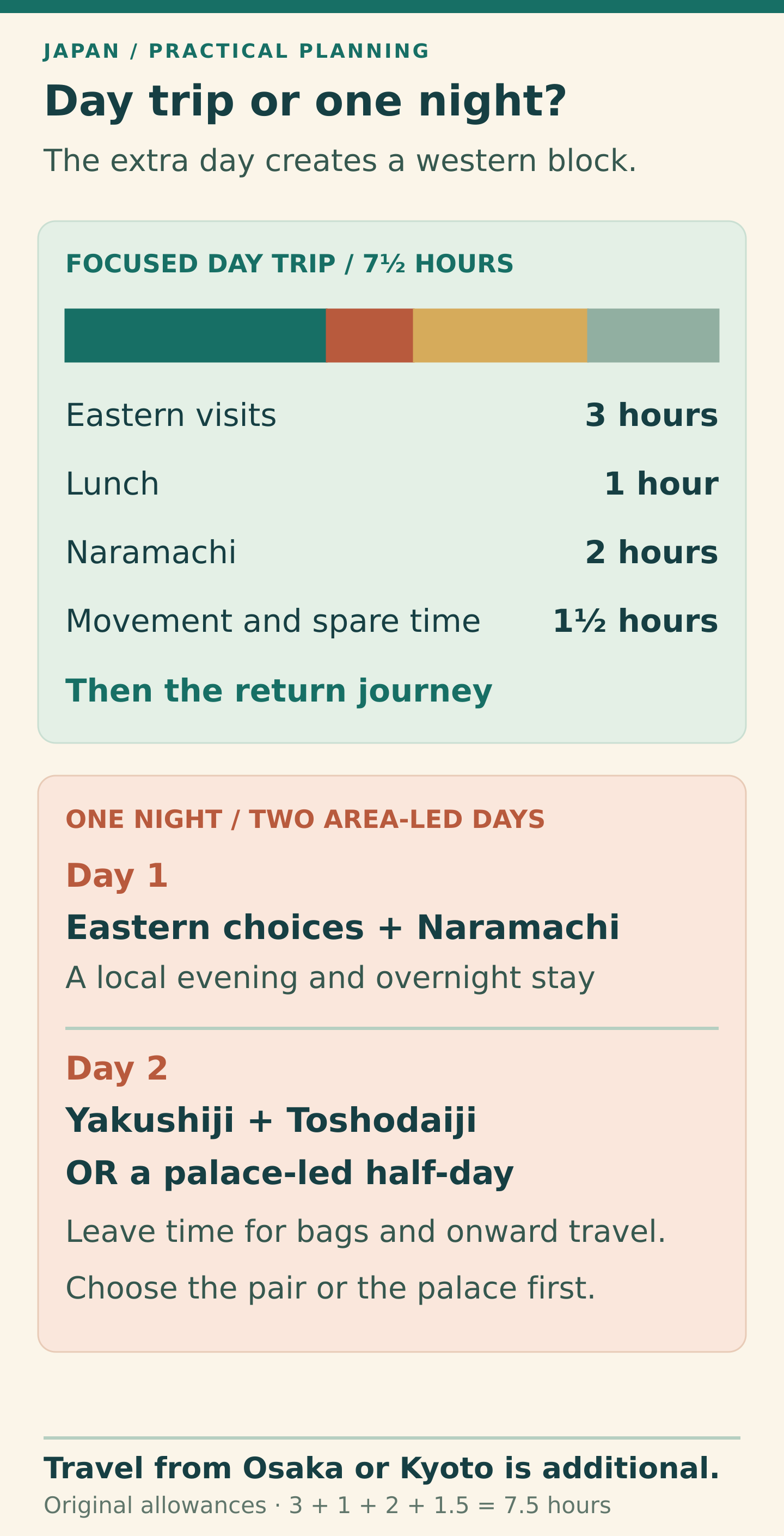
The following schedules are original planning models. They assume time in Nara itself, a lunch break and ordinary walking between visits; travel from your Osaka or Kyoto hotel comes on top. Change the order for closures, worship or a booked exhibition.
| Plan | Morning | Afternoon | What to leave out |
|---|---|---|---|
| First visit: temples and town | Todai-ji, then Kasuga Taisha if you want a temple-and-shrine pair. | Lunch and a protected Naramachi block: Gangoji, a townhouse interior and a café. | Western Nara; extra gardens and collections unless you remove something else. |
| Art and architecture day | Kofukuji’s collection, then Isuien or a currently open museum exhibition. | Naramachi, with Gangoji as the religious link to the town. | A compulsory deer-feeding stop or a dash to every eastern temple. |
| One night, two distinct days | Day one: selective eastern sights and Naramachi. | Day two: Yakushiji and Toshodaiji; choose the palace instead of extending the temple list if archaeology matters more. | Assuming a hotel move or luggage collection takes no time. |
For a seven-and-a-half-hour day, a useful starting allocation is three hours for eastern visits, one hour for lunch, two hours for Naramachi and 90 minutes for movement and slack. These are adjustable allowances. Add a garden or long collection visit by replacing a stop, not by assuming that lunch and walking disappear.
If you arrive late, reverse the ambition rather than racing the clock: choose one open interior, the surrounding district and a meal. Naramachi’s daytime interiors and Kasuga’s special admission close too early to be treated as guaranteed end-of-day additions.[5][9]
Getting to Nara and reaching the western sites
Choose the arrival station for your starting point
From Osaka-Namba, a direct Kintetsu service to Kintetsu-Nara takes about 40 minutes. From JR Osaka Station, the direct Yamatoji Rapid to JR Nara takes about 50 minutes. From Kyoto, the JR Miyakoji Rapid takes about 45 minutes; the Kintetsu limited express is about 35 minutes but requires a supplement. These are station-to-station reference times, not total hotel journeys.[18]
Kintetsu-Nara is convenient for the central eastern approach and Naramachi, while JR Nara can be the sensible choice when your hotel or existing rail plans favour JR. Compare your actual departure station, transfer and final walk; saving minutes on one train does not necessarily save time overall.[1][18]
An ordinary Kintetsu journey does not require a premium sightseeing train. Limited expresses have reserved seats and need a separate limited-express ticket in addition to the basic fare; a rail pass does not automatically cover that supplement.[19]
Pass or transfer comparison
If you are comparing a regional pass or private transfer, open Osaka-to-Nara options on 12Go or Kyoto-to-Nara options on 12Go. The checked pages list passes and transfers, so do not assume they quote an ordinary single train ticket. Compare the exact pass area, validity, eligible journeys and supplements with buying the basic fares you need.[26][27][19]
Within the city
For western Nara by rail, use Kintetsu’s network map to plan the connection via Yamato-Saidaiji towards Nishinokyo. Nara Kotsu also serves the city’s major sightseeing areas, including the western temples. Budget a real journey between clusters, and check the return route before beginning the second temple.[20][18]
Buses can shorten the longer park approaches, but payment depends on the vehicle. Nara Kotsu uses both front- and rear-boarding systems; follow the signs and IC-reader instructions. If paying cash, have small denominations: the farebox requires the correct fare, and its banknote changer accepts ¥1,000 notes rather than larger ones.[21]
Should you stay overnight, and what should you budget?
A night in Nara makes most sense when you want an early eastern start, time in the town and a separate western visit. If changing hotels would mean repacking a family or interrupting an otherwise convenient Kyoto or Osaka base, a focused day trip may be the better trade-off. The gain comes from the extra usable time, not from the overnight stay itself.
| Base | Best fit | Before booking |
|---|---|---|
| Near Kintetsu-Nara | A first stay focused on the eastern sights and town. | Check station exit, luggage route and whether the room faces a busy street. |
| Naramachi | A stay in which the town, cafés and a smaller property are part of the attraction. | Check stairs, bathroom arrangement, check-in deadline and dinner requirements. |
| Near JR Nara | A stay aligned with JR arrival, departure or onward travel. | Compare the walk or bus journey to your first sightseeing stop. |
Once you have chosen the area, compare Nara accommodation on Agoda with Nara accommodation on Booking.com for the same dates, occupancy and meal basis. Check the final total and cancellation conditions, and confirm dinner times directly if booking a stay that includes meals. No room availability or price for your dates is implied here.[24][25]
| Visit | Reference admission | Budget implication |
|---|---|---|
| Todai-ji Great Buddha Hall | ¥800[6] | Separate from other paid halls or the museum. |
| Kasuga special inner visit | ¥700[9] | An optional paid interior within the wider shrine visit. |
| Gangoji | ¥700; autumn special exhibition ¥800[4] | Allow cash and check the exhibition period. |
| Isuien | ¥1,200[12] | Includes its museum; check closure and access suitability. |
| Toshodaiji | ¥1,000 ordinary admission[16] | Special displays may be additional. |
The ordinary-admission combination of the Great Buddha Hall, Kasuga’s special visit and Gangoji totals ¥2,200 per adult, or ¥2,300 during Gangoji’s stated autumn special-exhibition period. Add your actual return transport, lunch, drinks and any guide or overnight stay. This is an arithmetic basket of named choices, not an average daily cost or a bundled ticket.
The checks that keep a Nara visit comfortable
Check the opening calendar of your priority interior first, then build the day around it. A temple’s grounds, individual halls, garden and collection may follow different arrangements. Keep enough time before last admission to experience the place, not merely cross its threshold.
For limited mobility, separate the length of the route from its surface and steps. Ask attractions about the entrance you can use and arrange transport between longer blocks. Isuien explicitly excludes wheelchair access; do not replace a museum visit with it without checking whether that alternative works for your party.[12]
The deer are wild animals. Use only the approved deer crackers if feeding them, do not tease them with withheld food, supervise children and keep bags, paper and rubbish out of reach. Watch from a comfortable distance if you prefer; feeding is optional. Follow local staff and signs when animals are being managed.[23]
For live bus information and translation, use your existing Japan data cover if you have it. Otherwise, open Airalo and select Japan to compare eSIM plans. Check your phone is compatible and network-unlocked, then read the selected plan’s allowance, validity and activation rules. You do not need a second Japan plan merely because you are visiting Nara.[30][31]
Your Nara questions answered
Is Nara worth adding if I already have several temple days?
Choose it when the Great Buddha Hall, Gangoji’s connection with Naramachi or the western architectural comparison adds something you actively want. If you would only be adding another temple checklist to an already compressed holiday, shorten the list or leave Nara for a later trip. The strongest reason to come is a clear interest, not the pressure to include every Kansai stop.
Will an organised day tour leave time for Naramachi?
Check that the itinerary names Naramachi and gives you usable daylight time there. A general Nara stop does not establish that Gangoji, a townhouse interior or a café break is included. Ask which interiors are visited and whether that time is guided or free; for a private tour, agree the town block before booking.
What works on a rainy day?
Choose an open collection, Gangoji and townhouse interiors, with shorter outdoor connections and a long lunch. Check the actual museum exhibition: Nara National Museum’s Buddhist Sculpture Hall is expected to remain closed until around spring 2028. An indoor-led day still involves some exposed walking between buildings.[13]
How should I handle luggage on a one-night stay?
Confirm whether your property can store bags before check-in and after check-out, then include the collection journey in your departure plan. If you intend to use station storage, check current location, opening arrangements and bag-size limits first. A western-temple route is easier to enjoy when a large suitcase is not dictating every connection.
Choose the plan that fits your trip
Choose the visit you want Nara to be. For a full day, pair major eastern sights with a protected Naramachi afternoon. For temple architecture and the former capital beyond the park, add a night and give western Nara its own block. Let opening arrangements and your interests reduce the list: the city is more rewarding when there is time to understand a few places well.
How this guide was researched
This guide uses official temple, museum, tourism and railway information, with current booking listings checked for their actual scope. The editorial review date is 17 October 2026. Route allocations, suggested stay lengths and the admission-cost example are transparent planning judgements and arithmetic; they are not reports of personal visits or guarantees of crowd conditions.
Sources and checks
Official, operator and relevant booking information checked on 17 October 2026. Opening arrangements, fares and availability can change; recheck the linked source for your travel dates.
- Nara Prefecture tourism — Naramachi
- Nara Prefecture tourism — Nishinokyo
- Gangoji — temple history
- Nara Prefecture tourism — Gangoji visitor information
- Nara City Tourism Association — Naramachi Koshi-no-Ie
- Todai-ji — admission and visiting hours
- Todai-ji — Nigatsu-do
- Todai-ji — official temple leaflet
- Kasuga Taisha — visitor guidance
- Kofukuji — official five-storey pagoda conservation project
- Kofukuji — National Treasure Hall
- Isuien — official visitor and access information
- Nara National Museum — current admission and closure information
- Nara City Tourism Association — Yakushiji
- Toshodaiji — official English introduction
- Toshodaiji — visiting information
- Heijo Palace Site Historical Park — Suzakumon area
- Nara City Tourism Association — getting to and around Nara
- Kintetsu Railway — ticket and service questions
- Kintetsu Railway — network map
- Nara Kotsu — how to use the bus
- Nara City Tourism Association — local food guide
- Nara City Tourism Association — responsible deer encounters
- Agoda — Nara accommodation search
- Booking.com — Nara accommodation search
- 12Go — Osaka to Nara
- 12Go — Kyoto to Nara
- Viator — Nara customisable private walking day tour
- GetYourGuide — Nara private tour with a local
- Airalo — Japan eSIM plans
- Airalo — device compatibility
- Nara National Museum — Selections of Buddhist Sculptures
Illustrations in this article were created for Taylor’s Trailblazing Travels. Third-party photographs, where used, are credited beside the image or in the source list.