Where to Stay in Tokyo for First-Time Visitors: Best Areas Explained
Choose the neighbourhood that makes your own trip simpler—not the one that wins an abstract city-wide ranking.
- Seven contrasting bases
- Area first, room second
- Match airports and evenings
An original Tokyo-inspired city illustration. It does not depict the view from any named hotel or room.
The best place to stay in Tokyo is the one that supports the trip you are actually taking. A lively west-side base, an eastern neighbourhood near museums, and a room convenient for an onward train solve different problems. Trying to name one winner for everyone hides those trade-offs.
This guide is about choosing the area and checking the room before booking. It does not attempt to replace a Tokyo sightseeing itinerary or a detailed Shinjuku exit guide. Start with a shortlist of two neighbourhoods, then compare real properties against your arrival, fixed plans and evenings.
This article contains affiliate links. If you book or buy through them, Taylor’s Trailblazing Travels may earn a commission. Recommendations are chosen for their relevance to the trip.
Best area for whom?
Your evening plans and fixed departures should shape the shortlist.
Airport reality
A convenient airport train can still end far from the hotel entrance.
Room reality
Occupancy, beds and floor area matter as much as the headline price.
Booking reality
Compare the same room and terms before calling an offer cheaper.
Where to stay in Tokyo: compare seven bases
| Area | Strongest reason to shortlist it | Reconsider when… |
|---|---|---|
| Shinjuku | West-side evenings plus extensive transport choices | You want a simple small station or a uniformly quiet neighbourhood |
| Shibuya | Fashion, dining and evening plans around western Tokyo | You dislike busy crossings, hills or a large station environment |
| Tokyo Station / Yaesu | Arrival and onward rail journeys shape the stay | You mainly want spontaneous late evenings in Shinjuku or Shibuya |
| Ginza / Shimbashi | Central shopping and dining with several station choices | You assume every “Ginza” hotel is equally convenient for the same train |
| Ueno / Okachimachi | Museums, the park and eastern-city plans | Most fixed activities and evenings are across the city in the west |
| Asakusa | A historic neighbourhood and a local morning/evening atmosphere | You expect all stations called Asakusa to be the same station |
| Shinagawa station area | Haneda access and onward rail logistics | You want your hotel neighbourhood to be the main sightseeing attraction |
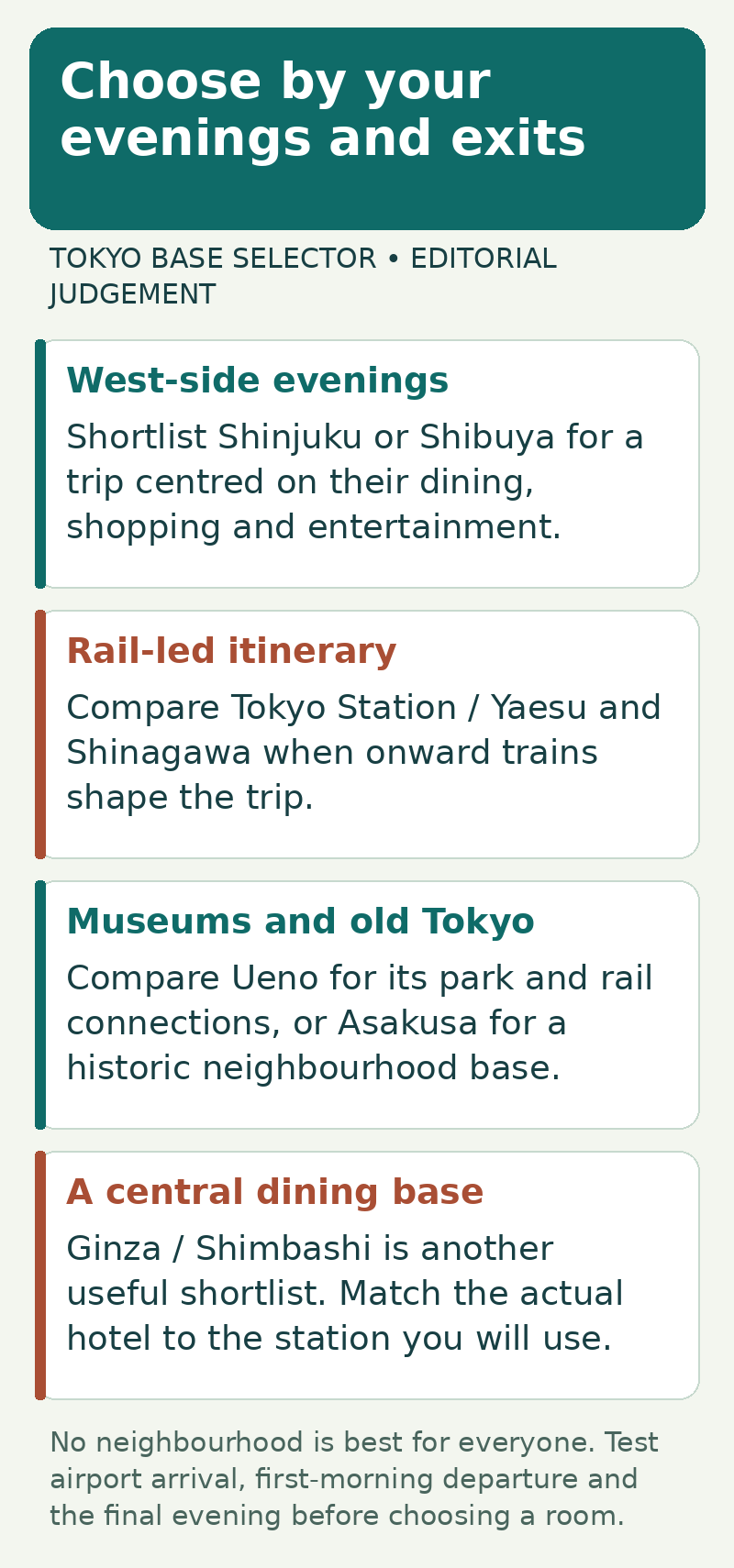
A district can work well without being the place in which you spend the most sightseeing time. What matters is whether its repeated journeys are tolerable. Give particular attention to the journeys you will make tired, with luggage or under time pressure.
Avoid blanket price claims such as “Ueno is always cheaper” or “Shinjuku is always expensive”. Your dates, room occupancy and cancellation terms can reverse a broad assumption. First choose workable areas; then use actual like-for-like room quotes.
Run the three-journey test before falling for a room
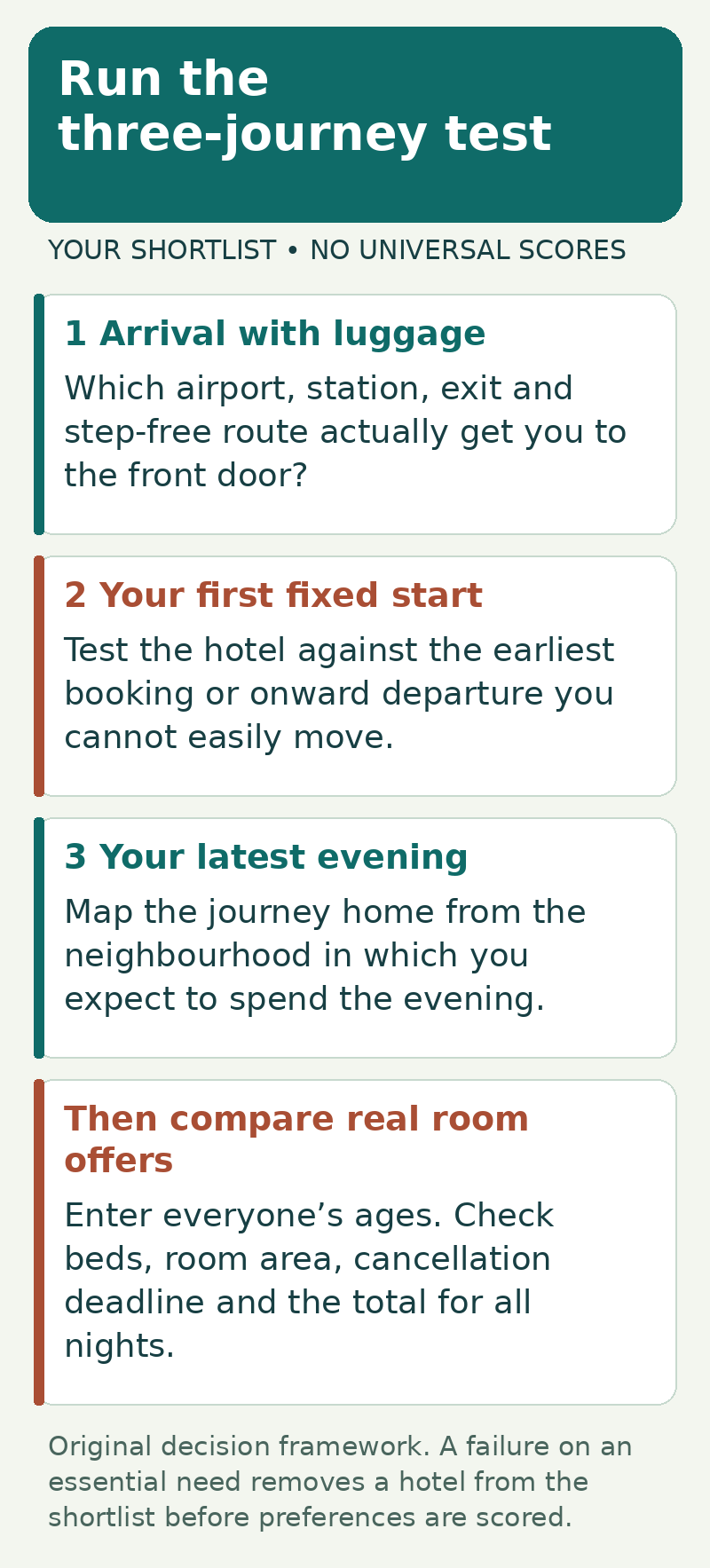
Write down three journeys: airport to hotel with bags; hotel to the first fixed early start; and the latest likely evening back to the hotel. Use the exact property entrance, not a map pin for the district centre. Include the station operator and exit, any required lift, and whether the transport runs at the time you need it.
Treat an essential failure as a reason to remove the hotel, not a small score deduction. A room outside the group’s occupancy limit, an inaccessible arrival route or an impossible early connection is not rescued by attractive décor. After those checks, preferences such as dining, shopping and outlook can decide between the remaining options.
| Trip pattern | Start with | Deciding test |
|---|---|---|
| Four nights; most evenings in western Tokyo | Shinjuku versus Shibuya | Which specific hotel makes the likely journey home easiest? |
| Family trip centred on museums and older neighbourhoods | Ueno versus Asakusa | Which room layout and airport-to-door route suit the whole family? |
| Short Tokyo stop before an onward train | Tokyo Station versus Shinagawa | Which station actually serves the departure, and on which side is the hotel? |
This approach also prevents overvaluing one fast airport journey. Saving a few minutes once may be less important than making four evenings awkward. Conversely, with only one night and an early departure, the arrival and onward transfer can reasonably dominate the choice.
Shinjuku and Shibuya: choose your west-side evening base
Shinjuku: useful, but choose a side
Shinjuku combines major rail connections, department stores, entertainment areas and a western high-rise district. [1] Its value is flexibility: you can return to the room between daytime sightseeing and an evening nearby. The drawback is that “near Shinjuku Station” describes several very different walks.
For a first visit, shortlist the south or west side when a more straightforward hotel approach matters more than being inside the entertainment district. Choose an eastern location deliberately for its evening setting, not because every Shinjuku address is assumed to be equivalent. This is a neighbourhood trade-off, not a claim that one entire side is safe and another is unsafe.
Shibuya: useful when the evenings are here
Shibuya is a strong candidate for a trip shaped by shopping, contemporary culture and dining around western Tokyo. [2] It is less persuasive when you will spend most nights elsewhere and are only visiting the famous crossing once.
Check the gradient and actual walk to the hotel with luggage. A calm side street can be attractive, but its convenience should be established rather than inferred from the word “Shibuya” in the property name. Neither Shibuya nor Shinjuku is automatically the best choice for a traveller who dislikes busy station environments.
Tokyo Station, Ginza and Shinagawa: different kinds of convenience
Tokyo Station / Yaesu: useful for a rail-led stay
Tokyo Station sits between Marunouchi and Yaesu, with major rail services and commercial areas on both sides. [3] For a short stay around an onward train, proximity can remove an unnecessary cross-city luggage journey. Yet “Tokyo Station hotel” still needs an exit-level check: a property on the opposite side from your intended route may involve more station navigation than the description suggests.
Shortlist this area when arrival or departure logistics are central to the trip. It is not a substitute for Shinjuku or Shibuya’s evening atmosphere, and there is no need to choose it solely because the station has the city’s name.
Ginza / Shimbashi: central, but not one station
Ginza’s appeal is its shopping and dining environment; the wider Ginza–Shimbashi shortlist can also suit travellers who want a central base without sleeping in the busiest west-side entertainment streets. [4] Match each hotel to the line you will actually use. Ginza, Higashi-ginza, Yurakucho and Shimbashi are different stations, not interchangeable entrances to one building.
Do not let a large search radius conceal the walk between them. A hotel close to the most useful station for your own route is more valuable than a generic claim of centrality.
Shinagawa: choose it for a practical reason
The station area is worth considering when Haneda access or an onward rail journey is a priority. [7][10] It is an editorial logistics choice rather than a recommendation that every first-time visitor should sleep there. Check the hotel’s station side and any uphill approach; a short rail journey is not the full journey to reception.
With several sightseeing days, compare the everyday trips too. A very convenient departure morning does not automatically compensate for a neighbourhood that does little for the rest of your plans.
Ueno and Asakusa: eastern Tokyo without pretending they are identical
Ueno / Okachimachi: museums and useful connections
Ueno combines a major station area with its park and museum cluster, while nearby Okachimachi adds another practical accommodation shortlist. [5] It can suit families and travellers whose sightseeing is concentrated in eastern Tokyo, without requiring that every day begin in the busiest west-side districts.
For Narita arrivals, Keisei’s Skyliner serves Keisei Ueno and Nippori. [8] Keisei Ueno is not the same building as JR Ueno, so map the onward walk to the property. A hotel’s “three minutes from JR Ueno” claim does not describe your walk from the Skyliner.
Asakusa: atmosphere, with a station-name trap
Asakusa is attractive for travellers who want to begin or end the day in a historic neighbourhood around Senso-ji and its shopping streets. [6] It is less useful to treat it as a universal answer for a trip concentrated on western Tokyo nightlife.
The Tsukuba Express Asakusa station is separate from the river-side Asakusa stations used by other operators. Richmond’s access page illustrates the difference: its walk from the Tsukuba Express station is materially shorter than its listed walks from the Ginza and Toei Asakusa lines. [13] Check which Asakusa is meant before deciding an airport arrival is simple.
Use real hotel examples to test the location claim
These are examples chosen to demonstrate access or room-layout distinctions, not an exhaustive ranking or reports of personal stays. No room inventory, personalised rates or guest-review scores have been verified. Use the hotel’s own information for its access and room details, then compare the actual offer you can book.
| Example | Published detail | Reader decision |
|---|---|---|
| Hotel Ryumeikan Tokyo | Near Tokyo Station’s Yaesu North Exit; its official access page identifies the approach. [12] | Does a Yaesu-side base match your arrival and onward train? |
| MIMARU Tokyo Ueno East | Offers four-single-bed apartments and rooms with a kitchen/dining area; near JR Ueno’s Iriya Exit. [11] | Would one properly configured apartment suit the family better than two conventional rooms? |
| Richmond Hotel Premier Asakusa International | Publishes separate access instructions for Tsukuba Express, Ginza and Toei stations. [13] | Which station will your airport or daily train actually use? |
| JR Kyushu Hotel Blossom Shinjuku | The hotel publishes a route from JR Shinjuku South Exit. [14] | Does a south-side Shinjuku approach suit your plans better than an entertainment-district address? |
For an apartment, confirm the exact bed arrangement, maximum occupancy and whether laundry equipment is in the room or shared. For a conventional hotel, distinguish a double room from a twin and check the room’s floor area rather than estimating it from photographs. A listing for a room type is not a guarantee that it remains available for your dates.
Make the airport and room details agree
Narita Express services connect Narita with major Tokyo-area stations including Tokyo, Shibuya and Shinjuku; check the actual train destination and stopping pattern. [9] JR also lists altered Narita Express services around the 7 November 2026 works date, including affected services on the preceding evening and following morning; check the named train. [16] The Skyliner has a different route, while Haneda access uses its own rail options. [8][10] Choose an arrival route for your terminal and time, rather than assuming “airport train” means one service.
A late arrival deserves special attention. Check the last practical connection, the hotel’s late-arrival procedure and the consequence of a delayed flight. A refundable first night or a different arrival-day base may be worth more than a theoretical saving across the whole trip.
Before payment, verify every occupant’s age, beds, bathroom arrangement, smoking status, room area, breakfast, tax treatment, payment currency and cancellation deadline. Accommodation tax is a separate item to check in the offer and current Tokyo guidance. [15] Do not compare one room-only prepaid price against a refundable breakfast-inclusive package and call the difference a location premium.
Make a confident shortlist without over-planning
Should a first-time visitor split the Tokyo stay between two areas?
Usually compare the benefit with the disruption before deciding. A move can make sense when Tokyo is split by an out-of-city trip or when airport logistics change, but changing hotels purely to experience another neighbourhood spends time packing, storing bags and checking in. You can visit an area without sleeping there.
Is staying beside the Yamanote Line essential?
No. It is a useful network reference, not the only workable way to stay in Tokyo. The relevant test is whether your hotel’s actual lines and walking routes serve the plans you have made. Avoid rejecting an otherwise suitable subway-based property simply because it lacks that one label.
Which area is best on a limited budget?
There is no dependable winner without dates and room requirements. Compare workable locations with the same occupancy and cancellation terms, then consider whether the cheapest room creates extra transfers or fails a basic comfort requirement.
Can the search platform choose the area for me?
It can show inventory and filters, but it does not know which evening, lift or early train matters most to you. Use the three-journey test to narrow the map before sorting by price.
Your next decision
Start with two areas that suit the trip, test three essential journeys, then compare actual rooms. Shinjuku and Shibuya are not compulsory; Ueno, Asakusa, Tokyo Station, Ginza or Shinagawa can be the better answer for a different traveller. The successful choice is a workable front door and room—not an impressive neighbourhood name.
How this guide was prepared
Area character is grounded in GO TOKYO; train information comes from the operators, and property examples from hotel access and room pages. The three-journey method and traveller scenarios are original editorial judgement, not measured hotel rankings or personal stays. Verify current room offers and access for the intended dates.
Sources
Information reviewed on 18 October 2026. Check current operating notices, prices and booking conditions for your travel dates. Some local primary sources are in Japanese.
- GO TOKYO — Shinjuku area guide
- GO TOKYO — Shibuya area guide
- GO TOKYO — Tokyo Station and Marunouchi
- GO TOKYO — Ginza area guide
- GO TOKYO — Ueno area guide
- GO TOKYO — Asakusa area guide
- GO TOKYO — Shinagawa and Tennozu
- Keisei — Skyliner and Narita access options
- JR East — Narita Express routes and services
- Keikyu — Haneda access guide
- MIMARU Tokyo Ueno East — room layouts and access
- Hotel Ryumeikan Tokyo — location and access
- Richmond Hotel Premier Asakusa International — station-specific access
- JR Kyushu Hotel Blossom Shinjuku — South Exit access
- GO TOKYO — accommodation types and accommodation tax
- JR East — date-specific Narita Express changes for tunnel works
Illustrations in this article were created for Taylor’s Trailblazing Travels. Third-party photographs, where used, are credited beside the image or in the source list.