Osaka Castle Park Guide: Museum, Grounds and Nearby Stops
Choose the right entrance, decide which interiors deserve your time and build a realistic visit around the castle.
- Public grounds · Free to enter
- Museum pair · Plan about 3 hours
- Route choice · Pick your exit first
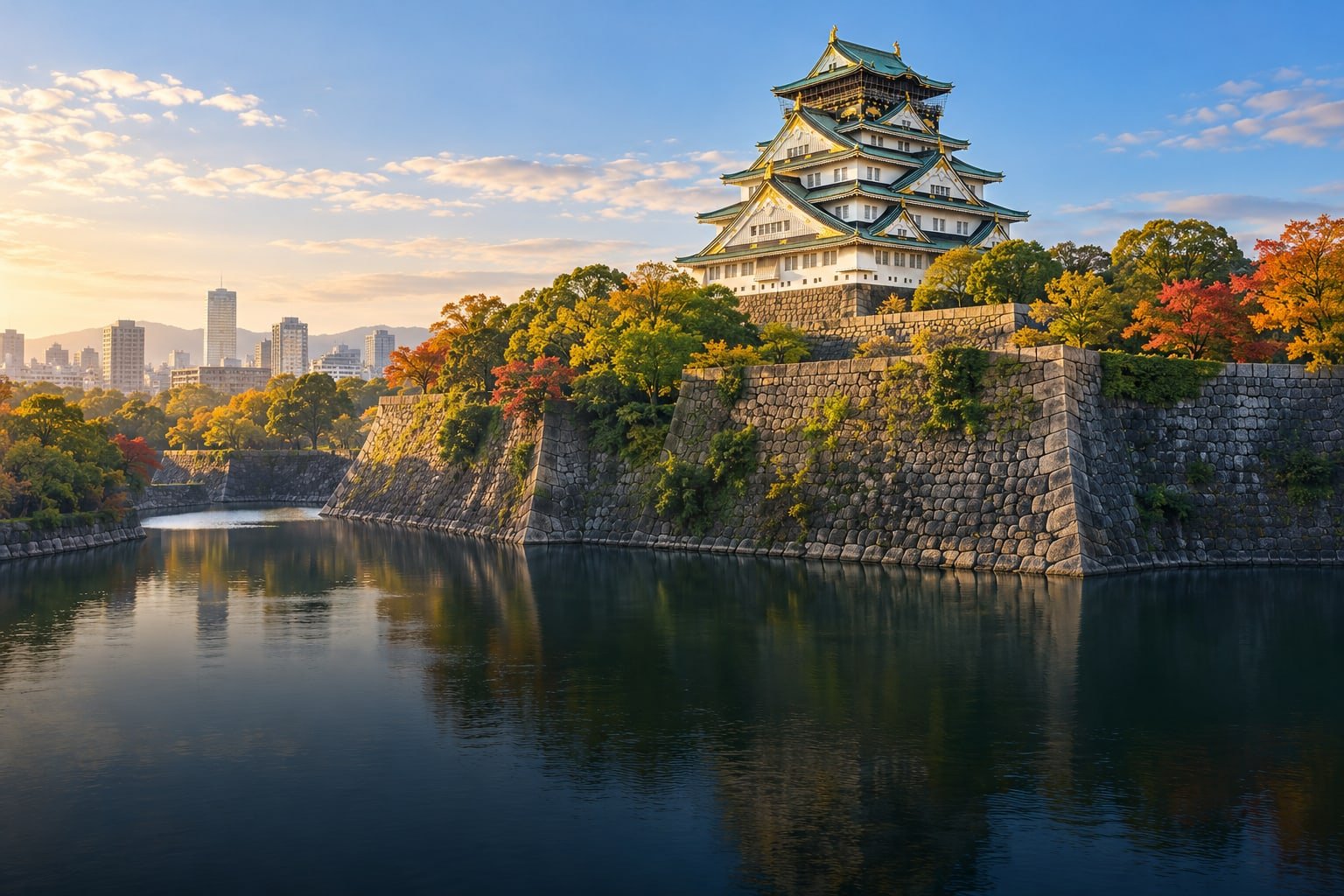
AI-generated editorial illustration inspired by Osaka Castle Park; an imagined composition, not a documentary photograph or verified viewpoint.
Osaka Castle Park rewards a visit with a purpose. You might want a walk beside the moats, the story behind the fortress, a garden view or a longer history day. Those choices need different amounts of time, and they do not all require the same ticket.
This Osaka Castle Park guide starts with that decision, then connects it to the right station and a workable route. The public grounds are free, while individual attractions have their own admission arrangements. A little planning prevents a long walk from consuming the time you meant to spend inside.[1]
This guide contains affiliate links. If you book or buy through them, Taylor’s Trailblazing may earn a commission at no extra cost to you.
Only 90 minutes?
Keep the visit outdoors: select gates, moat views and the castle exterior, leaving the museums for a longer block.
Interested in history?
Pair the tower museum with the included Toyotomi stone walls so the different castle periods become easier to understand.
Choosing a station?
Use the station that fits your next stop. A park entrance is still some distance from the main tower.
Considering a pass?
Count the admissions and eligible transport you will actually use. A castle-only visit does not automatically justify a city pass.
Osaka Castle Park: choose the visit you actually want
The park, the main tower museum and Nishinomaru Garden are different visits. The public grounds let you appreciate the moats, walls and exterior without buying a museum ticket. Choose the interior for historical interpretation; choose the garden for its lawn and view back towards the tower.[1][8]
| Part of the site | What it adds | Ordinary adult admission |
|---|---|---|
| Public park grounds | Moats, gates, parkland and exterior castle views | Free[1] |
| Osaka Castle Museum | Historical displays inside the main tower | ¥1,200[3] |
| Toyotomi Stone Wall Museum | An underground view of surviving earlier castle walls | Included with the tower ticket[4] |
| Nishinomaru Garden | A separate garden west of the tower | ¥300[8] |
The main tower dates from 1931 and has operated as a museum since its reconstruction. Many visible walls and gates belong to the later Tokugawa castle, while the Toyotomi remains lie beneath it. That layering is the most rewarding way to read the site: look at the defensive landscape outside, then use the museums to understand what changed.[2][4]
For someone primarily interested in an outdoor landmark and photographs, the grounds can be a satisfying complete visit. For a history enthusiast, the tower and stone-wall museum make a stronger pair than paying for the tower simply to look out from it.
Pick an approach, then choose your exit
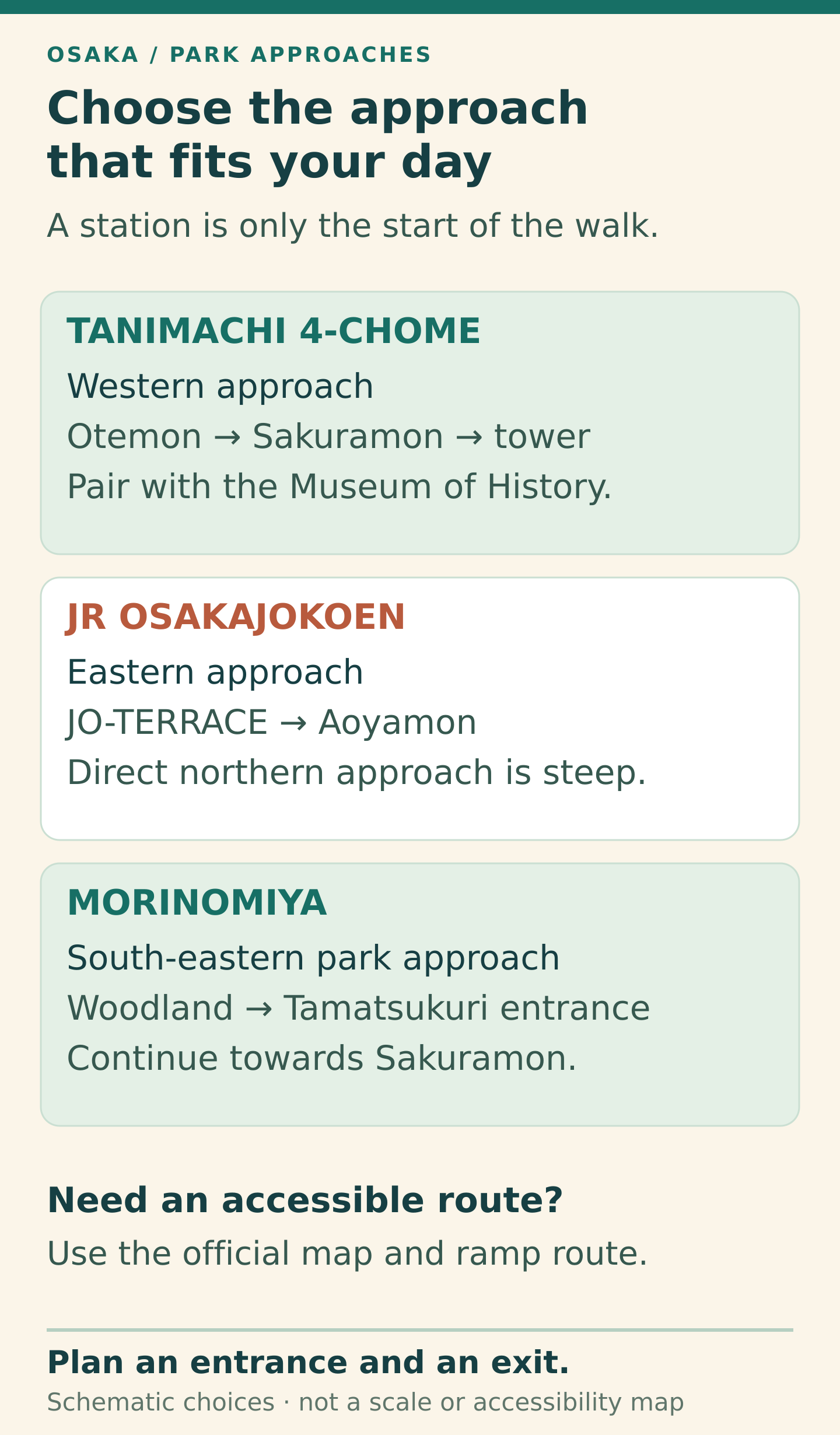
Osaka Castle stands inside a substantial park. Selecting a nearby station gets you to its edge; it does not remove the walk to the tower. The official sightseeing model links Tanimachi 4-chome and Osakajokoen over approximately 3 km, including the central sights. Use that as a route framework, with your own allowance for stopping.[6]
| Approach | Useful connection | Why choose it? |
|---|---|---|
| Tanimachi 4-chome | Osaka Metro Tanimachi and Chuo lines[5] | West-side approach through Otemon and Sakuramon; useful for the Museum of History. |
| JR Osakajokoen | JR Osaka Loop Line[5] | Eastern approach past JO-TERRACE and Aoyamon; convenient for a meal near the station. |
| Morinomiya | JR Loop Line; Metro Chuo and Nagahori Tsurumi-ryokuchi lines[5] | South-eastern park approach; useful if those lines already suit your journey. |
| Temmabashi | Keihan Railway or Metro Tanimachi Line[5] | A further western option when the railway or riverside location fits your day. |
For an ordinary sightseeing walk, entering on one side and leaving on another avoids retracing every path. Start at Tanimachi 4-chome, pass Otemon and Sakuramon, visit the tower area, then continue towards Aoyamon and JO-TERRACE before leaving at Osakajokoen. Reverse that order when the Museum of History is your final stop.[6]
Need to avoid the steeper northern approach? The official accessible map recommends Tanimachi 4-chome via Otemon and Sakuramon. From Osakajokoen it instead directs visitors through Aoyamon, left up Gangizaka Slope and around to Sakuramon. It warns that the Gokurakubashi approach is steep and has stretches without handrails. Follow the official accessible-route map for lifts, crossings and gradients.[7]
On a narrow screen, swipe the diagram sideways to read the details.
Inside the tower: give the history room to work
Expect a museum devoted to Toyotomi Hideyoshi, the castle and the conflicts surrounding it. The surviving historical objects and changing exhibitions deserve more attention than a hurried circuit to the top. This is a reconstructed tower with museum displays, so an expectation of untouched feudal residential rooms would lead you astray.[2]
The nearby Toyotomi Stone Wall Museum exposes masonry buried when the Tokugawa government rebuilt the castle. It is included in the main tower admission and opened in 2025. Seeing the lower, earlier wall after the great ramparts outside makes the chronology tangible. Access can be suspended if the condition of the exposed wall requires it.[4]
A guide is most useful if you want the defensive layout and competing historical periods explained as you walk. The Osaka Castle walking tour with tower admission on Viator combines the castle and Hokoku Shrine and finishes at the tower. Its current listing describes moderate walking and says it is not wheelchair accessible. Check the meeting point, group size, language and included admission before choosing it.[17]
An independent visit suits people who prefer to linger over selected objects or shorten the route. Set a realistic museum allowance before buying the next timed activity; a ticket that bypasses the purchase counter does not promise an empty building.
Buy the right ticket and test any pass against your day
The museum normally opens 09:00–18:00, with last admission at 17:30, and closes 28 December–1 January. The operator may stop people joining the ticket queue earlier when necessary. High-school and university students pay ¥600 with the required identification; overseas students should check the ISIC requirement. Junior-high-school pupils and younger are admitted free with the required eligibility evidence; being 15 alone is not sufficient if the visitor is already in high school. These arrangements were checked on 17 October 2026.[3]
Start with the museum’s official ticket link to see its current terms. If you prefer a booking platform, compare the Osaka Castle museum and tower entry ticket on GetYourGuide. The checked listing includes the Toyotomi Stone Wall Museum and is non-refundable. Have its entry QR code ready and read the validity instructions; skipping the ticket-purchase queue does not remove crowd controls.[16]
The ordinary Osaka Amazing Pass costs ¥3,500 for one day or ¥5,000 for two consecutive days under the current 2026–27 offer. Its participating attractions include the tower/stone-wall museum and Nishinomaru Garden, subject to their opening arrangements. Check the exact pass version, eligible transport and any special-event exclusions.[9][10]
Original cost check: tower plus ordinary garden admission is ¥1,200 + ¥300 = ¥1,500. A ¥3,500 one-day pass therefore needs another ¥2,000 of eligible transport or attractions you would actually use to reach the same value. A free-grounds visit creates no castle-admission saving at all. Do the arithmetic for your real day before adding activities merely to justify the pass.[9][10]
Keep this attraction choice within your wider Japan travel budget. Currency conversion and accommodation can matter more than a small admission saving; this guide keeps the checked attraction figures in yen.
Build a visit around the time you have
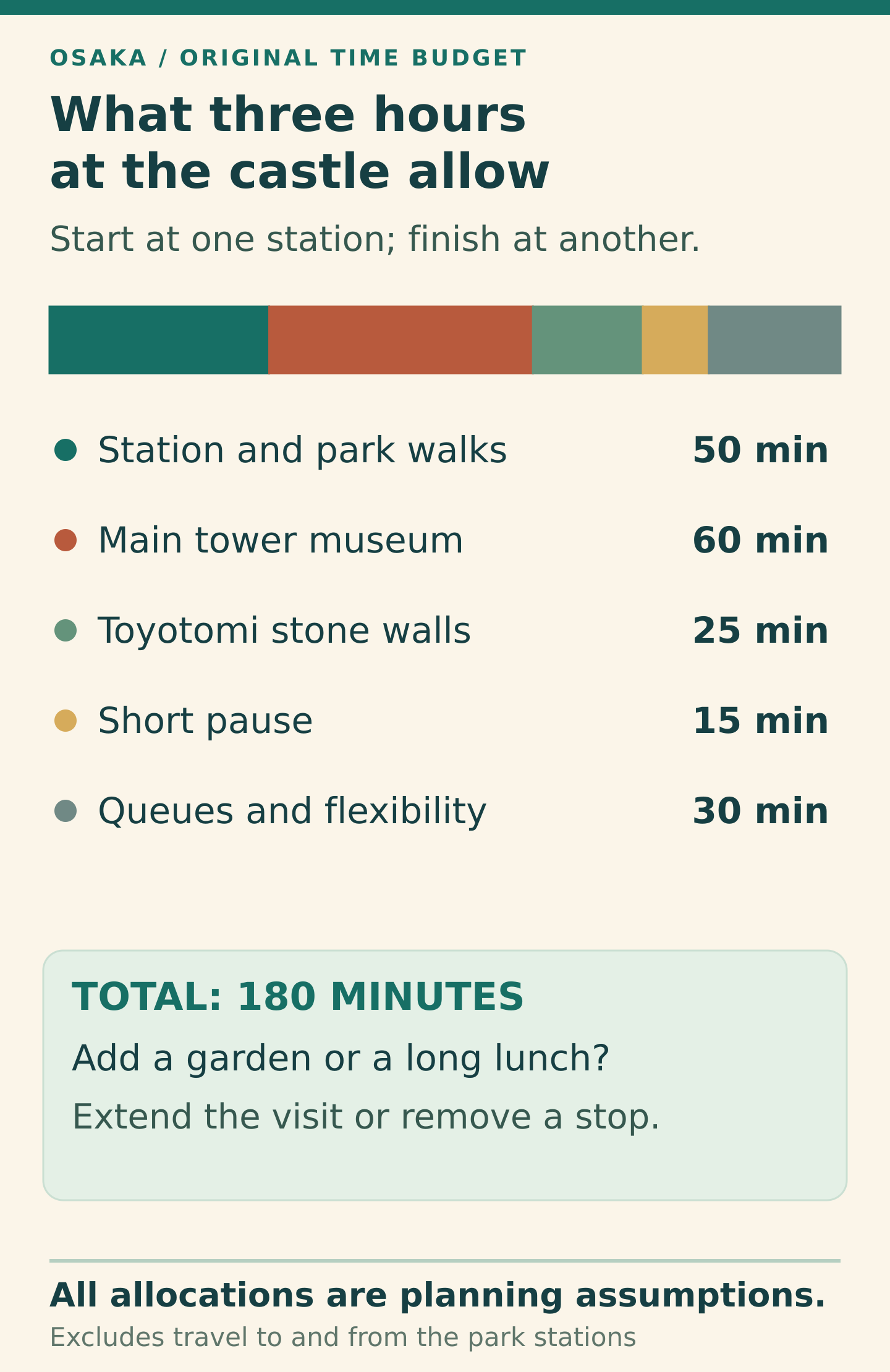
The following are original planning allocations, not measured completion times. They assume an ordinary walking pace, a visit within opening hours and no unusually long queue. The three-hour example begins and ends at park-side stations; your train journey from the hotel is extra.
| Available time | A coherent plan | What to leave for another visit |
|---|---|---|
| About 90 minutes | 55 minutes moving between station, gates and exterior viewpoints; 25 minutes looking and photographing; 10 minutes flexibility. | Museum interiors, a long meal and paid seasonal events. |
| About 3 hours | 50 minutes of station/park walks + 60 in the tower + 25 at the stone walls + 15 for a pause + 30 for queues and flexibility = 180 minutes. | Nishinomaru, turrets and a full lunch need more time. |
| About 4½–5 hours | Keep the three-hour core and add one substantial nearby visit; allow separately for extra walking and a meal. | Trying to fit every garden, museum and boat ride into the same block. |
For a practical morning, enter from Tanimachi 4-chome, take the central museum pair, then finish near JO-TERRACE for lunch. If the castle galleries matter most, increase their allocation to 90 minutes. That absorbs the example’s entire 30-minute flexibility allowance, so extend the visit or remove the stone-wall stop rather than treating both as free additions.
For a broader history day, reverse the route so that the western side becomes your exit. A 90-minute Museum of History allowance plus 15 minutes for the additional transfer adds 105 minutes to the three-hour core: 4 hours 45 minutes before a substantial meal. This is an editorial example; the museum itself offers both a shorter highlights route and a more detailed course.[12]
Nishinomaru is the lighter addition: allow an extra 30–45 minutes as a starting assumption, longer when photographing blossoms or attending an event. On a short Osaka stay, choose that garden, the extra museum or a long lunch according to your interests. Use the Japan trip-length comparison if the larger itinerary is already overfilled.
On a narrow screen, swipe the diagram sideways to read the details.
Make the garden and season earn their place
Nishinomaru is a separately gated lawn garden west of the tower, known for its cherry trees and views towards the castle. Current ordinary adult entry is ¥300. Its usual hours are 09:00–17:00 March–October and 09:00–16:30 November–February, with entry ending 30 minutes earlier. It closes Mondays, moving to the following day when Monday is a national holiday, and 28 December–4 January. Seasonal hours and fees differ; details checked 17 October 2026.[8]
Choose the garden when you want time for the setting and a composed castle view. A last-minute entry just before closing gives little room to enjoy it. The wider park also has a plum grove and seasonal planting, so a visit need not depend on a single flowering tree or a fixed blossom date.[1]
Separate the ordinary visit from a dated event
For autumn 2026, the park advertises Tamon and Sengan turret interiors on Saturdays, Sundays and holidays through 29 November. The ¥900 adult ticket includes Nishinomaru; the advertised tower set is ¥2,000. Turret hours are 10:00–16:30, last entry 16:00, with ticket sales ending at 15:30. Check the specific day before building a route around them.[15]
The announced Osaka Castle Illuminage runs 20 November 2026–14 February 2027 in Nishinomaru, with a separate adult fee of ¥2,000. It is an evening event, not an extension automatically included in ordinary garden admission. Recheck its date-specific ticket and operating details.[15]
For an ordinary daylight visit, treat blossom, autumn colour or a special event as a reason to allow more time, not a guarantee attached to the calendar. In hot weather shorten exposed walks and leave room for water and indoor breaks; in persistent rain decide whether the museum pair alone still justifies the outdoor approach.
Choose one nearby stop that complements the castle
Osaka Museum of History: add the city around the castle
The Museum of History sits near Tanimachi 4-chome. Its standard permanent-exhibition adult ticket is ¥600; normal hours are 09:30–17:00, last entry 16:30. It closes Tuesdays, or Wednesday if Tuesday is a national holiday, and 28 December–4 January. Special exhibitions can have separate charges; practical details checked 17 October 2026.[11]
The exhibitions use reconstructions and models to explore the wider city, and the route offers views towards Osaka Castle and Naniwa Palace. Choose it when you want to connect the fortress with Osaka’s longer development. The museum publishes an approximately one-hour highlights course, but a more detailed visit naturally needs longer.[12]
MIRAIZA: a convenient pause near the tower
MIRAIZA occupies the former military headquarters building beside the castle area, with cafés, restaurants and shops. It is a useful central pause if you do not want to walk out of the park for refreshments. Check the individual venue before relying on a particular meal, rooftop session or opening time.[13]
JO-TERRACE: finish near the railway
JO-TERRACE sits by JR Osakajokoen and has a range of cafés and eating places. It works particularly well as the end of a west-to-east visit because food and your departure station come together. Tenant hours vary; its directory is a better guide to the current choice than an old fixed restaurant list.[14]
The sequence matters more than collecting names. Use MIRAIZA for a break during the central visit, JO-TERRACE when leaving east, or the Museum of History when leaving west. If you want an entirely different part of Osaka afterwards, finish at the station serving that journey instead of completing a needless park circuit.
Plan for gradients, lifts and younger visitors
The tower’s usual lift route takes visitors upwards to the fifth floor, with stairs for the remaining ascent and normal descent. Wheelchair users and people who have difficulty walking can use staff-assisted lift access to all visitor floors. Ask staff on arrival. Pushchairs are normally left at the free entrance storage point because upper galleries are narrow.[3]
A lift inside the museum does not make the approach level. The official access map shows gradients, crossings and different lift exits for each station. From Morinomiya, its accessible directions follow the outside edge beneath Chuo-dori before entering by the marked route, rather than treating every park path as interchangeable. Consult that map and discuss assistance needs with the attraction before travelling.[7]
With children, choose one paid interior first and treat the second as optional. A morning walk, a focused museum visit and an unhurried meal can work better than a programme with several admission deadlines. Keep bags light, use the toilet before a longer gallery visit and save the return station on your phone.
Download the park map in advance. If you need mobile data for live directions and ticket access, browse Airalo and select a Japan plan after checking coverage, validity and activation conditions. Your phone must support eSIM and be network-unlocked. An existing roaming package may already cover the task; compare the actual allowances.[20][21]
Fit the castle into your Osaka stay
A castle visit rarely needs a hotel chosen solely for its view of the tower. First work out the rail station, airport journey and evening area that matter to the whole Osaka stay; then check the exact walk from the property to its nearest useful station. A room described as being in the castle area can still leave a substantial walk to the entrance you want.
Once the location is decided, compare Osaka accommodation on Booking.com and compare Osaka accommodation on Agoda. These are city searches, not recommendations for an inspected property. Use the same dates, occupancy, room type, breakfast and cancellation terms on both, and examine the map before selecting a cheaper rate.[18][19]
- Confirm whether you want the free grounds, the museum pair, the garden or a dated event.
- Choose the park entrance and departure station before buying a timed tour.
- Read the attraction’s opening calendar and any pass exclusions for the actual day.
- Leave room for the walk, a queue and a change of pace.
For the rest of the route, start with the first-time Japan planning guide and the Japan guide collection. The castle is a manageable part of a city day when it has a clear purpose and a realistic time allowance.
Your Osaka Castle Park questions answered
Can this be a short stop between onward trains?
Only after protecting the whole station-to-station journey. The park models exclude your arrival train, any luggage collection and the onward boarding margin. If the departure time is fixed, choose a focused exterior walk or one museum and leave a clear cut-off for returning to the railway.
Can I photograph everything inside the museum?
Follow the notices in each gallery. The museum prohibits photography in restricted areas and equipment that interferes with other visitors. Keep the camera decision separate from the outdoor park visit, where your main concern is leaving paths clear.[3]
Choose the plan that fits your trip
For a first visit with an interest in history, reserve a three-hour park block for the tower and Toyotomi stone walls, then add lunch. With less time, make the exterior walk the main event. Add Nishinomaru for the garden setting or the Museum of History for wider context, giving the extra stop its own time.
The most useful booking decision comes after the route decision: choose what you want to understand or see, identify the correct entrance, and buy only the admission that serves that plan.
How this guide was researched
This guide draws on official park, museum, access and ticket information checked on 17 October 2026, alongside the named booking services. The route choices and time budgets are original editorial planning models with stated assumptions. The current garden fee was checked against the park operator’s own information. The guide does not claim a personal visit, tested queue time or inspected hotel.
Sources and checks
Official, operator and relevant booking information checked on 17 October 2026. Opening arrangements, fares and availability can change; recheck the linked source for your travel dates.
- Osaka Convention & Tourism Bureau — Osaka Castle Park
- Osaka Castle Museum — official overview
- Osaka Castle Museum — visitor information
- Osaka Castle — Toyotomi Stone Wall Museum
- Osaka Castle Museum — transport access
- Osaka Castle Park — official sightseeing model route
- Osaka Castle Park — official accessible-route map
- Osaka Castle Park — Nishinomaru Garden
- Osaka Amazing Pass — current prices and conditions
- Osaka Amazing Pass — participating attractions
- Osaka Museum of History — official visitor information
- Osaka Museum of History — permanent exhibitions
- MIRAIZA Osaka-Jo — official venue directory
- JO-TERRACE Osaka — official directory and access
- Osaka Castle Autumn Festival2026 — official events
- GetYourGuide — Osaka Castle museum and tower entry ticket
- Viator — Osaka Castle walking tour and tower admission
- Booking.com — Osaka accommodation search
- Agoda — Osaka accommodation search
- Airalo — Japan eSIM marketplace
- Airalo — device compatibility
Illustrations in this article were created for Taylor’s Trailblazing Travels. Third-party photographs, where used, are credited beside the image or in the source list.