Japan · Setouchi art islands
Naoshima Art Island Guide: Museums, Tickets and Ferries
Choose the art you care about, then give the ferry, island roads and museum doors enough room.
Naoshima rewards a selective itinerary. A museum that holds your attention for an extra half-hour is part of the pleasure; it becomes a problem only when the rest of the day depends on leaving immediately.
This guide helps you choose between the museum coast and Honmura, understand which tickets are separate, and connect the island visit to the correct ferry. Start with one unmissable venue, then add nearby places you would still want to see without a checklist.
The worked day below uses published ferry departures and original planning allowances. It is a way to test your available time, not a confirmed set of museum reservations or bus connections.
Taylor’s Trailblazing Travels may earn a commission when you book or buy through an affiliate link in this guide, at no extra cost to you. This helps fund the research and upkeep of the site.
Choose one anchor
Let one museum you care about determine the day, then add nearby visits.
Check the exact ticket
A museum booking, an Art House ticket and a ferry ticket cover different things.
Allow island travel
Miyanoura, Honmura and the museum coast are separate planning areas.
Protect the return
Keep a port margin and check the operator’s current service notices.
Choose museums by interest and area
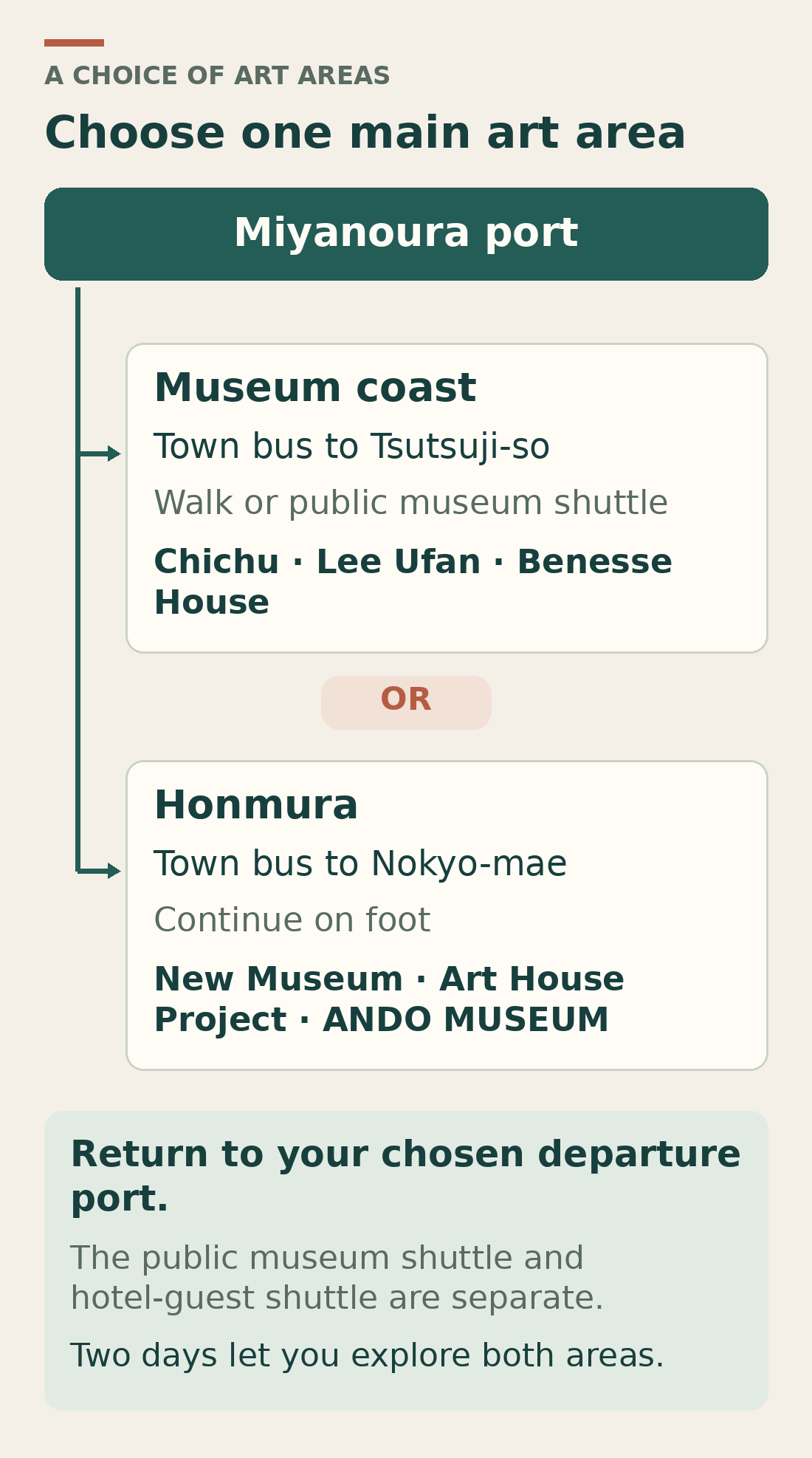
The most useful first decision is whether you want the concentrated museum coast or a day moving between contemporary art and Honmura’s village streets. The table shows six principal choices; you do not need to visit all six.
| Venue and area | Choose it for | Ticket and normal hours |
|---|---|---|
| Chichu · museum coast | Monet, Turrell and De Maria in Tadao Ando’s largely underground building; daylight is part of the encounter. | ¥2,500 weekdays; ¥2,700 weekends/holidays. Timed entry. 10:00–17:00, last admission 16:00.[1] |
| Lee Ufan · museum coast | A focused collection of Lee’s paintings and sculptures, with space for slower looking. | ¥1,200. 10:00–17:00, last admission 16:30.[3] |
| Benesse House · museum coast | A broader contemporary collection, installations and a connection to the coast. | ¥1,300. 08:00–21:00, last admission 20:00. Normally open daily; maintenance exceptions apply.[4] |
| Naoshima New Museum of Art · near Honmura | Contemporary work from Asia, including Japan, in the hilltop museum opened in 2025. | ¥1,500. 10:00–16:30, last admission 16:00.[2] |
| Art House Project · Honmura | Art spread through adapted buildings and village lanes. | Five-house ticket ¥1,200. Minamidera and Kinza each require a separate ticket. Several houses close for different midday breaks.[5] |
| ANDO MUSEUM · Honmura | Architecture, models and drawings inside a traditional house transformed with concrete. | ¥600. 10:00–13:00 and 14:00–16:30; last admission 16:00.[6] |
On a small screen, swipe inside the table to see every column.
Chichu is the strongest anchor if those particular artists and the building are your reason for coming. If you are more interested in the relationship between art and inhabited streets, give Honmura the substantial block of time. Save a third major area for another day when a long lunch or an absorbing exhibition would otherwise become an inconvenience.
Book the museum you want before fixing the day
Start with Benesse’s opening calendar for your actual date. Chichu, Lee Ufan, the New Museum, ANDO MUSEUM and the Art House Project usually close on Monday; a national-holiday Monday normally shifts their closure to the next day. Do not treat Benesse House’s longer hours as evidence that the rest of the island’s museums are open.[7]
The New Museum’s published exhibition-change closure covers 24 November–12 December 2026; recheck any reopening arrangements for 12 December. Chichu’s announced closure is 12 January–19 March 2027, while several other main venues close 12–18 January. Kinza is already closed at this review: 13 October 2026–20 January 2027. Haisha also closes 12 January–22 February 2027. Check the named venue rather than relying on an island-wide “open” label.[8][9]
- Choose the date, your ferry approach and one priority venue. If you are staying overnight, check accommodation at the same time.
- Use the official ticket-reservation page. Chichu, Minamidera and Kinza use specific date-and-time tickets; other venues have their own admission conditions.[10]
- Leave room before the first slot for the crossing, island transport, walking from the stop and finding the entrance. A ferry arrival is not a museum arrival.
- Read cancellation conditions and retain the booking confirmation before buying the rest of the day. Agree any guide arrangements before duplicating tickets.
Chichu explicitly says there are no on-site sales when its online tickets have sold out. Arriving at the door is therefore a poor fallback for an unbooked visit.[1]
The Art House multi-site ticket now covers five houses, excluding Minamidera and Kinza. It is not a pass to every museum or every Art House. The five-house online ticket is ¥1,200, against ¥600 for one eligible house: two single-house tickets cost the same; a third eligible visit makes the multi-site option cheaper, provided the houses you want are open.[5]
Choose Uno or Takamatsu and the correct boat
From the main Honshu rail corridor, Uno is the convenient approach to compare first: Benesse gives approximately 50 minutes from Okayama to Uno by train, plus a short walk to the port. Check the actual rail connection for your date. Takamatsu makes more sense when you are already staying in Shikoku.[15]
| Crossing | Published duration and fare | Planning consequence |
|---|---|---|
| Uno · ferry | About 20 minutes; ¥370. | The regular ferry takes foot passengers, bicycles and vehicles. The separate passenger boat is about 15 minutes; ordinary daytime fare ¥370, with a higher late-night fare.[11] |
| Takamatsu · ferry | About 50 minutes to Naoshima, 60 minutes back; ¥680. | Check each direction. The crossing time is not identical both ways.[12] |
| Takamatsu · high-speed boat | About 30 minutes; ¥1,590. | Foot passengers only; no bicycles or cars. Tickets are sold at the counter, with cash payment.[12] |
On a small screen, swipe inside the table to see every column.
Ferries and high-speed boats use different piers at Takamatsu and Miyanoura. Read the boat type as well as the destination on your ticket. Honmura is another port on Naoshima, so a sailing to Honmura does not deliver you to Miyanoura.[13][15]
Shikoku Kisen says boarding reservations are not accepted and passengers are handled in arrival order. Check the operator’s service status before setting off and again before the return; weather or sea conditions can disrupt sailings. A prebooked museum cannot make a cancelled boat run.[13]
If you are approaching from Osaka, compare Osaka–Okayama rail options on 12Go alongside your preferred rail booking service. Confirm the exact departure station, train, seat type, fees and collection method. That purchase covers the approach to Okayama; you still need the Uno connection and a separate ferry ticket.[21]
Treat island transport as part of the visit
The town bus links Miyanoura, Honmura and Tsutsuji-so. For the museum coast, continue from Tsutsuji-so on foot or on the public Benesse Art Site shuttle. The town bus costs ¥100 per adult ride, paid in coins when getting off; the public museum shuttle is free. For Honmura’s village art, Nokyo-mae is the useful stop to identify on the current map.[14]
Download the official island map and current bus information before travelling. On days when Chichu and Lee Ufan are closed, the public shuttle is suspended. Check the current timetable during maintenance periods. The Benesse House hotel-guest shuttle is a separate service: do not plan to board it unless you are an eligible guest.[16]
A rental bicycle gives flexibility between stops, but you cannot ride through the restricted section of the museum grounds. Park where directed and continue on foot or by shuttle. A car also has access restrictions, so neither option removes all walking.[14]
Choose buses if you would rather avoid riding unfamiliar hilly roads. Choose a bicycle only if the weather, your confidence and the rental conditions suit the day. If you need vehicle assistance, arrange it in advance and ask about the exact museum entrance; a taxi should not be the unbooked rescue plan for a tight ferry connection.
Test a one-day plan against the ferry clock
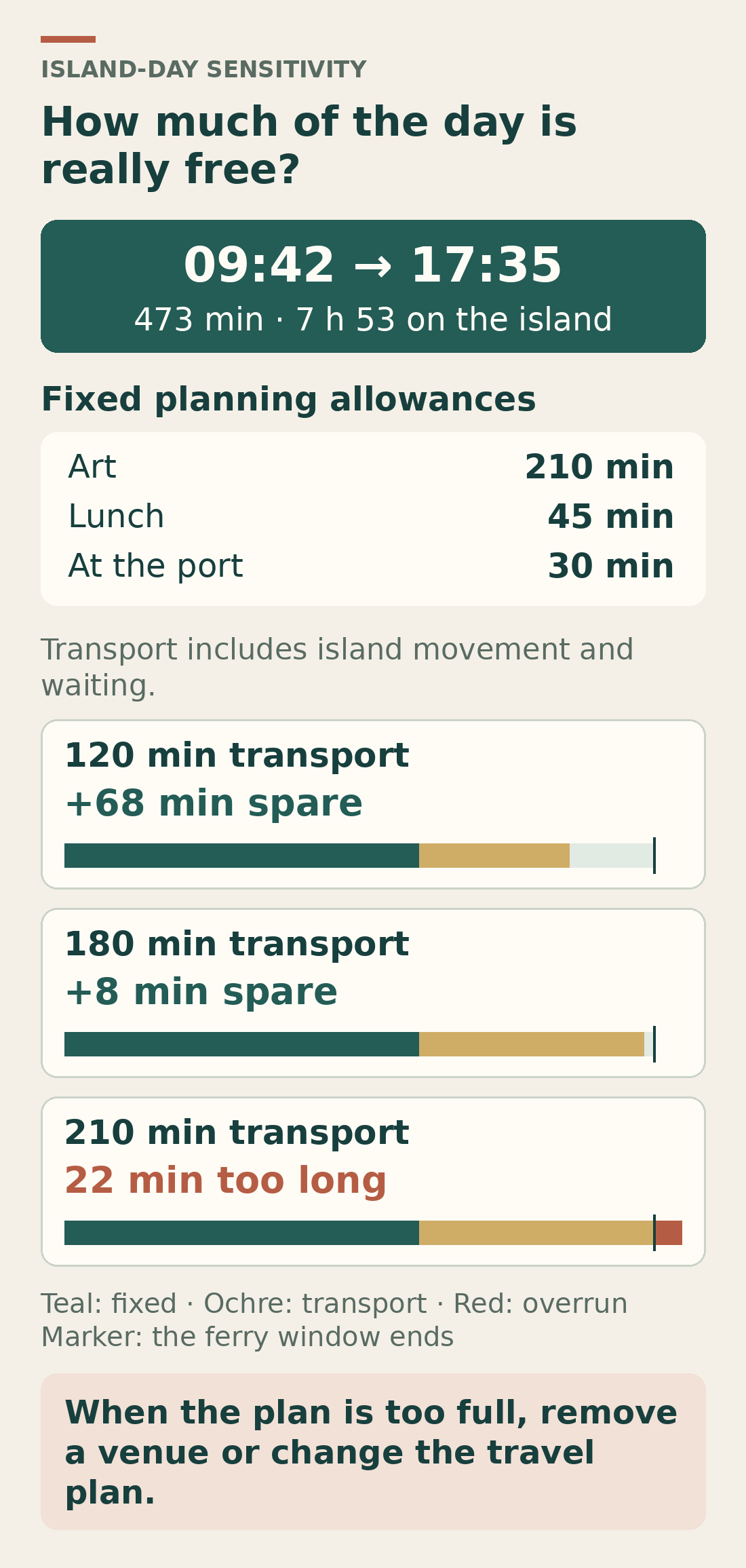
Here is a worked museum-coast day from Uno. The published 09:22 ferry arrives at Miyanoura at 09:42; a 17:35 departure returns to Uno at 17:55. That gives 7 hours 53 minutes, or 473 minutes, on the island before departure. These are timetable entries checked on 18 October 2026, not guaranteed capacity or future operation.[11]
An illustrative 11:00 Chichu reservation leaves 78 minutes after the ferry’s scheduled arrival for the island connection and entry preparation. Verify the actual buses and the museum’s arrival instructions before choosing that slot. After Chichu, keep the remaining art visits on the museum coast and return to Miyanoura.
| Use of the island window | Minutes allowed |
|---|---|
| Chichu / Lee Ufan / Benesse House | 90 + 45 + 75 = 210 |
| Lunch | 45 |
| All island travel, walking and waiting | 120 |
| At the departure port before the boat | 30 |
| Total committed | 405 |
| Remaining flexibility | 473 − 405 = 68 |
The useful result is the sensitivity, not the neat total. If land travel and waiting take 180 minutes, flexibility falls to 8 minutes. At 210 minutes, the plan is 22 minutes over. Remove a visit, choose an earlier arrival or stay overnight; do not recover time by dropping the port margin. The 30-minute margin is a planning allowance, not a boarding guarantee.
Use this test for a Honmura day too, replacing the museum allowances with the art you actually want. Check the midday breaks at the houses and ANDO MUSEUM. Trying to add an entire Honmura circuit to the worked coast day spends flexibility that was meant for queues, tired feet and the unexpected.[5][6]
Budget for separate admissions and local transport
For the three museums in the worked coast day, standard adult online admission totals ¥2,500 + ¥1,200 + ¥1,300 = ¥5,000 on a weekday, or ¥5,200 on a weekend or national holiday. Buying each at the door, where available, raises those totals to ¥5,700 and ¥5,900 respectively.[1][3][4]
Add two ordinary Uno ferry crossings (¥740) and two town-bus rides (¥200): the weekday example becomes ¥5,940, or ¥6,140 at a weekend. Food, the mainland rail journey, accommodation, bicycle hire, extra rides and special programmes are excluded. These are calculations from the standard published prices, not a package offer.[11][14]
Do not buy a visit simply because it makes a pass look better value. If an extra museum pushes out the art you came for, the cheaper day may also be the more satisfying one. Take cash for the small transport payments even if you have already paid for museum entry online.
For the wider trip, place this day inside the Japan budget for UK travellers rather than converting a few admission fees into an unsupported full holiday total.
Use an overnight stay or guide to solve a real constraint
Stay overnight on Naoshima if your interests span both the coast and Honmura, or if you want a slower morning after the day visitors arrive. Miyanoura is a practical base for your arrival and departure; Honmura suits a village-art emphasis. Check the property’s location against the map, its luggage arrangements, meal provision and latest check-in before booking.
Compare Naoshima stays on Agoda or browse Naoshima accommodation on Booking.com. These are island-area searches, not a promise of a particular room, port location or available date. Use the property map and confirm your arrangements with the accommodation.[19][20]
For a two-day outline, give the arrival day to the museum coast and the following morning and afternoon to Honmura, or reverse that order to suit the tickets. Benesse House Museum’s normal evening opening can help an island overnight, but check your transport and the maintenance calendar first. Staying at Benesse House includes its museum admission; a room elsewhere on the island does not.[4]
A guide is useful when you want interpretation, help coordinating the day or a route tailored to your interests. Japan Guide Agency’s Naoshima tour on GetYourGuide is a customisable walking day; its conditions say a private vehicle is not included and public transport or taxis may be used. Agree the start point, duration, ticket purchases and extra costs before relying on the sample itinerary.[17]
Another option is the private Naoshima guide listed on Viator. Its published meeting point is JR Hotel Clement Takamatsu; confirm the start that applies to your booking. Its itinerary marks museum admission as excluded. Ask for the final route and a written breakdown of tickets and transport for your party. Paying for a guide does not itself confirm a Chichu time slot.[18]
Prepare for the spaces, the weather and the neighbourhood
Wear shoes you can walk in and remove easily. Chichu asks visitors to leave large items at its lockers or ticket centre, prohibits photography and video inside, and requires shoes off in some spaces. Leave enough time to store luggage rather than carrying it to the entry queue.[1]
Accessibility varies by room and building. Chichu and the New Museum both say some spaces are not accessible to every visitor and invite direct enquiries. Explain the assistance you need before booking; do not assume that a short shuttle journey means a step-free museum route.[1][2]
Honmura remains a residential neighbourhood. Keep doorways clear, lower your voice between buildings and follow signs about photography and access. Inside any venue, the room’s rules take precedence over what you saw someone else doing. Outdoor art and sea views are weather-dependent; carry a light waterproof and water, and allow an indoor pause when conditions become uncomfortable.
Keep ticket confirmations, the map and return options available offline. If your existing roaming does not suit the trip, browse Airalo and select Japan to compare data plans. Check the plan’s activation instructions and confirm that your phone supports eSIM and is network-unlocked. Mobile data is helpful for updates; it does not guarantee reception on every crossing.[22][23]
Frequently asked questions
Can I enjoy Naoshima without getting a Chichu ticket?
Yes. Choose a Honmura day with the New Museum and village art, or consider Lee Ufan and Benesse House if those collections appeal. Confirm the date and admission for each. If Chichu is your main reason for travelling, changing the day is more sensible than hoping for tickets at the door after online slots sell out.[1]
Are the museums suitable for children?
Age rules vary. Chichu, the New Museum and Lee Ufan admit children aged 15 and under free but still require them to be included in reservations. Minamidera does not admit children aged five and under. Check each venue’s rules and choose a number of visits that suits your family.[10]
Can I add Teshima to the same day?
It adds another island, another crossing and another set of admission decisions. For a first visit, keep the worked day for Naoshima and plan Teshima separately. If you deliberately choose a short visit on each, rebuild the day from the current inter-island operator timetable and confirmed museum slots.[13]
What if the weather disrupts the ferry?
Check the operator’s current notice and ask port staff about the available options. Contact your museum or accommodation through the booking channel; its own conditions govern changes. Keep onward travel flexible enough that a disrupted island crossing does not depend on an immediate long-distance connection.[13]
Is Monday always the wrong day?
It is a poor default for a broad museum day because many main venues usually close then. Benesse House has different normal opening days, and national holidays shift some closures. Use the official calendar for the exact date and museum before deciding.[7]
The next planning step
Choose the museum that makes the journey worthwhile, check its calendar, then confirm the ticket and build the rest of the day around your ferry. For a first visit, one coherent area with time to look is a strong plan. Add an overnight when your interests extend across the island.
Use the Trip Itinerary Planner to place Naoshima’s nights and travel days within the wider journey, and return to the Japan guides for the rest of your route. Keep the museum reservations and actual transport bookings alongside that outline.
Sources and further reading
Visitor information and booking conditions checked for this editorial review on 18 October 2026. Recheck the linked operators for your travel date; planning allowances are identified separately in the guide.
- Benesse — Chichu Art Museum: collection, hours, admission and visitor rules
- Benesse — Naoshima New Museum of Art: collection, location and admission
- Benesse — Lee Ufan Museum: art, hours and admission
- Benesse — Benesse House Museum: art, hours and admission
- Benesse — Art House Project: five-house ticket, separate admissions and midday breaks
- Benesse — ANDO MUSEUM: architecture, admission and midday closure
- Benesse — current opening calendar and exceptional closures
- Benesse — revised New Museum closure, 24 November–12 December 2026
- Benesse — announced maintenance closures for January–March 2027
- Benesse — ticket reservations, timed facilities and child-entry conditions
- Shikoku Kisen — Uno–Miyanoura ferry and passenger boat: times, fares and piers
- Shikoku Kisen — Takamatsu–Miyanoura ferry and high-speed boat: times and fares
- Shikoku Kisen — route selection, operating-status link and boarding policy
- Naoshima Town Tourism Association — first-visit transport and island areas
- Benesse — mainland approaches and separate ferry and passenger-boat piers
- Naoshima Town Tourism Association — maps, town buses and hotel-guest shuttle
- GetYourGuide / Japan Guide Agency — customisable Naoshima walking tour
- Viator — private Naoshima tour with a licensed guide and museum exclusions
- Agoda — Naoshima accommodation search
- Booking.com — Naoshima accommodation search
- 12Go — Osaka–Okayama transport comparison
- Airalo — Japan eSIM plans
- Airalo — eSIM compatibility and network-unlocked device requirement
Illustrations in this article were created for Taylor’s Trailblazing Travels. Third-party photographs, where used, are credited beside the image or in the source list.