Cycling the Shimanami Kaido: Route, Bike Hire and Overnight Stops
Build a ride around your pace, a bike you can return, and an island stop worth staying for.
- Around 70 km on the main route
- One day or a slower crossing
- Bike-return rules matter
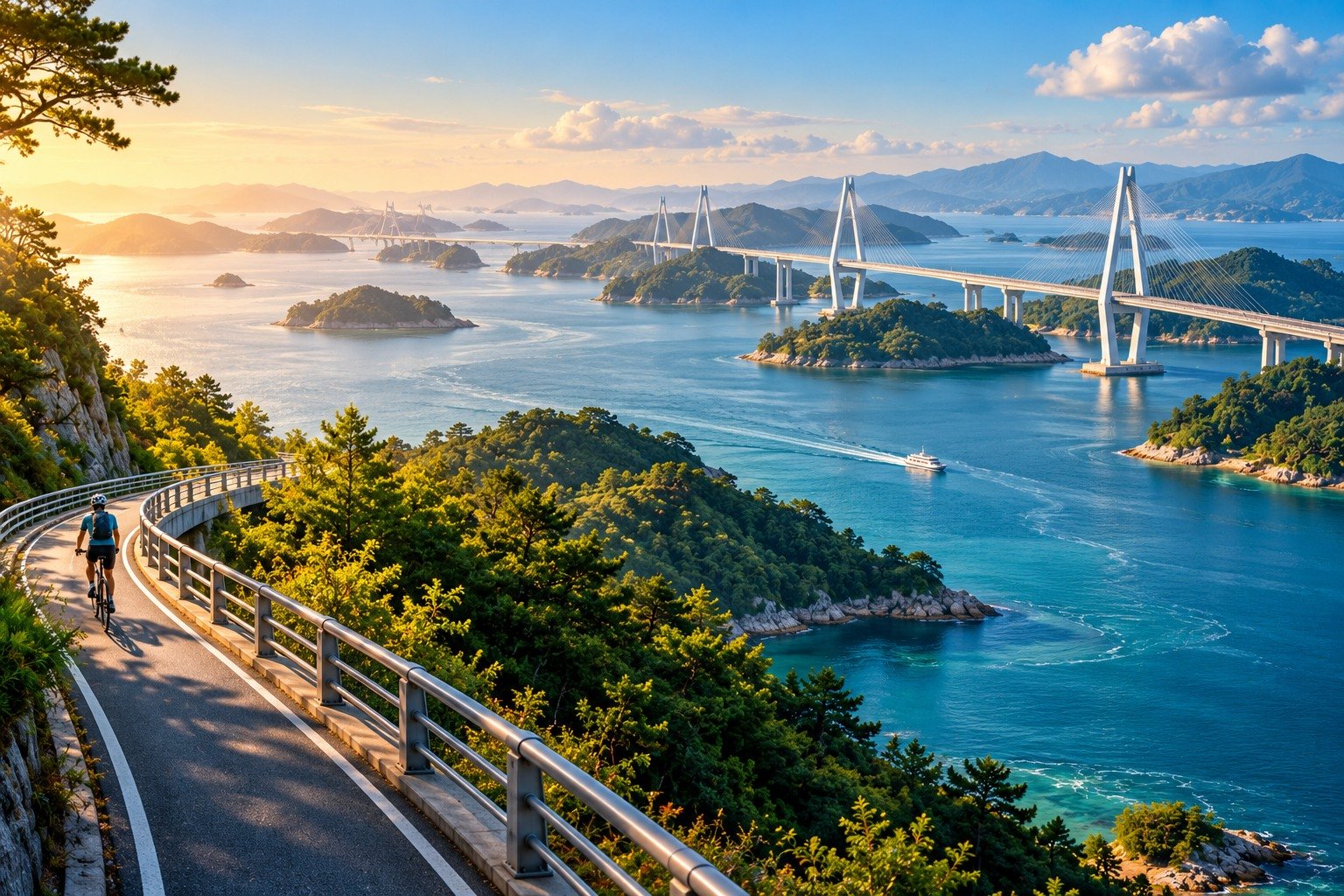
An original Shimanami-inspired illustration, not a documentary view of a particular bridge approach.
Cycling the Shimanami Kaido is an island journey, not simply a bridge photograph with a bicycle in the foreground. The main Blue Line route runs roughly 70 km between Onomichi and Imabari, and the official tourism body suggests spreading it over two or three days when a single day would feel rushed. [1]
The most useful planning order is bike, overnight location, luggage and onward transport—not hotel first and logistics afterwards. This guide explains how those decisions fit together, including a shorter ride for travellers who want the scenery without committing to the entire crossing.
This article contains affiliate links. If you book or buy through them, Taylor’s Trailblazing Travels may earn a commission. Recommendations are chosen for their relevance to the trip.
Route shape
A one-way crossing avoids riding the same distance back.
Overnight choice
Match the island hotel to both riding days, not just the view.
Hire decision
Confirm size, collection, return terminal and permitted duration.
A shorter alternative
A partial ride with a confirmed ferry can be the better holiday.
Cycling the Shimanami Kaido: choose your ride
| Format | Best fit | What must work |
|---|---|---|
| Partial day | Scenery, a café stop and a manageable first taste | A return ferry, same-terminal return or an agreed one-way hand-back |
| One full day | Cyclists accustomed to a sustained day in the saddle | Early collection, realistic pace and a return deadline with margin |
| Two or three days | Island stays, longer lunches and less clock-watching | Permitted multi-day hire, secure overnight storage and balanced stages |
A long ride is not made suitable merely by putting it on a holiday itinerary. Consider the distance you have comfortably ridden recently, your confidence descending and the tolerance of the least experienced member of the group. An electrically assisted bicycle can reduce effort; it does not remove traffic, braking or balance decisions.
Treat the route as a sequence of islands with ordinary roads as well as dedicated bridge approaches, rather than a completely traffic-free cycleway. The bridges have different layouts; the Innoshima Bridge, for example, has a separate lower-level passage. Follow the cycling signs, not a navigation setting that routes cars over the expressway. [4][7]
Follow the islands, not a straight line on the map
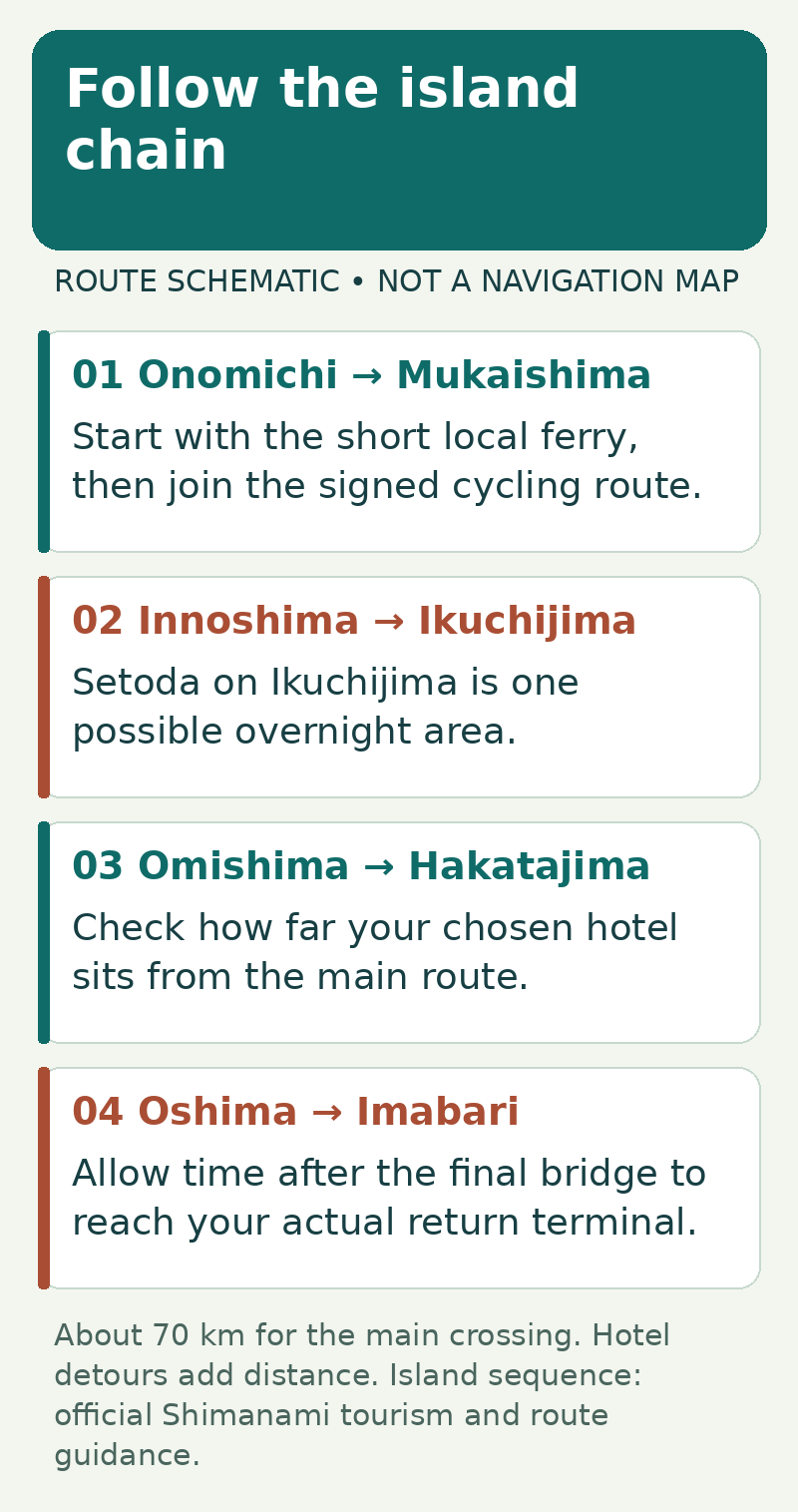
From Onomichi, begin with the local ferry to Mukaishima. The official area guide identifies the Onomichi Port crossing and gives a cash fare of ¥100 per person plus ¥10 for a bicycle; confirm the fare at the jetty. This small crossing is a separate service from any longer ferry used to shorten the ride. [3]
Continue through Innoshima, Ikuchijima, Omishima, Hakatajima and Oshima before reaching the Imabari end. Bridge access ramps and the journey between the final bridge and your chosen finish are part of the day. A photograph at the end of a bridge does not necessarily mean that you have reached the rental desk or railway station. [1][7]
Either direction can work. Decide from confirmed hire availability, the next destination in your Japan route and the location of the overnight stop. Do not choose a direction on the assumption that the wind will help throughout; the forecast and exposure matter more than a generic recommendation.
Test the day before reserving a one-day bike
Use a moving-speed estimate that you can sustain, not the speed briefly shown on a bike computer. Then add every non-riding task. The following is an original comparison using a 70 km route, no sightseeing detours, and three hours for collection/ferry tasks, meals, rests, photographs and contingency.
| Input | Steadier rider | Slower rider |
|---|---|---|
| Moving speed | 15 km/h | 10 km/h |
| Moving time: 70 ÷ speed | 4 h 40 min | 7 h |
| Non-riding allowance | 3 h | 3 h |
| Total planned day | 7 h 40 min | 10 h |
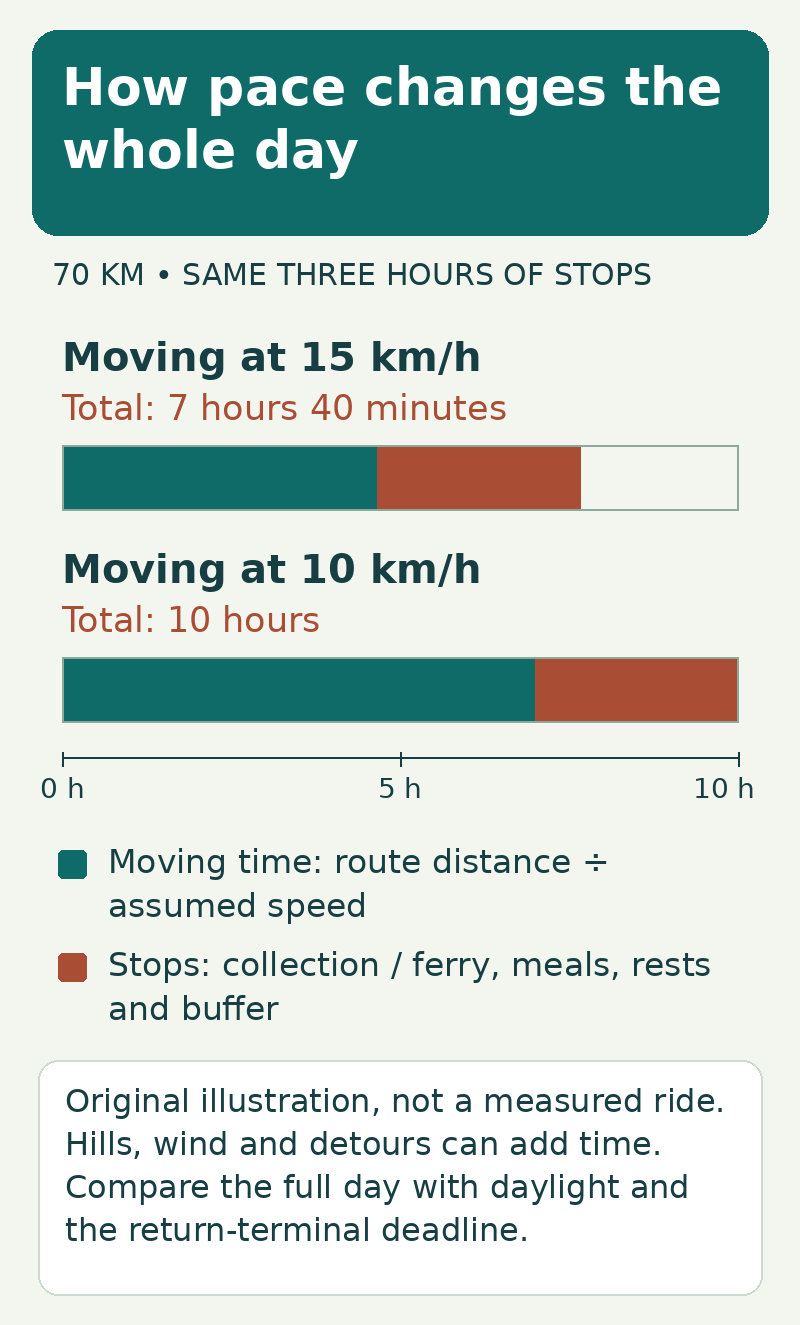
This is a feasibility test, not a target to chase. A headwind, a wrong turn or repeated climbs can increase the moving time. A long museum visit is extra, not hidden inside a modest photo allowance.
Work backwards from the earlier of daylight and the return desk’s deadline, leaving margin before any onward train. If that available window is shorter than your model, book an overnight stop or reduce the route. Do not solve the mismatch by quietly removing lunch, rests or the safety buffer.
Book the right bike, not just an electric one
| Category | Published daily charge | Duration / return distinction |
|---|---|---|
| Cross bike or city cycle | ¥3,000 per calendar day | Multi-day hire permitted; network-terminal return |
| Battery-assisted bicycle | ¥4,000 per calendar day | Multi-day hire permitted; designated collection points |
| E-bike category | ¥8,000 per calendar day | Same-day return; not the multi-day category above |
| Tandem | ¥4,000 per calendar day | Same-day return to the collection terminal |
Reserve the frame size and category, then confirm the exact collection and hand-back locations. Battery range is a planning variable: load, hills and assistance level change consumption. Ask which battery support or charging arrangements apply to the bike actually assigned to you. Do not transfer rules between a public rental, a shop rental and a guided-tour bicycle.
For illustration, two calendar days at the published cross-bike rate total ¥6,000 per adult before any additional charge. Two adults therefore start with ¥12,000 for the bikes alone. Ask about one-way charges, damage liability and cancellation before comparing that total with another provider; an overnight hotel and luggage service are not included.
The public operator requires a helmet, supplies it with hire and prohibits night riding. Its Japanese conditions also emphasise left-side riding, controlled descents and consideration for pedestrians. [4] Choose a fit you are comfortable wearing all day, and test the brakes and gears before leaving.
Choose an overnight stop that balances both days
| Area | Why consider it | Check before paying |
|---|---|---|
| Setoda, Ikuchijima | A village-based break within the island chain | Remaining distance on day two and the location of the actual property |
| Omishima | A later stop when you prefer a longer first stage | Distance from the main crossing to the hotel and back |
| Onomichi before the ride | Avoids adding a long arrival journey to the riding morning | Collection arrangements and breakfast timing |
| Imabari after the ride | Removes pressure to catch a distant connection immediately | Which terminal and station your hotel is near |
A two-day sketch is simple: arrive in Onomichi the previous afternoon; collect the bicycle and ride to the booked island hotel on the first riding day; continue to the agreed Imabari terminal on the second. Plot the exact addresses before treating the stages as balanced. Do not automatically divide the advertised route length by two and assume the hotel lies precisely halfway.
Ask the accommodation about secure bike storage, charging permission where relevant, meal arrangements, late arrival and whether it accepts luggage deliveries. A room without dinner may be a poor fit after a late rural arrival unless an alternative meal is confirmed. Equally, an attractive remote property is not a bargain when the detour makes the second day unmanageable.
Separate the bicycle, luggage and passenger journeys
There are three transport plans, and each needs an answer. Where will the bike be returned? Where will your suitcase be delivered or stored? How will you travel after the return? Solving only the third question leaves a bike or a bag on the wrong side of the Inland Sea.
Sagawa’s service information describes the Onomichi–Shimanami–Imabari area and participating facilities, with handling cut-offs varying by location; delivery can be delayed by traffic or weather. Confirm both endpoints and the applicable service before promising yourself same-day access to a suitcase. Keep medication, essential clothing and travel documents with you. [6]
For a shortened ride, check the precise ferry sailing, whether an assembled rental bicycle is accepted, any capacity limit and the rental company’s return conditions. A passenger bus booking does not automatically transport an assembled bike. The official Shimanami transport directory is the starting point for operator routes and timetables. [5]
Use conditions and alternatives to protect the trip
Leave space to change the riding day when conditions deteriorate. Heat can make a familiar distance feel very different; rain and gusts change bridge exposure and braking. Check local forecasts and operator notices before collection and again before exposed sections. Stop and seek local advice rather than pushing on simply because a hotel deposit has been paid.
Carry water, food you can eat between settlements, a charged phone, offline route information and the rental contact. Refill before a long exposed stretch. Discuss a breakdown procedure with the desk, including how to describe your location and where a replacement or recovery can actually be arranged. A guide is useful for interpretation, pacing and logistics; it is not a guarantee against weather or mechanical problems.
A shorter guided ride is a legitimate alternative, not a failed crossing. Viator’s three-hour private product from Onomichi covers only part of the Shimanami route and lists bicycles, helmets and ferry tickets among its inclusions. It is not the complete Onomichi–Imabari ride. Read its route, fitness requirements and cancellation terms before deciding whether it fits. [9]
Questions worth settling before you go
Can a beginner cycle the whole route?
Some can, but “beginner” says little about stamina or road confidence. Use recent riding experience and a realistic total-day calculation. A partial ride or two days is usually a more adaptable first plan than committing to a one-day equipment return with no tested pace.
Does a one-way rental mean any return point is acceptable?
No. It means the provider accepts the agreed hand-back under that product’s conditions. A private shop, a public terminal and a hotel are not automatically interchangeable. Obtain the location and closing time in writing before you start.
Should the hotel be on the first or second island?
Choose from mapped stages, not island count. Ferry choices, detours and your exact Imabari finish can move the practical midpoint. A stop that leaves too much for the final day undermines the purpose of riding more slowly.
What is the most expensive avoidable mistake?
Committing to mismatched bookings: an overnight island stay with same-day-only bike hire, a suitcase sent to a non-participating property, or an onward train that requires an unrealistically fast finish. Confirm those interfaces before choosing non-refundable rates.
Your next decision
Choose the version that leaves enough time to notice the islands. For a slower first crossing, that normally means arriving before the riding day, using permitted multi-day hire and choosing an overnight stop from the actual route. A confident one-day rider still needs a clear return deadline; a casual visitor can sensibly choose a smaller section and enjoy it properly.
How this guide was prepared
Route facts and rental distinctions come from Shimanami tourism and operator information. The riding-day calculation and overnight framework are original editorial planning tools. No ride, equipment test, hotel stay or booking transaction was performed. Charges and service arrangements should be rechecked for the intended date.
Sources
Information reviewed on 18 October 2026. Check current operating notices, prices and booking conditions for your travel dates. Some local primary sources are in Japanese.
- Visit Shimanami — main Blue Line itinerary
- Shimanami Japan — public bike categories, charges and conditions
- Visit Shimanami — Mukaishima and the initial ferry crossing
- Shimanami Japan — Japanese rental conditions and cycling precautions
- Visit Shimanami — transport services and operator links
- Sagawa Express — hands-free travel service questions
- Visit Shimanami — the bridges and their different arrangements
- 12Go — Osaka to Fukuyama booking comparison
- Viator — private three-hour partial cycling tour from Onomichi
Illustrations in this article were created for Taylor’s Trailblazing Travels. Third-party photographs, where used, are credited beside the image or in the source list.