Kyoto Travel Guide: Neighbourhoods, Temples and Trip Planning
Build the visit around neighbourhoods and a few meaningful places—not a race between famous temple gates.
- Three geographically grouped days
- Temples, shrines and city life
- Accommodation tax explained
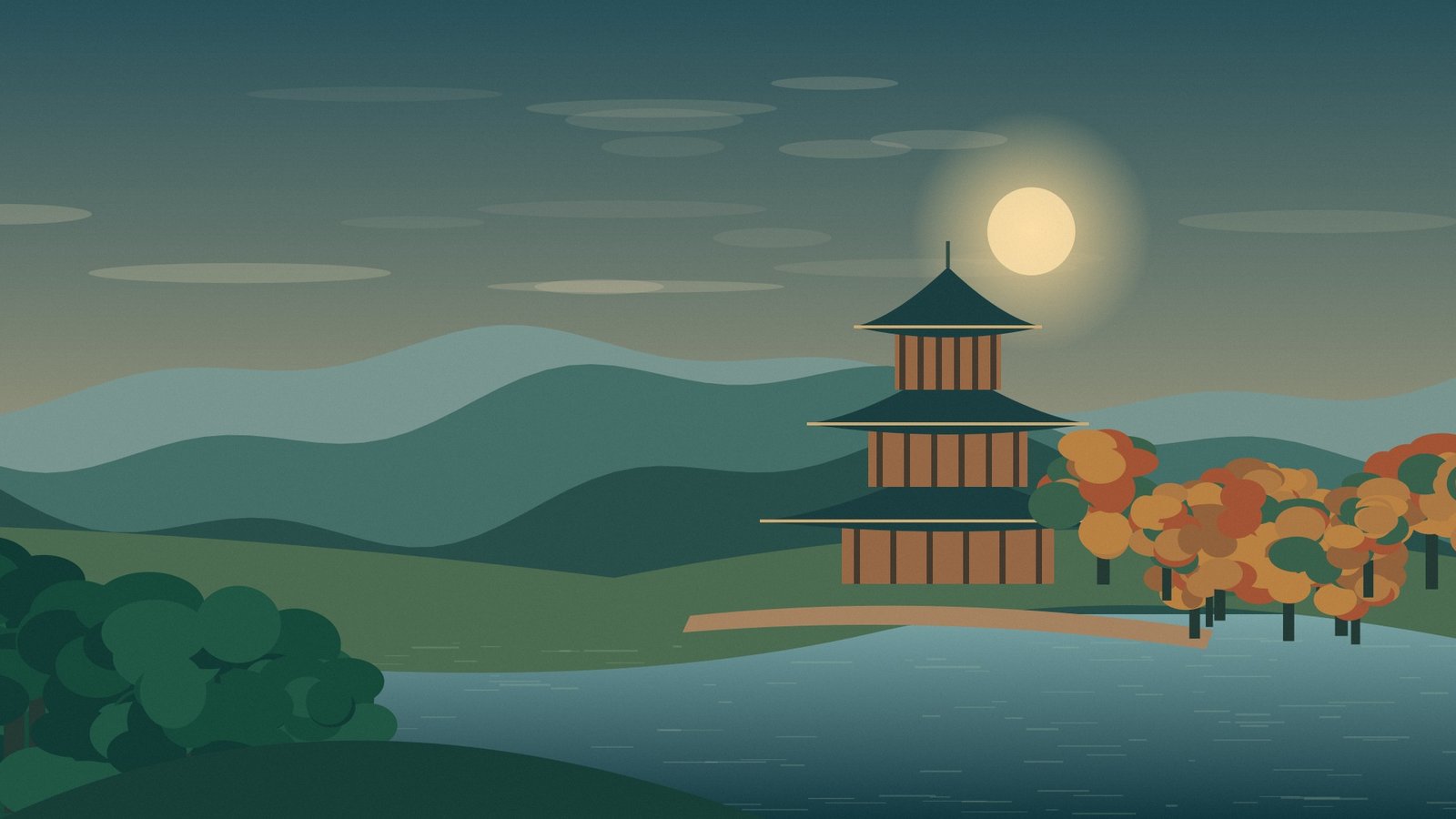
Original Kyoto-inspired editorial illustration of an imagined garden and pavilion; it is not a photograph of a named temple or evidence of a visit.
Kyoto rewards a plan with space between its famous places. A temple visit, an ordinary lunch, a walk through a neighbourhood and a quiet garden can make a fuller day than a sequence of taxi rides between distant highlights.
This Kyoto travel guide connects the city’s geography with the practical decisions: which area to stay in, how to group temples and other sights, when to use rail rather than a crowded bus, and what to check before booking. The suggested night count and day plans are editorial recommendations, not a claim that every visitor needs the same itinerary.
This guide contains affiliate links. If you book or buy through them, Taylor’s Trailblazing Travels may earn a commission at no extra cost to you.
One main area each day
East, west and south need separate thought—not repeated cross-city journeys.
Four nights to start
A useful editorial starting point for three full days, not a fixed requirement.
Rail before the last mile
Compare train or subway plus walking with the complete bus journey.
Respect a living city
Private lanes, worship and people going to work are not visitor attractions.
Understand Kyoto’s sightseeing geography first
The official city guide divides Kyoto into areas with very different visitor interests: central streets and the station area; the eastern Higashiyama and Gion districts; western Saga and Arashiyama; and southern Fushimi, among others. These are useful planning groups, not places you should expect to cover in a single continuous walk.[1]
Mark the places that matter most, then choose one main geographical focus for each full day. A restaurant reservation, workshop or particularly important temple can be the anchor. Add one nearby optional stop and leave room to remove it without losing the purpose of the day.
Four nights can support three full days when arrival and departure sit at the edges. Two nights can still make a worthwhile focused visit, but do not label the arrival afternoon and departure morning as two additional full days. Add time when a slower pace, extra rest or a specialist interest matters.
Choose a neighbourhood that fits your evenings as well as your days
| Base | Useful for | Main advantage | Check before choosing |
|---|---|---|---|
| Downtown: Shijo / Sanjo | A first visit balancing food, shops and different sightseeing areas. | A practical evening base when you want choices outside the hotel. | The exact station, street noise and the walk across or along the river. |
| Kyoto Station area | Rail arrivals, onward travel and a simple luggage day. | Starting and finishing near the main station. | Which side and entrance; the station name alone does not establish a short walk. |
| Higashiyama / Gion surroundings | Eastern neighbourhoods and deliberately early or late walks. | Staying near an important part of your sightseeing rather than commuting in. | Slopes, steps, luggage access and individual private-street restrictions. |
| Karasuma Oike / central Kyoto | A less nightlife-centred central base and subway access. | A practical compromise for mixed days. | Your actual dinner options and connections to the places on your list. |
| Arashiyama | A stay deliberately centred on western Kyoto, gardens or a particular inn. | More time in the area beyond a quick excursion. | The extra effort of repeated journeys elsewhere; a specialist choice rather than an automatic city-wide base. |
Use the city’s area and transport guides to test these choices against your own route.[1][2] A broad district can contain streets with very different surroundings. Inspect the actual address, room category and arrival instructions before choosing.
A traditional-looking room is not automatically the best practical fit. Check bed type, bathroom arrangements, stairs, quiet hours and meal timings. Ask for specific confirmation of dietary, mobility or family requirements rather than inferring them from photographs.
Choose different kinds of highlights, not just more temples
Kiyomizu-dera and eastern neighbourhoods
Kiyomizu-dera is a Buddhist temple known for its main hall and wooden stage. Use the official visitor information for the part of the site you want to see and the opening arrangements on your date. Its surrounding eastern streets make a coherent area visit; a quick photograph should not be the only purpose.[3]
Fushimi Inari Taisha
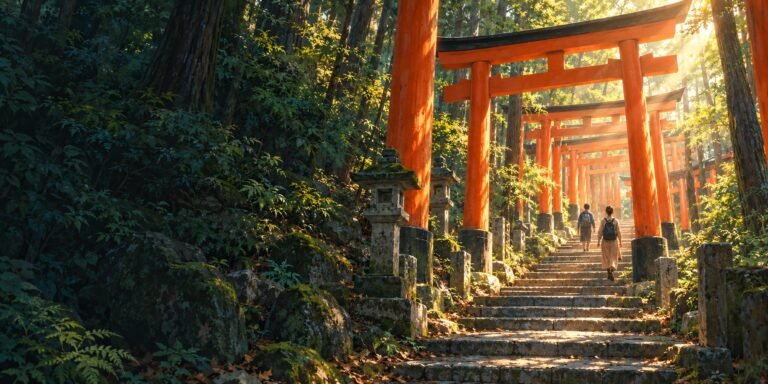
Fushimi Inari is a Shinto shrine, not a Buddhist temple. Decide whether you want a lower-area visit or a longer walk on the shrine’s mountain routes. Do not assume a visit around the lower gates is the same undertaking as a full ascent.[4]
Tenryu-ji and Arashiyama
Tenryu-ji’s garden and temple buildings have separate admission arrangements. The official guide identifies JR Saga-Arashiyama, Randen Arashiyama and Hankyu Arashiyama as different access points. Choose the journey that suits your base rather than assuming “Arashiyama Station” describes one interchangeable place.[5]
Nijo-jo Castle and the central city
Nijo-jo adds a castle visit rather than another temple to the mix. Consult its official guide for the areas included in your ticket and any separate reservation or closure information. Keep the rest of that day compatible with a central-city plan.[6]
For a first visit, choose perhaps two or three substantial religious-site visits across the stay, then adjust for your interests. That is a pacing suggestion, not a maximum. Someone travelling for gardens, architecture or religion may reasonably choose more; another visitor may prefer food, crafts and ordinary neighbourhood time.
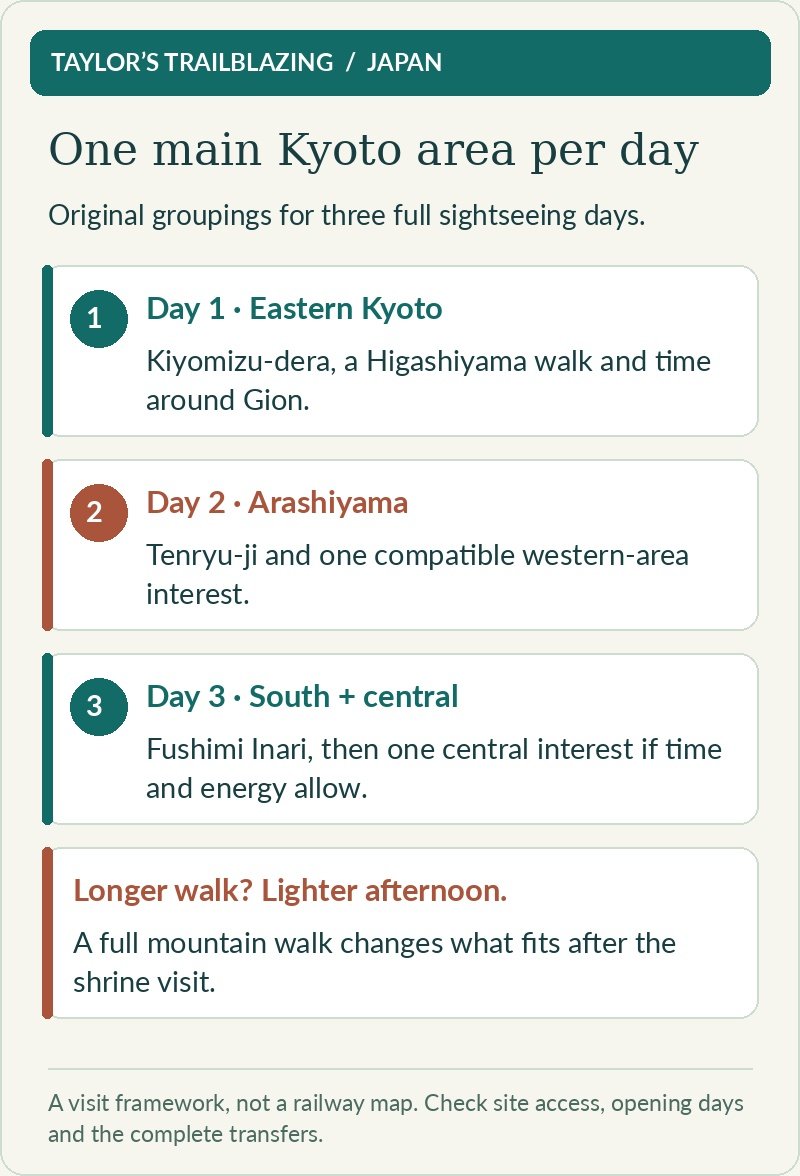
Use these three day groupings as a starting framework
| Day | Main focus | How to keep it manageable |
|---|---|---|
| 1 · Eastern Kyoto | Kiyomizu-dera, a selected Higashiyama walk and time around Gion. | Give the temple a proper visit, take a meal break and follow permitted streets. Do not automatically add a distant western landmark. |
| 2 · Western Kyoto | Arashiyama, Tenryu-ji and one compatible garden or riverside interest. | Select your arrival station deliberately. Keep an optional stop removable if the main visit takes longer. |
| 3 · Southern and central Kyoto | Fushimi Inari, then one central interest such as a carefully timed Nijo-jo visit or downtown exploration. | Decide how far you will walk at the shrine. A long mountain walk changes what fits afterwards; choose central alternatives rather than stacking them all. |
This is a set of visit groupings, not a booked itinerary. Site and transport arrangements come from the official visitor guides; the allocation of days is our editorial judgement.[3][5][7][6]
With an extra day, consider a more sustained northeastern-area visit, a craft or food interest, or simply a slower version of the same three days. Do not fill it automatically with another city. Kyoto itself can justify the additional time.
For rain, heat or fatigue, shorten the outdoor part and keep a nearby indoor or seated option. A flexible day should have a clear purpose, but it does not need several prepaid commitments to count as a plan.
Compare the whole journey before joining a bus queue
Use rail or subway for a useful first section where it fits, then assess the walk, bus or taxi needed at the end. The city’s official guidance explains the different systems and warns that popular bus services can become crowded. Take large luggage to the accommodation or a suitable storage service instead of carrying it through a full sightseeing day.[2][8]
Fushimi Inari is next to JR Inari Station on the Nara Line and can also be reached from the separate Keihan Fushimi-inari Station. Tenryu-ji’s guide likewise distinguishes the different Arashiyama stations. These examples show why matching the exact arrival point is more useful than choosing a transport mode in the abstract.[7][5]
Count the walk to the stop, waiting, the ride and the final walk. A journey that appears simpler because it has no changes may be slower or less comfortable when queues and luggage are included. For step-free needs, verify the station exits and the destination’s actual accessible route in advance.
Include Kyoto’s accommodation tax in the room comparison
Kyoto City changed its accommodation-tax bands from 1 March 2026. The band is based on the accommodation charge per person per night, not simply the total shown for a shared room. These are the published bands checked on 17 October 2026.[9]
| Accommodation charge per person per night | Accommodation tax |
|---|---|
| Under ¥6,000 | ¥200 |
| ¥6,000 to under ¥20,000 | ¥400 |
| ¥20,000 to under ¥50,000 | ¥1,000 |
| ¥50,000 to under ¥100,000 | ¥4,000 |
| ¥100,000 or more | ¥10,000 |
The city’s detailed guide says the relevant accommodation charge includes the room and accompanying service charges, but excludes meals and consumption tax. It also explains that you do not pay the accommodation tax again at the property if it has already been collected through a booking site or travel agency.[10]
A four-night example with two adults
Assume a qualifying room-and-service charge of ¥24,000 per night for two adults, excluding meals and consumption tax. Dividing by two gives ¥12,000 per person per night, placing this example in the ¥400 tax band. Four nights therefore produce ¥400 × 2 × 4 = ¥3,200 in accommodation tax. This is an illustrative room-price example, not a live hotel rate.
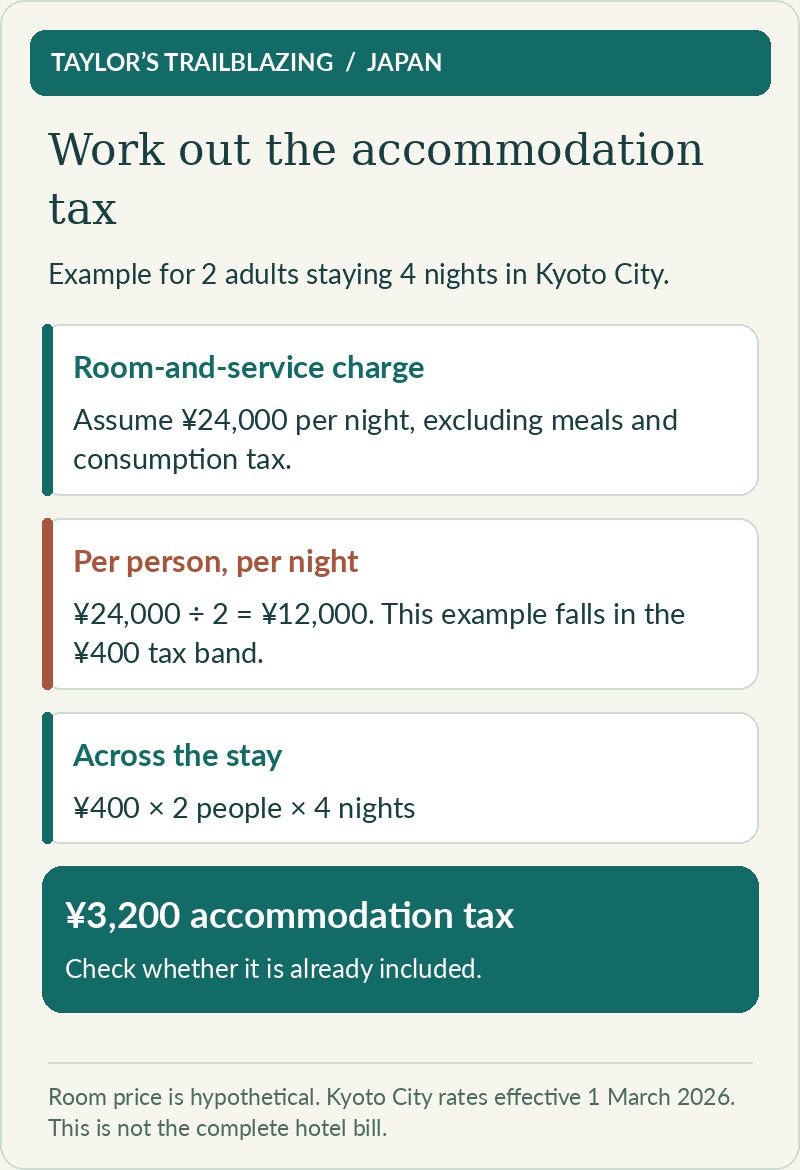
Check whether the displayed quote includes that tax or shows it as payable separately. Do not simply add it twice. Other taxes, meals and optional services need their own treatment; the ¥3,200 calculation is not a complete holiday or hotel bill.
Make food and cultural experiences part of the route
Choose a meal in the area you will already be visiting instead of crossing the city repeatedly for a single recommendation. Keep one special reservation when it matters to you, and leave simpler meals flexible around the actual pace of the day.
Nishiki Market is a useful central food stop, but the city explicitly asks visitors not to walk through the market while eating or drinking. Eat in the space provided at the shop and follow its rubbish arrangements. Do not assume every stall shares the same opening hours or dietary suitability.[11]
For food allergies, mobility requirements or other essential arrangements, obtain specific confirmation from the provider before paying. A booking platform description should start the enquiry, not replace it.
Plan for crowds and behave considerately
Kyoto’s visitor guidelines ask people to respect private property, keep streets clear, observe photography restrictions and not stop, touch or photograph geiko and maiko without permission. Read the signs on the street you are actually using; a restriction on one private lane is not the same as all of Gion being closed.[13]
Start important visits when their published opening arrangements allow, but keep early neighbourhood walks quiet. A residential lane is not a photography studio. Do not block entrances or traffic while deciding where to go next.
Spring blossom and autumn colour can influence the trip, while summer heat and humidity or winter cold can change how much outdoor walking feels comfortable. Regional weather guidance is only a starting point; check the actual forecast and the site’s seasonal calendar before committing to a long outdoor day.[14]
Book a room for the trip you would still enjoy without a perfect blossom or foliage photograph. On busy days, reduce the number of distant sights rather than allowing queues to turn every meal and connection into a deadline.
Kyoto planning questions
Is Kyoto Station the best place to stay?
It is a practical choice for arrivals, departures and some rail journeys. Downtown may suit evening meals and mixed sightseeing better, while Higashiyama can suit an eastern focus. Choose against your actual days rather than one universal “best” area.
Are Fushimi Inari and Kiyomizu-dera the same kind of site?
No. Fushimi Inari is a Shinto shrine; Kiyomizu-dera is a Buddhist temple. Approach each as an active religious place and follow its own visitor instructions.[4][3]
Can I see Arashiyama and eastern Kyoto on the same day?
It may be physically possible, but that does not make it the best first-visit plan. Choose the combination only after accounting for the full transfer, opening times and the length of visits you actually want. Separate area days are the calmer starting point.
Does the accommodation tax apply once per room?
No. The published Kyoto City tax is per person per night, with the band based on the relevant accommodation charge per person. Ask the property how the charge is calculated for your room and party, especially when a package includes meals.[10]
Give a few places the time they deserve
Choose the base that supports your evenings, group the city into manageable days and let a few important visits carry the trip. Include the real transport effort and accommodation tax before comparing prices. Kyoto becomes easier to plan when you leave room for ordinary neighbourhood time as well as its famous religious sites.
Official city, site and provider information was reviewed on 17 October 2026. The area-fit table, three-day framework and four-night tax example are original editorial planning tools. The room price is hypothetical, and no hotel stay, attraction visit or dated booking availability is claimed.
Sources
Source information reviewed on 17 October 2026. Recheck operating arrangements, prices and advice for your travel dates. Booking links do not establish live availability or guarantee a particular outcome.
- Kyoto City Official Guide — City areas
- Kyoto City Official Guide — Getting around Kyoto
- Kiyomizu-dera — Official visitor information
- Fushimi Inari Taisha — Official shrine information
- Tenryu-ji — Official admission and access information
- Nijo-jo Castle — Official visitor guide
- Fushimi Inari Taisha — Train and local access
- Kyoto City Official Guide — Travelling by bus
- Kyoto City Official Guide — Accommodation tax from March 2026
- Kyoto City — Accommodation-tax guide, effective 1 March 2026 (PDF)
- Kyoto City Official Guide — Considerate visits to Kyoto, including Nishiki Market
- GetYourGuide — Kyoto tours and activities
- Kyoto City Official Guide — Four visitor guidelines
- JNTO — Weather and geography
Illustrations in this article were created for Taylor’s Trailblazing Travels. Third-party photographs, where used, are credited beside the image or in the source list.