Narita Airport to Tokyo: Train, Bus or Private Transfer?
Choose the right Tokyo arrival point, understand the real cost and make the last stretch to your hotel easier.
- Hotel-area decisions
- Fares checked 18 October 2026
- Terminal 3 explained
AI-generated editorial illustration of an airport arrival and Tokyo skyline; a composite scene, not a photograph of a specific train or station.
The best way from Narita Airport to Tokyo depends on where your hotel sits. A fast train to the wrong side of the city can leave you with another ticket, a platform change and a suitcase walk when you are already tired.
Start with the hotel’s nearest station and entrance, then compare the next suitable departure. This guide weighs cost, changes, luggage and arrival time so you can choose a transfer that works all the way to your accommodation.
Some links in this guide are affiliate links. If you book or buy through them, Taylor’s Trailblazing Travels may earn a commission at no extra cost to you.
Skyliner’s 36 minutes means Terminal 2·3 station to Nippori, on the fastest service.
TYO-NRT’s standard adult fare is ¥1,500; its late-night fare is ¥3,000.
Compare a direct N’EX with a bus stopping at your actual hotel.
Add everyone’s fares before judging a private vehicle quote.
Narita Airport to Tokyo: options at a glance
Adult one-way figures below were checked on 18 October 2026. Rail times are station to station; bus times are to the stated stop. They exclude immigration, baggage reclaim, waiting and the journey to your hotel.
| Option | Useful endpoint / journey time | Adult fare | Frequency and trade-off |
|---|---|---|---|
| Keisei Skyliner | Nippori: 36 minutes fastest from Terminal 2·3 station; Ueno: about 45 minutes from the airport | ¥2,580 standard | Advertised three services an hour; reserved seat. A different hotel area may require another train. [1] [2] [6] |
| Narita Express (N’EX) | Tokyo: about 60 minutes; Shinjuku: about 90 minutes | Tokyo ¥3,140; Shinagawa, Shibuya or Shinjuku ¥3,330 | Usually about two departures an hour in the daytime; fewer late. Check the destination of your carriage. [3] [5] [6] |
| Airport Bus TYO-NRT | Tokyo Station: many departures allow 68–88 minutes from Terminal 1; add 5 minutes from T2 or 10 from T3 | ¥1,500 standard; ¥3,000 late-night service | Often 10–20 minutes apart to Tokyo, with some closer departures; Ginza services are less frequent. Subject to traffic. [7] [8] |
| Airport Limousine Bus | Shinjuku Station: sampled daytime timetable allows 105 minutes from T1, 110 from T2 or 115 from T3; hotel stops can be later | ¥3,600 for the Shinjuku route shown | Main Shinjuku departures roughly 15–30 minutes apart in the sampled timetable. Individual hotel services are less frequent. [9] |
| Keisei Access Express | Useful through services towards Oshiage, Asakusa, Nihombashi and Higashi-Ginza; check your exact journey | Ordinary route fare; no limited-express supplement | Destination and through-service pattern matter. Use Keisei’s date-specific search before choosing a departure. [10] |
| Pre-booked private transfer | Your agreed hotel address; road journey and pickup time depend on the booking | Obtain a total vehicle quote | No public timetable. Confirm luggage, waiting and any night, toll or out-of-area charges. [20] [21] |
The cheapest useful option is the one that reaches your part of Tokyo with a manageable final journey. A discounted airport ticket loses its appeal if it creates an expensive taxi ride at the other end.
Match the transfer to your hotel area
Use this decision rule: prefer the route with the fewest awkward changes after allowing for its next departure and the walk from its actual stop.
| Hotel area | Start your comparison here | What could change the choice? |
|---|---|---|
| Ueno / Nippori | Skyliner to the nearer endpoint | Check the precise hotel entrance and whether you need a local connection. |
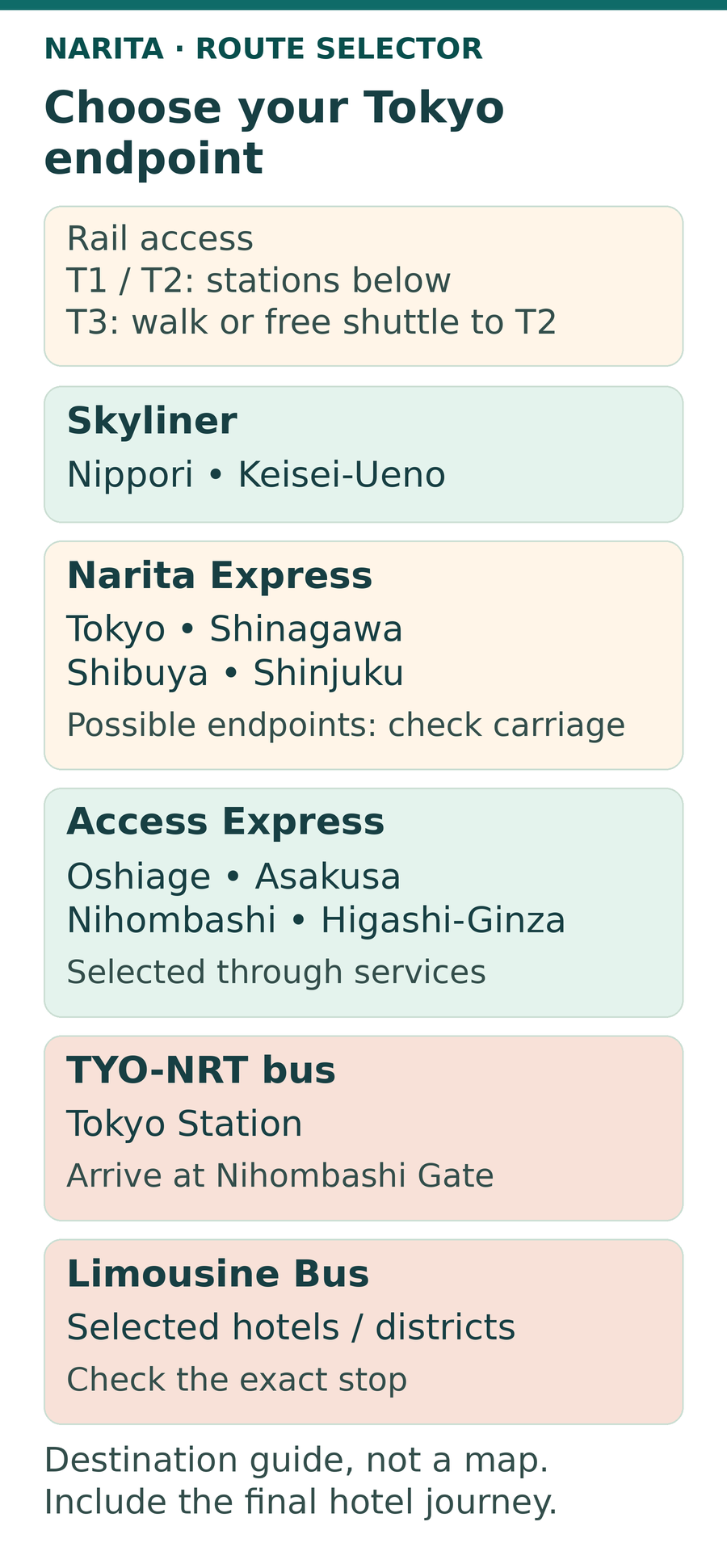
| Tokyo Station / Marunouchi / Yaesu | N’EX for rail; TYO-NRT for the lower standard fare | Tokyo Station’s bus arrival is at the Nihombashi Gate. Match that side of the station to your accommodation. |
| Shinjuku / Shibuya / Shinagawa | A direct N’EX; a hotel bus where the stop is useful | A long wait for your hotel’s bus can cancel out the benefit of avoiding the station. |
| Asakusa / Nihombashi / Higashi-Ginza | A suitable Access Express through service | Confirm that particular train serves your stop; the service name alone is insufficient. |
| Hotel well away from a convenient station | Hotel bus, rail plus a short local taxi, or private transfer | Compare the full party cost and the walking or step-free route. |
The rail endpoints and bus stop in this selector come from the operators; the preference for fewer difficult changes is editorial judgement. [2] [4] [8] [10]
If you have not chosen accommodation, look at the map before buying the transfer. You can compare Tokyo stays on Agoda and Tokyo stays on Booking.com; these are city searches, so narrow them to the station or bus stop you intend to use. Check the hotel’s own access directions as well as the booking map.
From arrivals to the correct platform or bus stop
Terminals 1 and 2
Terminal 1 uses Narita Airport Station; Terminals 2 and 3 use Narita Airport Terminal 2·3 Station. The railway levels are beneath Terminals 1 and 2. Follow the signs for your chosen operator: JR for Narita Express or Keisei for Skyliner and Access Express. [6] [11]
Terminal 3
There is no separate Terminal 3 railway station. The airport gives an approximate ten-minute walk to Terminal 2·3 Station and also describes a free terminal shuttle. Allow more if you need lifts, move slowly or stop to buy tickets. A suitable bus departing from T3 avoids this station transfer. [11] [12]
- Clear the arrival formalities and collect your bags before judging which departure is realistic.
- Open your hotel’s full address and nearest station or named bus stop. Show the address to staff if the route is unclear.
- For rail, buy or collect the correct ticket and seat reservation where needed. For a bus, confirm the stop, departure time and terminal before paying.
- Check the platform display or bus ticket, keep valuables with you and allow time to load luggage.
- At the Tokyo end, follow your planned hotel exit. “Arrived at the station” is not the same as “arrived at the hotel”.
Save the hotel address, tickets and pickup instructions offline. If you want mobile data for maps or driver messages, check Airalo and select Japan. Check the plan’s activation instructions before travelling and confirm that your handset supports eSIMs and is network-unlocked. [22] [23]
Choose tickets that fit your arrival and return
Skyliner and Narita Express
Skyliner uses reserved seating. Its standard fare combines the basic journey with the Skyliner supplement; the operator lists an eligible online one-way price of ¥2,310. Check the offer’s exchange or digital-use instructions rather than assuming every voucher opens the gate. [1] [24]
N’EX also needs a base fare plus the limited-express ticket. Buy through JR East or at the airport, and reserve the right service for your destination. For Shibuya or Shinjuku, check your carriage carefully because some services divide at Tokyo. [3] [26]
For a comparison across sellers and transport types, compare Narita Airport–Tokyo options on 12Go. Check each result’s real terminal, Tokyo endpoint, ticket collection, baggage conditions and total payable price against the operator’s offer. “Tokyo” in a search result does not necessarily mean Tokyo Station. [25]
When the N’EX return offer helps
The N’EX TOKYO Round Trip Ticket costs ¥5,200 for an adult holding a non-Japanese passport and covers the outward trip from Narita followed by a return within 14 days. Present the passport at collection. Both Tokyo-area endpoints can differ within the permitted area. [13]
Two standard Shinjuku singles total ¥6,660, so the return offer saves ¥1,460 if both journeys suit your trip. That saving is calculated from the stated fares. Do not buy a return solely because it is discounted if you are leaving Japan from another airport.
Airport buses
For a normal TYO-NRT departure from Narita, buy a ticket for a particular bus at the terminal counter and reach the stop at least five minutes before departure; seats are unassigned. The last service uses a different payment procedure, explained below. For Limousine Bus, search your exact hotel or stop and date before booking. [7] [9]
An arrival clock that includes the hotel journey
A useful comparison starts after you have cleared customs. The example below models a traveller leaving Terminal 2 for a hotel close to Tokyo Station. It uses rounded planning inputs, not booked services or measured travel times.
| Time component | N’EX | TYO-NRT | Skyliner + local JR |
|---|---|---|---|
| Reach transport and obtain tickets | 15 | 15 | 15 |
| Assumed wait | 15 | 10 | 10 |
| Main journey | 60 | 75 | 40 |
| Change at Nippori + local train allowance | 0 | 0 | 15 + 15 |
| Exit and hotel walk | 20 | 10 | 20 |
| Modelled total | 110 minutes | 110 minutes | 115 minutes |
Assumptions: one manageable suitcase, no disruption, a hotel near the appropriate exit, and the bus serving Tokyo Station. Main-journey inputs are rounded from the operators’ guidance; waits, walking and the local-rail allowance are planning assumptions. Immigration and baggage reclaim are excluded because they happen before this clock starts. [1] [6] [8]
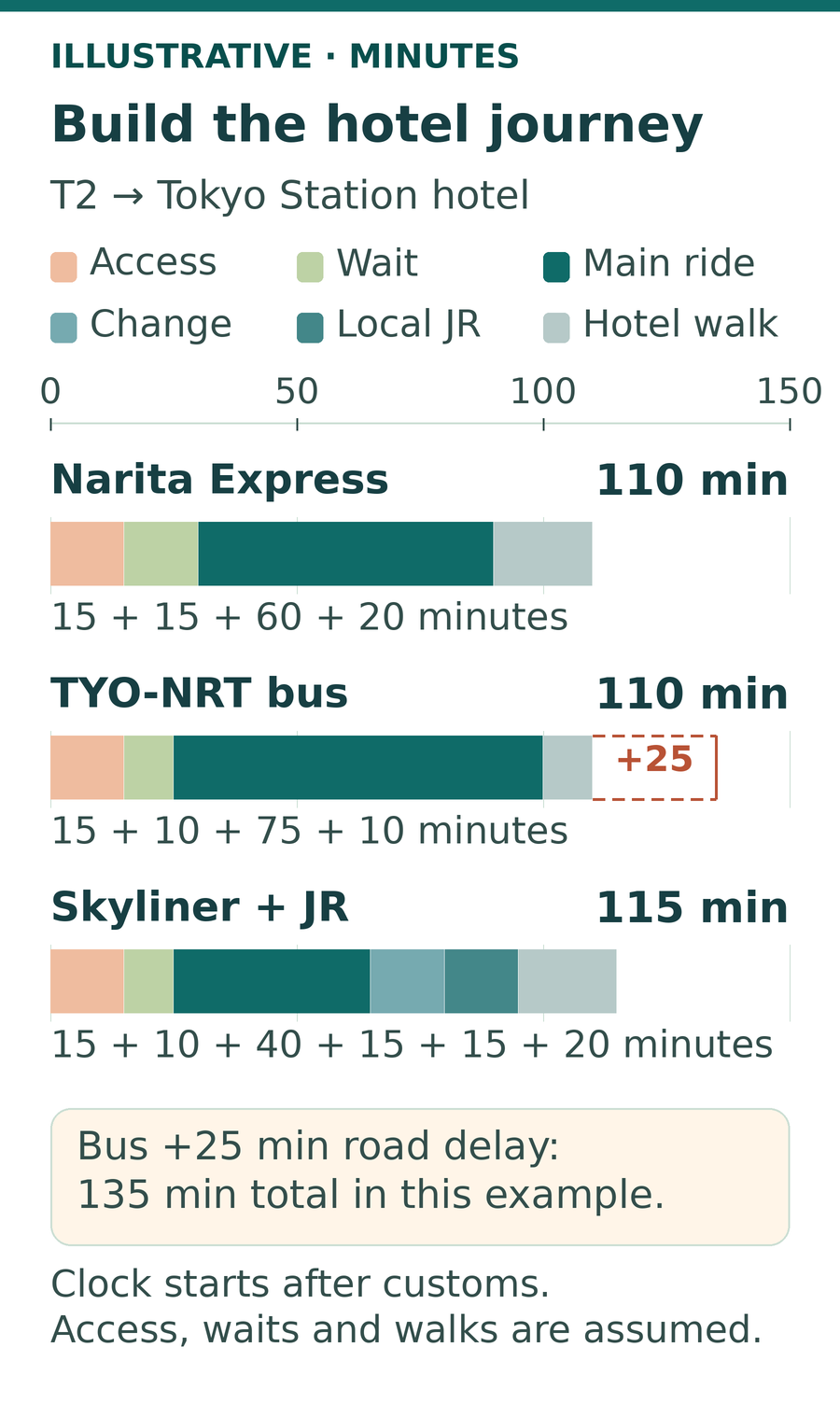
The lesson is about sensitivity, not a predicted five-minute winner. A 25-minute road delay makes the bus example 135 minutes; a longer N’EX wait changes its result too. Move the hotel to Ueno and the Skyliner’s onward change disappears. Replace these assumptions with your own hotel, date and next departure before booking.
When a private transfer earns its cost
A private vehicle is worth comparing when several people share the bill, someone cannot manage the station journey, or the hotel has an awkward final connection. Its useful advantage is getting your group and bags to one agreed address. Road traffic still affects it.
Calculate the convenience premium
| Party | N’EX to Shinjuku | Shinjuku Limousine Bus | How to assess a private quote |
|---|---|---|---|
| 2 adults | ¥6,660 | ¥7,200 | Subtract the public option’s full cost from the vehicle quote. |
| 4 adults | ¥13,320 | ¥14,400 | Divide that difference by four to see the extra cost per person. |
These calculations assume every traveller pays an adult single fare, with no pass or discount. Add any local journey needed after rail or bus, and compare a vehicle that actually fits every passenger and bag. The table is a benchmark, not a private-transfer price claim. [3] [9]
A separate reference is the airport’s fixed-fare taxi tariff: Shinjuku is in Zone D, listed at ¥31,500 via Keiyo Road or ¥32,500 via the Bayshore Freeway, plus tolls. Night surcharges apply from 22:00 to 05:00. Ask for the applicable fixed fare before hiring; these figures do not set the price of a pre-booked transfer. [17]
Two booking options with different conditions
View SAIITSU’s Narita transfer on GetYourGuide if your group fits its stated limit of five passengers and four cases of 24 inches or smaller. The listing’s 90-minute airport waiting allowance starts at actual landing; a driver holding a name sign inside arrivals is an optional extra. Its standard area is Tokyo’s 23 wards. [20]
Compare Elife’s Narita transfer options on Viator for a choice of vehicle sizes, including larger groups. This listing states a different waiting arrangement: 60 minutes from your selected pickup slot, which should allow time to clear customs. It is listed as not wheelchair accessible. Select the Narita-to-Tokyo option and confirm the precise hotel, luggage allowance and final inclusions. [21]
Before paying, get the pickup location, the point when waiting charges start, the flight-delay policy and any child-seat requirement in writing. A vehicle described by its seat count may accept fewer passengers when luggage is included.
Luggage and accessibility can decide the route
Skyliner has dedicated luggage space. N’EX provides large-bag storage without a separate luggage-space reservation, but that space is limited. Choose a route whose station changes and hotel walk you can manage with the bags you will actually bring. [2] [4]
TYO-NRT allows one suitcase per customer, with combined dimensions of approximately 158 cm, and excludes extra luggage and items such as bicycles, skis and golf bags. It does not allow standing when the bus is full. Airport Limousine’s published allowance is up to two cases per person, each within 50 × 60 × 120 cm and 30 kg. Confirm unusual or oversized items with the operator. [14] [15]
For wheelchair travel, assess the complete route: terminal, boarding assistance, destination lift and hotel entrance. Ordinary Limousine coaches are not step-free; selected lift-equipped services need specific confirmation and exclude Terminal 3 in the operator’s listed Narita routes. A generic private-transfer or “accessible” label is not enough to establish whether you can remain seated in a wheelchair. [16]
Use the airport’s rail, bus and taxi accessibility information to plan assistance. Ask for a suitable vehicle and confirm dimensions, loading equipment and whether a seat transfer is required. [18]
Late arrivals, delays and a workable second option
Check the last service for your date and terminal, then check the onward journey. The October JR timetable lists a final N’EX departure from Terminal 1 at 21:44; that is a platform departure, not a safe flight-arrival deadline. [5]
The linked TYO-NRT timetable shows its last bus leaving T3 at 23:20, T2 at 23:25 and T1 at 23:30 for Tokyo Station. That service costs ¥3,000: go directly to the stop and pay with cash or a transport IC card; credit cards are not accepted on board. Its scheduled Tokyo arrival is 00:38, so check the remaining journey to your hotel before choosing it. [7] [8]
Travelling on 6–8 November 2026?
JR East has announced tunnel works affecting N’EX beyond Tokyo: affected trains run to or from Tokyo instead of continuing to Shinjuku or Ofuna. The disruption covers the evening of 6 November, 7 November and part of the morning of 8 November. Check the train-specific notice and arrange the Tokyo connection or a different route. [19]
If you lose your planned connection, ask staff for the next workable route to your actual hotel. A bus can be an alternative during a railway disruption, and rail can avoid road congestion, but neither guarantees that every other service is operating. For an arrival too late for a practical city journey, consider an airport-area night or a confirmed private pickup; check hotel check-in and shuttle hours before committing.
Questions before you travel
Can I use Suica or PASMO without buying anything else?
Do not assume a tap-in covers an airport express. Narita Express and Skyliner each need the appropriate limited-express ticket as well as the base fare. An IC card can cover the base-fare component in the permitted arrangement, but it does not itself reserve your express seat. [3] [24]
Is the N’EX round-trip ticket useful if I fly home from Haneda?
Usually no: its second journey is back to Narita, within its 14-day validity. Compare a one-way ticket with the transfer you will actually use. The pass also does not give unlimited sightseeing journeys around Tokyo. [13]
Do children need their own Narita Express ticket?
JR East lists child fares for ages 6–11. A younger child normally travels free within its accompanying-child rules, but needs a child ticket to occupy an individual reserved seat. If everyone in your family needs a seat, price that requirement explicitly. [3]
What happens if my flight is late and I miss a reserved N’EX?
JR East’s guidance says a missed reserved train can be followed by a later N’EX on the same day, without an assigned seat; you must give up an occupied seat if its reservation holder arrives. Check the rules attached to your actual ticket, especially a reseller voucher, and ask staff about your next departure. [4]
Does a seven-seat private vehicle carry seven travellers with suitcases?
Use the product’s passenger-and-bag limits, rather than its vehicle description. The SAIITSU listing linked here states up to five passengers and four cases of 24 inches or smaller. Larger cases, a wheelchair or a child seat need specific confirmation before payment. [20]
Make your transfer choice
Choose the arrival point first. For Ueno or Nippori, begin with Skyliner. For Shinjuku, Shibuya or Shinagawa, compare the next direct Narita Express with a useful hotel bus. For Tokyo Station, decide whether the train’s protection from road delays is worth the difference from the ¥1,500 bus. Pay for a private transfer when its confirmed capacity, meeting arrangements and door service solve a problem your group actually has. [7]
Keep your hotel address, preferred route and a second option together. The Japan travel hub is the next place to organise the rest of your trip.
Sources and editorial method
Editorial review: 18 October 2026. Core fares and routes have been cross-checked against official transport information. Timetables, ticket eligibility and commercial listing terms can change; confirm your travel date, terminal and selected option before paying.
Hotel-area recommendations are editorial judgements. The illustrated time comparisons and party-cost calculations are original planning tools, with their inputs and assumptions stated beside them; they are not observed or guaranteed journeys. Private-transfer terms describe the named listing and option, rather than every car service.
- Keisei: Skyliner discount ticket and standard fare
- Keisei: Skyliner service and luggage facilities
- JR East: Narita Express tickets
- JR East: Narita Express routes and facilities
- JR East: Narita Airport Terminal 1 departure timetable
- GO TOKYO: Narita Airport access
- Airport Bus TYO-NRT: fares and how to board
- Airport Bus TYO-NRT: published timetable
- Airport Limousine: Narita to Shinjuku timetable
- Keisei: Access Express route map
- Narita Airport: rail access
- Narita Airport: Terminal 3 to the railway station
- JR East: N’EX TOKYO Round Trip Ticket
- Airport Bus TYO-NRT: luggage and riding rules
- Airport Limousine: baggage guidance
- Airport Limousine: wheelchair access
- Narita Airport: taxi fares
- Narita Airport: rail, bus and taxi accessibility
- JR East: November 2026 tunnel works
- GetYourGuide: SAIITSU Narita private transfer
- Viator: Elife Narita private transfer
- Airalo: Japan eSIM options
- Airalo: device compatibility
- Keisei: buying Skyliner tickets
- 12Go: Narita Airport to Tokyo route comparison
- JR East: example N’EX service dividing at Tokyo
Illustrations in this article were created for Taylor’s Trailblazing Travels. Third-party photographs, where used, are credited beside the image or in the source list.