Where to Stay in Kawaguchiko for Mount Fuji Views
Start on the north or eastern shore for lake-and-Fuji outlooks, then match the exact room, bath and arrival plan to your stay.
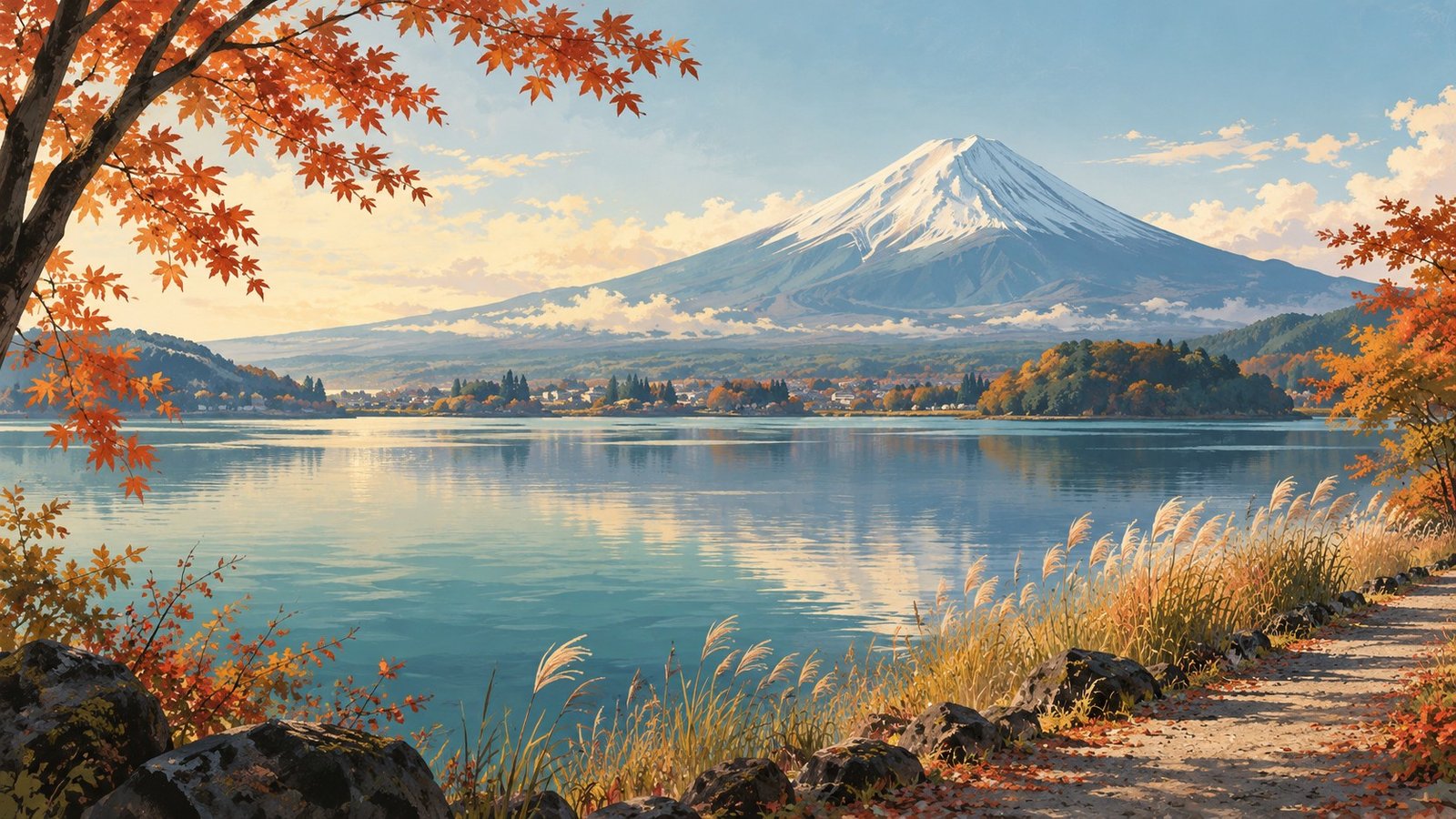
AI-generated editorial illustration of Lake Kawaguchi and Mount Fuji; not a photograph or a verified view from a named hotel.
Choosing where to stay in Kawaguchiko for Mount Fuji views involves two bookings in one: somewhere you will enjoy sleeping, and a particular place from which to look at the mountain. The hotel’s best photograph does not tell you which room, bath or shared terrace produced it.
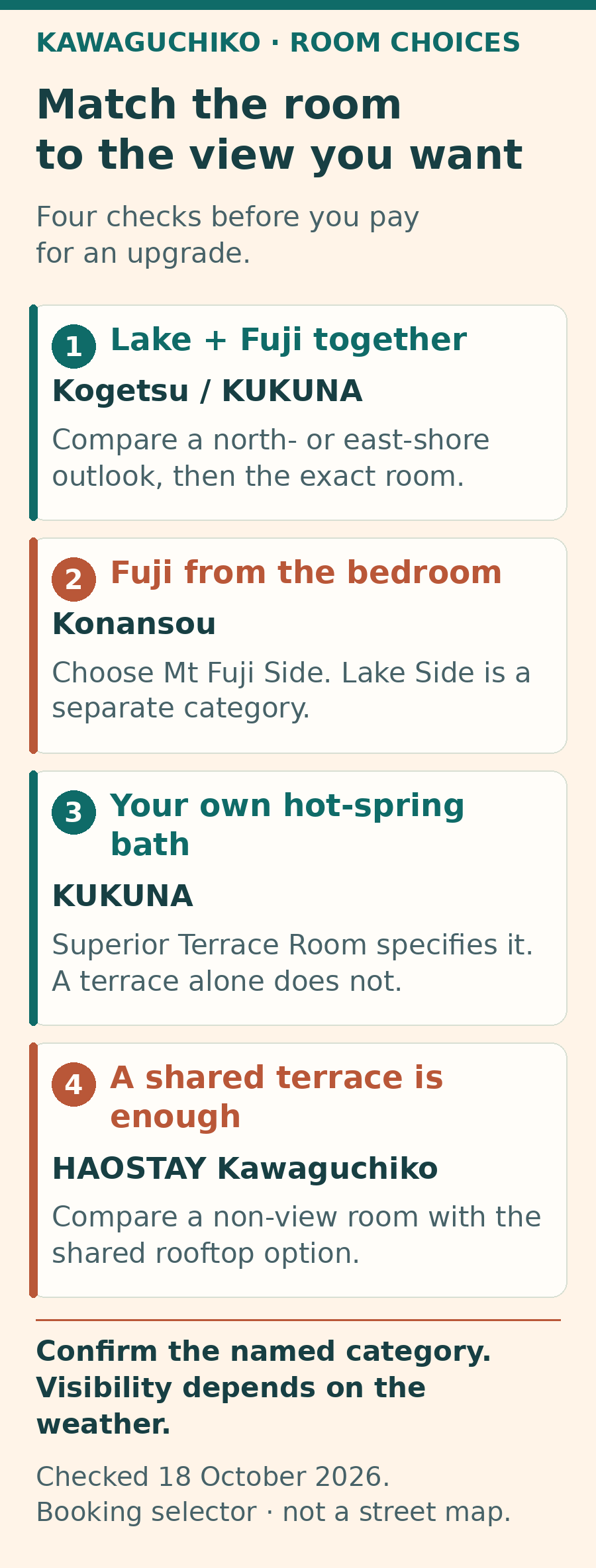
The north shore is a strong starting point for Fuji across Lake Kawaguchi. Yet room direction matters even at a lakeside property: Konansou, on the southern side, explicitly separates Lake Kawaguchi Side and Mt Fuji Side categories.[1][4] A better booking starts with that distinction, then checks transport, meals and the time you intend to spend there.
This guide compares four useful starting areas and five researched hotel examples, with a simple way to judge a view upgrade. It is based on published hotel and operator information, without a personal-stay claim.
Some links in this guide are affiliate links. Taylor’s Trailblazing Travels may earn a commission if you book or buy through them, at no extra cost to you.
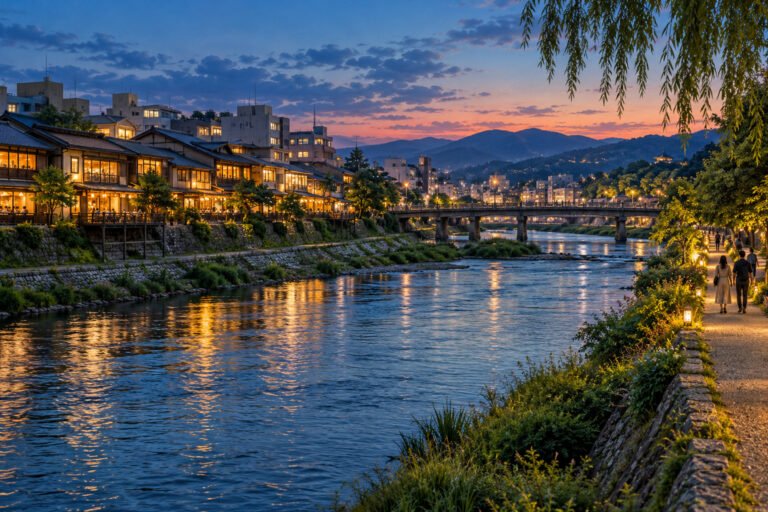
LAKE + FUJI
North or east shore
Start with the outlook, then check the actual room.
ARRIVAL FIRST
Funatsu / station side
Compare the full luggage journey, not just the hotel pin.
ROOM UPGRADE
Name the benefit
Bedroom view, private bath and shared terrace differ.
WEATHER
Keep the stay flexible
More local time helps you plan; it cannot promise visibility.
Where to stay in Kawaguchiko: start with the outlook
Start on the north shore if your priority is Fuji with Lake Kawaguchi in the foreground. JNTO specifically points visitors towards the lake’s north side for mountain views. Kogetsu’s position and room description illustrate that combination; KUKUNA also advertises a lake-and-Fuji outlook from its eastern-shore location.[1][2][3]
Further south, a hotel can face the lake in one direction and Fuji in another. Konansou’s separate room filters make the distinction unusually clear. A lake-view label alone is therefore insufficient for this particular booking decision.[4]
Swipe across the table to compare →
| Area | Start here when… | Example to examine | Compromise to resolve |
|---|---|---|---|
| North shore / Kawaguchi and Oishi direction | You want the lake and Fuji together, with time around your accommodation. | Shuhokaku Kogetsu, on the north shore, advertises both from all guest rooms.[2] | Arrange the station transfer and your evening meal; a northern lakeside address is a separate arrival leg. |
| Eastern shore / Asakawa | A lakeside terrace or private bath is part of the stay itself. | THE KUKUNA has explicit terrace-room choices.[3][8] | Check whether the terrace includes a private hot-spring bath, and arrange the hotel pickup. |
| Southern lakeside / Funatsu and the station side | You value a workable station approach and will also go out to public viewpoints. | Konansou for a named Fuji-side room; HAOSTAY Kawaguchiko for selected room views or its shared roof terrace.[4][6] | Separate the exact bedroom outlook from lake views, rooftop photographs and the property’s name. |
| Katsuyama / western part of the south shore | You prefer a hotel with gardens and are happy to use a shuttle or car. | Fuji View Hotel’s explicitly named Mt Fuji View categories.[5][17] | Garden View is a different category, even within the same hotel. |
For a couple spending an afternoon and two mornings around the hotel, begin with the first two rows. For someone arriving late and leaving early, begin with the southern or station-side approach and put the room premium under closer scrutiny. Families should establish the required beds and occupancy before comparing terraces.
Five hotel choices, with the room distinction that matters
These examples were selected for useful differences in outlook, bathing and station access. They are researched booking options, without personal-stay ratings. Rates and availability for your travel dates have not been checked. Compare the same occupants, meal plan, cancellation conditions and named room category across the hotel and booking sites.
Shuhokaku Kogetsu: north-shore lake and mountain views
Kogetsu is the clearest starting point here for the classic lake-and-Fuji combination. Its standard Japanese-style room has a 12.5-tatami room with an enclosed sitting area; the current room page lists a shower and separate toilet. A room with a footbath or full open-air hot-spring bath is a different choice.[2][7] Choose the standard room if the outlook matters more than private bathing; choose an explicitly named bath category if soaking privately is central to the trip.
For stays from 25 January to 7 April 2027, check the dining-renovation notice before booking a family or group. Most room/plan combinations are restricted to two or three people, counting children sharing beds; the four second-floor open-air-bath rooms have an exception for up to four. The notice also changes dinner arrangements, including further changes from 19 April 2027.[12]
Compare Kogetsu on Booking.com or check Kogetsu on Agoda. The hotel has reported missing bookings and room discrepancies through some unnamed overseas sellers. Confirm the reservation and room directly with Kogetsu before your cancellation deadline; its notice does not identify either linked platform by name.[13]
THE KUKUNA: choose the terrace and bath together
The Superior Terrace Room is advertised at 50 m² for two people, with a water terrace containing an open-air hot-spring bath, footbath and reclining bath area. Its own page specifies Fuji and lake views.[8][9] This is a useful couples’ choice when the terrace will get substantial use.
The similarly named Superior Japanese-style room is 35 m², with a 10 m² terrace and a shower booth. The word “terrace” by itself does not establish that the room has a private onsen.[9] Use KUKUNA’s Agoda listing to compare plans, then match the offered category to the hotel’s description before paying.
Konansou: a Fuji-side room on the southern lakeside
The Type D Japanese-Western room combines 12.5 tatami, twin beds and an open-air natural hot-spring bath on the Mt Fuji side. The official specification is 80 m² for one to four guests, with two 140 cm-wide beds. Konansou cautions that layout and outlook can vary within a room type.[10] This suits travellers wanting beds, a sitting area and private bathing while retaining a southern lakeside base.
Keep “Mt Fuji View” in the final room description. A Lake View category answers a different preference. Compare Konansou on Agoda and Konansou on Booking.com, checking how additional occupants sleep and whether dinner is included.
Fuji View Hotel: conventional beds and an explicit view category
The Moderate Twin Room with Mt Fuji View is 36 m² on the fourth or fifth floor, with two 120 cm-wide beds and a stated maximum of three guests. Ask how a third guest is accommodated. The hotel separately lists a 36 m² Moderate Twin with Garden View.[5][11] That makes this a useful comparison for travellers who want a regular twin-room layout and can evaluate the price difference between outlooks.
The name “Fuji View Hotel” covers both categories. Search Fuji View Hotel on Booking.com or Fuji View Hotel on Agoda, then check the view assigned to the room in your basket.
HAOSTAY Kawaguchiko: a simpler stay with shared viewing space
This is the original HAOSTAY Kawaguchiko hotel, whose official site gives a 14-minute walk from the station and five minutes to the lake. Some Japanese-Western twin rooms have Fuji views, while the rooftop terrace is shared. The hotel also lists coin laundry, a microwave and a water dispenser.[6] It is a sensible comparison when daily room function matters more than a private bath.
A non-view room plus the roof terrace can be a deliberate choice. If you want to see Fuji from your bedroom, confirm the exact mountain-view category. Compare HAOSTAY Kawaguchiko on Booking.com and HAOSTAY Kawaguchiko on Agoda; avoid confusing it with the separate HAOSTAY properties elsewhere around the lake.
Check the view from the place you will actually use
Read the final room description as a set of separate promises. A mountain-facing bedroom, an open balcony, a private bath and a communal restaurant window are different benefits. Konansou distinguishes the room’s direction; KUKUNA distinguishes terrace facilities; HAOSTAY distinguishes selected guest rooms from its shared roof terrace.[4][6][9]
- Does the named room explicitly say Mt Fuji view, or only mountain view, lake view or “view available”?
- Can Fuji be seen from the seated position or bed you care about, or only by standing at the window or stepping outside?
- Does the exact room photograph show the balcony rail, adjacent building or trees that could affect the outlook?
- If you want private bathing, is the bath in your room, available by reservation elsewhere, or shared? A footbath does not provide the same experience as a full bath.
- Will the view remain useful for your needs if the window cannot open, the terrace is uncomfortable in the weather, or you require step-free access?
Ask the hotel one precise question: “For this room category, where can we see Mount Fuji from, and are there any permanent obstructions?” If a particular floor, bath or sightline is essential, request confirmation of what is included in the booking. A general preference in a comments box is weaker evidence than the category description.
Swipe sideways to read the full planning graphic.
Decide how much the view premium is worth
A view premium is easier to assess when you compare it with time deliberately kept free at the hotel. Begin with two otherwise suitable offers for the same party. If their meals, room size, bath and cancellation terms differ, value those differences separately before calling the entire price gap a view premium.
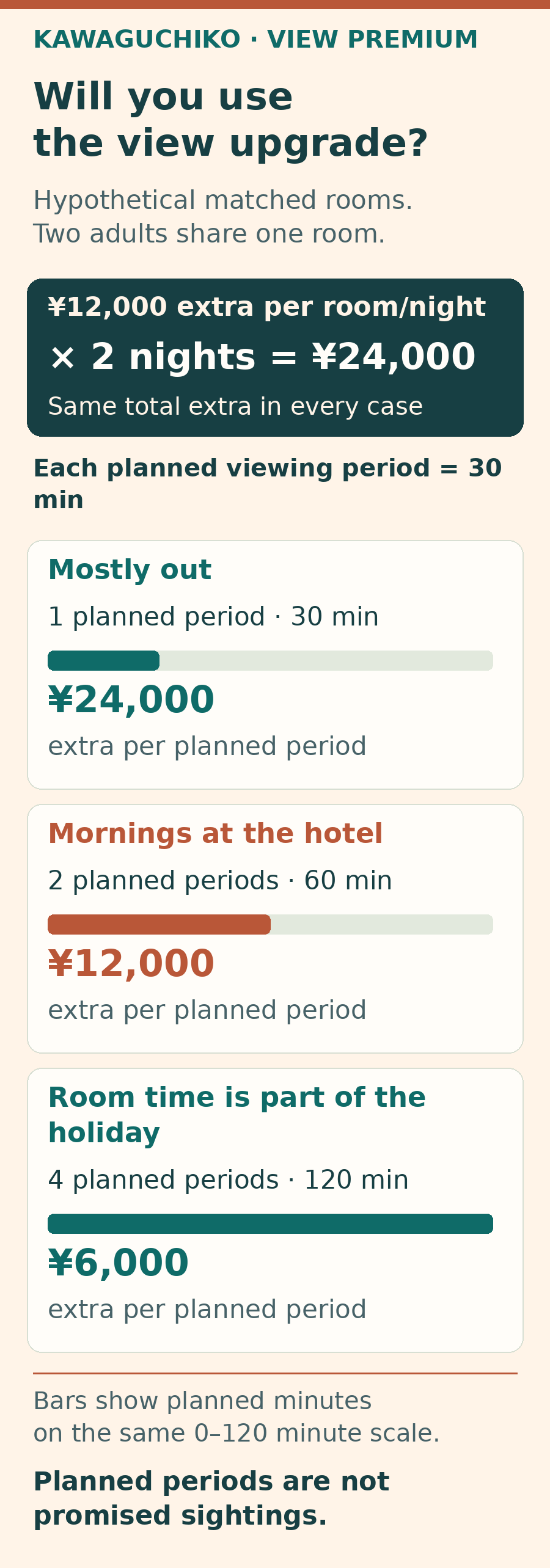
Consider this hypothetical example for two adults sharing one room for two nights. Assume comparable offers differ by ¥12,000 per room per night, solely for the room outlook. The additional stay cost is therefore ¥24,000. These are invented planning inputs, not advertised prices for any hotel above.
Swipe across the table to compare →
| Your two-night schedule | Periods deliberately kept free | Planned time | Extra cost per planned period |
|---|---|---|---|
| Mostly out | One morning | 30 minutes | ¥24,000 ÷ 1 = ¥24,000 |
| Mornings at the hotel | Two mornings | 60 minutes | ¥24,000 ÷ 2 = ¥12,000 |
| Room time is part of the holiday | Two mornings and two daylight late-afternoon periods | 120 minutes | ¥24,000 ÷ 4 = ¥6,000 |
The total premium is unchanged in every row. The calculation reveals how much of your itinerary actually uses the benefit. It does not predict clear skies, treat four periods as independent chances, or give a cost per successful sighting. Fuji might remain hidden throughout.
Swipe sideways to read the full planning graphic.
For an anniversary with long breakfasts and time around a private bath, the extra may fit the holiday. For a tightly scheduled sightseeing trip, a comfortable lower-priced room and public viewpoints may fit better. Ask whether you would still be content with the room, food and facilities if the mountain never appeared. Then place the extra within your overall Japan trip budget, including meals and the local transport you will actually use.
Make the station-to-hotel journey work
The arrival leg changes the value of a lakeside room. A train or coach ticket to Kawaguchiko Station does not include a hotel pickup. Establish both legs before committing to a dinner plan or a northern-shore stay.
Reach Kawaguchiko with your arrival time in mind
For rail, Fuji Excursion links Shinjuku and Kawaguchiko, with reserved seating; check the service for your travel date. If it is fully booked, JR East describes a route using Kaiji or Azusa to Otsuki and changing to a Fujikyu local train.[19][20] For coaches, the official Shinjuku–Fuji Five Lakes operator recommends advance reservations because services can fill up.[18]
You can also compare Tokyo–Kawaguchiko transport on 12Go.[21] Read the specific departure point, arrival stop, luggage terms and total price for your chosen service. “Tokyo” covers several boarding locations; compare an arrival at Kawaguchiko with the hotel transfer you have arranged.
Check the final connection, especially without a car
Swipe across the table to compare →
| Hotel | Practical arrival arrangement | What to confirm |
|---|---|---|
| Shuhokaku Kogetsu | Call on arrival for pickup, advertised 14:30–18:30; its local-bus stop is Itchiku Kubota Art Museum.[15] | Your station arrival falls within the pickup window, plus the morning return arrangement. |
| THE KUKUNA | The hotel asks guests wanting its station transfer to contact it in advance. The local stop is Kaze no Terrace KUKUNA-mae.[3] | Where and when to meet, including any luggage or mobility needs. |
| Konansou | About ten minutes on foot is advertised, with station pickup also offered.[16] | Confirm pickup hours directly: the dedicated access and room pages currently give different windows.[10][16] |
| Fuji View Hotel | Its scheduled station shuttle takes about ten minutes one way; the published timetable has a gap around midday.[17] | Your exact departure, return and fallback if traffic or weather affects service. |
| HAOSTAY Kawaguchiko | The original hotel advertises a 14-minute station walk.[6] | The full property name, address and actual walking route with your luggage. |
Fujikyu’s Red Line serves the northern lakeside and Oishi Park, and the operator warns that traffic can cause delays.[14] Check your dated timetable for the last useful service. For an early photograph or a late dinner, arrange a walkable option or other transport instead of assuming the daytime sightseeing bus will meet the need.
Save the hotel address and pickup instructions offline. For maps and translation, compare eSIM options at Airalo and select Japan. A suitable phone must support eSIMs and be carrier-unlocked; Airalo’s Japan page currently offers data plans.[22][23] Data alone does not provide an ordinary phone call to a hotel, so establish how you will make a requested pickup call before arrival.
Keep time for Fuji and make a plan for cloud
JNTO favours mornings for Lake Kawaguchi because haze and clouds can obscure Fuji later. Its wider Fuji guide also warns of cloud during the rainy season, roughly early June to mid-July.[1][29] Keio’s local bus guide highlights winter visibility and provides an Oishi Park live-camera link.[26] These are useful tendencies for planning; they cannot tell you whether your booked room will see the mountain on a particular day.
Two nights allow two mornings and a full intervening day, which can justify keeping the same base. Leave part of that day uncommitted if the mountain is the priority. Check the local camera before travelling to a viewpoint, while remembering that its location and observation time differ from your room. A second night creates more time locally, without guaranteeing a clear view.
Choose outings that fit your overnight base
If you want someone else to organise a day beyond the hotel, this six-hour private tour from Kawaguchiko on GetYourGuide lists pickup from local accommodation and selected stations. Confirm your exact hotel and the itinerary before booking; the offer explicitly excludes Mount Fuji’s Fifth Station.[24] Its practical advantage for a northern lakeside stay is an agreed local pickup.
For confident cyclists, the Lake Kawaguchiko Bike Tour on Viator is advertised at about 3½ hours, with a bicycle and helmet, starting and finishing at Kawaguchiko Station. It is not wheelchair accessible.[25] Account for the station journey when choosing your hotel and ask the operator about bike fit and weather arrangements. Either outing should leave the room time you are paying for intact.
On a cloudy stay, favour accommodation whose bath, meals or everyday comfort you also value. If those features do not interest you, keeping the room cost down can leave more freedom for another part of Japan.
Check the conditions that can outweigh the view
Dinner timing deserves an early check. Konansou requires guests on dinner-inclusive plans to check in by 18:00; after that, dinner is cancelled without a refund.[10] Choose an arrival that leaves room for delays, or arrange a different meal plan before booking. For an early departure, ask when breakfast starts rather than assuming you can use an included meal.
Discuss dietary requirements before selecting half board. Kogetsu’s FAQ says it cannot accommodate severe allergies or gluten-free requirements, and limits changes to its cooking stocks.[28] For any property, obtain a clear answer about the meal you need; a well-matched room does not resolve an unsuitable dinner package.
Read the cancellation deadline in Japan time. A refundable description may still have an early cut-off: Kogetsu’s published schedule begins charging 21 days before the stay.[28] Check the conditions attached to your actual booking channel and plan, then decide whether you are comfortable committing before a useful short-range forecast.
For nights from 1 April 2027, allow for Fujikawaguchiko Town’s new accommodation tax of ¥200 per person per night. The municipality’s handbook says paid child and infant stays are taxable; bed-sharing without an accommodation charge is not. Two paying adults staying two nights would add ¥800. Check whether that sum, and any separate bathing tax, is included in the displayed total.[27]
Useful questions
Is one night enough, or should I book two?
One night can work for a stay centred on the room, dinner and the following morning, provided your arrival leaves useful daylight. Two nights give a full day between arrivals and departures and another morning. Choose that extra night for time you want locally; it does not ensure Fuji will be visible.
Can I book a cheaper room and use a viewing terrace instead?
Yes, where the property provides shared viewing space. HAOSTAY Kawaguchiko lists a rooftop terrace while only some twin rooms have Fuji views.[6] Confirm terrace access hours and whether its route suits your mobility. You are choosing shared access to an outlook, so assess how much privacy and immediate access matter to you.
Does an open-air bath always contain hot-spring water?
The room description should say so explicitly. Konansou’s Type D page identifies natural hot-spring water, and KUKUNA’s Superior Terrace Room specifies a hot-spring bath.[8][10] Check the exact category elsewhere, including whether the bath is private and where its view is visible from.
Should I change hotels after one night to try another view?
Usually keep one base for a two-night stay unless the second hotel offers a different experience you particularly want. A move adds packing, baggage handling and another check-in, reducing time you could keep free for the room or a viewpoint. Compare the two stays’ complete value before splitting them.
How should families compare a ryokan price?
Enter every child’s age and specify the beds, futons and meals needed. Compare the complete party total under the same conditions, then check the room’s occupancy limit. A headline price for two adults is a poor comparison with a family plan that includes extra bedding and dinners.
Book the view you mean to spend time with
Choose the north or eastern shore when lake-and-Fuji scenery is central to the stay. Choose the southern or station-side approach when the arrival and onward journey matter most, and Katsuyama when its hotel setting and transfer arrangement fit. Then book the exact room benefit you want, preserve time to use it, and make sure the rest of the stay earns its price even under a cloudy sky.
Sources and checks
Research-led accommodation guidance with original planning comparisons. Linked operator and tourism sources provide the starting evidence; confirm current room categories, access and booking terms directly for your dates.
- JNTO: Fuji Five Lakes itinerary — north-shore outlooks and morning visibility
- Shuhokaku Kogetsu: official room types and lake/Fuji outlook
- THE KUKUNA: location, views and station access
- Konansou: separate Lake Kawaguchi Side and Mt Fuji Side room categories
- Fuji View Hotel: room categories and their stated outlooks
- HAOSTAY Kawaguchiko: original hotel, room types, shared terrace and access
- Shuhokaku Kogetsu: standard Japanese-style room and shower facilities
- THE KUKUNA: Superior Terrace Room and private hot-spring terrace
- THE KUKUNA: room sizes, terraces and occupancy
- Konansou: Type D Mt Fuji-view Japanese-Western room, bath and dinner conditions
- Fuji View Hotel: Moderate Twin Room with Mt Fuji View
- Shuhokaku Kogetsu: 2027 dining renovation and booking restrictions
- Shuhokaku Kogetsu: notice about discrepancies through some overseas booking sites
- Fujikyu Bus: sightseeing-bus routes and operating information
- Shuhokaku Kogetsu: local bus stop and station pickup hours
- Konansou: walking approach and station pickup instructions
- Fuji View Hotel: station shuttle timetable and journey information
- Highwaybus.com / Keio Bus: Shinjuku–Fuji Five Lakes reservations
- JR East: October 2026 Fuji-Excursion service information and reserved seating
- JR East: alternative via Otsuki when Fuji Excursion is fully booked
- 12Go: Tokyo–Kawaguchiko route comparison
- Airalo: Japan data eSIM plans
- Airalo: device compatibility and carrier-unlocked requirements
- GetYourGuide: locally starting private Mount Fuji tour from Kawaguchiko
- Viator / Fuji Bike Tour: Lake Kawaguchiko Bike Tour and station meeting point
- Highwaybus.com / Keio Bus: seasonal viewing guidance and Oishi Park live camera
- Fujikawaguchiko Town: accommodation-tax collection handbook, August 2026, pages 5 and 8–9
- Shuhokaku Kogetsu: cancellation terms, meals, dietary restrictions and guest information
- JNTO: Mount Fuji viewing guidance, including rainy-season cloud
Illustrations in this article were created for Taylor’s Trailblazing Travels. Third-party photographs, where used, are credited beside the image or in the source list.