Osaka Travel Guide: Neighbourhoods, Food and Attractions
Choose a useful base, eat beyond the famous signs and give Osaka’s very different districts enough time.
- Suggested stay · 2–3 nights
- First decision · Namba or Umeda
- Pace · Two districts a day
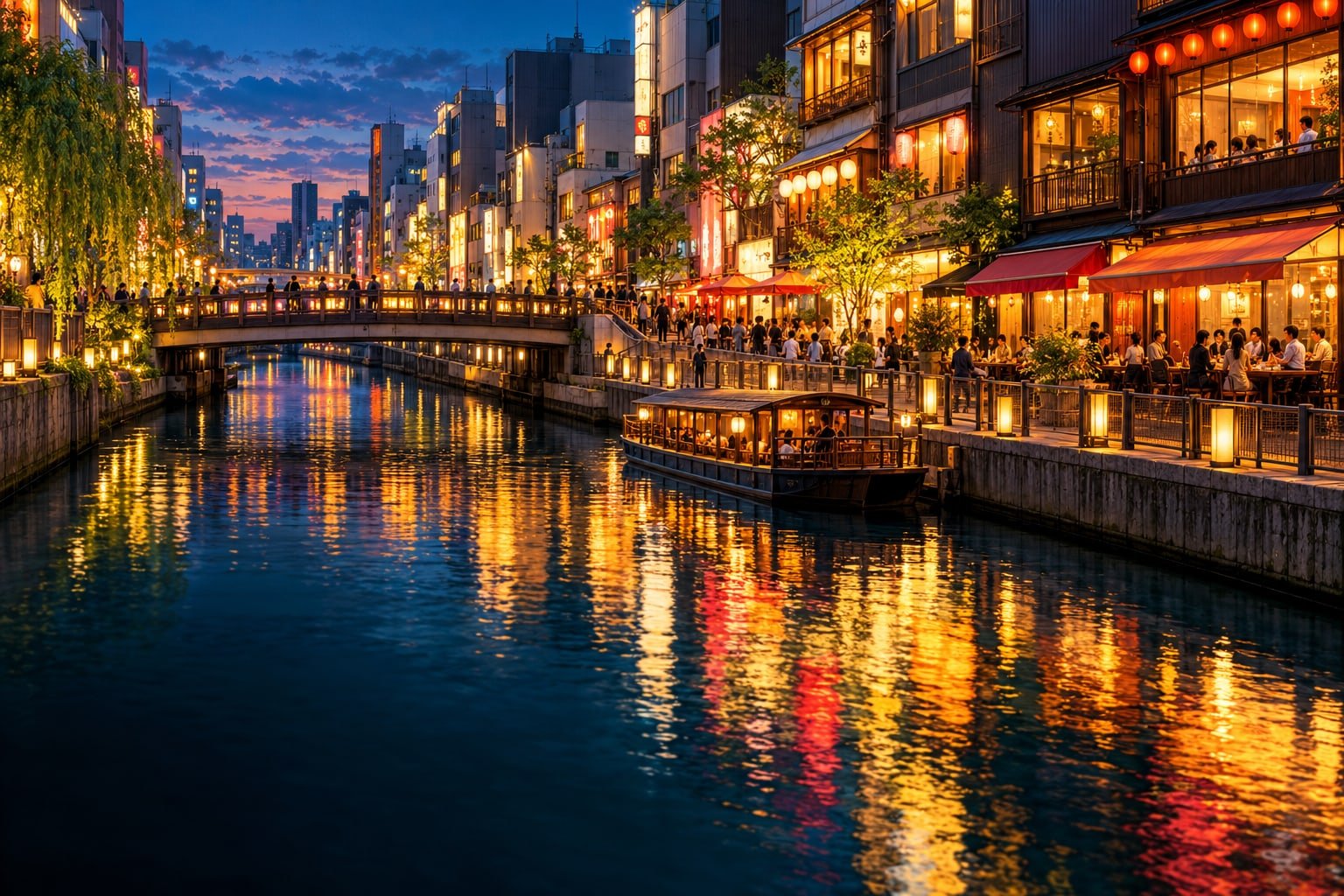
AI-generated editorial illustration inspired by Osaka’s canal-side food districts; an imagined composition, not a photograph of a verified viewpoint.
Osaka rewards a plan with room for dinner. Its main districts offer different versions of the city: Umeda’s shopping and station hub, Namba’s entertainment streets, and Tennoji’s mix of major modern buildings and older sights. Choosing where to sleep is therefore a decision about how you want your days to end.[1]
For a first visit, this guide recommends two full city days, usually within a two- or three-night stay. Use one day for the castle, riverside and northern skyline, and another for southern neighbourhoods and food. Add a separate day if Universal Studios Japan matters to you. These are planning recommendations, with the alternatives explained below.
This guide contains affiliate links. If you book or buy through them, Taylor’s Trailblazing Travels may earn a commission at no extra cost to you.
Start with your evening
Choose a base near the restaurants and streets you expect to use after sightseeing; test the exact station exit and hotel walk.
Protect two city days
Arrival and departure days rarely equal full sightseeing days. Add a full day for Universal Studios Japan if it is a priority.
Choose one skyline
Match your observation deck to your route and the weather. A second deck usually adds less than a different neighbourhood.
Keep meals flexible
Reserve a meal that is central to your trip, then leave room for smaller dishes and spontaneous stops.
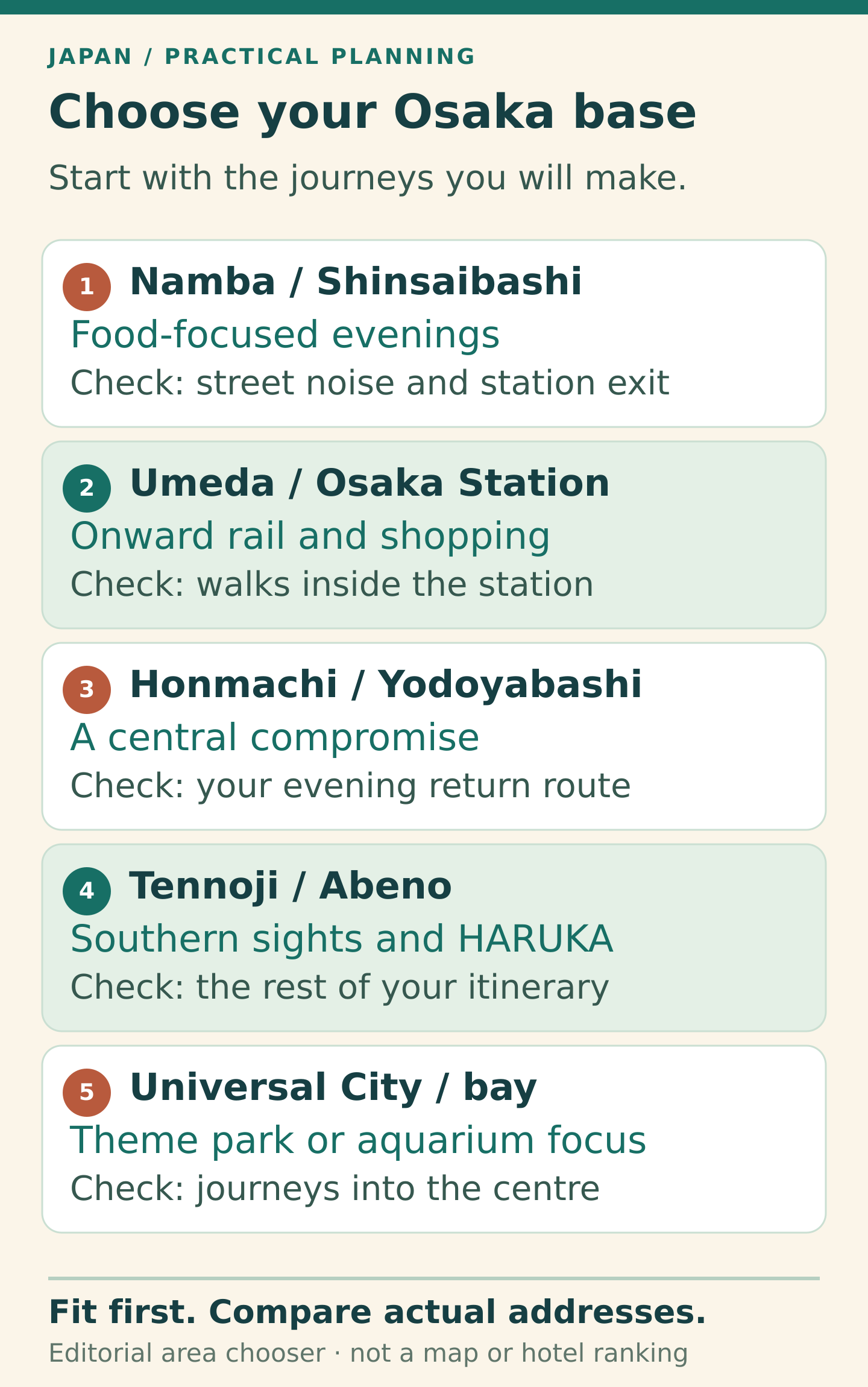
Which Osaka neighbourhood should you stay in?
The first useful division is north versus south: Umeda/Osaka Station and Namba are separate hubs, while Dotonbori belongs to the southern Minami area. Nakanoshima adds a riverside cultural district between the major shopping and entertainment centres.[1][2][3]
| Area | Choose it for | Trade-off to check |
|---|---|---|
| Namba / Shinsaibashi | A short first stay built around eating and evening walks. | A room on a busy entertainment street may be less restful. Check recent noise comments and the actual entrance. |
| Umeda / Osaka Station | Onward rail travel, department stores and a northern sightseeing day. | Allow time to learn the station complex. “Near Osaka Station” still needs a map check. |
| Honmachi / Yodoyabashi | A central compromise when you are happy to travel for dinner. | Check the exact evening route back; central on a map does not mean every sight is walkable. |
| Tennoji / Abeno | A southern base when your plans favour the temple, Shinsekai or HARUKA airport rail. | Compare your door-to-door journeys with Namba before choosing on room price alone. |
| Universal City / the bay area | A stay organised primarily around the theme park or bay attractions. | Decide whether that priority outweighs repeated journeys to your preferred central restaurants. |
Do the hotel comparison only after choosing the district. Check room size, bed configuration, cancellation deadline, luggage storage and the final total for your party. A lower headline price loses its advantage if the room does not suit you or every evening requires an extra journey. Use Agoda’s Osaka accommodation search and Booking.com’s Osaka accommodation search for the same dates and room requirements; neither link represents a checked quote for your trip.[21][22]
Choose attractions that give you different experiences
Osaka Castle: go inside for the museum
Treat the castle tower as a museum visit, with time to read and move through the building. The current adult fee is ¥1,200. Published opening is 09:00–18:00, with last admission at 17:30; it closes from 28 December to 1 January. If military and political history hold little interest, make a considered decision about the interior instead of joining a queue automatically.[4]
Nakanoshima and Shitennoji: change the register
Nakanoshima offers river walks, civic architecture and cultural venues, including Osaka City Central Public Hall and the Museum of Oriental Ceramics. It is a useful counterweight to a trip built entirely around shopping streets.[3]
Shitennoji adds a religious-history stop in the south. Its founding is associated with Prince Shotoku and early state support for Buddhism. Choose it when temple architecture and worship interest you, and give the precinct time rather than treating it as a photograph between meals.[5]
Umeda Sky Building or HARUKAS 300?
Umeda Sky Building combines indoor observation floors with an open-air roof; standard adult admission is ¥2,000. Its published hours extend to 22:30, with last entry at 22:00, although severe weather can close the roof. HARUKAS 300’s current standard adult ticket is ¥2,200. Choose Umeda when you are already spending the afternoon in the north, or HARUKAS when Tennoji fits your day.[6][7]
For most first visits, one deck is enough. Check visibility before committing to a skyline-led afternoon, and compare the selected ticket’s entry and cancellation terms. The recommendation is about adding variety to a short trip, not judging one view universally superior.
Kaiyukan or Universal Studios Japan?
Kaiyukan, in the bay area, focuses on Pacific habitats and includes a major whale-shark tank. Allowing two to three hours inside is a planning estimate; add the journey and a meal before deciding what else fits. It can anchor a wet-weather day, although you should still check timed tickets and the current opening calendar.[8]
Universal Studios Japan deserves a separate day if its rides and themed areas are a main reason for visiting Osaka. Buy the correct visit-date Studio Pass and distinguish park admission from any additional access product. Super Nintendo World can require a separate area timed-entry or standby-entry arrangement; ordinary park admission alone is not a promise of immediate access to that area.[9][10]
Use the official park ticket and area-entry guidance before comparing an Express Pass or package. Check exactly which attractions and entry times the selected product covers. Trying to add a castle visit and aquarium around a theme-park day would undermine all three.
Build meals around Osaka’s food, not just its signs
A useful first food plan mixes textures and meal sizes. Try one flour-based favourite, one skewer meal and a simpler noodle or sushi meal across your stay, instead of ordering every famous fried dish in the same sitting.
| Dish | What to expect | Useful place in the day |
|---|---|---|
| Takoyaki | Batter balls with octopus; toppings vary.[12] | A small snack before deciding how hungry you are for dinner. |
| Okonomiyaki | A griddled cabbage-and-batter dish, often with pork and a dashi base.[11] | A sit-down meal when you want something substantial. |
| Kushikatsu | Breaded, deep-fried skewers of meat or vegetables.[11] | Order a few, then add more rather than guessing a large set. |
| Osaka-style udon | Soft noodles with broth commonly made using kelp and bonito.[11] | A change of pace between richer meals. |
| Pressed sushi | Rice and toppings shaped in a mould, rather than only hand-formed pieces.[11] | An alternative when another fried meal does not appeal. |
Dotonbori is a useful evening introduction to Minami’s canal-side spectacle. Decide separately where to eat: a famous sign, a long queue and a menu that suits you are three different things. Have a second restaurant in mind if the first wait would consume your evening.[2]
For a market visit, use Kuromon’s official shop map to choose a few stops. Check individual opening arrangements and prices, particularly before ordering premium seafood. Treat the market as a place to browse and taste; do not assume that every product is cheaper because it is sold at a market.[13]
Dietary requests need ingredient-level questions. Vegetable toppings do not establish that broth, batter or sauce is vegetarian, and a shared fryer may matter to your requirements. Ask the shop about the whole dish; for kushikatsu, follow the restaurant’s current sauce-sharing instructions.[11]
When a food walk earns its place
A guide can be useful if choosing menus or understanding neighbourhood food is the main obstacle. Review this daytime Shinsekai food walk on GetYourGuide; the listing describes three hours and four food stops. Or compare Osaka food tours on Viator. Check dietary suitability, meeting point, walking pace and what food or drinks the selected option includes before paying.[14][15]
Arrive at the right hub and keep local travel simple
From Kansai International Airport
For Namba, compare Nankai services. Rapi:t runs to Nankai Namba with reserved seats; the fastest published journey is 34 minutes, and the limited-express charge is additional to the base fare. That headline time excludes the walk through the airport and from the station to your hotel.[16]
For Tennoji, Osaka Station or Shin-Osaka, compare JR-West’s HARUKA. Its route serves those hubs, but discounted tourist tickets have eligibility conditions: read the particular fare’s rules rather than assuming every advertised price applies to you. These recommendations concern Kansai International Airport; check your arrival airport before booking.[17]
From Tokyo and elsewhere in Japan
Shinkansen services arrive at Shin-Osaka, which is a different station from Osaka Station/Umeda. Include the onward local journey when comparing your hotel options.[12]
If you are deciding between intercity modes, compare Tokyo-to-Osaka transport on 12Go. Check the actual operator, arrival station, baggage conditions, cancellation terms and total fees against the operator’s own offer. A flight or overnight coach is a different use of your time from a daytime train, even before price enters the decision.[23]
Within Osaka
An accepted IC card such as ICOCA keeps individual Metro journeys straightforward. It is a payment method, not automatically a sightseeing discount.[18]
The Enjoy Eco Card costs ¥820 for an adult on weekdays or ¥620 on weekends and public holidays. It covers Osaka Metro, except Yumeshima, and qualifying Osaka City Bus routes; it does not cover separate railway companies. Add the eligible journeys you actually plan to make before buying, and avoid paying IC fares again for travel your pass already covers.[19]
Save the hotel’s exact station exit and a route back before going out. Choose one compact district for a walking block, then take transport to the next. A citywide pass cannot recover time spent repeatedly crossing Osaka.
A realistic two-day Osaka route
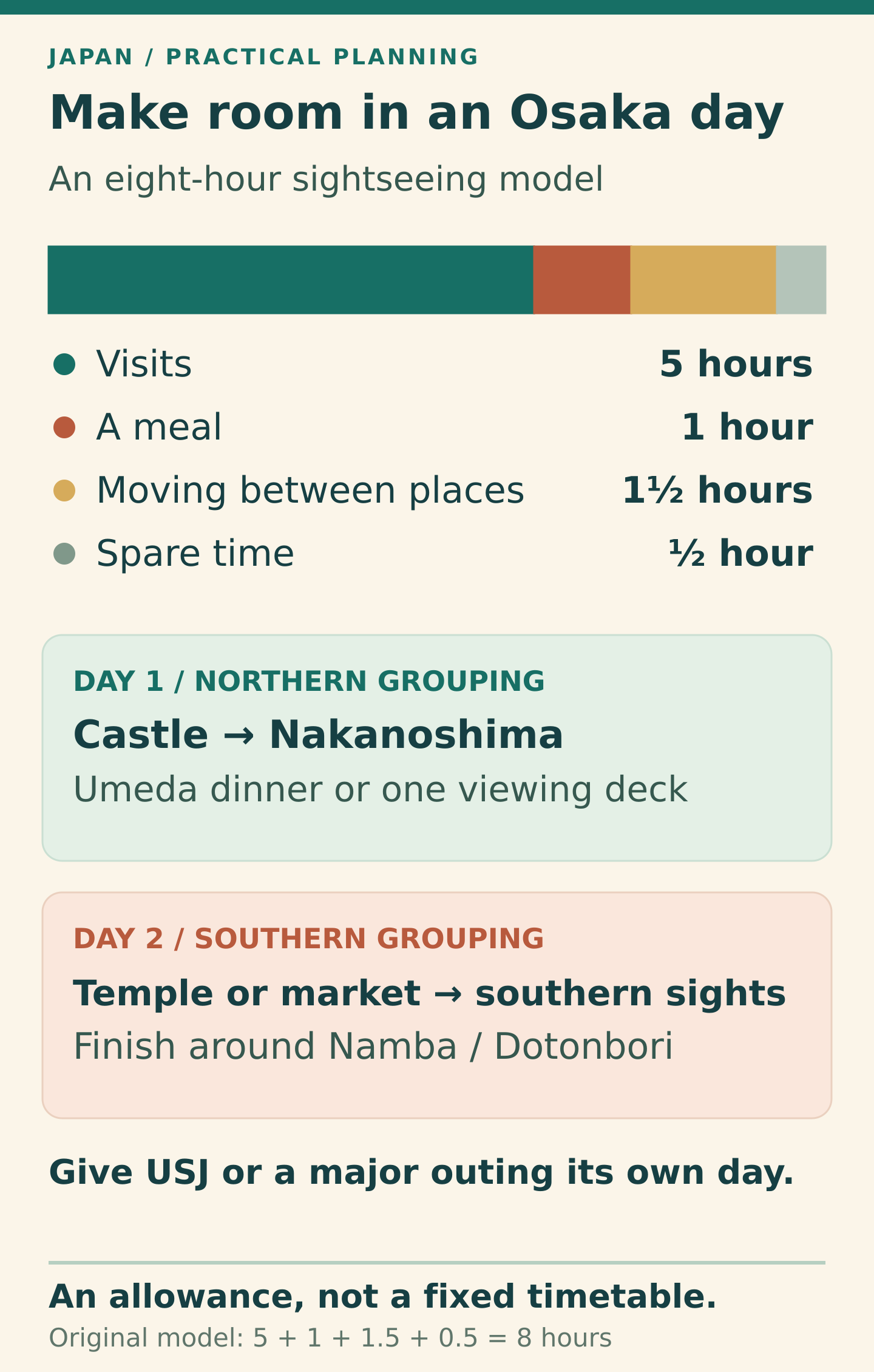
The groupings below are editorial planning models, not timed tours. An eight-hour sightseeing window with one hour for lunch, 90 minutes for transfers and station walks, and 30 minutes of slack leaves about five hours for actual visits. A slow lunch, children’s breaks or a major queue reduces that further.
| Day | Morning | Afternoon | Evening |
|---|---|---|---|
| Day 1: castle, river and north | Osaka Castle museum and its approach; use the current opening information. | Lunch, then Nakanoshima. Choose a cultural interior or a longer riverside walk. | Umeda Sky Building if visibility and energy suit; dinner in the north. |
| Day 2: southern Osaka | Choose Shitennoji for temple history, or Kuromon for food browsing. | Tennoji/Shinsekai at an unhurried pace. Substitute HARUKAS for the previous evening’s deck if preferred. | Namba and Dotonbori, with one meal as the anchor and time for the canal-side walk. |
Do not interpret the alternatives as extra stops. Visiting Shitennoji, a market, a museum, two decks and every food district in one day would require removing the time that makes them worthwhile. If a guided food walk is booked, let it replace part of day two rather than adding it to a full schedule.
For a third full day, choose one direction: Universal Studios Japan; the aquarium with a slower bay afternoon; or more time in the neighbourhood that interested you most. If you have only one day, choose castle and Namba for a broad introduction, or a southern food-and-neighbourhood day if eating is your priority. Keep an onward train comfortably outside your final sightseeing block.
What to budget and what to book first
Use yen to build the local budget, then convert at your actual payment rate. Hotel prices depend on dates, room type and cancellation terms, so a live total is more useful than a universal “Osaka costs this much” claim.
| Item | Current reference price | What it tells you |
|---|---|---|
| Osaka Castle museum | ¥1,200[4] | A distinct paid history visit. |
| Umeda Sky Building observatory | ¥2,000[6] | One paid skyline option. |
| HARUKAS 300 | ¥2,200[7] | An alternative deck, not an automatic addition. |
| Enjoy Eco Card | ¥820 weekday / ¥620 weekend or public holiday[19] | Compare only eligible Metro and bus journeys. |
For an editable example, set aside ¥3,500 for meals and snacks, then add ¥820 for a weekday Eco Card, ¥1,200 for the castle and ¥2,000 for Umeda Sky Building: ¥7,520 for that selected day. The food figure is a planning allowance, not a surveyed average. Accommodation, airport or intercity travel, shopping and other tickets are excluded; replace each item with your own choices.
Osaka’s accommodation tax is assessed per person per night. From September 2025, the taxable accommodation-charge bands are: below ¥5,000 exempt; ¥5,000–14,999 attracts ¥200; ¥15,000–19,999 attracts ¥400; and ¥20,000 or more attracts ¥500. Ask the property whether the displayed total already includes the applicable tax and how the charge is allocated for your booking.[20]
Book the elements that fix the shape of the trip first: the room, a theme-park date if relevant, and any specific restaurant or guided experience you would regret missing. Keep weather-dependent sightseeing flexible where the ticket terms allow. Compare the final payable amount, not just the first number on a search page.
Weather, access and the last checks
Spring and autumn are sensible starting points for a walking-led visit. Summer brings heat and humidity, so move a long outdoor block earlier and use a museum, shopping break or aquarium around the hottest part of the day. A skyline visit benefits from visibility more than from a rigid place on the itinerary.[12]
For step-free travel, check the exact station exit and attraction route rather than relying on the presence of a lift somewhere in the complex. Osaka Castle’s museum uses managed lift arrangements and stairs on the usual route; visitors who need an accessible route should check the museum’s instructions before visiting.[4]
Mobile data is useful for station exits, platform changes and menus. If your existing plan does not cover Japan, open Airalo and select a Japan eSIM. Compare allowance, validity and activation rules with your expected use, and check that your specific phone is eSIM-compatible and network-unlocked before purchasing. Download essential addresses as a backup.[24][25]
Your Osaka questions answered
Is one night in Osaka worthwhile?
Yes, if it gives you an evening and most of the following day. Choose a base near your dinner plans and one daytime priority. Two nights are easier when you want both northern and southern sightseeing without using arrival or departure time as if it were a full day.
Can Osaka be my only Kansai base?
It can suit a trip where avoiding hotel changes and enjoying Osaka evenings matter more than starting every outing early. Compare the complete journey to each planned day trip, then multiply that travel time by the number of outings. If another destination is the focus of several days, sleeping there may recover more time than a single base saves. Osaka’s regional rail connections make either approach possible.[12]
What should I check if my flight arrives late?
Use the airport railway’s current timetable for the date and terminal, allowing for immigration, baggage and the walk to the station. A scheduled landing before the last train does not establish that you can catch it. Confirm the hotel’s latest check-in time and a workable alternative transfer before committing to an arrival-night plan.[16][17]
Do I need to rent a car for this Osaka itinerary?
No car is needed for the route proposed here. Plan it with the rail services described above and walking within each district; use a taxi for a particular access need if that works better for your party. If Osaka sits inside a longer driving holiday, decide separately whether keeping the car during the city stay is useful.
Choose the plan that fits your trip
Start with the hotel district, then protect two full city days if your wider route allows. Give each day one major attraction, a coherent area to explore and a meal worth lingering over. Choose one skyline view and add the theme park only when you can give it the time you want. Osaka becomes easier to plan once every famous sight stops competing for the same afternoon.
How this guide was researched
This guide combines official tourism, attraction, railway and prefectural information with checked booking landings. Prices and operating details were reviewed on 17 October 2026. Neighbourhood rankings, suggested durations, route groupings and the example spending allowance are editorial planning judgements, not claims of personal visits or measured traveller averages.
Sources and checks
Official, operator and relevant booking information checked on 17 October 2026. Opening arrangements, fares and availability can change; recheck the linked source for your travel dates.
- Osaka Convention & Tourism Bureau — understanding Osaka’s districts
- Osaka Convention & Tourism Bureau — Dotonbori
- Osaka Convention & Tourism Bureau — Nakanoshima public spaces
- Osaka Castle Museum — visitor information
- Osaka Convention & Tourism Bureau — Shitennoji
- Umeda Sky Building — official visitor information
- HARUKAS 300 — official tickets
- Osaka Convention & Tourism Bureau — Osaka Aquarium Kaiyukan
- Universal Studios Japan — official park and ticket information
- Universal Studios Japan — area timed entry
- Osaka Convention & Tourism Bureau — Osaka cuisine
- Japan National Tourism Organization — Osaka
- Kuromon Market — official store map
- GetYourGuide — Osaka Shinsekai daytime food tour
- Viator — Osaka food tours
- Nankai Electric Railway — Rapi:t
- JR-West — HARUKA airport services and tickets
- Osaka Metro — ICOCA
- Osaka Metro — Enjoy Eco Card
- Osaka Prefecture — accommodation-tax rates
- Agoda — Osaka accommodation search
- Booking.com — Osaka accommodation search
- 12Go — Tokyo to Osaka
- Airalo — Japan eSIM plans
- Airalo — device compatibility
Illustrations in this article were created for Taylor’s Trailblazing Travels. Third-party photographs, where used, are credited beside the image or in the source list.