Yokohama Travel Guide: Waterfront, Chinatown and Local Sights
Build a harbour day with room for a proper meal, then choose the extra sights that deserve another morning.
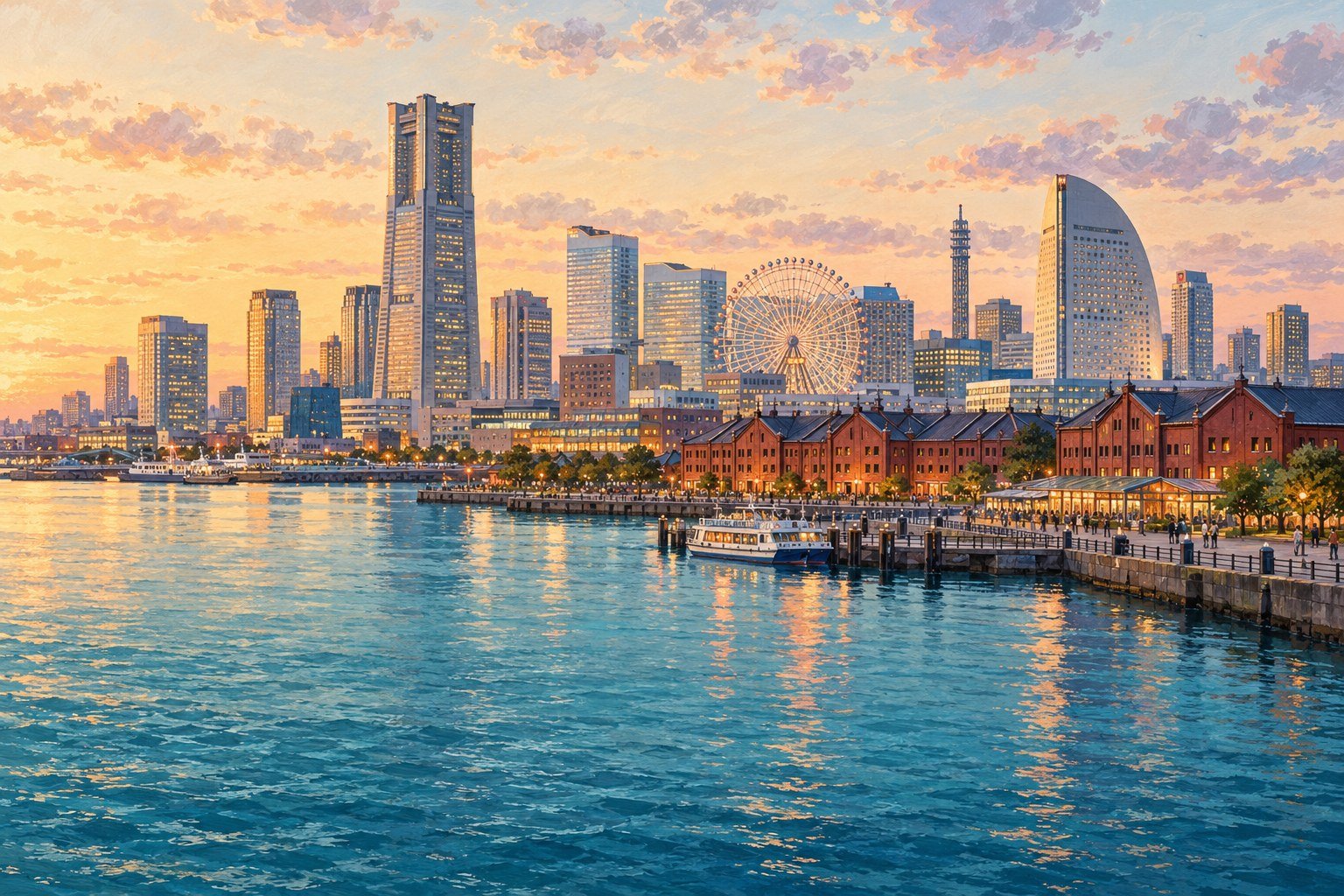
AI-created editorial illustration inspired by Yokohama’s Minato Mirai waterfront; an illustrative scene, not a photograph of a verified viewpoint.
Yokohama rewards a day that reaches into the evening. The harbour gives you room to walk; Chinatown gives you a reason to sit down; and the skyline changes the mood after dark. The useful planning question is how much to add around those two anchors.
This Yokohama travel guide builds a first visit around the waterfront, with separate choices for a museum activity, Sankeien Garden and the older streets inland. The suggested durations and spending examples are editorial planning allowances, built from the official access and ticket information cited below.
This article contains affiliate links. If you make a booking or purchase through them, Taylor’s Trailblazing Travels may receive a commission at no extra cost to you.
One full day
An editorial allowance of 7–9 hours locally leaves room for one paid anchor, the harbour and a meal.
Give it a purpose
A late Chinatown dinner plus Sankeien the next morning makes a stronger case than changing hotels for the same waterfront walk.
Yokohama ≠ Shin-Yokohama
The Shinkansen station is a separate inland arrival point; include the local connection to your hotel. [21][33]
Osanbashi rooftop
The public wooden deck is open 24 hours; stay on permitted paths and check any local restrictions. [5]
Yokohama travel guide: choose your visit length
Choose the meal or evening you want first, then fit the daytime sights around it. This avoids filling the day with indoor bookings and reaching the waterfront just as you need to leave.
Scroll sideways to see all columns.
| Time available | A workable focus | What to leave for another visit |
|---|---|---|
| About four hours | Chinatown meal, Yamashita Park and an Osanbashi detour if time allows. | The full Minato Mirai circuit and Sankeien. |
| Seven to nine hours | Sakuragicho, one museum activity or scenic ride, Red Brick Warehouse, harbour walk and Chinatown. | A second substantial museum visit or a garden outing. |
| One night, with the following morning free | Waterfront and Chinatown on day one; Sankeien or Yamate on day two. | Adding both garden and hill district before an early onward train. |
The core route moves from Sakuragicho through the Shinko waterfront towards Yamashita Park and Chinatown. Osanbashi is an out-and-back pier detour, so allow time to return to its entrance. Minatomirai, Bashamichi, Nihon-odori and Motomachi-Chukagai stations provide different points to join or leave the area; Sakuragicho is a separate JR/municipal-subway station. [2][3][5][25]
On a phone, swipe the diagram sideways to read its labels.
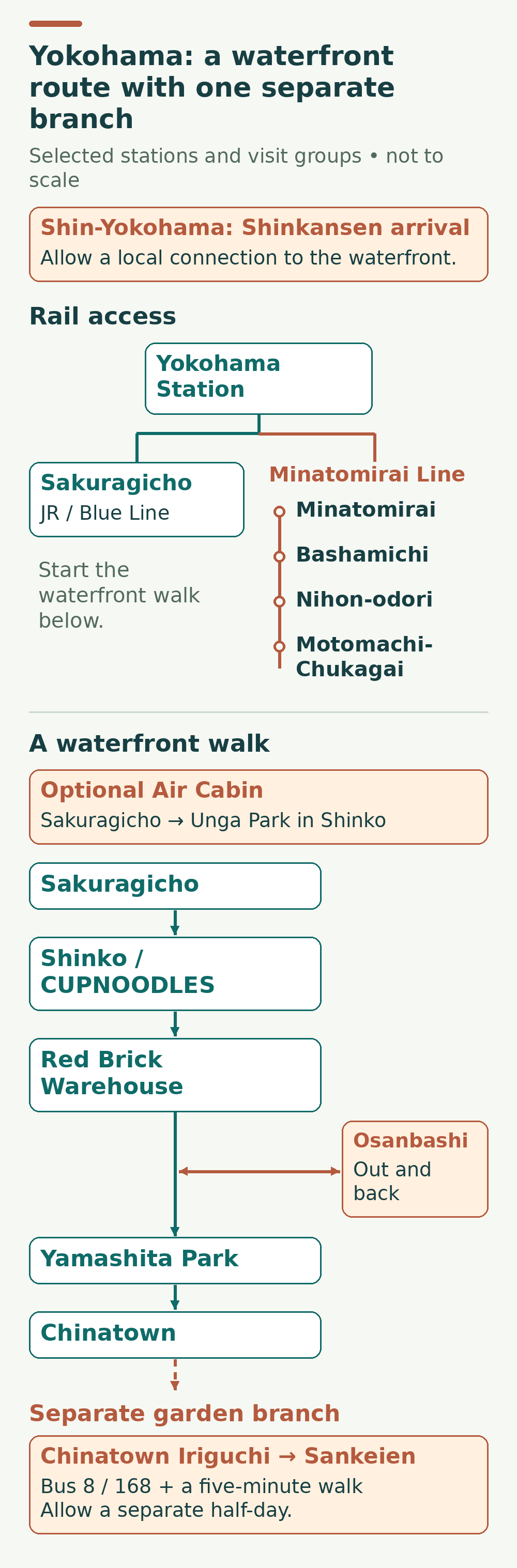
The diagram shows planning relationships, not street-level navigation. Keep Sankeien on a separate bus branch. For a shorter day, starting at Motomachi-Chukagai and concentrating on the older harbour saves the need to cross the whole waterfront.
Walk the harbour and choose your paid view
Sakuragicho, Shinko and the Red Brick Warehouse
The former railway promenade, Kishamichi, gives the walk from Sakuragicho its waterside character. The Red Brick Warehouse’s official access guide allows about 15 minutes from the station via this route; pauses and detours add to that. If you book CUPNOODLES, visit its Shinko site before continuing towards the warehouses. [3][12]
The two red-brick buildings were completed in 1911 and 1913 as port warehouses and later adapted for shops and cultural uses. Visit for the buildings, browsing and harbour setting; a particular market or festival depends on the event calendar. [4]
Osanbashi and Yamashita Park
Osanbashi’s undulating wooden rooftop is the place to linger over the skyline. Its public deck is open around the clock, so you need not buy an observation ticket to enjoy the harbour after dark. Return towards the city and continue to Yamashita Park, a useful open-air pause before turning inland for Chinatown. [5][6]
Air Cabin or SEA BASS?
Air Cabin links the front of Sakuragicho Station with Unga Park in Shinko. At ¥1,000 per adult one way, it makes most sense as a short scenic experience that replaces part of the walk. A return costs ¥1,800, but returning to the same station may not suit an onward waterfront route. Operation can change with weather. [7][8]
SEA BASS offers a view from the water and can replace a longer land transfer. Its current route connects Yokohama Station’s East Exit/Bay Quarter, Hammerhead, Pier Red Brick and Yamashita Park, with different calls on different sailings. East Exit–Yamashita Park costs ¥1,500 per adult one way. Check the actual sailing, pier and weather notice; ordinary individual journeys are not reserved in advance. [9]
For 25 October 2026, the boat operator warns of Yokohama Marathon traffic controls and crowding around Hammerhead, Red Brick Warehouse and Yamashita Park. Allow extra time to reach your boarding point. [39]
Make Chinatown a meal, not just a snack stop
Choose how you want to eat before joining the first queue. A sit-down lunch or dinner gives you a proper pause in the day; a few small purchases suit a shorter visit. Doing both works better when the snacks follow the meal.
Chinese merchants established the community after the port opened in 1859. The ornate Zenrinmon Gate on the western side is a useful landmark for entering the main street; take time to look beyond the queues at the architecture and imported-food shops. [38]
The official Chinatown directory separates Cantonese, Sichuan, Shanghai and other regional cooking, as well as dim sum and Chinese tea shops. Its food filters also identify dumplings, steamed buns and egg tarts. Use those categories to select a style of meal, then check the menu and portion sizes outside. A long queue alone tells you little about whether the food suits your appetite or budget. [10]
For a small group, decide whether you want individual bowls or shared dishes. Travellers eating alone can use the directory’s solo-friendly filter. Ask about ingredients directly if you have dietary requirements; a dish’s appearance is not enough to establish its contents. [10]
Pause to eat in an appropriate space and keep other businesses’ entrances clear. The Chinatown association specifically asks visitors to stop safely when eating food on skewers. It points to Yamashitacho Park inside Chinatown as a place to sit; this is a different park from the larger waterfront Yamashita Park. [11]
If the evening meal is your priority, leave a little unbooked time before it. A walk around the gates and side streets is easier to enjoy when you are not trying to beat a museum’s last admission.
Book the CUPNOODLES activity you actually want
CUPNOODLES MUSEUM YOKOHAMA is a useful indoor anchor, especially when making something is more appealing than another viewpoint. Normal opening is 10:00–18:00, with last museum admission at 17:00. It usually closes on Tuesdays, or the following weekday when Tuesday is a holiday, with additional year-end closures. Adult museum entry is ¥500; high-school pupils and younger enter free. [12]
Designing and filling a cup at My CUPNOODLES Factory costs another ¥500. The museum’s official online package combines adult admission and the timed activity for ¥1,000. Tickets for the following month go on sale at 10:00 on the first day of the month; sales finish by midnight before the visit or earlier if sold out. The activity itself takes around 45–60 minutes. [13]
The booked time applies to the activity. For an online package, keep the QR ticket or confirmation accessible and follow the admission instructions in your booking; the museum says online tickets do not require kiosk collection. Allow time to reach the reserved activity slot. Ordinary museum admission does not guarantee an activity slot. Chicken Ramen Factory, where you make noodles, is a separate reservation and fee; participation is in pairs, with age conditions. [13][14]
For English-language interpretation, compare the guided CUPNOODLES Museum visit on GetYourGuide. The current listing describes a 1½-hour visit including museum entry and the My-Cup-Noodle experience, meeting at the museum entrance. It is an optional guided alternative to the direct ¥1,000 package. The provider states that its food experience is unsuitable for vegetarians and vegans. [15]
Give the garden and inland districts enough time
Sankeien: a separate half-day
Sankeien suits travellers who want a Japanese garden and historic buildings as a counterpoint to the modern waterfront. Traditional buildings from elsewhere in Japan have been preserved within its landscaped grounds. Give the visit about two hours, then allow for the journey and bus waiting: a half-day is a sensible planning allowance. [29]
The garden normally opens 09:00–17:00, with last entry at 16:30; it closes 26–31 December. Adult admission is ¥900. From Chinatown Iriguchi bus stop, the garden’s current access diagram shows municipal buses 8 or 168 to Sankeien Iriguchi, about 15 minutes on the bus followed by a five-minute walk. Add waiting and traffic time. [16][17]
The pagoda is part of a conservation project planned over approximately five years from fiscal 2025. Check the garden’s current notices if a particular building or unobstructed pagoda view matters to your visit; the project is not a reason to assume the whole garden is closed. [18]
Yamate or Noge: choose the mood you want
Yamate rises above Motomachi, with preserved traces of the foreign residential district and Harbor View Park. It is a good alternative to Sankeien when you want architecture and a neighbourhood walk close to Chinatown. The hill is a real part of the choice: a longer promenade on the harbour may suit limited walking stamina better. Individual house and museum opening days need separate checking if you plan to go inside. [19]
Noge lies landward of Sakuragicho and is lined with izakaya, restaurants and bars. Choose it for an evening of smaller eating and drinking venues, especially on a return visit. Combining a full Chinatown dinner with a second large meal in Noge rarely adds much. [20]
For a locally guided visit, compare Viator’s customised half-day Yokohama tour. The listing offers a licensed English-speaking guide and a choice of two or three sites over roughly four hours. Meeting is on foot; private transport is excluded, and local fares, admission and meals are extra. Agree on a geographically sensible selection rather than treating its long list of possible stops as an itinerary. [28]
Arrive at the right station or terminal
From Tokyo, use the rail approach that fits your starting point. JR routes connect Tokyo and Shinagawa with Yokohama; the Tokyu Toyoko Line is useful from Shibuya, with onward services towards the Minatomirai Line. The city’s indicative Tokyo Station–Yokohama journey is around 25 minutes, but slower services take longer. Add your hotel-to-station journey and the local connection to the waterfront. [21][2]
Yokohama Station is the main transport and shopping hub. Shin-Yokohama is the separate Shinkansen station inland. For the waterfront, continue to a suitable local station; the municipal Blue Line serves Sakuragicho, while the Minatomirai Line serves the bay-side districts and Motomachi-Chukagai. [2][25][33]
From Haneda, Keikyu gives indicative rail times to Yokohama Station of 23 minutes from Terminal 3 and 28 minutes from Terminals 1/2. These are railway journey figures, not landing-to-hotel times. Check the service and connection for your arrival terminal. [22]
Travelling with bulky luggage or a group? Compare Haneda–Yokohama transfers on 12Go; the route currently lists taxi options in different vehicle sizes. Check the exact drop-off address, luggage capacity, flight-delay waiting terms and total group price against the rail alternative. [32]
From Narita, compare the Narita Express and airport-coach options linked in the city’s official arrival guide. Check whether the service reaches Yokohama Station or YCAT, then allow for the onward journey to your hotel. [21]
Cruise passengers should use the terminal name on their sailing documents. Osanbashi, Shinko and Daikoku are distinct terminals; a hotel convenient for one is not automatically convenient for another. [21]
Count your rides before buying a local pass
For a mainly walking day, an IC card and individual fares keep things simple. A pass becomes useful when it covers journeys you already intend to make. Do not add bus rides just to make the arithmetic work.
- Municipal bus single: ¥220 per adult on ordinary flat-fare journeys. [36] Akai Kutsu is a sightseeing loop, so check its direction and stops before treating it as the quickest connection. [23]
- Municipal bus day ticket: ¥600, covering Yokohama municipal and Yokohama Traffic Development buses. It does not cover every bus company. Purchase options include my route and an on-board purchase using Suica/PASMO. [24]
- Minato Burari Ticket: ¥700, covering municipal/Kanachu buses in its designated area, including Sankeien, and the Blue Line between Yokohama and Yoshinocho. JR and the Minatomirai Line are separate. [25]
- Minatomirai Line day ticket: ¥460 for that railway only. Compare it with your actual station-to-station fares; a single journey into Chinatown does not automatically justify a pass. [2]
On a phone, swipe the diagram sideways to read its labels.
The Sankeien discount changes the comparison
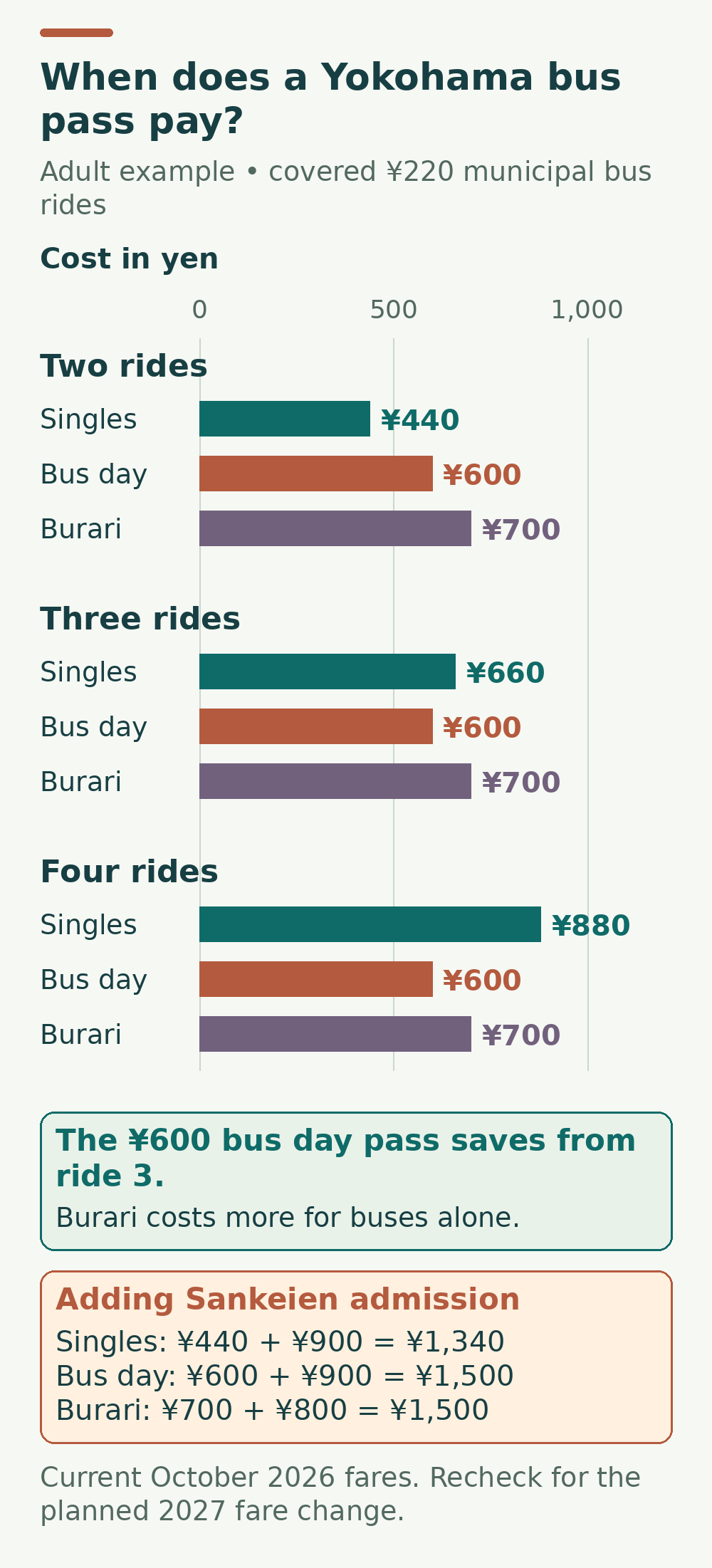
For an adult taking only ordinary ¥220 municipal buses, two rides cost ¥440, three ¥660 and four ¥880. The ¥600 bus day ticket therefore saves money from the third ride. Without another benefit, the ¥700 Burari ticket costs more for the same bus journeys.
Sankeien reduces adult entry from ¥900 to ¥800 when you present a qualifying Minato Burari Ticket. That makes either pass plus garden admission total ¥1,500: ¥600 + ¥900, or ¥700 + ¥800. Two singles plus normal admission cost only ¥1,340. With three singles, the comparable total is ¥1,560, making either pass ¥60 cheaper; Burari then offers extra covered transport at the same combined cost. The garden’s discount cannot be combined with other discounts. [16]
These are original adult calculations using fares checked on 17 October 2026. They assume ordinary municipal bus rides within the relevant ticket coverage and no other discounts. Attraction tickets, Air Cabin and SEA BASS are separate. If you need Shin-Yokohama, examine the ¥750 Burari Wide ticket’s station rules instead of applying the ¥700 example. [23][24][25]
The city plans to raise the adult municipal bus fare to ¥240 around January 2027; its current notice says the implementation date will be announced after approval. Recheck all ticket prices for a 2027 visit instead of carrying these October calculations forward unchanged. [37]
Choose a base, then set a realistic spending allowance
For one night, proximity to your evening plans usually matters more than being beside the biggest station. Use the hotel’s actual map location and room description, especially when paying extra for a harbour view.
Scroll sideways to see all columns.
| Base | Choose it for | Check before booking |
|---|---|---|
| Sakuragicho / Minato Mirai | The waterfront, evening skyline and a museum-led first visit. | The walk from the named station and whether your room category includes the promised view. |
| Kannai / Nihon-odori / Yamashita / Chinatown | An evening meal, older harbour streets and the Motomachi/Yamate side. | These are neighbouring areas, not one station; locate the hotel relative to your chosen meal and return route. |
| Yokohama Station | Convenient airport and regional connections, shopping and a short practical stop. | The exit and walking route through a large station district; budget for local travel to the harbour. |
| Shin-Yokohama | An early Shinkansen departure or a specific event nearby. | The separate journey to the bay. It is not a waterfront location. |
Search the chosen area on the Agoda Yokohama accommodation map and compare with Yokohama stays on Booking.com. Both are city searches. Match dates, occupancy, breakfast, cancellation and the final total; no room rate or availability for your stay is assumed here. [26][27]
Two transparent day-cost examples
For an adult waterfront day, allow ¥1,000 for museum entry plus My CUPNOODLES, ¥440 for two municipal bus rides and an adjustable ¥3,500 for meals and drinks: ¥4,940 in total. For a garden day with at least three covered municipal bus rides, either pass-and-entry combination above totals ¥1,500; adding the same food allowance gives ¥5,000. [13][16][23][24][25]
The ¥3,500 food figure is a planning assumption, not a surveyed meal price. Both examples exclude travel into Yokohama, accommodation, taxis, guided tours, boat rides and Air Cabin. If you prefer walking throughout the core, remove the bus allowance; if you choose a longer meal or another paid attraction, add it explicitly.
Adjust for weather, then book the few things that matter
Spring and autumn are the easier seasons for a long outdoor day; the city describes summer as hot and humid. In heat, shorten the exposed walk and build in indoor breaks. In wet or windy weather, centre the visit on a meal and an indoor attraction that is open that day, then use shorter outdoor sections as conditions allow. [29]
For families, make the CUPNOODLES activity the fixed appointment and keep the rest flexible. For limited walking stamina, select one part of the harbour, use the appropriate station and check lift access; Yamate’s hills and the full waterfront circuit are different physical commitments. Sankeien offers wheelchair loans, but these cannot be reserved. [16][19]
- Choose the local arrival station and your one main paid activity.
- Check its closure calendar, then book a timed activity or guide if needed.
- Reserve accommodation only after choosing the area and the following morning’s plan.
- Count planned local rides; buy the pass that covers them.
- Save the return journey and, for a cruise, the correct terminal.
Mobile data is useful for station exits, bus changes and menu translation. If your existing roaming does not cover Japan, check Airalo’s Japan data options. Choose Japan on the landing service and check that your phone supports eSIM and is carrier-unlocked, along with the package’s validity and activation conditions. Keep key addresses and tickets available offline too. [30][31]
Continuing towards Kyoto or Osaka? Plan the local connection to Shin-Yokohama, then compare the official JR Central booking options. For the Kyoto leg, 12Go’s Yokohama–Kyoto comparison also lists rail and coach choices. Check the exact departure point, reserved versus unreserved seating, ticket collection and total price; the city name alone does not identify your boarding place. [33][34][35]
For most first visits, the strongest plan remains a harbour walk with one chosen activity and a generous Chinatown meal. Add the overnight when you know what you want to do the next morning.
Sources and planning notes
This is a research-led guide. Official tourism bodies, transport operators and attraction information inform the factual advice; base choices, pacing and explicitly labelled budget examples are editorial planning judgements. Sources checked on 17 October 2026. Recheck current prices, conditions and operating notices for your travel dates.
- Yokohama Visitors Guide — Sky Garden temporary closure
- Minatomirai Line — fares, tickets and stations
- Yokohama Red Brick Warehouse — access
- Yokohama Red Brick Warehouse — history and use
- Osanbashi — rooftop plaza
- Yokohama Visitors Guide — Yamashita Park accessibility
- Yokohama Air Cabin — official tickets and operation
- Yokohama Air Cabin — route and cabins
- Yokohama Cruising — SEA BASS routes, fares and operating information
- Yokohama Chinatown Development Association — official directory
- Yokohama Chinatown Development Association — eating while visiting
- CUPNOODLES MUSEUM YOKOHAMA — hours and admission
- CUPNOODLES MUSEUM YOKOHAMA — official online ticket sale
- CUPNOODLES MUSEUM YOKOHAMA — visitor FAQs
- GetYourGuide — guided CUPNOODLES Museum visit
- Sankeien — visitor information and admission
- Sankeien — official access diagrams
- Sankeien — Tomyoji pagoda conservation project
- Yokohama Visitors Guide — Motomachi and Yamate walking itinerary
- Yokohama Visitors Guide — Noge Shopping Avenue
- Yokohama Visitors Guide — arriving by rail, air and cruise
- Keikyu — Haneda Airport fare and time search
- Yokohama Visitors Guide — Akai Kutsu sightseeing bus
- Yokohama City Transportation Bureau — one-day tickets
- Yokohama City Transportation Bureau — Minato Burari Ticket
- Agoda — Yokohama accommodation search
- Booking.com — Yokohama hotels
- Viator — Yokohama customised half-day local guide
- Yokohama Visitors Bureau — districts and climate
- Airalo — Japan eSIM packages
- Airalo — device compatibility
- 12Go — Haneda Airport to Yokohama
- JR Central — station layout maps
- JR Central — official Shinkansen booking
- 12Go — Yokohama to Kyoto
- Yokohama City Transportation Bureau — ordinary bus fares
- Yokohama City Transportation Bureau — planned fare revision
- Japan National Tourism Organization — Yokohama Chinatown
- Y Cruise — Yokohama Marathon traffic restrictions on 25 October 2026
Illustrations in this article were created for Taylor’s Trailblazing Travels. Third-party photographs, where used, are credited beside the image or in the source list.