Kamakura Travel Guide: Temples, Coastal Walks and Beaches
Choose two areas, protect your time by the sea, and decide whether an overnight stay earns its place.
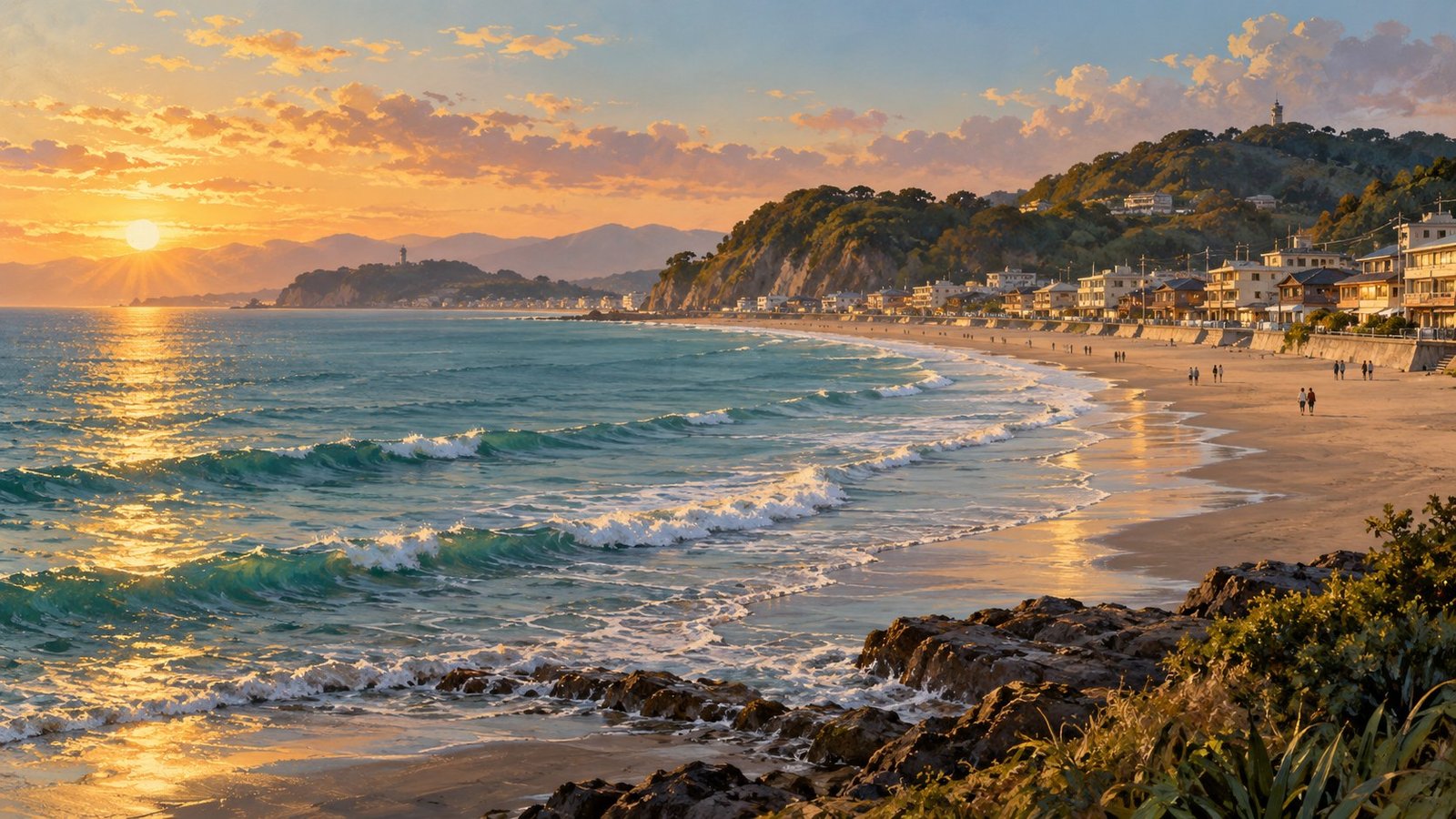
AI-created editorial illustration inspired by Kamakura’s Yuigahama coastline; an illustrative scene, not a photograph of a verified viewpoint.
Kamakura brings temple visits and a coastal afternoon within reach of Tokyo, but its attractions occupy several different pockets. Hase has the Great Buddha and Hasedera; Kita-Kamakura has its own temple setting; the central shrine and eastern bamboo garden require separate choices. The city sits between hills and Sagami Bay, so a short distance on a map does not always make a convenient sightseeing sequence. [1][17]
This Kamakura travel guide uses a simple planning rule: choose two main areas for a day trip, then give an extra night a specific purpose. It suits travellers who want cultural visits with time for lunch and the sea. A swimming afternoon, a forest hike or Enoshima needs its own share of the day.
This article contains affiliate links. If you make a booking or purchase through them, Taylor’s Trailblazing Travels may receive a commission at no extra cost to you.
Hase + central
Pair the Great Buddha and Hasedera with the central shrine, keeping lunch and transfers in the plan.
One night
Use a second morning for northern temples, the eastern bamboo garden or an unhurried coast visit.
Enoden pass ¥800
The adult one-day Noriorikun covers Enoden; compare it with the single fares for your actual stops. [14]
Choose two areas before choosing your sights
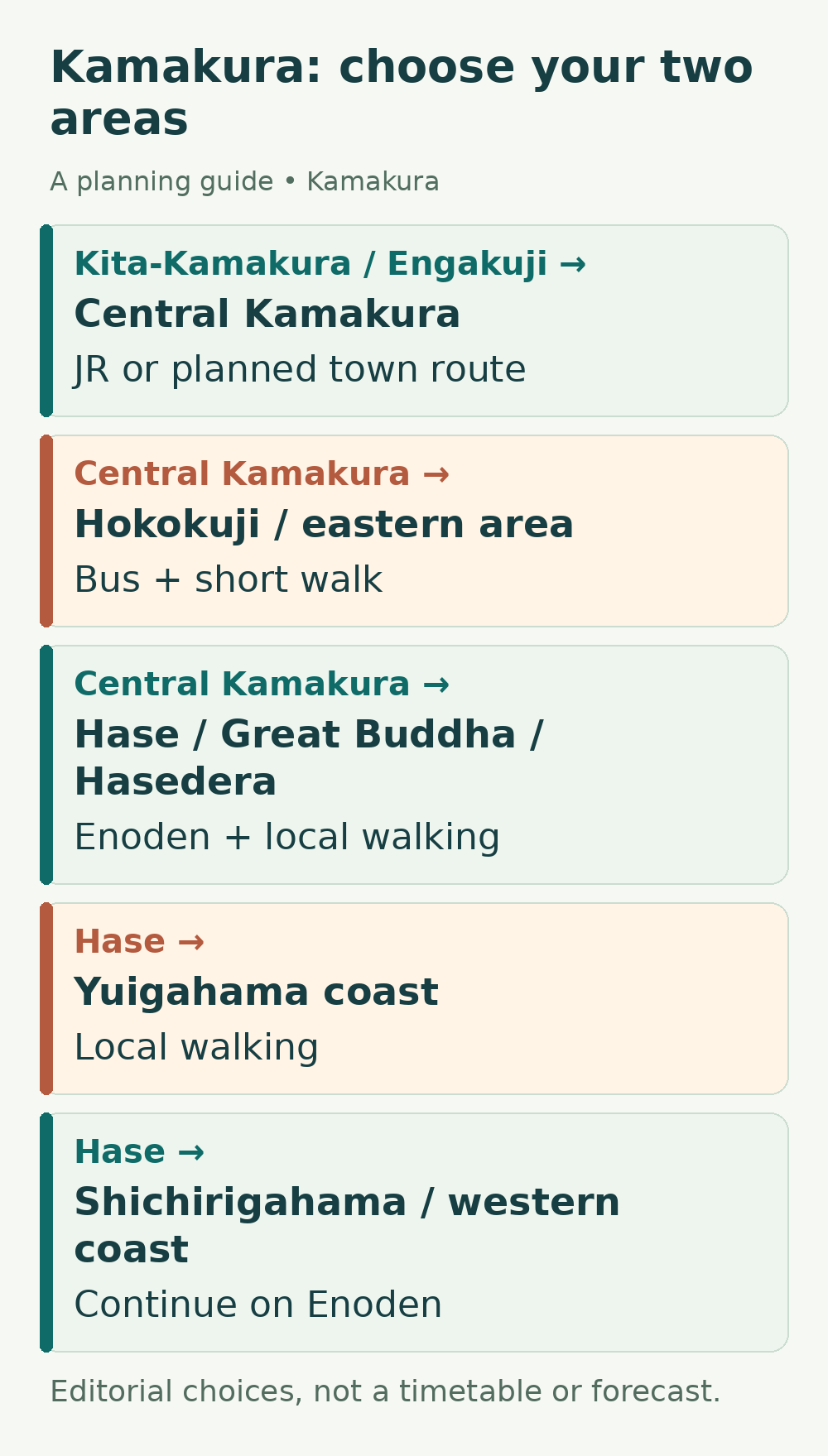
The following areas are planning groups, based on the city’s geography and transport access. They are not a ranking of attractions. A pair of nearby visits usually gives more breathing room than a circuit of every famous temple. [1]
| Area | Main reason to go | Best pairing | What to leave for another visit |
|---|---|---|---|
| Central Kamakura | Tsurugaoka Hachimangu, its approach and time around the station | Hase, Kita-Kamakura or eastern Hokokuji | A long western coast excursion if you have already chosen a second temple area |
| Hase and Yuigahama | Great Buddha, Hasedera and a nearby beach walk | Central Kamakura for a first visit | An additional northern temple circuit |
| Kita-Kamakura | Engakuji and a visit centred on Zen temple grounds | Central Kamakura | Hokokuji unless you have another day |
| Eastern Kamakura | Hokokuji’s bamboo garden and optional matcha | The central shrine area | A full Hase programme on the same day |
| Western coast | Shichirigahama scenery and travel along the Enoden line | A lighter Hase visit | Enoshima as an automatic last-minute addition |
Day trip, one night or longer?
A day trip works well for two areas when you start early enough to use the opening hours. One night is worthwhile when it creates a second morning: choose another temple area, spend more time by the sea, or reserve a separate block for Enoshima. Two nights make sense for a deliberately slow coastal stay or several substantial walks; they are not necessary just to see the headline sights.
If you are already settled in Tokyo and only want the Great Buddha, Hasedera and the central shrine, keeping that hotel can be the easier choice. Moving accommodation earns its place when the extra morning matters more than packing and check-in.
Choose temple visits for different experiences
Hase: Great Buddha, gardens and a sea view
Kotoku-in and Hasedera make a useful pair because they offer different experiences within a short walk. Start with the Great Buddha for its scale and open-air setting, then give Hasedera time for its Kannon statue, gardens and lookout towards the sea. Kotoku-in places Hasedera about five minutes away on foot. [3][5]
Kotoku-in’s adult admission is ¥300; entry inside the Buddha costs another ¥50. The grounds open at 08:00 and close at 17:00 from October to March, or 17:30 from April to September, with last admission 15 minutes earlier. The interior has a separate, earlier closing time. [3]
Hasedera’s official Japanese guide lists adult temple admission at ¥400. Its normal admission window is 08:00–16:30, with the grounds closing at 17:00; from April to June those times extend by 30 minutes. The Kannon Museum is separately charged at ¥500, so do not mistake its fee for the temple’s main admission. Prices and hours checked 17 October 2026. [4][6]
Central Kamakura: the shrine and its approach
Tsurugaoka Hachimangu gives the central visit a clear focus. Minamoto no Yoritomo moved the shrine to its present location in 1180, linking it to Kamakura’s rise as a centre of samurai power. JNTO places it about ten minutes’ walk from Kamakura Station. [2]
Allow time for the approach rather than treating it simply as a transfer. The station-to-shrine area includes Wakamiya Oji and Komachi Street, with shops and places to eat. Choose one for the outward walk and the other for the return if the streets are comfortable to use. [17]
Kita-Kamakura or Hokokuji: choose your quieter-paced interest
Engakuji suits travellers who want to spend time in a temple complex. Its buildings rise along a valley, and its entrance is about a minute’s walk from Kita-Kamakura Station. Adult entry is ¥500; published visiting hours are 08:30–16:30 from March to November and 08:30–16:00 from December to February. A slower itinerary does not guarantee quiet grounds. [7]
Hokokuji, east of the centre, offers a different focus: a garden of roughly 2,000 bamboo stems. Adult bamboo-garden entry is ¥400, with optional matcha and sweets at ¥600. It opens 09:00–16:00 and closes from 29 December to 3 January; matcha sales normally end at 15:30 and may stop earlier when busy. Treat the tea stop as extra time, not something to squeeze in near closing. [8]
For this guide’s suggested visits, reserve roughly 2½ hours for the Hase pair, or 60–90 minutes for one of the other temple anchors plus time to arrive. These are planning allowances, not official visit durations; keen photographers, worshippers and anyone needing more frequent rests should extend them.
Coastal walks, swimming beaches and the right season
Choose the coast according to what you want to do
Yuigahama is the straightforward beach addition to a Hase-focused visit. For a simple out-and-back, use Hase Station as your starting point, walk to the beach, spend your shore time beside the sea, then return the same way. The tourism association gives about five minutes from the station to the beach; the 45-minute seafront allowance in the plan below comes on top of that access walking. [24]
Changing, swimming, drying off and lunch need a much larger block. For a beach-focused summer day, reduce the sightseeing to one main temple visit.
The city’s designated bathing beaches are Yuigahama, Zaimokuza and Koshigoe. Its published 2026 opening period was 1 July–31 August, with supervision hours of 09:00–17:00. That season has ended as of this guide’s review. For a future summer, check the newly announced dates, lifeguard hours and on-site flags before entering the water. A warm day outside the season is not evidence that swimming services are operating. [10][11]
Shichirigahama belongs in a scenery plan: the official tourism page describes it as unsuitable for swimming because of coastal conditions. It is about two minutes on foot from Shichirigahama Station, making a separate Enoden stop possible. Do not plan it as your swimming beach. [12]
For a coastal walk, choose a specific accessible stretch and turn back while the return is easy. A beach stroll at Yuigahama is a different commitment from travelling west along the coast. Use streets, designated paths and stations for connections; the suggestions here do not assume a continuous walkable strip of sand.
Match the visit to the season
June brings hydrangeas and rainy weather, so make the gardens the main objective and leave slack for crowded entrances. July and August require more shade and rest time. For autumn foliage, the tourism association points to late November and early December; blossom and leaf conditions still vary. Winter can suit temple and seafront walks, but shorter daylight limits late additions, and New Year shrine visits can be busy. [13]
On a wet or windy day, trade the long shore walk for a shorter temple programme, lunch and an indoor break. If sea conditions are poor, a booked hotel night can still buy a slower morning without requiring a beach activity.
Get there by rail, then match local travel to the area
The official tourism access guide gives indicative JR Yokosuka Line journeys of about 60 minutes from Tokyo Station, 50 minutes from Shinagawa and 25 minutes from Yokohama to Kamakura. These are station-to-station examples, not door-to-door timings or a live timetable. Add the journey from your accommodation, platform time and any required change. [1]
Use Kita-Kamakura Station for an Engakuji-first day. For the Great Buddha and Hasedera, continue to Kamakura and use Enoden to Hase: the temples publish walks of about seven and five minutes respectively from Hase Station. Hokokuji’s official site instead describes a bus journey of about 12 minutes from Kamakura Station, followed by a three-minute walk from Jomyoji bus stop. Traffic and waiting time are additional considerations. [3][4][9]
The Enoden Noriorikun one-day ticket costs ¥800 for an adult and ¥400 for a child, with unlimited Enoden journeys on its date of issue. It does not cover JR or buses. Compare the single fares for your planned stops before buying: a Hase return and a day travelling repeatedly along the western coast are different use cases. Checked 17 October 2026. [14]
Driving introduces parking and road congestion into a compact sightseeing day. The tourism association recommends public transport because the main visitor areas can be congested on weekdays as well as weekends. A car is worth considering when it solves a specific access need, rather than simply because the city appears close to Tokyo. [1]
For onward travel, check the route from your actual overnight base. Staying beside the Enoden line can add a local leg before a JR journey. If Kamakura sits between Tokyo and another destination, compare the luggage transfer and hotel change with keeping it as a separate day trip.
Where to stay, what to eat and what to budget
Choose the overnight location before comparing rooms
For an overnight visit split between several areas, favour accommodation within a comfortable walk of Kamakura Station. It keeps the next day’s direction open and makes departure simpler. Hase or Yuigahama is the better editorial choice when you specifically want a coastal evening or morning. Check the property’s exact station, the walking route and any steps; a “Kamakura” address covers more than the central sightseeing area.
A western coastal property can suit a stay centred on sea views, but it is less convenient for repeatedly returning to the northern or eastern temple areas. Before paying a premium for “sea view”, check whether it applies to your room category, whether a road separates the property from the shore and whether breakfast fits your planned departure.
After choosing the area, compare Kamakura accommodation on Agoda with Kamakura hotels on Booking.com. These links open city searches, not a promise of a particular room. Use the map and compare the same dates, occupancy, meal basis and cancellation terms; displayed headline rates alone are not a fair comparison. Both destination pages were checked on 17 October 2026. [15][16]
Keep lunch part of the visit
Local choices include shirasu rice bowls, made with whitebait, and dishes using Kamakura vegetables. The tourism association also highlights shojin cuisine, the Buddhist cooking tradition based on plant ingredients, and wagashi sweets with tea. Choose a sit-down meal in the area you are already visiting rather than crossing town for a restaurant that displaces your main sight. Ask about the day’s menu and dietary requirements directly. [17]
A transparent day budget
| Item | Amount | Basis |
|---|---|---|
| Kotoku-in + Hasedera admission | ¥700 | Published adult main-entry fees, excluding Buddha interior and museum. [3][4] |
| Lunch, a drink and a snack | ¥1,500–¥2,500 | Editorial allowance; choose restaurants to fit it |
| Subtotal before transport | ¥2,200–¥3,200 | Admission plus the stated food allowance |
| Optional Enoden day ticket | ¥800 | Only if it suits the route; otherwise add your actual single fares. [14] |
| With that day ticket | ¥3,000–¥4,000 | Still excludes travel to/from Kamakura, shopping and optional activities |
For an overnight stay, add the room quote divided by the number sharing, plus dinner and breakfast if excluded. This avoids treating a room price as a per-person price. Do not use the day budget as an estimate for a private guide, taxi, beach facilities or accommodation.
Daily groupings that leave room for the journey
A first visit: Hase and central Kamakura
Start with the Hase pair, keep lunch nearby, and take a short Yuigahama walk if conditions suit. Then move to the central shrine area before returning to the station. Putting the coast beside the Hase portion avoids making it a separate journey at the end of the day.
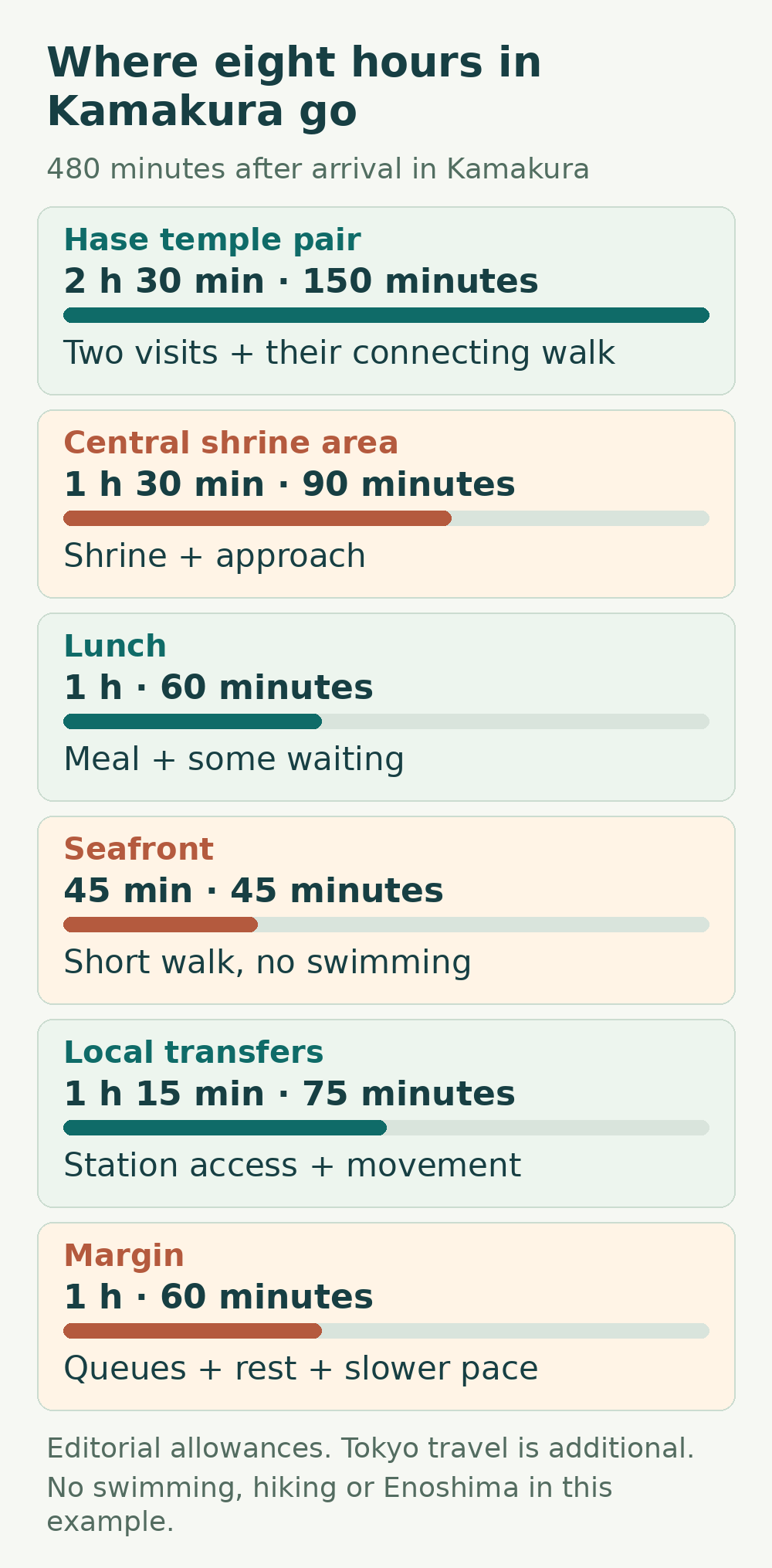
The model below allocates eight hours within Kamakura, from arrival to departure at Kamakura Station. It assumes public transport, ordinary walking pace and no swimming, museum visit, forest hike or Enoshima excursion. Travel from Tokyo is outside these eight hours. This is an original time budget, not a timetable or a guarantee of queue lengths.
| Part of the day | Allowance | What it covers |
|---|---|---|
| Hase temple pair | 2 hours 30 minutes | Two visits and walking between them |
| Central shrine area | 1 hour 30 minutes | The shrine and part of its approach |
| Lunch | 1 hour | A seated meal, with some waiting time |
| Short seafront walk | 45 minutes | Time beside the sea, not swimming |
| Local transfers | 1 hour 15 minutes | Station access, trains and movement between areas |
| Unallocated margin | 1 hour | Queues, a rest, slower walking or an earlier return |
If you arrive with only five or six hours available, choose one Hase temple plus the central area, or keep both Hase temples and drop the central visit. Preserve lunch and transfer time when cutting the plan.
Two useful alternatives
For a Zen-focused day, begin at Engakuji in Kita-Kamakura and continue to central Kamakura, using rail or a planned town route. For bamboo and tea, pair Hokokuji with the central shrine area. In either case, resist adding Hase merely because its name appears on the same city map.
For a beach-focused day, choose one morning temple and reserve the afternoon for Yuigahama or another designated bathing beach during its operating season. If Enoshima is your main interest, give it a separate half-day or more in your own plan and shorten Kamakura accordingly; the eight-hour model above has no spare island excursion hidden inside it.
One night: give the second morning a job
Spend the first day on Hase and central Kamakura, then use day two for either Kita-Kamakura or Hokokuji before travelling onwards. Alternatively, reduce day one’s sightseeing and keep the coast for a slower second morning. An overnight stay works best when it removes pressure, rather than adding another full checklist.
When a guide helps, and the practical checks that matter
Book interpretation or help with the journey
A guide can add context to the temples and help you choose a coherent route. Compare where the guided day starts, how much walking it involves and which costs sit outside the advertised price.
If you want help travelling from Tokyo, compare this eight-hour Kamakura guided day on GetYourGuide. Its booking notes describe an on-foot meeting in Tokyo and a customisable walking tour with no private vehicle; transport, entry fees and meals cost extra. Elsewhere, the page mentions a private vehicle, so confirm the selected option’s transport and meeting point with the provider before booking. Travel time is included in the eight hours: agree where the tour ends and how the return journey fits. [18]
If you will meet locally, view the private Kamakura Zen temples and gardens tour on Viator. Its listed six-hour format lets you choose sites with a licensed guide and meet on foot in Kamakura. Entry fees, transport and lunch cost extra. The long list of possible sights is a selection menu, not a promise to visit them all. [19]
Keep the route usable on the day
Save the property address, your return route and the admission details before leaving. If your existing roaming does not cover Japan, check Japan data options through Airalo for maps and translation. Confirm that your phone is unlocked and eSIM-compatible, then check the chosen plan’s data allowance and activation conditions. An eSIM is optional if you already have suitable connectivity. [20]
Mobility needs should shape the area choice. Kotoku-in recommends a helper for wheelchair users because some sections are difficult to manage alone; Engakuji’s grounds rise along a valley. Ask each attraction about the specific spaces you want to reach, rather than treating station proximity or a generic tour accessibility label as proof that every part of the visit is step-free. [3][7]
At shrines and temples, follow the local photography signs, keep voices low and avoid obstructing worship. At the Kamakurakokomae railway crossing, keep clear of tracks, moving traffic, private property and pedestrian flow; follow staff directions rather than stopping in the road for a photograph. The city’s tourism-manners guidance explicitly addresses obstructive and dangerous photography. [21][22]
Final choices before you set the date
Can a forest trail replace the transfer between temple areas?
Only when hiking is a deliberate part of your plan. Check the current tourism notices and weather before setting out, and use a town or rail route if conditions are poor. Closure information can change: the Tenen section closed after a fallen tree in March 2026 reopened on 10 March. That notice confirms that particular reopening, not the present condition of every trail. [23]
Is an overnight stay worthwhile if I do not plan to swim?
Yes, when it creates time for a second temple area, an unhurried meal or a coastal morning. Otherwise, a focused day trip can be sufficient. Base the decision on what you would do with the extra morning, then compare its value with the room cost and hotel move.
What should I settle before booking?
Choose your two areas, decide whether the beach means a walk or several hours in the water, and check the current opening times of the main attraction. Then decide whether you need accommodation or a guide. For most first visits, Hase plus central Kamakura is the balanced starting point; add a night when you can name the extra experience it makes possible.
Sources and planning notes
This is a research-led guide. Official tourism bodies, transport operators and attraction information inform the factual advice; base choices, pacing and explicitly labelled budget examples are editorial planning judgements. Sources checked on 17 October 2026. Recheck current prices, conditions and operating notices for your travel dates.
- VISIT KAMAKURA — Access and transport
- JNTO — Tsurugaoka Hachimangu Shrine
- Kotoku-in — Official visitor information
- Hasedera — Official Japanese visitor guide
- VISIT KAMAKURA — Hasedera Temple
- Hasedera — Kannon Museum admission change
- Engakuji — Official English visitor information
- Hokokuji — Official visitor guide
- Hokokuji — Official English access information
- Kamakura City — 2026 beach opening announcement
- Kamakura City — Summer beach use and flags
- VISIT KAMAKURA — Shichirigahama Beach
- VISIT KAMAKURA — Seasons
- Enoden — Noriorikun one-day ticket
- Agoda — Kamakura accommodation search
- Booking.com — Kamakura hotels
- VISIT KAMAKURA — About Kamakura
- GetYourGuide — Kamakura walking tour from Tokyo
- Viator — Private Kamakura Zen temples and gardens tour
- Airalo — Japan eSIM guidance
- VISIT KAMAKURA — Respect Kamakura guidelines
- Kamakura City — Tourism manners
- Kamakura Tourism Association — Tenen trail reopening notice
- VISIT KAMAKURA — Yuigahama Beach
Illustrations in this article were created for Taylor’s Trailblazing Travels. Third-party photographs, where used, are credited beside the image or in the source list.