Where to Stay on Miyajima: Ryokan and Island Overnight Guide
Choose the island setting, meal plan and arrival schedule together—then decide which ryokan fits.
- Four island stay examples
- Dinner-led arrival plan
- Half-board comparison
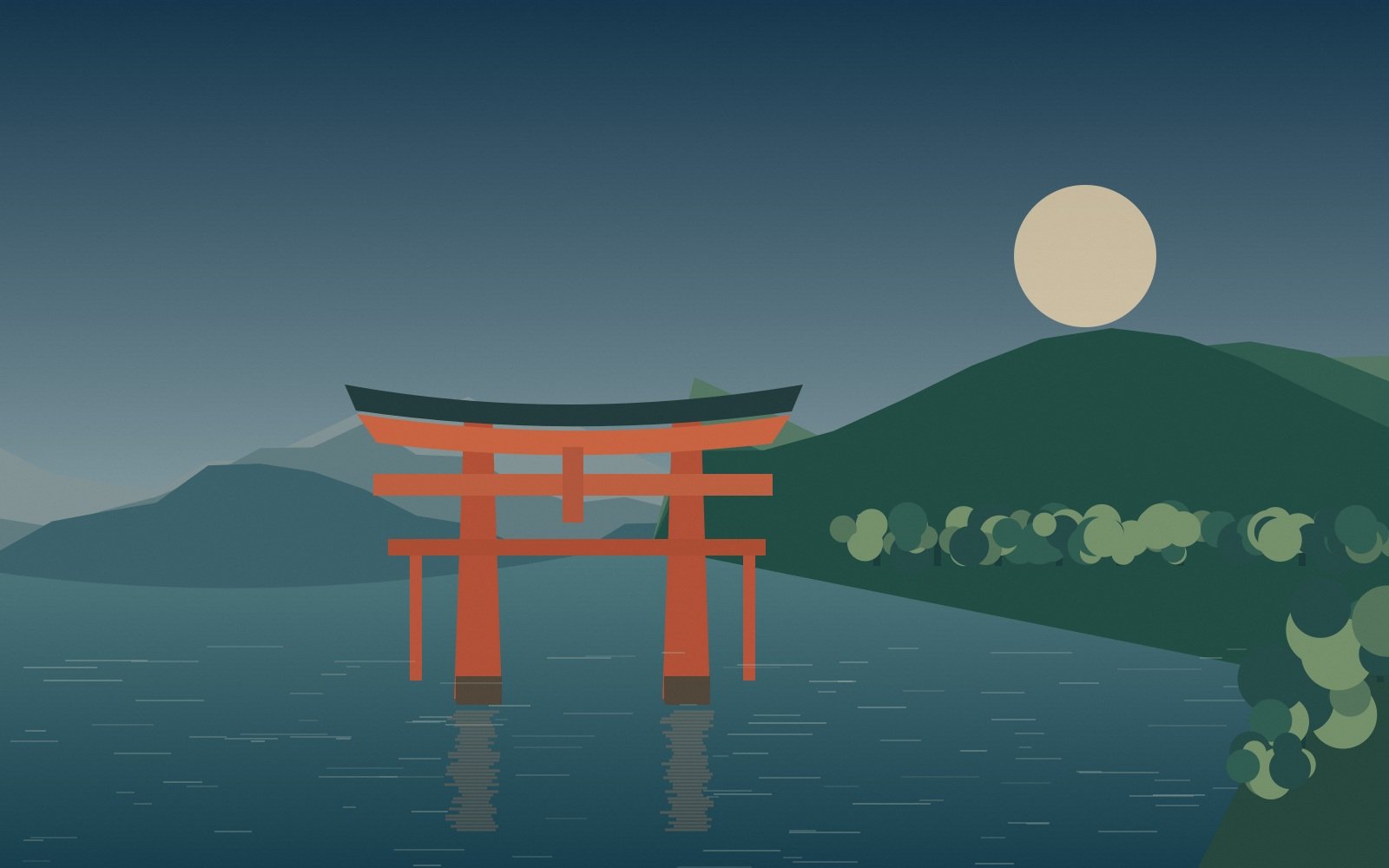
Original stylised illustration inspired by Miyajima’s torii and wooded shoreline; not a photograph, hotel view or tide forecast.
Staying on Miyajima buys time on the island after a day trip would normally end. The value can be an evening meal at the inn, a quieter waterfront stroll or an early start without first travelling from Hiroshima. It is not simply a way to avoid looking at a ferry timetable.
The right booking depends as much on meals and arrival as on the room. A ryokan rate can be per person and include dinner, while another listing may show a room-only total for two. A hotel named after Miyajima can also be on the mainland. This guide makes those comparisons explicit.
This guide contains affiliate links. Taylor’s Trailblazing Travels may earn a commission when you book through them. Recommendations are chosen to help with the accommodation decision.
Check the island pin
Miyajimaguchi and Miyajima are different overnight experiences.
Book the meal plan
Do not assume dinner can be added on arrival.
Confirm the room
Futon, Western bed, ensuite bathroom and private onsen are different features.
Work back from dinner
Choose a real ferry with margin before the inn’s deadline.
First decide: island overnight or mainland ferry access?
Miyajimaguchi is the mainland approach to the ferries; Miyajima is the island destination. Check the exact property pin before interpreting “Miyajima hotel” as an island stay. The ferry operator’s access guide separates the rail and mainland approach from the island crossing.[1]
| Stay choice | Main benefit | Main compromise |
|---|---|---|
| On Miyajima island | Evening and early-morning island time without commuting from Hiroshima | Meals, luggage and onward travel must fit the inn and ferry arrangements. |
| At mainland Miyajimaguchi | A convenient position for the ferry while remaining on the mainland | You still leave the island at the end of the day. |
| In Hiroshima city | One city base and a wider choice of evening plans | An island visit includes the approach and crossing each way. |
Choose the island because you want that time and setting, not because a search result makes it look like a simple extension of central Hiroshima. For a late arrival followed by an early long-distance train, mainland or city accommodation may be the better fit.
Where to stay on Miyajima: three useful island zones
| Zone | A useful starting fit | The booking question |
|---|---|---|
| Pier / main shopping-street area | A straightforward arrival and easy luggage handling | How far is the actual entrance, and what is open for dinner nearby? |
| Shrine / Momijidani edge | Travellers who value the shrine-side or wooded setting | Is the approach uphill, and is a pier transfer available? |
| More separated shoreline | A hotel-centred stay and a different waterside setting | When does the shuttle run, and can you eat at the property? |
“Seaside” does not mean every room has a sea view, and “ryokan” does not promise a private hot-spring bath. Decide which parts of the experience matter: a traditional sleeping arrangement, a Western bed, a meal-inclusive rate or an actual view category.
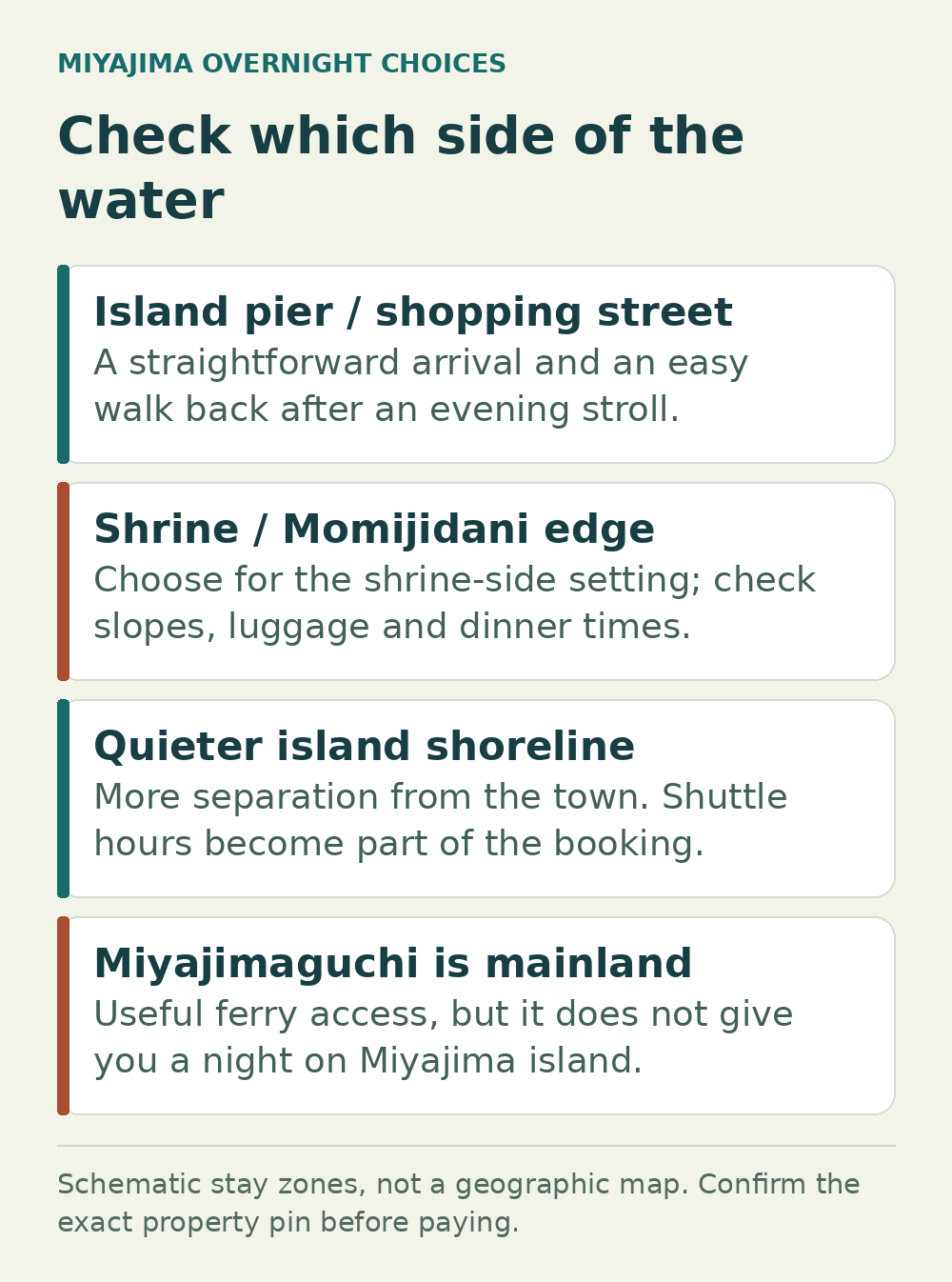
Four island properties with different practical strengths
The examples below are selected for contrasting positions and stay styles. They are not ranked by guest ratings or current prices, and no personal stay is implied. Compare the actual room category and meal plan before making a shortlist final.
Iwaso: a wooded, traditional ryokan setting
Iwaso is in the Momijidani setting and distinguishes its historic main building, cottages and Shinkan rooms. Its official room information is important because bathrooms and building arrangements are not identical across all categories.[2]
Its access information describes a roughly fifteen-minute walk from the island pier and a guest pickup arrangement. This is useful when you prefer not to carry luggage through town; arrange the pickup rather than assuming it runs like a scheduled public bus.[10]
Start here when the traditional setting is the reason for the overnight. Check bedding and bathroom needs before accepting the category that happens to be cheapest. Compare Iwaso room and meal plans
Miyajima Grand Hotel Arimoto: a shrine-side stay
Arimoto’s official information lists rooms with bath and toilet, including distinct open-air-bath categories with different inclusions. Its FAQ places Itsukushima Shrine around three minutes away on foot.[4][5]
This is a useful comparison when being near the shrine-side area matters. Do not assume that a photograph of an open-air bath or a lounge applies to an ordinary room: the hotel restricts some benefits to specified categories. Check Arimoto accommodation options
Miyajima Seaside Hotel: choose the more separated shoreline
The official site lists both sea-view and no-view rooms, including Japanese and Japanese-Western categories. Its current published pier-shuttle periods are 08:00–10:00 and 15:00–18:00; confirm the arrangement for your booking rather than relying on an older listing with different hours.[6]
Choose it when a hotel-centred shoreline stay appeals and the transfer works for your arrival. Do not treat the more separated location as equivalent to sleeping on the main shopping street. Compare Miyajima Seaside Hotel rooms
Itsukushima Iroha: compare the specific room experience
Itsukushima Iroha lists an ocean-view UMI Suite with a queen bed, a mountain-view YAMA Suite with a queen bed, Japanese Premium rooms and other categories. The named suite and view are booking choices, not features of every room.[7]
Include it when you want to compare a different island inn experience with the more traditional or more separated alternatives. Check view, bed type, meals and access for that category. See Itsukushima Iroha’s official rooms and plans
Choose the meal plan before choosing a ferry
Half-board normally describes dinner and breakfast, but verify the particular package. Check whether the price is per person or per room, whether children’s meals and bedding are included, and whether drinks or special menu choices cost extra.
Iwaso says evening restaurant options on the island are limited and that dinner cannot be added on the day of arrival. Its FAQ asks for dietary and allergy requirements at least seven days ahead and explicitly does not guarantee completely allergen-free meals.[3]
A room-only stay can still be appropriate when you have a confirmed dinner plan. It is less sensible to choose one solely because the displayed price is lower and then assume you will easily find a suitable late meal. Check actual operating days and reservation conditions with the restaurant.
Agree the meal time and the room needs together
Arimoto publishes dinner from 18:00, with a last start of 19:00. That is a property-specific rule, not an island-wide standard. Ask your chosen inn for its own latest arrival that still allows the booked meal.[5]
For a child who eats early, a traveller with a strict diet or anyone needing a Western bed, settle those essentials before paying for a non-refundable package. A preference left in a booking note is not proof that the inn can meet it.
Work backwards from the inn’s deadline
The last public ferry is not the right planning target for a meal-inclusive arrival. Start with the agreed meal or latest check-in time and work backwards through settling in, the pier-to-hotel approach, crossing, ticketing and waiting.
| Target | Assumed allowance | Resulting time |
|---|---|---|
| Dinner | Fixed example start | 18:00 |
| At the hotel | 30 minutes to check in and settle | 17:30 |
| At the island pier | 25 minutes for pickup or the approach | 17:05 |
| Ferry departure target | 10-minute crossing assumption | 16:55 |
| At the mainland pier | 30 minutes for ticketing, waiting and modest margin | 16:25 |
The 16:55 figure is a deadline to compare against a real timetable, not a claim that a ferry leaves at that minute. Choose an actual sailing no later than the calculated target, then allow more margin if services are reduced, your hotel is further away or the party needs additional assistance.[8]
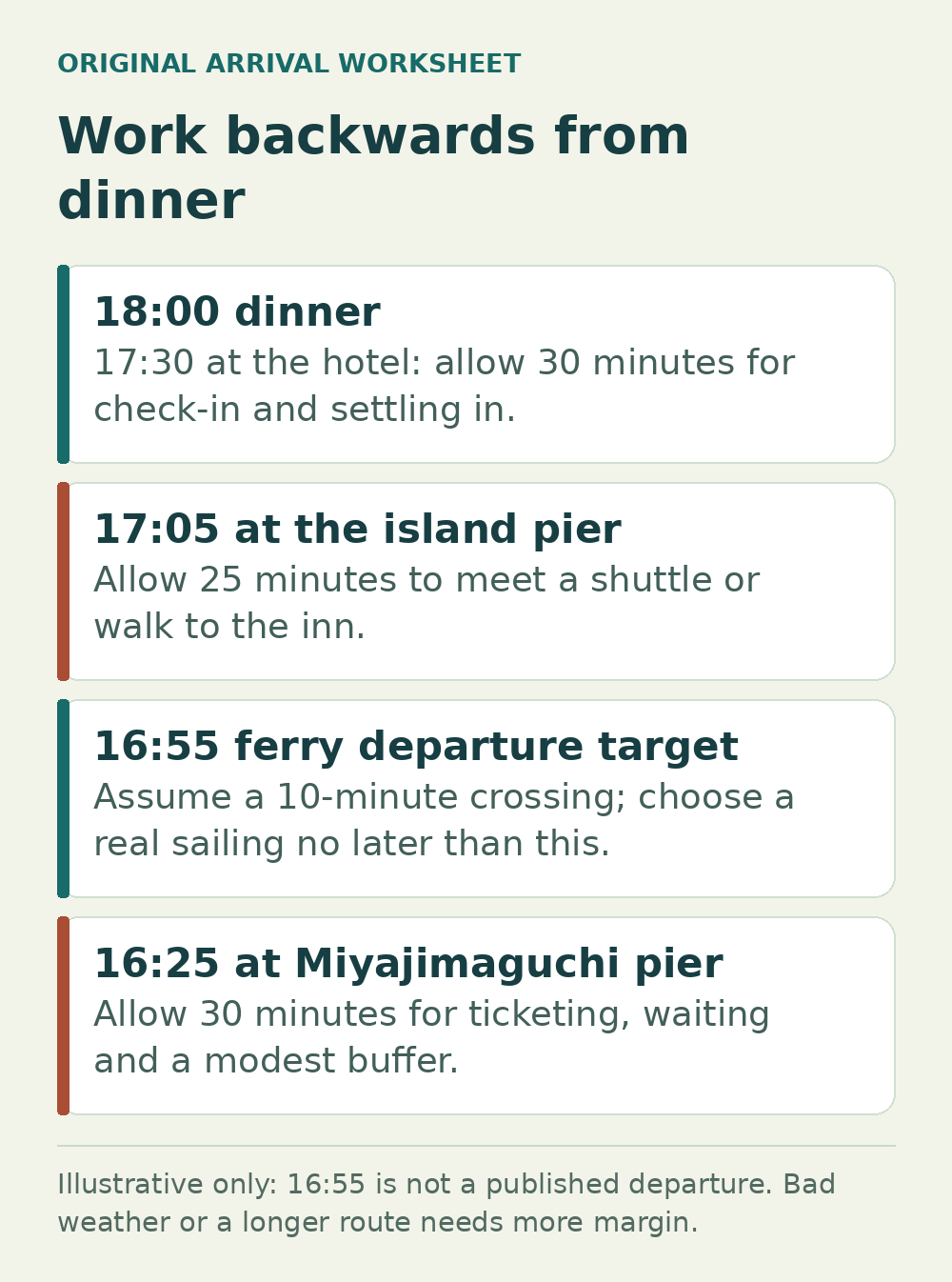
Build the train or road approach to Miyajimaguchi backwards from the mainland-pier target as a separate step. A long-haul arrival on the same day deserves considerably more margin than a journey from a Hiroshima hotel. When the schedule is fragile, spend the preceding night on the mainland or choose a different island arrival day.
If delayed, contact the inn promptly and ask what remains possible. Do not interpret an earlier agreement about dinner as a guarantee that a late meal will be held indefinitely.
Compare half-board with room-only on the same basis
A per-person ryokan quote and a per-room hotel quote are easy to misread. Put both on a whole-party, whole-stay basis before comparing. The following is an original one-night example for two adults; none of these figures is an advertised rate from the properties above.
| Item | Half-board example | Room-only example |
|---|---|---|
| Accommodation quote | ¥28,000 per person × 2 = ¥56,000 | ¥38,000 per room |
| Dinner for two | Included in the example package | Assumed ¥8,000 |
| Breakfast for two | Included in the example package | Assumed ¥3,000 |
| Comparable total before taxes / extras | ¥56,000 | ¥49,000 |
The example half-board premium is ¥7,000 for the party. That premium buys the particular included meals and the convenience of an agreed dinner arrangement; it does not establish that either choice is better. Replace the meal allowances with actual options you are willing and able to book.
Hiroshima Prefecture’s accommodation tax is ¥200 per person per night when the qualifying tax-exclusive room charge is at least ¥6,000. Meals and consumption tax are excluded from that qualifying room amount. Ask the property how its meal-inclusive rate is apportioned, and do not add a tax already included in your total.[9]
Keep ferry charges, any visitor levy, drinks, parking, transfers and optional activities as separate lines where applicable. Do not quietly compare a flexible rate on one platform with a non-refundable rate on another and call the lower total a like-for-like saving.
Choose one or two nights by the experience you want
One night: protect the evening and following morning
Arrive with enough time to drop bags, orient yourself and reach the inn before dinner. Leave the evening relatively open rather than adding a demanding sightseeing list. The following morning can hold a shrine-side walk and one main visit before luggage collection and departure.
Check the day’s tide times and the current opening hours for anything you intend to enter. A waterfront stroll and access to a shrine or attraction are different activities; an overnight stay does not create after-hours admission or guarantee a particular tide view.
Two nights: create flexibility rather than twice the checklist
A second night can suit a slower pace, a weather-dependent activity or a hotel experience that you want time to enjoy. Confirm whether meals vary between nights and whether you want the same board arrangement on both. Otherwise, the second night may add cost without changing the part of the island you experience.
If an early flight or an important long-distance train follows, test the island departure before booking the final night. The most atmospheric location is not necessarily the best place to sleep before a time-critical connection.
Check luggage, mobility and bathing separately
Ask the inn where it can hold luggage before check-in and after checkout, whether the pier pickup includes bags, and how you should make contact. If forwarding a large case elsewhere, confirm transit time and acceptance with both properties rather than assuming it arrives the same day.
Traditional accommodation can have limitations hidden by attractive room photographs. Iwaso’s FAQ says its communal onsen is reached by stairs and that it has no universal-design rooms; its recommended options for some mobility needs still require individual confirmation.[3]
An ensuite bathroom is not automatically a private onsen. Iwaso states that it has no private onsen, while some rooms have ordinary private bathrooms. Ask the property about tattoo rules and any private-bathing alternative rather than assuming a general island policy.[2][3]
Arimoto describes ways to avoid some steps with staff assistance but does not call the building barrier-free. Its public-bath rules also restrict tattooed guests. Confirm a workable room and bathing arrangement before making that feature central to your stay.[5]
For families, agree children’s bedding and meals explicitly. For anyone unable to sleep comfortably on a futon, confirm a real bed category rather than counting on a limited folding-bed request after arrival.
Questions before booking an island stay
Is a Miyajimaguchi hotel actually on Miyajima?
No. Miyajimaguchi is on the mainland ferry approach. Check the property pin and address when you specifically want an island overnight.[1]
Can I add dinner when I reach the ryokan?
Do not assume so. Iwaso explicitly says it cannot add dinner on the day of arrival. Check the selected property and plan before travel.[3]
Does a sea-view hotel guarantee a sea-view room?
No. Miyajima Seaside’s official room list includes no-view accommodation as well as sea-view categories. Book the exact view category you want.[6]
Will staying overnight make every visit uncrowded?
No. It gives you different times to be on the island, not control over visitor numbers, special events, weather or opening hours. Keep expectations specific to what the booking actually offers.
The decision to make
Choose the island only after the setting, room, meals and arrival schedule work together. A pier-side stay simplifies arrival, a shrine-side ryokan can make the overnight feel purposeful, and a more separated shoreline hotel can work with a confirmed transfer. The best booking is the one you can reach comfortably, eat at as planned and sleep in well—not simply the prettiest room photograph.
How this guide was researched
The comparison uses the properties’ own room and access information, with operator timetables and prefectural tax guidance kept separate. The meal-cost comparison and arrival worksheet are original illustrative tools, not real hotel quotes or a published ferry schedule. No personal stays or guaranteed availability are claimed. Editorial review: 18 October 2026.
Sources
Hotel, transport and tourism sources are listed below. Access instructions, taxes and booking conditions can change. Hotel walk times are provider estimates; original models are labelled separately.
- JR West Miyajima Ferry — access between the mainland and island
- Iwaso — official rooms and building differences
- Iwaso — official FAQ: meals, baths, access and luggage
- Miyajima Grand Hotel Arimoto — official facilities and room information
- Miyajima Grand Hotel Arimoto — official FAQ and meal times
- Miyajima Seaside Hotel — official room categories and shuttle hours
- Itsukushima Iroha — official hotel and room information
- JR West Miyajima Ferry — current timetable selection
- Hiroshima Prefecture — accommodation-tax scheme overview
- Iwaso — official access guide
Illustrations in this article were created for Taylor’s Trailblazing Travels. Third-party photographs, where used, are credited beside the image or in the source list.