Japan · Walking day trips
Walking the Nakasendo Trail from Magome to Tsumago
A forest-and-post-town walk whose transport, baggage and daylight deserve as much thought as the trail.
The Magome to Tsumago walk connects two historic post towns through woodland, small settlements and stretches of the old Nakasendo road. Its appeal is the change of pace: a sloping town street gives way to a mountain pass, then a longer descent towards Tsumago. It is manageable as a single walking day, provided you leave enough room for the journeys at either end.[1][24]
The useful question is how the walk fits between your first train and your final bus. The plan below separates those commitments, so you can adjust your pace, carry less and decide whether an overnight stay would make the day better.
Taylor’s Trailblazing Travels may earn a commission when you book or buy through an affiliate link in this guide, at no extra cost to you. This helps fund the research and upkeep of the site.
Start with your return
Choose a Tsumago departure and a realistic onward train before setting your trail start.
Keep the pack light
Send or store your main bag according to where you will finish the day, rather than automatically returning for it.
Spend the margin deliberately
A longer lunch or slower descent needs extra time; it cannot share the same minutes as a museum visit.
Check the day locally
Ask about weather, wildlife and any path restrictions before leaving the post town.
Plan the whole walking day
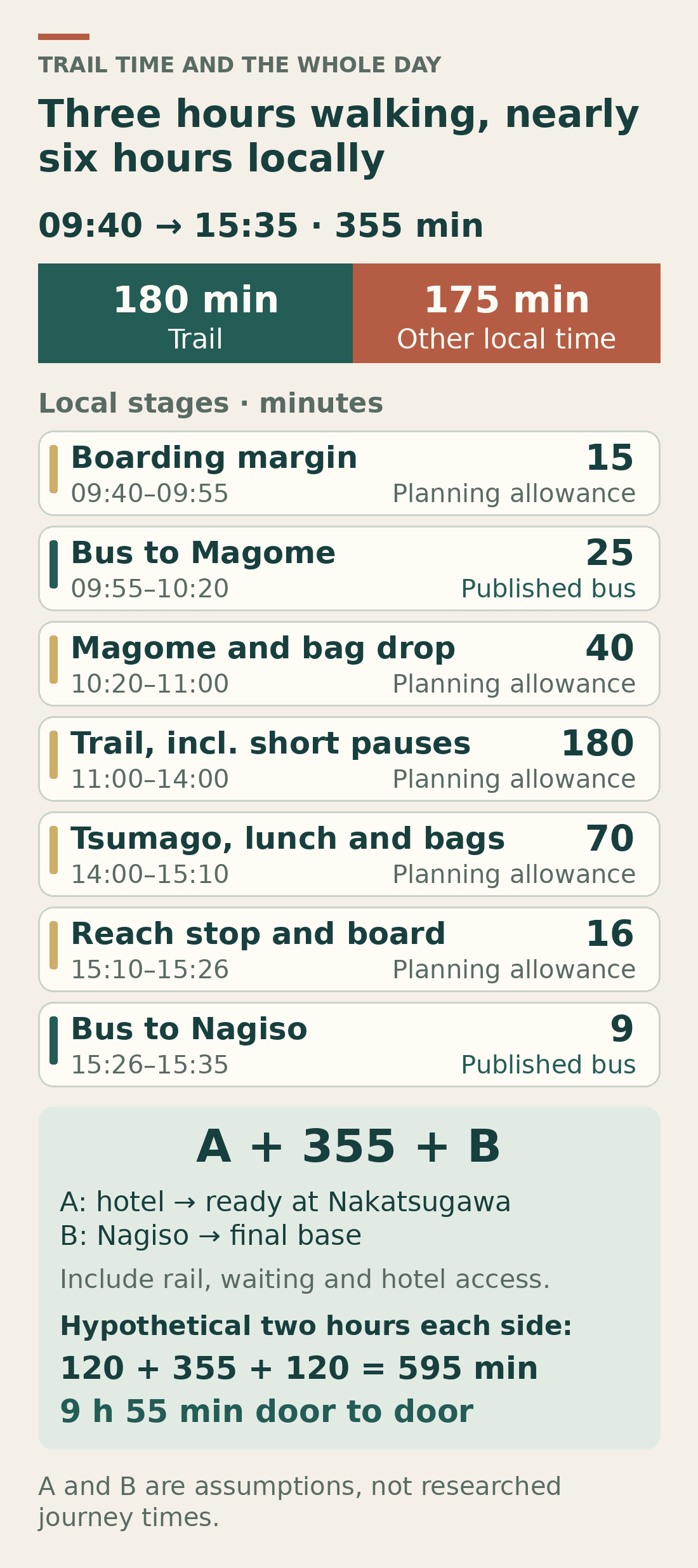
Here is an adjustable example for a day when the published services below operate. The bus times are taken from the current operator timetables; the town stops, walking allowance and boarding margins are editorial planning choices. They are not measured personal walking times or a confirmed rail connection.
| Time | Stage | Basis |
|---|---|---|
| 09:40–09:55 | Ready at Nakatsugawa; find the bus and board | 15-minute allowance |
| 09:55–10:20 | Bus to Magome | 25 minutes in both current weekday and holiday timetables[4][5] |
| 10:20–11:00 | Magome street, supplies and any bag drop | 40-minute allowance |
| 11:00–14:00 | Walk to Tsumago, with short pauses | Three-hour walking allowance |
| 14:00–15:10 | Tsumago: lunch, bag collection and a look around | 70 minutes; for example, 35 + 10 + 25 |
| 15:10–15:26 | Reach the correct stop and board | 16-minute allowance |
| 15:26–15:35 | Bus to Nagiso station | Nine minutes on the current Magome Line[6] |
On a small screen, swipe inside the table to see every column.
That is 355 minutes locally: 180 minutes walking and 175 minutes on everything else. Your door-to-door total is A + 355 + B, where A is hotel-to-Nakatsugawa time, including the train and any wait before 09:40, and B is Nagiso-to-your-final-base time, including the wait after 15:35. If A and B each take an assumed two hours, the day becomes 9 hours 55 minutes. Those two-hour inputs are examples, not researched train connections.
Test the model against the slowest part of your own day. A four-hour walk would reach Tsumago at 15:00 and leave just 26 minutes before the example bus. You would need an earlier start or a later return to retain the town visit. Likewise, a museum deserves its own allowance; do not count it inside time already allocated to lunch.
The current Tsumago Line also shows departures at 15:40 and 16:10, arriving at Nagiso at 15:48 and 16:18. They are alternatives to check against your train, not permission to ignore daylight or a luggage collection deadline.[7]
Choose your direction and walking load
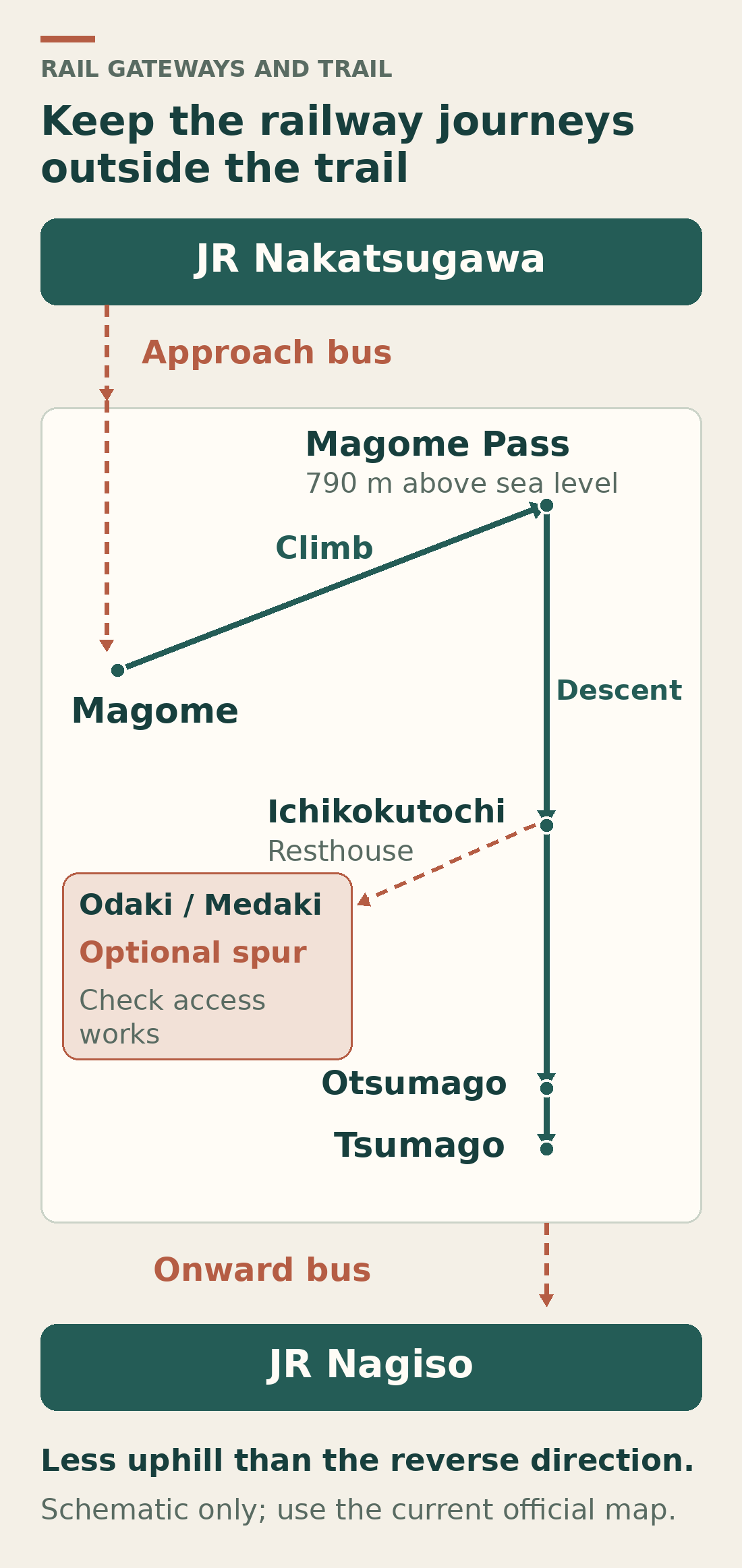
Magome to Tsumago is the useful default because it has less ascent than the reverse direction. Expect an initial climb towards Magome Pass, followed by more downhill walking. Reverse the route if your accommodation or transport makes that materially easier, while accepting the longer uphill section.[1]
The official distance figures differ: Kiso Ontake describes about 8 km and Magome Tourism about 9 km. Treat this as an 8–9 km outing rather than planning to an exact GPS total; the pages do not establish identical measurement points. The pass is 790 m above sea level. That is its elevation, not the height you climb from Magome.[1][2]
This is a walking trail with uneven surfaces, stone paving and gradients. It also crosses inhabited countryside and includes some paved road sections; it is not continuous remote forest.[1] Shoes with dependable grip, a pack you can carry comfortably and enough time for the descent matter more than trying to match someone else’s pace. Wet paving needs particular care.[11]
Follow the old road through the pass
Begin by walking up Magome’s sloping main street. The wooden buildings and waterwheel make the town part of the outing, so give it time before treating the trail clock as started. Beyond the town, the walk alternates between woodland, clearings and small settlements.[24]
Follow signs towards Magome Pass, then Tsumago. The Ichikokutochi resthouse gives the middle of the route a recognisable pause point. Nearby, the former timber checkpoint recalls the controls once placed on timber leaving this area. Continue through Otsumago and into Tsumago, where the post-town street provides a natural place to stop before your onward transport.[2][12]
Treat the waterfalls as conditional
Odaki and Medaki are optional additions, not an essential test of completing the walk. At the October 2026 check, local tour operator Snow Monkey Resorts reported construction on the waterfall access path until February 2027, with access unavailable on some days. This is an operator notice, not confirmation that the whole Magome–Tsumago route is closed. Ask the tourist office about the day’s signed route and follow any barriers or diversions.[13]
In Tsumago, choose between a slower look around the street and a visit inside a historic building. The Wakihonjin, the former secondary inn, is one option for understanding the post town beyond its exterior.[24] Check opening arrangements locally and allow more time if you want to go inside.
Reach Magome and leave Tsumago
The usual rail-and-bus approach uses JR Nakatsugawa for Magome and JR Nagiso for Tsumago, on the Chuo railway corridor between Nagoya and the Kiso Valley.[24] Nagiso has fewer limited-express stops than a glance at the route map might suggest. Check the local tourism transport page and its current English train timetable for the actual departure you intend to use.[10]
| Leg | Adult one-way fare | Planning point |
|---|---|---|
| Nakatsugawa station → Magome | ¥800[8] | Kitaena Bus; platform 3 at Nakatsugawa[3] |
| Tsumago → Nagiso station | ¥300[9] | Check both Tsumago and Magome Line services |
| Tsumago → Magome | ¥1,000[9] | Useful if your car or overnight bag remains in Magome |
On a small screen, swipe inside the table to see every column.
The two buses in the example total ¥1,100 per adult; rail tickets, food and any admission are extra. Carry coins and small notes for the local buses. Kitaena describes boarding with a numbered ticket and paying when leaving; its buses cannot change ¥2,000, ¥5,000 or ¥10,000 notes.[3]
From Nagoya, you can also compare Nagoya–Nakatsugawa transport on 12Go. Check the actual arrival stop, ticket conditions and total fee for your date: a result ending at a highway stop is not automatically an arrival at JR Nakatsugawa station. The onward bus to Magome remains a separate part of your plan. Use the operator timetables above to assess that connection.
The autumn direct coach needs a different time budget
A reserved Meitetsu service runs daily from 17 October to 29 November 2026 between Nagoya, Magome and Tsumago, at ¥3,000 one way for an adult. Its published arrival in Magome is 11:10, while its Tsumago return leaves at 15:20. Travel solely between Magome and Tsumago is not offered on this coach.[14]
That gives 4 hours 10 minutes between arrival and departure. A modest 30 minutes in Magome, three-hour walk, 45 minutes in Tsumago and 15-minute boarding margin require 4 hours 30 minutes. For that pace, the coach window is 20 minutes too short. It can suit town sightseeing or a deliberately shorter outing; for the full walk with time in both towns, prefer an earlier local arrival or a nearby overnight stay.
Send luggage to the end you actually need
The published regular luggage service runs from 20 March to 30 November 2026. Drop bags between 08:30 and 11:30; collect them between 13:00 and 17:00. The charge is ¥1,000 per bag. Listed points include the Magome and Tsumago tourist information offices, Magome-juku BASE and participating Otsumago inns. This is a service between designated points, so confirm the exact drop-off and collection locations when arranging it.[11]
| Your day ends… | Useful bag plan | Consequence |
|---|---|---|
| Beyond Tsumago, via Nagiso | Send the main bag to Tsumago | Collect it before boarding for the railway; no return to Magome needed |
| Back at a Magome stay or car | Ask your stay about storage, or use local storage | Choose a Tsumago–Magome return bus in advance |
| At a Tsumago or Otsumago inn | Confirm whether that exact inn participates | Do not assume delivery to every accommodation |
| Outside the published service season | Arrange storage or forwarding before travel | A winter transfer cannot be inferred from the summer rules |
On a small screen, swipe inside the table to see every column.
Magome Tourism lists storage at its information office and coin lockers near Magomekan.[15] For the one-way model, one transferred bag brings the local bus-and-bag cost to ¥2,100 for one adult. Keep water, food, rainwear, medication and valuables with you.
The association also describes individually arranged transfers outside the normal reception window, but do not assume that means an all-season, on-demand service. Confirm any exception with the office, including the price and collection arrangements, before relying on it.[11]
Choose the day and prepare for the trail
A morning start makes the plan more resilient in every season. Magome Tourism warns that the trail has no streetlights and asks walkers to start by 15:00 in summer and 14:00 in winter. These are published latest-start requests, not a promise of a comfortable daylight finish for every pace. Use an earlier personal cut-off when conditions or your walking speed require it.[2]
Snow can occur from December to March.[15] In winter, ask locally about ice, snow and any restricted sections; use suitable footwear and turn to a town visit if the route exceeds your equipment or experience. In warmer weather, carry enough water and build in cooling pauses. During prolonged or heavy rain, check the forecast and local advice before committing to the forest section; postponing is a sensible option.
Check current wildlife advice
Tsumago Tourism’s 30 April 2026 notice reports black-bear sightings in Nagiso. That warrants a current local check rather than assumptions based on a previous visitor’s account.[16] Nagano Prefecture advises making your presence known with a bell, whistle or radio, avoiding dawn and evening, and turning back if you find signs such as tracks or droppings. If you encounter a bear, stay calm, back away slowly and do not run or approach it. A bell is a precaution, not a guarantee.[17]
Ask the tourist information office about local bear-bell rental if you need one.[11] Pack a rain shell, an extra layer, water, a snack or picnic, and a charged phone. Buy food before leaving town so a closed cafe does not become the day’s deciding factor.
Save navigation before setting off
Download the official South Kisoji trail map and town maps, and save your return timetables where they work offline.[18] If you need mobile data for transport changes, browse Airalo, then choose Japan. Japan plans are offered, but check your exact device’s eSIM compatibility and confirm that your phone is unlocked before buying.[19][20] Keep the saved map and transport information available independently of reception; a data plan does not establish continuous signal on this trail.
Stay nearby or choose a guided walk
Choose a Magome night for a simpler morning start, a Tsumago or Otsumago night to finish close to your room, or a Nakatsugawa base if railway access matters more than sleeping in a post town. Make the choice alongside your bag plan: an attractive room at the wrong end can add a retrieval journey.
Two Magome stays with different meal arrangements
Magome Chaya is a practical property to consider on the post-town street, with shared bathroom and toilet facilities. Its own site says breakfast service ended in 2026, so arrange your morning food separately and check dinner arrangements when booking.[21] You can check Magome Chaya on Agoda.
Tajimaya offers Japanese-style rooms and meal plans including dinner and breakfast. That may suit walkers who want breakfast arranged before leaving, but check the exact rate and meal inclusions you select.[22] You can check Tajimaya in Magome on Booking.com. These are researched options, not first-hand reviews; compare cancellation terms, room facilities and availability for your dates.
Match a guide to the walk you want
Compare the private Magome-to-Tsumago hiking tour on Viator if you want guiding in this article’s direction. The operator, Nagoya is not boring, describes a roughly nine-hour day with guiding, lunch and other stated inclusions, but excludes train, bus and taxi fares. Confirm the complete transport cost, current start time and meeting point before booking.[23]
Compare Snow Monkey Resorts’ Nagoya Nakasendo day tour on GetYourGuide if organised transport is the main benefit. Its walking itinerary runs from Tsumago to Magome, the reverse of this guide, and therefore involves more uphill walking. The operator includes transport and guiding, asks walkers to bring lunch and also offers a non-hiking version. Check that version carefully if a companion has mobility needs; the operator does not describe it as wheelchair accessible.[13]
A guided trip can simplify transport and add context, but it still has a fixed meeting time and its own pace. Compare the actual walking direction, distance, inclusions and weather policy rather than choosing from a tour title alone.
Frequently asked questions
Can I walk back to Magome afterwards?
You can plan an out-and-back walk, but roughly doubling the route gives about 16–18 km before extra town wandering. That is a different walking day, with another climb and much less room for sightseeing. The one-way bus return or a stay at the far end is usually the more useful starting plan.
Does the trail finish at Nagiso railway station?
No. Tsumago is the end of this walk; Nagiso is a separate onward journey. The day model includes the local bus between them. If you want to continue on foot, use the official South Kisoji walking map and add that section to your time and distance budget before choosing a train.[6][18]
Is this a suitable walk for children?
Judge it by the child’s recent walking experience: several hours outdoors, uphill sections and an uneven descent matter more than age alone. Start early, carry food and choose a shorter outing if the full route would already be near their limit. A pushchair is unsuitable for the trail.[2]
What should I book in advance?
Book any room, guided trip or seasonal reserved coach you want, and confirm the terms of your rail ticket. Arrange inn meals separately where required. For an independent walk, the most valuable preparation is a current route and weather check, a workable return and a clear luggage plan.
The next planning step
Choose Magome to Tsumago when you can give the walk a full day, begin with a light pack and keep your return flexible enough for your actual pace. Use the 5-hour-55-minute local model as a starting calculation, replace its allowances with your own, and add the complete journeys from and back to your accommodation. If the result feels compressed, stay nearby or shorten the outing; the towns deserve time as well as the path.
Sources and further reading
Visitor information and booking conditions checked for this editorial review on 18 October 2026. Recheck the linked operators for your travel date; planning allowances are identified separately in the guide.
- Kiso Ontake Tourism Office: Magome to Tsumago
- Magome Tourism Association: Nakasendo hiking guidance
- Kitaena Bus: current timetables, boarding and payment guidance
- Kitaena Bus: Magome Line weekday timetable, effective 1 October 2025
- Kitaena Bus: Magome Line weekend and holiday timetable, effective 1 October 2025
- Nagiso Town: Magome Line timetable, effective 1 April 2026
- Nagiso Town: Tsumago Line timetable, effective 1 April 2026
- Kitaena Bus: Magome Line fare table, revised 8 March 2025
- Nagiso Town: bus routes and fares updated for April 2026
- Nagiso Tourism Association: English JR train timetable, revised 14 March 2026
- Tsumago Tourism Association: walking and 2026 luggage transfer
- Nagiso Tourism Association: walking the historic Nakasendo, updated 4 September 2026
- Snow Monkey Resorts: Nakasendo hike from Nagoya and current waterfall access notice
- Meitetsu Bus: autumn 2026 Nagoya, Magome and Tsumago service
- Magome Tourism Association: visitor questions, winter conditions and luggage storage
- Tsumago Tourism Association: wildlife notice, 30 April 2026
- Nagano Prefecture: English bear precautions, updated 11 June 2026
- Nagiso Tourism Association: official walking maps and brochures
- Airalo: Japan eSIM plans
- Airalo: device compatibility guidance
- Magome Chaya: current facilities and meal information
- Tajimaya: official Magome accommodation and meal plans
- Nagoya is not boring: private Magome to Tsumago hiking tour and exclusions
- Go Nagano: walking between Magome and Tsumago, updated 24 April 2025
Illustrations in this article were created for Taylor’s Trailblazing Travels. Third-party photographs, where used, are credited beside the image or in the source list.