Shibuya Things to Do: Crossing, Shops and Nearby Sights
Pair the famous crossing with the shops, skyline or nearby streets that make the visit yours.
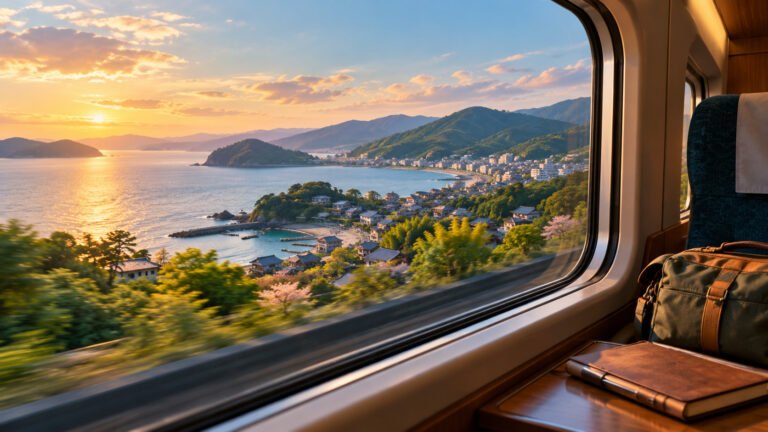
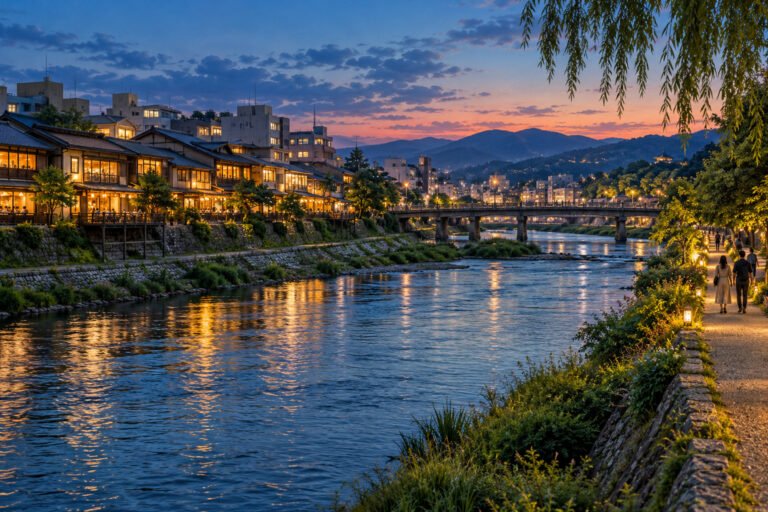
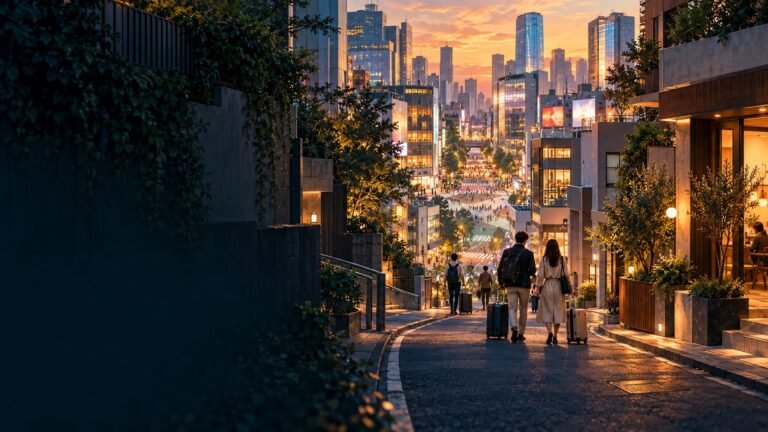
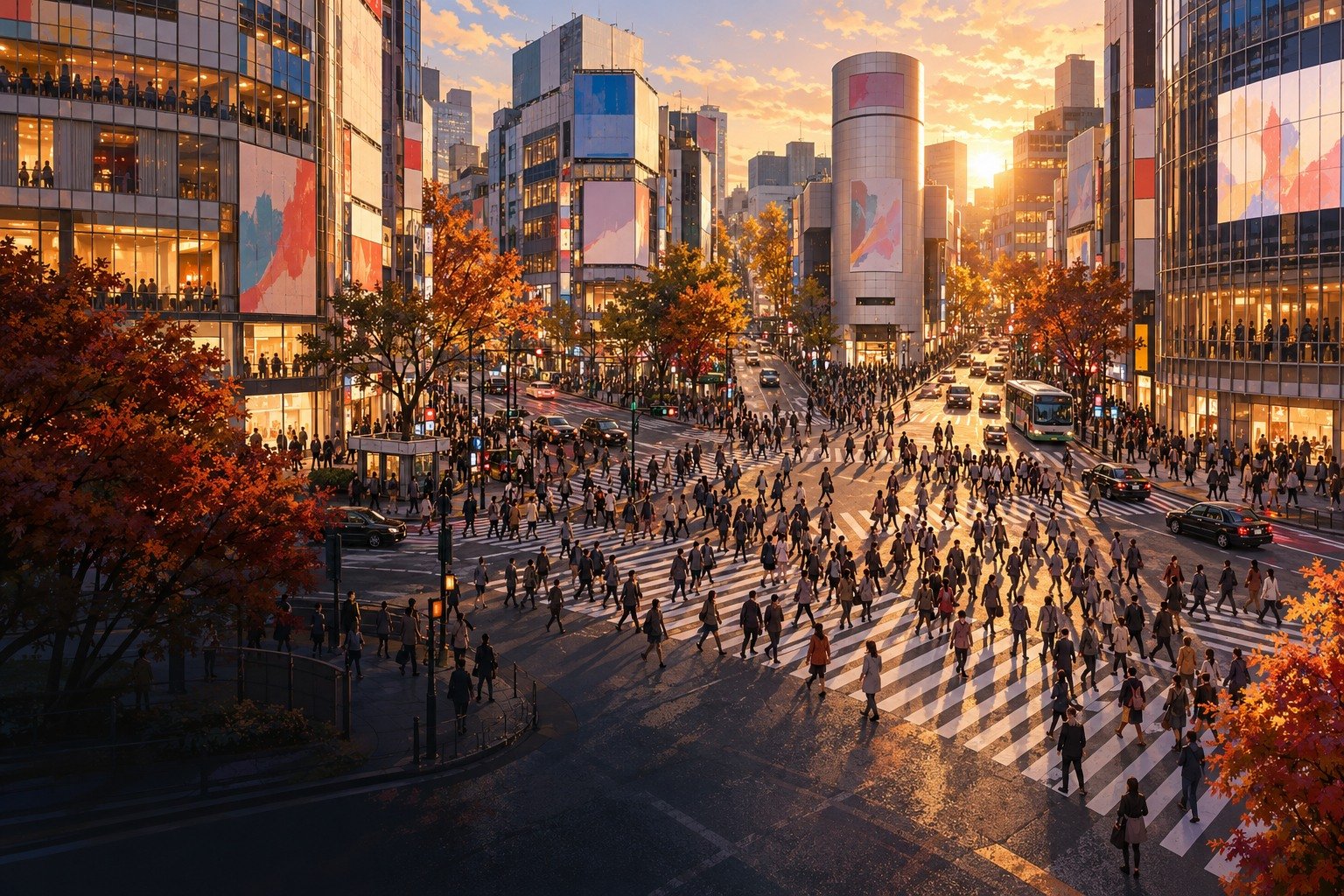
Original AI-created illustration inspired by Shibuya; not a documentary photograph.
Shibuya is easy to recognise and surprisingly easy to overfill. The crossing takes minutes to experience, while a character-store queue, a long lunch or a timed skyline visit can absorb a large part of the afternoon. A useful plan starts by deciding which of those experiences actually matters to you.
This guide focuses on the streets around Shibuya Station and explains what fits into a realistic visit. The routes and spending models are original planning estimates, informed by current venue and transport information. For a wider trip, start with the Japan travel guides.
Some links in this guide are affiliate links. Taylor’s Trailblazing Travels may earn a commission if you book or buy through them, at no extra cost to you.
A flexible first visit
Four hours
Combine the crossing, one shopping interest, a break and a meal.
Make it personal
Choose your shops
Give time to characters, fashion or music rather than every mall.
An optional addition
Book the skyline
Add a protected block if SHIBUYA SKY matters to your visit.
Nearby streets
Choose one extension
Give Harajuku or Daikanyama its own time allowance.
Choose the Shibuya things to do that fit your interests
Start with the crossing and Hachiko, then choose a reason to stay: character shops, fashion, a skyline view or an unhurried meal. The shortlist below favours places that combine logically around Shibuya Station. It is an editorial selection for a first visit, based on geographic fit, distinct experiences and the time each choice consumes; it is not a ranking by visitor numbers or review scores.
Swipe across the table to compare →
| Your main interest | Best starting choice | Allow | The trade-off |
|---|---|---|---|
| The recognisable city scene | Crossing and Hachiko [2] [3] | 25–40 minutes | A compact introduction; add a second purpose for a longer visit. |
| Nintendo and Pokémon | Shibuya PARCO 6F [4] [5] | 60–90 minutes | Popular releases or timed store entry can expand the visit. |
| Fashion browsing | SHIBUYA109 or PARCO [6] [7] | 45–90 minutes | Choose the styles you enjoy; visiting every floor is unnecessary. |
| A skyline panorama | SHIBUYA SKY [10] [12] | 75–100 minutes | Paid timed entry and weather exposure use a substantial block. |
| A pause between shops | Miyashita Park [9] | 20–40 minutes | The rooftop is outdoors; it is not a wet-weather refuge. |
| Music shopping | Tower Records Shibuya [8] | 30–60 minutes | A better use of time for music enthusiasts than another fashion mall. |
For a two-hour visit, choose one shopping stop and keep the crossing central. Four hours supports a meal and more relaxed browsing. If a skyline ticket is the priority, reserve its time first and build the street route around it.
On a narrow screen, swipe the diagram sideways to read the details.
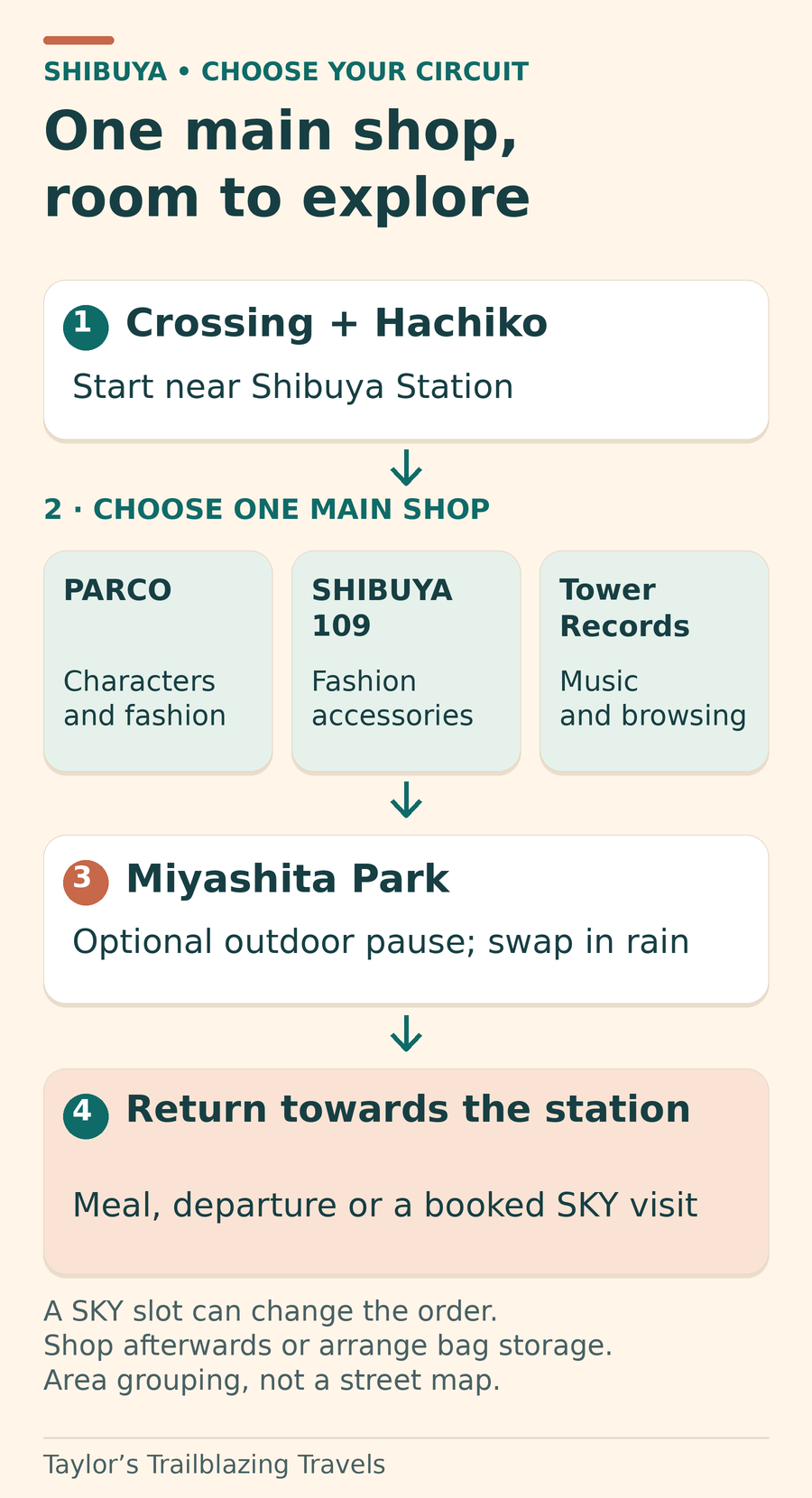
See the crossing and Hachiko without getting stuck there
The scramble crossing sits immediately outside the station area, with Center Gai on the opposite side. It is a public crossing with no admission charge. Make one crossing, step clear of the pedestrian flow, and watch another signal cycle from the pavement. That gives a better sense of the place than repeatedly stopping in the roadway for photographs. [2]
Hachiko is a small statue near the crossing, commemorating the Akita dog who continued returning to the station after his owner died. Its scale makes the surrounding crowd more noticeable than the monument itself. Allow a little extra time if a photograph matters; otherwise, seeing it in passing is enough. [3]
Agree on a precise meeting point if your group separates. “At Shibuya Station” covers several railway systems and many levels, while “by Hachiko” can still mean searching through a crowd. Save a map pin and a photograph of the agreed entrance. For organised tours, use the location on the booking confirmation: some explicitly meet away from the statue.
Late afternoon is a useful compromise if you want shops open and the streets beginning to light up. A morning visit is better when you want a short orientation before moving elsewhere, but check shop opening times before allocating your main browsing session. These are pacing choices, not a prediction that any particular hour will be quiet.
Choose your shops: characters, fashion or music
Nintendo TOKYO and Pokémon Center Shibuya
Both stores are on Shibuya PARCO’s sixth floor. The published hours are 10:00–21:00, earlier than the 11:00 opening of most PARCO retail floors. Nintendo entry is free, but the operator uses numbered entry tickets on expected busy days, including weekends and holidays. Follow the current on-site distribution instructions rather than treating the shop as a fixed ten-minute stop. [4] [5] [6]
For a keen fan, visit this floor early in your Shibuya block and check any entry arrangement before lunch or other shopping. Set a spending limit before browsing. The Pokémon shop publishes separate notices for special activities and product releases; ordinary shop access does not guarantee a particular item or session. [5]
SHIBUYA109 and the wider PARCO floors
SHIBUYA109 suits a focused look at youth fashion and accessories; PARCO provides a broader mix of fashion, design and culture alongside the character shops. SHIBUYA109 currently publishes 10:00–21:00 business hours. Choose one as your main fashion stop, then add the other only if the first leaves you wanting more. [1] [6] [7]
Tower Records
A music enthusiast can replace a fashion stop with Tower Records Shibuya, whose published store hours are 11:00–22:00. Browse with a specific interest or artist in mind to make the time useful. Do not plan around an in-store performance unless you have checked that event’s own admission conditions. [8]
Hours throughout this section were checked on 18 October 2026; individual floors, events and holiday arrangements can differ.
Use Miyashita Park as a break in the route
The rooftop park provides an outdoor pause above the surrounding shops. Its operator lists opening hours of 08:00–23:00 and a regular closure from 29 December to 3 January. Sports facilities have separate hours and arrangements, so the presence of a skate park is not a promise of a spontaneous activity session. [9]
Put this stop between PARCO or Tower Records and your return towards the station. Allow 20–40 minutes for a rest and a look around; a dedicated shopping or meal visit takes longer. In rain, use the indoor shopping and dining areas instead, rather than retaining the rooftop simply because it appears on the route.
For a straightforward meal, the South building’s food hall offers a practical alternative to joining a famous restaurant queue. As one example, the operator’s Maguro Market listing describes tuna-based bowls and roll sushi with shared food-hall seating. Choose according to appetite and dietary needs rather than treating one named outlet as an essential stop. [17]
Decide whether SHIBUYA SKY earns its time and cost
Choose SHIBUYA SKY for a wide city panorama and the experience of an open rooftop. If your only aim is to see people crossing the road, the street visit already answers that need. Give the skyline visit a protected block rather than squeezing it between two shopping appointments.
Swipe across the table to compare →
| Ticket | Before 15:00 | From 15:00 |
|---|---|---|
| Adult online ticket, age 12+* | ¥2,700 | ¥3,400 |
| Adult ticket-counter price, if available | ¥3,000 | ¥3,700 |
| Child, age 6–11*; same-day counter only | ¥1,200 | ¥1,200 |
*A 12-year-old primary-school pupil uses the child category; children aged five or younger, plus six-year-olds not yet at primary school, are free. Adult tickets sold out online are also sold out at the counter. The official site currently sells up to two weeks ahead. [10]
Work back from the booking
The operator’s published sales rule opens tickets at midnight Japan time, two weeks before the visit. For someone booking from Britain, that is the previous calendar day at 16:00 during British Summer Time or 15:00 during GMT. Calculate the date in Japan first, particularly near the UK clock change. [11]
The current published hours are 10:00–22:30, with final admission at 21:20. Allow time to reach the ticket level and complete entry; a booked entry time is not the moment you arrive on the rooftop. [12]
Make the weather decision before entering
Wind, rain, thunderstorms or heat can close outdoor areas. The operator’s published policy provides cancellation routes for eligible official web tickets, including a limited opportunity before entry when the rooftop is closed at the designated time. Check the applicable deadline before entering; separate tour or reseller terms may differ. [11]
Book through the official SHIBUYA SKY ticket page if you want admission alone. If you also want a guide, compare this Shibuya walking tour with Sky admission on Viator. Its itinerary lists the deck ticket as included; check the selected option, meeting time and cancellation terms. It is a guided package, not an official-price admission substitute. [20]
Leave large shopping bags and luggage before the visit: the venue restricts items taken onto the rooftop. Do your serious shopping afterwards, or arrange storage before returning to the station complex. [10]
Build a two-, four- or six-hour Shibuya visit
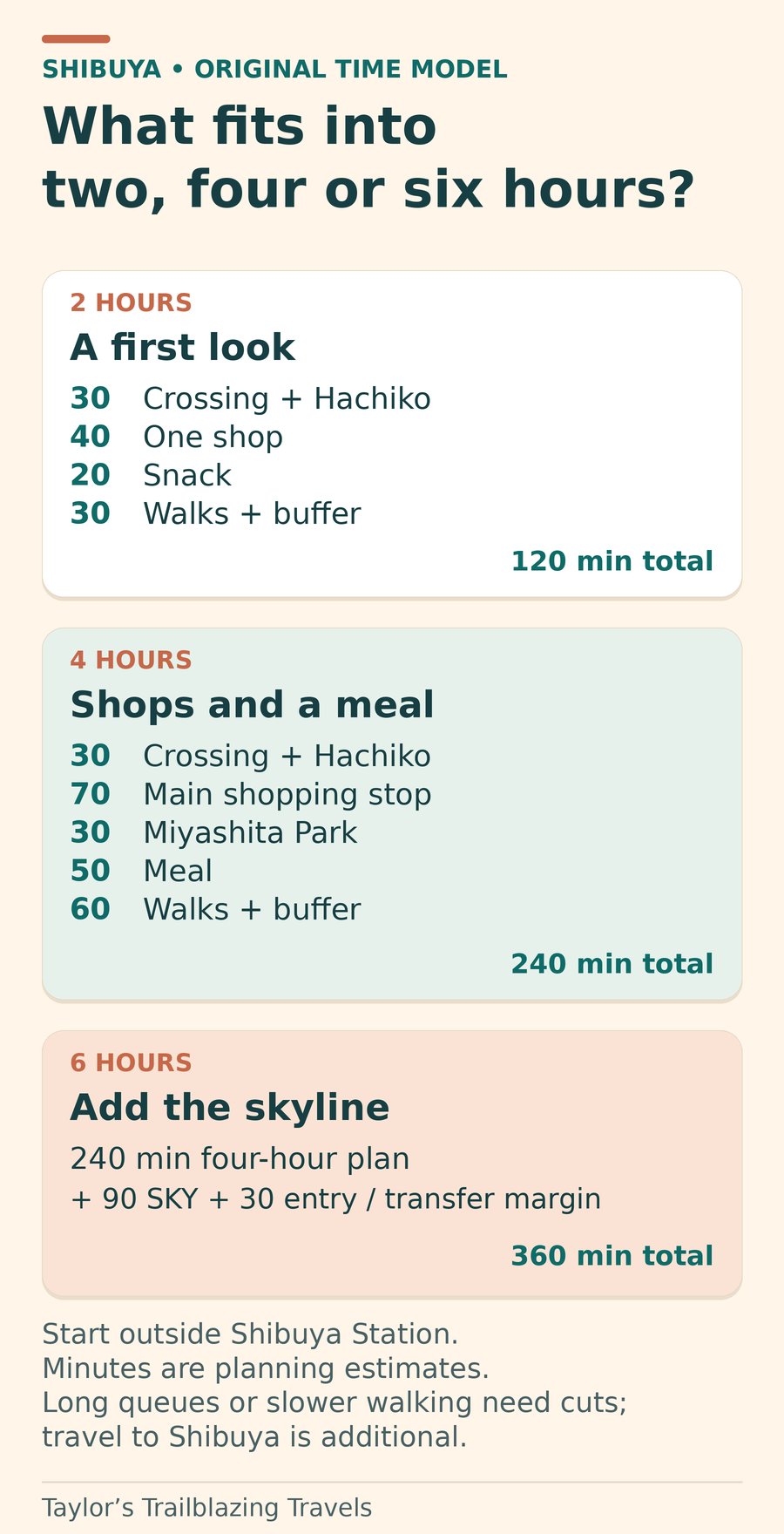
These are original time budgets beginning outside Shibuya Station, not train timetables or measured walks. They include time for streets, pauses and finding entrances. They assume independent exploration, ordinary walking mobility and no long retail queue. If a shop issues a later return time, remove another stop instead of compressing everything.
Swipe across the table to compare →
| Plan | Time allocation | Best fit |
|---|---|---|
| 2 hours: a first look | 30 crossing/Hachiko + 40 one shop + 20 snack + 30 walking and buffer = 120 | A short visit before dinner elsewhere; no SKY ticket. |
| 4 hours: shops and a meal | 30 crossing/Hachiko + 70 PARCO or another main shop + 30 Miyashita Park + 50 meal + 60 walks and buffer = 240 | The most flexible first visit; substitute Tower Records or SHIBUYA109. |
| 6 hours: add the skyline | The 240-minute plan + 90 SKY + 30 extra transfer and entry margin = 360 | A full district visit with a booked deck slot; shopping follows bag storage or the deck. |
For the four-hour route, start at Hachiko and cross towards Center Gai. Continue to your chosen western or northern shopping stop, use Miyashita Park for a break if the weather suits, then return towards the station for a meal. You can reverse the order when a shop appointment or dinner reservation makes that easier.
The six-hour model buys one major addition. It does not automatically include Harajuku, Meiji Jingu and a food tour as well. A three-hour guided meal replaces the independent meal and some browsing; it does not fit into the fifty-minute meal allowance.
If you arrive late, prioritise the booked or earliest-closing activity. Do not keep a low-value shopping stop simply because it comes earlier in a suggested route.
On a narrow screen, swipe the diagram sideways to read the details.
Add one nearby area, with its own time allowance
Harajuku and Meiji Jingu: a separate half-day extension
GO TOKYO gives roughly twenty minutes for walking from Shibuya Station towards the Harajuku or Omotesando areas. That is a connection to the area, not a complete shrine visit. Budget 2½–3 hours for the walk, a purposeful Harajuku stop and Meiji Jingu’s approach and grounds, before adding a substantial Shibuya visit. [1]
Put the shrine first when daylight is limited. Meiji Jingu’s published gate closing time is 16:40 in October, 16:10 in November and 16:00 in December; other facilities inside can close earlier. The main shrine grounds are free. An evening Shibuya route therefore pairs better with an earlier shrine visit than with a shrine detour after dinner. [13]
Daikanyama: a slower change of scene
Daikanyama is a useful alternative when boutiques, books and cafés appeal more than another busy shopping floor. GO TOKYO describes it as roughly a fifteen-minute walk from Shibuya; allow 20–30 minutes for your particular route and crossings, then 60–90 minutes to browse. T-SITE is a natural bookshop focus, while the surrounding streets support an aimless café stop. [14]
Choose the extension for the experience it adds. Harajuku and Meiji Jingu bring a stronger contrast of shopping and shrine grounds; Daikanyama makes sense when you want to keep browsing at a less hurried pace. For the rest of your trip, use the Japan destination collection to organise separate days instead of stretching this district visit.
Give dinner or a guided food walk a proper place
For independent dining, choose a neighbourhood and a budget before choosing a restaurant. A food hall is practical when your group wants different dishes; a reserved sit-down meal is better when you want a calmer end to the day. Eating is part of the visit, so leave space for it instead of relying on snacks between shops.
A guided food walk earns its extra cost when you want help choosing dishes and navigating several venues. Compare the Best of Shibuya Food Tour on Viator: the Arigato Japan listing is about three hours and includes five food stops, dessert and one drink. Confirm dietary arrangements directly before booking. [18]
For adults seeking an evening centred on bars, check MagicalTrip’s Shibuya izakaya tour on GetYourGuide. The current listing gives a 3½-hour guided visit, with food and drinks paid separately and an additional suggested allowance of about ¥6,000 per person. It excludes under-20s and lists several dietary and mobility limitations; read those before choosing it. [19]
Neither experience is necessary to enjoy Shibuya. The practical comparison is an independently chosen meal versus several guided stops, including the total time and any extra food cost. Always follow your own tour’s meeting instructions.
Keep alcohol inside appropriate venues. In the designated area around Shibuya Station, the city prohibits drinking in streets, parks and other public places from 18:00 to 05:00 year-round. Check the city’s mapped area and any event-specific access notices. [16]
Arrive at the right side of the station, and choose a base carefully
Shibuya is served by JR, Keio, Tokyu and Tokyo Metro. The metro station has Ginza, Hanzomon and Fukutoshin services; use your operator’s current station map rather than assuming every line shares one entrance. Allow an extra 15–20 minutes beyond the train-arrival time for finding an exit or appointment on your first visit. [1] [15]
Use Hachiko and the crossing as your street-level starting reference. For a timed SKY visit, follow signs for Shibuya Scramble Square instead of walking around the crossing first. Travellers needing lifts should check the station’s access information for their actual line and destination. A short map distance can still involve several levels.
If Shibuya will also be your hotel base
Staying nearby is useful when evening meals and west-Tokyo shopping fill several days. Compare Shibuya Area stays on Booking.com with Agoda’s Shibuya accommodation search. Open the map before comparing prices: area searches can extend beyond the station district, especially across the wider ward. Judge the actual walk, luggage access and room terms rather than the district name alone. No travel dates or room availability have been assumed. [21] [22]
For a luggage-heavy arrival from Haneda, compare Haneda-to-Shibuya transfer listings on 12Go alongside the airport’s public-transport options. Check the individual vehicle or shuttle listing for your terminal, hotel drop-off, luggage limit and waiting policy; a broad route search is not a confirmed door-to-door service. [23]
Keep the budget and the weather plan flexible
A visit built around the crossing, Hachiko and browsing can have no attraction-entry cost. Food, purchases and transport determine the spend. To compare the decision rather than predict prices, the following model uses a self-selected ¥2,000 meal allowance and ¥700 for a snack or drink; these are budgeting assumptions, not quoted restaurant prices.
Swipe across the table to compare →
| Version | Calculation | Planning total |
|---|---|---|
| Street and shopping browse | ¥2,000 meal + ¥700 snack/drink | ¥2,700 |
| Add an adult online SKY entry before 15:00 | ¥2,700 baseline + ¥2,700 ticket | ¥5,400 |
| Add an adult online SKY entry from 15:00 | ¥2,700 baseline + ¥3,400 ticket | ¥6,100 |
For two adults the later online ticket adds ¥1,400 compared with the earlier band. Pay that difference when the later view is a real priority; choose the earlier band when daylight views and a flexible evening suit you. A tour price needs its own calculation and should replace, rather than be hidden inside, the independent meal model.
Rain, heat and slower walking
In persistent rain, make PARCO or SHIBUYA109 the main stop, keep the crossing visit brief and reserve a proper indoor meal. The rooftop park and outdoor skyline can be removed without losing the main shopping experience. In hot weather, shorten exposed walks and leave room for indoor breaks.
Miyashita Park’s operator describes its rooftop as flat and accessible for wheelchairs and pushchairs. PARCO lists facilities including pushchair loans, but access within a shop or restaurant still depends on the venue. Use a smaller number of stops when lifts, rests or crowded pavements make movement slower. [6] [9]
Save tickets, meeting locations and a return route before leaving Wi-Fi. If you need mobile data, browse Airalo and select a Japan plan. Check the exact phone model, eSIM support and carrier-unlocked status first, then read the chosen plan’s activation terms. [24] [25]
Useful questions
Is Shibuya the same place as Shinjuku?
No. They are separate Tokyo districts and stations. Check the exact meeting point when booking a tour or hotel; a product URL or search result containing an old district name may not describe its current itinerary.
Should I visit before or after a long flight?
Keep an arrival-day visit flexible: the crossing, a meal and one shop are easier to shorten than a prepaid sequence. Avoid a tight timed booking until you have allowed for immigration, the transfer and luggage storage. Departure-day plans also need a protected airport journey.
Is a child interested in Pokémon enough reason to visit?
Yes, if you give the character shops enough room and keep the rest selective. Pair PARCO with a short crossing visit and a meal, and use the rooftop park only if conditions suit. Check separate store notices for special products or activities. [5]
Can I fit Shibuya into a whole Tokyo sightseeing day?
Yes. Use the two-hour or four-hour version and put the other part of the day in a geographically compatible area. Decide whether the skyline is already covered elsewhere before buying another observation-deck ticket.
Make the next planning decision
Choose your main interest first, then select the matching time budget. For most first visits, the four-hour plan gives Shibuya enough breathing room without turning every shopping centre into an obligation. Add the skyline when the view justifies its ticket and time, or use that time for one nearby neighbourhood. Keep your confirmed booking, meal and return journey visible in the plan.
Sources and checks
Research-led planning guidance, with original itinerary and decision analysis. Sources below were consulted on the dates shown. Recheck operating information, prices, access rules and booking terms for your travel dates.
- GO TOKYO: Shibuya district, transport and neighbourhood contextChecked 18 October 2026.
- GO TOKYO: Shibuya Scramble CrossingChecked 18 October 2026.
- GO TOKYO: Hachiko StatueChecked 18 October 2026.
- Nintendo: official stores, Tokyo hours and entry-ticket arrangementsChecked 18 October 2026.
- Pokémon Center: Shibuya store and current noticesChecked 18 October 2026.
- Shibuya PARCO: access, opening hours and facilitiesChecked 18 October 2026.
- SHIBUYA109: current shops and business hoursChecked 18 October 2026.
- Tower Records: Shibuya store informationChecked 18 October 2026.
- Miyashita Park operator: opening hours, facilities and rulesChecked 18 October 2026.
- SHIBUYA SKY: current ticket types, prices and sales windowChecked 18 October 2026.
- Shibuya Scramble Square: official ticket and cancellation policy announcementChecked 18 October 2026.
- SHIBUYA SKY: opening hours and operating informationChecked 18 October 2026.
- Meiji Jingu: seasonal opening hoursChecked 18 October 2026.
- GO TOKYO: Daikanyama, walking access and shopsChecked 18 October 2026.
- Tokyo Metro: Shibuya station, timetables and access informationChecked 18 October 2026.
- Shibuya City: designated street-drinking restriction area and hoursChecked 18 October 2026.
- RAYARD MIYASHITA PARK: Maguro Market food-hall listingChecked 18 October 2026.
- Viator: Best of Shibuya Food Tour, supplied by Arigato Japan KKChecked 18 October 2026.
- GetYourGuide: MagicalTrip Shibuya izakaya tour and extra-cost termsChecked 18 October 2026.
- Viator: Shibuya Crossing, Hachiko and Shibuya Sky guided tourChecked 18 October 2026.
- Booking.com: Shibuya Area accommodation searchChecked 18 October 2026.
- Agoda: Shibuya accommodation area searchChecked 18 October 2026.
- 12Go: Haneda Airport to Shibuya transport listingsChecked 18 October 2026.
- Airalo: Japan eSIM plansChecked 18 October 2026.
- Airalo: device and carrier-unlock requirementsChecked 18 October 2026.
Illustrations in this article were created for Taylor’s Trailblazing Travels. Third-party photographs, where used, are credited beside the image or in the source list.