Three Weeks in Japan: A Multi-Region First Trip
Add the gardens of Kanazawa and the streets of Hida Takayama, with enough slack to enjoy the journey between them.
- 21 days · 20 nights
- 6 bases · 5 hotel changes
- Hokuriku + Hida + Kansai
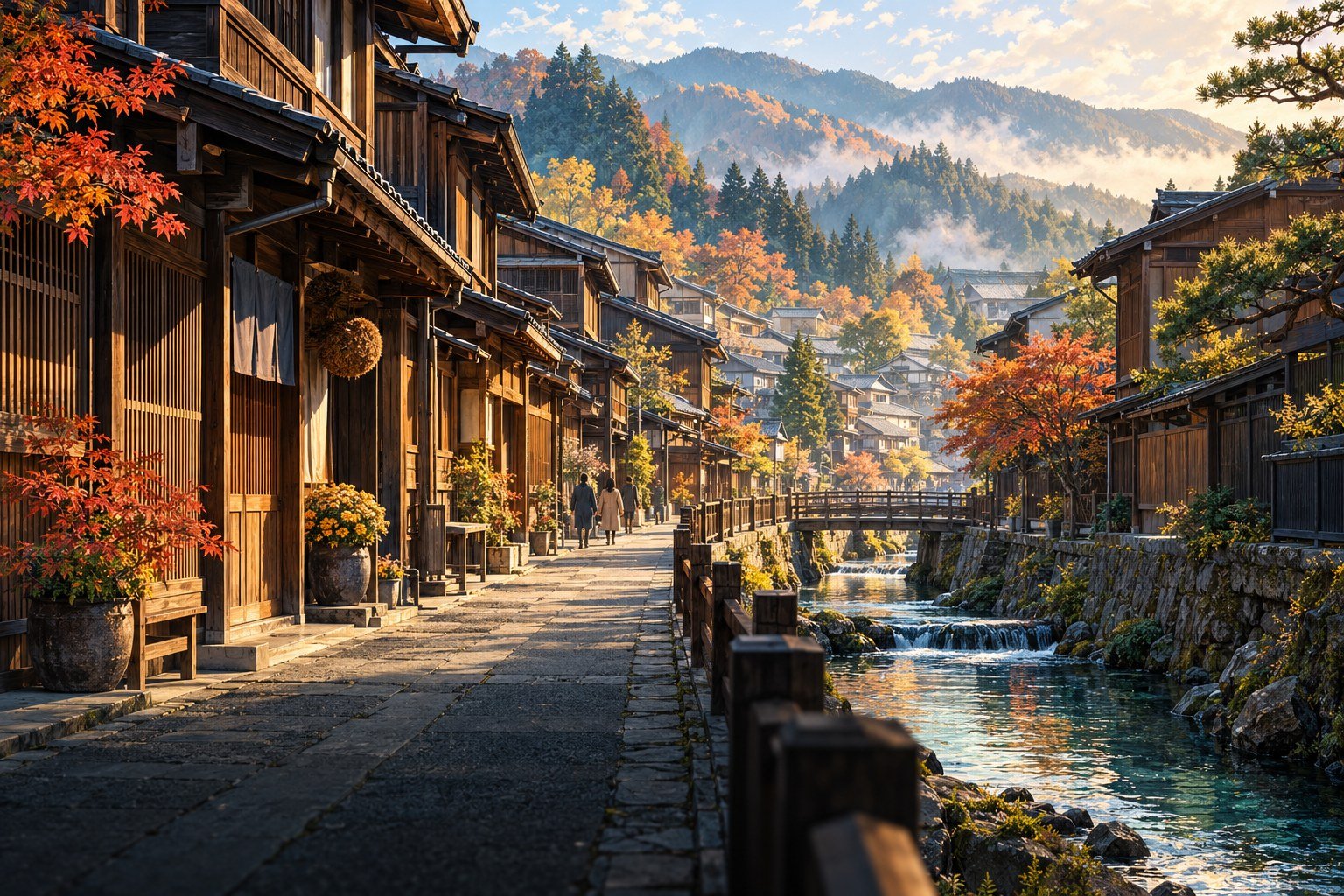
AI-generated editorial illustration inspired by Takayama and the Hida region; buildings and waterway are imagined, not a documented street view.
Three weeks in Japan gives a first trip room for an extra region as well as the major cities. This route connects Tokyo with Kanazawa and Takayama before continuing to Kyoto, Hiroshima and Osaka. The quieter days have a job too: laundry, a second look at a favourite neighbourhood, and time to recover if a transfer takes longer than expected.
The schedule means 21 calendar days in Japan, counting arrival and departure, with 20 hotel nights. It is designed for independent travellers interested in gardens, traditional streets, food and cultural history. It is not a specialist hiking itinerary, and it does not assume mountain excursions are available all year.
Kanazawa’s gardens and craft heritage, then two nights in Hida Takayama.
Five hotel changes; flexible time in Tokyo, Kanazawa, Kyoto and Osaka.
¥785,000 for two adults before flights, with every budget input shown.
Day 8 needs a confirmed route into Takayama, with or without Shirakawa-go.
Three weeks in Japan: a balanced 20-night route
Book the route around the places you want to spend time, then compare flights. An arrival in Tokyo and departure from Kansai International Airport avoids a final return to eastern Japan. If Tokyo return flights are better value overall, use the final-night adjustment below rather than adding a long train journey on departure morning.
| Days | Base | Nights | Purpose |
|---|---|---|---|
| 1–4 | Tokyo | 4 | Arrival and a choice of city neighbourhoods |
| 5–7 | Kanazawa | 3 | Gardens, historical districts and a slower regional day |
| 8–9 | Takayama | 2 | Old streets and Hida culture after the bus journey |
| 10–13 | Kyoto | 4 | Connected sightseeing days and room for one cultural experience |
| 14–16 | Hiroshima | 3 | A full memorial day and a separate Miyajima day |
| 17–20 | Osaka | 4 | City time, an optional day trip and a calm finish |
| 21 | Depart Osaka | 0 | Airport transfer and departure |
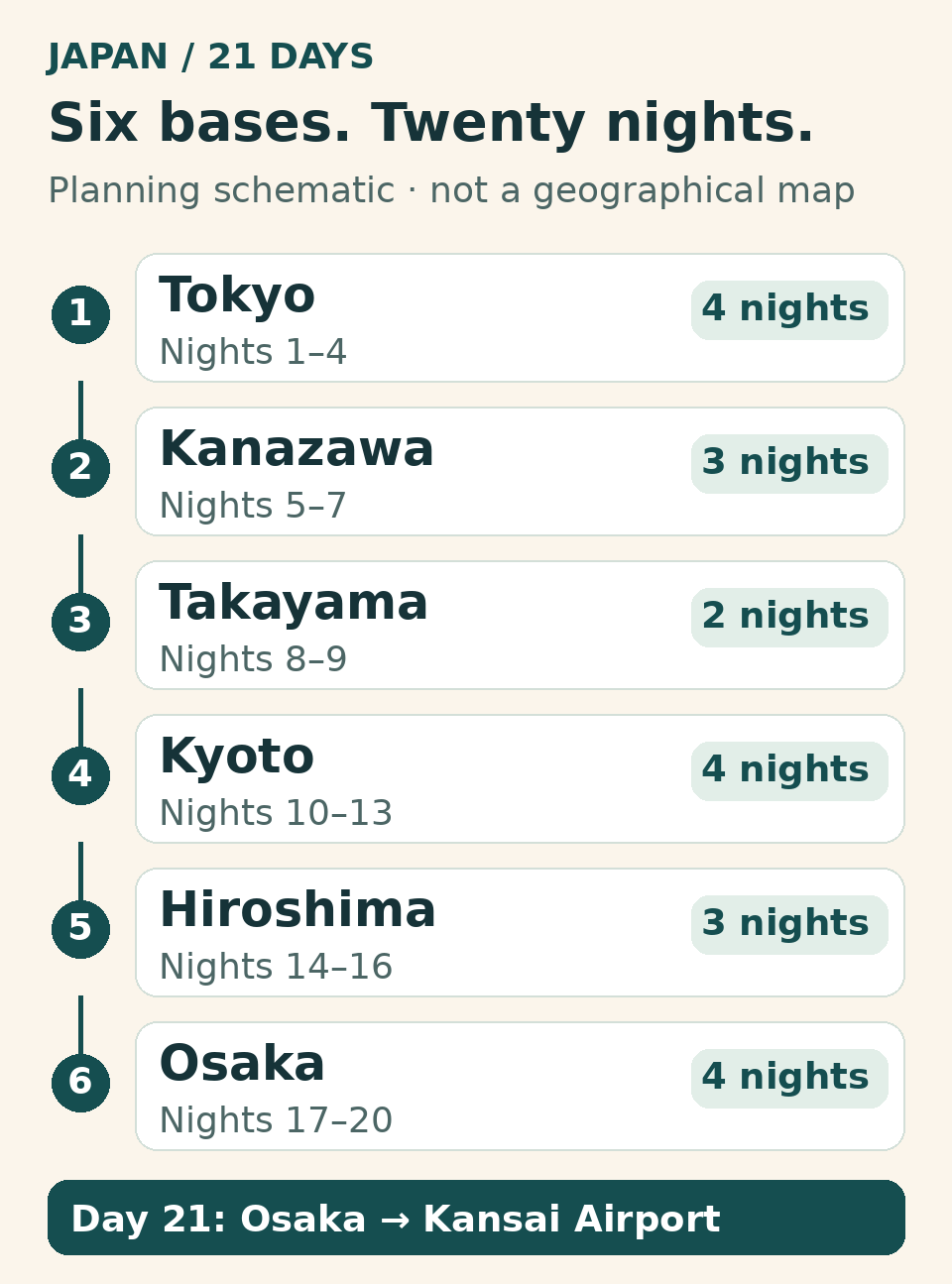
The main compromise is the Kanazawa–Takayama detour. It brings a different pace and landscape, but introduces bus reservations and a slower onward rail journey. If you mainly want restaurants, shopping and big-city museums, the four-base alternative will serve you better.
Days 1–4: Tokyo with one flexible day
Day 1: arrive and settle in
Choose the simplest route to your hotel and keep the first evening local. Do not count on a full sightseeing day after a long-haul flight. An early arrival may allow a gentle walk; a late arrival may leave time only for dinner.
Days 2–3: explore one side of the city at a time
Use day 2 for Asakusa and the Sumida riverside, or combine Asakusa with Ueno if a museum interests you. Use day 3 for Meiji Jingū, Harajuku and Shibuya. These are proposed district groupings rather than a list of timed admissions; select one or two anchors each day and let the rest stay flexible. [1]
Day 4: follow an interest
Choose shopping, an exhibition, a food-focused afternoon or a neighbourhood you want to revisit. Keep this day available for anything displaced by tiredness or weather. A distant day trip is optional, but using every spare day to leave the city undermines the slower pace.
Choose the Tokyo hotel with both the airport arrival and day 5’s departure in mind. A straightforward journey to Tokyo or Ueno Station is useful for the Hokuriku Shinkansen. Compare Tokyo stays on Agoda or Tokyo stays on Booking.com, checking the actual station walk and whether the room comfortably holds your luggage. Four nights in one location is the starting point.
Days 5–7: Kanazawa’s gardens, crafts and old districts
Day 5: Tokyo to Kanazawa
The official Kanazawa access guide gives around 2½ hours by Hokuriku Shinkansen from Tokyo. Allow roughly four to five hours from hotel departure to bag drop in Kanazawa, including station access and boarding time. [2] Keep the first afternoon for a short walk and an easy dinner.
For an additional booking comparison, check Tokyo–Kanazawa transport on 12Go. Select a train that fits this daytime transfer; compare the exact stations, class, final price, ticket delivery and amendment rules with the JR option. The existence of a route listing does not confirm seats for your date. [3]
Day 6: Kenrokuen, the castle park and Higashi Chaya
Make Kenrokuen the morning anchor, continue into the adjoining castle park, and leave time for Higashi Chaya’s traditional streets. The garden and castle sit together, while the chaya district makes a separate walking or local-transport leg. Rather than visiting every museum, pick the art or craft collection that most interests you. [4]
If you would value a guide, compare the Kanazawa highlights walk with a taxi connection. The three-hour listing includes Kenrokuen, the castle exterior, Nagamachi and Higashi Chaya, using a taxi for the longest leg. It remains mainly a walking activity and is listed as unsuitable for wheelchair users and people with low fitness. Use it to replace that portion of the independent programme, and move other sightseeing to day 7; check current inclusions before booking. [5]
Day 7: Omicho, Nagamachi and time to pause
Spend the morning around Omicho Market and continue to the Nagamachi district, or substitute a craft activity for one of them. Kanazawa’s tourism association groups the market and Nagamachi in a suggested half-day course. [6] Keep the other half for laundry, a café, weather flexibility or a longer museum visit. This is the value of the third night.
Stay near Kanazawa Station if the arrival and bus departure are the priority, or around the central shopping districts for evening walking. Compare Kanazawa stays on Agoda or Kanazawa stays on Booking.com, then check the exact location against your day 8 bus stop.
Day 8: decide how to include Shirakawa-go
The most useful way to add Shirakawa-go is during the journey from Kanazawa to Takayama. It avoids returning to Kanazawa and then repeating part of the route. It also turns a transfer into a longer day, so the village stop needs a confirmed onward plan.
Option 1: reserve two separate bus legs
Book Kanazawa–Shirakawa-go and Shirakawa-go–Takayama as separate journeys, allowing two to three hours in the village plus sensible waiting time. The published travel times are roughly 75 minutes and 50 minutes respectively. [2] Both selected departures must be bookable for your group; a through reservation is not permission to get off and resume later.
Nohi’s current fare table lists ¥2,800 for each of those legs, or ¥5,600 per adult combined. A through Kanazawa–Takayama fare is ¥4,200, making the two-ticket visit ¥1,400 more before luggage storage or admissions. These are operator-published benchmarks checked 18 October 2026. Nohi also warns that traffic, snow or road closures can cause delays of two hours or more. [7]
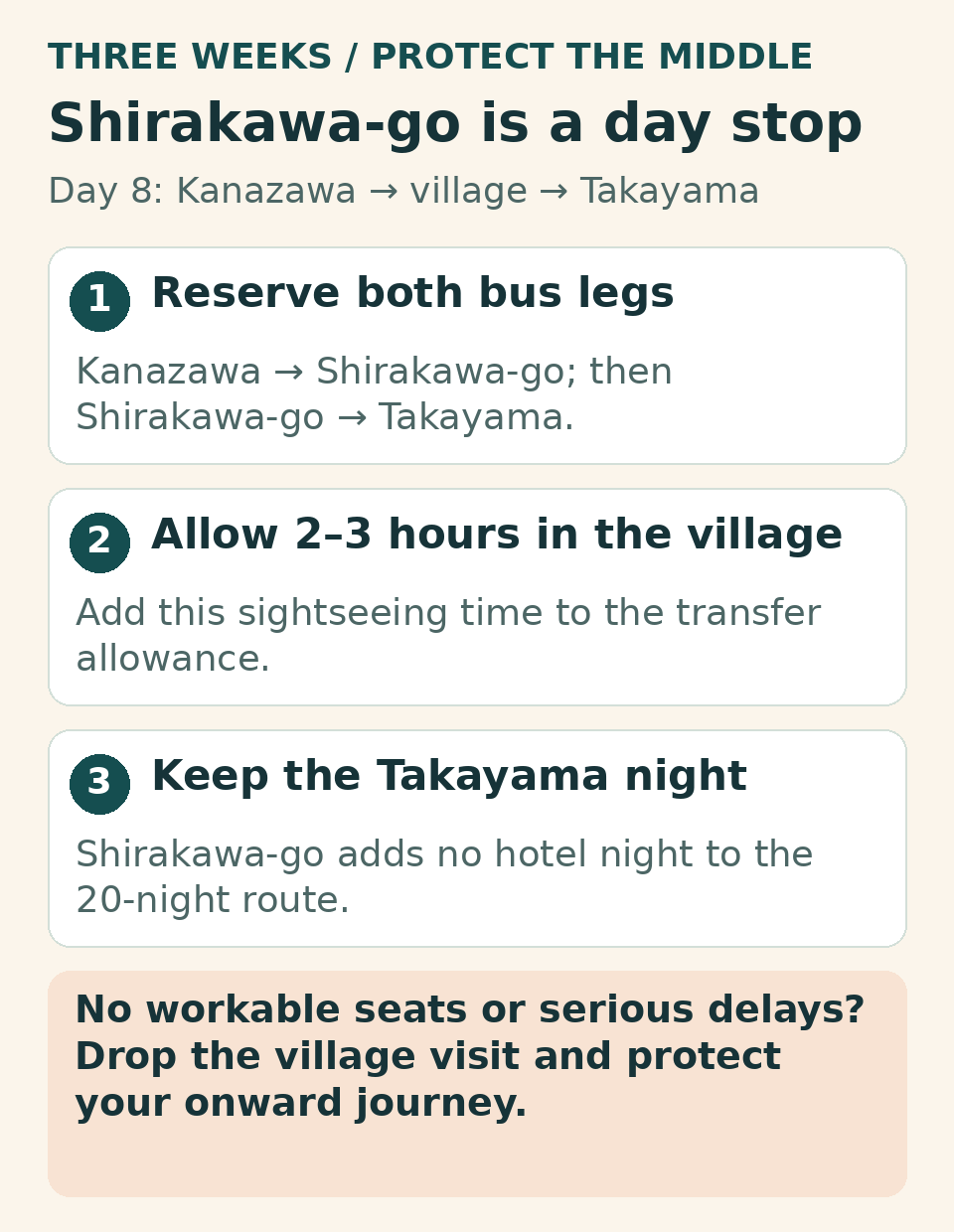
Keep the visit simple: a walk through Ogimachi, lunch or a snack, and one house open to visitors if time allows. Do not turn two hours into a compulsory viewpoint, museum and restaurant circuit. Leave luggage only with an available, suitable storage service, or travel with bags you can manage; storage capacity is not guaranteed.
Option 2: a single arranged transfer
Check the one-way Kanazawa–Takayama transfer with a Shirakawa-go stop if you prefer one booking. LIMON Tours’ listing describes a transport service with a shorter fixed sightseeing stop, rather than a guided village tour. Compare its stopping time, luggage allowance and late-afternoon arrival with your Takayama hotel’s meal deadline. [8]
Takayama: arrive on Day 8, then explore on Day 9
On the evening of day 8, check in and have dinner nearby. Takayama’s old streets can wait until the morning if the bus day ran late. Two nights provide one full day here; they do not create two complete sightseeing days.
Day 9: market, old streets and one deeper visit
Begin at a morning market, then explore the Sanmachi streets. The official visitor guide lists the Miyagawa market as operating until noon, with a later start in winter. [9] Leave time for a slower lunch and choose between a historical building, the local museum or more wandering.
Hida Folk Village is an alternative if the region’s traditional houses interest you, especially if you skipped Shirakawa-go. It is an open-air collection of buildings, rather than the same experience as a lived-in village. [10] Keep enough time for the extra local journey instead of adding it as an afterthought.
Stay within comfortable reach of the station and town centre for this short visit. Compare Takayama stays on Agoda or Takayama stays on Booking.com, checking whether your choice is actually in town or further into the surrounding mountains. If choosing an inn, confirm meal times, room layout, stairs and bathing arrangements.
A Kamikochi excursion would replace this Takayama day and needs its own seasonal and transport planning. The base itinerary keeps the day in town; a distant mountain outing is not necessary to justify coming to Hida.
Days 10–13: Kyoto after the regional detour
Day 10: Takayama to Kyoto
Take the limited-express Hida towards Nagoya, then connect to the Shinkansen for Kyoto. JNTO gives around 2 hours 20 minutes between Takayama and Nagoya; the Kyoto connection, platform change and hotel access are additional. [11] Budget four to five hours hotel to hotel and keep the evening near your accommodation.
Day 11: Higashiyama and Gion
Walk from the Kiyomizu-dera area through southern Higashiyama towards Yasaka Shrine and Gion. Choose one or two visits that interest you, with a break between them, rather than trying to enter every temple on the way. This follows a geographically connected part of Kyoto’s official sightseeing guidance. [12]
Day 12: Arashiyama at a manageable pace
Spend the day in western Kyoto, combining the bamboo grove area, a garden or temple and the riverside. Keep the afternoon in the same area or return for a rest. [13] If you want a specific cultural activity instead, swap part of the day rather than adding another journey across the city.
Day 13: a chosen experience and breathing room
Use this day for the attraction you care about most, a food or craft experience, or revisiting somewhere without a schedule. It also gives room for laundry before Hiroshima. Avoid moving every missed Tokyo or Takayama activity into Kyoto’s remaining time.
Compare Kyoto stays on Agoda or Kyoto stays on Booking.com for one four-night stay. Station access helps on days 10 and 14; central districts may be more convenient for evenings. Check the map and room plan rather than relying on a district name alone.
Days 14–16: give Hiroshima and Miyajima full days
Day 14: arrive without a museum deadline
Travel from Kyoto to Hiroshima, drop bags and explore locally. Keep dinner straightforward. Unlike the shorter classic route, these three nights let you visit the memorial sites on a full day instead of attaching them to the train journey.
Day 15: Peace Memorial Museum and park
Start with the museum and allow the pace its exhibits require. Then visit the Peace Memorial Park and Atomic Bomb Dome, with breaks before any evening plans. The city’s official visitor information recommends advance web tickets and notes that some extended admission periods are reservation-only. Check the calendar before choosing a time. [14]
If you want a guide to explain the park’s memorials, look at the Hiroshima Peace Memorial Park historical walking tour. Choose a duration that leaves enough museum time, check its starting point and confirm what the selected option includes. It replaces the independent park walk. [15]
Day 16: Miyajima
Use the local train to Miyajimaguchi and ferry to Miyajima, then spend the day around Itsukushima Shrine and the town. The boat crossing is approximately ten minutes, but allow for the city journey and waiting as well. [16] Check the tide information before arranging the day if you particularly want to see the shrine surrounded by water; conditions do not always allow a walk out towards the great torii. [17]
You can swap days 15 and 16 to suit tickets or weather because the hotel remains the same. That flexibility is the strongest reason for the third Hiroshima night. Keep an optional longer walk dependent on conditions and your energy rather than treating it as compulsory.
Search Hiroshima stays on Agoda or Hiroshima stays on Booking.com. The station area eases rail days; a central location closer to the memorial area may suit travellers who prefer more evening walking. Staying on Miyajima instead requires revising the luggage and ferry plan.
Days 17–21: Osaka with space around the final flight
Day 17: arrive and enjoy the evening
Travel from Hiroshima to Shin-Osaka, then onwards to your chosen district. Drop the bags and spend the evening around local food and a walk. Avoid reserving a distant attraction immediately after the transfer.
Day 18: one optional day trip
Use this day for Nara if its temples and park are a priority, or Himeji if you particularly want a castle visit. Choose one and check its current opening and transport arrangements. This day falls within the suggested regional pass period, but the pass is useful only on its eligible services. Staying in Osaka is equally valid.
Day 19: a full Osaka day
Give this day to Minami: browse Kuromon Market in the late morning, make Namba the afternoon shopping stop and finish beside Dōtonbori’s canal. The market, Namba and Dōtonbori work as a walking sequence; allow breaks rather than treating the route as a continuous march. [29] If Universal Studios Japan is central to your trip, it replaces this programme and requires separate ticket planning. Keep that evening flexible after a long attraction day.
Day 20: a deliberately light finish
Revisit a neighbourhood, finish shopping, pack and confirm the airport route. The spare time is useful if an earlier plan moved, but it need not become a last-minute excursion. Three weeks of walking and transfers can make an unstructured final day valuable.
Day 21: fly from Kansai International Airport
Use the route and terminal that match the actual flight, adding the airline’s check-in buffer. JR and Nankai serve different useful Osaka stations; the airport rail station connects directly to Terminal 1, while Terminal 2 needs its separate transfer. [18]
Compare Osaka stays on Agoda or Osaka stays on Booking.com and check the station journey before booking four nights. The best final base is one that suits both your evenings and the airport transfer.
Transport time and the rail passes worth comparing
| Day | Main journey | Allow | Planning consequence |
|---|---|---|---|
| 5 | Tokyo → Kanazawa | 4–5 hours | Keep the arrival afternoon light |
| 8 | Kanazawa → Takayama | 4–5 hours | Add 2–3 hours for the independently arranged village visit |
| 10 | Takayama → Nagoya → Kyoto | 4–5 hours | Protect the Nagoya connection; dinner near the hotel |
| 14 | Kyoto → Hiroshima | 3½–4½ hours | Full memorial day follows on day 15 |
| 17 | Hiroshima → Shin-Osaka → Osaka hotel | 3–4 hours | Local train or subway needed after Shin-Osaka |
The five changes account for about 18½–23½ hours before the optional village visit and airport journeys. These are planning ranges, not train-running times; delays can exceed them. Multi-night stays keep the slower transfers from dominating the trip.
The western section has the clearest pass case
For eligible visitors, start the ¥17,000 five-day Kansai–Hiroshima Area Pass on day 14, covering the outward and return western rail legs through day 18. Take a conventional JR train between Kyoto and Shin-Osaka; the Shinkansen on that section is excluded. JR Miyajima ferry travel is included but its visitor tax is separate. Day 21’s airport journey is outside this pass period. [19]
As a benchmark, SmartEX’s published regular-season reserved Nozomi fares are ¥11,740 Kyoto–Hiroshima plus ¥10,750 Hiroshima–Shin-Osaka, totalling ¥22,490. That makes the pass worth comparing, with its different Kyoto connection and coverage rules. Dates, ticket products and reservation conditions can change the result. [20]
Keep the eastern section separate until you have actual quotes
Price Tokyo–Kanazawa, the two bus legs and Takayama–Kyoto for your dates. The Takayama–Hokuriku Area Tourist Pass costs ¥19,800 for five consecutive days, but it is not an all-Japan ticket. Its covered rail route reaches Kyoto via Toyama and Tsuruga; it does not include Tokyo or the Nagoya–Kyoto Shinkansen used in this plan. Compare the full routing before changing trains merely to use it. [21]
The nationwide Ordinary adult Japan Rail Pass costs ¥100,000 for 21 days through the official online channel, or ¥105,000 through overseas agencies. Fourteen-day prices are ¥80,000 and ¥84,000 respectively. [22] Duration alone is a poor buying rule: much of this holiday is spent walking around a base, and the village buses require separate coverage. Add up the tickets you would actually buy within the proposed pass dates before paying.
What to budget for three weeks
This example is for two adults sharing one room, using ordinary rail services and a mix of city hotels and two more expensive Takayama nights. It is an original budgeting model, not a claim about average hotel rates or a quote for your dates. Figures are Japanese yen, with international flights excluded.
| Item | Calculation | Total for two |
|---|---|---|
| City hotels | 18 nights × ¥18,000 per room | ¥324,000 |
| Takayama stay | 2 nights × ¥32,000 per room | ¥64,000 |
| Transport | 2 people × ¥65,000 allowance | ¥130,000 |
| Food | 21 days × 2 people × ¥4,500 | ¥189,000 |
| Admissions and activities | 2 people × ¥24,000 allowance | ¥48,000 |
| Local accommodation taxes and contingency | Shared allowance | ¥30,000 |
| Total before flights | ¥324,000 + ¥64,000 + ¥130,000 + ¥189,000 + ¥48,000 + ¥30,000 | ¥785,000 |
The total is ¥392,500 per person when sharing the stated rooms. The transport allowance is intended to cover the main intercity journeys, the two village bus tickets, the western regional pass, airport transfers and local journeys. Replace it with current quotes before treating the total as your spending limit. Optional guided transfers or private tours can use more of the activity and transport allowances.
The full daily food allowance remains even if a room includes breakfast or dinner; deduct those meals if you want to tighten the model. Shopping, travel insurance, connectivity and high-cost theme-park options need their own provision.
Kyoto’s accommodation tax changed in March 2026. If the ¥18,000 shared room rate is the taxable lodging fee, the ¥9,000-per-person share attracts ¥400 per night: 4 nights × 2 adults × ¥400 = ¥3,200. This is included in the shared tax and contingency allowance. Replace it with the actual taxable charge, and avoid adding it twice where a hotel quote already includes tax. [23]
Three changes with a visible effect
- If the 18 city nights cost ¥5,000 more per room, add ¥90,000 to the total.
- If each traveller spends ¥1,000 more on food every day, add ¥42,000.
- If both Takayama nights cost ¥18,000 instead of ¥32,000 per room, subtract ¥28,000.
These calculations make it easier to choose where to spend more: a room near a useful station, a special inn night, or a guided experience that matters to you. Solo travellers need their own room quotations; do not halve the accommodation line. The Japan budget guide provides wider cost context.
Choose the version that fits the season and your energy
Keep the regional leg focused on towns
Kanazawa and Takayama give this trip regional variety without requiring a high-mountain excursion. Plan gardens and outdoor streets around the conditions, with indoor visits and slower meals as alternatives. Do not assume the same clothing or walking conditions will suit every base.
Kamikochi is a separate seasonal decision. Its official 2026 information gives April access arrangements and a 15 November season-ending ceremony, with some facilities closing earlier. [24] [25] A winter Takayama visit should not be sold as access to the same mountain walks. Snow and road disruption can also affect the bus leg; if that makes the trip too uncertain for you, choose the rail-focused four-base version before booking.
A slower four-base trip
Remove Kanazawa and Takayama, then use Tokyo 6 nights, Kyoto 6, Hiroshima 3 and Osaka 5: still 20 nights, with three hotel changes. This version trades the extra region for deeper city time and simpler logistics. Do not fill the reallocated time with new long-distance excursions.
If your international flight returns from Tokyo
Keep the main route through Hiroshima, then use Osaka 2 nights and Tokyo 2 nights at the end. The complete ledger becomes Tokyo 4, Kanazawa 3, Takayama 2, Kyoto 4, Hiroshima 3, Osaka 2, Tokyo 2: 20 nights. Travel Osaka–Tokyo on day 19, keep day 20 in the Tokyo area and fly on day 21.
This gives a buffer before the flight and uses the second Tokyo stay for final shopping. It costs another intercity ticket and removes two Osaka nights. Compare that total with the Tokyo-in/Osaka-out airfare rather than comparing the flight prices in isolation.
More rural time instead of more hotels
If Takayama is a priority, take one Osaka night and add it there: Tokyo 4, Kanazawa 3, Takayama 3, Kyoto 4, Hiroshima 3, Osaka 3. Choose the additional day’s programme after checking season and transport. Extend an existing stay before creating a seventh base.
Booking priorities for a three-week journey
- Match the flight dates to 21 days in Japan and settle the departure city.
- Check Kanazawa and Takayama room availability against the day 8 connection, then reserve the other bases with suitable cancellation terms.
- Confirm the village visit as two bus legs or a single arranged transfer. If neither works, choose a direct route and keep the overnight ledger intact.
- Compare railway tickets and passes using the actual dates, including any return to Tokyo.
- Book the few museum or guided experiences that need a set time, leaving flexible days free.
For the regional detour, ask the hotels whether luggage forwarding between Kanazawa and Kyoto is possible and when delivery can be expected. Keep the Takayama stay’s clothing and essentials with you. Nohi warns that luggage-bay capacity is limited; do not assume several large cases will be straightforward on a full bus. [7] Check the separate baggage rules for each rail service before travelling. [26]
Keep tickets and hotel addresses available offline, alongside a way to get current information. Browse Airalo eSIM options if mobile data would help with translation and connections; select a Japan plan with validity covering the whole journey, and check how it activates. Compare it with your existing roaming arrangement. Airalo’s Japan offers and device guide should be checked before purchase: the phone needs to be compatible and unlocked. [27] [28]
Save the final stops and nights in the Trip Itinerary Planner. For documents and practical preparation, use the first-time Japan guide and entry requirements for British travellers, checking current requirements for your own circumstances.
Questions before you book
Why give Kanazawa three nights and Takayama only two?
Kanazawa gets an arrival afternoon, a full sightseeing day and a slower day before the bus transfer. Two Takayama nights then provide an arrival evening and one full town day. If Hida is the main draw, take one night from Osaka and add it to Takayama rather than compressing the bus visit.
Should I visit Shirakawa-go as a day trip from Kanazawa instead?
That can suit travellers who want to return to the same hotel, but this route continues to Takayama. A separate day trip would repeat some of the bus corridor. The transfer-day visit uses the travel direction efficiently, provided both bus legs are confirmed and you can manage luggage.
Can I add Hakone as well?
You can, but it creates another stop and requires taking nights from the existing route. First decide whether you want a hot-spring stay or specifically Hakone: an inn stay around an existing base may meet the first need with fewer transfers. If Hakone is essential, redesign the route rather than attaching a one-night detour to an already reserved sequence.
Is a car necessary for the Kanazawa and Takayama section?
The proposed route uses trains and buses, so a car is not part of the plan. Accommodation far from the stations or a remote rural extension changes that calculation. Check the location and transfer arrangements before selecting a property simply because it looks close on a regional map.
Is this too much for a first trip with children?
That depends on the children’s ages, walking tolerance and how much luggage you carry. Six bases and the day 8 bus connection require more coordination than the four-base alternative. Protect rest time, use one main activity per day and remove a stop if those requirements leave little room to enjoy it.
Make the itinerary your own
Choose this route when Kanazawa and Hida are reasons to travel, and keep the flexibility that makes them manageable. Confirm the day 8 connection before committing to its village stop, give Hiroshima its full days, and use the final Osaka stay to finish well. If the bus detour appeals less than deeper city time, the four-base version is a sound three-week trip in its own right. Continue planning through the Japan travel hub.
Sources and research
Research checked on 18 October 2026. The route and pacing choices are editorial planning recommendations. Journey estimates and cost allowances are identified where used; check current operators before booking.
- GO TOKYO: things to do and district groupings.
- Kanazawa City Tourism Association: getting to Kanazawa and regional connections.
- 12Go: Tokyo–Kanazawa transport comparison.
- Kanazawa City Tourism Association: gardens and historical districts.
- GetYourGuide: Kanazawa highlights walking tour with taxi connection.
- Kanazawa City Tourism Association: Omicho and Nagamachi course.
- Nohi Bus: Kanazawa–Shirakawa-go–Takayama timetable, fares and cautions.
- GetYourGuide / LIMON Tours: one-way Kanazawa–Takayama transfer with Shirakawa-go stop.
- Hida Takayama official visitor guide: Miyagawa Morning Markets.
- Hida Takayama official visitor guide: Hida Folk Village.
- Japan National Tourism Organization: Hida Takayama and rail access.
- Kyoto City: sample itineraries including Higashiyama.
- Kyoto City: Saga and Arashiyama.
- City of Hiroshima: Peace Memorial Museum visitor information.
- GetYourGuide: Hiroshima Peace Memorial Park historical walking tour.
- JR West Miyajima Ferry: timetable.
- Miyajima Tourist Association: tide information.
- Kansai International Airport: rail and terminal access.
- JR West: Kansai–Hiroshima Area Pass.
- SmartEX: published reserved-seat fare table.
- JR Central / JR West: Takayama–Hokuriku Area Tourist Pass.
- Japan Rail Pass: official online and overseas agency prices.
- Kyoto City: accommodation tax from March 2026.
- Kamikochi official website: 2026 opening.
- Kamikochi official website: 2026 season ending and facility closures.
- SmartEX: taking baggage onboard.
- Airalo: Japan eSIM plans.
- Airalo: compatible-device requirements.
- OSAKA-INFO Experience: Kuromon Market and walking onwards to Namba and Dōtonbori.
Illustrations in this article were created for Taylor’s Trailblazing Travels. Third-party photographs, where used, are credited beside the image or in the source list.