Where to Stay in Shibuya: Best Streets and Nearby Districts
Choose the right side of the station, weigh nearby districts and find a room that fits the way you will use Tokyo.
An original AI-created editorial illustration of Shibuya’s neighbourhood atmosphere, rather than a photograph of a particular hotel or street.
Deciding where to stay in Shibuya starts with a smaller question: which streets will you want outside your hotel door? A room beside Mark City, one near Miyashita Park and one in Shinsen can all appear under “Shibuya”, yet produce different daily journeys.
Shibuya combines JR, private railway and Metro services with shopping and late-evening entertainment.[1] That is useful if your plans use them. The advantage shrinks when the hotel is on the wrong side for your usual train, its smallest room does not fit your luggage, or the surrounding nightlife clashes with an early bedtime.
This guide compares five central areas and three nearby alternatives, then turns the shortlist into a room-and-route decision.
Some links in this guide are affiliate links. Taylor’s Trailblazing Travels may earn a commission if you book or buy through them, at no extra cost to you.
First visit
Start beside the station
Match Mark City or Stream to the railway you will use.
Longer stay
Check the room plan
Laundry, kitchens and beds can outweigh a shorter walk.
Nearby alternative
Consider Ebisu
A useful balance of restaurants and JR connections.
Before booking
Pin the entrance
Check the walking route, lifts and overnight access.
Where to stay in Shibuya: choose your small area first
Start with your likely evenings, then the railway lines for your busiest days. The following matrix is an editorial decision framework: its recommendations combine published hotel approaches, transport connections and neighbourhood character. It is not a price league table or a measured noise survey. Room prices and availability depend on your dates.
Swipe across the table to compare →
| Area | Strongest reason to choose it | Street-level decision | Trade-off to accept |
|---|---|---|---|
| Station-side Dogenzaka / Mark City | Shibuya evenings and frequent rail departures | Keep the hotel approach near the station end of Dogenzaka. | Busy surroundings; a farther-uphill address changes the walk.[2][3] |
| East side / Shibuya Stream | A short JR New South Gate or C2 approach | Match the hotel entrance to the line you will actually use. | C2 is not an equally short route from every platform.[4] |
| Sakuragaoka / Sakura Stage | A longer stay with room facilities as a priority | Check the deck route and the exact room layout. | A district label does not guarantee a flat street approach.[5] |
| Miyashita Park / Jinnan | Shopping between central Shibuya and Harajuku | Choose the north side if most daytime stops are here. | Allow for the station walk and the hotel’s overnight entrance.[1][6] |
| Shinsen | Laundry or kitchenette facilities beyond the station core | Compare the full Shibuya walk with the smaller Shinsen station. | A three-minute Shinsen walk is not a three-minute JR walk.[7] |
| Ebisu | Restaurants plus direct access to JR and the Hibiya Line | Start near the west-side station approaches for this comparison. | Station restaurant streets can still be lively at night.[8] |
| Daikanyama | Boutiques, cafés and a neighbourhood-led stay | Choose it because you want to spend time locally. | The station has only the Tokyu Toyoko Line; JR requires another approach.[9] |
| Omotesando / Aoyama | Design shopping and a Metro-focused itinerary | Map the hotel against Omotesando and Gaienmae separately. | No JR platform at Omotesando; “Aoyama” can mean another station.[10][19] |
For a short first stay, shortlist one hotel beside the station and one in your preferred quieter or more residential setting. Compare those actual rooms. Expanding the search to every address in Shibuya ward creates more choices without necessarily improving the decision.
Station-side streets: Mark City, Stream and Sakuragaoka
Mark City and the lower end of Dogenzaka
Choose this side when you expect repeated Shibuya nights or several departures on different lines. Shibuya Excel Hotel Tokyu is inside Mark City: its published approaches are three minutes from JR’s Central ticket gate, two from the Keio Inokashira Central gate and five from the Ginza Line’s Scramble Square-direction gate.[3] That makes it a sensible station-focused candidate, although “connected” still involves passages and level changes.
Its Standard Twin is listed at 30.0–32.8m², compared with 22.3–23.3m² for a Standard Double; choose the room category before comparing prices.[11] Check the same dates on Agoda’s Shibuya Excel Hotel Tokyu page and Booking.com’s property page.
The east side around Shibuya Stream
Shibuya Stream Hotel is a different property from Excel. Its current route guide places it one to two minutes from the JR New South ticket gate and connects it with exit C2 for the specified Tokyu and Metro lines. The hotel lobby is on the fourth floor.[4] This is a useful starting point if that approach matches your arrival and daily journeys.
The 24.8m² Standard Double and the 23.8m² shower-only Standard Double are separate categories.[13] Use Shibuya Stream Hotel on Booking.com to compare the exact room and bathroom description. A similar-looking name is not a reason to assume identical facilities.
Sakuragaoka and the Sakura Stage approach
Hyatt House Tokyo Shibuya is the practical apartment-style example here. Its 32m² King room has a kitchen and washer-dryer; larger categories and sofa-bed variants require their own room checks.[14] The hotel publishes a three-minute pedestrian-deck approach from JR’s New South Gate. Its vehicle drop-off address differs from its registered address, so ask for the car-arrival instructions if booking a transfer.[5]
This is especially useful when washing clothes or preparing simple meals will be part of the stay. It is less compelling if you will barely use the room and the price premium is large. Compare Hyatt House Tokyo Shibuya rooms
North and west: Miyashita Park, Jinnan and Shinsen
Miyashita Park and Jinnan for shopping-led days
The north side makes sense when your plans lean towards Shibuya’s shops and onward walks towards Harajuku. Jinnan offers smaller fashion shops; Koen-dori rises gently through this part of town.[1][2] Compare the exact frontage: a side street and a room over a busy junction are different propositions.
At sequence MIYASHITA PARK, the useful details are unusually specific. The advertised walk is seven minutes from Hachiko Exit or three from Metro exit B1. Check-in starts at 17:00 and check-out is 14:00. The park-side entrance closes from 23:00 to 08:00; overnight access uses the hotel lifts at the Jingu6 intersection on the complex’s north end.[6]
Its smallest “Double” is 13.7m² with a published capacity of one. Medium Double is 16.3m² for two; Queen is 18.3m² for two.[15] That distinction matters more than a fashionable lobby photograph. Check sequence MIYASHITA PARK room types
Shinsen for room facilities and a different daily rhythm
Tokyu Stay Shibuya, at Shinsencho 8-14, is advertised as three minutes from Shinsen’s south exit, eight from Shibuya Metro exit A0 and ten from JR Shibuya’s west exit.[7] Price it as a longer Shibuya approach, even if a search result prominently displays the shorter Shinsen figure.
The Standard Double is 20m² for two, with a kitchenette, microwave and washer-dryer. The 40m² Residential Family category lists four occupants.[16] For a multi-night stay, compare Tokyu Stay Shibuya on Agoda with the same property on Booking.com, entering every guest’s age.
Shinsen is a useful place to look beyond the crossing, but do not treat every western backstreet as quiet. Nearby Maruyamacho is associated with music venues and clubs.[1] Dogenzaka is an uphill street, so trace the approach before committing to a route with wheeled luggage.[2]
When Ebisu, Daikanyama or Omotesando works better
Ebisu: restaurants and JR connections
Ebisu is the strongest alternative in this comparison for travellers who want dining close to their hotel while retaining JR access. The station serves the Yamanote, Saikyo and Shonan-Shinjuku lines, plus Tokyo Metro’s Hibiya Line. Its western side leads towards Daikanyama; the restaurant lanes around the station are lively rather than uniformly hushed.[8]
Prince Smart Inn Ebisu gives a concrete smaller-room comparison: five minutes from the JR west exit or three from Hibiya exit 5.[17] The official Standard Double is 13m² with a 140cm-wide bed and a shower, without a bathtub.[18] It can suit a solo traveller or a couple travelling light; two large open cases may make a larger room worth paying for. Compare Prince Smart Inn Ebisu rooms
Daikanyama: choose the neighbourhood deliberately
Daikanyama’s boutiques, cafés and leafy residential streets are the reason to stay here. The transport compromise is clear: only the Tokyu Toyoko Line serves its station. GO TOKYO gives broad walking estimates of 15 minutes from Shibuya and ten from Ebisu, which are area orientation figures rather than a promise for an individual hotel entrance.[9]
For daily JR departures, an Ebisu-side hotel can be the more practical compromise: visit Daikanyama on foot while keeping the railway you need closer. For slow mornings and local browsing, prioritise a verified Daikanyama address. Check the map carefully when a booking site uses “Daikanyama” to describe a property actually nearer Ebisu or Shibuya.
Omotesando and Aoyama: a Metro-led base
Choose these streets for design shops, cafés and Aoyama itself. Omotesando station has the Ginza, Hanzomon and Chiyoda lines, giving it a different transport pattern from a JR-based hotel.[10] The official tourism guide describes the area’s boutique shopping and dining and places it roughly a 20-minute walk from Shibuya; the particular hotel can add more walking.[21]
The Aoyama Grand Hotel illustrates why the nearest station matters: it advertises three minutes from Gaienmae exit 3, versus eight from Omotesando exit A3.[19] Its Standard Queen is 32m²; Garden Queen categories are larger and are separate choices.[20] View The Aoyama Grand Hotel room options
Aoyama is a worthwhile destination-led choice, but it is not the logical default if most evenings and morning departures are in Shibuya. Neither neighbouring district should be assumed cheaper: compare the complete stay for the room you would actually book.
Read the entrance route before the walking-time claim
These published JR approaches start at different gates. They are useful directions, not a league table of total journey times: reaching the named gate from your platform, waiting for lifts and finding reception all add time. The station-side property that works best can change with the railway line you use.[3][4][5][6][7]
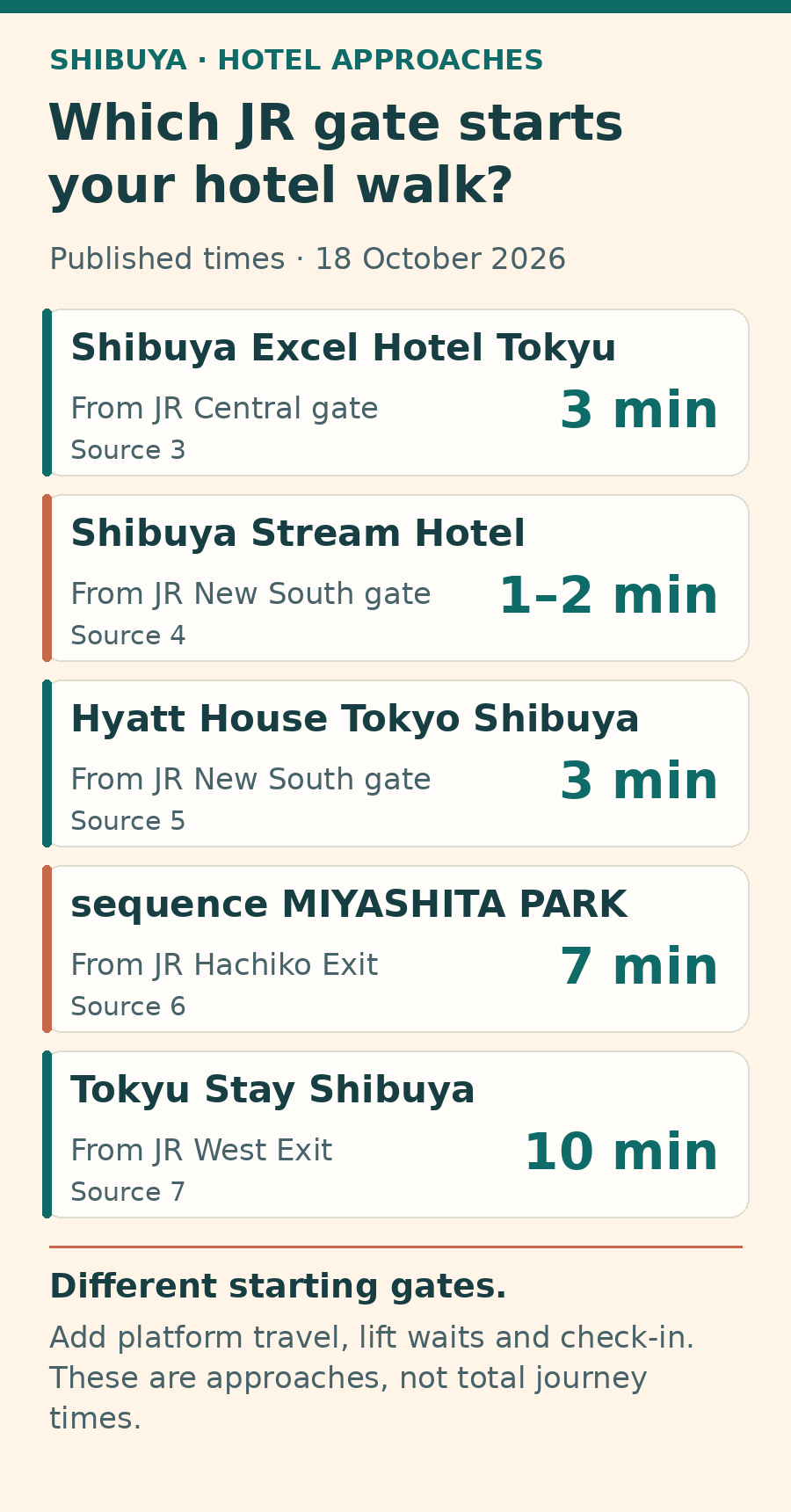
For a first arrival, build a door-to-platform allowance from separate pieces: your actual street or deck walk, the correct accessible entrance, then the internal station route. As a planning margin, add ten minutes beyond a familiar route estimate when carrying luggage; add more if you need step-free access or cannot easily recover from a missed train. That margin is a suggestion, not a measured Shibuya transfer time.
Where mobility matters, ask the hotel for the route from your named line and gate, including any lift opening restrictions. Excel publishes separate barrier-free approaches, which differ from its ordinary walking instructions.[3] A station-connected hotel should still pass this test.
Match the room to your stay, then price convenience
Use the first column below to decide which compromise matters. These are planning scenarios, not universal hotel rankings. Discard a room that fails your occupancy, accessibility or spending limit before giving extra credit for its location.
Swipe across the table to compare →
| Traveller | First priority | Useful starting point | Decision to make |
|---|---|---|---|
| Two adults, three nights, out until late | Short return from the evening area | Mark City / lower Dogenzaka, or Stream if its railway approach fits | Do not pay for a kitchen you will barely use. |
| Family, five nights, an afternoon rest most days | Confirmed beds and occupancy, then repeat journeys | Sakuragaoka apartment-style rooms or a suitable Tokyu Stay family category | A larger room wins only if its bed configuration fits everyone. |
| Solo traveller, four nights, restaurant evenings and JR day trips | Manageable room size and a useful railway base | Ebisu west side; compare a central Shibuya room before deciding | A compact room may be sufficient, but it may not be cheaper on your dates. |
A four-night convenience calculation
Suppose two otherwise suitable rooms differ by ¥3,000 per night, and the more convenient one cuts eight minutes from each one-way walk you would otherwise make. Over four nights, its extra cost is ¥12,000. Assume four days on which you make the journeys below.
Swipe across the table to compare →
| Daily pattern over four days | One-way journeys | Total time saved | Four-night room premium |
|---|---|---|---|
| One outing and return per day | 8 | 8 × 8 = 64 minutes | ¥12,000 |
| Morning outing, afternoon return, evening outing and return | 16 | 16 × 8 = 128 minutes | ¥12,000 |
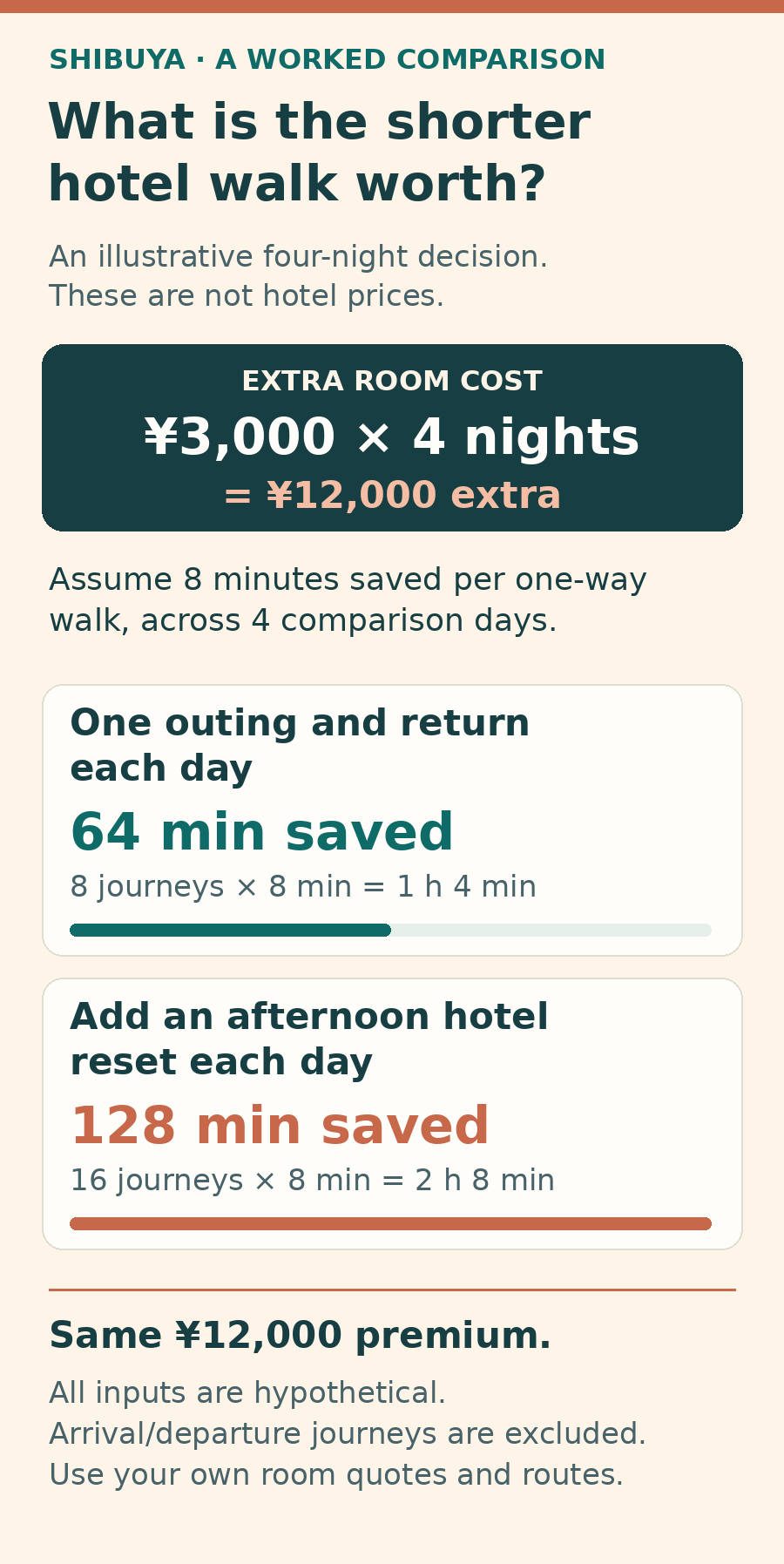
For a couple who leave after breakfast and return once, paying ¥12,000 saves just over an hour in this model. For a family returning for an afternoon rest every day, the saving doubles. The same location premium can therefore be reasonable for one trip and unnecessary for another.
Replace the assumptions with your actual complete-stay quotes and mapped routes. If a larger room, a kitchen or a quieter confirmed room aspect is the real benefit, compare that benefit separately; the calculation measures only walking. It excludes airport arrival and departure journeys, public-transport fares, traffic, luggage handling and any difference in room comfort.
Choose an airport arrival that reaches the right side
Narita: the train is only part of the hotel journey
JR East’s Narita Express has Shinjuku-bound services calling at Shibuya. Select a service that actually stops there; other destination patterns differ.[22] Then use your hotel’s current approach from the appropriate gate. An airport train that avoids changing services can still leave a substantial station or street walk.
For a road-transfer comparison, 12Go’s Narita Airport–Shibuya listing currently offers van services.[24] It is a route listing, so confirm the actual drop-off, luggage allowance and operating time before paying. Do not assume its Shibuya label means delivery to your reception.
Haneda: Mark City can make the bus attractive
The official Shibuya–Haneda bus route serves Mark City, Shibuya Fukuras and Cerulean Tower. As checked on 18 October 2026, the published adult one-way fare is ¥1,300 and the operator gives a broad 45–80-minute journey range. Check your terminal and departure: not every service serves every stop or terminal.[23]
A useful bus stop beside your hotel may outweigh a slightly quicker train headline. Conversely, a long walk from the stop can remove that advantage. Keep the final flight-day plan tied to the live timetable and allow for road delays.
When a private transfer earns its place
For several travellers, substantial luggage or an arrival outside a suitable public-transport window, compare a vehicle quote with the group’s full alternative cost. H.I.S.’s private airport transfer on GetYourGuide offers Haneda or Narita transfers to or from hotels in Tokyo’s 23 wards; select the correct airport and direction.[25] Pick-U’s Narita transfer on Viator offers one-way or return arrangements and separately lists extra waiting and night-time surcharges.[26]
Before booking either, supply the actual hotel entrance, passenger count, suitcase dimensions and any child-seat or mobility requirements. Obtain the matching vehicle and waiting allowance in the confirmation. A general accessibility or passenger-capacity label cannot answer those individual questions.
Save the hotel’s Japanese name, entrance pin and arrival instructions offline. If your existing roaming plan is unsuitable, browse Airalo and select Japan for a data-plan comparison. Japan plans are offered, but your phone must be eSIM-compatible and network-unlocked; check the chosen plan’s activation instructions before travel.[27][28]
Five checks before reserving a room
- Enter all guests and ages. Read the maximum occupancy and count actual beds; an attractive double-room photograph does not establish family suitability.
- Compare the complete stay. Match room category, breakfast, cancellation deadline, payment timing and any separately payable taxes or service charges.
- Check the entrance twice. Trace the daytime railway approach and the route you will use after an evening out. Save any separate taxi drop-off instructions.
- Ask about the room aspect. If sleep is a priority, ask about railway frontage, nearby entertainment, current works and rooms away from lifts. A higher floor alone is not a guarantee.
- Choose the compromise consciously. A kitchenette, larger bed or more useful station can matter more than a fashionable district name. Recheck the property’s latest notices before the free-cancellation deadline.
These examples were selected for distinct location or room decisions using official property information. They are not based on personal stays, sound tests or a live search for your dates. A suitable room on one booking platform may have different terms from a similarly named room elsewhere.
Useful questions
Does a double room always allow two guests?
No. Room names describe a bed or category, while the occupancy rule controls how many people can stay. For example, sequence MIYASHITA PARK lists its 13.7m² Double for one person and Medium Double for two. Enter the full party before comparing rates.[15]
Will housekeeping clean the room every day?
Check the property’s policy. sequence MIYASHITA PARK publishes cleaning every two days. Tokyu Stay Shibuya offers limited cleaning on request for consecutive nights, with full room cleaning weekly for stays of seven nights or more. Those arrangements can matter on a longer stay.[6][16]
Does a Shibuya hotel automatically have a crossing view?
No. At Excel, crossing-view twins are separately named categories. Check the guaranteed room description if that view is a deciding factor; a hotel’s general skyline photographs do not establish the outlook from every room.[11]
Is it worth changing between Shibuya and Ebisu during the same Tokyo stay?
Usually only if the move solves a specific problem, such as unavailable dates or a different room requirement. For a straightforward four-to-six-night stay, one suitable base avoids packing, luggage storage and a second check-in. Compare the time and price of moving with simply travelling to the other neighbourhood.
Choose the Shibuya stay that fits your days
Choose central Shibuya when short returns and its railway connections will improve most days of your trip. Choose Ebisu, Daikanyama or Omotesando when their own streets and transport pattern better match the stay. Once you have two suitable rooms, compare the full price, sleeping arrangement and actual entrance route. That is a more useful final decision than choosing the most familiar name on the map.
Sources and checks
Research-led hotel and neighbourhood guidance with original planning comparisons. Sources below were consulted on the dates shown. Check room details, access notices, transport and booking conditions for your own travel dates.
- GO TOKYO: Shibuya neighbourhood and transport overview
- Shibuya City: named streets and slopes around Shibuya Station
- Shibuya Excel Hotel Tokyu: access by railway line and barrier-free routes
- Shibuya Stream Hotel: railway approaches and hotel entrance
- Hyatt House Tokyo Shibuya: rooms, arrival and booking FAQs
- sequence MIYASHITA PARK: access, overnight entrance and hotel arrangements
- Tokyu Stay Shibuya: Shinsen, Metro and JR access
- GO TOKYO: Ebisu neighbourhood and railway lines
- GO TOKYO: Daikanyama neighbourhood and access
- Tokyo Metro: Omote-sando Station and its three lines
- Shibuya Excel Hotel Tokyu: current room categories
- Shibuya Excel Hotel Tokyu: restaurant renovation and breakfast arrangements
- Shibuya Stream Hotel: room sizes and bathroom categories
- Hyatt House Tokyo Shibuya: room sizes and facilities
- sequence MIYASHITA PARK: Double, Medium Double and Queen rooms
- Tokyu Stay Shibuya: room facilities, occupancy and housekeeping
- Prince Smart Inn Ebisu: station access
- Prince Smart Inn Ebisu: official room sizes and bathrooms
- The Aoyama Grand Hotel: Gaienmae and Omotesando approaches
- The Aoyama Grand Hotel: Standard Queen and Garden Queen rooms
- GO TOKYO: Aoyama and Omotesando neighbourhood
- JR East: Narita Express routes and facilities
- Tokyu Bus: Shibuya–Haneda Airport timetable, stops and fares
- 12Go: Narita Airport–Shibuya route listing
- GetYourGuide: H.I.S. Tokyo Private Airport Transfer Service, product 678130
- Viator: Pick-U Tokyo–Narita Airport private transfer, product 468127P2
- Airalo: Japan eSIM plans and connection guidance
- Airalo: eSIM compatibility and network-unlocked devices
- JR East: November 2026 tunnel works and altered Narita Express services
Illustrations in this article were created for Taylor’s Trailblazing Travels. Third-party photographs, where used, are credited beside the image or in the source list.