Where to Stay in Takayama: Old Town or Station Area
Choose a convenient base, then make the room, bathing and meal plan fit the time you will actually spend there.
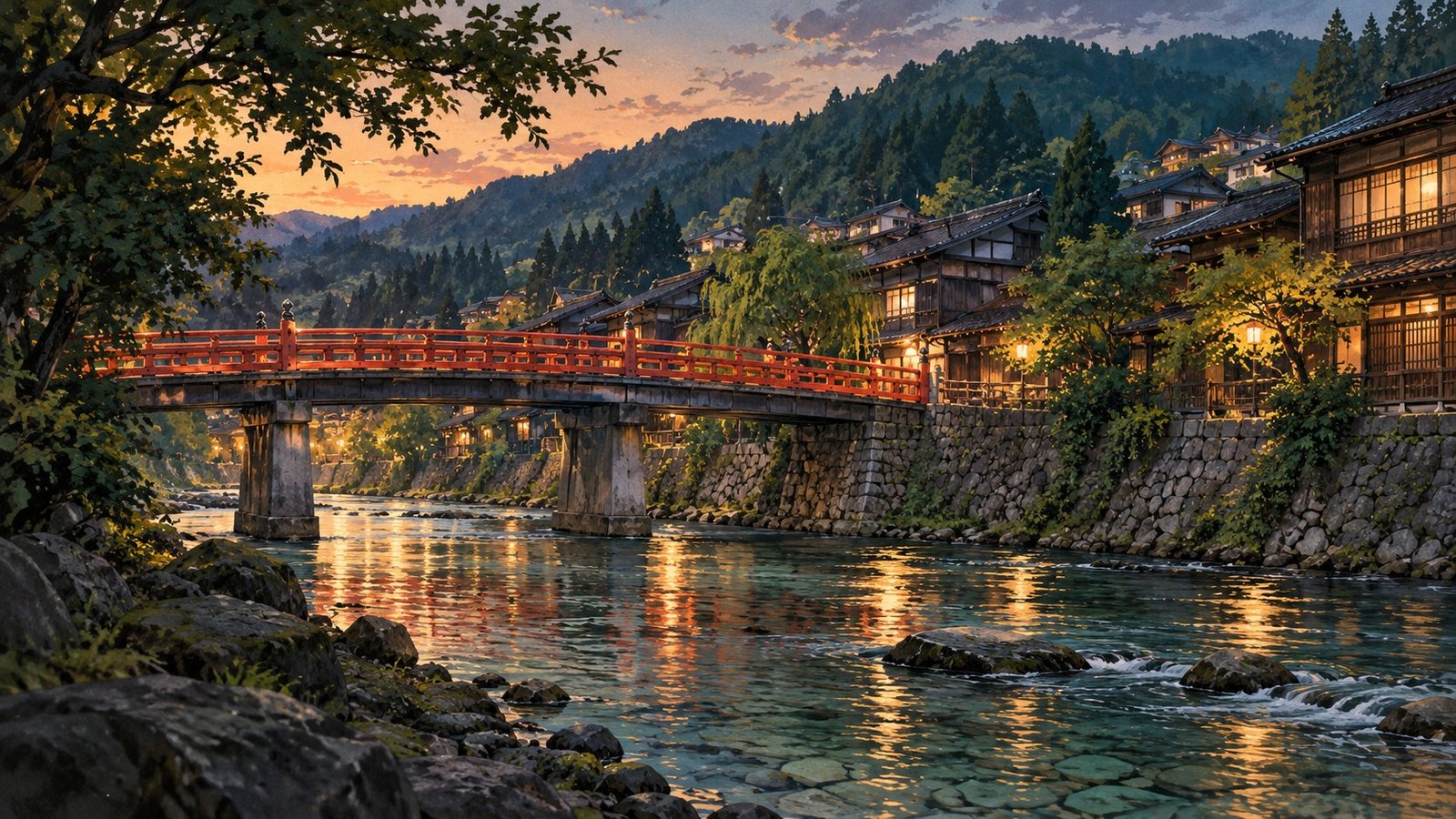
Original AI-created editorial illustration inspired by Takayama; an imagined town scene, not a photograph of a hotel or a promised room view.
Deciding where to stay in Takayama is less about finding one winning neighbourhood than choosing how you want the stay to work. A room beside the station makes departures simpler; a ryokan by Jinya gives you a reason to keep an unhurried evening in town.
The historic sights remain accessible from central station hotels, while a hotel’s room size, bedding and meal rules can change the experience more than a few extra minutes on foot. This guide compares four useful bases and five specific properties using published operator information, with no claim of personal stays or checked availability.
Some links in this guide are affiliate links. Taylor’s Trailblazing Travels may earn a commission if you book or buy through them, at no extra cost to you.
Early departures
Station east
Match the hotel door to the bus centre or rail entrance.
Town and ryokan time
Jinya edge
Keep time for the inn as well as nearby sightseeing.
Family room check
Beds and ages
Capacity alone does not tell you how everyone sleeps.
Meal-plan decision
Return time first
A shorter walk cannot rescue an unsuitable excursion return.
Where to stay in Takayama: four useful bases
Start with the hotel entrance and your first fixed commitment each morning. Takayama’s central choices are close enough that a station hotel can still support a town-focused visit. The tourism authority gives a 15-minute walk from JR Takayama Station to Miyagawa Morning Market; Tokyu Stay lists the station at two minutes and the historic streets at around ten minutes from its door. These are published estimates, not timed walks with luggage.[1][2]
Swipe across the table to compare →
| Base | Choose it for | Trade-off to accept | Example to examine |
|---|---|---|---|
| Station east, around Hanasatomachi | Early departures, a short visit or several bus excursions | Your room is outside the historic streets; walk into town for that setting | Tokyu Stay or Mercure Hida Takayama |
| North-east of the station, towards Kokubunji | A compromise between the station and the river-side walking area | An ordinary central-city address rather than an old-town frontage | Hida Hotel Plaza |
| Jinya, Nakabashi and the old-town edge | A ryokan evening, nearby sightseeing and returning to the room between outings | Plan your luggage journey back to the station | Honjin Hiranoya Kofukan |
| Station west | Choosing a hotel for its baths, dining and room space | The west-exit shuttle is a different meeting point from the east-side bus centre | Takayama Green Hotel |
The east-side recommendation follows the location of the rail/bus interchange and the published station approaches to the central hotels. Kofukan describes itself as about ten minutes from the station and a minute from the old streets; Green Hotel’s shuttle specifically uses the west exit.[2][3][4][5][6]
Swipe sideways to read the full planning graphic.
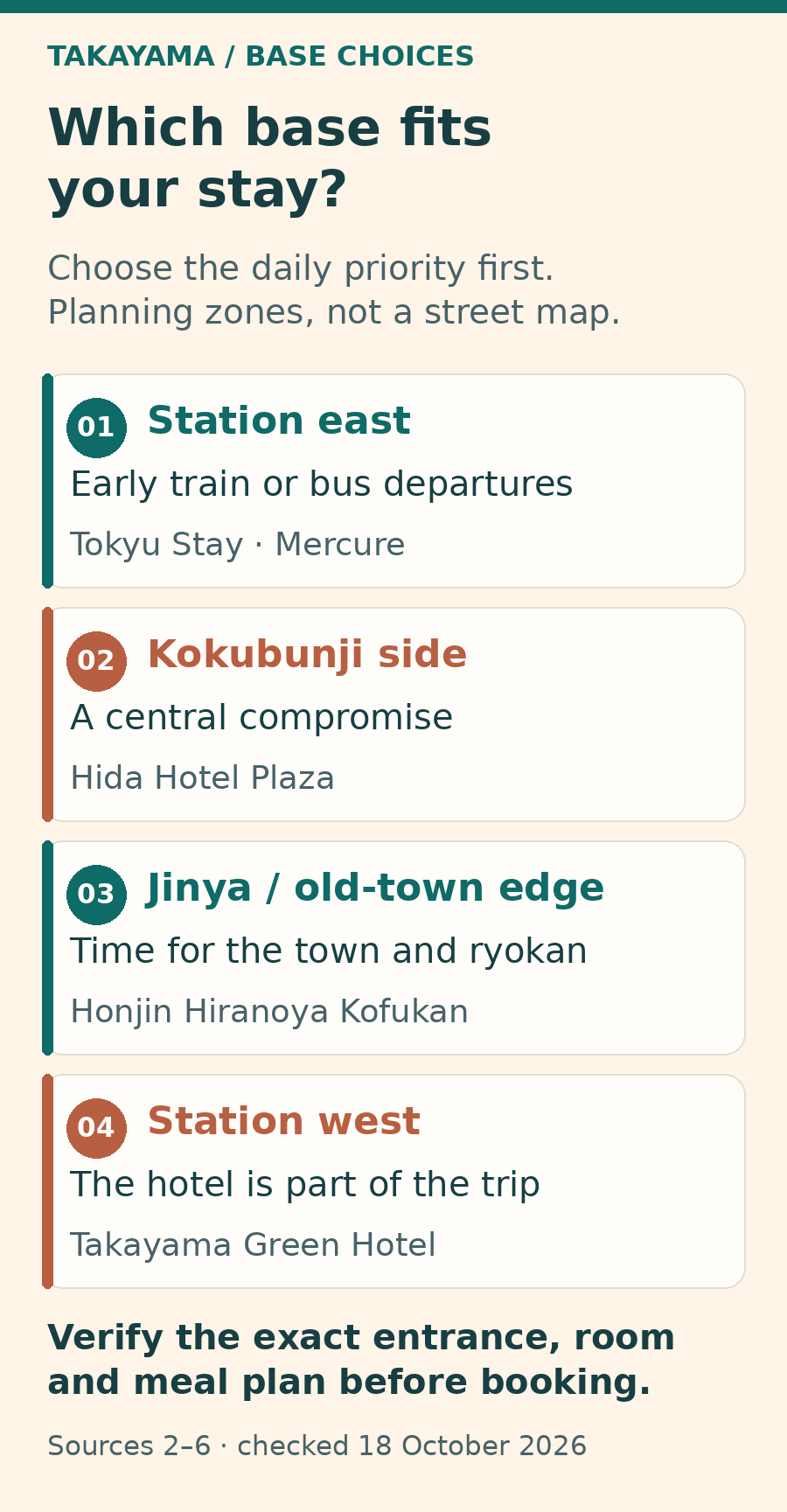
For a first visit, choose the eastern side unless a room wins you over
Station east is a practical default when arrival and departure dominate a one-night stop. Move towards Jinya and the river if you will spend the afternoon and next morning in town, especially when a ryokan meal is part of the attraction. The Kokubunji side is useful when neither station access nor old-town surroundings should dominate the decision.
West of the station can work well when the hotel itself is a substantial part of the holiday. Check the walking route to your chosen sights before accepting a generic “near Takayama Station” label. The same station can serve two different hotel approaches.
A central address does not guarantee a quiet room
Choose an exact room position if traffic, voices or early activity will disturb you. Ask whether the room faces the road, river, courtyard or service area, and whether the property can confirm that position. A river-facing room is a view category, not an independently verified promise of silence. This shortlist has no noise measurements.
Five hotels to compare by room and purpose
These examples were selected for distinct uses: laundry and kitchenette facilities, a compact hotel with baths, a larger central twin, a ryokan beside Jinya, and a hotel west of the station with extensive facilities. They are research-based candidates, not a ranking of personal stays or the cheapest rooms for your dates. Room descriptions come from the operators; live rates, availability and cancellation offers were not tested.
Swipe across the table to compare →
| Property | Room example | Useful distinction | Check before paying |
|---|---|---|---|
| Tokyu Stay | Residential Twin, 28 m², up to three guests | Kitchenette, microwave and washer-dryer shown for this category | The exact third-person bedding arrangement and amenities on your offer[7] |
| Mercure | Superior Twin, 22 m², two guests | Superior Triple is a separate 25 m² category for three | Whether a 22 m² twin suits your bags and room time[8] |
| Hida Hotel Plaza | Standard Twin, 27 m², two guests | A straightforward twin with a combined bath/toilet unit | Room type and wing, rather than the largest room shown in the gallery[11] |
| Kofukan | River-view Japanese room, 10 or 12 tatami mats | The 12-mat type has separate bathroom and toilet | View, bedding and meal plan; do not assume an in-room onsen[12] |
| Takayama Green Hotel | Orinkaku Comfort Twin, 33 m², up to three guests | Two beds plus a sofa that becomes the third bed | Building name and whether you want a room with its own open-air bath[14] |
Tokyu Stay Hida-Takayama Musubi no Yu: useful for laundry and light meals
The Residential category is the reason to shortlist this property for a longer journey. A kitchenette can help with a simple breakfast or a child’s familiar food, while a washer-dryer can reduce the clothes you need to carry. The official site shows both features for the Residential Twin, but also warns that some hotel rooms lack a washer-dryer. Confirm the named category on the offer you buy; the brand name alone is insufficient.[7]
Its station-side location is particularly useful before an onward train. For a purely atmospheric ryokan evening, start with the Jinya option below instead.
Mercure Hida Takayama: a compact room with shared and private-bath options
Mercure’s room offer is easy to distinguish: a 22 m² Superior Twin for two, or a 25 m² Superior Triple for three. The latter has three beds; a standard twin should not be treated as the same family arrangement. The hotel publishes a four-minute station walk.[8][10]
Shared indoor and outdoor onsen are available. A separate private onsen session is listed at ¥4,500 for 45 minutes, with requests made at reception at check-in. That is an additional facility, not a bath inside the Superior Twin, and a desired session is not guaranteed before it is arranged. Confirm the fee and private-bath arrangement directly for your dates.[9]
Hida Hotel Plaza: a larger central twin without committing to a futon room
Its Standard Twin gives two travellers a clear 27 m² comparison point. The property also lists several Japanese and Japanese-Western layouts, so it is worth examining the room plan when a larger party wants to stay together. Bathroom configurations differ between categories.[11]
The operator’s walking directions use the station’s Norikura, or east, exit and head north towards the hotel. This makes it a useful compromise for travellers who want a conventional hotel and straightforward station access, while still planning their town sightseeing on foot.[4]
Honjin Hiranoya Kofukan: a ryokan beside the old-town sights
This is the property formerly called Honjin Hiranoya Bekkan or Annex; Kachoan is a separate sister property. Use the current name and address when comparing older booking-page labels. Kofukan’s operator describes an immediate setting by Jinya, the morning market and Nakabashi, with luggage storage before check-in and after check-out.[5]
The room decision matters. River-view Japanese rooms differ from town-view Japanese rooms, while Jinya-view and river-view twins provide bed-based alternatives. A private bathroom should not be read as a private hot-spring bath. The published terms give Kofukan room use from 15:00 to 10:00 the following day, distinct from Kachoan’s later check-out. Confirm any exceptions in your own plan.[12][13]
Choose it when you can protect time for the inn and its dinner. If every day ends with an uncertain road return, compare a breakfast-only or room-only arrangement before buying meals you may struggle to reach.
Takayama Green Hotel: choose facilities and building before the station label
The Orinkaku Comfort Twin provides 33 m² and an extra bed made from the sofa for a third guest. Other buildings and categories offer different layouts; some explicitly include an open-air bath. The ordinary Comfort Twin should not be booked on the strength of a photograph from one of those rooms.[14]
Green Hotel lists a free shuttle from the station’s west exit, shared onsen and several dining options. Its published passenger-car parking charge is ¥1,000 per night, with no reservation required; availability is still finite. This is a logical candidate if you will spend meaningful time at the hotel, or arrive by car. It is less compelling when your only priority is the shortest route to the east-side bus departure point. Parking details checked 18 October 2026.[6]
Compare the same dates, number and ages of guests, bedding, meals, tax treatment and cancellation deadline across both booking services and the hotel’s own site. A property link does not guarantee that the room category described here is the one selected when the page opens.
Test the evening timetable before buying dinner
A ryokan can be an excellent choice on a town day and a poor fit for a day that returns late. Work backwards from the arrival deadline attached to the meal plan, then allow for the final journey and time to settle in. A restaurant’s closing time is not permission to check in immediately beforehand.
The following is an original planning example. Assume that a hotel has confirmed an 18:30 dinner; allow 45 minutes for road delay, 15 minutes from the bus centre to the hotel, and 45 minutes for check-in and changing or bathing. These are deliberately chosen inputs, not a Nohi timetable, a particular hotel’s rule or a predicted delay.
Swipe sideways to read the full planning graphic.
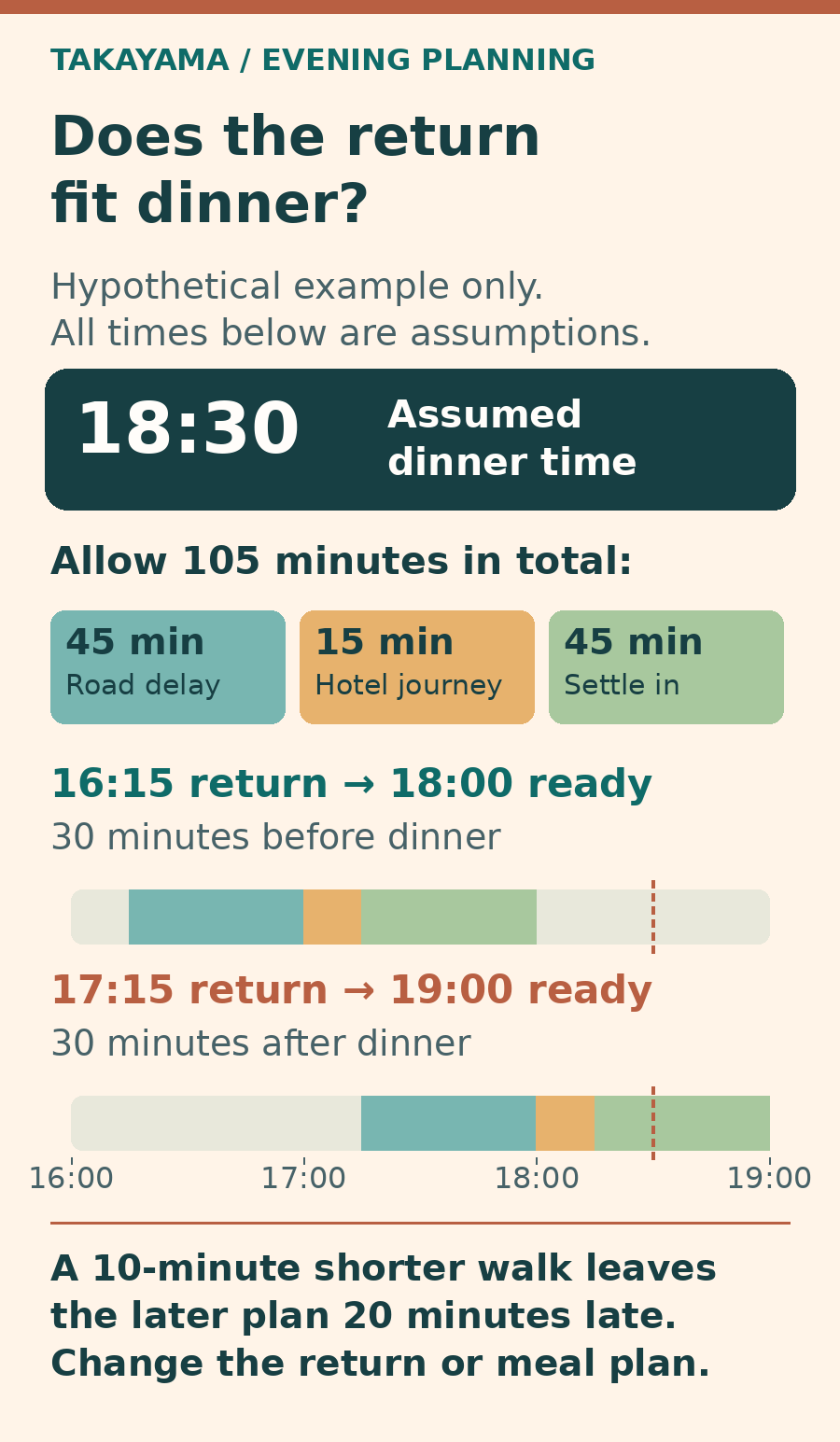
A planned 16:15 return leaves you ready at 18:00, with half an hour before dinner. A 17:15 return produces 19:00, missing the assumed dinner time by half an hour. Changing the final walk from 15 minutes to five saves only ten minutes: the later return still leaves you ready at 18:50.
The implication is practical: on a long excursion day, change the return plan or the meal arrangement before paying more for a slightly closer hotel. If bathing before dinner matters, keep that time in the calculation. If your confirmed plan requires arrival earlier than dinner, work backwards from that earlier deadline instead.
Keep a town morning for the room you have chosen
For a two-night first visit, an appealing arrangement is one day largely in Takayama and one excursion, rather than leaving town both mornings. That preserves time to use the hotel and enjoy the nearby streets. Miyagawa market’s published trading hours are 07:00–noon from April to November and 08:00–noon from December to March, checked 18 October 2026. Allow flexibility for the stalls that actually open.[1]
A hotel breakfast and an early market visit are not mutually exclusive, but check the breakfast window before buying it for a departure day. The value of half board is the meal you will enjoy and the time it gives you, not simply the number of inclusions on a booking page.
Arrivals, luggage and excursions from your base
Separate the station exit from the bus booking
Nohi’s express network connects Takayama with places including Shirakawa-go, Kanazawa and Nagoya. The Shirakawa-go corridor contains both reserved and non-reserved services; the Japanese operator page distinguishes them individually. Choose the actual departure you intend to use rather than assuming that all buses on the route follow one booking rule.[3][21]
A station hotel simplifies the morning walk but does not secure a seat. Nohi’s current FAQ says Takayama-Hokuriku Area Tourist Pass holders must arrange reserved services by telephone, because the online booking flow requires payment. After reserving, the pass must be presented at the counter for the seat ticket. Those instructions are separate from buying a normal ticket. Checked 18 October 2026.[15]
Continuing to Kanazawa?
Use the operator’s route information for the service and boarding details, then compare the specific options offered for your date. Compare Takayama–Kanazawa transport on 12Go if you want an additional booking service. Check the operator, stops, destination terminal, baggage terms and whether the offer is a direct journey or includes sightseeing time. The search page is not a confirmed seat or a universal bus timetable.
Plan bag storage around where you finish
If you stay by Jinya, ask whether bags can remain at the property after check-out and how long collection will take before your train or bus. Kofukan explicitly offers storage around the stay, while Tokyu Stay also publishes luggage-storage guidance. The sensible location for a bag depends on the end of the walking route, not just the place you slept.[2][5]
For a late arrival, confirm reception arrangements in advance. For a very early departure, check whether breakfast can be used and whether a shuttle operates at that hour. Do not build the plan around a hotel shuttle without reading its current direction, stop and operating times.
A short walking tour can preserve the afternoon at your hotel
Travellers who want some guided context can compare two different commitments. GetYourGuide lists a two-hour private Jinya and old-town walk, meeting at the reception desk near Jinya’s main gate. Viator’s licensed-guide listing currently offers a four-to-six-hour private walking format; transport and admissions are additional, and any vehicle needs a separate arrangement. Select the actual option and starting time before fitting it around meals. Confirm the fee and private-bath arrangement directly for your dates.[18][19]
Check the two-hour Jinya and old-town walk on GetYourGuide · Compare the private licensed-guide walk on Viator
For maps, translation and checking the return journey, compare Airalo’s Japan eSIM options if your phone supports the service. Check compatibility, lock status, data allowance and validity before buying; keep the hotel address and return ticket available offline as well. Airalo’s Japan page provides its current plan and device information.[20]
Check bedding, baths and the whole booking total
Choose the sleeping arrangement before the photograph
“Japanese-style” usually describes the room format, but the booking must still tell you whether you will sleep on futons or beds. A twin plus an extra sofa bed gives a different night from three identical beds. Enter every child’s age and confirm whether the quote includes separate bedding and meals; a room’s headline capacity does not resolve those details.
For an onsen stay, distinguish a shared bath, a private session elsewhere in the building and a bath inside the room. If private bathing is essential, get confirmation that the exact arrangement is available for your party. Ask directly about tattoo policies, assistance, steps and the path from the room to the baths. The guide has not assessed any property’s suitability for a particular mobility requirement.
Takayama has separate accommodation and hot-spring taxes
Swipe across the table to compare →
| Taxable accommodation amount | Accommodation tax |
|---|---|
| Below ¥10,000 | ¥100 |
| ¥10,000 to below ¥30,000 | ¥200 |
| ¥30,000 or more | ¥300 |
The city’s accommodation tax began on 1 October 2025. It is assessed per person, not per room. Children who have not reached the first 31 March after their 12th birthday are exempt; for check-in by 31 March 2027, the city specifies birth on or after 2 April 2014. Ask the property to allocate a package containing meals correctly rather than using its whole advertised price as the tax base.[16]
The separate hot-spring bathing tax is ¥150 per person per day, with a one-night stay counted as one day. The city’s current leaflet exempts children through the first 31 March after their 12th birthday, using the same age boundary as the accommodation tax. Confirm how the charge applies to your booking, what is included in the quoted total and what is collected locally.[17]
When comparing two offers, keep the same room, people and meal plan, then add any excluded local charges, parking, private-bath sessions and transport you actually need. The Japan trip budget guide helps place that complete stay cost within the wider holiday.
A practical order for booking your stay
- Mark your arrival, departure and excursion departures first. These decide whether the station side has a meaningful advantage.
- Choose one likely area and a second area only if it solves a real trade-off, such as room space or a particular ryokan meal.
- Compare the exact room category, bedding and bath arrangement. Read the plan text beside the room photograph.
- Get the dinner-arrival requirement and any essential accessibility or dietary arrangements confirmed before making a restrictive booking.
- Check cancellation cut-off, local time zone, payment currency and the complete total. Save the confirmation with the hotel name and address in Japanese.
For most short visits, keep one hotel base. Moving between the station and old town can consume check-out, bag storage and check-in time without creating a substantially different trip. A split stay makes more sense when the second property is itself an experience you have deliberately chosen.
Useful questions
Can a station hotel still work for the morning market?
Yes. The tourism authority lists Miyagawa Morning Market as a 15-minute walk from the station. Allow more time for your pace and the actual hotel entrance. A room on the river side becomes more valuable if you want several short outings with breaks at the hotel.[1]
Does staying in a ryokan mean sleeping on the floor?
No. Check the room, not just the accommodation label. Kofukan offers Japanese rooms and separate Jinya-view or river-view twin categories. Request the bed configuration explicitly when getting into and out of a futon would be uncomfortable.[12]
Is Takayama Station west exit inconvenient?
It can work well for the right property. Green Hotel uses the west exit for its shuttle; the key is to plan that meeting point separately from your bus departure and town walking route. Decide whether the hotel’s facilities justify the particular approach for your trip.[6]
Can I book a private bath after I arrive?
Sometimes. Mercure publishes a private-session option requested at check-in. That is useful if timing is flexible, but it does not guarantee a slot. If privacy is essential, obtain a confirmed arrangement before choosing a non-refundable room.[9]
Choose your Takayama room around the stay you want
Start with station east if Takayama is a brief stop on a longer route. For a visit built around the old streets and a ryokan dinner, choose the Jinya edge and protect the evening. Use the Kokubunji side for a balanced central hotel, or station west when the room and facilities are the reason to stay.
Once the base works, spend the booking effort on the exact bedding, bath and meal conditions. Those choices will shape the stay long after the walk from the station is over.
Sources and checks
Research-led accommodation guidance with original planning comparisons. Linked operator and tourism sources provide the starting evidence; confirm current room categories, access and booking terms directly for your dates.
- Hida Takayama tourism: Miyagawa Morning Markets
- Tokyu Stay Hida-Takayama: official access information
- Nohi Bus: express bus routes and boarding guidance
- Hida Hotel Plaza: station directions and access
- Honjin Hiranoya Kofukan: official property and location information
- Takayama Green Hotel: facilities, station shuttle and parking
- Tokyu Stay Hida-Takayama: Residential room categories
- Mercure Hida Takayama: room categories
- Mercure Hida Takayama: shared and private onsen facilities
- Mercure Hida Takayama: access and parking arrangements
- Hida Hotel Plaza: rooms and bathing facilities
- Honjin Hiranoya Kofukan: river, town and Jinya room categories
- Honjin Hiranoya Kofukan: accommodation terms and room-use hours
- Takayama Green Hotel: room comparison and individual room specifications
- Nohi Bus: booking, pass-holder and accessibility FAQs
- Hida Takayama tourism: accommodation tax and current child exemption
- Takayama City: current hot spring tax leaflet (October 2025)
- GetYourGuide: Takayama Jinya and Old Town private walking tour
- Viator: Takayama private tour with a government-licensed guide
- Airalo: Japan eSIM plan information and device checks
- Nohi Bus: Takayama–Shirakawa-go–Kanazawa/Toyama/Takaoka route
Illustrations in this article were created for Taylor’s Trailblazing Travels. Third-party photographs, where used, are credited beside the image or in the source list.