Japan · Tokyo neighbourhoods
Asakusa and Senso-ji: What to See Beyond the Main Temple
A temple, a neighbourhood and one well-chosen detour — with room to stop along the way.
Senso-ji is a strong starting point for Asakusa, but the approach through the great lantern gate can make the rest of the district feel like an afterthought. Give yourself a second destination before arriving: a river view, a craft collection or a shop you actually want to browse.
This guide builds a compact visit around the temple and adjacent shrine, then shows how to extend it without turning a half-day into a rushed circuit. The three options suit different interests. You can finish with open river views, explore the western lanes and traditional crafts, or devote the shopping time to Kappabashi.
The routes and time budgets below are editorial planning suggestions, with opening hours checked separately against official information. They allow for looking, resting and finding your way; they are not recorded walking times.
Taylor’s Trailblazing Travels may earn a commission when you book or buy through an affiliate link in this guide, at no extra cost to you. This helps fund the research and upkeep of the site.
Choose one extension
River, crafts or kitchenware: decide what you want the second half of the visit to do.
Match the hours
An early temple visit and a full shopping visit need different start times.
Keep a real break
Allow 40 minutes for a meal and 20 minutes of flexibility in the sample plan.
Check the station
Tsukuba Express Asakusa is separate from the riverside subway and Tobu stations.
Start with a core route and one extension
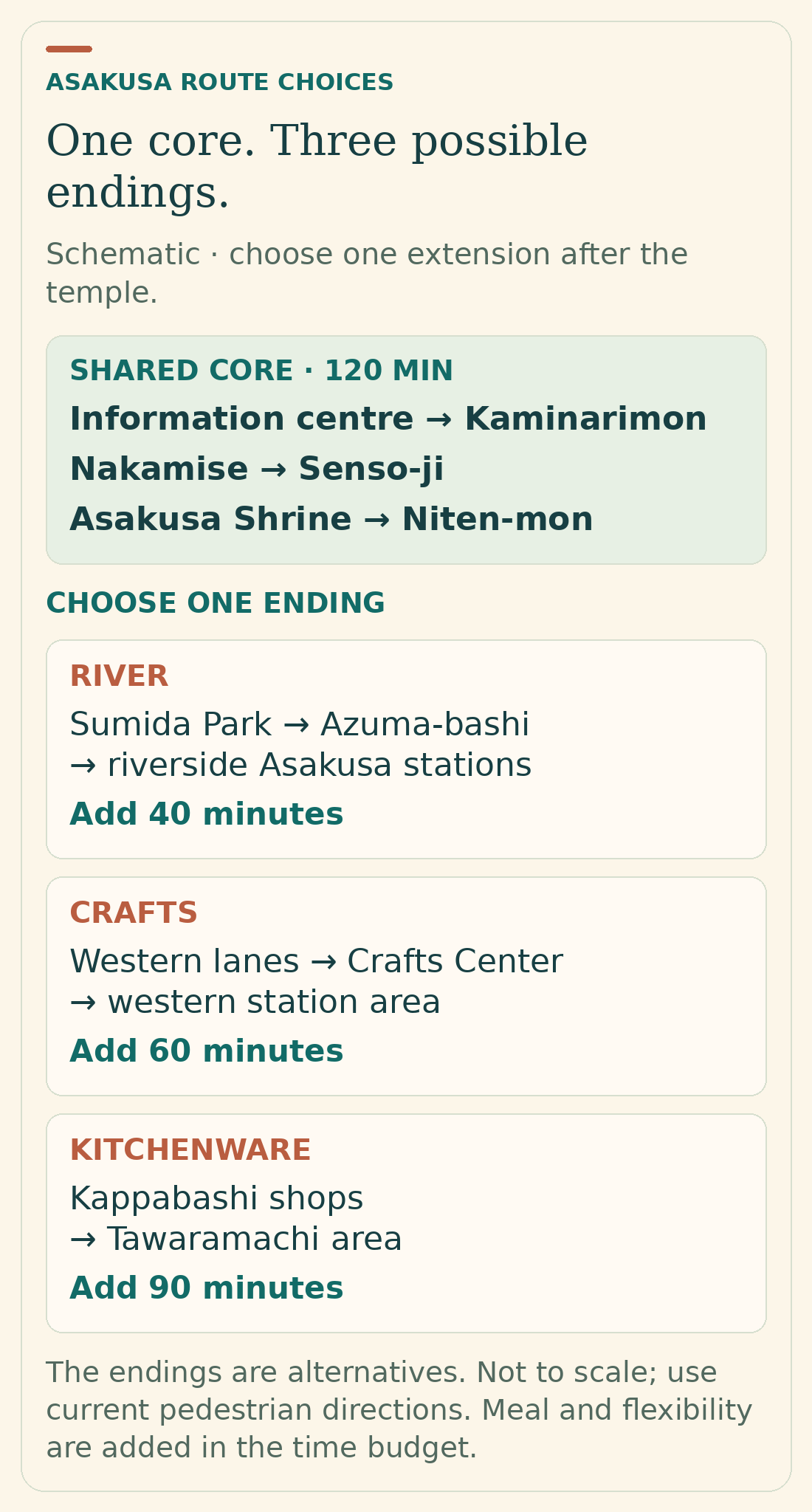
The compact core is Culture Tourist Information Centre → Kaminarimon → Nakamise → Senso-ji main hall and grounds → Asakusa Shrine and Niten-mon. It follows the main approach before stepping to the eastern side of the complex. The information centre gives you an overview before the street-level detail; Tokyo’s official walking guide uses the same centre-to-temple approach.[6][1]
From there, choose the extension that best answers what you want beyond the main temple. The time allowances include moving between the named places, but not travel from your accommodation.
Swipe or scroll sideways to read every column.
| Extension | Choose it for | Allow after the core | Useful finish |
|---|---|---|---|
| Sumida riverside | Open views and a change from shopping streets | 40 minutes | Riverside Asakusa stations |
| Crafts and western lanes | Small-scale browsing and a free craft collection | 60 minutes | Tsukuba Express Asakusa; allow extra time to return to the river |
| Kappabashi | Kitchenware and food-model shopping | 90 minutes | Tawaramachi, subject to your last shop |
These are three alternative endings. Combining them adds crossing and browsing time that the basic half-day does not contain. Pick the one you would most regret missing, then give it the time it needs.
Only two hours? Keep the temple, adjacent shrine and a brief river look. Omit the information-centre terrace, longer shopping and the seated meal from this shortened outing, or let the river go if the temple needs the time.
Give the temple’s edges some attention
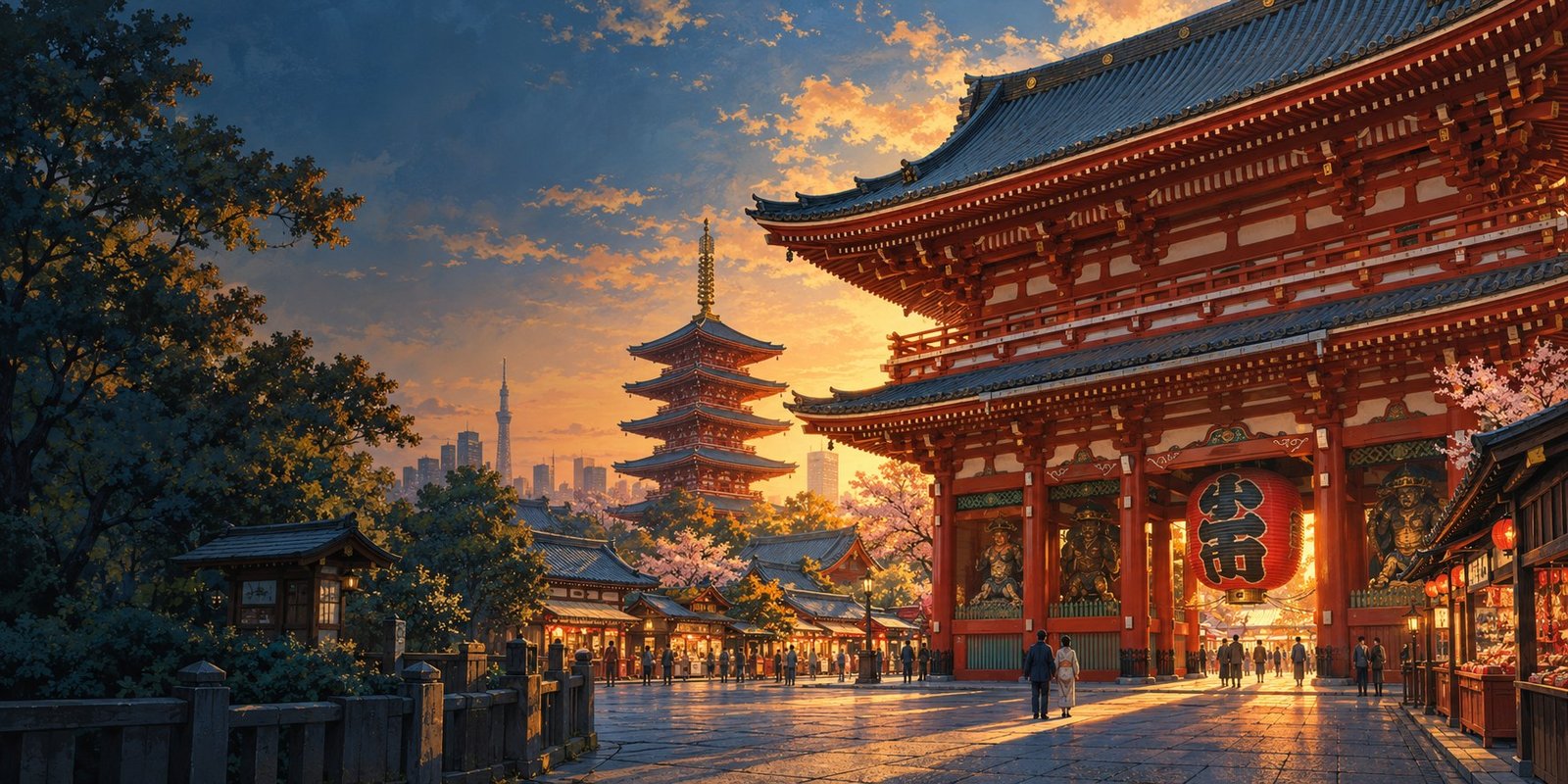
Walk through Kaminarimon and along Nakamise towards Hozo-mon, then the main hall. Resist using every minute on the first shopping stretch: a small reserve for the sides of the complex is what makes this visit more than a photograph of the lantern.
Senso-ji is a Buddhist temple dedicated to Kannon. Its principal image is normally hidden from view, so do not arrive expecting an exposed statue to inspect. If you choose to pray, the temple describes bringing the palms together; you can also observe respectfully without taking part.[3]
Next, look for Asakusa Shrine beside the temple. This is a separate Shinto shrine. Its founding legend honours the two fishermen and the man associated with the discovery and enshrinement of the Kannon image. Understanding that connection makes the short move between the two sites more rewarding.[4]
Niten-mon, on the eastern side, is a useful final landmark before choosing your onward direction. Senso-ji dates the present gate to 1649. Take a moment for the guardian figures and proportions rather than expecting another large attraction behind it.[1]
If you collect temple seals, Senso-ji directs visitors to Yogo-do on the western side. Add time for any queue and check the desk’s own availability; the main hall’s opening hours do not establish every smaller hall’s service hours.[3][2]
Denboin Street is not Denboin Garden. The surrounding streets can form part of a neighbourhood walk, but Senso-ji’s current information lists the garden as closed to the public. Do not build a route around entering it unless the temple itself announces a specific opening.[1]
Choose the river for open views and an easy finish
After Niten-mon, use current pedestrian directions to reach the Asakusa side of Sumida Park. Walk along the river towards Azuma-bashi and the station area. GO TOKYO highlights the red Azuma-bashi bridge as a viewpoint for Tokyo Skytree.[7]
This is the extension to choose when you want a change of scale after the narrow approach streets. Make one deliberate pause to look across the water, then decide whether you want to keep walking or stop for food. For the shorter version, remain on the Asakusa bank: crossing the river creates another decision about where to return.
The 40-minute allowance assumes a modest river stroll and brief view stops. A long photography session, a seat with a drink or a walk all the way to Skytree needs a larger block. Nothing in this plan requires you to reach the tower.
A river cruise is a different commitment. The Asakusa pier serves sightseeing routes.[7] Check departures, destinations and ticket conditions separately. Choose a boat trip because you want time on the water, then replace part of the afternoon; do not treat a departure queue and cruise as something already included in this walking allowance.
Adjust to the weather. Choose the craft option when a windy or wet riverfront would make lingering unpleasant. In strong heat, shorten exposed walking and bring the seated break forward.
Choose crafts and western lanes for neighbourhood detail
For western shopping and entertainment streets, choose among Nishi-sando, Denboin Street and Rokku.[17][7] Make the Edo Taito Traditional Crafts Center on Hisago-dori your specific destination.[8] You do not need to walk every named street to make this extension worthwhile.
Displays include bamboo blinds, cabinetry and wood joinery, with multilingual explanations available on a smartphone. Demonstrations are periodic or arranged for reserved groups.[8] The collection can help you understand craftwork before shopping, but do not count on an artisan being there.
Admission is free. The current hours are 10:00–18:00, with closure on the second and fourth Tuesday of the month, or the following day when that Tuesday is a public holiday. Check the centre’s event and visitor information before making it the reason for your route.[8]
For the 60-minute extension, use roughly half the time for the collection and half for walking, brief lane stops and finishing at Tsukuba Express Asakusa. Returning to the riverside stations takes additional time. If browsing draws you in, let it become the afternoon rather than adding Kappabashi afterwards. A restaurant queue or performance belongs outside that hour.
Rokku also works as a place to look for lunch, but choose the meal on its own merits. A theatre ticket is a separate experience: Tokyo’s tourism guide notes that traditional storytelling at Asakusa Engei Hall is in Japanese.[7] It suits someone interested in the performance form more than a visitor expecting English interpretation.
Choose Kappabashi when shopping is the point
Kappabashi gives the walk a clear purpose: finding a bowl, utensil, piece of kitchen equipment or realistic food model that interests you. It is a kitchenware district serving practical as well as souvenir needs, and the association says almost all shops also sell to individual customers.[9]
From the temple area, head west using the association’s map and current pedestrian directions. Rather than zigzagging through the entire district, pick a small number of shops, browse one stretch and choose your final station from there. Tawaramachi on the Ginza Line is a useful option for the southern side; the association lists it as a five-minute walk to the district, not a guarantee from every shop.[11]
The association’s current operating notice says shops generally trade around 10:00–17:00, with individual exceptions. Saturdays usually offer a wider choice than Sundays: its FAQ estimates that about 30% of shops open on Sunday. The published monthly Sunday and holiday list is more useful than assuming the whole street shares one timetable.[10][9]
Choose this extension on a weekday or Saturday if a particular purchase matters, then confirm that shop directly. Sunday can still work for a relaxed look, provided you are comfortable with a reduced selection.
The 90-minute allowance leaves approximately an hour for browsing and half an hour for the approach and station finish. Serious shopping can easily use longer. Before buying, think about weight, packing space and care: a beautiful object is a better souvenir when it will survive the journey and suit how you use it at home. Ask the retailer about materials, care and packaging instead of assuming everything sold here is handmade or locally produced.
Build the half-day around the opening hours
For a visit that includes shops and the craft centre, a 10:00 start is a practical default. It sacrifices the earliest part of the day but reduces the mismatch between temple opening and commercial activity. Individual Nakamise shops still set their own hours.
Swipe or scroll sideways to read every column.
| Place | Published hours or access | Planning consequence |
|---|---|---|
| Senso-ji main hall | 06:00–17:00; opens 06:30 in October–March | An early visit can precede shops and other facilities.[2] |
| Tourist information centre | Information floors 09:00–20:00; free eighth-floor terrace 09:00–22:00 | Use the terrace before the street route, or return for an evening view.[5] |
| Traditional Crafts Center | 10:00–18:00; second/fourth Tuesday closure, with holiday adjustment | Check the date before choosing the craft extension.[8] |
| Kappabashi shops | Generally around 10:00–17:00; individual days and hours vary | Confirm any shop that is the main purpose of your visit.[10] |
| Senso-ji illumination | Daily from sunset until about 23:00 | Exterior lighting continues after the main hall closes.[12] |
A worked half-day, with the arithmetic visible
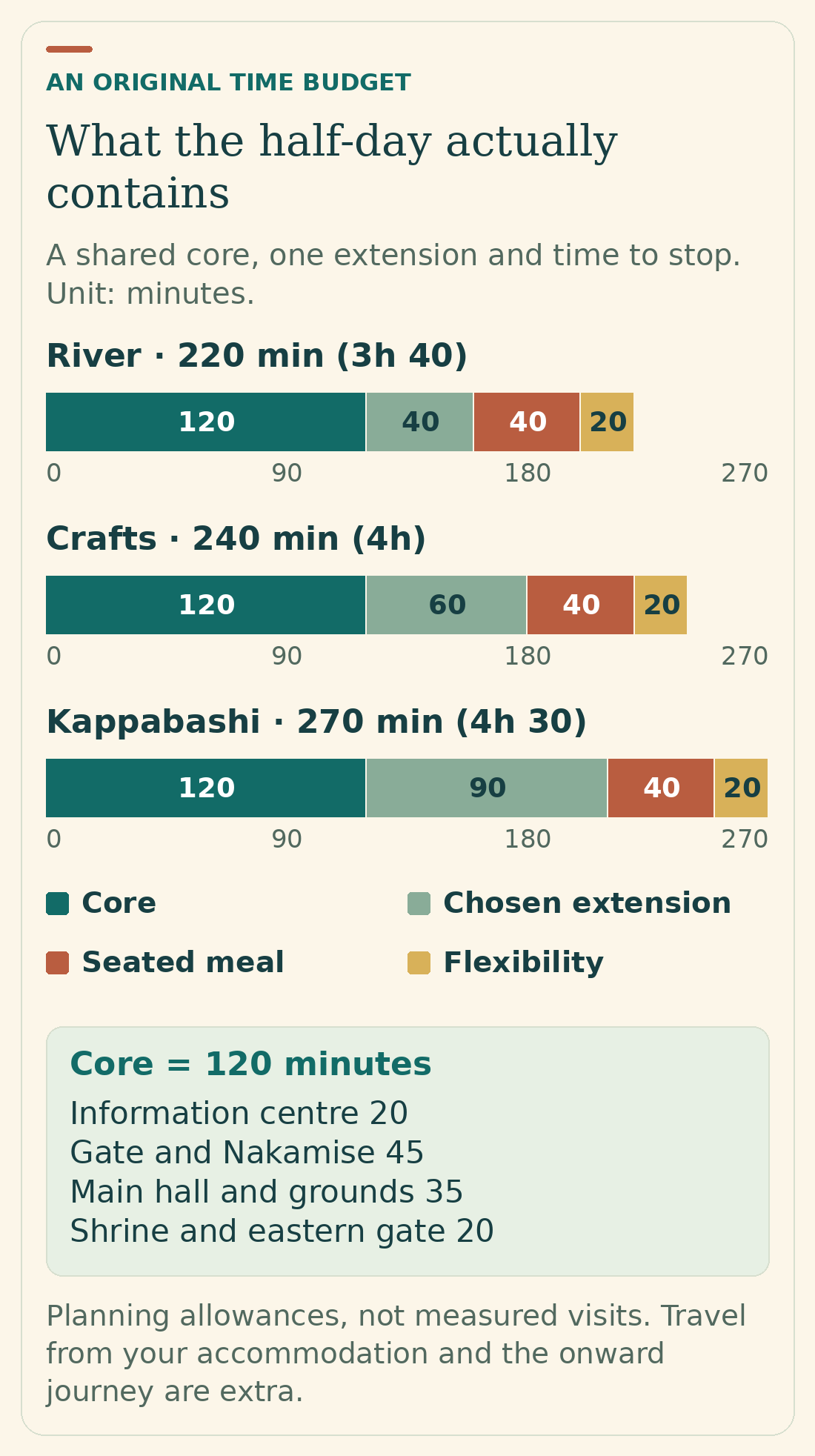
Budget 120 minutes for the core: 20 at the information centre, 45 for Kaminarimon and Nakamise, 35 for the main hall and nearby grounds, and 20 for the adjacent shrine and eastern gate. Movement within the core is included. These are allowances, not minimum visit lengths.
Add your chosen extension, then 40 minutes for a seated meal and 20 minutes of flexibility. The river version totals 220 minutes, or 3 hours 40; crafts totals 240 minutes, or 4 hours; Kappabashi totals 270 minutes, or 4 hours 30. From a 10:00 start, the illustrative finishes are 13:40, 14:00 and 14:30. Travel to Asakusa and onward afterwards is extra.
An earlier start works better when architecture and worship matter more than shopping. Visit the temple first and move the terrace or browsing later. An evening visit instead favours the illuminated exterior and dinner; it does not offer the same set of open interiors or shops. No starting time guarantees empty streets.
Use the trip itinerary planner to organise your Tokyo nights and other stops, then leave this half-day clear for Asakusa.
Decide whether a guide or rickshaw adds enough
A self-guided visit works well when you prefer your own pace. Normal Senso-ji sightseeing does not require an admission ticket; the official Tokyo listing identifies it as a free attraction. Any paid tour is a purchase of guiding or an experience, rather than access to the ordinary temple visit.[20]
A free introduction to the temple and neighbourhood
Tokyo SGG Club offers an English walking tour lasting about 90 minutes, meeting at the first-floor counter of the Culture Tourist Information Centre. Arrive ten minutes before the advertised start. Places can be limited and tours can be cancelled, so check the club’s current calendar rather than relying on a recurring weekday alone.[15]
Taito City currently lists Asakusa tours on Sunday, Monday, Tuesday, Thursday and Saturday at 10:30 and 13:15, without advance reservation. Use the dated calendar for your actual day. This walk can replace the main sightseeing part of the core route; do not add the entire self-guided core again afterwards.[14]
A longer private walk for questions and context
The Private Asakusa Big-Picture Tour on GetYourGuide is listed as a 3.5-hour walk covering the temple, shrine and western entertainment streets, with snacks and a choice of English or Japanese. It suits someone who wants the district explained in depth and space to ask questions. It replaces most of this half-day rather than fitting into a short gap. The listing contains conflicting mobility labels, so anyone needing step-free access should resolve the route with the operator before booking.[17]
A rickshaw for a different neighbourhood experience
Compare lengths and availability for the Tokyo Asakusa Rickshaw Tour on Viator. The Ebisuya listing offers different durations, and shorter options cannot cover every landmark shown. It explicitly excludes riding through Senso-ji’s temple grounds and Nakamise, so retain time for that part on foot or through the temple’s accessible facilities. Confirm seating, any transfer assistance, language, route and meeting point for your selected option.[16]
Buy the experience you want. Choose the free walk for an introduction, the private walk for extended interpretation, or the rickshaw for the ride and wider streets. Compare the selected date’s total price and cancellation terms before paying.
Leave room for food, photographs and small discoveries
Choose lunch as a deliberate break. A 40-minute allowance is a planning aid, so extend it if you want a particular restaurant with a queue. If you prefer to graze, still build in a place to sit: several snack purchases do not automatically provide a rest.
At food stalls, ask where purchases should be eaten and follow that shop’s guidance. Keep entrances, crossings and the worship approach clear. If you have a dietary requirement, check ingredients with the seller rather than inferring them from a familiar-looking snack or an English name.
For photographs, step out of the main flow, take the shot and move on. Respect no-photography signs, and ask before close portraits of vendors or worshippers. An active service is a reason to slow down and give people space, not a reason to pursue a better camera angle.
The easy mistakes are mostly planning mistakes: expecting the main hall to be open at night; arranging a craft visit on its closure day; treating Sunday as a full Kappabashi shopping day; booking a 3.5-hour tour on top of an already full morning; or returning to the first station out of habit when another is more convenient.
Keep one simple rule: when an interesting stop uses your spare time, remove the next optional stop. The pleasure of seeing beyond Senso-ji is having enough attention left to notice the neighbourhood.
Questions before you go
Is Asakusa worth visiting if I have already seen Senso-ji?
Yes, if one of the district’s other interests appeals: the river, the craft collection, the western entertainment streets or Kappabashi shopping. Start with that interest and treat another temple look as optional; you do not need to repeat the whole approach.
Can I see the temple and do Kappabashi shopping in one morning?
A brief version is possible, but the sample visit here takes 4 hours 30 including the core, shopping extension, meal and flexibility. Shops generally open later than the temple, so a very early start does not create equally early shopping time.
Is an evening visit a substitute for a daytime visit?
It offers a different experience: illuminated buildings and an opportunity for dinner. Senso-ji’s main hall normally closes at 17:00 while the lighting continues until about 23:00. If you want the craft centre or a broad choice of kitchenware shops, plan daytime hours.[2][12]
Can I enter Denboin Garden on this route?
Do not plan on it. Senso-ji currently identifies the garden as closed to the public. Walking Denboin Street is a separate activity; any announced special garden opening would need its own check.[1]
Make your choice
For a first visit, give Senso-ji and Asakusa Shrine a proper core block, then take the river extension unless crafts or kitchenware are a particular interest. That creates a clear contrast within a manageable half-day.
If you already know the temple, reverse the emphasis: start with the craft centre’s opening day or the Kappabashi shop you want, then add a short temple or river stop if it fits. Leave Asakusa with one neighbourhood experience you chose, rather than a list of streets you hurried through.
Sources
Official visitor information and the identified booking listings were consulted for this guide. Prices and dated operating information were checked on 18 October 2026; recheck the relevant venue and your selected ticket before travelling.
- Senso-ji — official English precinct guide
- Senso-ji — main hall visiting hours
- Senso-ji — visitor FAQ, seals and accessibility
- Asakusa Shrine — official English introduction
- Taito City — Asakusa Culture Tourist Information Center
- GO TOKYO — Explore Asakusa walking guide
- GO TOKYO — Asakusa district guide, updated February 2026
- Taito City — Edo Taito Traditional Crafts Center visitor information
- Kappabashi association — customer and opening-day FAQ
- Kappabashi association — current shop operating notice
- Kappabashi association — access and map
- Senso-ji — evening illumination
- Tsukuba Express — Asakusa station and exits
- Taito City — Tokyo SGG Club English tours, updated September 2026
- Tokyo SGG Club — free Asakusa tour and current schedule link
- Viator / Ebisuya — Tokyo Asakusa Rickshaw Tour product conditions
- GetYourGuide — Private Asakusa Big-Picture Tour: Sacred and Secular Japan
- Airalo — current Japan eSIM plans
- Airalo — device compatibility requirements
- GO TOKYO — Senso-ji visitor listing and free-attraction classification
Illustrations in this article were created for Taylor’s Trailblazing Travels. Third-party photographs, where used, are credited beside the image or in the source list.